
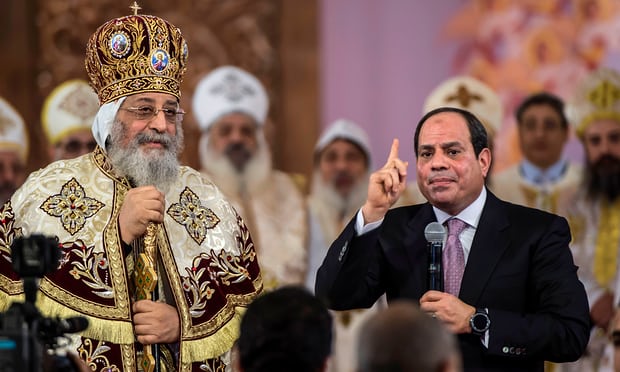
Christians in Egypt are facing unprecedented levels of persecution, with attacks on churches and the kidnap of girls by Islamist extremists intent on forcing them to marry Muslims, a report says.In the past year, Egypt has moved up an annual league table of persecution of Christians compiled by the charity Open Doors. According to its World Watch List, North Korea is still the most dangerous country in the world in which to be a Christian, and Nepal has had the biggest increase in persecution.But Egypt, home to the largest Christian community in the Middle East, is of particular worry. Officially about 10% of the 95 million population are Christian, although many believe the figure is significantly higher.The overwhelming majority are Orthodox, with up to 1 million evangelical Christians and 250,000 Catholics. Orthodox Christians celebrated Christmas on Sunday amid tight security, days after at least 11 were killed in attacks. The president, Abdel Fatah al-Sisi, attended midnight mass at a new cathedral 30 miles (45km) east of the capital as tens of thousands of armed soldiers patrolled streets around churches all over Egypt.According to Open Doors, 128 Christians were killed in Egypt for their faith and more than 200 were driven out of their homes in 2017. It attributed the rise in persecution to “the overspill of Islamic terrorists driven out of Iraq and Syria”.Last Easter, two church bombings killed 49 people, and another 29 were killed when extremists attacked people travelling to a monastery in May. More than 15 girls in Minya governorate were kidnapped in 2017 to be forced to marry Muslims and convert to Islam, Open Doors said.“Michael Jones”, a Cairo-based businessman and evangelical Christian, told the Guardian there was a gulf between statements from the national leadership regarding the Christian community and actions at a local level.“You hear the president speaking about Christians with a lot of respect and sympathy. Just a few days ago, he made a beautiful, emotional speech when inaugurating our new cathedral. It looked like an amazing affirmation that the state is supporting the church and the Christian community, and doing everything it can to guarantee our welfare,” said Jones, who asked for his real name not to be used.“Then you have have the local authorities in villages and towns – police, judges, business owners – and it’s evident that many of them are infected with a rejection of Christianity. You see this in daily practices – not usually violence, but discrimination.”Jones said Christians were overlooked for jobs or promotion, university students were given bad grades or failed, schoolchildren were made to sit at the back of the class, shop owners were boycotted and hospital patients were not given proper treatment.“There is only a minority of violent extremists, but the culture in Egypt cherishes the perception that Christians are infidels,” he said.The response of the Christian community was one of endurance, prayer and forgiveness, he said. “By forgiving our attackers, we’re not saying they should not be punished but retaliation and revenge is not our response. We don’t want to be part of a cycle of violence.”Jones, who is to address MPs and peers in parliament next week, said many Christians had left Egypt because of discrimination and persecution. “I have thought about leaving many times, but I believe God will take care of me. I don’t want my life defined by fear,” he said.Lisa Pearce of Open Doors said: “Christians in Egypt face a barrage of discrimination and intimidation yet they refuse to give up their faith. It is hard for us … to imagine being defined by our religion every single day in every sphere of life.“In Egypt, as in many other Middle Eastern countries, your religion is stated on your identity card. This makes discrimination and persecution easy – you are overlooked for jobs, planning permits are hard to obtain and you are a target when you go to church.”As well as highlighting persecution of Christians in Egypt, Open Doors said south-east Asia was the next emerging hotspot, fuelled by Islamist extremism in Malaysia, Indonesia, the Philippines and the Maldives.
Source: Christians in Egypt face unprecedented persecution, report says | World news | The Guardian
 DAILY DEVOTIONS, NEWS AND INFORMATION