
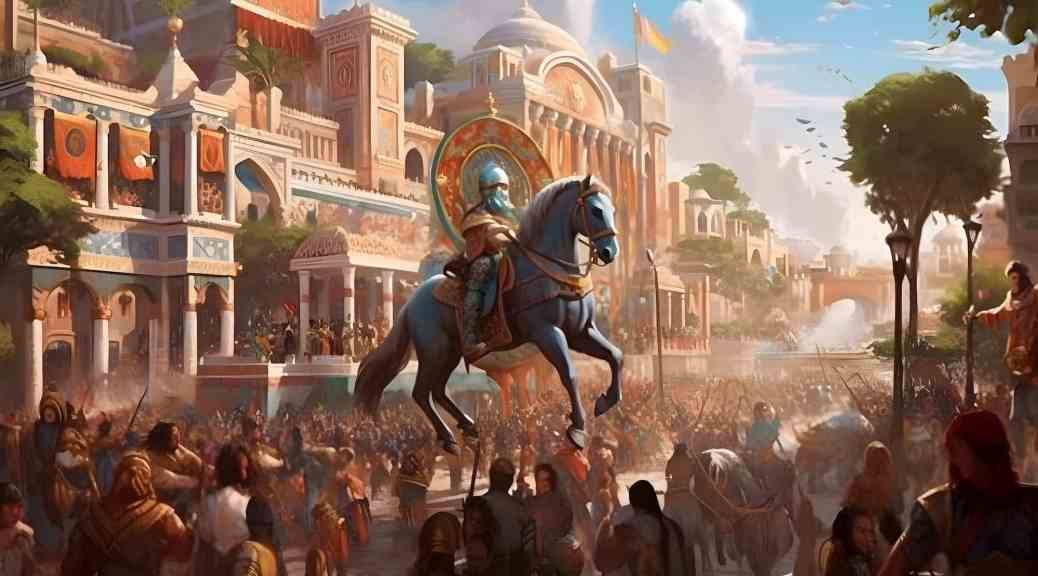
With mosques ablaze across Iran and protesters on the brink of toppling the Ayatollahs, the outlawing of Islam itself seems imminent. As the protesters openly talk of going back to their ancient religions, the West waits on the sidelines, ready to airdrop its anointed leaders and take charge.
However, the chosen leaders of the West have Islamic backgrounds even as the people of Iran want to shed themselves of Islam and embrace their pre-Islamic past. While one of the chosen leaders, Reza Pahlavi, the son of the Shah of Iran who was deposed in 1979, is cooling his heels in Washington, D.C., hoping to be their appointee, another leader in waiting is the hijab clad Maryam Rajavi of the National Council of Resistance of Iran (NCRI), which purportedly stands for democracy.
Both figures have cultivated support in the corridors of power in the US and Europe, and we can soon expect a hollow, manufactured debate over whether Iran deserves a monarchy or a democracy, one that falsely frames the choice as a binary between Pahlavi and the NCRI, followed by a declaration that the people of Iran have prevailed and made their own choice no matter who among them is planted as the new Iranian ruler.
In 2022, when Iranian women publicly burnt their hijabs in defiance of the Mullahs, the US State Department at first issued statements of support, but in what must be seen as an act of betrayal, it abandoned the women when they started opposing Islam itself. For many years, the annual reports of the State Department’s United States Commission for International Religious Freedom (USCIRF) and the affiliates of the State Department, such as Amnesty International and Human Rights Watch, have also supported Islam by presenting the perpetrators of Islamic oppression as the victims while demonizing the religions of the actual victims of Islam.
If we are to accept their worldview, it would result in the absurdity that the Iranian protesters burning mosques around Iran are the oppressors and violators of religious freedom, while the ayatollahs and their secret police are the victims of human rights violations.
To the east of the protesters, India, as a rising global power and a nation with deep civilizational ties to Iran, has also disappointed by abstaining from actively supporting the protests. The current situation presents a great opportunity for India and the United States to team up and send troops into Iran to protect the protesters.
Unlike the United States, which has faced political hurdles for more than fifty years when it comes to sending troops to other countries, India does not face such problems and can send in troops to complement the US and usher in the era of rekindling Iran’s ancient civilization as a replacement for Islam. As a country that has faced Islamic invasions over the centuries, India also understands how to address underlying tensions.
India’s role would be both strategic and restorative. Culturally, India remains a sanctuary for Zoroastrianism and other ancient traditions that share a common ancestry with Iranian culture. While the dominant religion among Persians is Zoroastrianism, Yazidis and certain Kurdish groups in western and northwestern Iran identify with specific Hindu traditions found in South India. Interaction with these Indian communities could help Iranians rediscover the cultural foundations.
However, the current situation does not instill much confidence as the credentials of NCRI and its leader, Maryam Rajavi, are suspect. Apart from the fact that Maryam Rajavi wears a hijab, revealing her Islamist leanings, her husband, Massoud Rajavi, who disappeared in 2003, was the founder of NCRI and was also the leader of the Islamic Marxist group Mojahedin-e-Khalq.
Like other Marxists, when the members of the NCRI throw around the word
“democracy,” they really mean “Marxist state,” and they use the term “democratic socialism” as an Orwellian euphemism for “the dictatorship of the proletariat.” Needless to say, they see Islam and Communism as natural allies.
As for the Pahlavi family, despite outward appearances and repeated claims that they were secular, they too ensured that Iran would remain an Islamist nation while they were in power. The Constitution of Iran during their reign explicitly stated that the official religion of Iran was Islam according to the “orthodox Ja’fari doctrine of the Ithna ‘Ashariyya” and mandated that the Shah was required to “profess and promote” this faith. The Constitution also mandated that no laws passed by Parliament could be “at variance with the sacred rules of Islam.”
Under the Pahlavi dynasty, the Bahaʼi community, the most populous non-Muslim group in Iran, faced systematic and severe discrimination. Groups like the Hojjatiyeh that carried out targeted attacks against the Baha’i community worked with the Shah’s intelligence agency (SAVAK). The Shah’s foreign policy, too, was based on religious considerations. During the Yom Kippur War, the Shah supported the Arab side, and he consistently supported the Islamic Republic of Pakistan over India.
This is not to say that Reza Pahlavi or Maryam Rajavi must never become part of the administration of Iran. A precondition for them to join the Iranian political mainstream should be that they renounce Islam and embrace one of the pre-Islamic religions so that they are aligned with the people of Iran.
To ensure their honesty, this would ideally include their converting to another religion and ensuring the same for their children and extended families. Even atheism would not be enough, and a conversion would be essential to prevent a member of a future generation from reverting to theocratic rule.
History offers a sobering example in this regard. While the Mughal king Akbar moved away from Islam and started his own religion, he neglected to convert his family members, and it resulted in his son, grandson, and great-grandson perpetrating cruelties on behalf of Islam.
Should the Iranian protesters succeed in their goal of removing Islam, they are sure to inspire other countries like Tajikistan, Kyrgyzstan, and Uzbekistan, and then Turkey. For now, the cynical path pursued by the US State Department of letting the protesters battle the Iranian regime and toppling it, while showing up just in time to reap the rewards by planting its Islamic proxies means that the best case scenario for the world would be for the protesters to succeed in overthrowing the regime after they have completely eliminated all traces of Islam so that Reza Pahlavi or Maryam Rajavi would be forced to follow suit in order to become part of the Iranian political ecosystem.
The protesters are determined and seem close to success this time. Despite severe internet blackouts, reports indicate that the protesters have taken control of some cities, including Abdanan and Malekshahi. Government forces have retreated in many other areas. There are protests even in Qom, the epicenter of Shia Islam. Those who support the freedom of Iranians from the religion forced on them wish the protesters the best and await the day when we can welcome our Iranian sisters and brothers into the global community!
Islam has never served a nation well, and the Persian people have a glorious history to fall back upon. Or, put another way, anything but Islam…
Source: New Iranian Rulers Must Embrace Their Pre-Islamic Past – American Thinker
 DAILY DEVOTIONS, NEWS AND INFORMATION