
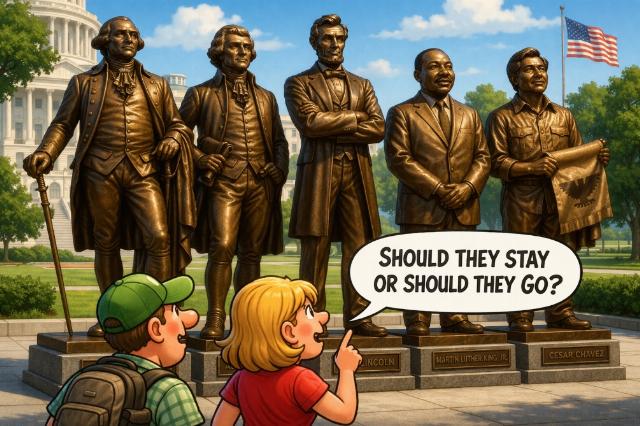
Conservatives are not being hypocritical when they say it’s okay for Cesar Chavez statues to go, but other civic statues to stay standing.
I’ve previously written that the United States should cancel Cesar Chavez and remove his images from the public square. Regardless of the alleged heinous crimes against women and children, he was a dedicated leftist committed to the union labor movement against farmers (and consumers) who didn’t respect free enterprise or free trade among the citizenry.
For me, this blunt decision brings up a larger question: If we should feel no compunction about tearing down Chavez, does that make conservatives in particular and common-sense Americans in general hypocrites because we opposed leftists removing other statues?
What’s the standard? Where do we draw the line? To form a more perfect union, should we scrap all the statues?
The slippery slope of social policy is real. We shouldn’t idly tear down everything we don’t like today just because our standards, knowledge, or public opinion have changed over the decades or even centuries past.
Furthermore, we must not ignore the subversive undercurrent about statute removals: Marxist agents in this country want to wipe out our entire history. Consider George Orwell’s devastating yet accurate maxim from 1984:
He who controls the present controls the past
He who controls the past, controls the future.
The important point, then, is to remember the past, not erase it. The same communistic miscreants who tried to erase two and a half centuries of American history also push climate alarmism, open borders, LGBT ideology, and collectivist ownership of property. They cannot succeed if the American people remember and revere their country, past and present.
In 2020, communists exploited the George Floyd Riots to erase America’s history, accomplished symbolically by damaging and destroying statues and monuments throughout the country. Even the Boston memorials recognizing President Abraham Lincoln and the 54th Massachusetts Regiment during the Civil War did not escape vandalism. Under the guise of erasing white supremacy, left-wing goons trashed, demolished, and destroyed our nation’s heritage, including those who undermined the perverse notion that one man’s value depended on his skin color.
What about the Confederate statues, conservatives? Should they have remained? That discussion certainly brings up complex issues!
Lincoln Project critics of Trump mocked the outrage from conservatives about the tearing down of statues. They posted a painting of colonists tearing down the statues of King George III at the outbreak of the American Revolution, then mockingly called them “Antifa” to deride the rest of us who didn’t want our country’s heritage removed. In effect, they dismissed the robust opposition to our nation’s heritage getting torn down, suggesting that it’s part of the American character to topple the monuments.
So, what should the standards be? We cannot—nor should we—remove all the statues, monuments, and commemorations. And yet we should have no problem with the removal of Cesar Chavez from the public square?
Here’s how I look at it:
One. We need to commemorate and celebrate those individuals and groups who built our country. Christopher Columbus is a no-brainer. He literally found the Americans!
Our American Founding Fathers should also remain. Establishing this great Republic on principles of ordered liberty, they pledged their lives and their sacred honor.
Critics will fault some of them for owning slaves during their fight for America, but we are not honoring demi-gods. Rather, they are heroes of our nation who accomplished great deeds despite their failings. Furthermore, some of the Founders, such as Thomas Jefferson, took great pains to try to end slavery before, during, and after the American Revolution. As the colonial governor of Virginia, he passed legislation to ease the process for the manumission of slaves. Unfortunately, a future governor repealed his efforts, but the will and hope of Jefferson and the patriots of his age pressed for the abolition of slavery.
Two. We should celebrate historical figures who improved the United States, or who helped steer this country from crisis to restoration. The Abolitionist movement and its adherents deserve our respect. President Abraham Lincoln should not be removed, either, but rather honored, even more than George Washington, in my view, because while Washington laid the groundwork for a new country, Lincoln overcame the contradiction of slavery to its eradication, and he kept the country together despite violent efforts to achieve its disunion.
Three. People of service who loved America should be honored. I don’t think this needs a great deal of explanation.
So, in general, when is it appropriate to tear down the statues?
One. If the man or woman being honored engaged in heinous crimes (heinous at the time they were committed, unlike slavery, which was legal), which were then covered up and revealed only later to the public—and those crimes are of such a horrific magnitude that no one would have commemorated them if everyone had been aware of those deeds.
There’s nothing wrong with tearing down the Cesar Chavez statues, presuming that all the allegations are true. Also consider when Penn State University removed the statue of famous football coach Joe Paterno after the horrid truth about his assistant coach, Jerry Sandusky, came out. That would-be philanthropist had abused thousands of children, all while running volunteer services for kids, and reports indicated that JoePa knew all about it and covered it up.
Frankly, it seems odd to me that any institution would put up statues honoring someone still alive. At least wait until the person of interest has passed away, when a committee or a historian can review his life and work and decide whether to honor him.
Two. When tyrannies fall and the corrupt, oppressive regimes of those dictators collapse, every citizen should gleefully demolish their former rulers’ physical tributes.
When the citizens of the Eastern Bloc countries were freed from communism, right away, they began tearing down and throwing away all the icons of Communism. To this day, I love looking at the trash cans and dustbins filled with portraits and busts of Marx, Lenin, Stalin, all the other vile collectivists who wrought a veritable hell on earth. This principle justifies our American forebearers tearing down the statues of King George III, as well—So take that, Lincoln Project!
Three. If the man or woman being honored did not actually accomplish anything, or if the mythos around the individual is false. Most Americans are not ready for this tough discussion, but Dr. Martin Luther King Jr. was not the freedom fighter, civil rights hero, or upstanding Christian minister that history (or rather progressive PR) makes him out to be. The whole truth about the man would fill another article. For now, follow historian Chad Jackson on Instagram to learn more.
One thorny question: the statues of the Confederate forces? Should they be torn down?
Those commemorations were erected in part to help the country heal. American military barracks received the names of Confederate generals for this reason, too.
Those memorials should remain as a testimony—and a reminder—that the Greatest, Freest country on earth held together despite a horrific civil war. Most countries never survive such a terrible conflict.
But we did.
That’s what statues and monuments are for: to remind us of our history, remember the good, and inspire us for future great exploits.
March 30, 2026
Arthur Schaper is the Field Director of the International Pro-Family Group MassResistance.
In his spare time, he is a writer and commentator on topics both timeless and timely; political, cultural, and eternal. A life-long Southern California resident, Arthur currently lives in Torrance, CA.
Source: Which Statues Should Stay? Which Should Go? – American Thinker
 DAILY DEVOTIONS, NEWS AND INFORMATION