
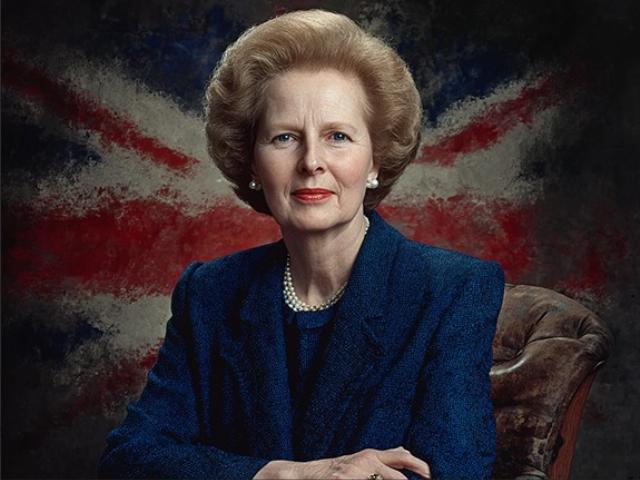
In the second half of the 20th century, she already had prescient insights into America, circa 2026.
Maggie Thatcher, easily one of the greatest leaders of the 20th century, was a no-nonsense woman. She became Prime Minister of the UK in 1979 and would rescue her nation from the economic quagmire her leftist predecessors had created.
Maggie was the daughter of a merchant. And as one might expect from the daughter of someone who had to deal with customers and vendors and regulators, all the while making sure there was something left in the bank at the end of the month, she was a straightforward and pragmatic leader.
For someone born almost exactly 100 years ago, she had a vision of government and culture that we could use more of today. She was something of a combination of Nostradamus, Mark Twain, and (rather sadly) Cassandra rolled into one.
Her thoughts and observations provide an extraordinary insight into many of our problems today.
The clarity began even before she was Prime Minister. In a series of campaign speeches before her historic election, she repeatedly stated a variation of this principle: “If a Government can’t protect citizens and their property against violence, vandalism, and theft, there is little point in having a government at all.” If anything resonates with Americans today, it’s the fundamental failure of government to do exactly that.
She also had a clarity on the economics of leftism, saying,
Let us never forget this fundamental truth: the State has no source of money other than money which people earn themselves. If the State wishes to spend more it can do so only by borrowing your savings or by taxing you more. It is no good thinking that someone else will pay—that ‘someone else’ is you. There is no such thing as public money; there is only taxpayers’ money.
Maggie clearly understood what most American politicians don’t, namely, that government can spend only as much as citizens produce. Only through taxes or IOUs can the government spend a single penny. Given that our national debt is almost $40 trillion and our unfunded liabilities are approaching $100 trillion, financed by a GDP of $30 trillion, another of her quotes drives home the reality:
We are told that the present Government have learned from their mistakes. I say that they have not learned. They still believe that you can spend your way out of recession and that you can create jobs by inflation… and that is the road to ruin. … You can’t tax and spend your way into prosperity. Eventually, you run out of other people’s money.
(This is more commonly remembered as “The problem with socialism is that you eventually run out of other people’s money.”)
Thatcher hit the bullseye with this idea, too, summed up in a common paraphrase: “The patronage state is an arrogant state. It assumes it can spend your money better than you do. Yet it expects you to work for it in the first place.”
Along those same lines, Thatcher anticipated the evolution of the left’s political MO beginning with the ascent of Barack Obama, where every critique, criticism, or disagreement was labeled racism, then expanded to every element of American politics: Homophobic, Islamophobic, Sexist, etc. She clearly recognized the tactics: “I always cheer up immensely if an attack is particularly wounding because I think, well, if they attack one personally, it means they have not a single political argument left.”
The Iron Lady addressed what would become one of America’s biggest problems when someone like Donald Trump, who is not a creature of the Swamp and wanted to upset the apple cart, came into office:
Whether it is in the United States or in mainland Europe, written constitutions have one great weakness. That is that they contain the potential to have judges take decisions which should properly be made by democratically elected politicians.
If there’s anything that characterizes America in 2026, it’s the army of black-robed judicial activists who think they have the power to transform themselves into the Executive. These leftist judges are making a mockery of our Constitution, and sadly, Congress and the White House are allowing them to do so.
And she understood that the left was not only a danger at home, but was an equally dangerous threat on the world stage. Her frequent speeches about Marx have resulted in this paraphrase: “To the extent that the West is to blame at all for the ills of the Third World, it is to the extent that the West created Marx and his successors, among whom must be numbered many of those who advised the Third World leaders in post-war years.” From the UN to the EU to the Democrat party, Marxism has almost certainly caused more death and destruction across the country and around the world than any other philosophy in all of human history.
And particularly resonant today is the fact that Thatcher understood what it meant to be an ally. After allowing Reagan to use US bases in the UK to strike Gaddafi, while other European allies wouldn’t allow him to use their airspace, she is reputed to have said the following, although it’s a paraphrase of several speeches, not a quotation:
It had the effect of cementing the Anglo-American alliance. What’s the good of having bases if when you want to use them you’re not allowed to by the home country. It made America realise that Britain was her real and true friend, when they were hard up against it and wanted something, and that no one else in Europe was. They’re a weak lot, some of them in Europe you know. Weak. Feeble.
There were many other jewels, of course. These are two of the best:
“Many of our troubles are due to the fact that our people turn to politicians for everything.”
“Being powerful is a lot like being a woman: If you have to tell someone that you are, invariably, you are not.”
Maggie Thatcher had a clarity of vision and an understanding of the nature of man and the nature of government that few Americans (or Brits for that matter!) appreciate today, and sadly, even fewer politicians.
April 11, 2026
Source: Maggie Thatcher’s Timeless Wisdom – American Thinker
 DAILY DEVOTIONS, NEWS AND INFORMATION