Tag Archives: topnews

American Education: From Biblical Roots to Atheism

American Education: From Biblical Roots to Atheism


American schools began with the Puritans in the 1600s for the purpose of Bible literacy. With the Bible as the core of learning, America’s first reader, the New England Primerwas created to teach children Bible stories, poems, hymns, and prayers. This emphasis on literacy and education promoted strong religious convictions among colonists and led to the creation of the most literate, educated society in the world.

By the 1800s, the core of learning in schools had begun to shift. For more than 200 years, American culture has endured an onslaught of secular ideologies that gradually have undermined our Christian foundations.

In late 1824, Robert Owen, a Welsh utopian textile manufacturer who communicated with spirits through mediums and séances, arrived in America. He founded the New Harmony socialist commune in Indiana that soon failed. He proposed that government should educate children and introduced the Prussian government indoctrination system that inspired our first public schools.

In the late 1830s, socialists, determined to replace the Biblical lessons with secularism, established government-controlled — public – schools. This would be implemented by teachers educated in the new teacher colleges that standardized what government wanted students to learn.

A signatory of the Humanist Manifesto that rejected the existence of God and moral truth, John Dewey was one of the most influential of the teacher education professors. Often referred to as the “father of public education,” Dewey believed that children should not think for themselves. His mission was to use public schools for the reconstruction of society. With his long tenure at the prestigious Columbia teacher college and his prolific publications, he was largely responsible in his lifetime for turning public schools from largely Protestant Christian academies into secular indoctrination centers.

In the 21st century, the core of education shifted still further from the Bible with the implementation of Common Core Curriculum Standards in public and some private schools. The standards were rooted in the U.N.’s occultist World Core Curriculum derived from the teachings of theosophist Alice Bailey, founder of the infamous Lucis Trust.

Although former U.S. Department of Education Secretary Betsy DeVos stated in a 2018 speech that “Common Core is dead,” it is alive and well — under aliases — even in states such as Texas that did not adopt Common Core during the Race to the Top under Obama. With the passage of the Every Student Succeeds Act in 2015, Common Core was codified so every school district that accepts federal funding is required to implement this leftist legislation with its occult rooted curriculum.

With the far-left teacher colleges churning out radical activists, public schools have become a magnet for paganism, witchcraft, and eastern religions that are contrary to our Judeo-Christian principles.

In California, the State Board of Education adopted an ethnic studies curriculum that required students to recite prayers and chants to pagan Aztec gods of war, human sacrifice, and cannibalism. A lawsuit forced the board to remove the section about chants with the rest of the curriculum remaining in place.

Florida students were subjected to witchcraft programming — “Witchy Wednesday” — via the school’s TV system during weekly announcements. Only when faced with allowing Christians to have equal time to profess their faith was the school administration willing to stop the witchcraft indoctrination.

In Chicago, students were coerced to participate in silent mantras to Hindu deities and in individual worship in dark rooms where they had to kneel in front of an altar with fruit offerings to the gods. The indoctrination stopped after the district was forced to pay a multi-million-dollar award to the victims over violation of their First Amendment rights with Transcendental Meditation (TM).

Some public schools such as Pin Oak Middle School in Bellaire, Texas, have credit-based classes in Hinduism and the culture of India. Where is a credit-based course in Biblical history?

Although schools and educators steadfastly refuse to integrate Christian prayer into the curriculum, Buddhism often is found in public classrooms as “mindfulness” and “meditation techniques.” Claimed to be a way to reduce student stress and promote mental well-being, Buddhist mindfulness meditation is akin to prayer for Christians while the mindfulness curriculum teaches Buddhist practices. Often referred to as the Quiet Time Program, students and teachers meditate for 10 to 20 minutes twice each day with instruction and follow-up by teachers trained to provide instruction.

Social and Emotional Learning (SEL) is claimed to improve student mental health, but actually it is a vehicle for indoctrination. The “circle time” practices used in SEL lessons in schools across the nation are drawn from Theosophy and Mahayana Buddhism.

In 1965, the Students International Meditation Society (SIMS) was founded to teach Transcendental Meditation in schools and universities. By 1974, TM was in local schools in 14 states and 50 universities. In 1979, the courts ruled that, although it is not a theistic religion, TM focuses on issues and ideas analogous to those in well-recognized religions and is prohibited, under the Establishment Clause of the First Amendment, from taking government funding for mandated programs. Determined to continue their mission to infuse Buddhist principles into Western schools using secular language, SIMS obtained private funding.

For decades, Saudi oil money has bought the “right” for Muslims to proselytize in the classroom through Middle East history, culture, and the Arabic language. In the red state of Texas, students chant to Allah, recite aloud Islamic prayers, learn the Five Pillars of Islam, visit mosques, and wear burqas. In conservative rural Tennessee, numerous school activities indoctrinate students in Islam.

Recently, Pennsylvania governor Josh Shapiro Pennsylvania announced a $5 million “grant,” funded by taxpayers, to the Al-Aqsa Islamic Society of Philadelphia to expand its K-12 Muslim school. Taxpayers already are funding Islamic education under various guises.

Once a moral and highly literate nation of people, America has become amoral, violent, and dumbed down. We cannot lay all the blame on public education, but we have to consider what kind of morals might develop when citizens are educated in a system that teaches God is irrelevant. We have to consider what effect that a steady barrage of atheism, paganism, and eastern religions in the classroom is having on our youth.

Angry parents have organized to “take back” public education. The problem is that they fail to recognize that they never controlled the government schools in the first place. They believe they can “fix” public schools. Yet public education was flawed from its inception. Education reformers have tried for decades to improve public schools, yet the problems grow ever more dire. Fixing public education requires changing its purpose. Don’t count on that happening.

If parents really want schools that produce highly literate and moral students, they should withdraw their children from public schools and seek alternate forms of learning — like those in colonial days.

Source: American Education: From Biblical Roots to Atheism – American Thinker

The Truth Satan Seeks To Erase Through Antisemitism


I have long looked for a definition of antisemitism that could help me explain to Christian’s why this targeted hatred of Jewish people is a spiritual battle that’s playing out in real time right before our eyes.

I finally found it in the words of Israeli journalist Haviv Rettig Gur, who captures antisemitism with rare clarity.

He argues that antisemitism is “an ancient idea that recurs throughout history—the archetype that Jews stand in the way of the redemption of the world.”

That definition gets to the heart of something many political commentators, academics, and activists miss entirely. Antisemitism isn’t ultimately about stereotypes, war, money, power, or politics. It’s about a deeper belief embedded across civilizations; it’s the belief that the Jewish people are the obstacle preventing the world from becoming what it ought to be.

For years, I’ve heard evangelicals insist that antisemitism is more than prejudice—that it is spiritual warfare, a satanic assault against the people God chose to bear His promises.

I agree!

But if we want to confront the rising tide of Jew-hatred—especially now that it spreads far beyond the progressive left, infecting conservative spaces and even Christian communities—we must go deeper.

If antisemitism is satanic, we must ask what Satan is actually trying to accomplish, and Gur’s framing, in my opinion, provides the key.

If the Jewish people are seen as the barrier to global redemption, then antisemitism is fundamentally a theological grievance disguised as political, cultural, or racial critique. It is the same ancient lie retold in new vocabulary. Antisemitism is a shapeshifter that has taken on three dominant forms throughout history.

The first is the oldest, religious antisemitism—the belief that Jewish faith and Torah observance are what threaten the world’s progress. That lie surfaces in the book of Esther when Haman describes the Jews as a people who refuse to obey the king’s laws. It resurfaces centuries later in Antiochus Epiphanes, a Greek king who outlawed Jewish practice because it interfered with his imperial vision of cultural conformity. It appeared in Medieval Spain, when King Ferdinand and Queen Isabella insisted Jewish difference was so intolerable after the Reconquista that Jews must convert, leave, or die.

Religious antisemitism persists today; it can be seen in Islamic teachings and certain Christian doctrine. Last year, social media influencer Father Calvin Robinson went on a viral rant claiming that there is no such thing as “Judeo-Christian” values, only Christian values. He refused to use the word Judeo. His post was received with acclaim by many, including Candace Owens, who said she’s stopped Judeo because of its “overtly political history.”

Religious antisemitism claims that Jews are a problem because they will not “become like us.”

A second form of antisemitism took shape in the modern era: racial, genetic antisemitism. Unlike earlier hatred, which targeted what Jews believed, this newer version targeted who Jews were. Jewishness became a biological stain, an inborn problem, a threat embedded in DNA. A Jew could be secular or observant, religious or an atheist—it didn’t matter. Their very existence, their bloodline, was now seen as the source of society’s corruption.

This is the worldview Adolf Hitler seized upon, accusing the Jewish people of poisoning Germany and dragging it into humiliation after World War I. Nazi propaganda went so far as to invent physical identifiers, like the infamous “Jewish nose,” even though scientific studies disproved such claims.

But the truth was irrelevant.

Demonization was the goal. And genetic antisemitism gave Hitler the ideological foundation to murder six million Jewish men, women, and children in the Holocaust. It didn’t matter what Jewish people believed; the problem with Germany and the world was the Jew.

A third form of antisemitism has become unmistakable in the 21st century: statehood antisemitism. It claims to be political, offering critiques of Israeli policy, but always ends by targeting Jewish people—anywhere, everywhere.

You see more clearly since the Hamas massacre on October 7, Jewish students on college campuses have been shoved, harassed, screamed at, and excluded from classrooms—many of them aren’t even Israeli.

Synagogues, kosher restaurants, and Jewish community centers across the world have been vandalized or threatened. The message is unmistakable: Israel’s existence as a Jewish state is the problem, and therefore Jews everywhere must pay the price.

Statehood antisemitism pretends to be about geopolitics. But it functions the same way ancient hatred always has: it collapses Israel, Judaism, and the Jewish people into a single target. The war in Gaza becomes a pretext for hostility toward Jews in New York, Paris, or London who may have never set foot in Israel. This is not “critique.” It is the same old lie wrapped in modern language.

As I considered these three expressions of antisemitism through Gur’s definition, one truth became impossible to ignore and helped me see Satan’s goal.

Every form of Jew-hatred aims at undermining the foundational promise God made to Abraham in Genesis 12—God’s promise of a land, a people, and a blessing for the nations.

Religious antisemitism attacks the blessing by targeting the Jewish faith through which Scripture, covenant, and the Messiah came into the world. Genetic antisemitism attacks the people by attempting to erase them entirely, which would make God’s promises void. Statehood antisemitism attacks the land by denying Israel’s legitimacy and centrality in God’s redemptive plan.

In other words, antisemitism tries to dismantle the Abrahamic covenant from every direction. And that is why it is satanic. Not simply because it is bigotry or hatred—though it is—but because it is a direct assault on God’s credibility. If Satan can convince the world that the land no longer matters, that the Jewish people are not chosen, that the blessing through Abraham is irrelevant, then he can convince the world that God is unfaithful.

This is why antisemitism is so persistent. It is why it mutates from religious to racial to political forms. It is why it appears on the left and the right. And it is why today’s Jew-hatred looks eerily like yesterday’s, even when the rhetoric has changed. The covenant God made with Abraham remains, and therefore the hatred remains.

But the Scriptures are clear: the Jewish people are not the obstacle to the redemption of the world—they are the vehicle of it. Through them came the Word of God, the prophets, the Messiah, and the promise of restoration that would begin in Jerusalem and extend to every nation. And through them God pledged to bless all the families of the earth. A promise that still stands!

That is the truth Satan seeks to erase through antisemitism. And that is why confronting antisemitism is not merely a political or moral duty—it is a spiritual one. To stand with the Jewish people is to stand with the covenant God made with them, going back to the moment Abraham took that step of faith to heed God’s call in Genesis 12. To resist antisemitism is to celebrate God’s promise to Abraham. And to proclaim the truth is to declare, again and again, that God’s promises still stand.

According to God, the Jewish people aren’t the obstacle to global redemption; their salvation is the pathway!


Source: The Truth Satan Seeks To Erase Through Antisemitism – Harbinger’s Daily

Is the Climate Grift Collapsing?


No, no it’s not. We will spend years and decades beating back the insane climate policies and squeezing out the corruption in the climate alarmism NGO complex. We need to completely rewrite curricula, deregulate, fire a bunch of teachers, reclaim our science journals from insane people who disdain truth, and nuke the World Economic Forum and the United Nations.

Still, peak climate is behind us. The peak was high, the damage done, and the cleanup will be as difficult as rooting out the Japanese soldiers hiding in the Pacific island caves, but the tide has turned. As with the trans hysteria, beating back the baddies will be a long and painful process, but we are winning.

Bill Gates has been a key enabler of the climate grift, although hardly the most powerful proponent of it. Despite his reputation as an innovator, he is and always has been more inclined to ride a wave than create one. If he is calling off the climate catastrophe talk, you can be sure that he is merely voicing what many people in his orbit are thinking.

There’s a doomsday view of climate change that goes like this:

In a few decades, cataclysmic climate change will decimate civilization. The evidence is all around us—just look at all the heat waves and storms caused by rising global temperatures. Nothing matters more than limiting the rise in temperature.

Fortunately for all of us, this view is wrong. Although climate change will have serious consequences—particularly for people in the poorest countries—it will not lead to humanity’s demise. People will be able to live and thrive in most places on Earth for the foreseeable future. Emissions projections have gone down, and with the right policies and investments, innovation will allow us to drive emissions down much further.

Unfortunately, the doomsday outlook is causing much of the climate community to focus too much on near-term emissions goals, and it’s diverting resources from the most effective things we should be doing to improve life in a warming world.

It’s not too late to adopt a different view and adjust our strategies for dealing with climate change. Next month’s global climate summit in Brazil, known as COP30, is an excellent place to begin, especially because the summit’s Brazilian leadership is putting climate adaptation and human development high on the agenda.

What I do think is insane are the claims that The Science™ says we are doomed, or even particularly threatened. The data sucks and is manipulated, the models are ridiculous, and the science is following the money.

And the money is HUGE. As in trillions of dollars a year, climate alarmism has been a gold rush for many and a power grab for everybody in the transnational elite.

Whatever the exact truth is, nobody who is shouting about climate change either knows it or remotely cares about what it might be. There is too much money and power to grab, and the more horrifying the stories they can concoct the more money and power they can grab.

Lomberg has rightly pointed out many reasons not to be terribly concerned about climate change, at least not now. There are far more pressing problems in the world, including hunger, disease, poverty, and the enduring lack of resilience to natural disasters.

But that is not my point. Obviously, rational arguments have made no impact on the climate “debate” over the past few decades, and they surely won’t now with the people who lie awake at night wondering what Greta Thunberg would do. These are not rational people.

Nor are many in governments around the world, but the decisions may soon be taken out of their hands. Many of the people who have ridden this wave but not relied upon it for their bread and butter are losing interest in it, and the stasis in European economies is giving members in the transnational elite—at least on this side of the Atlantic—pause.

What was good for business—the climate grift—is now bad for business. Energy crises in Europe will soon enough lead to the fall of governments and the rise of populism, as has happened in the United States with Trump.

The idiocy of climate alarmists has been obvious to anybody who paid attention for years, and it is infuriating that people like us have to fight against disastrous policies for years or decades before we are proven right. We don’t even get thanks or credit for being right, and the idiots don’t get punished for being perpetually wrong. As with COVID, it’s forgive and forget for the elites.

Imagine if we had built a hundred more nuclear power plants, or two hundred, since the 1980s. But no, the fearmongers stopped us, and the result is that we have spent decades trying to restart an industry that we killed for no reason other than alarmism.

It’s not until the damage is done, is obvious, and the bill is outrageously high that people move on. Germany, soon enough, will do an about-face on energy or simply wither away, but if and when they do, they will have to rebuild the nuclear plants they destroyed and work mightily to lure back any industries that might take the risk.

The damage was completely avoidable. We told them so. We jumped up and down. Showed the evidence. Took apart the models. Put things in context. Held conferences. Endured ridicule and censorship.

But it won’t be until people like Bill Gates shrug and say, “Gee, maybe there is a better way,” that anybody with power will listen. The climate grifters will have made bank, our economies will have been hobbled, and the people who are supposedly the beneficiaries of all the “nice” policies will have paid an enormous price for no gain.


To read full article with imbeded X Posts please click on source link below;

Source: Is the Climate Grift Collapsing? – HotAir

By – David Strom  8:00 AM | October 29, 2025


Prayer: The Most Neglected Weapon In The American Arsenal Is The One Most Urgently Needed


The United States of America is a nation conceived by and birthed through prayer. From the first colony of Pilgrims led by William Bradford that settled in Plymouth, MA to our first President, George Washington, who risked his life to secure the freedom we enjoy today, prayer was regarded as an indispensable part of daily life. Universally understood by countless generations of Americans has been the belief that any chance of prosperity and any hope in preserving the American way of life for our families, communities, and government, depends on our continual dependence upon God for His divine providence and protection.

So evident is this belief that the words “In God we Trust” are stamped on our currency, “One nation under God” is echoed in our Pledge of Allegiance, and “endowed by their Creator with certain unalienable rights” is enshrined in our Declaration of Independence from which our American liberty has been proclaimed.

The Decline of Prayer in a Nation in Crisis

Inherent in acknowledging God’s involvement in the affairs of our nation is the necessity to petition His favor through prayer for the provision of our needs, wisdom for our leaders, and security of our people. While this may be obvious to many American Christians who steadfastly uphold our homeland in prayer, a recent Pew Research Study has shown that prayer has steadily declined over the last several years with “fewer than half of Americans (44%) who say they pray each day.” This heartbreaking statistic is troubling when considering the growing, increasingly complex challenges and issues threatening to unravel the fabric of our society.

For decades, America has taken comfort in being a paragon of military strength and a vanguard for technological innovation, fostering a sense of security and stability that many have taken for granted. Americans have taken pride in the collective self-sufficiency of our leaders, our servicemen and servicewomen, and our state-of-the-art weaponry to defend the interests of the United States against internal threats and those from abroad.

At the same time, the predominant Judeo-Christian worldview that once underpinned the foundational beliefs of our society has steadily declined, resulting in an erosion of Biblical values and morals, growing hostility towards Christ-centered standards, principles, and wisdom, and an abandonment of prayer. The result is evident in perversion in classrooms, chaos in the streets, lawlessness in government, and the tearing apart of nuclear families—all of which testify to the degradation of our society.

Looking forward, the question we must ask ourselves is, how will we as Christians respond to factors threatening to unravel this great nation in which we live? When faced with external dangers such as hostile foreign entities, cyber warfare, nanotechnology, bioengineered diseases, and terrorism, or when confronted with internal perils such as inflation, racial division, socialism, and political corruption, will we be content to rely upon our own intellectual prowess and military fortitude to protect our people, to retain societal stability, or even bring cultural, and dare I say spiritual, reform?

If history is any sort of teacher, it demonstrates that this is nothing short of a misplaced sense of security and a false hope. Time and again, nations have fallen, and cultures have collapsed due to trusting in their own self-reliance.

Rediscovering Our Spiritual Weapon

The time has come for America to return to the Christian heritage of our forefathers and utilize a weapon so often neglected. It’s time for prayer to be restored as a regular component of the daily lives of Americans. I’m thankful for the wisdom of President Harry S. Truman and the US Congress who established a National Day of Prayer in 1952, recognizing the importance and necessity for prayer to be incorporated into the fabric of our nation.

It’s wonderful that the citizens of our country are reminded once a year to fight on their knees through prayer on behalf of our homeland. Yet praying once a year simply isn’t enough if we want to see America continue being a beacon of light, hope, and freedom among the nations of the world. We as American Christians need to seek God’s face in prayer daily to guide our leaders, protect our families, and uphold the godly values that have made this remarkable nation unlike any other in history. Every day ought to be a National Day of Prayer!

By now you’re probably wondering why I am referring to prayer as a weapon. Isn’t prayer more of a request for provision, a plea for help, an expression of gratitude, a gesture of faith, or a declaration of worship to God? Yes, absolutely! Prayer is every one of these things. In addition to these, prayer is a tool granted by God to believers for obtaining His protection as well as for assaulting the kingdom of darkness. It’s an instrument given to His followers to both confront and defend against evil.

In other words, prayer may be appropriately viewed as a weapon. As followers of Jesus engaged in a great spiritual battle (Ep. 6:12), I am reminded and encouraged by Paul’s words to the Corinthian believers, that “the weapons of our warfare are not of the flesh, but divinely powerful for the destruction of fortresses. We are destroying speculations and every lofty thing raised up against the knowledge of God” (2 Co. 10:4-5). Such weapons undoubtedly include prayer!

Tactically speaking, when you think about any type of weaponry, it’s important to recognize that a weapon may be used for either offensive or defensive purposes, or both. We see this in Scripture when David used a sling and a stone to offensively attack the giant, Goliath, who defied the God of Israel (1 Sa. 17:45-50). We also see this in Nehemiah when the people who rebuilt the wall of Jerusalem did construction with one hand while simultaneously carrying swords in their other hand, ready to defend themselves against potential attacks from their enemies (Neh. 4:17).

The same principles are true with prayer. As we pray, we can come before the Lord with an offensive mindset, appealing to Him to proactively destroy evil agendas, ideologies, behaviors, and works which seem to manifest themselves with increasing frequency, threatening the stability of our country and culture.

It is suitable and beneficial for Christians to pray that God would prevent or eradicate initiatives, laws, or causes that are contrary to His will, His character, and His Word. It’s fitting that believers would ask God to change the hearts of our fellow countrymen and those hostile toward godly values and morals. Jesus Himself instructed His followers to love their enemies and pray for those who persecute them (Mt. 5:44).

Equally applicable is coming to God in prayer with a defensive mindset, seeking His protection from dangers and threats having the potential to bring disruption, division, or destruction. As the flow of illegal drugs into our country persists, as homicide of the preborn is celebrated, as sexual perversion proliferates, as atheism, spiritualism, and demonic doctrines embed themselves into entertainment, education, commerce, and politics, the need for God to shield America with His protective hand from internal and external dangers is woefully apparent. Our need for God to fight on our behalf to retain, restore, and defend the Biblical roots of our nation is greater than ever!

The Power of Prayer Cannot Be Neglected

As Christians, it isn’t enough to simply rely on political, military, or academic leaders to solve our nation’s problems or protect our freedoms. We need to recognize that the most powerful weapon at our disposal is the one faithfully proven to be effective time and again throughout the pages of Scripture.

When Moses cried out to God in prayer, the Red Sea was parted to save the Israelites from destruction (Ex. 14:15). When Elijah prayed, the heresy of religious leaders who corrupted God’s people was laid bare through God’s consuming fire from heaven (1 Ki. 18:38-40). When Daniel prayed, revelation was given from God to declare and interpret King Nebuchadnezzar’s dream, leading the world’s most powerful leader at the time to acknowledge God’s supremacy (Da. 2:26-47). And when Jesus prayed, it strengthened Him to endure what no other man could, enabling Him to obtain salvation for humanity through His death, burial, and resurrection (Lu. 22:41-44).

Clearly, in each of these instances, the might and power of prayer was shown to obtain deliverance, counter false ideologies, change the mindset of powerful leaders, and provide strength needed to overcome sin and evil. What a mighty weapon indeed!

Commit to Pray for America Today

If heroes of the faith like these understood and valued the importance of prayer, we too as followers of Christ should do no less. We cannot afford not to pray! I am reminded of the words written by the Apostle James, “The effective prayer of a righteous man can accomplish much” (Ja. 5:16b).

Would you join me and commit to praying for America? Starting today, will you partner with me in praying daily for our families, our communities, our churches, our culture, and our leaders? Let’s join together and make every day a National Day of Prayer where we Christians in America collectively seek God to defend the interests of our fellow countrymen and turn the heart of our nation back to Jesus!

Let’s not neglect one of the mightiest weapons in our arsenal but rather deploy it as we stand in opposition against the schemes of the devil! As we fight together on our knees, we may just be surprised to see how powerfully God will move in our nation. Let’s pray!


Source: Prayer: The Most Neglected Weapon In The American Arsenal Is The One Most Urgently Needed – Harbinger’s Daily

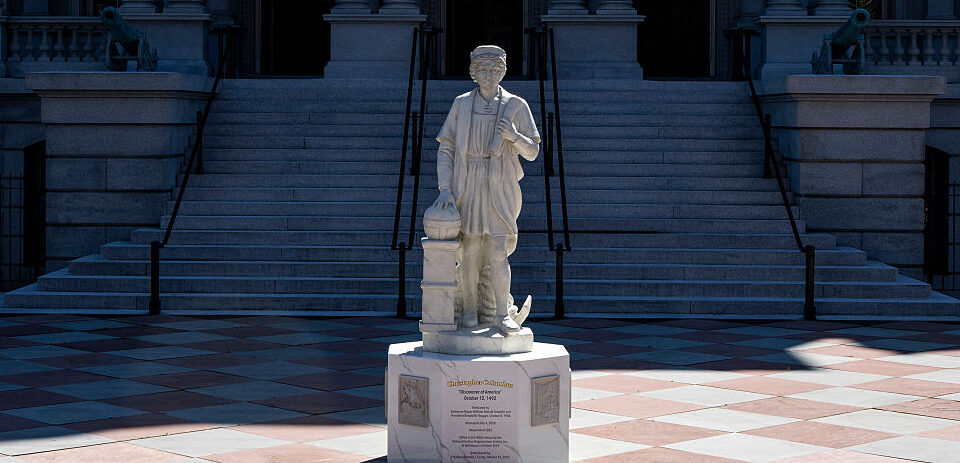
Spoiled leftists despise Columbus Day— but what they really hate is America


Battles over Columbus Day aren’t really about Christopher Columbus at all — they’re about whether America itself should exist.

“Columbus’ journey carried thousands of years of wisdom, philosophy, reason, and culture across the Atlantic into the Americas — paving the way for the ultimate triumph of Western civilization less than three centuries later on July 4, 1776,” President Donald Trump said in his Columbus Day proclamation.

Yet that’s why the holiday has so many enemies.

Unlike progressive movements of decades past, today’s ideological left doesn’t particularly want to lay claim to America’s heritage.

Even the Communist Party USA once made an effort to brand its radical creed as “20th century Americanism.”

Karl Marx himself saw the spread of bourgeois civilization as inevitable and even necessary for creating the conditions of worldwide class revolution.

That civilization is what opponents of Columbus Day reject.

Columbus extended the horizons of Western civilization, which is what the holiday in his name recognizes.

Yes, Italian-Americans are especially proud of Columbus, a son of Italy and the seafaring republic of Genoa in particular.

But this isn’t just an ethnic holiday — everyone whose ancestors weren’t already in this hemisphere when Columbus arrived owes the heroic explorer a debt of gratitude.

By forging permanent ties between the Americas and the wider world, Columbus made our lives and way of life possible.

He opened the way not only for Europeans and Christians like himself but ultimately for people of every land and religion to seek freedom, safety and opportunity in a New World without the class constraints and ancient hatreds of the Old World.

In 1492, the same year Columbus sailed into the uncharted Atlantic, his Spanish royal patrons banished Jews from their land — yet because of Columbus’s discoveries, Jews would one day find haven half a world away from the persecutions they long endured elsewhere.

Columbus didn’t introduce slavery to the Americas; the natives already had that evil institution before Europeans came.

He did, however, set in motion the end of the New World’s own characteristic horrors, such as the Aztecs’ human sacrifices and the cannibalism practiced by the Caribs.

Columbus deserves no blame for the diseases that devastated native populations.

Sooner or later these peoples — with no immunity to infections which most of the human race had contended with for generations — would have suffered the same tragic fate from contact with the outside world.

The Black Death that ravaged medieval Europe came from abroad, too, from contact with Asia.

Only in the modern world, as a result of Western science and medicine, is humanity free to travel and trade with little fear pestilence will follow.

And when new diseases like COVID do spread around the globe, the resources of civilization that Columbus helped spread are able to meet the threat.

Columbus Day is not meant to be a saint’s day.

Like our nation’s Founding Fathers, Columbus was flawed, and his reputation bears the stains of his age’s evils, including slavery.

But like them, Columbus was an exemplar of much that is best in our character.

He was the first and in many ways an archetypal American, an enterprising immigrant who risked everything for a new hope, who not only set out to improve his family’s lot in life but understood his work as service to God.

He was our first pioneer, and he’s been honored in the United States since the late 18th century, when New York City’s Society of Tammany — also known as the Columbian Order — began celebrating his October birthday.

The federal holiday is more recent, with Congress first asking Franklin Roosevelt to proclaim a day for Columbus in the 1930s, and the statutory holiday established in 1971.

But it’s the pitched opposition to Columbus that’s really novel.

Mayor Eric Adams has had to urge New York’s Landmarks Commission to grant protected status to the admiral’s statues, so Zohran Mamdani can’t tear them down if he becomes mayor.

On college campuses and in state capitals across the country, left-wing activists call for replacing Columbus Day with an “Indigenous Peoples Day.”

It’s an ironic demand, since the very notion of indigenous peoples only makes sense from a Eurocentric point of view.

Because every “indigenous” group at some point migrated from someplace else — usually displacing older, more indigenous populations in the process — the term doesn’t refer to the original inhabitants of any land.

Instead, it means populations pre-dating the arrival of Europeans or other ideologically disfavored groups: Despite millennia of history there, Jews certainly aren’t indigenous enough to the Holy Land for the “anti-colonialist” left.

Columbus Day celebrates the birthday of Western civilization as something not confined only to Europe.

Yet in our country, all too many of the spoiled heirs to this civilization regret the very achievements that made their existence possible — including the supreme achievements of Christopher Columbus.


Daniel McCarthy is the editor of Modern Age: A Conservative Review and editor-at-large of The American Conservative.
source:


It Is God Alone That Secures Our Nation’s Liberty And Peace

A Call Back To Our Foundations: It Is God Alone That Secures Our Nation’s Liberty And Peace


This week, in the aftermath of the assassination of Charlie Kirk, many are asking whether incendiary words are fueling violent deeds. A recent Reuters poll found roughly two in three Americans believe harsh political rhetoric encourages violence. And when U.S. Attorney General Pam Bondi said on a podcast that the Trump administration would target “hate speech,” the backlash from conservatives was swift; she later clarified that any focus must be on true threats of violence, not the nebulous catch-all of “hate speech.”

But is speech the core problem? Jesus taught, “Out of the abundance of the heart the mouth speaks” (Matthew 12:34). Words reveal what is inside; they do not create it. If the heart is diseased, our discourse will be too.

Our descent into violence did not begin with profanity-laced accusations on the floor of Congress. It began when our leaders — and many others — abandoned the founding truth that rights come from God, not government. The Declaration of Independence asserts that we are “endowed by our Creator with certain unalienable Rights.” That conviction restrains government from becoming tyrannical and restrains citizens from taking justice into their own hands. When rights are treated as government-issued rather than God-given, they can be revoked when inconvenient — and trampled by those willing to intimidate.

That rejection rests on a deeper shift: the denial of transcendent truth. The Founders called some truths “self-evident” — fixed, enduring, above politics. Today, truth is too often reduced to preference or power. In that vacuum, disagreement is not argued; it is punished. Without a shared standard, the loudest crowd, the angriest rhetoric, or the most ruthless actor prevails. Violence becomes the ultimate argument.

Beneath even that lies the loss of God as Creator. If we are not made in His image, human life has no inherent worth. If He is not the Author of life, life can be discarded whenever it is inconvenient or intolerable. Remove God from public life, and the ground under human dignity crumbles; nothing durable remains to resist the slide into total lawlessness.

History offers sobering case studies. The blood-soaked revolutions and regimes of the 20th century — Soviet communism, Maoism, Nazism — were driven by ideologies that denied God, discarded objective truth, and devalued people. Once God was rejected, persons became expendable, and mass violence followed. We are not immune to similar consequences if we persist down this path.

That is why this moment calls us back — not merely to America first principles, but to the eternal foundation beneath them. We must recover the conviction that there is a Creator who gives life, endows rights, and establishes truth. From that foundation, we can demand just laws, reject political revenge, and rebuild a culture where freedom and justice flourish. This renewal begins close to home: pastors preaching without fear or favor, parents shaping tender consciences, neighbors refusing to dehumanize opponents, and citizens insisting that every person bears the image of God.

So let us pray, speak the truth in love, and stand with courage — calling our nation back to the God who alone secures both our liberty and our peace.


Source: A Call Back To Our Foundations: It Is God Alone That Secures Our Nation’s Liberty And Peace – Harbinger’s Daily

God Warned Us!

God Warned Against Calling Good Evil And Evil Good—And That Warning Still Stands Today

By Tony Perkins September 8, 2025

The prophet Isaiah warned a wayward nation: “Woe to those who call evil good, and good evil; who put darkness for light, and light for darkness.” Right was condemned as wrong, and what darkened the soul was repackaged as enlightenment. Isaiah cautioned that rejecting God’s Word would bring devastation. The warning still stands.

Two developments this past week expose the warning’s timeliness. For years, activists in media and government have advanced a gender ideology that tells even children they can choose an identity opposite of their biological reality. That confusion is not benign. In Minneapolis, a gunman opened fire during a school Mass at Annunciation Catholic Church, killing two children and injuring many others. Police identified the attacker as Robert Westman, who identified as transgender and, in notes posted before the attack, expressed regret and anger about “being trans” and deep confusion about identity.

This is not isolated. Recall the Covenant School massacre in Nashville, and now we have Minneapolis — both carried out by individuals who identified as transgender. The point is not to stigmatize anyone; it is to confront a reality our culture keeps trying to deny: ideas have consequences and masquerading a lie as the truth can be deadly. Yet rather than pause to reassess the narrative, legacy outlets scolded themselves for “misgendering.” NBC News even issued a correction after its initial report used what it called the wrong pronoun when referring to Westman as “he.” “She used female pronouns,” NBC sycophantically stated. This, despite law enforcement identifying the killer as male.

What a commentary on the press. Apologizing for mistakenly telling the truth reflects a deeper malady: trading evil for good and darkness for light. And when this deception is celebrated, children suffer. A civilization cannot protect what it refuses to name, and language becomes a veil for violence.

Still, the media is not the fountainhead of this confusion; they are its amplifiers. The deeper problem is philosophical. If truth is now established by feelings, then law must enforce the feelings. That brings us to this week’s Senate Foreign Relations Committee hearing. Virginia Senator Tim Kaine (D) berated a State Department nominee for affirming the American principle that our rights come from God, not government — calling that view “very, very troubling,” and likening it to the ideology of Iran’s theocracy. Think about that: the creed of the Declaration recast as dangerous and akin to the rule of the Ayatollahs.

Our Founders knew better. Thomas Jefferson wrote that we are “endowed by our Creator with certain unalienable Rights.” Alexander Hamilton insisted the “sacred rights of mankind” are “written, as with a sunbeam, by the hand of the Divinity itself” and cannot be erased by mortal power. Governments secure rights; they do not invent them. And when government presumes to redefine reality — whether human nature or human rights — it imperils the very people it claims to protect.

So here is the choice: return to first principles — truth over ideology, reality over rhetoric, the Creator over the state — or keep stumbling in the dark while calling it light. For the sake of our children and our country, choose the true light — and live by it.


Source: God Warned Against Calling Good Evil And Evil Good—And That Warning Still Stands Today – Harbinger’s Daily

The Spiritual And Social Roots Of Washington DC’s Crime Problem


As a former police officer, I’ve seen firsthand how both crime and criminals have changed since my days on the beat. Today, drugs, untreated mental illness, and a wholesale devaluing of human life drive the violence we see in our cities. But these social pathologies are symptoms of something deeper.

President Trump has once again drawn the ire of the Left and the legacy media for exercising his statutory authority to federalize the Metropolitan Police Department in response to Washington, D.C.’s dangerously high crime rate. In the nation’s capital, you are 52 times more likely to be the victim of a crime than you are to win the D.C. Pick 3 lottery’s $500 top prize.

Critics argue that because crime has declined since 2023, this action was unnecessary. What they fail to mention is that 2023 marked a decade-high crime rate. Even after the recent drop, D.C. residents still face a one in 19 probability of being a crime victim each year. That’s 5.3% — double the 2.5% risk in Chicago. By any objective measure, our nation’s capital remains one of the riskiest cities in America.

President Trump’s move was neither arbitrary nor unnecessary. But here’s the reality: taking control of a police department that city leaders have pressured to coddle criminals rather than enforce the law may address the symptoms — but it won’t cure the underlying disease.

That deeper problem is rooted in the breakdown of the family. D.C. not only has one of the highest crime rates in the nation — it also has one of the highest percentages of children under 18 living in single-parent homes, most without a father. Roughly 53% of children in D.C. grow up in single-parent households — double the national average.

Federal studies and decades of social science research confirm what common sense tells us: father absence is linked to lower self-esteem, higher anxiety, identity struggles, and greater aggression — including criminal behavior. And beyond the social science, there are spiritual consequences. Many who grow up without a father struggle to relate to the very concept of God as a loving, heavenly Father. That loss of connection has ripple effects on how we treat one another. As Jesus said, the two greatest commandments are to love God and to love your neighbor — and the two are inseparable.

Yes, D.C. needs police who enforce the law and prosecutors who prosecute criminals. But the city named for our Founding Father needs fathers — fathers in the home, fathers in schools, fathers invested in the lives of children. I’m not calling for another federal program. I’m calling for a national awakening to the spiritual and social roots of our crime problem. Because until we restore fathers to their rightful place in the family, no amount of policing will bring lasting peace to our streets.


Source: An Underlying Disease: The Spiritual And Social Roots Of Washington DC’s Crime Problem – Harbinger’s Daily

There Are Few Verses In Scripture As Mishandled As ‘Judge Not’


The couple who became famous from HGTV’s popular Fixer Upper show, Chip and Joanna Gaines, made headlines recently because they are professing Christians, and yet they platformed two men in a gay “marriage” on their new show. Reportedly, in response to the outcry from Christians, the couple claimed, “Doesn’t the Bible say ‘judge not’; who are you to tell people what they can, and cannot do?” Well, the Bible tells us what we can and can’t do as Christians!

There are few verses in Scripture that are mishandled as much as Matthew 7:1, “Judge not, that you be not judged.” Whenever someone quotes that verse, as apparently the Gaineses did, to justify embracing or turning a blind eye to sin, they are completely ignoring the context.

Here’s a larger part of the passage, “Judge not, that you be not judged. For with the judgment you pronounce you will be judged, and with the measure you use it will be measured to you. Why do you see the speck that is in your brother’s eye, but do not notice the log that is in your own eye? Or how can you say to your brother, ‘Let me take the speck out of your eye,’ when there is the log in your own eye? You hypocrite, first take the log out of your own eye, and then you will see clearly to take the speck out of your brother’s eye. Do not give dogs what is holy, and do not throw your pearls before pigs, lest they trample them underfoot and turn to attack you” (Matthew 7:1–6).

Clearly, within context, Jesus is not saying never to make judgments—that’s impossible anyway. The Gaineses couldn’t even do it. In saying, “Who are you to tell people what they can, and cannot do?” they are judging the person they are claiming is being judgmental!

Rather, Jesus is telling his followers not to make judgments in a hypocritical, condemning manner that ignores a glaring sin in one’s own life while obsessing over the smaller sin in another person’s life. We’re to soberly consider ourselves first and deal with our own sin, and then we can see clearly to help our brother with his sin.

We can and should make moral judgments . . . but we can only do so consistently when we start with the authority of God’s Word. When we start with Scripture—judging with a righteous judgment as God commands in John 7:24—we are using an objective standard that God, our Creator, has given us. Our judgments aren’t based on our own opinion, our feelings, or our culture. Rather, they are based in God’s revealed Word. Only then can we know that our judgment is “righteous.”

This kind of misinterpretation of Scripture because of a lack of belief in the authority of Scripture (often coupled with biblical illiteracy!) is sadly very common, not just among professing Christian celebrities, but within churches, Christian colleges and universities, and even seminaries. It’s tragic, and we see the fruit as more and more Christians abandon the truth of God’s Word for the wisdom of our age. As I’ve always said, once you abandon the truth and authority of God’s Word beginning in Genesis, more compromise follows. And that’s exactly what we see in so many of these stories of compromising Christians.


Source: Biblical Illiteracy: There Are Few Verses In Scripture As Mishandled As ‘Judge Not’ – Harbinger’s Daily

The Marne Was Just the Beginning: How July 15, 1918 Marked America’s Rise on the World Stage

The River Where America Arrived

It was July 15, 1918. In the heat of a brutal French summer, German artillery opened up on Allied lines at the Marne River. A barrage unlike all others, it was Berlin’s final gamble to break the Western Front. What they didn’t count on was that a new player had arrived, and he wasn’t bluffing.

America wasn’t just sending weapons anymore. We were sending boys who would soon become men by force of fire, and in doing so, the United States proved, once and for all, that it was no longer a mere spectator on the global stage.

Modern Parallels: From the Marne to Ukraine

When Germany launched its last offensive at the Marne, they were gambling on exhaustion. They believed the Allies were too fatigued, too fractured, and too under‑resourced to withstand one final blow. But then American boots hit the dirt. More than 250,000 Americans stood in defiance—not just a token few—by the time the counterattack surged forward.

Today, in Ukraine, we see echoes of that gamble again. A significant power pushes forward under the illusion that the West has grown soft and wouldn’t respond, thinking that American strength is nothing but a bluff.

Although late to the game, the world learned in 1918 that the United States alone had the strength to alter the course of the war. Lessons learned echo in chambers deep inside the Kremlin, Beijing, and Tehran. The entire world knew then that when America commits, we don’t simply turn the tide; we bring a tsunami.

This isn’t arrogance talking. It’s the memory shared by each nation that watched the Marne become the moment the war turned.

The Grit of American Industry: Mobilization Without Hesitation

Americans were underestimated before even firing a shot. European leaders believed that a republic founded by farmers and shopkeepers was unable to manufacture the tools of war quickly enough to make a difference. They were convinced that timelines and logistics would be barriers that couldn’t be breached.

Boy, were they wrong.

Midway through 1918, the United States transformed itself from a standing army of less than 130,000 to a wartime machine capable of shipping hundreds of thousands across the ocean and, most importantly, resupplying them every week.

Everything, from munitions to uniforms, trucks, and artillery, was manufactured with fantastic efficiency.

This wasn’t just hyperbole; it was real production. The American Expeditionary Forces were fed, armed, and clothed by an industrial base without precedent in history.

Modern wars require advanced technology, including AI integration, waves of drones, and cyber dominance. The Marne reminds us of what made nations fear our industry. America didn’t need perfect conditions to succeed; it builds, adapts, and overwhelms.

It’s hard to imagine that same Marne-era mindset driving today’s society, where engineers, welders, coders, and designers are just as vital to our liberty as those who wear the uniform.

Where Blood Met Soil: Belleau Wood and Château‑Thierry

It’s one thing to read about America’s efforts in WWI, but nothing compares to listening to the veterans who were there, telling their stories.

At Château‑Thierry, U.S. troops held bridges while forcing back the Germans using bayonets. The U.S. 3rd Division earned the moniker “Rock of the Marne” for a specific reason. Even when they were outgunned, they refused to retreat.

U.S. Marines didn’t stop the German offensive at Belleau Wood. They smashed it. The men fighting weren’t just veterans; they were Kansas farm boys and Pittsburgh steelworkers. Many of our boys were working through their first combat just days after arriving. They fought through poison gas, machine gun nests, and terrains from Hell.

There was one legendary man who yelled something that grew larger than he did. Gunny Sergeant Dan Daly rallied his men when he yelled, “Come on, you sons of bitches, do you want to live forever?”

What those men fought for wasn’t an empire; they fought for the men alongside them, and because liberty isn’t something inherited, it’s something that is defended.

From Isolation to Respect

It’s true that after World War I, the United States recoiled. We rejected the League of Nations. We withdrew into the comfort of distance. But the world didn’t forget what happened at the Marne.

They didn’t forget the speed of our arrival, the depth of our sacrifice, the rhythm of our industry—and they didn’t forget that the war ended in November, not years later, because America finally showed up and meant it.

We may have pulled back from international entanglements in the 1920s and ’30s, but global powers never again ignored the capabilities of the American people.

The Marne didn’t make us an empire; it made us respected.

Final Thoughts: Why We Share the Marne

Some anniversaries fill the calendar, some drift by, and others ought to be shouted from rooftops. July 15 deserves the latter.

We don’t just remember it because Americans fought. We remember it because they proved we belonged.

During an age where America’s influence is questioned, especially from within, we must remember the blood that carved our seat at the table. That seat wasn’t bought or inherited. It was earned at Château‑Thierry, Belleau Wood, and the banks of the Marne.

At some point, they’ll learn for good that the American spirit is still alive, and it’s not just something read about in our history.

Until then, let them question our wherewithal.

And then let them fear our answer.


Source: The Marne Was Just the Beginning: How July 15 Marked America’s Rise on the World Stage – PJ Media


David Manney

David Manney is a writer and thinker passionate about truth, clarity, and challenging systems that fail those they claim to serve. He brings a sharp eye, a steady voice, and a deep sense of purpose to everything he creates.

Read more by David Manney


July 4th – Independence

Washington’s Cross: The Retreat, the River, and the Republic

On July 4th, Americans celebrate independence. But we rarely ask: Who carried the weight of  that word when it meant nothing more than hope scrawled on parchment? In 1776, the  Revolution was not yet a republic. It was a retreat.

George Washington stood in the breach—not just as general, but as a man who bore the full  weight of a collapsing cause. His army was disbanding. The Congress was in flight. The enemy  was closing in. And yet, through those first desperate months, Washington held the line—often  by sheer force of will. The cross he carried was not only military—it was national and moral.

Defeat after defeat dogged the early months of the war. The British stormed New York. The  Continental Army staggered through New Jersey. Morale was near collapse. Men deserted.  Supplies vanished. And yet, Washington never surrendered—not to the British, not to fear, and  not to the easier path of blaming others.

The retreat across New Jersey is often remembered as tactical survival. But it was more than that.  It was symbolic. Washington, a man of wealth and stature, was being emptied—stripped of  certainty, stripped of glory. And still he pressed on, carrying the soul of a nation in exile.

Then came the river. The Delaware—icy, black, and swollen—stood between ruin and a second  chance. In the dead of night, on December 25th, 1776, Washington led his weary men across. It  was not merely a military maneuver. It was a baptism of the Revolution. From retreat to resolve.

That crossing was not a solitary moment of courage, but the culmination of a deeper calling.  Washington was no mere tactician. He was a man who believed in the hand of Providence. Again  and again in his writings, he invoked divine favor as an anchor. He did not fight for power. He  fought because he believed liberty was not man’s invention, but God’s intention.

Victory at Trenton. Momentum at Princeton. But even those triumphs were not final. The war  dragged on. Temptations abounded—temptations to seize control, to crown himself, to become  what the Revolution was fighting against. Washington resisted them all.

And then, at the end, he did something no conqueror had ever done: he gave power back. He  surrendered his sword to Congress. He walked away. And then, years later, when his nation  called him again—this time not to fight but to govern—he accepted, reluctantly, dutifully. He  became the first president not by ambition, but by necessity.

In doing so, he did more than lead. He showed the world what leadership in a republic looks like:  restraint, dignity, humility, and purpose.

The Fourth of July is not just about the signing of a document. It is about the forging of a people.  That forging happened through fire—through retreat, river, and ultimately, renewal.

Washington’s greatness was not in his genius or his charm, but in his calling. He accepted the  weight of history and bore it with resolve. He believed this new republic was not just a political  experiment, but a destined one. One that required character. One that demanded sacrifice.

We live now in the inheritance of that cross. Our republic survives not just because of systems,  but because one man was willing to walk through darkness carrying a nation’s hope on his back.

So as the fireworks light the sky, let us remember the retreat. Let us remember the river. And  above all, let us remember the man who made the republic possible—not by force, but by faith.


Robert Orlando | Jul 04, 2025

Source: Washington’s Cross: The Retreat, the River, and the Republic

What does the Bible say about transgender people?

Our culture is confused about sexuality. For many, we permit—if not celebrate—nearly all forms of sexual expression. Currently, transgenderism presents a thoroughly unique movement. But what does the Bible say about transgender people?

In February 2022, swimmer Lia Thomas won the women’s 500-yard freestyle in the national championship, becoming the first transgender athlete to win a Division I championship of any sport. Thomas was born biologically male. Since then, similar stories have become a relatively routine fixture in the news cycle.

An Oregon mother tried to adopt a child but was rejected for her biblical beliefs about sexuality, including transgenderism. Her lawsuit reads, “Oregon’s policy amounts to an ideological litmus test. Those with ‘correct’ views on sexual ethics may adopt; those with religious views may not.” The case is now working its way through the U.S. Court of Appeals.

Prior to closing earlier this year, the main gender clinic in the UK saw the number of referrals for children seeking to transition increase from under 250 to more than 5,000. The surge in girls deciding they’re boys with no history of gender distress paved the way for a new theory: “late-onset gender dysphoria” or “rapid-onset gender dysphoria.”

In addition, according to a survey by the Washington Post, “Many [trans people] have been harassed or verbally abused. . . . A quarter have been physically attacked, and about 1 in 5 have been fired or lost out on a promotion because of their gender identity.”

In the midst of a cultural upheaval under modern gender ideology, parents feel bewildered, therapists and physicians don’t seem trustworthy, and those with gender dysphoria (including trans people) feel stigmatized and rejected by the church.

And though there are signs the cultural currents surrounding transgenderism—particularly when it comes to transitioning children—may be shifting, we must adhere to a biblical conviction in every area of this discussion. That means concerning ourselves not just with truth and theological principles (orthodoxy), but also with demonstrating  love, kindness, and self-sacrifice (orthopraxy). While we want to cover a biblical understanding of sex and gender, we can’t lose sight of the individual humans created in God’s image who may be suffering from a myriad of confusing, deep-seated hurts. We’ll emphasize this point throughout.

Dr. Preston Sprinkle is a biblical scholar specializing in sexuality and the author of Embodied. In it, he talks about Alan, his friend who struggled with his gender identity, and how Alan accepted and understood his biblical masculinity despite persistent confusion about his gender. Sprinkle writes, “Love, not logic, changed Alan’s heart. People are rarely argued into the kingdom.”

While right theology and doctrine are essential, without love, we are “noisy gongs,” “clanging cymbals,” and “nothing” (1 Corinthians 13:1–3).

Content – (Links will take you to source article)

What does the evidence say about gender dysphoria and transgender people?

We’ll use the word sex to refer to the person’s biological sex, i.e., the sex they were born to.

Gender refers to how a person lives and presents themselves as either masculine or feminine.

In the past, these terms were used interchangeably.

Not so today.

What are transgenderism and gender dysphoria?

Transgender, or trans, is an umbrella term. Most trans people have “gender dysphoria” (previously “gender identity disorder”), which refers to psychological distress accompanied by a strong conviction that they don’t belong in their bodies’ sex. In that world, some people use “cisgender” to refer to non-trans people. People with gender dysphoria experience intense discomfort and distress feeling like they’re the wrong sex. We’ll later argue that gender identity disorder is a better term, helping lead to better treatment for people experiencing distress.

For many, gender dysphoria is long-term, hounding, and horrific. One described their bout with the distress as a “creepy serum . . . injected all over my body to create an odd, numb yet painful feeling coursing through my blood vessels and seeping into my flesh. My torso and limbs feel like static, and not from pins and needles. My stomach is always uneasy and my whole body is slightly tensed up.”

Justin Sabia-Tanis, a transgender Christian author, asks cis-gender Christians to empathize: “Imagine waking up in the morning and having to wear the clothes you associate with the opposite sex.”

We must understand the plight of trans people with gender dysphoria at the outset, sympathizing with what amounts to an intense psychological discomfort. Body dysmorphia is both a symptom and a broad category for feeling extreme discomfort about one’s body. For example, anorexia nervosa includes body dysmorphia, because people with anorexia have an irrational fear of their body becoming fat, which causes distress. Gender dysphoria includes body dysmorphia. The question we’ll raise and answer later is how to treat gender dysphoria, and whether we should consider it a disorder.

Some trans people identify as “genderqueer,” which means they don’t identify as the opposite sex. Instead, they reject the idea that sex and gender are “binary” and claim they’re somewhere between male and female on a gender spectrum. Some even want to exist outside the spectrum.

A 2023 Washington Post survey found that far more young trans people identify as “nonbinary” or “gender nonconforming” instead of the opposite sex of the one they were given at birth. The same article states that “less than a third have used hormone treatments or puberty blockers, and about 1 in 6 have undergone gender-affirming surgery or other surgical treatment to change their physical appearance.”

This emphasizes the flexibility of the term trans, and it signals a move by young people away from the classic “transsexual” version of transgenderism. However, this paper will nevertheless focus on male-to-female and female-to-male transgenderism. For more insight into gender-queerness and gender nonconformity, read “Is gender binary?” in our forthcoming book, Biblical Insight into Tough Questions: Vol. 12.

Many people with gender dysphoria believe their distress means they are, in reality, the opposite sex they were born into. Thus, they change their gender to counter the distress of living in the “wrong” body.

This act is called “transitioning.”

What is transitioning?

First, a word of warning: because we’re discussing sex and gender, some graphic medical terms will be used out of necessity.

Trans people who transition will present as the opposite gender by “socially transitioning,” which includes changing their clothing and hair and using the opposite sex’s pronouns, or “they/them” for genderqueer people. The next step is taking hormones, testosterone or estrogen, to shift to more masculine or feminine traits. This will change their voice, hair growth, muscle mass, fat distribution, and even their personality temperament. After this, many go on to change their bodies through Sex Reassignment Surgery (SRS).

According to Johns Hopkins, clinics can offer hormone replacement therapy, vaginal construction/vaginoplasty, facial feminization surgery, and breast augmentation for male-to-female transitions. For female-to-male transitions, they can perform hormone replacement therapy, chest masculinization, facial masculinization surgery, and penile construction/phalloplasty.

Penile construction, vaginal construction, double mastectomies, and breast augmentations are highly invasive, wildly expensive, and don’t replicate functioning male or female anatomy—just look-alikes. However, all these procedures can carry life-altering side effects. Even puberty blockers and hormone treatment, the least invasive procedures, can cause urinary tract infections, increase heart problems, decrease bone density (causing joint pain), and can lead to sexual dysfunction and infertility later in life.

Trans children can access “puberty suppressants” and hormone treatment, and teens can access all of these procedures. We’ll discuss adolescents transitioning in more depth later.

So, what have we learned so far?

If someone identifies as “trans,” they may mean different things. A trans person may identify and present as the opposite sex, changing their gender. Others might consider themselves genderqueer, neither identifying as a man nor a woman. Young people will often be confused, bouncing between identities and queer feelings at a rapid pace. Many, but not all, trans people experience gender dysphoria—intense psychological distress from their biological sex. To escape that pain, they will turn to change their gender identity.

Where does transgenderism come from?

The path of a trans person is not easy. While the LGBTQ+ community may praise and support them, they nonetheless will face intense hardships. Many of them face what they perceive as workplace harassment and discrimination.

Most trans people cannot afford expensive sex reassignment surgery, but even those who can may not convincingly present as the opposite sex. Gender dysphoria may remain or flair up later in life after transitioning. As we’ll see later, transitioning, even by secular standards, is a therapeutically dubious way to treat gender dysphoria.

In our opinion, gender dysphoria seems to be a kind of disorder that causes mental distress and needs psychological intervention. If gender dysphoria is better construed as a disorder, it further suggests that transitioning wouldn’t necessarily be the best treatment, even from a secular therapeutic standpoint. Let’s consider why we believe gender identity disorder should still exist.

Trans people have high “comorbidity” with other mental illnesses

In the previous edition of The Diagnostic and Statistical Manual of Mental Disorders (aka, the DSM, the psychologist’s “Bible”), gender dysphoria was classified as a disorder. Trans people often face high rates of other mental illnesses. Typically, mental disorders are “comorbid” with other mental illnesses, meaning multiple mental health issues often exist in the same person. For example, people with anxiety are at higher risk of depression.

The fact that trans people face such a higher risk for other mental illnesses suggests that transgenderism has roots in a mental disorder. The previous edition of the DSM-4, the 4th edition, included “gender identity disorder” for anyone who wanted to change their sex. In the 5th edition, they replaced it with “gender dysphoria,” which means that not everyone who wants to transition has a mental disorder. According to this new standard, trans people should only be diagnosed with gender dysphoria if they experience intense distress from their “gender incongruence.” Whereas before, the feeling of gender incongruence was considered a disorder in and of itself.

However, the high rate of mental health issues in trans people suggests the desire to transition stems from a disorder. This would also provide a clearer path to treatment.

So, what do trans people experience much more frequently?

Three pathologies—depression, anxiety, and self-harm—are two to three times higher in trans people than in the general population. It’s even higher for young trans people. In addition, autism, dissociative disorders, schizophrenia, and eating disorders run higher among trans people. At least a quarter of young girls who claim to be trans also have autism.

In addition, the risk factors for suicide, suicidal ideation, and substance abuse are much higher than in the general population.

Paul R. Eddy summarizes, “ADHD, autism, affective and anxiety disorders, depression, and schizophrenia occur at significantly higher-than-usual rates among transgender people.”

Unfortunately, the countless other issues trans people deal with can confound studies. For example, studying trans people for their rates of self-harm raises a question: Are trans people self-harming because they’re trans or because they have higher rates of depression? These confounding effects aren’t always mentioned in the literature. Media outlets frequently reverberate studies’ success without mentioning their limitations.

With that said, let’s consider some theories about the origins of transgenderism and gender dysphoria.

The trans-brain theory (the nature argument)

Neuroscientists debate whether the human brain is “sexed.” Some scientists believe that trans people have a condition where a female-like brain is in a male body or a male-like brain is in a female body. Brains have a remarkable amount of “neuroplasticity,” meaning that our experiences and behavior can change their structure. While some evidence of brain differences between men and women exists, whether this is the root cause of gender dysphoria is heavily disputed.

One Christian author in support of transgenderism felt confident that this science would prove this theory true. Perhaps, but as of now, the theory doesn’t get off the ground. Even if we humans were “male and female-brained,” there’s no solid evidence that it would be the origin of gender dysphoria.

The psychological trans theory (the nurture argument)

Some believe transgenderism arises from nurture rather than nature. People with gender dysphoria are more likely to experience abuse as children than the general population. In addition, some psychological, subjective reasons may prompt dysphoria or a desire to transition rooted in something apart from gender dysphoria.

Dr. Susan Bradley told Dr. Deborah Soh of teen girls transitioning to males, “Some of these girls, before transitioning, have been sexually abused or threatened. They feel that they’re unable to protect themselves as females and that’s another spur to say, ‘I would be better off as a male.’”

A girl in middle school with autism might not fit in with her peers and prefer the company of boys. When puberty hits, she experiences distress that universally accompanies this change for young girls. She might then opt for a route that both makes her popular and diminishes the effects of female puberty with testosterone or hormone blockers.

Indeed, evidence points to some trans tendencies as a social contagion. Social contagion is when psychological disorders spread through popularity and because of culture. However, few modern studies are conducted on the social contagion of transgenderism because the results might not fit the narrative of trans ideology.

Autogynephilia, for male-to-female trans people

Though lesser-known (and disfavored by trans ideology), autogynephilia is a psychological theory that explains some male-to-female transitions. Autogynephilia refers to an erotic, sexual attraction of men to themselves as females.

Each case is different

The question of the essence of transgenderism and gender dysphoria is important for several reasons, but these various theories do little to affect our biblical reasoning. Several factors will likely play a role in any given person’s gender dysphoria. When talking with transgender people, we should ask them why they believe they experience distress or why they’ve transitioned. They might not know themselves.

Most will just affirm that they “are” the opposite sex and that the “incongruence” of their self-understanding and their bodies is the source of their distress.

Affirming is not the answer

These issues are clearly complex. Unfortunately, because of transgender ideology, many have opted for a simple—though severely flawed—solution that washes over these depths: Just affirm the person’s transition. Therapeutically, this is quite counterintuitive at its base level.

Therapists don’t usually (if ever) affirm people’s body dysmorphia. Imagine a psychologist “affirming” an anorexic woman, telling her that she’s indeed quite obese and should cut back on calories despite her objective state of starvation.

Someone with body dysmorphia obssesses about their bodily appearance. They notice miniscule flaws in their body, often even inventing them. They may avoid pictures, spend hours on cosmetics, or endlessly diet when they’re underweight. Imagine a therapist “affirming” their “flaws,” pointing out newly forming wrinkles.

Imagine a therapist affirming someone’s irrational fear of elevators, or a therapist spinning up a story about how the FBI monitors a paranoid schizophrenic.

So why do therapists affirm trans people’s identity? Why is it illegal to do otherwise in some places? To understand that, we need to consider “transgender ideology.”

What is transgender ideology?

By its proponents, transgender ideology is called trans activism, LGBTQ+ allyship, and other such names. The ideology comes attached to a worldview called “expressive individualism.” The view says people should not only accept other people’s internal beliefs about themselves as paramount but must also celebrate them.

The ideology of transgenderism is the assumption that anyone with gender dysphoria or who wants to transition for almost any reason ought to transition. This is called affirmative care. Anyone impeding that process oppresses the trans’ person’s true self. Anyone promoting caution or claiming on religious grounds that transitioning is not the best choice is labeled “transphobic” then shut out, condemned, and put aside.

Transgender ideology stifles helpful research, even for secular, transgender-affirming specialists. Dr. Kenneth Zucker led the Child Youth and Family Gender Identity Clinic in Canada, a clinic that specialized in treating gender dysphoric kids. He headed up the DSM-5 gender dysphoria entry. Despite falling out of the public’s graces, he remains one of the world’s research and treatment experts.

In 2015, Dr. Zucker was unceremoniously fired for false allegations made by trans activists. His real crime? Helping kids with gender dysphoria, first and foremost, feel comfortable in their own bodies before considering transition as an option.

Dr. Zucker believes that kids who socially transition will be reinforced into that new gender and that gender dysphoria usually arises from nurture rather than nature. Activists called his therapy “conversion” and “reparative,” which is illegal in Canada. Effectively exiling a world-class scientist to satiate an activist mob was an appalling sight, even to the secular, scientific world. He sued the hospital for libel and won more than half a million dollars in a settlement in 2018. The hospital admitted wrongdoing and apologized “without reservation.”

Under the threat of transgender ideology, even the world’s leading expert in gender dysphoria isn’t safe.

While it sounds like trans ideology has won in our most significant institutions, we’re hopeful. It appears that a new wave of opposition to trans ideology has been coalescing in the past couple of years, especially in the area of children and teens. We’ll discuss that more later.

Because scientific research into transgenderism is under pressure from activism and ideological forces, we must review the evidence carefully. Science strives to be objective, but it is a human endeavor involving promotions, grants, tenures, money, and reputation.

Take this example of a subtle but commonplace twisting of the evidence. “Reduction in Mental Health Treatment Utilization Among Transgender Individuals After Gender-Affirming Surgeries: A Total Population Study” was published in the American Journal of Psychiatry in 2015. It was widely circulated in the media for concluding that “the longitudinal association between gender-affirming surgery and reduced likelihood of mental health treatment lends support to the decision to provide gender-affirming surgeries to transgender individuals who seek them.”

In other words, it was a long-term study that showed trans-affirming practices improved people’s mental health.

It was large and longitudinal—finally! A good, conclusive study.

However, upon closer inspection of the data, the numbers yielded “no advantage of surgery.” Fortunately, the authors and the American Journal of Psychiatry acknowledged the error. Unfortunately, the original study remains up on their site without an indication of the correction, and the damage was already done.

News organizations beholden to trans-ideology wouldn’t dare post about the correction. To this day, trans-affirming sites loudly proclaim at the top of Google’s results this since-corrected research: “New Study Shows Transgender People Who Receive Gender-Affirming Surgery Are Significantly Less Likely To Experience Psychological Distress Or Suicidal Ideation.”

Such is the case with many studies. Faulty research is taken at face value and creates the appearance of “consensus” with little to no basis in fact.

Based on the still tenuous evidence, the major institutions of health and psychology in the West nearly all recommend some version of “affirmative therapy.” This refers to the assumption that anyone who wants to transition should be supported in that endeavor. According to this theory, if someone expresses distress from incongruence in their gender and sex, they should transition. Beyond just recommending affirmative therapy, therapists or physicians could lose their licenses for refusing to do so. “Conversion therapy” is illegal in many places, and what counts as “conversion therapy” can be twisted and abused by LGBTQ+ activists.

This ideological pressure trickles down and corrupts the physicians and counselors who could otherwise help people with gender dysphoria.

Take one example among countless misleading statements by institutional professionals. The American Psychological Association’s “Gender Dysphoria Diagnosis” outlines the diagnoses for gender dysphoria according to the DSM-5. In the article, they write that trans people may have other psychiatric disorders “just like any other part of the population,” strongly implying gender dysphoric people have psychoses comparable to the rest of the general population (though even the DSM-5 admits otherwise). This softening language obscures the truth.

Nearly every institution, at every level, promotes trans ideology and shuts down skeptics of affirmative care.

The evidence about trans issues remains scant, especially as it relates to minors. Many problems plague studies, often to no fault of the researchers. For example, to this day, transgender people are relatively rare (0.5 percent of US adults), so massive studies are more difficult (although good studies are done on this size of population all the time). Many studies involve self-reported surveys, which can be subject to bias. Not many long-term studies exist either since funding for these studies has only recently begun to surge.

But transgender ideology tries to control the debate regardless, fixed on affirming a worldview assumption: People will be happier when everyone affirms their preferences and feelings as their ultimate reality. Any studies showing how trans people experience greater distress than the general population are buried under the heading of “discrimination” or chalked up to their being victims of oppression.

This prevents discussion about the well-being of people with gender dysphoria because it assumes affirmation is always the best treatment.

At the end of the day, transgender ideology clouds the discussion, forces opposition away, squashes resistance, deceives people about the “science,” and aims to push transgenderism past commonsense objections by taking hold of institutions, particularly in the case of teens and confused young people.

What does the available evidence say about transitioning?

What kind of transition? Puberty blockers for kids? Hormone therapy? Double mastectomies for females-to-males? Socially transitioning? A combination? What about therapy? The questions vary, and so do the answers.

Most studies are small and don’t follow up long-term. Lately, no studies will use control groups because it’s deemed “unethical” not to affirm their transition (another adverse effect of transgender ideology).

For each of the thousands of studies, challenges present themselves. We can’t go through them all. If  you’re interested in diving deeper, especially into the papers studying children, go to the “Society for Evidence-Based Gender Medicine.

Evidence should help institutions make policies, but the evidence about treating gender dysphoria with blanket affirmation is not yet clear and untangled enough to claim a “consensus.”

In full disclosure, it does seem that for adults, presenting as a different gender and transitioning in some way leads to self-reported higher life satisfaction. But even that self-reported satisfaction conclusion is contested in the wider literature.

Yet even if the evidence shows that trans people statistically have a better self-reported quality of life, transgender ideology still rests on postmodern assumptions. Postmodernism claims that interpretation and experience trump all “external” truth notions. Someone’s internal self-understanding is de facto the final say on the matter. According to postmodernism, anyone claiming something contradictory is an oppressor.

The evidence alone simply cannot answer whether it’s ethically good for anyone to transition; it cannot because the scientific research rests on ideological assumptions. The evidence is important and useful, but life satisfaction cannot be the end-all ethical goal.

So, the question remains, what does the Bible say about the ideology of transgenderism?

First, let’s take a closer look at transitioning gender-confused children.

Evidence about transgenderism in children and teens

Despite the lack of conclusive evidence about transitioning’s effectiveness, transgender ideology presses on all sides that the “science” affirms affirmative care. Trans activists pressure parents to reinforce their child’s transition. Often, they push change through to parents with a frightening verbal weapon: the threat of suicide.

“Experts” will pose this dilemma: “Would you rather have a dead daughter or a son?” Because suicidality is higher among teens with gender dysphoria, they incorrectly insist that transitioning will lower that suicidality. That said, the suicidality of gender-questioning kids is highly exaggerated. The often-quoted study that says 48 percent of trans kids attempt suicide has deep methodological problems.

Puberty suppressors

For prepubescent kids, or kids going through puberty who question their gender (often as young as twelve), therapists will now push them toward puberty suppressors, which will supposedly “buy them time” to make sure they’re trans.

Therapists make this disastrous recommendation despite the fact that “no high-quality, long-term studies on the psychological impacts of suppressing normal puberty exist. When studies include controls, they show no significant benefits from blockers and highlight a risk of permanent negative impacts on cognitive function, and worsening body image (particularly in females).”

The UK did a systematic review of its evidence and found that hormone blockers to suppress puberty in the (supposedly) trans kids did not ease their gender dysphoria.

A study suggests that medical reassignment in adolescents with gender dysphoria doesn’t help their lives overall. If they did well before the transition, they tended to do well afterward. If they were doing poorly before, they did poorly after. This suggests that gender transitioning doesn’t necessarily address the root problem of dysphoria.

In other words, evidence shows that puberty suppressors provide no significant benefits and plenty of drawbacks.

Several broad reviews of the evidence from the US, Sweden, Finland, and the UK signal low-quality evidence for the effectiveness of cross-sex hormone treatment. The review of these studies, along with others, prompted England and Sweden in 2022 to signal “the intention to stop transitioning youth as routine medical practice.” Tavistock, the largest youth gender clinic in the world, was shut down due to a scathing audit of their pernicious practices.

These new revelations and actions could be a catalyst against trans ideology’s corruption harming hundreds of thousands of teens every year (the UCLA report as many as three hundred thousand trans youth). Some US States, sixteen as of writing, have started making gender affirming transitions for underage kids illegal.

What is rapid-onset gender dysphoria?

Evidence shows that if parents, friends, teachers, physicians, and therapists all encourage impressionable children to transition, they will do so.

A new study of over 1,600 cases of children leads credence to the “rapid-onset gender dysphoria” hypothesis. It concludes, “Youth with a history of mental health issues were especially likely to take steps to socially and medically transition.” Nine out of ten parents of these children were progressive, LGBTQ+-affirming parents.

In other words, the rise in children “coming out” as trans is not because children are finally free to express their true selves in our progressive societies but because of social contagion and other mental health issues leading to the switch.

Of course, if the children aren’t supported in transitioning and are given support and help for their general well-being, the evidence suggests that most will stop insisting that they’re trans.

Kids will get easy support and access to help to transition online. They may receive a deceitful or midsguided  message from trans people who hide the difficulties of transitioning and only promote the happiness they feel. Influencers will undermine parents and authority figures, and they will train your kids on the right words to say to get the hormone supplements they crave.

YouTube, Tumblr, social media, and other sites will strongly reinforce trans ideology.

While rapid-onset gender dysphoria is not a clinical diagnosis at this time, and trans ideology rejects the theory, mounting evidence seems to confirm the phenomenon. Rather than showing an improvement in quality of life after transition among kids, the Society for Evidence-Based Gender Medicine reports a “deterioration in children’s mental health and intrafamilial bonds following gender-transition.”

Hormone treatment does not help children. It does not decrease suicide; it leads to “irreversible damage,” as defended by Abigail Shrier. In reviewing her book Irreversible Damage, I wrote:

Girls often face emotional turmoil, discomfort from puberty, body image distress, and social anxiety in their teen years. Social media makes this far worse; depression and anxiety afflict a greater number of teens every year.

When girls are isolated and feel lost in the turmoil of middle school and high school, they might cling to anything that promises an escape.

Activist elementary, middle, and high school teachers celebrate and spur LGBTQ sexuality. TV shows, movies, social media, teachers, therapists, politicians, and the internet seem to shower transgenderism with praise. With so many teen girls looking for acceptance and respite, is it any wonder that they turn to questioning their sexuality and gender?

Our culture makes it easy for girls’ bodily discomfort and shame to suggest another belief: “I’m not a female.”

In other words, the secular evidence seems compelling that for late-onset gender dysphoric kids, not transitioning is the best option. Other mental health issues like autism or a need to impress their peers probably play a significant role in why they want to transition.

What about kids with genuine gender dysphoria?

Some kids have expressed “consistent, persistent, and insistent” distress because of their gender. These cases are different than so-called “late-onset” cases and need more special attention.

Why adolescents fall into gender dysphoria is not simple, but there are many explanations that trans ideology rejects out of hand, which might provide some good answers.

For example, the rate of mental disorders in the mothers of children with gender dysphoria is much higher than usual. Perhaps the mental illness of a child’s mother interferes with the child’s healthy development. That’s not the only possible reason, of course, but those avenues of research are completely a priori rejected by trans ideology.

We would want a biblically based, well-trained psychologist to intervene here. There are different legitimate theories as to the source of gender dysphoria in kids. Each child is unique, and professional input will help immensely.

Even among gender dysphoric children, according to a landmark (albeit disputed) study, 80 percent of children who wanted to transition grew out of their desire by adulthood. In most of those followed in the study, homosexual attraction arose later in life. (For more, see Dr. Jim Denison’s “What does the Bible say about homosexuality?”)

All this evidence can make one’s head spin. You won’t see the studies that challenge the mainstream narrative in the media—thanks to the ubiquitous and powerful trans ideology. Outside of the assumptions of trans ideology, there is no real consensus among medical experts. Remember, many therapists and physicians either live in fear of transgender ideology or stand to profit from helping teens transition.

Parents, don’t cede your authority over your children to trans ideology.

Of course, children should be consulted and heard, but parental wisdom must win the day. Adolescents cannot give informed consent to irreversible hormone treatments and surgeries. Countless heart-breaking stories from “detransitioners” show the detrimental effects of “irreversible” transitioning. Detransitioners refer to people who’ve gone through trans transitions and reverted back to the gender of their biological sex.

As a case in point, Chloe Cole was prescribed puberty blockers and androgen when she was twelve and was recommended for a double mastectomy when she was fifteen. Her breasts were removed, a decision she deeply regrets. She “de-transitioned” at seventeen. She was diagnosed with autism later in life. Cole experienced a urinary tract infection and joint pain from weakened bone density. Cole will never be able to breastfeed and might experience sexual dysfunction.

She filed a lawsuit against her treatment clinic in February 2023. With more detransitioners cropping up and starting to sue medical providers, we can expect a wave of opposition against teen transitioning. Detransitioners seem to be relatively rare, although many of these studies show limitations. This is likely, at least in part, because of overwhelming social pressure to stick to one’s transitioned self.

Take Ritchie Herron, who started transitioning from an early age and eventually had vaginoplasty at thirty years old, a surgery that reconstructed his male genitalia into an approximation of female genitalia. When he looked in the mirror after the surgery, he immediately felt a wave of regret. Since that day, he began living as a male and became a detransitioner.

It’s no wonder more and more young people with gender dysphoria are simply calling themselves genderqueer.

If parents pressure their feminine boys to identify as female or their masculine girls as male, the parents reveal their modern, sexualized assumptions (or maybe even a pathology).

Under normal psychological prediction, a boy may try out a dress once or twice as play experimentation, then move on. Such actions do not indicate gender incongruence, nor should they raise alarm among parents. But, painful, deep-seated gender dysphoria among children is real, if rare.

For parents with gender-questioning children

For parents with children questioning their gender or under gender distress, seek biblical, psychological help. True gender dysphoria is difficult for your child to live with. The evidence does not necessarily show that affirming their transition as adolescents helps in the long run, especially if they’re wanting to change gender out of the blue.

This makes common sense. Giving in to gender dysphoria, if one views it as a disorder, won’t necessarily help. For anorexia patients, therapists don’t affirm their incorrect view of their bodies. Nor should we for gender dysphoric teens.

If you lovingly direct them toward a grace-filled biblical view, which we will review later, their distress may or may not persist. But there is no good reason to think it will persist more than if they were to transition, and it certainly doesn’t seem to decrease their suicidality.

Studies might show that lack of parental approval leads to a risk of things like depression, but parental love and approval do not need to be affirming or extend to acquiring medical sex changes for children.

Abigail Shrier documents the horror stories of teens, sometimes even younger, being shuffled into transitioning and regretting it later in their lives. She focuses on the concerning explosion of transitions among teen girls, specifically. Shrier recommends a few steps to parents that we summarize in our review of her book Irreversible Damage:

  • “Don’t get your children a smartphone.
  • Don’t relinquish your authority as a parent.
  • Don’t support gender ideology in your child’s education.
  • Reintroduce privacy into the home.
  • Stop pathologizing girlhood.
  • Don’t be afraid to admit: it’s wonderful to be a girl.”

We don’t want to necessarily vilify all parents, teachers, physicians, and therapists who believe transitioning helps children. They are often duped and pressured by trans ideology and the threat of their child’s suicide.

That said, medical and psychological community leaders are either pushing this ideology, which rests on postmodern assumptions, or, just as damning, staying silent about the irreversible damage they know the trans “treatment” does to children.

Biological differences between men and women exist

Let’s state something obvious: biological distinctions between sexes exist.

  • Humans have different genetic chromosomes, either XX or XY.
  • Humans have two types of gametes, either eggs or sperm.
  • Men produce more testosterone, while women produce more estrogen (although both produce both).

Biological sex split all humans into male or female, categorically speaking. Humans are “dimorphic,” which means the human species needs one female and one male to produce offspring. This is a statement of fact, and it’s important to keep in mind as we continue.

Sexes are physically different and split between two: men and women. Dr. Deborah Soh, a neuroscientist and sexologist (and not a Christian), defends this point elaborately in her book The End of Gender.

While a nature versus nurture debate rages on about whether men and women are different in surface-level things (like personality), there are very basic facts about biological differences that serve as identifying the sex of someone.

What about intersex people?

Sadly, intersex people often get dragged into this debate in an attempt to undermine binary sexuality. Intersex people “have reproductive or sexual anatomy that doesn’t fit into an exclusively male or female (binary) sex classification.”

At the outset, we must note that most intersex people view their condition as a sex disorder and fully identify as a male or female. While as many as 1.7 percent of the US population is intersex, we can’t fail to distinguish the kinds of intersex conditions. Many of them don’t even know they have an intersex condition until they’re much older. As many as 99 percent of people with intersex conditions are “unambiguously male or female.”

For those incredibly rare cases of people who have both male and female anatomy and cannot be distinguished one way or the other by biological factors, Dr. Sprinkle stays consistent and writes that they are indeed both biologically male and female. They can decide to be one or the other and have corrective surgery or live with the identity as both male and female simultaneously.

While we cannot dismiss the tiny fraction of people who have sincerely contradictory biological markers, we can safely say it shouldn’t be used as a foundational argument for everyone else. Indeed, even the most sex-ambiguous intersex people still lack or combine the two sexes—reinforcing our point. These conditions (like other biological disorders) are a result of the fallen world.

God will beautifully redeem intersex people’s sexuality, but whole-cloth shifting our understanding because of an incredibly rare sex-disorder condition makes no sense. God’s kingdom will welcome all kinds of people.

One pastor says that the eunuchs in Matthew 19:12 and Acts 9 show that “all people, including the sexual ‘other,’ are part of the Family of God.” He uses this point to further transgender ideology, but all believers should accept this idea. Christ opens the doors to his kingdom to same-sex-attracted people, people who struggle with heterosexual lust, physical eunuchs, single-for-life people, and those with intersex.

This leads perfectly into our biblical discussion.

How should Christians respond to transgenderism?

“And the eunuch said to Philip, ‘About whom, I ask you, does the prophet say this, about himself or about someone else?’ Then Philip opened his mouth, and beginning with this Scripture he told him the good news about Jesus. And as they were going along the road they came to some water, and the eunuch said, ‘See, here is water! What prevents me from being baptized?’ And he commanded the chariot to stop, and they both went down into the water, Philip and the eunuch, and he baptized him” (Acts 8:34–38).

This passage demonstrates the wonderful inclusiveness of the gospel, the good news for every nation. While eunuchs were considered “other” and weren’t allowed to “enter the assembly of the Lᴏʀᴅ” (Deuteronomy 23:1), God makes his inclusion of the Ethiopian eunuch into the kingdom as a message: the good news is for everyone.

This says nothing about affirming transgenderism, but it does remind us of our duty to present the gospel to all people and restrict none from being baptized into Jesus’ family if they’ve repented and are determined to follow him.

Christians are called to a higher identity

Dr. Sprinkle writes, “We need to first understand who we are (ontology) before we know what it means to become who God wants us to be (discipleship). Ontology is integral to discipleship, because discipleship means living as we were designed to live—living as divine images.”

Everyone who becomes a disciple of Jesus must throw off their old identity and become a “new creation.” Biblically speaking, nearly all calls to obedience are preceded by a reminder of our identity. As Paul writes in Galatians, “Formerly, when you did not know God, you were enslaved to those that by nature are not gods. But now that you have come to know God, or rather to be known by God, how can you turn back again to the weak and worthless elementary principles of the world, whose slaves you want to be once more? . . . For freedom Christ has set us free; stand firm therefore, and do not submit again to a yoke of slavery.” (Galatians 4:8–95:1)

The Bible uses several powerful examples: We were slaves, now we’re free. We were in darkness, now we’re in the light. We were in the flesh, now we’re in the Spirit. We were outcasts, now we’re adopted children of God, co-heirs with Christ.

How does this work practically?

Consider depression. We know some practical tips to combat depression, like exercising and completing small tasks, but there can be more to it. For Christians, medicine, therapy, science, and the Bible exist cohesively with issues like this. Depression goes against God’s will by considering oneself unworthy, shameful, worthless, incapable, and caught in the ruts of doing nothing.

It usually doesn’t help to respond to anyone struggling to live faithfully in their God-given identity with “Just pick up your cross!” Someone struggling with depression entails a complex lack of trust in their identity as a beloved child of God. Platitudes won’t help.

Nor will platitudes help people with gender dysphoria or transgender people beyond their transition.

Nevertheless, Christians must look to their identity in all areas of life to understand their sanctification (messy and imperfect as it is).

Biblical identity for men and women

The Bible is most concerned with the discipleship of people, regardless of sex. The call to “make disciples of all nations” is addressed to all of Jesus’ followers, many of whom were women.

For Paul, our identity rests most firmly in Christ than our sex: “For as many of you as were baptized into Christ have put on Christ. There is neither Jew nor Greek, there is neither slave nor free, there is no male and female, for you are all one in Christ Jesus. And if you are Christ’s, then you are Abraham’s offspring, heirs according to promise” (Galatians 3:27–29, emphasis added).

Christian brothers and sisters are co-heirs with Christ, equal before God.

That said, the Bible repeatedly affirms our sexual identity as grounded in our bodies. While transgender ideology argues that our preference for gender should rule our identity, according to the Bible, God’s creation of physical differences between men and women plays the defining role in determining our sex.

When God created humanity, he made them male and female (Genesis 1:27). They were to shepherd creation, tending and ruling on behalf of their creator. God told them to have sex, procreate, and fill the earth—to “multiply” (v. 28).

Biologically speaking, humanity is “dimorphic.” As we discussed, gametes (eggs or sperm) biologically determine our sex. For humans to properly image God, men and women must exist. This is reflected in Adam’s looking at all the pairs of animals and longing for a partner of his own. Adam’s maleness and Eve’s femininity were integral parts of their being. They were “both naked and were not ashamed” (Genesis 2:25). Exposure of their male and female bodies did not bring them discomfort.

What a beautiful and unimaginable thing for any person, especially someone with gender dysphoria, to hope for—a complete lack of shame about our bodies.

In Genesis, man and woman were created to be images of God with the potential to procreate (Genesis 1:27–28). This means that Adam and Eve’s sexual identities were grounded in their biology. Sexual union in marriage means to “become one flesh” (Genesis 2:24). Sex is grounded in our bodies, not our self-perception. The rest of Scripture reiterates this truth (e.g., Mark 10:6–9).

As far as Genesis is concerned, Adam and Eve did not have children before they were banished from the paradisal Eden. Presumably, if they lived longer in the Garden, they would have fulfilled God’s command to procreate. This is important to note: They did not procreate in the Garden, but their potential to procreate was nevertheless essential to their identity. After the Fall, the biological inability to procreate would count as part of the brokenness of creation (this includes intersex conditions). Many of the Bible’s heroines were unable to conceive before the Lord favored them. Hannah prayed one of the most beautiful prayers after giving birth to the Prophet Samuel (1 Samuel 2:1–10).

Paul will later say that singleness is a godly path to take in life, or, as Jesus put it, “Eunuchs who have made themselves eunuchs for the sake of the kingdom of heaven” (Matthew 19:12). Churches must come around and support people who choose singleness. Some Christians choose abstinence because of their persistent homosexual attractions, while others simply want to pursue the ministry with all their attention.

To say gender expression can change means that sexuality must exist on a spectrum is a category error, like asking, “How much does green weigh?” Sprinkle writes, “Sex isn’t a spiritual category. It’s a biological one. All the immaterial aspects of personhood are important . . . . But these don’t determine a person’s sex.”

We’ve so far established that, in an ideal world envisioned and spoken into reality by Yawheh in Genesis, men and women complemented each other to act as God’s full image. Humanity is physically split between two sexes, and that’s important in the creation story.

Biblical sexuality precludes transgenderism

The biblical authors consistently affirm that each human is either male or female. How do we know which we are? By looking at reality as the source of truth, not the internal feelings of a person.

Underneath transgenderism is the assumption that our internal state, our soul or mind, should override the identity of our body. While Jesus says to his weary disciples, “The spirit indeed is willing, but the flesh is weak” (Matthew 26:41), the word flesh deals with a spiritual reality grounded in the body.

The fact that the New Testament describes the physical, literal “flesh” as a spiritual reality should give dualists pause. Our bodies are extremely interconnected with who we are.

In 1 Corinthians 6, Paul says that sexual relations with a prostitute mean you’re bound to them as one flesh—a ludicrous outcome, but that’s the point. Our bodies matter. It’s not as though our disembodied spirit will float to heaven one day when we die. On the contrary, Paul says God will raise us from the dead in a bodily fashion as Christ was. The abrupt introduction of resurrection talk in 1 Corinthians 6:14 makes perfect sense, as one commentator writes, “God’s claim means that the body of the believer—or better, the body of the believers—and bodies of the believers—do not belong to the believer(s). They belong to the power of God, which raises them from the dead and which already works to transform them in the present.”

Paul says, “Or do you not know that your body is a temple of the Holy Spirit within you, whom you have from God? You are not your own, for you were bought with a price. So glorify God in your body” (1 Corinthians 6:19–20). Sprinkle points out that Paul actually interchanges “you” and “body” several times throughout this passage. While the “you” is plural and the “body” refers to the church of Corinth, it also applies to individuals. Paul’s point from earlier about fornication with prostitutes continues; the sexual sin impacts the body of Christ and the person’s individual body.

Your sexual identity is grounded in your physical body. Spirituality is not separate from our bodies; what we do as embodied people is spiritual.

We should not deny the reality of the feelings themselves either. But, as with other disorders and brokenness, we must ask, “Do feelings, even strong, deep feelings, determine truth?” Or does the embodied identity bestowed by God determine truth?

What does the Bible say about transgender people?

Let’s take stock of what we’ve established so far.

From the beginning, God created man and woman to complement each other (setting aside the egalitarian and complementarian debate). This complement included sex for the mutual, selfless giving of pleasure to one’s married partner and for procreation—to bring life into our marriages and literally bring life into the world. When affirmed in the Bible, the identity of men and women refers to how God bodily created them.

Romans 1:26–27 says, “For this reason God gave them up to dishonorable passions. For their women exchanged natural relations for those that are contrary to nature; and the men likewise gave up natural relations with women and were consumed with passion for one another, men committing shameless acts with men and receiving in themselves the due penalty for their error.”

This condemnation of homosexuality roots itself in its “unnatural” relations. Paul uses uncomfortable words to modern ears: shamefulperversion, and indecency. Uncomfortable though it may be, Paul condemns sexuality outside of anything between a man and woman as “unnatural.” God gave people over to their “shameful lusts” because they don’t glorify God.

Who does God consider men and women here to be?

Who they were bodily.

Other passages make this line of reasoning as well. Deuteronomy 22:5 is relevant here: “A woman shall not wear a man’s garment, nor shall a man put on a woman’s cloak, for whoever does these things is an abomination to the Lᴏʀᴅ your God.”

Some commentators believe that this law prohibited the religious practice of married people switching clothing in a Canaanite fertility ritual. Other commentators maintain that it refers to something amounting to modern cross-dressing, while others say it “can scarcely refer to [cross-dressing].” Regardless, Brown notes, “It emphasizes that gender-distinctions are part of the created order and must not be obliterated,” in addition to referring to and prohibiting ancient “magical ceremonies.”

The authors of the New Interpreter’s Bible Commentary write that this is part of regulating “sexual boundaries.” The command prohibits “cross-dressing as a forbidden crossing of one of the foremost distinctions established at creation.” The “context of the ruling shows that it was concerned to uphold what were perceived to be given boundaries of the natural order, rather than being a further ruling to outlaw acts of apostasy from the Lᴏʀᴅ God. . . .  Formal gender distinctions marked one of the formative structural boundaries of life. Such boundaries were not to be blurred or willfully crossed.”

As we’ve already observed, what those gender expressions are will vary from culture to culture. It’s worth noting that no punitive, civil punishments were given for this sin. It was nevertheless a grave sin in God’s eyes, an “abomination.”

In the New Testament, some believe 1 Corinthians 11:2–16 broadly shows that Paul wants women to be “distinct” even as they fully participate in worship alongside men, as equals before God. But this passage is so rife with tangled, complex interpretations it would take us too far afield. This commentary will suffice for now: Paul is arguing that “men and women are different, that women and men are dependent on each other, and that in the Lord there is both a mutuality and a distinctiveness that results both from creation and from redemption.”

For more on women in ministry leadership and a discussion of gender roles, read “Should women be pastors? Or church leaders, deacons, or teachers?” by Dr. Jim Denison.

Genesis established God’s good and perfect will for humans to be either male or female, which was grounded in their bodies. Later biblical authors called anything outside of this plan “unnatural” and sinful. The Bible doesn’t force people into gender stereotypes or make ridiculous claims like “men must wear pants and women must wear dresses.” We can distinguish between people’s sex without such strict rules.

In fact, the Bible gives room for people to uniquely express their gifts, talents, and personalities, all submitted to the Holy Spirit. The Bible opens the way for singleness as a beautiful choice of life that honors God. Jesus gives dignity to people of all shapes and sizes, with all kinds of unique qualities and quirks, but he also requires submission of all those things under his feet.

Where God draws the line, for our own good, is at deceiving ourselves or others about which sex we are. That said, we must carefully examine the ideas of biblical masculinity and femininity.

Don’t add to Scripture: What are biblical femininity and masculinity?

God makes us each unique in personality and interests. Christians have sometimes erroneously enforced what our culture values as “masculine” or “feminine.” Following this to its conclusion will make gender dysphoria worse.

Entrenching and enforcing perceptions of masculinity and femininity can drive people into the idea that our actions make our identity when, in truth, God has named us as male or female.

There’s nothing wrong with the stereotypes of masculinity or femininity, either. To bash traditional masculinity or femininity as superior or inferior in and of themselves can lead to confusion.

However, discouraging women from working in STEM and men from taking care of their children entirely misses the point and isn’t supported by the Bible. If we lead women or men away from their Spirit-given gifts, we might even find ourselves opposing the Holy Spirit’s purposes for someone’s life.

Men and women have more in common than differences, and churches should be wary when reinforcing gender stereotypes as more or less biblical. Nearly all commands from Scripture are for all disciples, male or female. Paul did not describe male fruit of Spirit and female fruit of the Spirit. It is the exception to specifically address men and women in the Bible, not the rule. Of course, specific people are always male or female, and that’s based on their sex.

By the same token, we should not actively discourage traditional femininity or masculinity either. Dr. Soh writes, “Whether a trait is deemed ‘masculine’ or ‘feminine’ is culturally defined, but whether a person gravitates toward traits that are considered masculine or feminine is driven by biology.”

Some evidence shows that equal societies increase gender personality differences; they do not diminish them as the prevailing secular creed would have us believe. For example, all things being equal, men tend to be more interested in things and women more interested in people.

Wholesale repression of traditional masculinity or femininity isn’t sustainable. At the same time, legalistically forcing every person into those molds will also backfire. Enforcing strict black-and-white values of femininity and masculinity that alienate effeminate men and masculine women is not the way of Christ.

The bottom line is that each person will live out their sexuality in unique ways. We should not punish those unique paths taken up by brothers and sisters in Christ as long as they don’t go against biblical principles.

Let’s keep our convictions biblical.

Intense distress that arises from the male body that a man might feel or intense distress arising from the female body that a woman feels categorically does not say anything about whether they are a man or woman.

The way they want to present themselves, the way they desire to gender themselves, says nothing about their state of being, according to the Bible.

Every trans person is unique, and we must love them

Darkness, tragedy, and complexity of all kinds make transgenderism impossible to simplify. Our review of the current scientific evidence shows us that. How to love each person best cannot be encapsulated in one article (even one this long)—that’s what biblical community and the guidance of the Holy Spirit are for.

The Fall’s brokenness makes life cracked and difficult. Walking with someone struggling with this, whether a child or an adult, will be incredibly difficult and might not show a reward.

It starts with love, with the overpowering love of Jesus to wash away our sins and make us a “new creation.”

The church must be a place of truth. Chris Legg, pastor and LPC therapist, concludes in an article about the church and mental illness,

In today’s culture, there are very few places where truth is celebrated, much less studied and spoken into our lives. One of those few places is the local church.

Make sure you find a church that clearly teaches submission to God’s word and there you will find truth that can serve as a trustworthy foundation, even when our own brains are lying to us. When we are confused in our depression, anxiety, or delusions, we can hold fast to these truths. Mental illness is tough enough to navigate without a compass that points to true north.

By the same token, truth without love is like a “clanging cymbal” (1 Corinthians 13:1). The Lord can work through a donkey or Jonah, but following Jesus requires compassion, empathy, and love, not only truth.

Sprinkle writes, “And—I can’t emphasize this point enough—if you are a Christian in leadership, or any Christian mentoring or parenting someone who’s trans, we must give trans people space to wrestle with the ethical aspects of transitioning. A top-down, heavy-handed, compassionless approach that gives no room for personal wrestling—‘Thus sayeth me and the Lord!’—will most likely push people toward transitioning and away from us . . . . Discipleship is a long process. God doesn’t demand overnight sanctification, and we’re all thankful that he doesn’t.”

Transgender ideology does not give gender dysphoric people good answers for their lives. It leads to dead ends in dark confusion, but “God is not a God of confusion but of peace” (1 Corinthians 14:33).

Should Christians use trans people’s preferred pronouns?

We must navigate this question with care. On one hand, some argue that using female pronouns to refer to a biological (and as biblically defined) male is tantamount to lying and approval of their sin. On the other hand, transgender people might not consider it that way.

If your trans friend or acquaintance knows you’re a Christian, they may already suspect your beliefs on transgenderism. Using their preferred pronouns might build enough of a bridge to open up a discussion about Jesus. It seems unlikely that refusing to use their pronouns will help communicate the message of truth.

According to theologian Gregory Coles, who interviewed several transgender people, “None of my interviewees were inclined to interpret a cisgender Christian’s pronoun hospitality as an automatic indication that this Christian agreed with everything about the way in which the trans person expressed their gender.” Coles argues that to communicate, we need common ground in language. The way to refer to someone is a matter of communication and respect for them. Calling them by the wrong pronoun on purpose (called “deadnaming” by those who support trans ideology) might cause their gender dysphoria to flair up, creating an awkward, painful discomfort in the moment. (Sprinkle makes the necessary point in our culture ruled by transgender ideology: “Using the pronouns a person identifies with should be a matter of common courtesy, not a legal demand.”)

Regardless, the basic root of this idea is in Jesus’ teaching, “Whatever you wish that others would do to you, do also to them” (Matthew 7:12).

I tend to lean toward using the preferred pronouns of adult trans people as a matter of love and mutual respect. If a relationship deepens and they start to consider following Jesus, at that time, speaking the truth about gender identity will become important.

However, Christians should follow their conviction in the matter. Maybe, if you’re close enough to the person, you can quickly pull them aside and lovingly tell them you will use their pronouns but that you don’t mean to approve their decision to express a different gender. This will show both common courtesy and conviction.

If you hold a firm, thoughtful conviction that Christians shouldn’t call people by their trans pronouns because words matter, follow that conviction. One could make a strong case from this verse that we shouldn’t call transgender Christians by their trans pronouns because it leads them to stumble: “Do not lie to one another, seeing that you have put off the old self with its practices and have put on the new self, which is being renewed in knowledge after the image of its creator” (Colossians 3:9–10).

While pronoun use is not an issue of orthodoxy, whether a Christian affirms transgender ideology is a more serious matter.

So far, we’ve talked about adults. If a teen or child demands their parents use their trans pronouns, that’s an entirely different matter. If you are a parent, you are in authority over your children, and, in that relationship, using their pronouns will almost certainly amount to providing a “stumbling block.” As we already mentioned, take loving, drastic measures if needed to rescue them from transgender ideology or to help them grapple with gender dysphoria.

From a pastoral perspective, we recommend treating a trans person as you would an unmarried couple living together. If that would bar them from membership, apply the principle to the trans person living by a gender other than their sex. We could go into much more, but we’ll limit our discussion for this paper.

Conclusion

God created man and woman to represent him on earth, to bear his image. Their differences and ability to become “one flesh” through matrimony and sexual intercourse help reflect God’s unity of three persons in the Trinity. To the biblical authors, our embodied nature grounds facts about our sexuality and identity as men and women.

  • Christians must show overwhelming compassion to everyone who struggles with their body and sexuality, either from anorexia, same-sex attraction, gender dysphoria, or people who are just confused about their place in the world.
  • Parents should love their children regardless of their actions. If your child starts questioning their gender, do your best to restrict sources of positive reinforcement of transitioning.
  • Churches must do their best to learn to love trans people without affirming gender transition. Leaders mustn’t add to Scripture by reinforcing biblical or feminine stereotypes as doctrinal.
  • In the culture, Christians should always speak the truth in love, but particularly, we must stand against trans ideology’s maleficent manipulation of young people.

We would all do well to remember: “Behold, the dwelling place of God is with man. He will dwell with them, and they will be his people, and God himself will be with them as their God. He will wipe away every tear from their eyes, and death shall be no more, neither shall there be mourning, nor crying, nor pain anymore, for the former things have passed away” (Revelation 21:3–4).

For Christians with gender dysphoria, hope beautiful and sweet awaits you in your new Christlike bodies: no more distress from sex, but fully healed in Jesus’ power.

No more tears, no more discomfort, no more questioning, and no more pain.

Would you share that good news today?

Works consulted

For further trans research

Commentaries consulted:

  • The Expositor’s Bible Commentary
  • The New Interpreter’s Bible
  • The New International Biblical Commentary
  • Tyndale Commentary
  • International Critical Commentary

Ideas change culture:

If you want to know more about God’s design for sexuality, check out our book, Sacred Sexuality: Reclaiming God’s Design. The book arms believers with the knowledge and wisdom needed to confront the challenges of a post-Christian culture with the unchanging truth of the Bible.


June 16, 2025 – 

Source: What does the Bible say about transgender people?

With Each Passing Day, The Words Of Biblical Prophecy Come More Clearly Into Focus


Although Jesus’ command for us to watch for His coming applies to all the ages of church history, the closer we get to the time of His appearing, the better we understand Bible prophecy. There’s always been a future reward for believers who long for His appearing (2 Timothy 4:8), but there’s something about today that enables us to see the end with greater clarity.

The words of Daniel 12:4 speak to the current unfolding drama of the last days: “But you, Daniel, shut up the words and seal the book, until the time of the end. Many shall run to and fro, and knowledge shall increase.”

I believe the prediction that “knowledge shall increase” refers to a surge in our understanding of Bible prophecy, such as we have seen during the past several decades. A few verses later, the Lord confirms this latter-day expansion in our awareness when He told Daniel that the “words” of his prophecy would be “sealed until the time of the end” (Daniel 12:9).

When I was in college fifty years ago, I believed the Rapture could happen at any moment. Since then, like the cutting away of layers of an onion, we have seen an unfolding of world events that have not only confirmed the nearness of the Tribulation and thus to the Rapture but have also enabled us to better understand the fulfillment of events during the Tribulation.

Below are some examples of how our grasp of end-time events continues to grow.

Mind-boggling Advances in Technology. Back when Hal Lindsey’s book, The Late Great Planet Earth, burst on the scene, we had only a vague idea, at best, of how the antichrist could control the buying and selling throughout the entire world. I envisioned a great army in every nation enforcing his mandate.

Now, with the advances in Artificial Intelligence (AI), the development of gigantic databases, the Internet, and emerging worldwide connectivity, the technology for the mark of the beast (Revelation 13:16-18) is already here. Not only that, but the globalists have plans to mandate control of all commerce through a worldwide Central Bank Digital Currency (CBDC). By the middle of the Tribulation, the beast will be able to dictate the conditions for all buying and selling and then mandate compliance with just the flip of a switch.

Preparations for the Beast’s Empire. Although in the works for well over a century, during the past decade, the globalists have become more open about their plans to implement a one-world government. Once regarded as “crazy conspiracy theory,” we know that world domination is clearly the goal of the World Economic Forum and the UN. It’s not even a matter of speculation, though some refuse to see it.

On a recent of Jan Markell’s Understanding the Times broadcast, Billy Crone mentioned the necessity of today’s ongoing preparation for the reign of the antichrist. Because the Restrainer is keeping the antichrist’s identity unknown until after the Rapture, it necessitates the existence of a group of elite power brokers setting the stage for the antichrist’s rule. The globalists are performing the necessary preliminary work that will later allow the beast to rise to power over all the earth in a relatively short amount of time.

Israel’s Nonstop Wars as Preparation for the Beast’s Covenant. Since 1948, the surrounding nations have repeatedly attacked Israel, seeking to destroy it. Hamas’ barbaric attack on October 7, 2023, along with the almost daily sirens warning of incoming missiles, the ongoing conflict with Hamas, and Iran’s threats of annihilation are already conditioning Israel’s leaders to accept the future peace “covenant” that the antichrist will offer to them (Daniel 9:27).

Unfortunately, the people will trust the antichrist rather than God for their protection (Isaiah 28:14-18).

An Easily Deceived Populace. Jesus spoke about the deception that will lead many astray during the last half of the Tribulation (Matthew 24:24). In Revelation 13:11-15, John wrote about how people will fall under the spell of the “beast” who will deceive many with his great “signs.” The widespread deception and gaslighting of our day not only points to the nearness of the Tribulation but is also a preparation for it.

The majority of those left behind at the Rapture will not suddenly transition from discerning people to those whom the beast will easily deceive. They will fall for his devices because they have already rejected the truth and thus possess the “debased mind” Paul wrote about in Romans 1:28-32.

Lawlessness. I never thought I would see such lawlessness and corruption before meeting Jesus in the air. Of course, Paul described the coming beast as a “man of lawlessness” and wrote that the “mystery of lawlessness is already at work” (2 Thessalonians 2:37), but just twenty years ago, who could’ve imagined what we see today on the streets and throughout our government?

Not only does this tell us that the Tribulation is ever so close, but it also displays the conditioning of people to acquiesce to the insane degree of anarchy during the Tribulation.

Rampant Anti-Semitism. During the past dozen years or so, hatred for the Jewish people has skyrocketed. Its spectacular growth since October 7, 2023, defies all common sense. Yet what we see today will continue to build until the last three and a half years of the Tribulation when the deadly persecution of Jews will reach epidemic proportions, likely worse than during WWII under Adolf Hitler.

Twenty-five years ago, I thought that anti-Semitism would need to increase so as to make this level of demonic hatred for the Jewish people possible. Sadly, we already see it even though the Tribulation has not yet even begun.

A lot has changed since my college days. Our understanding of Daniel’s prophecies and those of the book of Revelation have increased just as the Lord told the prophet (12:4, 9). As the drama of future Bible prophecy continues to unfold, I’m reminded of the words of Daniel 12:10“Many shall purify themselves and make themselves white and be refined, but the wicked shall act wickedly. And none of the wicked shall understand, but those who are wise shall understand.”

God’s Word shouts with the message that we live in the season of Jesus’ appearing. The wise understand the times because they believe the words of Scripture pertaining to the end times.


Source: With Each Passing Day, The Words Of Biblical Prophecy Come More Clearly Into Focus – Harbinger’s Daily

Creator Conflict

The Real Problem Behind The Anti-Biblical Ideologies Plaguing Our Culture


We were made from dust in the image of our Creator. But in rebellion, our culture tells us that we are the creators now.

What is the connection between climate alarmism, abortion, and transgenderism? Or between feminism, critical race theory, and postmodernism? In fact, what is the connection between the whole host of anti-biblical social issues and philosophies we’re concerned about in modern America? When we consider all the ideologies and trends rising around us, it can be bewildering to work out what real problem lies behind it all.

The answer begins with an important truth about human beings, revealed in Genesis 2:7: “The Lord God formed the man of dust from the ground.” That might seem like an obscure reference because when we answer the question “what is a human being?” we usually turn our minds to Genesis 1:27. There we learn that God created humans in His own image and likeness. This truth teaches us that men and women were made to reflect God’s glory in creation.

Yet being made in God’s image and likeness is only one truth. The other truth is this: we were made from dust.

This truth tells us that we are not gods. It tells us that we are only creatures—part of the stuff that God created. This humbling, constraining truth tells us that there are limits on how we can image, or reflect, God. We could image his holiness, and therefore His love, goodness, mercy, justice, truth, and so on. However, a whole other side of God’s nature is totally inaccessible to us, such as his infinity, omnipotence, self-existence, omniscience, and so on. God will always be the great and mighty Creator. We will always be his dependent and finite creatures.

Our world hates this truth. Remember, the serpent tempted Eve by falsely promising, “You will be like God” (Genesis 3:5). The first humans wanted something more than mere creatureliness. They wanted to be like the Creator Himself. In Genesis 3, they tried to imitate His creation power by refusing to submit to His definition and deciding for themselves what was good and evil. They started acting as if they were God, with power over right and wrong.

This account captures something that connects the sins of our day. In so many cases, the basic problem is rebellion against God as Creator. Human beings are seeking to redefine what he has already defined by His creation power.

Transgenderism

Transgenderism is fed by the belief that the fingerprint of God on our biology has no bearing on how we ought to live. We can redefine ourselves, rebelling against the definitions the Creator gave when he made the human race, male and female (Genesis 1:27).

Abortion

Abortion is an act that makes us the lord of another life. We can decide when life is life, or if a pre-born human should live. But, in reality, that decision has already been made by the Creator of life at fertilization.

Homosexuality

In Romans 1, the Apostle Paul argued that homosexuality opposed God’s creation authority. He did so because God has left a blueprint for sex in our anatomy. Biologically, it’s not hard to see how various parts of our bodies work together. But we deny this blueprint when we apply those parts in ways which they were evidently not designed to be used.

Climate Alarmism

Climate alarmism puts mankind on the Creator’s throne. It says that we are in control of the climate’s destiny and therefore the planet. While we may see real value in being environmentally conscientious, God has told us that the ultimate destiny of the earth is in his hands—it will end in his time, according to his plan (Genesis 8:22).

Critical Race Theory

Critical race theory teaches that skin shades create insurmountable divisions between people groups. As different “races,” we experience different truth paradigms which cannot be shared. White will oppress black, and black will be victimised by white forever. But we know that God the Creator made just one human race—a radically shared humanity. Though our lived experiences differ, the unifying truth paradigm of the gospel is proclaimed on equal terms no matter a person’s skin shade.

Feminism

God made the first woman, Eve, with the commissioning word “helper.” Then, she is called “mother.” Whether or not she marries and has children, a woman is created as a person-centric human, with many relevant gifts and abilities. She is extraordinarily gifted at making others their best. She is relevantly equipped to be the strength and stay of others. She has emotional perception, interpersonal concern, and nurturing desire that are generally stronger, more natural, and more developed than in men. These are key areas where femininity shines brightest. This is deliberate, in God’s design. But feminism enters the picture with one defining word—“independence.” It undermines the emphasis of her creation entirely. It totally redefines woman when God had already defined her.

Seeking the Scepter

In these examples of contemporary sociopolitical issues, the theme should be clear. We are in a struggle to pry the scepter from the Creator’s hands so that we may rule with it instead. We crave the status of Creator. We want to redefine what he has already defined. We have forgotten that we are dust.

Indeed, if we forget that we were made to bear God’s image, we will be content to live as animals, enslaved to the debasing and degrading effects of sin. If we forget that we were made from the dust of the ground, we will strive to live as gods, inflated by the prideful effects of sin. We are not merely animals—we were made for glory. We are not gods—we were made by God.

The Apostle Paul began his great defense of the gospel—the book of Romans—with a creation apologetic. He proclaimed the reality of God as Creator before demonstrating our rebellion against him and pointing to the redemption in Jesus Christ. Scripture never divorces the truth of God as Creator from the truth of God as Redeemer. When we know God is Creator, we know we must answer to him. When we know God as Redeemer, we find out how we can answer him. If we are not proclaiming the truth about creation to a God-rejecting culture, as the Apostle Paul did at Mars Hill, then we are not building the best foundation for the saving gospel. This is why Genesis apologetics matter.


Source: Creator Conflict: The Real Problem Behind The Anti-Biblical Ideologies Plaguing Our Culture – Harbinger’s Daily

Christian Persecution Still Rampant Globally


Christians around the world face harassment, arrest, displacement, or murder on a daily basis, particularly in Communist and Islamic countries.

From the Christian genocide in Syria to the jihad violence in Nigeria and Democratic Republic of the Congo (DRC) to calls for widespread rape of Christians in an Indian province to the government crackdowns in China and Iran, Christians in many nations constantly have to make the choice between their faith and their freedom — or their lives.

Multiple recent stories published on International Christian Concern’s (ICC) Persecution.org illustrate the increasing gravity and threat of Christian persecution, especially in Africa and Asia. For instance, the Islamic Allied Democratic Forces (ADF) are causing deadly havoc in the DRC. In the previously “thriving” village of Mutwanga, over a hundred residents were murdered, and homes stand empty and ravaged.

“The night was filled with the sounds of gunfire,” said Mutwanga survivor Jeremie Mahembe. “I heard my neighbors screaming, but there was nothing I could do. I escaped with my children, but my wife … she did not make it, she was killed. The attackers were everywhere, death shadows. I never thought I would live to see the day my life, my home, would be destroyed in an instant.”

Chief Kighoma said that jihadis even target children and the elderly: “It is as if the earth has swallowed us whole.”

Pastor Munduwighulu mourned the indifference of the world: “We are not animals, but what has been done to us is worse than anything imaginable. How many more people must die before the world acts?”

Unfortunately, much of the world, including “Christian” nations, is so obsessed with mourning Gaza terrorists (who also persecute Christians) that it has no time for innocent African Christians. ICC said hundreds of thousands of people have been displaced in DRC, where sexual violence and looting are rampant.

ICC also highlighted the recent arrests of multiple Iranian Christians by the terror-sponsoring Islamic dictatorship in that country. On March 7, ICC reported the arrests of Nasser Navard Gol-Tapeh in Parand and Joseph Shahbazian in Tehran, who have been arrested before for involvement with home churches. They had been sentenced to years in prison before being released early but have again been arrested. Back on Feb. 26, Somayeh Rajabi was arrested during a raid of a Christian gathering:

Agents from the Islamic Revolutionary Guard Corps (IRGC) stormed the gathering, which occurred in Gatab, and confiscated Bibles, phones, and musical instruments. Agents reportedly ripped crosses from individuals’ necks and forced the Christians to divulge the passwords to their electronic devices. According to Article 18, agents also stopped emergency medical assistance from reaching the Christians.

Meanwhile, the Chinese Communist Party is openly boastful of its anti-Christian persecution. ICC cited CCP state propaganda outlet Global Times, which pretends that devout Christians are cult members: “China’s public security authorities intensified efforts to dismantle cult organizations in 2024. They have worked to curb the growth and spread of cult organizations, mitigating potential threats to national political security and maintaining social stability.”

ICC explained:

China is known to have forced abortions on its citizens, sterilized women without their consent, and murdered religious minorities to sell their organs on the black market. Christian home churches are an attempt to escape government scrutiny, but even they are often raided and their members arrested on charges of working against the interests of the state.

China is a world leader in the use of technology to surveil and repress its citizens… Chinese government officials use the data captured by this system to track and control those it deems a danger to the state. Notably, this includes anybody associated with the unregistered house church movement and anyone else who might desire to practice religion outside the confines of the state-run institutions.

If a vengeful government turns Chinese citizens’ digital QR codes red, the citzens cannot go anywhere or buy anything.

Pray for persecuted Christians and urge our Western leaders, especially in the U.S., to acknowledge the global crisis of Christian persecution.


Catherine Salgado | 1:00 PM on March 10, 2025

Source: Christian Persecution Still Rampant Globally – PJ Media

Moral Sickness And Depravity Is A Problem That No President, Legislature, Or Law Can Solve

As President Donald J. Trump begins his second term in the Oval Office, he faces a number of urgent challenges on the international and domestic fronts, and he certainly will need God’s wisdom to deal with them.

There is of course the longstanding war in Ukraine, where the conflict has now entered its fourth year. There have been tens of thousands of deaths on both sides and many more wounded and injured. President Trump is keen on ending the war and bringing about an acceptable peace, but it won’t be easy.

Domestically, a number of issues demand his attention and action, from the border to the economy to energy policy and the judiciary. However, there is one area that no president has control over, one that concerns me as a Christian more than any other political, legal or territorial matter.

That’s the ever-growing moral decadence that seems to have gripped so much of our nation, especially among young people.

I’m sure you recall a tragic incident from just a few months ago when the CEO of United Healthcare was gunned down on a New York sidewalk as he was leaving his hotel and headed to an early morning meeting. The assailant shot Brian Thompson from behind, and then walked up to him as he lay bleeding on the sidewalk and drilled two more shots from his silenced sidearm. Thankfully, law enforcement officials caught up with Luigi Mangione at a McDonald’s in Altoona, Pennsylvania, when he was recognized by a patron and an employee as he sat in a corner booth.

It was nothing less than cold-blooded murder—by an Ivy League graduate who has expressed no remorse for his cowardly assassination.

But what has shocked many Americans is the large number of people who believe that this killer actually did nothing wrong by resorting to murder to express his grievances toward the health care industry.

The social media platform TikTok was filled with comedy-type references to the killing. Some posters referred to the assassin as some sort of folk hero. The United Healthcare website was forced to turn off comments after a post about Thompson’s death received more than 36,000 “laugh” reactions. Merchandise celebrating the killer was sold across the internet.

If this isn’t unbelievable enough, an Emerson College poll found that 17% of the American public believed the murder was “acceptable” or “somewhat acceptable.” Even more shocking, 40% of young adults (ages 18-29) felt the killer’s actions were either acceptable or somewhat acceptable. They endorsed his murder as a justified killing.

This moral sickness and depravity is a problem that no president, legislature or law can solve. It’s a spiritual degeneracy that can only be cured by repentance and faith in the Lord Jesus Christ. There is no other remedy or hope.

The Prophet Isaiah said it this way 700 years before the birth of the Savior, to an Israel that had long abandoned its loyalty and allegiance to God, and instead replaced it with idolatry, meaningless rituals and sacrifices that incurred God’s wrath, not His blessings. “Woe to those who call evil good, and good evil; who put darkness for light, and light for darkness; who put bitter for sweet, and sweet for bitter!” (Isaiah 5:20).

That is exactly what we are seeing right now in our sin-rotten culture. We have forsaken God. We have ignored God. We have forgotten God. Without a Biblically informed conscience and a commitment to the authority of Scripture, truth is turned on its head, leading to actions that are devoid of absolute right and wrong. Isaiah put it this way: “Truth is fallen in the street” (Isaiah 59:14).

If this kind of moral corruption continues to spread, can you imagine the consequences? In another few decades, we’ll have a generation of young adults with no respect or adherence to Biblical truth or principles. As Scripture states, “And because lawlessness will abound, the love of many will grow cold” (Matthew 24:12).

I don’t believe we have reached the tipping point yet. God’s grace and mercy is still powerful and transformative. But it will take a sovereign move of the Lord Jesus Christ to bring our society to a point of repentance, faith for revival, and restoration. We must pray for Almighty God to move and for the power of the Gospel to prevail in hearts through the ministry of His Word and the Holy Spirit.

It has happened before in our country, through several mighty spiritual awakenings, and it can happen again. But it will not be brought about by any political maneuvering, only through a mighty outpouring of God’s Spirit.

As my father once said, “Man without God is a contradiction, a paradox, a monstrosity. He sees evil as good and good as evil. That is why some people love evil and hate that which is good—they are still in their sins. For them, life’s values are confused. … Before Paul’s conversion, he saw Christ as the greatest evil‘breathing threats and murder against the disciples of the Lord’ (Acts 9:1). But after he encountered Christ on the Damascus road, he loved what he had so fervently hated. At last, he could see evil as evil and good as good. His values were straightened out because his nature had been changed by the redeeming grace of God.”

This is exactly what our country needs right now. Pray that it may be so.


Source: Moral Sickness And Depravity Is A Problem That No President, Legislature, Or Law Can Solve – Harbinger’s Daily

6G Is Not Just A Tech Upgrade, It’s A Preview Of The Global System Described In Prophecy 

I don’t know how many people remember Operation Mockingbird. This was a covert CIA program launched in the 1950s to manipulate mainstream media. Journalists on the CIA payroll were given talking points to push specific narratives, influencing what Americans saw and believed. This was exposed in 1976 by The Church Committee Hearings, which the Senate Intelligence Committee conducted. These hearings revealed that terms like “fake news” was a term created by the CIA for the JFK Assassination.

In a 1977 Rolling Stones magazine article, Carl Bernstein confirmed that major media outlets—including CBS, NBC, ABC, NY TimesAP, UPI, ReutersSaturday Evening PostNewsweek, and Time—had news reporters and journalists on the CIA payroll. George H.W. Bush, the CIA director at the time, said, “The CIA will no longer pay journalists to write stories; it will now be voluntary.”

6G and AI integration

I remind you of this because there was a time when the elite wanted to keep what they were doing under wrap. That has changed. These elites are now so confident that nothing can be done to stop their plans that they are now publicly releasing what they plan to do next. Even with their plans being put out for all to see, they seem confident that most of the general public still has no understanding of what is being planned—6G and AI integration—which are being promoted as a breakthrough for sustainability, efficiency, and convenience.

But the reality is far deeper: this has been a slow, deliberate march toward total surveillance, control, and the erosion of individual autonomy. Let’s understand this has been forty years in the making.

The Evolution of Wireless Technology

Do you remember the days of 1G? 1G (first-generation) was analog, meaning it was technology that was voice only. The first commercially automated mobile communication network was launched in Japan in 1979. However, it was five years later when 1G was first introduced to the citizens of Tokyo. Then, in the early to mid-1990s, 1G was superseded by newer 2G (second-generation) cellular technologies. Finland was the first nation to have 2G in 1991. The Nokia 3210 was the phone everyone wanted. This sold over 160 million units. But then, 2G succumbed to 3G.

What made 3G revolutionary, though, was the ability to surf the internet and stream music on mobile. Although 2G did offer the same features, they weren’t as advanced as 3G in terms of download speed. For those who wanted to be cutting edge in 3G, remember the Blackberry?

It wasn’t until 2007 that the original iPhone came out. 4G saw the iPhone 6 and the Samsung Galaxy S4, which became the best-selling android-powered mobile phone ever.

In the 2010s, 5G was introduced. South Korea was the first country to offer 5G in March 2019. The big difference between 5G and 4G was bandwidth size.

  • 1G (1980s) – Analog technology, voice-only communication.
  • 2G (1990s) – The rise of digital signals and text messaging.
  • 3G (2000s) – Internet access and mobile data revolutionized communication.
  • 4G (2010s) – High-speed streaming, social media, and smartphone dominance.
  • 5G (2020s) – Ultra-fast connectivity, paving the way for smart cities and automation.

Each step has led us closer to a world where digital infrastructure governs daily life.

What Is 6G?

This brings us to what is next: 6G. 6G is now poised to take full control.

It is being said that user demand is driving new technology, especially the demand for better streaming media. However, unlike previous generations, 6G isn’t just about faster internet, it’s about complete integration with AI, automation, and global connectivity.

Samsung, one of the leaders in this technology, has released white papers outlining its vision. Samsung is saying 6G will revolutionize the way people interact with technology. They say 6G will address economic, environmental, and societal needs. It will be used in entertainment, medicine, education, and manufacturing.
Here’s what they’re planning:

  • Immersive Extended Reality (XR) – Digital environments are so realistic that they mimic human experiences. This is designed to produce an experience as close to being human without being human.
  • Digital Twins – Virtual replicas of physical people and places, allowing interaction with AI-driven copies of ourselves.
  • Global Smart Networks – 6G will manage a massive amount of data, all by automation. This will include smart homes, smart factories, and smart cities. This automated technology is being designed to be available even in sparsely populated areas such as the desert, mountains, and the sea. Developers want to cover the entire globe with this new technology. Realize that this means NO one anywhere will be unreachable or untraceable.
  • Fixed Wireless Access (FWA) – will allow individuals to operate 6G in the comfort of their own home.
  • AI-Based Energy Saving Management (ESM) – The ability to remotely turn off cell phones and devices under the pretext of “energy efficiency.” This means this technology’s creators will be able to deactivate cell phones. They will do this under the banner of saving energy.
  • AI-Controlled Traffic Loads – 6G will have energy-efficient hardware such as “Peak-to-average power ratio” (or PAPR) for consumers and “Doherty PA,” which will be used in commercial networks. Technology such as “Symbol-level power tracking” (or SPT) and “Faster than SPT” (or F-SPT) will give AI control and decisions over traffic loads. Meaning AI will decide whose cell phone to turn off and when.
  • Automated 6G Networks – For our safety and the planet’s good, the general public will be told we need “AI-Based Network Automation.” We will be told that as networks become tremendously complex, a fully automated 6G network is necessary because it will allow us to learn and manage the network without any human intervention. Remember, this is being designed to be done without any human intervention.

6G will mean the total automation of society—every action, conversation, and movement tracked, monitored, and potentially controlled.

6G and the Biblical Prophecy

Why does this matter? Because Bible prophecy tells us that a global system of control will rise before Christ’s return. Scripture speaks of a time when a one-world government, economy, and religion demand allegiance to the Antichrist’s rule (Revelation 13:16-17). Technology like 6G sets the stage for this reality. What we are seeing now must be set into place and be available then.

  • Total Surveillance – No one will be “off the grid.” AI-driven monitoring will track every individual’s movements, purchases, and communications.
  • Digital Identification and Cashless Society – 6G will facilitate the infrastructure for a global digital ID system, controlling who can buy or sell.
  • AI Decision-Making – With 6G, AI—not humans—will control systems that dictate access to essential services.

For some, this new technology will be welcomed as progress. For others, it will be an alarming step toward complete dependence on AI-driven governance. The reality is that rejecting it may not be an option. It is designed to consume and control every aspect of life, but what it cannot control is the sovereignty of Jesus Christ.

The Blessed Hope

As we watch these technological advancements unfold, believers must not live in fear but in awareness. The very fact that this system is emerging aligns with what Scripture has foretold for thousands of years. These are signs pointing to the soon return of Jesus Christ. To me, the most significant sign to all of this technology is the soon return of Jesus. The development and implementation of 6G sets the stage even more for the soon disappearance of believers as the Rapture takes place while the world is left with its controlling technology and the judgment of God.

6G is not just another tech upgrade, but a preview of the coming global system described in prophecy. But for those who trust in Christ, our future is not one of fear and control, but of hope, freedom, and eternal security in Him.


Source: 6G Is Not Just A Tech Upgrade, It’s A Preview Of The Global System Described In Prophecy – Harbinger’s Daily

The Abandonment Of Truth Comes With A Painfully High Cost 


The 21st century is different from all other generations, at least in this way: We are living in the first era of an international attempt to suppress moral knowledge. I refer to the widespread cultural abandonment of belief in “natural law.”

In the classroom, through the media, in our entertainment and via rigidly enforced corporate policies, accommodation of clear moral truth is being squelched with unrelenting pressure. America’s founders (and thought leaders throughout history) often referred to our knowledge of right and wrong as “natural law.” Phrases like “self-evident truth,” “higher law” or “the laws of nature and nature’s God”—these were terms used to describe the awareness of right or wrong known to all people.

The Ubiquity And Source Of Moral Knowledge

Natural law doesn’t mean that people always do what is right. But deep down, in our conscience, people really do know what’s right. This has been amply documented by many scholars, persuasively arguing that humans are a species uniquely hard wired with the ability to know right from wrong. In his 1943 classic “The Abolition of Man,” C.S. Lewis documents precepts of the moral codes held by major cultures throughout history, all of which strongly echo the Ten Commandments in Exodus 20.

Face it, we are moral creatures. And no scientific theory can account for why humans are born knowing right from wrong. The Bible points out the moral awareness universally embedded within us. Romans 2:14-15 states, “When Gentiles, who do not have the law, by nature do the things in the law, these, although not having the law, are a law to themselves, who show the work of the law written in their hearts.”

Romans 3 and 1 Peter 4 speak of the “oracles of God,” which were entrusted to the Jewish people. But because knowledge of right and wrong is known to all people, we are accountable to our Creator. We should do right because in our heart of hearts, we actually know what is right.

Activists for secularism, for abortion, and for the promotion of homosexuality and transgenderism fight the recognition of objective morality. All of these groups pressure professional societies, academics and legal professionals to side with them in their opposition against natural law. LGBTQ activists deem any disagreement with their message an act of violence on par with physical assault. Their lobbying of major corporations to make policies more accepting of LGBTQ demands has been very successful.

The Torture Of Gender Confusion

This widespread abandoning of morality not only gravely undermines our (currently) protected rights regarding freedom of religious expression and the freedom to share the Gospel, it also endangers people’s well-being and eternal souls. The cultural call to sexual license and gender fluidity is not the innocuous path to personal freedom our society is being led to believe. Abandonment of known truth comes with a painfully high cost.

While I was attending graduate school in the early 1990s, one of the jobs I worked was as assistant manager of a Christian bookstore. Ministry opportunities seemed to walk through the door daily, and one unforgettable person we met was Russ. He would come to the bookstore many times each week, and he struggled with many things. Physical abuse that went back to childhood had taken a severe toll on this young man.

For Russ, the peace of Christ and a stable spiritual walk seemed elusive. One day he informed us that from then on, he was to be called “Courtney.” The real answer to his problems, he was convinced, was to become a woman. Shortly after, Russ told us that he was now living with people who truly loved him—but only as “Courtney.” He let us know that his new community had a different understanding of Scripture than we had been sharing. His visits to our store became less common.

There is desire in every heart for love and acceptance that only Jesus can fill. It was clear that this young man was seeking fulfillment in some very unhealthy places. At one point, “Courtney” expressed desire to permanently return to being Russ, but the pressure to conform to the standards of the alternative community was intense. The last time we ever saw Russ, my wife and I begged him to seek counseling.

The newspaper headline reported that Russ’s death was an unsolved case. Whether or not he was murdered, committed suicide, or died accidentally was never known.

But in the gender-fluid climate of the 21st century, this is certain: Christians who tried to help Russ would today be accused of hate crimes for refusing to encourage the dark, destructive identity of “Courtney.” For trying to help this young man trust God’s design for his life, we would be guilty of “misgendering.” We had taken Russ into our homes, our lives and our hearts. But progressives today would say that the Christian truth we offered amounted to acts of violence.

Morality Unobscured By Cultural Spin

Because there is a universal witness of God written on every heart, Romans 1:20 contains some sobering words: “They are without excuse.” Before the Almighty, we are accountable. Perhaps this accountability to God—and not just to ourselves—is why many in our culture wish there were no natural moral law. This is certainly what John 3:19 indicates: “Men loved darkness rather than light, because their deeds were evil.”

We have all done things we know are wrong. This is called sin. By breaking the known moral law, we are guilty before the Lawgiver. How sad it would be if the story ended there.

Thankfully, though John’s Gospel contains the indictment of man’s love for sin, in this same chapter, verse 16 records God’s intervention to save us from our guilt: “For God so loved the world that He gave His only begotten Son, that whoever believes in Him should not perish but have everlasting life.” The most morally correct and wise thing anyone will ever do is to respond in faith and obedience.


Source: The Abandonment Of Truth Comes With A Painfully High Cost – Harbinger’s Daily

God’s Binary World

God’s Binary World


The spirit of relativism, which rules our society, insists that any choice we make, as long as it makes us “feel good,” is the right choice. God tells us that isn’t so. We have two choices, God, or not God. This is the question Joshua asks the Israelites just before his death after recounting the journey to the promised land of which he was a principle leader. (Joshua 24:15)


“He who is not with me is against me, and he who does not gather with me scatters.” Lk 11:23

“Before a man are life and death, good and evil, and whichever he chooses will be given him.” (Sir 15:17)


This can pose great difficulty in our daily lives as so many things don’t seem to boil down to a simple black and white decision. So how do we approach life? Rather than just barreling through life and “winging it” we need to build a firm foundation for our lives so that when a situation presents itself we instinctively know what to do. This is called forming our consciences and conforming them to God.

Having served over 23 years in the military, I am aware this is how we prepared ourselves for daily events and especially for special events like refueling at sea or launching and recovering aircraft. We practiced, rehearsed, and continually reviewed proper procedures. If you didn’t do this or were prevented by distractions like DEI indoctrination, ships collided, ran aground, planes crashed, people died. Training had to be a priority, especially where safety was concerned. Doing the right thing became instinctive.


And practice and continued preparation is the way of spiritual warfare. When we sit back and become complacent or convince ourselves that we are “good” and do only the bare minimum (and even be selective about adhering to our faith), the devil has the upper hand.

And so we are called to choose; the way of God or the way of the devil. As Joshua told the Israelites on entering the promised land, “Choose whom you will serve… [secular gods], the gods in whose country you are dwelling. As for me and my household, we will serve the Lord.” (Joshua 24:15) The secular call to “tolerance” rather than admonishing the sinner, puts us on the wide, easy path, which many follow. “Enter by the narrow gate; for the gate is wide and the way is easy, that leads to destruction, and those who enter by it are many. For the gate is narrow and the way is hard, that leads to life, and those who find it are few.” Mt 7:13-14


Our secular society and even religious leaders have been caught up in the intolerance of tolerance, calling good things evil and, rather than calling out sinners as is their duty, actually preach on accepting sin as the new normal. The Episcopal bishop of Washington, D.C., Mariann Budde, at the inauguration prayer service, called for acceptance of “the people in our country who are scared now,” Budde said. “There are gay, lesbian, and transgender children…” As seems to be the trend in so many religious leaders today, the message of sin and repentance is swept aside, even though this was the primary message of Jesus. At the beginning of His public ministry, Jesus said, “Repent, for the kingdom of heaven is at hand.” (Mt 4:17) They call for mercy, but the lesson of salvation history is that mercy comes after repentance.

Catholic Vote characterizes Bishop Budde and the congregation she represents as follows: “The Episcopal Church to which the prelate belongs is a liberal mainline Protestant denomination that supports abortion, same-sex “marriage,” the subjection of children to experimental sexual surgeries, and the ordination of women.” All of these positions are highly political and are contrary to Catholic teaching.


“For mercy and wrath are with the Lord; he is mighty to forgive, and he pours out wrath. As great as his mercy, so great is also his reproof, he will judge a man according to his deeds.” Sir 16:11-12

And repentance comes after acknowledging our sin, which too many people are reluctant to do, and religious leaders seem to avoid teaching on it. In this way, they are misleading and failing the flock as God described in Ezekiel 34 and Jesus described of the scribes and pharisees in John’s gospel: “Jesus said, ‘For judgment I came into this world, that those who do not see may see, and those who see may become blind.’ Some of the Pharisees near him heard this and they said to him, ‘Are we also blind?’ Jesus said to them, ‘If you were blind, you would have no guilt; but now that you say, ‘we see,’ your guilt remains.’” (John 9:39-41)


“Woe to those who call evil good and good evil, who put darkness for light and light for darkness, who put bitter for sweet and sweet for bitter! Woe to those who are wise in their own eyes, and shrewd in their own sight!” (Is 5:20-21)

Giving lip-service to the teachings of Christ while acting contrary to His teaching, especially where sin is concerned, is not an act of love of neighbor. If you love someone, you look out for what is good for them; the common good. Leading them into or even being lukewarm about them heading toward the cliff of sin is not love. “The only way one can ever prove love is by making an act of choice; mere words are not enough.” (Sheen, On the Demonic) Compassion for sinners does not mean we condone their sin.

The following quotes from Scripture and leaders of Christian teaching attest to the binary aspect of salvation.

“And this is the judgment, that the light has come into the world, and men loved darkness rather than light, because their deeds were evil. For every one who does evil hates the light, and does not come to the light, lest his deeds should be exposed. But he who does what is true comes to the light, that it may be clearly seen that his deeds have been wrought in God.” (Jn 3:19-21)

“There is but one good; that is God. Everything else is good when it looks to Him and bad when it turns from Him.” C.S. Lewis, Mere Christianity

“Moral principles do not depend on a majority vote. Wrong is wrong, even if everybody is wrong. Right is right, even if nobody is right.” Fulton J. Sheen

“Very few people believe in the devil these days, which suits the devil very well He is always helping to circulate the news of his own death. The essence of God is existence, and he defines himself as: ‘I am who am.’ The essence of the devil is the lie, and he defines himself as” ‘I am who am not.’ Satan has very little trouble with those who do not believe in him; they are already on his side.” Fulton J. Sheen

“God has to keep reminding us of the two most obvious truths in the world: that we are not him, and that he is not us.” Dr. Peter Kreeft, Food for the Soul, Cycle C,

Straddling the fence is not a viable option. Cafeteria, liberal, and progressive Catholics should take note. Form your conscience in accordance with Church teaching and live your faith. Witness is more effective than preaching; actions speak louder than words.


By Thomas Klocek

Source: God’s Binary World – American Thinker

AI Trojan Horse

AI Trojan Horse: The Infrastructure Necessary For The Antichrist’s Technology Is Being Developed And Used Today – Harbinger’s Daily


Greek mythology tells the story of the Trojan horse. The people of Troy—the Trojans—were defeated by the Greeks after they left behind a large, hollow wooden horse and pretended to sail for home. The Greeks persuaded the Trojans that the horse was an offering to Athena (the goddess of war), and believing the horse would protect the city of Troy, the Trojans brought the horse inside the city walls as they were unaware the wooden horse was filled with Greek warriors. At night, these Greek warriors emerged from their hiding place and opened the gates to the city of Troy, letting the Greek army into the city, leading to the defeat of the city of Troy.

Transitioning from Greek mythology to modern-day technology, we may have another Trojan horse, and it may be embraced and welcomed into our homes and lives just as that ancient wooden horse once was. This trojan horse is called Open AI, especially Open AI o.3.

General Intelligence or AGI

OpenAI is far and away the market leader in generative AI. ChatGPT is a term most people are familiar with. ChatGPT is general intelligence or AGI. ChatGPT has over 250 million users, and over 10 million are paying subscribers. The New York Times recently reported that it estimates the annual revenue for Open AI to be over 3 billion dollars. That may seem impressive. However, it’s nothing compared to what they just raised in capital. OpenAI CEO Sam Altman has confirmed that Open AI has just raised 6.6 billion dollars. They have plans to continue introducing more technological advancements.

We need to realize that it’s NOT about where we are right now; it’s about where we are heading. AI, virtual reality, drone warfare, genetic engineering, nanotechnology—all of this is the Fourth Industrial Revolution! I believe 2019 and 2020 were NOT about disease or plague; they were about the jab. They were about what could be injected into our bodies.

Seekr, an AI-powered Wearable Device

The Consumer Electronics Show, known as CES, is about to take place in Las Vegas. Each year, this show is considered a global event because it brings together tech companies focused on solving humanity’s greatest problems.

One piece of technology about to be revealed is Seekr, an AI-powered wearable device designed to empower the visually impaired. Seekr uses real-time machine algorithms to process visual data and send audio feed to the users’ bluetooth earpieces. This device is designed to help the visually impaired identify objects, navigate obstacles, and even read signs.

I admit that technology has some amazing abilities; it could allow some people to have their sight restored. It has the hopes of helping the lame walk, the blind see, and the deaf hear. Now, I use that reference on purpose because in Scripture, a sign of the Messiah, according to Jesus, is the lame walking, the blind seeing, and the deaf hearing. Let me be clear on what I am saying here. I am NOT saying that technology is God; I am saying that companies designing this technology tend to think they are god-like in their abilities.

DeepSeek V3

For example, a Chinese lab has created what appears to be one of the most powerful “open” AI models to date. The model is called DeepSeek V3, which was developed in China by the AI company DeepSeek. This technology is designed for coding, translating, and collecting data. This is where the danger comes in. If this technology isn’t dangerous, why in 2023 did the U.S. Department of Commerce prevent the sale of more advanced artificial intelligence chips to China?

The dictionary defines technology as: “machinery and equipment developed from the application of scientific knowledge.” It seems AI goes far beyond that definition. Some will say AI improves the quality of everyday life by doing routine and even complicated tasks better than humans can, which ultimately makes life simpler, safer, and more efficient. Yet, others will argue that AI poses dangers such as privacy risks.

Zechariah 14:12

Centuries ago, many theologians writing commentaries on the minor prophet Zechariah, were unable to finish. Why? Because they could not explain or even imagine how chapter 14 would ever come to pass: “Their flesh will rot while they are still standing on their feet, their eyes will rot in their sockets, and their tongues will rot in their mouths” (Zechariah 14:12).

We now have technology used in warfare that, unlike many theologians in the past, the modern-day believer knows could fulfill that passage of Scripture. Many people are aware that someday the Mark of the Beast will be implemented. We are NOT there yet, which will occur during the Tribulation. However, the infrastructure for the technology needed for the Mark of the Beast to function is being developed and used today.

Open AI o.3

Just three months ago, Open AI announced the launch of a generative AI model with the code name “Strawberry” but officially called OpenAI o.1. That was just three months ago. They are now ready to announce the launch of Open AI o.3. This new Open AI has the ability to “think” before it responds to questions. The desire to create a machine that can think for itself is not new. The ability to possess that technology is.

The Turing Test

The Turing test, proposed by English mathematician Alan Turing in 1950, was an artificial intelligence test designed to determine whether it was possible for a computer to actually “think.” Later, in 1957, at Cornell University in Ithaca, New York, Frank Rosenblatt created a prototype of an artificial network designed to see if Turing’s test was realistic. Rosenblatt’s work was called “Perceptrons”.

For years, Hollywood has portrayed machines as taking over the human race. I see technology launching the elites into a place where they can accomplish their goals. They now have technology that can, as they say, hack the human mind and body.

We are living in a day where we have another Trojan horse in our midst. This is not from Greek mythology but from the world of technology. It is a Trojan horse because, as the people of Troy did, the general population is welcoming this technology into their homes and lives with open arms. Like the hidden Greek warriors, this technology is designed to come out and capture our data and control our lives.

Let’s remember what the apostle Paul warned us about in Galatians 6:7“Do not be deceived; God is not mocked.”


ByDavid Bowen


Source: AI Trojan Horse: The Infrastructure Necessary For The Antichrist’s Technology Is Being Developed And Used Today – Harbinger’s Daily