
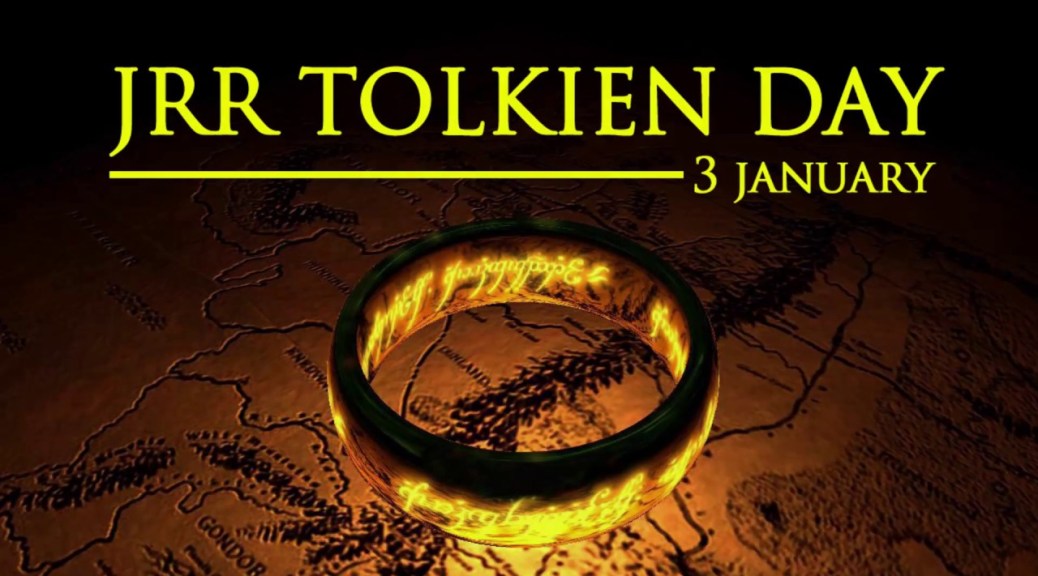
Whether you know the characters of The Hobbit and The Lord of the Rings from the books or movies, you will enjoy celebrating JRR Tolkien Day on Jan. 3
J.R.R. Tolkien Day on January 3 is “The Lord of the Rings” author’s birthday and you’re encouraged to toast him in celebration. You may remember from the story that Frodo toasts his Uncle Bilbo on Bilbo’s birthday every year. Now, over sixty years after the trilogy’s original publication, The Tolkien Society asks fans to honor Tolkien’s birth, which itself was January 3, 1892. Come up with a few words of adulation on your own, or use the official Society phrase: “The Professor!” If you want to celebrate J.R.R. Tolkien Day with a few extra meals in addition to the toast, in true hobbit fashion, Frodo would certainly approve!
History of JRR Tolkien Day
Aside from the fact that “The Hobbit” and “The Lord of the Rings” directly influenced the entire fantasy genre and opened the door for the creativity of writers like David Eddings, Robert Jordan, and Ursula K. LeGuin, among many more, many critics describe Tolkien’s magnum opus as an allegory combining the horrors of World War I with the sweeping societal change of pastoral life’s gradual crumbling under the weight of industrialism. Respectively, think of the sweeping battle scenes in LOTR, and then the hazy summer of the Shire compared with the blighted, tree-bare landscape of Saruman’s domain.
The clash of these opposing worldviews and the way Tolkien masterfully depicted it, amplified by the series of Peter Jackson films and their visual splendor, make it no surprise that the Tolkien Society, founded in 1969, is still around today.
The author interacted with the Society in its early days, his assistant phoning their leadership in 1972 after they sent him a container of top-shelf tobacco in honor of his becoming a Commander of the Order of the British Empire; she said that he’d considered the gift to be the highest honor of the whole to-do.
Of course, it was the Tolkien Society that declared their commitment to publicly celebrate Tolkien’s birthday with a toast each year on January 3. So after breakfast is out of the way, along with “second breakfast” and “elevensies,” lunch, and a puff of Longbottom Leaf, have a friend over and drink to the juggernaut of fantasy fiction. The professor!
HOW TO CELEBRATE J.R.R. TOLKIEN DAY
-
Read the books, or watch the movies or both
The best way to celebrate J.R.R. Tolkien Day is to read one of the classic books. If you’ve never read “The Lord of the Rings” trilogy, that’s a good place to start. Granted, you probably won’t be able to read all three books in one day. So cheat a little and watch one of the movies instead, or if you have the entire day to celebrate, maybe tackle all three!
-
Eat a few extra meals or snacks
Hobbits certainly enjoy a good meal … or half a dozen meals. As the book says, hobbits would “enjoy six meals a day, if they could get them.” And the great thing about these pint-sized powerhouses is that they will eat just about anything that tastes good, so your extra meals can involve just about anything you like: cakes, bread, and ale, it’s all fair game. It’s a good thing hobbits aren’t worried about counting carbs!
-
Work the words “my precious” into every conversation
Gollum may be one of the creepiest characters in all of Middle Earth — heck, maybe in all of literature — but his referring to “the ring” as “my precious” is classic. So spend the day calling everything in sight “my precious”: your wedding ring, your spouse, your vehicle, the stapler on your desk, it doesn’t matter. Just be careful around the edges of any volcanic chasms…
FIVE AMAZING FACTS ABOUT THE FILMING OF THE “RINGS” MOVIES (GG):
-
Taking a hike
Sean Bean, “Boromir” in the films, is deathly afraid of flying, so he took to walking to locations in the early morning, which he had to do in full makeup and costume since there were no tents nor personnel for those things on-site at his destinations.
-
Second fiddle?
Irish actor Stuart Townsend (“Queen of the Damned,” “The League of Extraordinary Gentlemen”) was originally cast as “Aragorn,” and when he was cut loose at the last minute, Viggo Mortensen was chosen, the seasoned actor accepting the role only because of his LOTR-fan son’s pleading.
-
Don’t take your eyes off the screen
Like the late Stan Lee in Marvel Comics movies, writer-director Peter Jackson has cameos in each of the three “Rings” films, and so do each of his children.
-
Moth-man prophecy?
The species of moth used in the shots of Gandalf summoning his insect ally whilst prisoner at the top of Orthanc only lives one day; it was born that morning and died right after the first successful take.
-
“Don’t call me short”
Ironically, John Rhys-Davies, who played the dwarf “Gimli” in the trilogy, was the tallest actor on the set, at six-foot-one.
WHY WE LOVE J.R.R. TOLKIEN DAY
-
It’s a reminder that no obstacle is too tough
The journeys and challenges described in Tolkien’s books are unforgettable for many reasons, but the idea of a group of people working together to complete a goal is just plain inspirational. Perhaps you aren’t doing anything quite as important as saving the world from evil, but that doesn’t mean you can’t benefit from some inspiration in your everyday life.
-
You can discover a new book
Although Tolkien is best known for “The Lord of the Rings,” he wrote several other books (some of them novel-length background stories of “Rings” characters), as well as scholarly papers. Tolkien’s son contributed to and published a few more of Tolkien’s writings after his death. So no matter what, there’s plenty more to unearth.
-
The “little guy” wins
The little guy winning is a common theme in literature. But there aren’t many “littler” guys in books than hobbits. And even though the hobbits in Tolkien’s books don’t really have any uncommon strength or special powers like the wizards and elves do, they still manage to be heroic, making tough choices and saving the day. Observe J.R.R. Tolkien Day by celebrating the victory of the underdog.
Source: JRR TOLKIEN DAY – January 3, 2026 – National Today
My Favorite Book About JRR Tolkien – Info from – wikipedia
Letters from Father Christmas, formerly known as The Father Christmas Letters, are a collection of letters written and illustrated by J. R. R. Tolkien between 1920 and 1943 for his children, from Father Christmas. They were released posthumously by the Tolkien estate on 2 September 1976, the 3rd anniversary of Tolkien’s death. They were edited by Baillie Tolkien, second wife of his youngest son, Christopher. The book was warmly received by critics, and it has been suggested that elements of the stories inspired parts of Tolkien’s The Lord of the Rings.
Plot
The stories are told in the format of a series of letters, told either from the point of view of Father Christmas or his elvish secretary. They document the adventures and misadventures of Father Christmas and his helpers, including the North Polar Bear and his two sidekick cubs, Paksu and Valkotukka. The stories include descriptions of the massive fireworks that create the northern lights and how Polar Bear manages to get into trouble on more than one occasion.
The 1939 letter has Father Christmas making reference to the Second World War,[1] while some of the later letters feature Father Christmas’ battles against goblins, which were subsequently interpreted as being a reflection of Tolkien’s views on the German menace.[2]
Publication
The letters themselves were written over a period of over 20 years to entertain Tolkien’s children each Christmas. Starting in 1920 when Tolkien’s oldest son was aged three,[1] each Christmas Tolkien would write a letter from Father Christmas about his travels and adventures.[3] Each letter was delivered in an envelope, including North Pole stamps and postage marks as designed by Tolkien.[4]
Prior to publication, an exhibition of Tolkien’s drawings was held at the Ashmolean Museum. These included works from The Hobbit, The Lord of the Rings, and the Letters from Father Christmas.[5][6] The first edition was published by Allen and Unwin on 2 September 1976 under the name The Father Christmas Letters, three years after Tolkien’s death. The Houghton Mifflin edition was released later that year on 19 October.[7] It was the third work by Tolkien to be released posthumously, after a collection of poems and the “Guide to the Names in The Lord of the Rings“.[8] Edited by Baillie Tolkien,[9] the second wife of Christopher Tolkien,[1] it includes illustrations by Tolkien for nearly all the letters; however, it omitted several letters and drawings.[10]
When the book was republished in 1999, it was retitled Letters from Father Christmas and several letters and drawings not contained in the original edition were added.[10][11] One edition in 1995 featured the letters and drawings contained in individual envelopes to be read in the manner they were originally conceived to be.[12]
Reception
The reception to the first two works published posthumously had been warm, which was subsequently thought to be due to Tolkien’s recent death. The response to the Letters from Father Christmas was much more measured and balanced.[8] Jessica Kemball-Cook suggested in her book Twentieth Century Children’s Writers that it would become known as a classic of children’s literature,[13] while Nancy Willard for The New York Times Book Review also received the book positively, saying “Father Christmas lives. And never more merrily than in these pages.”[1] In 2002, an article in The Independent on Sunday described the work as rivalling “The Lord of the Rings for sheer imaginative joy”.[3] In 2023, an extract from one of the Letters from Father Christmas was read out by actor Jim Broadbent at the televised ‘Together at Christmas’ carol service in Westminster Abbey on Friday 8 December, broadcast to the nation on Christmas Eve that year.[14]
Influence
Paul H. Kocher, whilst writing for the journal Mythprint, suggested that the creatures in the Letters from Father Christmas may have been a precursor to those which appeared in Tolkien’s later works such as The Lord of the Rings,[15] a view which was shared by Laurence and Martha Krieg in a review in the journal Mythlore (issue #14).[16] For example, the 1933 letter features an attack on Polar Bear by a band of goblins. The Kriegs suggested that the wizard Gandalf may have been developed from Father Christmas.[16]
References
- Willard, Nancy (5 December 1976). “Christmas Letters”. The New York Times. Retrieved 22 November 2012.
- Walsh (2001): p. 63
- “Grand Tours: Who Travels the World in a Single Night?”. The Independent on Sunday. 22 December 2002. Archived from the original on 21 September 2013. Retrieved 22 November 2012.
- “Tolkien’s “Father Christmas Letters””. The New York Times. 7 December 2002. Archived from the original on 16 December 2012. Retrieved 22 November 2012.
- Johnson (1986): p. 136
- Lowe, Ian (13 January 1994). “Gazette: Diana Caithness”. The Independent. Retrieved 22 November 2012.[dead link](subscription required)
- “The Father Christmas Letters”. The Tolkien Library. Archived from the original on 12 January 2013. Retrieved 22 November 2012.
- Johnson (1986): p. 133
- Drew (1997): p. 421
- “Letters from Father Christmas paperback (16.08.09)”. The Tolkien Library. Archived from the original on 26 January 2013. Retrieved 22 November 2012.
- Thompson (2007): p. 11
- “Stocking Fillers”. The Independent. 19 November 1995. Archived from the original on 16 December 2012. Retrieved 22 November 2012.(subscription required)
- Johnson (1986): p. 188
- “Families celebrate Christmas at royal carol service”. Westminster Abbey. 24 December 2023. Retrieved 25 December 2023.
- Johnson (1986): p. 158
- Johnson (1986): p. 159
Sources
- Johnson, Judith A. (1986). J. R. R. Tolkien: Six Decades of Criticism. Westport, Conn: Greenwood Press. ISBN 9780313250057.
- Drew, Bernard A. (1997). The 100 Most Popular Young Adult Authors: Biographical Sketches and Bibliographies. Englewood, CO: Libraries Unlimited. ISBN 9780585176062.
- Walsh, Joseph J. (2001). Were They Wise Men or Kings?. Louisville, Ky.: Westminster John Knox Press. ISBN 9780664223120.
- Thompson, Kristin (2007). The Frodo Franchise: The Lord of the Rings and Modern Hollywood. Berkeley: University of California Press. ISBN 9780520247741.
External links
- “20 Wintery books (for every type of reader)!”. CarolynMarieReads. 10 November 2023 – via YouTube. (mini-review with display of illustrated book from 1:06 to 1:55 in video)

 DAILY DEVOTIONS, NEWS AND INFORMATION