
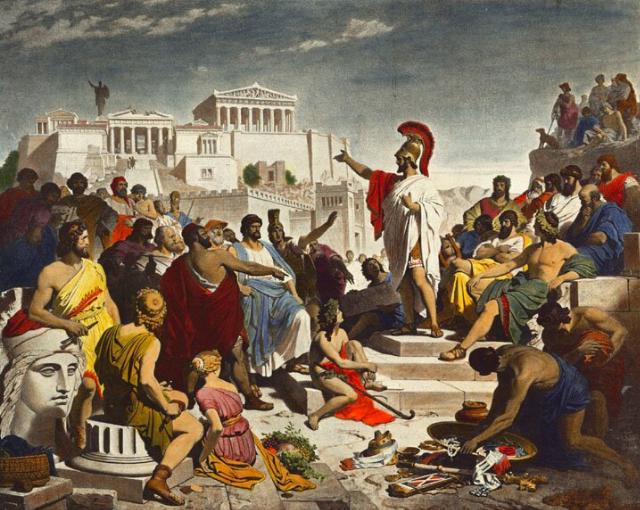
Picture Credit: From Wikimedia Commons: Pericles Gives the Funeral Speech (Philipp von Foltz, 1852)
In periods of civilizational stress, the defining intellectuals are rarely those who echo prevailing orthodoxies. Rather, they are individuals insisting on the legitimacy of first principles when those principles have become unfashionable or even dangerous to articulate. In contemporary Britain, Natasha Hausdorff, Douglas Murray, and Matt Goodwin exemplify this truth-seeking, altruistic calling. Each operates within a distinct professional domain—law, cultural criticism, and political science—yet all share a deeply anti-totalitarian idealism rooted in the defense of liberal democracy against ideological capture. Their engagement is not abstract but personal, involving reputational risk, social ostracism, and sustained public hostility. What unites them is not only dissent, but also a principled refusal to surrender truth, legality or democratic consent to coercive moral narratives.
Natasha Hausdorff’s contribution is distinguished by its juridical precision and moral clarity. As an international lawyer, she confronts one of the most ideologically distorted arenas of contemporary discourse: the legal treatment of Israel. Her merit lies not only in her mastery of international law but also in her insistence that law must remain tethered to evidence, context, and equal standards. In an environment where legal language is routinely weaponized to achieve political ends, her work exposes how selective interpretation and institutional bias corrode the credibility of the legal order itself.
Hausdorff’s anti-totalitarianism manifests in her resistance to what might be termed “normative inversion”: the process by which democratic self-defense is reframed as criminality, while terror, incitement, and authoritarian violence are excused as resistance. This inversion, which includes “victim blaming” at the national level, is not accidental but ideological, sustained by international bodies and NGOs that claim neutrality while advancing a rigid moral hierarchy. Hausdorff’s idealism consists in her refusal to abandon universal legal principles even when doing so would grant her professional safety. By applying the same standards to Israel as to any other state—and insisting those standards be applied universally—she challenges a deeply corrupt system that depends on exception and scapegoating.
The personal courage involved in this stance should not be underestimated. Defending Israel in contemporary legal and academic spaces often entails professional isolation, harassment, and reputational damage. Hausdorff’s willingness to endure these costs reflects a deeper conviction: that the erosion of legal objectivity in one case endangers all liberal democracies. Her engagement is therefore not parochial but civilizational. She understands that when law becomes a tool of ideological enforcement, it ceases to restrain power and instead legitimizes its abuse.
Douglas Murray’s singular merit lies in his capacity to articulate civilizational questions with philosophical depth and rhetorical force at a time when such questions are actively suppressed by mainstream media and academia. His legendary appearance at the Oxford Union twelve years ago became the precursor to numerous daring charges. Time and again, he has taken on Islamists and left-wing celebrities in front of menacing audiences. Importantly, he is not only a shrewd polemicist, who remains calm under pressure, but also a moral diagnostician of Western self-doubt. His anti-totalitarian idealism emerges from his insistence that liberal societies must believe in themselves to remain liberal. Against the prevailing assumption that self-criticism is the highest virtue, he argues that relentless self-denunciation becomes indistinguishable from moral abdication.
Murray’s battleground is primarily cultural. He confronts what might be called the “soft totalitarianism” of consensus enforcement: the informal but pervasive mechanisms by which dissenting views are marginalized without overt coercion. By challenging dogmas surrounding mass immigration, identity politics, and historical guilt, he violates the unspoken rules of acceptable discourse. The ferocity of the response to his work—character assassination, deplatforming campaigns, and persistent misrepresentation—testifies to the power of those rules.
Murray’s idealism is not reactionary nostalgia but a defense of Enlightenment inheritance: reason, individual moral agency, and universal rights. He rejects the reduction of individuals to group identities and resists the moral determinism that excuses behavior based on origin or grievance. This position places him in direct opposition to ideologies that divide society into permanent oppressors and victims, a framework mirroring the propagandistic logic of totalitarian systems even when expressed in therapeutic language.
Crucially, Murray’s engagement is animated by empathy rather than contempt. His unwavering critique of Islamism, for instance, is paired with a compassionate defense of Muslims who seek to live freely within liberal societies. What he rejects is not “diversity” as such but the refusal to draw moral boundaries. His courage consists in naming those boundaries when institutions and elites prefer ambiguity. In doing so, he exposes the paradox of a liberalism unwilling to defend its own conditions of existence. His deep concern is that the West, instead of standing firm on its Judeo-Christian ideals, is giving in to barbarism and thus preparing its own suicide.
Matt Goodwin’s merit is anchored in democratic realism. As a political scientist, he confronts the gap between elite consensus and popular consent, particularly on immigration, national identity, and sovereignty. His anti-totalitarian idealism is grounded in a simple but increasingly radical proposition: that democracy requires listening to voters even when their views are considered “inconvenient.” His work challenges the technocratic assumption that policy legitimacy flows from expertise alone rather than from democratic authorization.
Goodwin’s courage lies in his tireless determination to document and articulate patterns that many academics prefer to obscure for fear of ostracism or collapse of preferred theses. By analyzing electoral data, public opinion, and class realignments, he reveals how large segments of the population have been systematically excluded from meaningful representation. His critics often accuse him of “legitimizing extremism,” yet this accusation itself reflects a totalitarian impulse: the belief that certain preferences are illegitimate by definition and must therefore be managed rather than debated.
What distinguishes Goodwin’s idealism is his refusal to moralize disagreement. He does not portray voters as dupes or villains but as rational actors—fellow citizens with a claim to respect in that very capacity—responding to lived experience. In doing so, he restores dignity to democratic participation. This stance is costly in an academic environment increasingly aligned with activist (and, occasionally, extremist) priorities. Professional sanction, media hostility, and institutional marginalization (cancellation) are familiar risks for scholars who deviate from progressive orthodoxy. Goodwin accepts these risks as the price of intellectual honesty.
Taken together, Hausdorff, Murray, and Goodwin exemplify different dimensions of liberal, anti-totalitarian resistance. Hausdorff defends the integrity of law against ideological capture; Murray defends cultural confidence against moral coercion; Goodwin defends democratic consent against technocratic paternalism. Their idealism is not utopian but grounded in institutional realism. Unlike utopians, they do not imagine a conflict-free society, but they insist that conflict must be governed by rules, reason, and accountability rather than by intimidation or narrative dominance.
Hausdorff, Murray, and Goodwin have not spared themselves in the never-ending fight for justice. What makes the engagement of these three individuals particularly significant is that it occurs within liberal democracies that deny any resemblance to totalitarianism. Yet totalitarian tendencies rarely announce themselves openly. They emerge through the normalization of double standards, the stigmatization of dissent, and the substitution of moral certainty for empirical inquiry. Each in their own way, Hausdorff, Murray, and Goodwin recognize these patterns and refuse to accommodate them, even when accommodation would be personally advantageous.
The courage of those three modern heroes is therefore not performative but structural. It consists in sustained engagement over time—under conditions of persistent pressure. They do not retreat into irony or detachment but remain publicly accountable for their arguments. In doing so, behaving like true students of Socrates, they uphold a model of intellectual citizenship that is increasingly rare: one that treats truth as an honorable responsibility rather than a (narcissistic) posture.
Ultimately, the significance of Hausdorff, Murray, and Goodwin lies not only in the positions that they defend but also in the example that they set. They demonstrate that idealism need not be naïve, that realism need not be cynical, and that courage remains possible even in environments intrinsically hostile to independent thought. Their work reminds us that liberal democracy is not self-sustaining. It survives only so long as individuals are willing to defend its principles against both overt enemies and internal corrosion. In that defense, these three individuals stand as serious, if controversial, guardians of a fragile inheritance.
February 12, 2026
original article located here has Audio Play feature so that you can listen to the article;
 DAILY DEVOTIONS, NEWS AND INFORMATION