
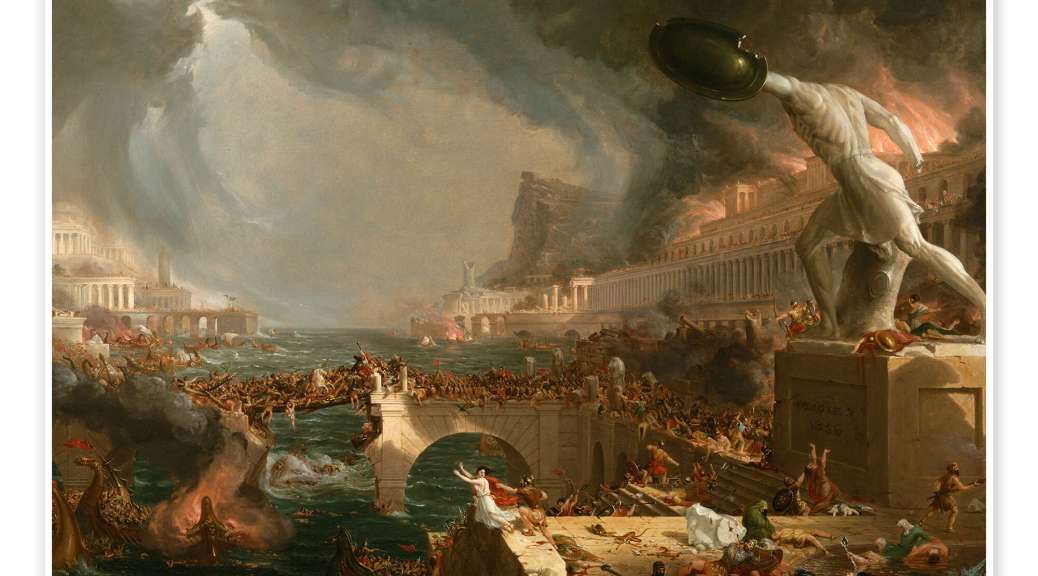
Parallels between the fall of Rome and the looming collapse of the modern West.
Western Europe, traditionally viewing itself as the cultural and institutional heir to Greco-Roman antiquity, confronts anxieties reminiscent of the late Roman experience.
The Western Roman Empire did not collapse suddenly or for a single reason; rather, it disintegrated through the cumulative interaction of internal fragility and external pressures. In a comparable manner, contemporary Europe and its cultural extensions are facing demographic imbalance, institutional erosion, cultural exhaustion, and sustained migratory pressures. While historical analogy should be applied cautiously, the parallels between late antiquity and the present are striking enough to warrant closer scrutiny.
Historians have debated Rome’s fall for centuries, attributing it variously to barbarian invasions, economic stagnation, overextension, corruption, climate fluctuation or epidemic disease. Modern scholarship prefers “multi-” to “unicausality.” Thus, Rome fell because its political, demographic, economic, and cultural systems insidiously eroded, decreasing resilience in the face of external shocks. In a civilizational perspective, the modern West appears vulnerable along four analogous dimensions: (a) large-scale migration, (b) demographic decline among native populations, (c) cultural decadence or exhaustion, and (d) the erosion of core institutions. If these trends continue unchecked, the foundational achievements of Western civilization—constitutional governance, individual liberty, and the rule of law—may suffer irreparable damage.
The Western Roman Empire saw a “civilian invasion” reflecting extensive population movements during the Migration Period (c. 300–600). Not so much as raiders as displaced populations seeking security, land, and opportunity, migrating tribes—Visigoths, Ostrogoths, Vandals, Franks, and Saxons—crossed the eastern border (Limes). Incursions by Huns and other nomadic groups further destabilized border regions. At the same time, the capacity of Roman legions to repel migrants decreased. The Rhine crossing of 406 symbolized the breakdown of Roman border control, culminating in the sack of Rome in 410 and the deposition of Romulus Augustulus, the last emperor, in 476.
Westward migrations were never inherently aggressive. In fact, barbarians admired Roman civilization, determined to enjoy the benefits of order and prosperity. However, Rome’s internal challenges—political instability, reliance on foederati, and erosion of military discipline—meant that integration increasingly failed. Autonomous power structures emerged by default, Roman law lost authority, and imperial cohesion dissolved. What proved fatal was not “diversity” as such, but state inability to assimilate newcomers into a shared civic and legal culture, defining and transmitting a unifying identity.
Contemporary Europe experiences demographic transformation through sustained mass immigration, particularly from regions whose indigenous populations—Christians and Jews—have been persecuted and oppressed by Muslims since the seventh century. As of the mid-2020s, the latter constituted approximately 6% of Europe’s population, with projections varying widely depending on migration and fertility trends. A reflection of deeply entrenched dogmatism in the diasporic ummah, security services have documented disproportionate involvement of immigrants in terrorist activity. These realities place strain on intelligence, policing, and social cohesion, analogous—though not identical—to the external pressures experienced by Rome when its borders gave way.
Demographic decline constituted a critical internal challenge in late Rome. From the late Republic onward, elite fertility rates fell sharply. Augustus attempted to reverse this trend through the Lex Iulia (18 BC) and Lex Papia Poppaea (9 AD), which incentivized marriage and childbirth. Despite these measures, economic burdens, urbanization, inheritance practices, and changing social norms limited success. Recurrent epidemics—most notably the Antonine Plague (165–180)—accelerated the population reduction, contributing to labor shortages and military vulnerability.
Contemporary Western societies face comparable demographic challenges. Fertility rates across Europe and North America remain well below replacement level. Scholars identify multiple causes: secularization, delayed family formation, economic insecurity, and the prioritization of individual autonomy over collective continuity. Immigrant populations normally exhibit higher fertility, gradually reshaping demographic profiles.
Douglas Murray’s argument in The Strange Death of Europe (2017) centers on this demographic asymmetry, a looming collapse that both presupposes and aggravates a loss of cultural self-confidence. Rather than holding immigration solely responsible for decline, he emphasizes what he sees as elite reluctance to articulate or defend Western cultural norms, compounded by historical guilt. While critics fault him for “selective evidence”, his central claim—that demographic decline among native populations weakens societal continuity—is broadly supported in demographic literature. Importantly, he refuses to assert demographic “replacement” as an inevitable biological process, identifying a political and cultural failure of integration and confidence.
Rome’s own demographic weakness forced reliance on barbarian recruits and settlers, altering the composition and loyalty of its institutions. Population reduction thus became not only a numerical problem but also a structural one, undermining resilience and continuity.
In The History of the Decline and Fall of the Roman Empire (1776–1788), Edward Gibbon famously attributed Rome’s fall in part to moral decline, though modern historians interpret “decadence” less as hedonism than as institutional complacency. Much as Roman elites indulged in luxury, the deeper issue lay in decreasing civic engagement, economic rigidity, and dependence on coercive bureaucracy. Citizens disengaged from public responsibility, content with state provision of entertainment and sustenance.
In the modern West, cultural decadence manifests less through excess than through relativism and institutional self-doubt. Universities, once guardians of intellectual tradition, prioritize ideological conformity over scholarly rigor. Critics argue that identity-based frameworks displace universalist inquiry, eroding shared academic foundations. Addressing overall trends, commentators such as Eric Zemmour contend that multiculturalism undermines social cohesion—a claim with historical precedent in Rome’s gradual cultural fragmentation.
A particularly vivid symptom of this cultural exhaustion is the widespread iconoclasm directed at symbols of Western heritage by younger generations. Following the 2020 Black Lives Matter protests, activists—typically university students and indiscriminate hooligans, as ideologically uncompromising as historically ignorant—toppled or defaced statues of figures like Christopher Columbus in Boston and Minneapolis, Edward Colston (a slave trader) in Bristol, and even Founding Fathers such as George Washington and Thomas Jefferson, whose legacies include slavery despite their roles in establishing freedoms. In Portland, statues of Abraham Lincoln and Theodore Roosevelt were pulled down amid accusations of racism towards Native Americans.
Similar actions targeted colonial-era monuments in Europe, including those of King Leopold II in Belgium. Proponents view these acts as “reckoning” with historical injustices, removing glorification of oppression from public spaces. Yet critics, including Murray, see them as manifestations of profound self-loathing: a rejection of the West’s complex inheritance, where imperfect figures advanced enlightenment values, rule of law, and the individual rights underpinning modern liberty.
This turning against one’s own civilizational symbols echoes Rome’s late-era apathy towards its proud traditions. By denying pride in ancestors who, flaws notwithstanding, forged a heritage of freedom and innovation, young Westerners risk forfeiting their birthright to a confident future. Masochistic gestures do not erase history but signal a tragic reluctance to defend or transmit it, leaving societies vulnerable to invasion—just as Rome’s loss of cultural assertiveness proved fatal amid external pressures.
Cultural exhaustion erodes the willingness to defend inherited norms. As Rome’s citizens increasingly avoided military service, contemporary Western societies exhibit decreasing civic participation and trust. This erosion does not destroy societies immediately, but renders them vulnerable to disciplined ideological movements, whether Islamist or Marxist.
Institutional decline ultimately sealed Rome’s fate. The third-century crisis exposed systemic fragility: rapid imperial turnover, fiscal collapse, and military mutiny. Diocletian’s reforms delayed collapse but entrenched bureaucracy and authoritarianism. The permanent division of the empire in 395 weakened the West irreversibly. By the fifth century, taxation crushed agricultural productivity, trade plummeted, and law receded.
Parallels in the modern West include decreasing trust in democratic institutions, polarization, and executive overreach. Secularization has left a moral vacuum, with Christianity’s social influence waning sharply across Europe. While profane governance is not invariably destabilizing, the loss of shared metaphysical assumptions complicates social cohesion. In America Alone (2006), Mark Steyn’s warnings of civilizational decline—predictably criticized for “alarmism”—underscore the risks of institutional fragmentation and cultural disunity.
The fall of Rome inaugurated centuries of economic regression and cultural contraction in Western Europe. While history never repeats mechanically, it may rhyme. The modern West is caught in an identity crisis. Renewal remains possible, as demonstrated by Byzantium’s example, but only through deliberate reaffirmation of demographic vitality, institutional integrity, cultural confidence, and moral purpose. Rome’s lesson is not that decline is inevitable, but that neglect ensures it.
February 22, 2026
 DAILY DEVOTIONS, NEWS AND INFORMATION