
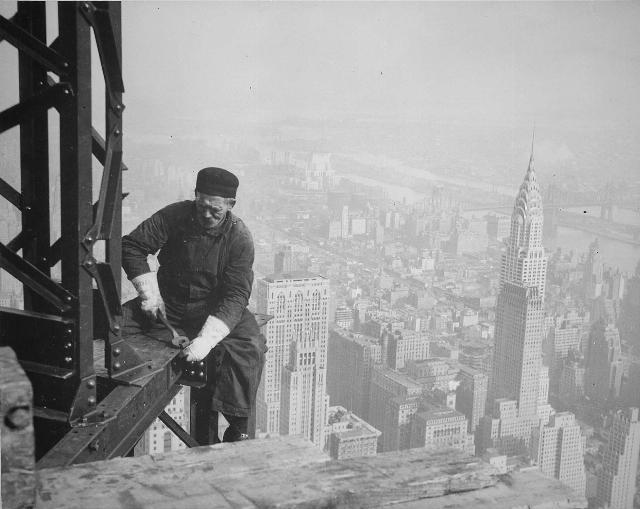
Graphic: Photograph of a Workman on the Framework of the Empire State Building. National Archives and Records Administration. Public Domain.
To restore the American mind, we must first restore the American hand
In every age, a nation reveals its true priorities not by what it proclaims, but by what it preserves. Today, as American education drifts further into abstraction—into identity, narrative, and self-construction—one domain remains stubbornly anchored to reality: the trades.
Here, in workshops and training yards, in welding bays and engine rooms, a different philosophy endures. It is older than the university, older than the credential, older even than the republic itself. It is the philosophy of making—of confronting the world not as an idea to be interpreted, but as a force to be engaged.
The modern educational system has largely abandoned this philosophy. Over the past several decades, vocational training was quietly demoted, then stigmatized, and finally displaced. The message was clear: success lay not in building, but in credentialing; not in mastering a craft, but in acquiring a degree. High school shop classes disappeared. Apprenticeships faded. The transmission of practical knowledge—once passed from hand to hand, from generation to generation—was broken.
In its place arose a new model of advancement: one centered not on competence, but on presentation. Students are now trained to curate themselves—to assemble identities, narratives, and affiliations that signal value within institutional frameworks. The question has shifted from What can you do? to How can you position yourself?
But reality has not changed its terms.
This is why the trades have become something more than a career path. They have become a refuge—a last institutional bastion where truth is still enforced by the material world itself.
It is precisely this confrontation with reality that produces the qualities once associated with American know-how: precision, discipline, resilience, and self-reliance. These are not abstract virtues. They are forged through repeated engagement with resistance—through trial, correction, and eventual mastery.
Today, much of that ecosystem has eroded. Regulatory complexity, economic consolidation, and cultural shifts have reduced the number of pathways through which practical knowledge can be transmitted. In many places, trade schools now serve as the primary remaining institutions where these skills are taught in a structured and accessible way.
At the same time, the broader economy is beginning to reveal the consequences of their decline. Employers across multiple sectors report persistent shortages of skilled labor. Technical roles go unfilled. Projects are delayed. Costs rise—not because demand has vanished, but because competence has become scarce.
This scarcity is not accidental. It is the result of a system that has systematically deprioritized the development of real-world skills in favor of more easily measured and more easily signaled attributes.
And yet, there are signs of reversal.
A growing number of students are turning away from the traditional college path, not out of rejection of learning, but out of recognition that the promised return on credentialing has weakened. Rising tuition costs, coupled with uncertain job outcomes, have forced a reevaluation. Trade programs are experiencing renewed interest. Wages in skilled trades are rising. A new generation is rediscovering the dignity and utility of work that produces tangible results.
This shift reflects more than economic calculation. It reflects a deeper correction—a reordering of priorities.
In a culture increasingly oriented toward identity and narrative, the trades stand as a reminder that some domains remain governed by objective constraints. They reintroduce a simple but powerful standard: reality itself.
This standard has implications beyond employment. It speaks to the health of society as a whole.
A nation that loses its capacity to build—literally and figuratively—loses more than productivity. It loses its grounding. It becomes dependent, fragile, and increasingly detached from the conditions that sustain it. Conversely, a nation that cultivates competence strengthens its resilience. It restores a connection between effort and outcome, between knowledge and function.
This is not an argument against intellectual life, nor against the study of history, philosophy, or literature. The great texts that Allan Bloom sought to revive still matter. They illuminate the human condition, sharpen judgment, and provide a framework for understanding the world.
But they cannot substitute for the ability to act within that world.
The restoration of American education will not come from choosing between thought and skill, but from reintegrating them—anchoring intellectual development in practical competence and grounding abstract reasoning in real-world application.
The trades, in their current form, offer a model of that integration. They demand both understanding and execution. They reward not what is claimed, but what is demonstrated. They cultivate individuals who are accountable not to narrative, but to result. In this sense, they represent more than an educational pathway. They represent a philosophical corrective. They restore a hierarchy in which competence is not secondary, but foundational. In doing so, they preserve something essential—not just for the workforce, but for the nation itself.
Even the most celebrated figures of the digital age emerged not from the culture of credentialing, but from the culture of making. Bill Gates wrote code before institutions could define him. Mark Zuckerberg built systems that had to function or fail in real time. Elon Musk forced ideas through the discipline of physics, where rockets either launch or explode.
None advanced through narrative. They advanced through reality. The tools have changed—but the law has not. The digital veneer of the branding age is thin, and the ‘fiat identities’ we have minted are already devaluing in the marketplace of reality. We cannot narrate our way out of a crumbling bridge or an unstable power grid. In the end, a civilization is not remembered for the stories it told about itself, but for the stone it laid and the steel it tempered.
To restore the American mind, we must first restore the American hand. When we teach a child to build, we are not just giving them a career; we are giving them a tether to the truth. A nation that forgets how to build will eventually forget how to stand, but a nation that masters the material world secures its place in history. The tools change, but the law remains: we are what we create, not what we claim.
March 19, 2026
 DAILY DEVOTIONS, NEWS AND INFORMATION
