

Category Archives: Charles Stanley

Charles Stanley – Can We Trust Our Conscience?


2 Corinthians 1:12

The conscience looks at thoughts and actions to determine if they are in line with a person’s principles. It is important to keep our internal monitoring system well maintained so it will be trustworthy. For our moral alarm to sound at the right time and for the right reason, we must:

Accept Scripture as our standard for behavior. 2 Timothy 3:16 says, “All Scripture is inspired by God and profitable for teaching, for reproof, for correction, for training in righteousness.” If we choose to adopt our culture’s values, which are often at odds with the Lord’s, our conscience will be unreliable. Instead, we want our radar to alert us to the possibility of going off course.

Align our thinking with the Lord’s. Romans 12:2 says to renew our minds. It is necessary and ongoing work to combat what this unbelieving world accepts as true and right.

Apply God’s Word to daily living. When our habits reflect godly values, our conscience will become more sensitive to what is right and wrong.

In addition, it is essential that we rely on the Holy Spirit for understanding. Our conscience by itself is of some usefulness, but it becomes indispensable when accompanied by the Spirit’s guidance (John 16:13).

The Scriptures teach us how to live—with regard to our thought life, conduct, and emotions. As we fill our mind with the Lord’s standards and wisdom, our conscience will become increasingly trustworthy because it is based on what’s important to our heavenly Father.

Bible in One Year: Ecclesiastes 1-4
 

http://www.intouch.org/

Charles Stanley – The Value of Our Conscience


1 Timothy 1:18-19

The conscience is God’s early warning system for alerting us to potential danger. It monitors our emotions, thoughts, and conduct.

Think of the conscience as a radar system that notifies us of possible trouble, usually without specifically identifying the problem. The principles and standards that we hold determine the sensitivity of our conscience. For example, if we believe lying is wrong, an alarm will sound when we start to shade the truth. But if we think lies are justifiable, it will be silent.

When programmed with the truth of God’s Word, the conscience has great value for a Christian. It detects deviations from the Lord’s standards and sends out a warning. The Holy Spirit uses that signal to get our attention. Then He will reveal what the problem is, give us understanding about it, and show us the right choices to make. He may guide us to friends, relevant Scripture verses, or other resources that can shed light on our situation and point out the implications of a wrong choice.

Failure to heed our inner alarm can bring serious consequences. Adam and Eve knew what God expected (Gen. 2:15-17). When tempted, however, they ignored their conscience and sinned against Him.

When your conscience sounds the alarm, do you stop and take notice or continue on the same course? Repeatedly ignoring your internal warning system can decrease its effectiveness at keeping you out of trouble. Ask God to help you program your inner alarm with His truth and sharpen your ability to hear it.

Bible in One Year: Proverbs 29-31


http://www.intouch.org/

Charles Stanley – When We Cry Out to God


Psalm 57:1-3

When you face a crisis, what is your first line of defense? The natural response is to attempt to fix the problem on your own. God, however, gives us a different way to handle difficulty.

David was no stranger to pressure or sudden appearances of evil. When he wrote Psalm 57, he was facing many hardships—including pursuit by King Saul, who wanted to kill him (1 Samuel 24:1-22). The shepherd’s response was to cry out to God and take refuge in Him until the calamity had passed.

Let’s learn from David’s example by exploring his words. Today’s passage has much to teach about the One to whom he cries.

First, David refers to God as El Elyon, or the Most High God. With all power and wisdom, He is the only one who can help us in our need.

Second, God is said to be our refuge. If He is a place of shelter for our soul, then we need not fear. He hovers over us and protects us when crises arise and leave us feeling helpless.

Third, the psalm expresses complete confidence that the Almighty can and will accomplish anything it takes for His purpose to be fulfilled. He’ll do whatever is necessary to intervene on our behalf, to hold accountable those who oppose us, and to surround us with His love and truth.

During His time on earth, Jesus brought great passion to His life and ministry . Therefore, we can approach Him when emotions run high. If your heart is troubled, cry out to the Lord. Know that you come before the throne of Him who is a powerful protector, capable and willing to do all you need.

Bible in One Year: Proverbs 26-28


http://www.intouch.org/

Charles Stanley – Unshakeable Foundation


2 Peter 3:10-13

With each passing year, the instability in the world seems more and more apparent. Natural and man-made catastrophes claim lives; political balance shifts; wealth and status come and go. It all causes us to ask, Is anything unshakeable?

As overwhelming as these things seem, let me give you an even bigger example. In today’s passage, we read that the heavens and earth will be shaken. It will all be destroyed—burned, to be exact. Thankfully, we have the promise that God will create new heavens and a new earth, but in the meantime our world will undergo great turmoil.

Instability can create feelings of insecurity and fear unless we latch onto the truths God has given us. The Bible refers to Jesus as a rock and firm foundation (1 Corinthians 3:10-11; Eph. 2:20). And we know that God is unchangeable and sovereign; nothing can undermine or move Him. His Word is truth, and it will last forever.

As Christians, we know that our eternal relationship with God is secure. We’ve been adopted as His children, and nothing can rob us of this position. What’s more, believers are assured of an eternal home with Him. Though we may at times feel unsettled by our circumstances, we can rejoice when trials bring us humbly to the cross of Jesus, where we will find peace and safety.

What assurance we have as God’s children! We can rest in peace and full confidence, knowing that our hearts are secure in Jesus Christ. As King David said in Psalm 16:8, “I have set the Lord continually before me; because He is at my right hand, I will not be shaken.”

Bible in One Year: Psalm 79-84


http://www.intouch.org/

Charles Stanley – Things That Cannot be Shaken


Hebrews 12:25-29

In general, people like security. We seek what is comfortable. Yet the reality of our world is that much instability exists. For example, finances, health, and even a country’s ability to survive are not guaranteed.

When our foundation is shaken, we often feel overwhelmed. Sometimes Satan causes the difficulty—with God’s permission, of course. At other times, challenging circumstances are brought about by the Lord’s hand. Regardless of the source, we have the promise in Romans 8:28 that “God causes all things to work together for good to those who love God, to those who are called according to His purpose.” And in either case, the Almighty’s purpose remains: to glorify Himself in our world and in our lives.

There are different reasons that the Lord permits turmoil, but for now, let’s focus on one: He will not allow anything that enables man to seem self-sufficient in his own eyes. Therefore, God may lovingly allow enough trouble for us to realize our need of Him. Consider the trials the Israelites faced each time they turned away from the Lord to worship other gods. In many ways, we do the same thing today. Individually, in our churches, and as a nation, we often glorify “gods” like money or status. But the One who created us will not tolerate this.

In our pride, we tend to think we’re able to manage without God. But out of love, He may stir up our life to reveal our dependence upon Him. If you are basing your security on anything except Jesus Christ—even something as seemingly innocent as comfort—it will prove to be sinking sand.

Bible in One Year: Psalm 76-78


http://www.intouch.org/

Charles Stanley – Jesus Identifies With Our Needs


Hebrews 4:14-16

We often forget that during His stay on earth, Jesus experienced need just as we do. Although Christ was fully God, He was at the same time completely human, with all of humanity’s weaknesses and shortcomings. Though He didn’t sin, He identified with our suffering.

When Jesus had finished a 40-day fast in the wilderness, He experienced physical hunger and an onslaught of temptation from the devil (Matt. 4:1-2). Later, after an exhausting day of healing people and feeding a crowd of more than 5,000, the Son of God required time alone with His Father for spiritual strength and refreshment (Matt. 14:23). And in the Garden of Gethsemane, Christ was under tremendous spiritual and emotional pressure as He faced the daunting task of paying for the sins of mankind through His death on a cross (Matt. 26:38-39).

In each weakness, Jesus turned to His Father. The Word of God was His defense in temptation, prayer was His source of strength for ministry, and submission to the Father’s will was His pathway to victory over sin and death. By passing through every difficult situation without sin, He became our Great High Priest, who intercedes for us and invites us to draw near to God’s throne for help in time of need.

Whatever your needs may be, you can follow Christ’s example and experience the Father’s provision. The Word of God is your protection, prayer is your strength, and submission to the Father is the way to victory over sin. Draw near with confidence, and let the Lord shower you with His grace.

Bible in One Year: Psalm 71-75


http://www.intouch.org/

Charles Stanley – Sharing the Good News


Romans 10:8-17

Can you imagine filling a ship with precious cargo and launching it into the sea, only to watch it repeatedly dock without offloading anything? I imagine silent Christians are much like this ship. God has personally blessed believers with salvation and eternal life and entrusted to them the message of the gospel, yet too few of His children are willing to share with others the good news of salvation in Christ.

What causes us to stay silent? We know that Jesus has commanded us to go and make disciples (Matt. 28:18-20). Furthermore, He has assured us that we will be empowered by His authority and presence with us. God is offering the invitation of salvation to “whoever will call on the name of the Lord.” He has even made it clear that our communicating the good news is the means by which people will come to saving faith (Rom. 10:13-14).

Sometimes Christians who don’t share their faith defend that choice by saying, “My faith is private. It’s between me and my God.” But that is not the model we see in Scripture. Genuine faith is confessed with the mouth and shared with the world.

Every believer has been entrusted with the good news of salvation through Christ. It is unquestionably the single most important piece of information we have, because it offers the only door to heaven. In John 14:6, Jesus said, “I am the way, and the truth, and the life; no one comes to the Father but through Me.” We have to courageously step forward in faith, be willing to set aside worldly concerns, obey God, and tell someone about Jesus.

Bible in One Year: Psalm 44-49


http://www.intouch.org/

Charles Stanley – Dying to Serve: A Parable


John 12:23-26

Imagine two grains of wheat lying on the floor of a warm and cozy barn. One day, the farmer comes in and tells them, “I want to take you out of this comfortable barn and plant you in the earth. I’m going to place you in the cold ground and cover you with soil. It will be dark, and you will die. But I promise that you will multiply and become very fruitful.”

The first grain of wheat turns down the suggestion. “No way!” he says. “Count me out. I like my comfort, and I don’t want to die.” But the second one, after carefully considering the pain and discomfort of dying, decides the promise of a future harvest is worth the sacrifice. So the farmer takes him outside and plants him in the ground, while allowing the first grain of wheat to remain inside the barn.

A few days later, a small green sprout begins to appear over where the seed has been planted. Then it grows and becomes a tall stalk of wheat that produces one hundred more grains. For the next 40 years, the farmer plants all the seeds that originated from that first grain of wheat, and year after year the harvest multiplies. Meanwhile, the grain of wheat that stayed in the barn remains there all alone, never growing or multiplying—but he has stayed very comfortable.

Which grain of wheat are you? Are you playing it safe, or have you let Christ plant you in the world? The only way you’ll become useful and fruitful in God’s kingdom is by abiding in Him and trusting that His desires for your life are worthwhile.

Bible in One Year: Psalm 39-43


http://www.intouch.org/

Charles Stanley – Healing for Inferiority


Ephesians 3:14-21

The world bombards us with messages that can trigger feelings of inferiority. Happiness and satisfaction are promised if we will only drive the latest car, wear the newest styles, or build up those muscles while shedding pounds. If we do not guard ourselves from commercialism, it will drive the truth of God from our mind, and we will pursue a fruitless search for adequacy and value.

So often we look at externals to prove to ourselves and others that we’re valuable. Or we think, If only I were better-looking, richer, or smarter, I would be accepted and esteemed. It’s not wise to let others’ opinions and standards determine our feelings about ourselves; the only accurate assessment of our worth comes from looking into the eyes of the One who loved us enough to die in our place.

Paul told his readers that true significance comes from knowing and understanding the full dimensions of God’s love for them. This knowledge is our anchor when feelings of worthlessness overwhelm or failures tempt us to berate ourselves and withdraw in defeat. Notice that the Lord doesn’t say He’ll give us all the qualities and possessions we think will overcome our sense of inferiority. Instead, He promises to strengthen us “in the inner man” (Eph. 3:16).

God is “able to do far more abundantly beyond all that we ask or think,” but His method is to work from the inside out, “according to the power that works within us” (Eph. 3:20). If you struggle with feelings of inferiority, ask God to heal your soul by doing a great work within.

Bible in One Year: Psalm 1-7


http://www.intouch.org/

Charles Stanley – Feelings of Inferiority


Ephesians 2:10

Early in my life, I experienced some feelings of inferiority. Because we struggled financially, my mother and I didn’t live in the “right” places, and I didn’t wear the “right” clothes. Even in school, I felt that I did not measure up academically to the other kids. The sense of failure and embarrassment at not being good enough was devastating to me.

The misery of inferiority is never what God intends for His children. Its seed usually takes root in the impressionable hearts of the young and thrives in an atmosphere of comparison. This kind of emotional baggage can have debilitating and enslaving ramifications in every area of life. Feelings of inadequacy may cause avoidance of healthy challenges; low self-esteem cripples personal relationships; and comparison steals contentment.

We need to understand how God sees us. Then, when feelings of inferiority come, we can cling to His accurate assessment rather than our own faulty one. He says we are His workmanship—His masterpieces. Each person is thoughtfully designed by the Creator for His purpose. The differences that cause us to make comparisons and feel discouraged are the very qualities that the Lord created to bring Him glory.

Feelings of inferiority are a hindrance to becoming the people that the heavenly Father designed us to be and a deterrent to fulfilling His purpose for our lives. When it comes to our value, we either accept the truth of His appraisal or decide not to believe Him and instead rely on our own feelings. What will your choice be?

Bible in One Year: Job 39-42


http://www.intouch.org/

Charles Stanley –Does God Want You to Succeed?


Proverbs 16:1-3

Is success a legitimate goal for believers? Is this something God wants for His children? The answers depend upon your definition of success. Many people define it as the achievement of wealth, prominence, or fame. If that’s what you’re seeking, then you are following the world’s definition, not the Lord’s.

In His eyes, true success begins internally—the first step is a relationship with Jesus, whereby you have trusted Him as Savior and are following Him obediently. His goal for you is ongoing growth in Christlike character and spiritual maturity, but that’s not all. He also has some work for you to accomplish here on earth (Eph. 2:10). God planned these tasks specifically for you and designed them with your personality, talents, abilities, and spiritual gifts in mind. You could think of them as your unique calling and responsibility in life.

Genuine success involves doing what the Lord has called you to do, not just occasionally but continually. It has to do with persistence rather than perfection. When this is your definition of success, you can know that the Lord wants you to succeed. And He’s committed to helping you become the person He designed you to be—and to accomplish the goals He’s set for you.

The ultimate evaluation of our success will take place when we stand before God and give an account of our life (Rom. 14:12). Any self-centered earthly achievements will be left behind. But if we’ve lived by His definition of success, our treasure will await us in heaven—along with the words “Well done!”

Bible in One Year: Job 13-16


http://www.intouch.org/

Charles Stanley – Following in Christ’s Footsteps


Matthew 10:24-42

Much of Christianity has a distorted view of discipleship. In our desire to see more people come to Christ, we may be guilty of offering a gospel that emphasizes the benefits of following Jesus while avoiding any mention of the cost involved.

However, Jesus didn’t shy away from speaking truth. He let people know that being His disciple would not be easy, because they’d be following in His footsteps. Since Christ didn’t sail through life without challenges, why should we? Our goal should be to become like our Savior, and that means we must be willing to suffer to one degree or another.

Contrary to what many contemporary sermons suggest, following Jesus may not make your relationships better. It could become a source of contention because a true disciple’s love, devotion, and loyalty to Christ supersedes every other relationship. If what a friend or family member desires contradicts what the Lord has commanded, then the choice must be to follow Christ rather than a loved one.

As Christians, we’ll frequently be tempted to compromise in order to avoid misunderstanding, criticism, rejection, or persecution. But as Christ’s followers, we are called to live a crucified life—and compromise undercuts the wholehearted nature of crucifixion. We cannot pursue the acceptance of the world and at the same time follow the Lord. Until we stand with both feet on the side of obedience, we forfeit assurance of God’s peace and blessings.

Although discipleship is costly, the reward is great. Jesus promises to confess us as His own before God when we enter our heavenly home.

Bible in One Year: Job 9-12


http://www.intouch.org/

Charles Stanley –The Cost of True Discipleship


Luke 14:25-35

Unlike many churches today, Jesus was never interested in gathering crowds, nor did He make His message more appealing in order to gain a larger following. In fact, He consistently emphasized the high cost of discipleship instead of making it easy for people to follow Him halfheartedly. That’s because His goal was to make true disciples who were totally committed to Him—and this is the same charge He gave us in the Great Commission (Matt. 28:19-20).

In contemplating what makes up the essence of a human being, we might think of an individual’s life, relationships, and possessions. Yet Jesus demanded that His followers surrender all three. In Luke 14, the Lord taught that to be His disciple, a person could not …

Love anyone more than Him (Luke 14:26). When Jesus used the word translated as “hate,” He wasn’t advocating animosity toward family members. Rather, He was emphasizing a commitment to place Him before any human relationship.

Love one’s own life more than Him (Luke 14:26-27). The image Christ used was that of carrying a cross. This symbolized death to our former sinful lifestyle and, if necessary, a willingness to die in order to remain faithful to Him.

Be unwilling to give up all possessions (Luke 14:33). This doesn’t mean we must live as paupers, but we should hold everything loosely, knowing that we are merely stewards of whatever God has entrusted to us.

None of us can fully live up to Jesus’ call. But by His grace, we can commit to Him all that we are and all that we have. This should be the mindset of those who enter through the narrow gate to eternal life (Matt. 7:13-14).

Bible in One Year: Job 1-4


http://www.intouch.org/

Charles Stanley – Living by Our Convictions


Romans 14:22-23

Have you ever had to take a stand against a barrage of opposing opinions in order to be true to Christ? Or has a group of friends or coworkers ever wanted to cut corners or participate in a sinful activity—and you were the only one saying no? When the godly voice is outnumbered, it can be challenging to speak up for righteousness.

We all have convictions that define who we are and determine our lifestyle and choices. We may like to think that these are a private matter, but in reality, they are constantly on display for all to see. That’s because we live them out each day with our words and actions.

Since convictions have a powerful influence, we should examine what ours are saying about us. Are they leading us to a righteous life in accordance with God’s will, or are they so weak that our life is dominated by the old fleshly nature?

God has given us principles from His Word to guide, protect, and help us lead godly lives. These standards are like guardrails that keep us from veering off track when temptations beckon. By holding firmly to these convictions, we follow a path that fits our identity in Christ. Instead of going along with the crowd, we’re to walk in God’s will and abstain from the sins that surround us in the world.

The time to establish our convictions is before we face temptations, not in the midst of them. We need solid, immovable biblical principles to shape what we believe and how we live.

Bible in One Year: Esther 6-10


http://www.intouch.org/

Charles Stanley – Following Our Convictions


Acts 4:1-20

Most of us have been blessed to live relatively free from persecution. We may have experienced some mocking, ridicule, or ostracism because of our beliefs, but we don’t have to fear punishment or death. However, that’s not the case elsewhere in the world. There are Christians in other countries for whom today’s passage is all too familiar.

Acts 4 tells us that Peter and John faced great opposition for their faith. After being thrown into jail for healing a sick man, they were warned not to speak or teach in Jesus Christ’s name. But they held firmly to their convictions and replied, “Do you think God wants us to obey you rather than him? We cannot stop telling about everything we have seen and heard” (Acts 4:19-20 NLT).

Our goal as believers is to become unshakeable in our faith. Peter and John didn’t flinch from their responsibility to proclaim salvation in Jesus’ name, even in the face of imprisonment and threats. Yet in reading this account, we may wonder how we could ever endure persecution.

The truth is that in ourselves, we can’t do it. But we are never alone. When we stand for our convictions, God’s Spirit is always present in us. He gives us the physical, spiritual, mental, and moral strength to stand firm when we are tested and tried (Luke 12:11-12).

God wants His children to trust Him with the future; He doesn’t want us becoming panicky about what may lie ahead. But if He ever calls us to suffer for Him, in that moment He’ll provide the grace we need in order to remain faithful.

Bible in One Year: Esther 1-5


http://www.intouch.org/

Charles Stanley – Strength for the Fearful


Isaiah 41:9-13

I recommend that believers underline Isaiah 41 in their Bible and meditate on it frequently. When one of God’s people is seeking an anchor in turbulent times, this is the right passage for the job. Here, Isaiah writes about the source of Christians’ strength.

In Isaiah 41:10 alone, the Lord promises strength, help, and protection. Moreover, He gives two commands: “Do not fear” and “Do not anxiously look about you.” Among Satan’s subtle and successful traps is the art of distraction. The evil one knows that fear can choke faith. He works hard to make unsettling circumstances a person’s sole focus. Once a believer’s attention is diverted from God, natural human tendencies take over. In the absence of prayer and worship, anxiety and doubt grow unobstructed.

Staying focused on the Lord can be hard. The flesh prefers to seek security by thinking through all possible angles. Our tendency is to weigh what we think could happen against what “experts” say will happen, and then to evaluate possible ways of preventing our worst fears from coming true. Instead of becoming more confident, we begin to realize how powerless we are. Thankfully, we serve an almighty God who says, “Surely I will help you” (Isa. 41:10). We can count on Him.

By focusing on our circumstances, we’re actually choosing to feel anxiety and doubt. But these emotions don’t belong in a believer’s daily life. Instead, let’s decide to trust in the promises God has given us. He’s filled His Word with scriptural anchors to keep His children steady in the faith.

Bible in One Year: Nehemiah 11-13


http://www.intouch.org/

Charles Stanley – Small Steps to a Great Destiny


Luke 5:1-11

God’s simple requests of us are oftentimes stepping-stones to His greatest blessings. Although we may view these lesser events as unimportant, the Lord sees them as a big deal. The apostle Peter is a wonderful example of a man who took small steps that led to a great destiny.

When Jesus asked to be taken out in Peter’s boat, the fisherman could have said no. After all, he’d put in a full night’s work and was probably exhausted. But by taking this small step, Peter received a front-row seat to hear the greatest teacher on earth, and he began a life-changing adventure.

Although Jesus’ first request was fairly ordinary, His next suggestion would challenge everything Peter knew to be logical. Heading into deep water at midday for the purpose of catching fish was ludicrous to this fishing expert. Sometimes the Lord asks us to do what seems unreasonable. We should remember that the Lord is not obligated to work within the realm of what’s normal or logical. If Peter had refused this unusual request, he would have missed the biggest catch of his life—and I don’t mean just the fish. This miracle opened Peter’s eyes to catch sight of his Messiah. When he got out of that boat, the fish meant nothing to him because Jesus became his everything.

The Lord isn’t waiting for us to do some big, impressive task for Him; He’s simply calling us to obey Him one small step at a time. Don’t miss the great adventure God has for you. Even when His ways seem unreasonable, follow Him faithfully, and your destiny will unfold before your eyes.

Bible in One Year: Nehemiah 8-10


http://www.intouch.org/

Charles Stanley – The Sacrificial Lamb


Hebrews 10:1-14

God’s grace has no limits. His mercy can reach the darkest part of our heart. What’s more, the forgiveness Jesus offered on the cross stretches back to earth’s first day and forward to its last. Christ not only erased our past, present, and future sin; He also paid for the wrongs of every generation.

When the Israelites brought a goat or a lamb to the temple for a sacrifice, they placed their hands on its head and confessed their sins. The priest then killed the animal and sprinkled some of its blood on the altar of atonement. The ritual symbolized a confessor’s payment for sin. But the lamb could not actually take on the sin and die in place of the Israelite (Heb. 10:4).

If an animal’s blood could actually erase a sin-debt, we’d still be offering those frequent sacrifices and Jesus’ death would have been unnecessary. Yet we must remember that though the act itself had no saving power, the ritual of sacrifice was God’s idea (Lev. 4:1-35). He established such offerings as a powerful illustration of the seriousness and penalty of sin. The practice also pointed to Christ’s perfect sacrificial death on our behalf and the salvation He offers. To use a modern metaphor, sacrifice can be thought of as similar to a credit card. God accepted the lamb’s blood as temporary payment. When the bill came due, Jesus Christ paid the sin-debt in full.

Modern believers do practice certain biblical rituals, but we are not pardoned through prayer, Bible reading, or even the act of confession. Like the Israelites, we must also look to a lamb—the Lamb of God. When we receive Jesus’ sacrifice for our sins, we are forgiven forever.

Bible in One Year: Nehemiah 4-7


http://www.intouch.org/

Laying Down Lives

LAYING DOWN LIVES

When Soldiers Die for One Another

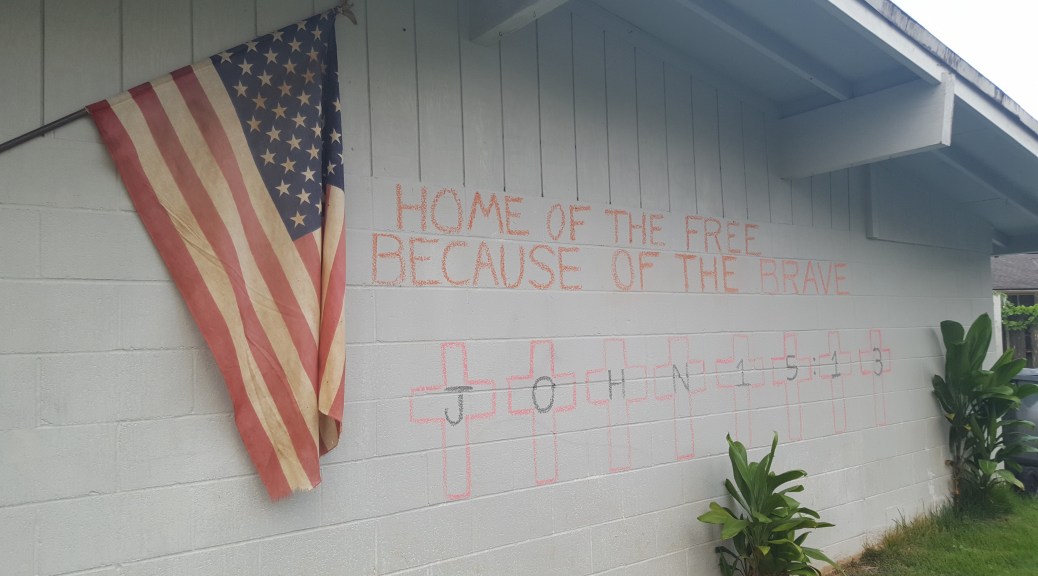
As we mark another Memorial Day honoring those in uniform who have given their lives in service to the nation, it’s important to remember a truism of war: In the heat of combat, a soldier fights not for his country but for his buddy on the right and the left. The bond among soldiers, forged in battle, is as strong, or stronger, than any tie to nation or family.Consider the case of Navy SEAL Michael Monsoor. On Sept. 29, 2006, Monsoor was serving with a small team of SEALs on a rooftop in hotly contested town of Ramadi. They were in the overwatch position, providing surveillance and security for the troops on the ground. They’d been engaged in several firefights already when an enemy grenade came flying over the edge of the roof, hitting Monsoor in the chest, before falling between his two SEAL comrades.Being situated next to the exit from the roof, Monsoor was the only one in a position to escape the blast. Instinctively he could have dropped down the stairs and taken cover a wall before the grenade exploded, and no one would have thought less of him for doing so.But Monsoor’s primary concern was not for his own safety; it was for the lives of his friends. Instead of ducking for cover, he turned and threw himself on the grenade just as it exploded, saving the lives of everyone else on the roof. For his courageous actions, he was awarded the Congressional Medal of Honor.Or consider the case of Army Rangers stationed in Mogadishu, Somalia, on Oct. 3, 1993—the day of the infamous Black Hawk Down incident when Somali militants shot down two Army helicopters. The Rangers who had gone to the crash sites were vastly outnumbered and cut off from resupply or rescue. Word went out that a rescue mission was to be mounted. Every cook, clerk, and supply assistant at the base was to gear up and prepare to move back into the dangerous city, despite the fact that several vehicles had just returned filled with dead and wounded.

Yet not a single man flinched or refused to go. Even those who could have been excused from action easily boarded vehicles to head back. One soldier even cut the cast off his broken arm so he could go with them.

At the second crash site, Master Sergeant Gary Gordon and Sergeant First Class Randy Shughart volunteered to rescue the fallen crew, knowing that what they were doing would almost certainly result in their deaths. Both Gordon and Shughart were posthumously awarded the Medal of Honor for their courage and honor.

This love for comrades, for that is what it is, is a great illustration of John 15:13: “Greater love has no one than this, that he lay down his life for his friends.” It is agape love in action, wishing the best for another, even at great cost. It is the love shown by Christ, who scorned the shame of the cross and faced an agonizing death all to save sinners (see Heb. 12:2). Like Monsoor, Gordon, Shughart, and numerous Rangers, He humbled himself and became obedient to death, all to save us (see Phil. 2:8).

So as you remember our fallen dead today, remember Him who, out of great love for us, gave his life.

This article was originally published on May 25, 2015, and is adapted from the Sermon Notes for Dr. Stanley’s message, “The Passion of God’s Love”.


By In Touch Ministries Staff


As you remember our nation’s fallen heroes today, remember Him who, out of great love for us, gave his life.

Source: Laying Down Lives

Charles Stanley – The Christ-Centered Life


2 Corinthians 5:14-15

If someone asked if your life is centered on Christ, how would you respond? Oftentimes a Christ-centered life is equated with going to church, giving, praying, reading the Bible, and talking to other people about Jesus. However, did you know that even if you do every one of these things, it’s still possible to live a life that is controlled by self rather than Christ?

This is because our motives may be self-centered. Religious activities can be done for a variety of reasons that have nothing to do with our love for Jesus. We could be seeking to relieve feelings of guilt or to make ourselves feel better or look more righteous. Perhaps we read the Bible to quickly find a verse that affirms us. Or prayer might be our attempt to get God to do what we want.

The answer is not to give up on these good activities but to shift our focus to Christ and what He desires. Our battle with self is one that will continue as long as we live in these earthly bodies. That’s why Paul tells us to “lay aside the old self, which is being corrupted,” and to “put on the new self, which in the likeness of God has been created in righteousness and holiness of the truth” (Eph. 4:22; Eph. 4:24).

A Christ-centered life is fueled by love for the Savior, which flows from increasing knowledge of Him. And we learn to know Jesus more intimately through reading, praying, and quietly abiding in His presence. As Christ increases in our mind and heart, we’ll discover that our self-focus decreases and He becomes the delight of our lives.

Bible in One Year: Ezra 5-7


http://www.intouch.org/