
Category Archives: News and Info

News and Information Posts from Bro Bo

The Lunar Anthropic Principle | Daily Planet | Air & Space Magazine

The Lunar Anthropic Principle

Is humanity destined to live on the Moon?

431737main_EC97-43969-1_full.jpeg
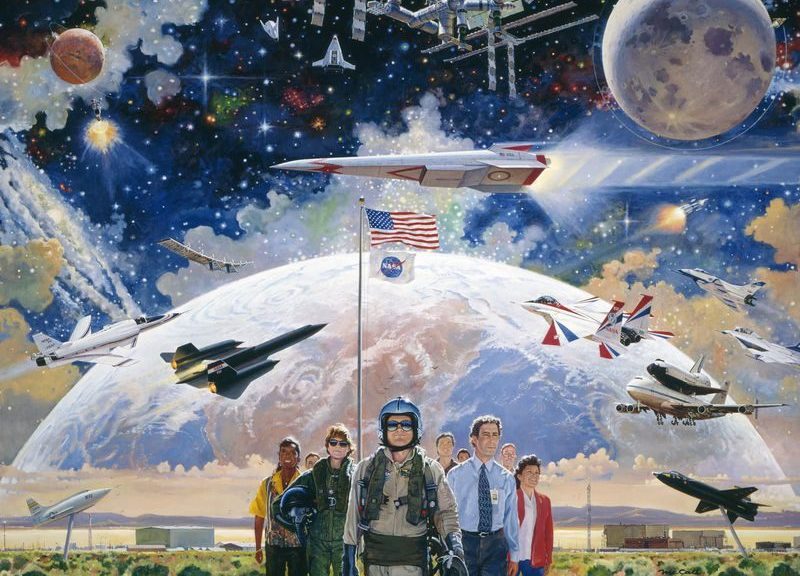
Humanity’s progress into air and space is dramatically illustrated by artist Bob McCall. Does the Moon exist to aid our progress into space? (NASA Armstrong Flight Research Center)

One of the most remarkable books of the last 30 years is The Anthropic Cosmological Principle by John Barrow and Frank Tipler. The “principle” is really nothing more than a statement that the laws governing how the universe operates seem to be arranged so as to require our existence and participation. In other words, the human race is not some accidental byproduct of creation, but an essential component of the way the universe is put together. This philosophical gem came up recently during a wide-ranging discussion of ideas at a post-lecture dinner with media/journalism honors students and their advisors at the University of Texas at Tyler. Though we discussed many things, the anthropic principle came up during questions regarding lunar development. And as good conversation always does, it made me think deeper.

I hadn’t previously connected the Barrow-Tipler principle with a quote (in the same vein) that I use in my lunar development talks. This quote comes from Krafft Ehricke, a member of Wernher von Braun’s original rocket design team from Peenemunde. Ehricke spent a lifetime thinking about the broader, philosophical aspects of space travel and the colonization of other worlds. Ehricke remarked in 1984 that, “If God wanted man to become a spacefaring species, He would have given man a Moon.” Ehricke’s quote distills down to its essence the truth about the Moon’s utility—its singular value in developing new spaceflight capabilities and our ability to travel throughout space. I’m tempted to call Ehricke’s statement “the lunar anthropic principle.”

I’ve detailed in previous writings the Moon’s value. The Moon’s proximity to Earth and its material and energy resources make possible the construction of a permanent spaceflight transportation infrastructure, thereby giving us the means to live and work on another world for extended periods of time. Because the Moon is close (in orbit around the Earth, 400,000 km away) we can travel to and from the Moon at will—launch windows are continuously open. There is no other extraterrestrial body for which this is true.

Our closeness to the Moon (three-second round-trip light travel time) also permits near-real-time control from Earth of machines located on the lunar surface—an amazing advantage in that much of the hard, repetitive or difficult work on the Moon can be accomplished using teleoperated robots. This capability positions humans for more creative pursuits, such as surface exploration, while limiting our exposure to harsh environments, as we build up our knowledge about our new surroundings—valuable information for those planning to venture further out into space.

The Moon’s resources come in two forms: energy and materials. The energy actually comes from the Sun—the Moon provides a place on its surface to collect solar photons nearly continuously. This illumination can be converted into electrical power via solar arrays. The poles offer multiple locations where the Sun can be seen for more than 80-90 percent of the year. The periods of darkness are short, from a few hours to a few tens of hours. We can bridge these dark periods with fuel cells that combine hydrogen and oxygen to generate electrical power, producing water as a byproduct. When the Sun is visible, the power generated by solar arrays can be used to crack stored water into its component hydrogen and oxygen gases. Thus, water becomes a medium of energy storage and permits the continuous generation of power, an essential condition for human habitation and productive work off the Earth.

Fortunately, the other side of the resource coin offers us the feedstock for this power system. The latest round of robotic spacecraft mapping the Moon have found significant quantities of water ice at both poles. The exact amounts and physical state of this water is still uncertain (we need to send robotic landers down to the surface to characterize the deposits in detail), but there is no doubt that the quantities of water present are significant, as much as 10 billion tons of water at each pole.

Thus, there are two areas of the Moon where resources (water and sun) are placed side-by-side: the poles, where the Moon’s axial tilt creates just the right conditions for light (solar energy) and darkness (water ice-traps). Before humans return to the Moon, we must send numerous small robotic probes to the poles to map and survey potential prospects. Such strategic knowledge is critical to selecting the optimum site for a permanent outpost.

Spudis Shackleton rim.jpg
The illuminated rim crest of the crater Shackleton, located near the south pole of the Moon. Points on the rim of this crater are illuminated by the Sun for more than 90% of the year, permitting the generation of nearly continuous electrical power. (NASA/ASU LROC)

Considering all of these fortunate coincidences, Ehricke’s conjecture is not far off the mark. No other space destination brings together such enabling proximity and utility as does the Moon. So why is the idea of resource utilization on the Moon still met with resistance by some? Over my long career in lunar studies, I’ve learned that part of this resistance comes from the reluctance of some engineers to consider the use of extraterrestrial materials. We have used solar energy on spacecraft for almost 60 years—it is a proven and well-founded technology. Extracting materials from space-based sources and forming them into useful spaced-based products is another matter. Since this has never been done, it carries with it the undeserved suspicion of being excessively risky. In truth, processing lunar material requires technology no more advanced than 19th-century industrial chemistry. Melt the ice, fractionally distill it to remove impurities, crack it into its component hydrogen and oxygen, then cryogenically freeze those gases for use as rocket propellant.

The Moon is ideally placed and provisioned to provide us what we need to build a permanent transportation and habitation system in space. In that sense, it is a form of the anthropic principle, and it requires human ingenuity to take advantage of what the Moon has to offer. It is a body ideally placed for our use and benefit—a “stepping stone,” if you prefer to see it that way. Of course, all this is enabled by our ability to perceive and decipher the physical laws that make spaceflight possible, again circling back to the original cosmological anthropic principle—that how the universe operates seems to be arranged so as to require our existence and participation.

The ability to simply fly into space and back is somewhat miraculous in itself. What Don Pettit explains as the “Tyranny of the Rocket Equation,” describes how getting into orbit is not only extremely difficult, but barely possible—as most of the mass of a rocket is propellant (what he identifies as “dumb mass”), leaving only a small fraction (usually less than 10 percent) available for the deliverable (“smart mass”) payload. In fact, as Pettit explains, if the radius of the Earth were 50 percent greater, spaceflight would not be possible—there is simply not enough energy in the chemical bonds of known propellants to get a payload to orbit. Again, it appears that our universe is constructed in a way that allows us to venture off the planet, but only “just”—and even then, only with great difficulty.

We can break the Tyranny of the Rocket Equation once we learn how to use what we find in space—first on the Moon, using lunar resources to provision and fuel spacecraft and habitation systems. By utilizing the Moon and its assets over time, flights between Earth and Moon, and all points in between, will become affordable, profitable and routine. Through the development of this new system, we will finally move from an Earth-based to a space-based operational template, one holding huge economic and national security benefits. It’s as if the Moon was created for our use and benefit. To ignore its value and importance to our future would be extremely shortsighted.

Paul D. Spudis

Paul D. Spudis is a senior staff scientist at the Lunar and Planetary Institute in Houston, Texas. His website can be found at www.spudislunarresources.com. The opinions expressed here are his own and do not reflect the views of the Smithsonian Institution or his employer.

Read more from this author


Source: The Lunar Anthropic Principle | Daily Planet | Air & Space Magazine

Bill Nye Does Not Speak for Us and He Does Not Speak for Science 


Bill Nye Does Not Speak for Us and He Does Not Speak for Science

By attending the State of the Union with NASA administrator nominee Jim Bridenstine, the Science Guy tacitly endorses climate denial, intolerance and attacks on science

Tonight, Bill Nye “The Science Guy” will accompany Republican Rep. Jim Bridenstine (R-OK), Trump’s nominee for NASA Administrator, to the State of the Union address. Nye has said that he’s accompanying the Congressman to help promote space exploration, since, he asserts, “NASA is the best brand the United States has” and that his attendance “should not be … seen as an acceptance of the recent attacks on science and the scientific community.

But by attending the SOTU as Rep. Bridenstine’s guest, Nye has tacitly endorsed those very policies, and put his own personal brand over the interests of the scientific community at large. Rep. Bridenstine is a controversial nominee who refuses to state that climate change is driven by human activity, and even introduced legislation to remove Earth sciences from NASA’s scientific mission. Further, he’s worked to undermine civil rights, including pushing for crackdowns on immigrants,ban on gay marriage, and abolishing the Department of Education.

As scientists, we cannot stand by while Nye lends our community’s credibility to a man who would undermine the United States’ most prominent science agency. And we cannot stand by while Nye uses his public persona as a science entertainer to support an administration that is expressly xenophobic, homophobic, misogynistic, racist, ableist, and anti-science.

Scientists are people, and in today’s society, it is impossible to separate science at major agencies like NASA from other pressing issues like racism, bigotry, and misogyny. Addressing these issues should be a priority, not only to strengthen our own scientific community, but to better serve the public that often funds our work. Rather than wield his public persona to bring attention to the need for science-informed policy, Bill Nye has chosen to excuse Rep. Bridenstine’s anti-science record and his stance on civil rights, and to implicitly support a stance that would diminish the agency’s work studying our own planet and its changing climate. Exploring other worlds and studying other planets, while dismissing the overwhelming scientific evidence of climate change and its damage to our own planet isn’t just dangerous, it’s foolish and self-defeating.

Further, from his position of privilege and public popularity, Bill Nye is acting on the scientific community’s behalf, but without our approval. No amount of funding for space exploration can undo the damage the Trump administration is causing to public health and welfare by censoring science. No number of shiny new satellites can undo the racist policies that make our Dreamer colleagues live in fear and prevent immigrants from pursuing scientific careers in the United States. And no new mission to the Moon can make our LGBTQ colleagues feel welcome at an agency run by someone who votes against their civil rights.

As women and scientists, we refuse to separate science from everyday life. We refuse to keep our heads down and our mouths shut. As someone with a show alleging to save the world, Bill Nye has a responsibility to acknowledge the importance of NASA’s vast mission, not just one aspect of it. He should use his celebrity to elevate the importance of science in NASA’s mission—not waste the opportunity to lobby for space exploration at a cost to everything else.

The true shame is that Bill Nye remains the popular face of science because he keeps himself in the public eye. To be sure, increasing the visibility of scientists in the popular media is important to strengthening public support for science, but Nye’s TV persona has perpetuated the harmful stereotype that scientists are nerdy, combative white men in lab coats—a stereotype that does not comport with our lived experience as women in STEM. And he continues to wield his power recklessly, even after his recent endeavors in debate and politics have backfired spectacularly.

In 2014, he attempted to debate creationist Ken Ham—against the judgment of evolution experts—which only served to allow Ham to raise the funds needed to build an evangelical theme park that spreads misinformation about human evolution. Similarly, Nye repeatedly agreed to televised debates with non-scientist climate deniers, contributing to the false perception that researchers still disagree about basic climate science. And when Bill Nye went on Tucker Carlson’s Fox News show to “debate” climate change in 2017, his appearance was used to spread misinformation to Fox viewers and fundraise for anti-climate initiatives.

Bill Nye does not speak for us or for the members of the scientific community who have to protect not only the integrity of their research, but also their basic right to do science. We stand with others who have asked Bill Nye to not attend the State of the Union. Nye’s complicity does not align him with the researchers who have a bold and progressive vision for the future of science and its role in society.

At a time when our ability to do science and our ability to live freely are both under threat, our public champions and our institutions must do better.

The views expressed are those of the author(s) and are not necessarily those of Scientific American.
ABOUT THE AUTHOR(S)

Source: Bill Nye Does Not Speak for Us and He Does Not Speak for Science – Scientific American Blog Network

Ravi Zacharias Ministry – God as Gardener

Ravi Z

I took up gardening a few years ago. (Well, actually gardening seemed to take me up.) It all started very innocently when a friend gave me a cutting from her jade plant. I knew nothing about plants. I had watched for years as my mother worked in her garden and I appreciated the interplay of color and texture created by the various flowers, trees, and shrubs. But I didn’t know the first thing about the process of cultivating or caring for a garden, and as far as I was concerned, the details involved in that process were best left up to my mother.

But all of that changed when I received my Jade cutting from my friend. She knew just how to initiate me into the wonders of gardening, without overwhelming me with the details. Jade plants are succulents; for those of you who do not know what a succulent plant is, it’s simply a plant that doesn’t need a great deal of water or attention. In other words, it’s the perfect kind of plant for a novice gardener! I was amazed by how quickly this one plant put down roots in my heart. Watching this little cutting grow tiny, threadlike roots, planting it in a pot filled with simulated desert soil, and experiencing the wonder as it grew into the small Jade tree that it is today—over 15 years later—amazed me at how something so small, so ordinary could become extraordinary.

I can tell you that it didn’t take long before I began to try my hand at plants that required more attention and care: african violets, cyclamen, gerbera daisies, iris, lilies, tulips, and a whole assortment of garden flora and fauna. I grew enchanted by the variety of color, texture, and arrangement each new species added to my garden. I learned about specific care regimens, their particular pests, the difference between a partial-sun and partial-shade plant, and how soil acidity impacts the color of certain types of plants.

More than all of this, gardening took me up because gardening quickly grew in me a sense of wonder. I suspect my friend knew this when she introduced me to my first, little jade plant. She knew that gardening would introduce me to the extraordinary in the ordinary. You cannot help but begin to pay attention to the tiniest details as you garden, and in turn, begin to notice all kinds of other awe-producing details all around you. The varieties of the color green in the trees, grasses, plants and shrubs, the nuances of blue and aqua hues that shimmer on lakes and oceans, and the little creatures that share the world with us—birds, rabbits, coyotes, skunk, deer, dogs, and cats.  Living now in the Pacific Northwest of the United States, where gardening is beloved and beauty envelopes us, this is all the more true for me.

The Christian Scriptures indicate that the natural response to wonder is worship. Indeed, the psalmist suggests that the very detailed elements of creation proclaim the glory and worship of God: The heavens are telling of the glory of God; and their expanse is declaring the work of his hands!  Whether we realize it or not, we are drawn into the very presence of God when we wonder in God’s creation. We affirm the beauty and the goodness of God as we wonder at and with and for creation. And as we wonder, we agree with God that all God made “was very good” (Genesis 1:31).

Have you lost your sense of wonder? Has your life gotten too busy, too laden with care or comfort or grief that you cannot see God’s extraordinary presence in the ordinary details of life? Or maybe God seems far off and unreachable, and you long for the tending and nurturing of a gardener yourself. I cannot explain away that longing any more than the psalmist, who expressed a similar lament when God felt far off to him. But I do know that nurturing my own garden and wondering aloud at the beauty of color and intricacy, I am comforted by the declarations of creation—of gardens and waters and heavens who seem confident, not only that there is a gardener, but one who is very good.

Margaret Manning Shull is a member of the speaking and writing team at Ravi Zacharias International Ministries in Bellingham, Washington.

Scriptures, Lessons, News and Links to help you survive.

