Category Archives: Ravi Zacharias

Ravi Zacharias Ministry – Detective and Theory

If you want to investigate whether Sherlock Holmes was a real or fictional person, you can’t believe everything you read on the Internet. His “biography” is as easy to find as Winston Churchill’s (and there seems to be some fact/fiction confusion on both counts).(1) Between the years of 1887 and 1927, Sir Arthur Conan Doyle wrote prolifically of the famous detective known for his heightened skills of observation and eccentric personality. Holmes was both memorable and beloved—and entirely fictional. It is a strange irony indeed that there are a great number of people who would claim the clues suggest otherwise. As Holmes himself once said, “The temptation to form premature theories upon insufficient data is the bane of our profession.”

The process of gathering and interpreting information is never ending. From childhood we learn patterns of life around us and create theories on how it all works and how we must live. Not knowing whether it is insufficient data or fast truth, children readily form theories. For instance: pans on the stove burn fingers. This is one theory a child might conclude having learned the hard way. But as data becomes more sufficient, a child’s theories are readily adjusted—namely, certain parts of a pan on a hot stove burn fingers. Though memory of the sting may last, there seems an unconscious acknowledgment that their theories are the means to understanding and relating to the world. This is very different then theorizing the end they might want, need, or hope to be true.

Strangely, the temptation Sherlock Holmes describes—forming theories upon insufficient data—seems to grow with age. As the questions we seek answers for become more difficult, so the ante for interpreting accurately increases as we grow older. And yet, as adults we are often less willing to adjust our theories. The biases we bring into investigating often prevent us from recognizing data as insufficient or even faulty. We also more readily remember the sting of being burned and hold onto it in our interpretation, so that even for some of life’s deepest questions we are responding with predisposed theories. For instance, God cannot exist because if God did exist my mother wouldn’t have died so young, or tsunamis and hurricanes wouldn’t kill people, or I wouldn’t still be struggling with my finances. But how would we respond to a child who insisted that if broccoli were good for her, it would taste like candy?

In one of his essays, F.W. Boreham writes of his grade school difficulties with geography class. When the teacher spoke of life in a far-off land, he found himself drifting off to scenes in that land and remaining there long after they had switched to another destination. One day, catching him in the midst of a daydream, the teacher called on Boreham and asked, “What part of the world are we studying?” Recognizing a fellow student in distress, a friend scribbled the correct rejoinder on the paper beside them. “Java is the answer,” said Boreham. “Good,” the teacher noted, “Now tell me, what was the question?”

Continue reading Ravi Zacharias Ministry – Detective and Theory

Ravi Zacharias Ministry – Three Questions

As a Christian writer and speaker, I am often asked what the most frequent questions are regarding the Christian faith. Of course, I am frequently asked questions of an intellectual or historic nature: Did Jesus of Nazareth really exist? Is his resurrection from the dead a historical event? How is one to understand the Bible as the Word of God? For some, the questions never go beyond intellectual curiosity or pursuit. For others, these questions need to be answered for constructing a sound apologetic.

Probe a bit deeper, however, and it isn’t difficult to discover that many questions come from the deepest places of the heart. They come because of personal experience with suffering of one form or another. Is there a God? If so, does that God care about me, know me? If so, why does God seemingly allow so much suffering? When the fervent prayers of righteous men and women do not prevent the cancer from spreading, or the child from dying, or the plane from crashing, or the marriage from failing, these more existential questions come like water bursting through the dam.

The kinds of questions I receive are not unique to my contemporary context. They have been asked for millennia. The technical term for the theist’s response to the issue of suffering is called theodicy. Theodicy is the word given in the seventeenth century by Gottfried Wilhelm Leibniz, one of the great intellectual thinkers of the Enlightenment period.(1) Theodicy attempts to explain how and why there can be suffering in the world if God is all-powerful and loving. In trying to solve this problem, some thinkers have denied the omnipotence of God; God is all-loving, but not able to do anything about suffering. Others dispense of the notion that God is all-loving, at least in any conventional understanding. But neither of these alternatives provides a satisfactory answer.

Intellectual wrangling over this problem, aside, the experience of suffering in light of both the goodness and power of God has caused many to doubt God, and others to walk away from faith altogether. If God does not prevent suffering, and if God does not care about the sufferer, then for some, the only alternative appears to be that God cannot exist in any meaningful way.

The Disciples See Christ Walking on the Water, Henry Ossawa Tanner, oil on canvas, 1907.

The writers of Scripture wrestled with these questions too. Often, they provided different ways of answering these questions. Some believed that suffering resulted from sin. Others believed that God causes suffering as a form of punishment. Still others asserted that suffering brings redemption.(2)

Continue reading Ravi Zacharias Ministry – Three Questions

Ravi Zacharias Ministry – Consider the Lilies

Wendell Berry has written a poem that haunts me frequently. As a creative writer, the act of paying attention is both a spiritual and professional discipline. But far too often my aspirations for paying quality attention to everything dissolves into something more like attention deficit disorder. As it turns out, it is quite possible to see and not really see, to hear and not really hear. And this is all the more ironic when my very attempts to capture what I am seeing and hearing are the thing that prevent me from truly being present. Berry’s poem is about a man on holiday, who, trying to seize the sights and sounds of his vacation by video camera, manages to miss the entire thing.

…he stood with his camera

preserving his vacation even as he was having it

so that after he had had it he would still

have it. It would be there. With a flick

of a switch, there it would be. But he

would not be in it. He would never be in it.(1)

I sometimes wonder if one of the most quoted sayings of Jesus is not often employed with a similar irony. “Consider the lilies,” Jesus said, “how they grow; they neither toil nor spin. Yet I tell you, even Solomon in all his glory was not clothed like one of these. But if God so clothes the grass of the field…will he not much more clothe you? Therefore, do not worry.“(2) Typically, Jesus is quoted here as giving a helpful word against worry. And he is. But worry is not the only command he articulates. Consider the lilies, he said. We hear the first instruction peripherally, hurriedly, as mere set up for the final instruction of the saying. And in so doing, we miss something great, perhaps even something vital, both in the means and in the end. With our rationalistic sensibilities, we gloss over consideration of the lilies; ironically, in an attempt to consider the real work Jesus is asking us to do.

But what if considering the lilies is the work, the antidote to anxious, preoccupied lives? What if attending to this short-lived beauty, to the fleeting details of a distracted world is a command Jesus wants us to take seriously in and of itself?

Continue reading Ravi Zacharias Ministry – Consider the Lilies

Ravi Zacharias Ministry – Non-Answers and Hope

In the fifteen seasons of the television series ER, there is one scene for me that uncomfortably stands out among the many. In a hospital bed rests a former prison doctor named Truman, ridden with cancer and laden with guilt. Julia, the ER chaplain, sits beside him, trying with great compassion to listen, and being slower to give answers than he’d like. One of Truman’s roles as a prison doctor was to administer lethal injections to those who were sentenced to die. With great torment, he remembers one man in particular who did not die after the injection and needed to be given a second round. Looking back, Truman believes it was a sign from God, a sign which he ignored and would never be able to undo; the man he injected was later found to have been innocent, framed for the crime for which he was killed.

Now desperate for answers—blunt and solid answers—Truman reels at Julia for the uncertain comforts she attempts to offer. “I need answers, and all your questions and your uncertainty are only making things worse!” he yells. But in his last, livid outburst he is even more honest: “I need someone who will look me in the eye and tell me how to find forgiveness, because I am running out of time.”(1)

The problem of injustice and the difficulty of forgiveness are specters often met with cries for answers. Christians who attempt to respond at all often invoke the story of Job, for in it, the questions of injustice reel like Truman in his hospital bed, and unexpected answers from God counter in a way we never fathomed. The story begins with an accusation that Job only serves God because God has allowed him to prosper. To prove Job’s accuser wrong, God steps back, removing divine protection and leaving the tempter to his destructive game. Job loses everything; he writhes in his own anguish, confusion, and ashes. In the end, he remains in his belief of God, though limping with his weighted questions, and he encounters God without pretense.

Former evangelist turned atheist Charles Templeton heard the story similarly, but thoroughly detested the idea that the tormented Job is an answer to anything at all. Templeton held that the story of Job reveled God as a “cruel and callous despot” and for him the story was anything but an answer to suffering.(2) His anger is often pointed at the seeming attempt to speak into pain and suffering at all, to make sense of that which often cannot be explained, and to bring God into it in a way that is meant to trump the cry for answers: “[The story of Job] is an immoral story and it portrays an immoral God.”(3)

Continue reading Ravi Zacharias Ministry – Non-Answers and Hope

Ravi Zacharias Ministry – Sharing Grief

I find it difficult to cry in front of people, and I’m not even sure why.(1) Even when I want to cry, I can’t. Behind closed doors I dissolve into a fountain of expression. But as I listened to Anna’s story, mutinous tears escapes my eyes, and I made no effort to wipe them away. I ached inside for this woman who had suffered one of the greatest kinds of loss in life. How was she still so graciously soft instead of hardened with bitterness?

She was his mother. She had carried him inside of her for nine months. She had felt the exhilaration of her child’s arrival into the world. She had held him, fed him, protected him, dreamed for him, cherished him. She would have given her very life for him.

As she held Jonathan’s tiny body in her arms sobs spilled from the depths of her soul. She carried him into the living room and looked desperately at her husband, pleading for him to fix what she knew could not be restored. Wordlessly, her husband gently took Jonathan from her arms. He looked at his son’s face, a face that resembled his own. He kissed the top of his head and then slowly, slowly raised his arms to lift the baby up to the heavens. Tears streamed down his face as he lifted his eyes upward in an act of submission to a fate that broke his heart.

Anna cried out in protest. No, no, no! She was not ready to give him back to God. He was an extension of her heart. She was not ready to part with him, not ready to accept what had been tragically forced on her.

For some time, she couldn’t bear to visit his grave. But in a sense, she visited it every day. There may have been a site where marble was engraved for everyone else to see, but his life and death were engraved on her heart. In that way, he stayed with her.

People tried to comfort her, but there is no comfort for such a loss. In an effort to console her, they said, “You’re young. You’ll have other children.” Perhaps, but she needed to grieve the loss of this child.

Over the years, Anna brought three more children into the world, but her family did not go to South America as missionaries as they planned. The call to South American had included Jonathan, and the idea of going without him brought with it enormous pain that was too much to bear. Twenty years passed before she returned to that calling and began to carefully unwrap it again. I want to believe that God understood this. Somehow, for me, it would seem to uphold the integrity of grief.

Continue reading Ravi Zacharias Ministry – Sharing Grief

Ravi Zacharias Ministry – Ashes of Grief

Psychologists use the term “cognitive dissonance” to describe the bothered, sometimes pained, state of mind that occurs when new evidence conflicts with a current belief or outlook. When such dissonance occurs, resolution is arrived at by discarding the new evidence, discarding the belief itself, or ideally, evaluating what is known to be true and integrating the new information.

If we closely examine the lives of certain biblical characters such dissonance is often and clearly evident. Abraham was devastated by the God he loved who asked him to trust, even as he led his young son to be sacrificed. Saul spent three days in blindness and without food trying to comprehend the presence of the Christ he once persecuted. Mary wept at the empty tomb, pleading with the gardener to show her the body of her friend and teacher. The instances where God’s plans conflicted with the understanding of God’s people are scattered throughout Scripture.

Even so, it is perhaps safe to say that Job suffered from the most significant case of cognitive dissonance known among humanity. Job’s understanding of a gracious and just God who rewards the righteous and punishes the unrighteous was shattered by new evidence. Grieving the loss of the God he loved, yet unable to discard the relationship, the question of divine justice tortured his mind. “As water wears away stones and torrents wash away the soil,” he cried, “so you destroy man’s hope.”(1) And yet, against the counsel of his wife, Job was unwilling to discard his belief and allow his hope to be washed away.

Job is the hopeful symbol of a steadfast mind amidst the ashes of our own questions. Why am I so troubled and afflicted? Why would a good God permit suffering? Why does God stand far off in times of trouble? Why is God so absent? The dung heap of life’s most plaguing questions is resistant to decomposition.

I remember the evening my mother had to call my grandparents and break the tragic news to them that their house was burning down. Fortunately, they were away for the weekend, and yet their home, which was literally built by their own hands, was at that very moment being consumed by fire and nothing would be salvaged. My grandmother’s response was calmly, but sorrowfully uttered: “The Lord works in mysterious ways.”

Continue reading Ravi Zacharias Ministry – Ashes of Grief

Ravi Zacharias Ministry – Dance of Grace

I have always been mesmerized by ballet dancers. I remember our family’s annual visit to McCormick Place in Chicago to see the Nutcracker. The fluid movement, the spinning on toes, arms floating around as if in flight, their movement told the story. The dancers made the most difficult technical movements seem natural and easy. I remember one friend speaking of the dancers’ expertise as being filled with grace. These artists had taken complicated and physically demanding choreography and infused it with simple elegance and refinement.

The concept of grace has a long history within the Christian tradition. In theological terms, grace is described as God’s unmerited favor toward human beings far beyond what we deserve—both in terms of our own failing, and in terms of the abundance of God’s blessing towards us. Grace is also understood as a way of life towards others. Since God gives grace freely, humans ought to extend grace towards one another. Like the experienced dancer, the grace extended toward others should be characterized with an elegance and refinement.

Easier said than done. For one like me, who is by nature clumsy and lacking in balance, extending grace to another can often feel like the most excruciating physical practice. What often results is not a refined and elegant performance, but the proverbial dancer with two left feet. So how does one, like the dancers in the Bolshoi Ballet, live in ways that are full of grace?

I asked this question to a friend as we conversed about living in ways that were permeated with graciousness. He shared a story with me about his children’s karate instructor. The instructor was a black-belt in karate and very skilled in his movements and technique. Like the dancers I saw in the Nutcracker, my friend marveled at both the fluidity and gracefulness of the instructor’s movements as he demonstrated karate. Afterwards, my friend asked the instructor if he always moved with such grace and ease—was that something that just came naturally and that one had to possess inherently in order to succeed at karate? The instructor laughed and took him into his office. He took out a video tape. The tape was recorded when the instructor was a student. My friend was amazed by what he saw: jerky, clumsy kicks and punches, falling down as he missed his target, defeat against one opponent after another. Was it really the same person he saw before him? Indeed, it was. So what was the instructor’s secret?

Continue reading Ravi Zacharias Ministry – Dance of Grace

Ravi Zacharias Ministry – Images of Things

I was on hold the other day trying to schedule an appointment for a haircut. As I waited for the receptionist, I half-listened to the obligatory recordings. The announcer asked me to consider scheduling a make-over with my upcoming appointment and to make sure I leave with the products that will keep up my new look. (Apparently, when you have a captive audience of customers “muzak” is hardly strategic.) But then I was caught off guard by a question: “What do the local communities of Chad, Africa, mean to you?” The answer he offered was as immediate as my inability to think of one: “Chad is a leading producer of organic acacia gum, the vital ingredient in a new line of products exclusively produced for and available at our salon.”

In a culture dominated by consumption, the commodification of everything around us is becoming more and more of an unconscious worldview. Thus, when we think of Chad, we can think of our favorite shampoo and its connection with our hair salon. The land where it came from, the conditions of its production, and the community or laborers who produce it are realities wholly disassociated with the commodity itself. Like soap and luggage, the nation of Chad can become just one of the many commodities within our consumer mindset.

As I put down the phone, I couldn’t help but wonder about Amos’s description of those who are “at ease in Zion.” How at ease do you have to be to begin to see the world in commodities?

In fact, at the time of Amos’s words, Israel itself was at one of its most opulent junctures. They had expanded their territory in more than one direction. Their winter palaces were adorned with ivory and their feasts were lacking nothing. They could be heard singing songs to the sound of the harp and seen anointing themselves with the finest of oils. It was in such affluence that the shepherd Amos proclaimed indomitably: “Woe to those who are at ease in Zion, and to those who feel secure on the mountain of Samaria.”(1)

Though unpopular words to voice, Amos’s warning is far from isolated in ancient Scripture. While Amos compares the drunken women of Israel to the fat cows of Bashan, Micah describes the rich as men full of violence, and Jeremiah cites those with wealth and power as those who grow fat and sleek. Likewise, in the book of Revelation, the church that God wants to spit out of his mouth is the one who has “acquired wealth and needs nothing,” the one who has not realized that they are “wretched, pitiful, poor, blind and naked.”(2)

Continue reading Ravi Zacharias Ministry – Images of Things

Ravi Zacharias Ministry – Permission to Lament

“Lamentation” is not a word that is heard very often. Words like sadness, regret, sorrow, and mourning are far more common. But I wonder if something is not lost in the dismissal of lament from our language and our lives.

The Christian hymn “Great Is Thy Faithfulness” is for me a song of lament. Because of certain associations, it is a song that immediately evokes a sense of grief, and yet it is the sort of mourning that is both held and expressed in worship. Whether the Christian story is one you embrace or not, the connection of these two ideas—worship and lamentation—may seem even more foreign than the word itself. Nonetheless, lamentation as worship was once a significant element in the Judeo/Christian vision and experience of the world.

Worship leader and songwriter Matt Redman was in the United States shortly after the attacks on the Pentagon and the World Trade Center. Leading worship in several churches in the weeks following, he was immediately struck by the powerful sermons that were being preached, eloquently expressing the love of Father, Son, and Spirit to a shocked and vulnerable people. He was also struck by the distinct lack of songs he had on hand for worship in the midst of suffering. Where were the songwriters for such a time as this? Where were the poets and prophets to help the people of God find a voice in worship? Writes Redman, “As songwriters and lead worshipers, we had a few expressions of hope at our disposal; but when it came to expressions of pain and lament, we had very little vocabulary to give voice to our heart cries.”(1)

Certainly hope is a needed expression, a gift not afforded by every worldview, and lamentation in this sense is similar. But more so, lamentation is a vital aspect of a life in relation with God. Seventy percent of the psalmist’s words are words of lament! “Hear my prayer, O LORD,” the psalmist pleads. “Let my cry for help come to you. Do not hide your face from me when I am in distress. Turn your ear to me; when I call, answer me quickly. For my days vanish like smoke; my bones burn like glowing embers.” Sadly dissimilar to many public and private expressions of grief, as well as many worship services today, the writers of Scripture identify with the pain of the world and do not hold back in addressing it before a God they believe needs to hear it. For these voices, lament is not a relinquishing of faith, but a cry in worship to the one who weeps with them.

At a funeral once, a fellow mourner caught me with tears in my eyes and told me that neither God nor the one we mourned would want me to cry. Her intentions were good; she meant to encourage me with the powerful hope of the Christian story, which holds at its center a crucified and risen Lord. But I desperately needed permission to lament, permission to look up at the cross with the sorrow of Mary and the uncertainty of the centurion. I needed to be able to ask why with the force that was welling up in that moment of grief, even as I clung to hope in the Son, trust in the Father, and life in the Spirit who holds us.

Continue reading Ravi Zacharias Ministry – Permission to Lament

Ravi Zacharias Ministry – The Last Enemy

In spite of the proverbial certainty of death and taxes, the human psyche has always dreamed of discovering loopholes in whatever mechanisms fix the limits. Yet though it might be possible to cheat on one’s taxes, “cheating death” remains a phrase of wishful-thinking applied to incidences of short-lived victories against our own mortality. Eventually, death honors its ignominious appointment with all of us, calling the bluff of the temptation to believe that we are the masters of our own destiny. But despite the universal, empirical verification of its indiscriminate efficiency, we continue to be constantly surprised whenever death strikes. Only a painfully troubled life can be so thoroughly desensitized against its ugliness as to not experience the throbbing agony of the void it creates within us whenever the earthly journey of a loved one comes to an end.

Such a peculiar reaction to an otherwise commonplace occurrence points strongly to the fact that this world is not our home. As Ecclesiastes 3:11 explains, God has put eternity in our hearts, and therefore the mysterious notion that we are not meant to die is no mere pipe dream: it sounds a clarion call to the eternal destiny of our souls. If the biblical record is accurate, there is no shame or arrogance in pitching our hopes for the future as high as our imaginations will allow. Actually, the danger is that our expectations may be too low, for “No eye has seen, no ear has heard, no mind has conceived what God has prepared for those who love him” (1 Corinthians 2:9). Far from being the accidental byproducts of a mindless collocation of atoms, we are indestructible beings whose spiritual radars, amidst much static noise, are attuned to our hearts’ true home.

Trouble begins, however, when we try to squeeze that eternal existence into our earthly lives in a manner that altogether denies our finite natures. We do so whenever we desensitize ourselves against the finality of death through repeated exposure to stage-managed destruction of human life through the media. Or we zealously seek ultimate fulfillment in such traitorous idols as pleasure, material wealth, professional success, power, and other means, without taking into account the fleeting nature of human existence. Or we broach the subject of death only when we have to, and even then we feel the need to couch it in palatable euphemisms. With some of our leading intellectuals assuring us that we have pulled ourselves up by our own bootstraps and we therefore have no need for God, the only thing missing from our lives seems to be the tune of “Forever Young” playing in the cosmic background. A visitor from outer space would probably conclude that only the very unlucky ones die, while the rest of us are guaranteed endless thrill-rides through space aboard this green planet.

Continue reading Ravi Zacharias Ministry – The Last Enemy

Ravi Zacharias Ministry – Unlikely Blessing

Stranger things have happened. My friends had struggled with infertility for most of their married lives. Employing the latest reproductive technologies didn’t work and thousands and thousands of dollars later there was still no child. As a result of all this, and because of their advanced age, they had given up the possibility of having a biological child and adopted a little boy. They were overjoyed to bring this little one into their family, and we rejoiced together at his baptism. Little did we know at the time that my friend was pregnant; nine months later this couple welcomed their daughter into the world. They were truly overwhelmed by this unexpected and unlikely turn of events. Sometimes, surprise is the greatest blessing.

Surprise is at the start of Luke’s gospel narrative which begins with two women, who were both, like my friend, unlikely candidates for mothers. Elizabeth was a woman beyond child-bearing age. She was barren. Mary was a young, unmarried girl. Yet, these two women were the mothers of two of history’s most famous individuals: John the Baptist, the last prophet of Israel, and Jesus, who would be called, Messiah. The announcement of these pregnancies must have been disconcerting at best. As if this strange news wasn’t enough, it was announced to both families by an angelic visitor. The first words spoken were “do not be afraid.” Do not be afraid, indeed! These births would turn the world upside down, and would change the lives of these women; both women were the unlikely recipients of unlikely blessing.

Despite the improbable circumstances, Elizabeth praises God by saying, “This is the way the Lord has dealt with me in the days when He looked with favor upon me, to take away my disgrace among men” (Luke 1:25). Elizabeth and Zacharias were both from priestly lines: Zacharias from Abijah, and Elizabeth from Aaron. The gospel alerts the reader that they “were both righteous in the sight of God, walking blamelessly in all the commandments and requirements of God” (Luke 1:5-6). However, Elizabeth’s barrenness would have called her “righteous” status into question. Childless women were a ‘disgrace among men’ in her day. Childlessness was naturally looked upon as a grave misfortune or even as a sign that one was cursed by God. The wife who presented her husband with no such tangible blessings or supporters felt that her aim in life had been missed. So the announcement that Elizabeth would bear a child beyond her child-bearing years was as unlikely as a virgin having a child.

Continue reading Ravi Zacharias Ministry – Unlikely Blessing

Ravi Zacharias Ministry – Overwhelming Rejection

There are those who say that lukewarm acceptance is more bewildering than outright rejection. I always wonder if they have ever heard the story of the Syrophoenician woman.

Jesus was on his way to a place where no one would recognize him. From the chaos of Jerusalem and the crowds of Galilee he withdrew to the region of Tyre. According to one of his disciples, when he had entered a house, he wanted no one to know of it. Yet, he did not escape notice. A Gentile woman of the Syrophoenician race immediately fell at his feet and began to cry out, “Have mercy on me, Lord, Son of David; my daughter is cruelly demon-possessed.” But he did not answer her a word.(1)

In the lives of those who believe in God, rejection is always a distinct possibility. Of course, this is not to say that God is rejecting us personally. As Jesus said, “All that the Father gives me will come to me, and whoever comes to me I will never drive away” (John 6:36). And yet, in the barren silence after years of praying for a child, in the slamming of a door that held a real and certain hope, in the wordless dismissal of a mother brought to her knees, the rejection is indeed personal.

But this woman at Jesus’s feet did not turn away at the first sign of his refusal. She was not deterred by the disciples’ request that she be sent away, nor was she convinced to cease her plea after the harsh words that finally did break Jesus’s silence:  “I was sent only to the lost sheep of the house of Israel.” Being a Gentile, she was not one of them. Lesser rejections have certainly brought me to crumbled mess. Yet even this was not a thought that would dissuade her. Bowing down before him, she pled once more, “Lord, help me!”

Continue reading Ravi Zacharias Ministry – Overwhelming Rejection

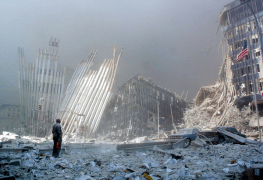
Ravi Zacharias Ministry – On the 15th Anniversary of Sept. 11, 2001:Life, Death, and the Search for God

9-11-flag-at-ground-zero

As some would continue to perpetrate the myth of progress, we live on this fifteenth anniversary of 9/11 under the cloud of a world dramatically changed since that terrible day. Anyone who travels sees and feels what a murderous ideology has done to our world. May we never forget what happened and ever be in pursuit of wisdom and courage to deal with those whose philosophy thrives on hate. Our prayers are for the families that lost a loved one and with gratitude for those who came to the rescue.

Civilization is always threatened by ideologues who embrace the moment and lose sight of the essential value of every human life. Answers will only be found in embracing the God of love and living by his precepts. Loving God and our fellow human beings are the two laws on which all other laws stand.  May God guide our leaders. The Scriptures call us to understand the times and know what to do (see 1 Chronicles 12:32). May we be faithful.

September 11, 2001: Was God Present or Absent?

Every thinking person has at some time raised the question, “Where is God in the midst of suffering?” That question without doubt echoed in millions of minds on September 11, 2001, and continues to do so, fifteen years later. If illustration were argument, an event such as this would give fodder to both sides of the issue—to those who want to establish the complete absence of God and to those who testify that He exists and is involved in the circumstances of our lives. To a watching world, the finest testimonials to the faith of the nation were the crowded churches the following Sunday and the extraordinary national memorial service.

Stepping back from the scene, two starkly different stories from September 11 represent the struggle of the search for God. One story was told by the men of Ladder 6, a company of the New York City Fire Department. Seven firemen were helping a sixty-nine-year-old woman by the name of Josephine down from the 73rd floor of one of the World Trade Center towers. These brave men, already laboring under 110 pounds of equipment on their backs, led Josephine step by step down the staircase. At times, she was ready to give up, but they helped, encouraged, inspired, and assured her she would make it. “They were like angels to me,” she said. She would stop to catch her breath and they would stop with her. She started to shiver with fear and one gave her his jacket. One floor at a time they got her down until, finally, she could walk no more and just sat down on one of the steps of the fourth floor.

They waited with her, coaxing her to stand up and resume walking because they were almost to the ground floor. But she could not move, and they refused to leave her. Suddenly, they heard and felt the floors beneath them give way under the tremendous weight of the collapsing building, and they were hurtled down with terrific force and enveloped in a suffocating cloud of pitch-black smoke. One of them even prayed, “God, if this is it, please let it be quick.”

But as the noise lessened and the smoke began to clear, they found that they had settled over the rubble of the caved-in floors below them. Miraculously, Josephine had refused to go any further at the one point that remained intact as the building fell. All seven firemen plus Josephine were eventually brought into the daylight of safety.

“Had we continued descending when we were pleading with her to keep moving,” they said, “we would have been killed by the crush of the floors above us.” One of them added, “Josephine was like an angel sent from God to stop us so that we could be safe.”

How can we react to a story such as this but to concede that those who were rescued in this way saw the hand of God leading, guiding, and stopping their steps? Yet, not every story ended like Josephine’s. The hearts of thousands of others who lost loved ones may well throb with a different emotion. I think of one young woman who, through weeks of struggle, torn by indecision at the marriage proposal of a young man, finally made her choice during the night. In the pre-dawn hours of the 11th she phoned his office at the World Trade Center from her home in California. Her message awaited him when he arrived at work, with words of love and the welcome news that she would marry him. But at midmorning when she retrieved her own messages, her world was unforgettably changed. The voice she heard was not the voice of a man exultant at the news of her acceptance. Instead, she listened to the terror in his voice as he told her that he loved her with all his heart, but his building had been struck by an airplane and was beginning to crumble before his eyes. No angels dragged him to safety.

Was God near or far? Any time a catastrophic event happens, numerous human-interest stories give God glory, while others give Him blame.

The Problem Is Greater Than We Think

Theologians have an interesting description for this predicament. They call it “the hiddenness of God,” or “divine hiding.” Why does not God make his presence more obvious? Many arguments are offered for why God “hides” in a world that seeks to see Him. The answer is ultimately found in the divine purposes of God. It is not that God has absconded or is absent; it is that there is a divine purpose behind his visibility or invisibility. If one can rightly read the clues, the mystery is opened up in profound ways. Just as evil can be understood only in the light of the ultimate purpose, so also must God’s presence or seeming absence be judged on the basis of his purpose.

Numerous times in the Scriptures, signs were asked from God, and they were given. But in spite of that, trust in God was not automatic. Probably no disciple received more displays of God’s power than the apostle Peter. He was one of only three who witnessed the Transfiguration of Jesus. Jesus had taken his disciples to the top of a mountain where they saw a sight not given to any other human eye. They saw Jesus’s body begin to glow with a whiteness that was almost blinding. Suddenly Moses and Elijah appeared and began to talk with Jesus. Peter asked Jesus if he could build shelters there for the three luminaries, but a voice thundered from the heavens saying, “This is my Son. Listen to Him” (see Luke 9:35). This experience had everything—Sight! Sound! Words! Power! Peter was so overcome that he did not want to go down from the mountain. But Jesus told them it was time to return to the humdrum world of their day-to-day existence.

But there is more. Jesus was trying to help his disciples to understand the frailty He saw in them—their chronic bent to be enchanted every moment. Peter saw the proof of Jesus’s divinity in his transfiguration. He did not doubt after that who Jesus was. Yet, when Jesus was arrested, Peter floundered and even denied that he ever knew Jesus. He was in momentary awe of the miraculous but could not trust God for the future. This failing was also common in Israel’s exodus from Egypt. The people would witness a miracle and follow God with national repentance. But as soon as God seemed to hide for some time, the grumbling and skepticism began. Peter was in momentary awe of the miraculous but could not trust God for the future.

The examples of Israel and of Peter are repeated endlessly in our own experiences. We have a limitless ability to trust God only when it suits our purpose. Rather than allowing God to be God and serving Him for who He is, we actually try to play God and He becomes our subject, expected to do our bidding at our every whim. I do not know of any greater fickleness in the human heart than this. We lie to ourselves after a miraculous event, believing it will have staying power. But the moment another steep hill appears before us, we wonder whether the miracle we witnessed some time back actually happened or was only a delusion. Reality is threatened by this fickleness, and if we do not understand and accept this, we live in an illusionary world of chronic skepticism. Our demand for more information is, in a real sense, a fight against our finitude.

The Solution Must Go Deeper Than We Seek

A subtle delusion keeps us from the real battle. The truth behind our clamor for explanation is that we assume ourselves to be only intellectual entities and thus, if only our intellect can be satisfied, we will be content. One of the most powerful encounters in the Bible is between Jesus and a learned man named Nicodemus. Nicodemus recognized the supernatural character of Jesus and said to Him, “Teacher, no one could do the miracles you are doing unless God is with him” (see John 3:2). That tacit endorsement could have easily elicited a commendation from Jesus. Instead, Jesus challenged Nicodemus that if he wanted to be part of God’s kingdom, he needed to have a new birth. This was not the direction Nicodemus had planned on going, but Jesus knew exactly what He was about. He was telling Nicodemus that it is not the miracle over matter that ultimately has staying power; it is the miracle over the way we think about reality that has eternal ramifications. We are not all intellect, and therefore some need beyond the intellect needs to be met.

But there is a second point I wish to make. We look for God to be something concrete, something we can see or handle or fully explain. This is a fallacy born out of our addiction to the external, and human history has repeatedly challenged that disposition. There are many evidences of God’s miracle-working presence. Incredible stories abound for which there is often no natural interpretation that satisfactorily explains them.

The supernatural is possible. It happens, but it does not lead to the greatest miracle in a life. For you see, anyone can take a miraculous story and explain it a dozen different ways. At best it just proves that there is a power beyond our own. So where does that leave us? What God seeks in every individual is not just companionship based on his intervention, but communion with Him based on his indwelling. That is what makes the difference when a building is collapsing. It is not whether a hand grabs your hand and rescues you from the carnage; it is that no matter what happens, his strength empowers you to rise beyond the devastation.

If humanity was only mind or intellect, evidence from the physical world would be all that mattered. But there is a depth to our being; a spiritual essence that goes deeper than our intellect. We are spiritual beings and God responds to us in spirit. That essence hungers for intimacy.

I would not at all be surprised to learn someday, when the words and thoughts of those who died in the devastation of September 11th are revealed in God’s presence, that many, many of them knew a profound sense of his presence, even when they knew life in its earthly sojourn was coming to an end.

There is at least one profound lesson that I draw from these life and death stories, and it is this: There is an appointed time for each of us when life will meet its end.

Peter Marshall, former chaplain to the United States Senate, told a story, called “Rendezvous in Samara,” of a man who worked as the servant of a wealthy merchant. He had gone into town to shop for the day when suddenly he felt someone brush heavily against his shoulder. Somewhat offended, he turned toward the person who had jostled him and found himself staring into a pair of eyes that spoke death to him. Panicking, he dropped everything and ran home. His master saw him running breathlessly toward the house, and met him on the front steps. “What on earth is the matter?” asked the master. “Oh, sir! Someone in the marketplace rudely brushed me, and when I turned to face him, he looked like the Angel of Death to me. He, too, had a look of shock on his face. It was almost as if he wanted to grab me but then backed away. I am afraid, sir. I don’t want to go back to the market.”

“Saddle one of our horses and ride all day ’til you reach the distant village of Samara,” the master said. “Stay there ’til you get word from me that it is safe for you to return.”

The servant rode off, and the master made his way to the market to find the person who had so frightened his servant. As he wound his way through the crowded streets, he suddenly came face to face with this strange looking individual. “Who are you?” the master said. “Are you the one who just scared my servant?” “Yes, indeed.” “Why did you frighten him?”

“Well, I was truly surprised to see him here. I am the Angel of Death, and I chose to spend the day here before heading to my stop for tonight. You see, it was not so much that I surprised him, as that he surprised me. I did not expect to see him here because I have an appointment with him in Samara tonight.”

We can flee the marketplace, only to find that the quiet village of Samara is where our rendezvous was to be. But, thanks be to God, He seeks to remind us that Samara is not the end, for He has designed us with a hunger for eternal companionship and in communion with Him alone is that hunger fulfilled. That beautiful song “The Lost Chord” ends with the lines: “It may be that only in Heav’n I shall hear the grand Amen.”

By Ravi Zacharias


http://www.rzim.org/

Ravi Zacharias Ministry – Come to Me

Grief is a strange thing in that its memory is more characterized by what the relationship was or was not than by what characterized the death.(1) You look forward and ache over what has now been lost for the future. You look backward and grieve what never truly was and can now never be.

The award-winning author Paulo Coelho is a beautiful writer, and his lines of pure poetry are disguised as novels. His book The Witch of Portobello, a mystical story with many unusual turns, remains on my shelf, no matter where I live. I often pull it off, brush my hand across the cover, and flip it open to a page I have nearly memorized.

The story begins in Beirut, Lebanon, a country that boasts of warm hospitality, platefuls of hummus and tabouli, the Mediterranean coast, and beautiful cedars. Coelho describes his heroine, Athena, as an unusual girl who possessed a sense of spirituality from the time of her youth. She married when she was nineteen and wanted to have a baby right away. Her husband left her when the baby was still young, and Athena had to raise him alone.

During one Sunday Mass, the priest watched as Athena walked toward him to receive Communion, and his heart was filled with dread. Athena stood in front of the priest, drew her eyes closed, and opened her mouth to receive. I picture her standing there in vulnerability, asking to receive Christ’s body, given for her. She was hungry for the grace that it offered.

Continue reading Ravi Zacharias Ministry – Come to Me

Ravi Zacharias Ministry – Lament No Longer

A sales receipt long tucked between the pages of a book can tell a story of its own. I am known for using the receipt handed to me at checkout as a bookmark for the purchase I don’t wait long to read. Discovered years later, it often seems like a clue, giving away a snapshot of a former day and a former self—the date of the transaction, the location of the store, the other books I bought along with the one I chose to read first. Something more seems to be said about the book itself and the thoughts going through my head at the time—a memoir chosen on a road-trip far from home, a classic wandering story acquired during an uncertain time of transition in college. Moby Dick was purchased alongside Till We Have Faces, a novel I picked up simply because the title caught my attention and a book I would later describe as changing my life. It is a glimpse at myself often forgotten, a specific day in the past speaking to the present one: I was here. I was searching. And in hindsight, the present often seems to answer: And perhaps I was not alone.

A receipt fell out of a book I was rereading not too long ago. It was tucked in the pages of a small book depicting the fragmented thoughts of a grieving father. Written by a professor of philosophical theology, Lament for a Son relays the beating heart and exasperated soul of a man forced by a tragic accident to bury his son at the age of twenty-five. But the sales receipt that marked its pages furthered the illustration of grief therein: the book was purchased exactly a year after my father died.

There is a language of loss that we share as humans, though many of us need help remembering how to speak it. Rediscovering the memory of sitting in a bookstore on an anniversary that seemed hard to believe, I am struck with this thought. We need the language of lament. We need permission to voice the broken hope within. We need to know lament is a song we are allowed to sing and that we are not alone in singing it.

In the preface of Lament for a Son, author Nicholas Wolterstorff relays a brief interchange with a friend who told him that he had given copies of the book to all of his children. Confused, Wolterstorff asked why he would want to give away a book of so much despair and pain. “Because it is a love-song,” came the reply. Returning to the preface, Wolterstorff writes, “Yes, it is a love-song. Every human lament is a love-song.” And then he asks a question that begins the outpouring that is the entire book: “Will love-songs one day no longer be laments?”

Continue reading Ravi Zacharias Ministry – Lament No Longer

Ravi Zacharias Ministry – Of Gratitude and Grief

Several years ago, I had the opportunity to visit with some friends who live in Colorado. We spent a couple of days hiking in the beautiful San Isabel National Forest. Within this section of the Rocky Mountains are five major mountain ranges that rise from 5800 to over 14,400 feet and have the most mountain peaks above 14,000 feet. The difference in elevation affords one multiple views from different perspectives.

Starting at the tree line populated by various conifers, aspens, and cottonwoods, we climbed to the more barren alpine terrain dotted with scrub brush, alpine wildflowers, and wildlife. Reaching the ridgeline, the vistas of the valleys and trails below took on ever-new perspectives. Climbing higher gave a broader panorama, obviously, but each step taken presented ever-changing views. From my perspective, I thought I had seen everything on the trail, and yet new aspects of the horizon continually became visible.

Like hiking, life often has a way of shifting one’s perspective. While on the hike, I received a text message from a concerned relative. “Was I anywhere near the shootings?” the text read. I hadn’t learned yet about the horrible massacre that had occurred just hours earlier in an Aurora, Colorado theater where 12 people were killed and 58 were seriously injured. From striking beauty and the grandeur of mountain vistas to images of suburban sidewalks spattered with blood, our perspective shifted once again. Now the awe producing vistas of our hike were juxtaposed against the horror and terror of what should have been any other night at the movies in suburbia. While we had been enjoying the landscapes, others were fighting for their lives. While we laughed at marmots at play, others wept over their lost loved ones. While our feet trod lightly without a care in the world, others bore the weight of worry and fear that their loved ones, too, were among those killed. And this grievous juxtaposition of opposites occurs over and over again in contexts all around the world.

How quickly our perspectives changed. Just as our view of the landscape looked differently as we made our way along the trail, so too changed our perspective of our precarious place in the world and the brevity of life. Despite the serene beauty around us, our perspective shifted to dark and deadly forces not two hours away from where we stood. Gratitude gave way to grief over what was lost.

Continue reading Ravi Zacharias Ministry – Of Gratitude and Grief

Ravi Zacharias Ministry – Explaining Away Fire

Ballet lost some of its wonder when it was explained. It was a class that was supposed to lift my mind, lighten my spirit, and boost my grade point average. Instead it became a one-credit nightmare—a class dedicated to dissecting moves I could not duplicate, within a semester that seemed to slowly dismember my romantic fascination with dance.

Explanations sometimes have a way of leaving their questioners with a sense of loss. Students note this phenomenon regularly. Expounded principles of light refraction and water particles explain away the rainbow, or at least some of its mystique. Air pressure, gravity, and the laws of physics deconstruct the optical mystery of the curve ball. Knowledge and experience can poignantly leave us with a sense of disappointment or disenchantment.

I recently read an article that scientifically explained the glow of a firefly. The author noted the nerves and chemical compounds that make the “fire” possible, pointing out that it is merely a signal used for mating and is, in fact, far from the many romantic myths that have long surrounded it. As one who delights in the gifts of science but also the gift a sky ignited with bugs, I put the article down with a sigh. And then a thought occurred to me in a manner not unlike the description of the firefly’s glow itself: The light shines in the darkness but the darkness has not mastered it.(1) Where nerves and photocytes explain the glow of the firefly, have we come any closer to erasing the miracle of light?

However accurate or inaccurate our explanations might be, they sometimes have a way of leading us to short-sighted conclusions. They have also led us to outright incongruity. Brilliant minds can articulate exquisitely complex aspects of the human person and simultaneously describe it as an accident, an impersonal, adult germ in a vast cosmic machine. We have brusquely described life as a tale told by an idiot, signifying nothing, only to claim that this should not lead us to despair. We have declared our appetites and our reason the gods of a better religion, while insisting both God and religion to be an invention of the human psyche. We scoff at the notion of a vicariously human savior who frees captive humanity and revives the creator’s image, while maintaining we live with every qualification for human dignity, distinction, and freedom. Are these even realistic applications of our own philosophies? Do the explanations warrant the conclusions?

Continue reading Ravi Zacharias Ministry – Explaining Away Fire

Ravi Zacharias Ministry – But as for Me

There are some thoughts about God a Christian carries as truths deeply cemented into the mind. That God is good, for instance, that Christ forgives, that God is a God of grace and mercy and strength. Recitation of these qualities could be offered on cue, or given as gentle correction from a friend when vision has become skewed: God loves you. God is in the midst of your situation. You are forgiven. These phrases are known by heart, even if there are times we do not apply them to our own:

“Surely God is good to Israel,

to those who are pure in heart.

But as for me, my feet had almost slipped;

I had nearly lost my foothold” (Psalm 73:1-2).

Here in these ancient words, a familiar lament is exposed in the expression of an unknown soul: There are times when what is true for all of Israel doesn’t seem true for the one, for me.

There are many reasons one might feel singled out from time to time as being separated from a particular promise or attribute of God. It may be that we are feeling cast aside from God’s presence or forgiveness because something is blocking our view of God’s mercy. A false sense of humility or remnants of shame from previous mistakes may cause us to keep a picture of blame ever before us, skewing our vision of the cross. Still other times, we find ourselves feeling alienated because it seems God has truly overlooked us. Surely God is good to Israel. But as for me… Whatever the cause, in our very admission of feeling overlooked, the Spirit may be attempting to draw us toward the face of God and away from the things that distance us.

No matter the spirit in which it is uttered, the addendum “but as for me” is a heartfelt cry for all. Yet, in a way, the words themselves cast us away from God as we draw ourselves in sharp distinction from what we know to be true. The truth is not moved by our addendums; we are.

Continue reading Ravi Zacharias Ministry – But as for Me

Ravi Zacharias Ministry – Explaining Emotion

In Daniel Goleman’s excellent book Emotional Intelligence he writes about the last moments of Gary and Mary Jean Chauncey battling the swirling waters of the river into which the Amtrak train they were on had plummeted. With every bit of energy they had, both fought desperately to save the life of their young daughter Andrea, who had cerebral palsy and was bound to a wheelchair. Somehow they managed to push her out into the arms of rescuers, but sadly, they themselves drowned.

Some would like to explain such heroism as evolution’s imprint, that we humans behave this way by virtue of evolutionary design for the survival of our progeny. One is hard-pressed not to ask, “Why did the healthier preserve the weaker and not themselves?” But even the author was unable to explain it all in mere Darwinistic terms. He added that “only love” could explain such an act.

In another story, you may recall the chess victory of the computer “Deep Blue” over the world champion Gary Kasparov, which caused many to compare the similarities of machines and humans. Yale professor David Gelertner disagreed. He explained:

“The idea that Deep Blue has a mind is absurd. How can an object that wants nothing, fears nothing, enjoys nothing, needs nothing, and cares about nothing have a mind? It can win at chess, but not because it wants to. It isn’t happy when it wins or sad when it loses. What are its [post]-match plans if it beats Kasparov? Is it hoping to take Deep Pink out for a night on the town?”

Gelertner continues: “The gap between the human and the surrogate is permanent and will never be closed. Machines will continue to make life easier, healthier, richer, and more puzzling. And humans will continue to care, ultimately, about the same things they always have: about themselves, about one another, and many of them, about God.”(1)

Is this not a unique capacity God has put within us? The capacity to feel? From the selfless sacrifice of loving parents to our own personal thought lives, we recognize that this ability is one aspect of the insurmountable differences between humans and machines. In the words of the biblical writer, it is we—and not our computers I might add—who have been made “a little lower than the angels.” Life, feeling, and thought are God’s gifts to us. And where we follow God’s thoughts, we feel and act in highest measure.

Ravi Zacharias is founder and chairman of the board of Ravi Zacharias International Ministries.

(1) David Gelertner, “How Hard Is Chess?” Time Magazine, 19 May 1997.


http://www.rzim.org/

Ravi Zacharias Ministry – ‘Roughing It’

Many years ago, my brother and I went on a backpacking trip in Washington State. My brother had done many such trips, but this would be my first. I was living in Tennessee at the time and had joined a hiking club that made frequent excursions into the Smoky Mountains. I ‘practiced’ for my backpacking trip by carrying a school backpack filled with water and snacks. I believed I was ready for the more arduous hiking in the North Cascades. But I could not begin to be ready for the 30-pound pack and the relentless switchbacks climbing a thousand feet or more up the backcountry peaks.

There was always something about camping and backpacking that appealed to me. I relished the thought of ‘roughing it’ for a time—forsaking the comforts of my normal life for the extreme deprivation of having to take only what was necessary into the wilderness. Perhaps I saw this kind of activity as a way to expand my own resilience by taking on the additional physical challenge of climbing a spectacular peak with a huge backpack on my back. In reality, the challenge of just getting my tent set up was enough to throw me into fits of whining and complaining. The thin mat I would sleep on barely hid the sharp rocks beneath me, and the constant insect threats revealed that my resilience was almost non-existent. I imagined the comforts of civilization—instant access to a shower, fresh water, and food—as we used a water filter to replenish our water supply from a local stream, ate just what was necessary to sustain us for a few days, and continued our trek without a change of clothes or a shower. If camping and backpacking taught me nothing else, it certainly taught me how much I take for granted in my life, and how easily I wanted to give up at the slightest inconvenience.

Continue reading Ravi Zacharias Ministry – ‘Roughing It’