Tag Archives: Zacharias

Ravi Zacharias Ministry – Overwhelming Rejection

There are those who say that lukewarm acceptance is more bewildering than outright rejection. I always wonder if they have ever heard the story of the Syrophoenician woman.

Jesus was on his way to a place where no one would recognize him. From the chaos of Jerusalem and the crowds of Galilee he withdrew to the region of Tyre. According to one of his disciples, when he had entered a house, he wanted no one to know of it. Yet, he did not escape notice. A Gentile woman of the Syrophoenician race immediately fell at his feet and began to cry out, “Have mercy on me, Lord, Son of David; my daughter is cruelly demon-possessed.” But he did not answer her a word.(1)

In the lives of those who believe in God, rejection is always a distinct possibility. Of course, this is not to say that God is rejecting us personally. As Jesus said, “All that the Father gives me will come to me, and whoever comes to me I will never drive away” (John 6:36). And yet, in the barren silence after years of praying for a child, in the slamming of a door that held a real and certain hope, in the wordless dismissal of a mother brought to her knees, the rejection is indeed personal.

But this woman at Jesus’s feet did not turn away at the first sign of his refusal. She was not deterred by the disciples’ request that she be sent away, nor was she convinced to cease her plea after the harsh words that finally did break Jesus’s silence:  “I was sent only to the lost sheep of the house of Israel.” Being a Gentile, she was not one of them. Lesser rejections have certainly brought me to crumbled mess. Yet even this was not a thought that would dissuade her. Bowing down before him, she pled once more, “Lord, help me!”

Continue reading Ravi Zacharias Ministry – Overwhelming Rejection

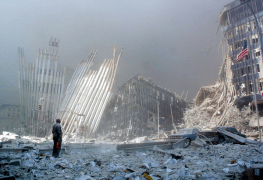
Ravi Zacharias Ministry – On the 15th Anniversary of Sept. 11, 2001:Life, Death, and the Search for God

9-11-flag-at-ground-zero

As some would continue to perpetrate the myth of progress, we live on this fifteenth anniversary of 9/11 under the cloud of a world dramatically changed since that terrible day. Anyone who travels sees and feels what a murderous ideology has done to our world. May we never forget what happened and ever be in pursuit of wisdom and courage to deal with those whose philosophy thrives on hate. Our prayers are for the families that lost a loved one and with gratitude for those who came to the rescue.

Civilization is always threatened by ideologues who embrace the moment and lose sight of the essential value of every human life. Answers will only be found in embracing the God of love and living by his precepts. Loving God and our fellow human beings are the two laws on which all other laws stand.  May God guide our leaders. The Scriptures call us to understand the times and know what to do (see 1 Chronicles 12:32). May we be faithful.

September 11, 2001: Was God Present or Absent?

Every thinking person has at some time raised the question, “Where is God in the midst of suffering?” That question without doubt echoed in millions of minds on September 11, 2001, and continues to do so, fifteen years later. If illustration were argument, an event such as this would give fodder to both sides of the issue—to those who want to establish the complete absence of God and to those who testify that He exists and is involved in the circumstances of our lives. To a watching world, the finest testimonials to the faith of the nation were the crowded churches the following Sunday and the extraordinary national memorial service.

Stepping back from the scene, two starkly different stories from September 11 represent the struggle of the search for God. One story was told by the men of Ladder 6, a company of the New York City Fire Department. Seven firemen were helping a sixty-nine-year-old woman by the name of Josephine down from the 73rd floor of one of the World Trade Center towers. These brave men, already laboring under 110 pounds of equipment on their backs, led Josephine step by step down the staircase. At times, she was ready to give up, but they helped, encouraged, inspired, and assured her she would make it. “They were like angels to me,” she said. She would stop to catch her breath and they would stop with her. She started to shiver with fear and one gave her his jacket. One floor at a time they got her down until, finally, she could walk no more and just sat down on one of the steps of the fourth floor.

They waited with her, coaxing her to stand up and resume walking because they were almost to the ground floor. But she could not move, and they refused to leave her. Suddenly, they heard and felt the floors beneath them give way under the tremendous weight of the collapsing building, and they were hurtled down with terrific force and enveloped in a suffocating cloud of pitch-black smoke. One of them even prayed, “God, if this is it, please let it be quick.”

But as the noise lessened and the smoke began to clear, they found that they had settled over the rubble of the caved-in floors below them. Miraculously, Josephine had refused to go any further at the one point that remained intact as the building fell. All seven firemen plus Josephine were eventually brought into the daylight of safety.

“Had we continued descending when we were pleading with her to keep moving,” they said, “we would have been killed by the crush of the floors above us.” One of them added, “Josephine was like an angel sent from God to stop us so that we could be safe.”

How can we react to a story such as this but to concede that those who were rescued in this way saw the hand of God leading, guiding, and stopping their steps? Yet, not every story ended like Josephine’s. The hearts of thousands of others who lost loved ones may well throb with a different emotion. I think of one young woman who, through weeks of struggle, torn by indecision at the marriage proposal of a young man, finally made her choice during the night. In the pre-dawn hours of the 11th she phoned his office at the World Trade Center from her home in California. Her message awaited him when he arrived at work, with words of love and the welcome news that she would marry him. But at midmorning when she retrieved her own messages, her world was unforgettably changed. The voice she heard was not the voice of a man exultant at the news of her acceptance. Instead, she listened to the terror in his voice as he told her that he loved her with all his heart, but his building had been struck by an airplane and was beginning to crumble before his eyes. No angels dragged him to safety.

Was God near or far? Any time a catastrophic event happens, numerous human-interest stories give God glory, while others give Him blame.

The Problem Is Greater Than We Think

Theologians have an interesting description for this predicament. They call it “the hiddenness of God,” or “divine hiding.” Why does not God make his presence more obvious? Many arguments are offered for why God “hides” in a world that seeks to see Him. The answer is ultimately found in the divine purposes of God. It is not that God has absconded or is absent; it is that there is a divine purpose behind his visibility or invisibility. If one can rightly read the clues, the mystery is opened up in profound ways. Just as evil can be understood only in the light of the ultimate purpose, so also must God’s presence or seeming absence be judged on the basis of his purpose.

Numerous times in the Scriptures, signs were asked from God, and they were given. But in spite of that, trust in God was not automatic. Probably no disciple received more displays of God’s power than the apostle Peter. He was one of only three who witnessed the Transfiguration of Jesus. Jesus had taken his disciples to the top of a mountain where they saw a sight not given to any other human eye. They saw Jesus’s body begin to glow with a whiteness that was almost blinding. Suddenly Moses and Elijah appeared and began to talk with Jesus. Peter asked Jesus if he could build shelters there for the three luminaries, but a voice thundered from the heavens saying, “This is my Son. Listen to Him” (see Luke 9:35). This experience had everything—Sight! Sound! Words! Power! Peter was so overcome that he did not want to go down from the mountain. But Jesus told them it was time to return to the humdrum world of their day-to-day existence.

But there is more. Jesus was trying to help his disciples to understand the frailty He saw in them—their chronic bent to be enchanted every moment. Peter saw the proof of Jesus’s divinity in his transfiguration. He did not doubt after that who Jesus was. Yet, when Jesus was arrested, Peter floundered and even denied that he ever knew Jesus. He was in momentary awe of the miraculous but could not trust God for the future. This failing was also common in Israel’s exodus from Egypt. The people would witness a miracle and follow God with national repentance. But as soon as God seemed to hide for some time, the grumbling and skepticism began. Peter was in momentary awe of the miraculous but could not trust God for the future.

The examples of Israel and of Peter are repeated endlessly in our own experiences. We have a limitless ability to trust God only when it suits our purpose. Rather than allowing God to be God and serving Him for who He is, we actually try to play God and He becomes our subject, expected to do our bidding at our every whim. I do not know of any greater fickleness in the human heart than this. We lie to ourselves after a miraculous event, believing it will have staying power. But the moment another steep hill appears before us, we wonder whether the miracle we witnessed some time back actually happened or was only a delusion. Reality is threatened by this fickleness, and if we do not understand and accept this, we live in an illusionary world of chronic skepticism. Our demand for more information is, in a real sense, a fight against our finitude.

The Solution Must Go Deeper Than We Seek

A subtle delusion keeps us from the real battle. The truth behind our clamor for explanation is that we assume ourselves to be only intellectual entities and thus, if only our intellect can be satisfied, we will be content. One of the most powerful encounters in the Bible is between Jesus and a learned man named Nicodemus. Nicodemus recognized the supernatural character of Jesus and said to Him, “Teacher, no one could do the miracles you are doing unless God is with him” (see John 3:2). That tacit endorsement could have easily elicited a commendation from Jesus. Instead, Jesus challenged Nicodemus that if he wanted to be part of God’s kingdom, he needed to have a new birth. This was not the direction Nicodemus had planned on going, but Jesus knew exactly what He was about. He was telling Nicodemus that it is not the miracle over matter that ultimately has staying power; it is the miracle over the way we think about reality that has eternal ramifications. We are not all intellect, and therefore some need beyond the intellect needs to be met.

But there is a second point I wish to make. We look for God to be something concrete, something we can see or handle or fully explain. This is a fallacy born out of our addiction to the external, and human history has repeatedly challenged that disposition. There are many evidences of God’s miracle-working presence. Incredible stories abound for which there is often no natural interpretation that satisfactorily explains them.

The supernatural is possible. It happens, but it does not lead to the greatest miracle in a life. For you see, anyone can take a miraculous story and explain it a dozen different ways. At best it just proves that there is a power beyond our own. So where does that leave us? What God seeks in every individual is not just companionship based on his intervention, but communion with Him based on his indwelling. That is what makes the difference when a building is collapsing. It is not whether a hand grabs your hand and rescues you from the carnage; it is that no matter what happens, his strength empowers you to rise beyond the devastation.

If humanity was only mind or intellect, evidence from the physical world would be all that mattered. But there is a depth to our being; a spiritual essence that goes deeper than our intellect. We are spiritual beings and God responds to us in spirit. That essence hungers for intimacy.

I would not at all be surprised to learn someday, when the words and thoughts of those who died in the devastation of September 11th are revealed in God’s presence, that many, many of them knew a profound sense of his presence, even when they knew life in its earthly sojourn was coming to an end.

There is at least one profound lesson that I draw from these life and death stories, and it is this: There is an appointed time for each of us when life will meet its end.

Peter Marshall, former chaplain to the United States Senate, told a story, called “Rendezvous in Samara,” of a man who worked as the servant of a wealthy merchant. He had gone into town to shop for the day when suddenly he felt someone brush heavily against his shoulder. Somewhat offended, he turned toward the person who had jostled him and found himself staring into a pair of eyes that spoke death to him. Panicking, he dropped everything and ran home. His master saw him running breathlessly toward the house, and met him on the front steps. “What on earth is the matter?” asked the master. “Oh, sir! Someone in the marketplace rudely brushed me, and when I turned to face him, he looked like the Angel of Death to me. He, too, had a look of shock on his face. It was almost as if he wanted to grab me but then backed away. I am afraid, sir. I don’t want to go back to the market.”

“Saddle one of our horses and ride all day ’til you reach the distant village of Samara,” the master said. “Stay there ’til you get word from me that it is safe for you to return.”

The servant rode off, and the master made his way to the market to find the person who had so frightened his servant. As he wound his way through the crowded streets, he suddenly came face to face with this strange looking individual. “Who are you?” the master said. “Are you the one who just scared my servant?” “Yes, indeed.” “Why did you frighten him?”

“Well, I was truly surprised to see him here. I am the Angel of Death, and I chose to spend the day here before heading to my stop for tonight. You see, it was not so much that I surprised him, as that he surprised me. I did not expect to see him here because I have an appointment with him in Samara tonight.”

We can flee the marketplace, only to find that the quiet village of Samara is where our rendezvous was to be. But, thanks be to God, He seeks to remind us that Samara is not the end, for He has designed us with a hunger for eternal companionship and in communion with Him alone is that hunger fulfilled. That beautiful song “The Lost Chord” ends with the lines: “It may be that only in Heav’n I shall hear the grand Amen.”

By Ravi Zacharias


http://www.rzim.org/

Ravi Zacharias Ministry – Come to Me

Grief is a strange thing in that its memory is more characterized by what the relationship was or was not than by what characterized the death.(1) You look forward and ache over what has now been lost for the future. You look backward and grieve what never truly was and can now never be.

The award-winning author Paulo Coelho is a beautiful writer, and his lines of pure poetry are disguised as novels. His book The Witch of Portobello, a mystical story with many unusual turns, remains on my shelf, no matter where I live. I often pull it off, brush my hand across the cover, and flip it open to a page I have nearly memorized.

The story begins in Beirut, Lebanon, a country that boasts of warm hospitality, platefuls of hummus and tabouli, the Mediterranean coast, and beautiful cedars. Coelho describes his heroine, Athena, as an unusual girl who possessed a sense of spirituality from the time of her youth. She married when she was nineteen and wanted to have a baby right away. Her husband left her when the baby was still young, and Athena had to raise him alone.

During one Sunday Mass, the priest watched as Athena walked toward him to receive Communion, and his heart was filled with dread. Athena stood in front of the priest, drew her eyes closed, and opened her mouth to receive. I picture her standing there in vulnerability, asking to receive Christ’s body, given for her. She was hungry for the grace that it offered.

Continue reading Ravi Zacharias Ministry – Come to Me

Ravi Zacharias Ministry – Lament No Longer

A sales receipt long tucked between the pages of a book can tell a story of its own. I am known for using the receipt handed to me at checkout as a bookmark for the purchase I don’t wait long to read. Discovered years later, it often seems like a clue, giving away a snapshot of a former day and a former self—the date of the transaction, the location of the store, the other books I bought along with the one I chose to read first. Something more seems to be said about the book itself and the thoughts going through my head at the time—a memoir chosen on a road-trip far from home, a classic wandering story acquired during an uncertain time of transition in college. Moby Dick was purchased alongside Till We Have Faces, a novel I picked up simply because the title caught my attention and a book I would later describe as changing my life. It is a glimpse at myself often forgotten, a specific day in the past speaking to the present one: I was here. I was searching. And in hindsight, the present often seems to answer: And perhaps I was not alone.

A receipt fell out of a book I was rereading not too long ago. It was tucked in the pages of a small book depicting the fragmented thoughts of a grieving father. Written by a professor of philosophical theology, Lament for a Son relays the beating heart and exasperated soul of a man forced by a tragic accident to bury his son at the age of twenty-five. But the sales receipt that marked its pages furthered the illustration of grief therein: the book was purchased exactly a year after my father died.

There is a language of loss that we share as humans, though many of us need help remembering how to speak it. Rediscovering the memory of sitting in a bookstore on an anniversary that seemed hard to believe, I am struck with this thought. We need the language of lament. We need permission to voice the broken hope within. We need to know lament is a song we are allowed to sing and that we are not alone in singing it.

In the preface of Lament for a Son, author Nicholas Wolterstorff relays a brief interchange with a friend who told him that he had given copies of the book to all of his children. Confused, Wolterstorff asked why he would want to give away a book of so much despair and pain. “Because it is a love-song,” came the reply. Returning to the preface, Wolterstorff writes, “Yes, it is a love-song. Every human lament is a love-song.” And then he asks a question that begins the outpouring that is the entire book: “Will love-songs one day no longer be laments?”

Continue reading Ravi Zacharias Ministry – Lament No Longer

Ravi Zacharias Ministry – Of Gratitude and Grief

Several years ago, I had the opportunity to visit with some friends who live in Colorado. We spent a couple of days hiking in the beautiful San Isabel National Forest. Within this section of the Rocky Mountains are five major mountain ranges that rise from 5800 to over 14,400 feet and have the most mountain peaks above 14,000 feet. The difference in elevation affords one multiple views from different perspectives.

Starting at the tree line populated by various conifers, aspens, and cottonwoods, we climbed to the more barren alpine terrain dotted with scrub brush, alpine wildflowers, and wildlife. Reaching the ridgeline, the vistas of the valleys and trails below took on ever-new perspectives. Climbing higher gave a broader panorama, obviously, but each step taken presented ever-changing views. From my perspective, I thought I had seen everything on the trail, and yet new aspects of the horizon continually became visible.

Like hiking, life often has a way of shifting one’s perspective. While on the hike, I received a text message from a concerned relative. “Was I anywhere near the shootings?” the text read. I hadn’t learned yet about the horrible massacre that had occurred just hours earlier in an Aurora, Colorado theater where 12 people were killed and 58 were seriously injured. From striking beauty and the grandeur of mountain vistas to images of suburban sidewalks spattered with blood, our perspective shifted once again. Now the awe producing vistas of our hike were juxtaposed against the horror and terror of what should have been any other night at the movies in suburbia. While we had been enjoying the landscapes, others were fighting for their lives. While we laughed at marmots at play, others wept over their lost loved ones. While our feet trod lightly without a care in the world, others bore the weight of worry and fear that their loved ones, too, were among those killed. And this grievous juxtaposition of opposites occurs over and over again in contexts all around the world.

How quickly our perspectives changed. Just as our view of the landscape looked differently as we made our way along the trail, so too changed our perspective of our precarious place in the world and the brevity of life. Despite the serene beauty around us, our perspective shifted to dark and deadly forces not two hours away from where we stood. Gratitude gave way to grief over what was lost.

Continue reading Ravi Zacharias Ministry – Of Gratitude and Grief

Ravi Zacharias Ministry – Explaining Away Fire

Ballet lost some of its wonder when it was explained. It was a class that was supposed to lift my mind, lighten my spirit, and boost my grade point average. Instead it became a one-credit nightmare—a class dedicated to dissecting moves I could not duplicate, within a semester that seemed to slowly dismember my romantic fascination with dance.

Explanations sometimes have a way of leaving their questioners with a sense of loss. Students note this phenomenon regularly. Expounded principles of light refraction and water particles explain away the rainbow, or at least some of its mystique. Air pressure, gravity, and the laws of physics deconstruct the optical mystery of the curve ball. Knowledge and experience can poignantly leave us with a sense of disappointment or disenchantment.

I recently read an article that scientifically explained the glow of a firefly. The author noted the nerves and chemical compounds that make the “fire” possible, pointing out that it is merely a signal used for mating and is, in fact, far from the many romantic myths that have long surrounded it. As one who delights in the gifts of science but also the gift a sky ignited with bugs, I put the article down with a sigh. And then a thought occurred to me in a manner not unlike the description of the firefly’s glow itself: The light shines in the darkness but the darkness has not mastered it.(1) Where nerves and photocytes explain the glow of the firefly, have we come any closer to erasing the miracle of light?

However accurate or inaccurate our explanations might be, they sometimes have a way of leading us to short-sighted conclusions. They have also led us to outright incongruity. Brilliant minds can articulate exquisitely complex aspects of the human person and simultaneously describe it as an accident, an impersonal, adult germ in a vast cosmic machine. We have brusquely described life as a tale told by an idiot, signifying nothing, only to claim that this should not lead us to despair. We have declared our appetites and our reason the gods of a better religion, while insisting both God and religion to be an invention of the human psyche. We scoff at the notion of a vicariously human savior who frees captive humanity and revives the creator’s image, while maintaining we live with every qualification for human dignity, distinction, and freedom. Are these even realistic applications of our own philosophies? Do the explanations warrant the conclusions?

Continue reading Ravi Zacharias Ministry – Explaining Away Fire

Ravi Zacharias Ministry – But as for Me

There are some thoughts about God a Christian carries as truths deeply cemented into the mind. That God is good, for instance, that Christ forgives, that God is a God of grace and mercy and strength. Recitation of these qualities could be offered on cue, or given as gentle correction from a friend when vision has become skewed: God loves you. God is in the midst of your situation. You are forgiven. These phrases are known by heart, even if there are times we do not apply them to our own:

“Surely God is good to Israel,

to those who are pure in heart.

But as for me, my feet had almost slipped;

I had nearly lost my foothold” (Psalm 73:1-2).

Here in these ancient words, a familiar lament is exposed in the expression of an unknown soul: There are times when what is true for all of Israel doesn’t seem true for the one, for me.

There are many reasons one might feel singled out from time to time as being separated from a particular promise or attribute of God. It may be that we are feeling cast aside from God’s presence or forgiveness because something is blocking our view of God’s mercy. A false sense of humility or remnants of shame from previous mistakes may cause us to keep a picture of blame ever before us, skewing our vision of the cross. Still other times, we find ourselves feeling alienated because it seems God has truly overlooked us. Surely God is good to Israel. But as for me… Whatever the cause, in our very admission of feeling overlooked, the Spirit may be attempting to draw us toward the face of God and away from the things that distance us.

No matter the spirit in which it is uttered, the addendum “but as for me” is a heartfelt cry for all. Yet, in a way, the words themselves cast us away from God as we draw ourselves in sharp distinction from what we know to be true. The truth is not moved by our addendums; we are.

Continue reading Ravi Zacharias Ministry – But as for Me

Ravi Zacharias Ministry – Explaining Emotion

In Daniel Goleman’s excellent book Emotional Intelligence he writes about the last moments of Gary and Mary Jean Chauncey battling the swirling waters of the river into which the Amtrak train they were on had plummeted. With every bit of energy they had, both fought desperately to save the life of their young daughter Andrea, who had cerebral palsy and was bound to a wheelchair. Somehow they managed to push her out into the arms of rescuers, but sadly, they themselves drowned.

Some would like to explain such heroism as evolution’s imprint, that we humans behave this way by virtue of evolutionary design for the survival of our progeny. One is hard-pressed not to ask, “Why did the healthier preserve the weaker and not themselves?” But even the author was unable to explain it all in mere Darwinistic terms. He added that “only love” could explain such an act.

In another story, you may recall the chess victory of the computer “Deep Blue” over the world champion Gary Kasparov, which caused many to compare the similarities of machines and humans. Yale professor David Gelertner disagreed. He explained:

“The idea that Deep Blue has a mind is absurd. How can an object that wants nothing, fears nothing, enjoys nothing, needs nothing, and cares about nothing have a mind? It can win at chess, but not because it wants to. It isn’t happy when it wins or sad when it loses. What are its [post]-match plans if it beats Kasparov? Is it hoping to take Deep Pink out for a night on the town?”

Gelertner continues: “The gap between the human and the surrogate is permanent and will never be closed. Machines will continue to make life easier, healthier, richer, and more puzzling. And humans will continue to care, ultimately, about the same things they always have: about themselves, about one another, and many of them, about God.”(1)

Is this not a unique capacity God has put within us? The capacity to feel? From the selfless sacrifice of loving parents to our own personal thought lives, we recognize that this ability is one aspect of the insurmountable differences between humans and machines. In the words of the biblical writer, it is we—and not our computers I might add—who have been made “a little lower than the angels.” Life, feeling, and thought are God’s gifts to us. And where we follow God’s thoughts, we feel and act in highest measure.

Ravi Zacharias is founder and chairman of the board of Ravi Zacharias International Ministries.

(1) David Gelertner, “How Hard Is Chess?” Time Magazine, 19 May 1997.


http://www.rzim.org/

Ravi Zacharias Ministry – ‘Roughing It’

Many years ago, my brother and I went on a backpacking trip in Washington State. My brother had done many such trips, but this would be my first. I was living in Tennessee at the time and had joined a hiking club that made frequent excursions into the Smoky Mountains. I ‘practiced’ for my backpacking trip by carrying a school backpack filled with water and snacks. I believed I was ready for the more arduous hiking in the North Cascades. But I could not begin to be ready for the 30-pound pack and the relentless switchbacks climbing a thousand feet or more up the backcountry peaks.

There was always something about camping and backpacking that appealed to me. I relished the thought of ‘roughing it’ for a time—forsaking the comforts of my normal life for the extreme deprivation of having to take only what was necessary into the wilderness. Perhaps I saw this kind of activity as a way to expand my own resilience by taking on the additional physical challenge of climbing a spectacular peak with a huge backpack on my back. In reality, the challenge of just getting my tent set up was enough to throw me into fits of whining and complaining. The thin mat I would sleep on barely hid the sharp rocks beneath me, and the constant insect threats revealed that my resilience was almost non-existent. I imagined the comforts of civilization—instant access to a shower, fresh water, and food—as we used a water filter to replenish our water supply from a local stream, ate just what was necessary to sustain us for a few days, and continued our trek without a change of clothes or a shower. If camping and backpacking taught me nothing else, it certainly taught me how much I take for granted in my life, and how easily I wanted to give up at the slightest inconvenience.

Continue reading Ravi Zacharias Ministry – ‘Roughing It’

Ravi Zacharias Ministry – The End of Hope

In John Bunyan’s abiding allegory, Pilgrim’s Progress, hope is personified in two ways. Hopeful is the traveling companion of Christian, the story’s protagonist, along the winding journey toward the Celestial City. Hopeful was born in the town of Vanity and grew up with great expectations of the things of the fair; honor and title, ownership and ease were his great hopes. But he had suffered bitter disappointment in these pursuits and found only shipwrecks of his own optimism. In this valley of emptiness, Hopeful was able to recognize the full and solid quest of Christian. And thus, Hopeful’s drastic conversion of hope begins with pilgrimage and community.

The other character marked by hope in Bunyan’s tale is encountered near the river one must cross on foot in order to enter the Celestial City. Vain-Hope is a ferryman, who offers to ferry travelers across the River of Death so that they don’t have to cross on their own. Yet as one man discovers, it is a promise that gets him across the river, but destroys all hope of staying there. In the end, Vain-Hope is a deadly end.

With these two lucid pictures, Bunyan divides hope in two, possibly simple, but maybe wise, categories: the life-giving and the destructive. Considering all the ways in which we use the word, it seems easily an oversimplification. In the painting above, for instance, artist George Frederic Watts shows a female allegorical figure of Hope, for which the painting is titled, sitting on a globe in a hunched position, blindfolded, clutching a wooden lyre with only one string left intact. According to Watts, “Hope need not mean expectancy. It suggests here rather the music which can come from the remaining chord.”(1)  G. K. Chesterton, who was far from alone in his criticism of Watt’s image, suggested that a better title for this work would be Despair. Chesterton describes the lone string of Hope’s lyre as “a string which is always stretched to snapping and yet never snaps. . . the queerest and most delicate thing in us, the most fragile, the most fantastic, is in truth the backbone and indestructible. . . Faith is always at a disadvantage; it is a perpetually defeated thing which survives all its conquerors.”(2)

Continue reading Ravi Zacharias Ministry – The End of Hope

Ravi Zacharias Ministry – Misdiagnosing ‘Normal’

Almost everyday, we are beset with news of daily atrocities, murders, and tragedies that continue to shake us. I sit in a somewhat curious state as I hear certain phrases so often repeated. “They seemed like such a normal person.” “My kids played at his/her house regularly.” Then the reporter chimes in, “How could such a normal person do such a thing?”

I guess what intrigues me in this constant replay from daily and weekly life is the surprise. The reporters genuinely seem surprised by the actions committed and in joining in with the social narrative’s rules, so do we! Many centuries ago, the ancient writer Herodotus wrote, “The most hateful torment for men is to have knowledge of everything but power over nothing.” This is perceptive.

The modern era was birthed in the consciousness of rational men and women in control of their own destinies. It was the age of reason; we can and would figure everything out. It was the age of man; no need for god, the gods, or superstitions of any kind. It was the age of science; the new insights, techniques, and technologies would allow us to build our brave new world. It was the age of progress, as many believed we would grow from good to great, and perhaps end up in something like Gene Roddenberry’s Star Trek future, where all need has been eradicated and all live for justice and the good of all.

The problem with this, and with all utopian dreams, is that they are illusions or delusions. They are fantasy constructs of the very sort Schopenhauer and Freud attacked in terms of religion. Despite promethean promises, guru advice, or our deepest sincere desires, wanting it badly enough does not make it so. What kind of a world do we live in? Who and what are we? What is wrong in life and with me? How can anything be improved? These are world and life view questions.

Continue reading Ravi Zacharias Ministry – Misdiagnosing ‘Normal’

Ravi Zacharias Ministry – At Ease or Uneasy

I found myself sighing with something like relief one day after reading a comment made by C.S. Lewis. He was responding to a statement made by a scholar who noted that he didn’t “care for” the Sermon on the Mount but “preferred” the ethics of the apostle Paul. As you might imagine, Lewis was bothered at the suggestion of Scripture alternatives between which we may pick and choose, and it was this that he addressed first. But his response also included an honest remark about the Sermon on the Mount as well, and this is what caught my attention. He wrote, “As to ‘caring for’ the Sermon on the Mount, if ‘caring for’ here means liking or enjoying, I suppose no one cares for it. Who can like being knocked flat on his face by a sledgehammer? I can hardly imagine a more deadly spiritual condition than that of the man who can read that passage with tranquil pleasure. This is indeed to be ‘at ease in Zion.’”(1)

To be “at ease in Zion” was the deplorable state of existence the prophet Amos spoke of in his harsh words to the Israelites hundreds of years before Jesus was giving sermons and causing commotion. Reeling in false security and erroneous confidence from their economic affluence and self-indulgent lifestyles, the Israelites, Amos warned, would be the first God would send into exile if they failed to heed his words: “Woe to those who are at ease in Zion… who lie on beds of ivory, and lounge on their couches… you have turned justice into poison and the fruit of righteousness into wormwood.”(2)

The Sermon on the Mount is equally startling. Lewis’s comparison of Christ’s words to a sledgehammer is not far off. Those potent chapters are not unlike the electric paddles used to shock the heart back to life, back to the rhythm it was intended to have.

The Sermon on the Mount is like the keynote address for the kingdom Christ came to introduce. On that mountainside, Jesus points out many of the mountains that blur visions of God in our very midst. He suggests that we may well not be seeing fully, not grasping reality as it really is. “You have heard that it was so…” he says again and again, “but I tell you…” His words are hard and thorough, and even the simplest of phrases is resonant with the promise of one who so values creation that he would join us within the very thick of it:

Blessed are the pure in heart,

for they will see God.(3)

Continue reading Ravi Zacharias Ministry – At Ease or Uneasy

Ravi Zacharias Ministry – Learning How to Think

There are patterns of thought that come as natural to us as our daily routines. These patterns of thought emerge from constructs and experiences that color and shape the way in which we view the world and they can emerge in the most unexpected ways. Sometimes we simply repeat what we have heard. Mindless phrases spill out of our mouths forming the patterns of response—even when the response is incongruent with the situation. “It is what it is,” we say, when compassionate silence is called for or “Everything has a reason” when faced with inexplicable chaos.

I recognize in my own life how these patterns of thought belie my true way of viewing the world, much to my chagrin. Oftentimes, they reveal callousness to the suffering of others. I’ll tell someone, “I’ll keep you in my thoughts and prayers” as a substitute for tangible assistance. Or my desire to fit every happening into a neat, understandable package compels me to speak when I first should listen.

Regardless of the situation, it seems a sad reality that so often these patterns of thought and action revolve around placing the self at the center of everything. Many function as if the world really does revolve around the immediate and urgent demands of living one’s own life. Everything is simply an incursion into the routine of putting me, myself, and I front and center. I automatically feel offended, for example, when cut off in traffic. I instinctively feel slighted or defensive that my very presence doesn’t delight and soothe the unhappy. I groan at the inconvenience of having to wait in another line and when I finally have my turn, I take offense at the clerk who doesn’t smile at me the way in which I think I deserve.

In his lauded address to graduates of Kenyon College, the late author David Foster Wallace exposed the routines of thought and action that place the self at the center.(1) In his remarks regarding the benefits of a liberal arts education in shaping one’s ability to think, he suggests that it is the “most obvious, important realities that are the hardest to talk about.”(2) In other words, one of those obvious realities is that when left to our own devices humans think and behave in self-centered ways. But it is one of those routines of thought that mostly goes unmentioned. He continues, “The choice is really about what to think about and how we think about it…to have just a little critical awareness….Because a huge percentage of the stuff that I tend to be automatically certain of is, it turns out, totally wrong and deluded.”(3) Rarely, Foster Wallace notes, do we think about how we think because what is revealed is that we are basically selfish in action and thought 99% of the time.

Continue reading Ravi Zacharias Ministry – Learning How to Think

Ravi Zacharias Ministry – Rebellion or Resignation

I have always loved that theologian David Wells refers to prayer as “rebelling against the status quo.”(1) No doubt the feisty among us have eyes that light up at the thought. To rebel against the status quo in this light is to challenge life where it has resigned itself to something less, to bring about rebirth and reformation where life or faith have grown stale.

Others may wonder what Christianity, and specifically Christian prayer, has to do with rebellion at all. The candid lyrics of a haunting song speak of Jesus Christ as a man of love and strength, but a man very much separated from everything we see and experience today. The lyrics sing of his living only inside our prayers, and come to the conclusion that while what Christ was may have indeed been beautiful, a man of the past can offer nothing at all for the here and now of real and wearying pain. The sentiment reflects a sorely honest philosophy that many have of the world today: It is what it is. And it won’t change anything to worry about it. Prayer, within such an imagination, is useless. The here and now of suffering is untouchable.

From headline to headline we find the weariness of life and the problem of a dark world screaming at us. Many have grown to see it as an unchangeable reality. But if we have come to terms with the world as it is, it is only because we have come to refuse thinking about how it could be, or how it was supposed to be, or how we could even have an idea that something is wrong in the first place. It is not that we are unconscious of the injustice, suffering, and even evil around us, but that we feel utterly powerless to do anything about it. Still others among us optimistically call for the abolishing of poverty or the end of trafficking or the stopping of whatever cause they are presently championing. While their efforts are needed, the end they call for doesn’t seem to ever occur.

Continue reading Ravi Zacharias Ministry – Rebellion or Resignation

Ravi Zacharias Ministry – Collective Memory

Aldous Huxley likened a person’s memory to one’s own collection of private literature. Housed within the confines of memory are countless pages of our own stories, perspectives, and thoughts—vast libraries uniquely existing within our own heads. It is this personal nature of memory that no doubt feeds our dismay when minds begin to slip. Forgetfulness is a fearful quality particularly because it is a quality that seems to erase part of the very person it describes.

The implications of memory are made known in the earliest pages of God’s story as told in scripture. But added to the cultural adage of Aldous Huxley is the idea that this ‘private literature’ can be edited. In other words, what we choose to remember affects who we are. And at that, our private literature is not entirely private; there is a communal aspect to memory as well. Surely we see this played out within the grumblings of the rescued Israelites. From the wilderness, the writer of Numbers reports:

“Now the rabble that was among them had a strong craving. And the people of Israel also wept again and said, ‘Oh that we had meat to eat! We remember the fish we ate in Egypt that cost nothing, the cucumbers, the melons, the leeks, the onions, and the garlic. But now our strength is dried up, and there is nothing at all but this manna to look at.’”(1)

Recollection, like resentment, is often contagious. In this moment of hunger, Israel together remembered Egypt as a place of produce instead of prison, and together they declared their longing to return to the very place from which they had been rescued. Together they wept; together they remembered; and together they remained lost in the wilderness. What we choose to remember indeed affects who we are—individually, collectively, boldly.

The great creeds of Christianity aim themselves at a similar principle. The Church confesses what we need to remember, what we long to remember. We confess the promises of God; we confess who God is; we confess who we are. The word “creed” comes from the Latin credo, meaning “I believe.” Confessed in unison, we follow the command of God to remember collectively: “These truths I give you today are to be upon your hearts. Impress them on your children. Talk about them when you sit at home and when you walk along the road, when you lie down and when you get up. Tie them as symbols on your hands and bind them on your foreheads. Write them on the doorframes of your houses and on your gates.”(2)

Continue reading Ravi Zacharias Ministry – Collective Memory

Ravi Zacharias Ministry – Our Finest Hour?

Winston Churchill was responsible for some of the most striking and memorable speeches ever delivered. The strong rhetoric he often deployed during the Second World War was of course partly out of necessity, as the country desperately needed inspiration, at a time when the conflict was very much in the balance. One of the most famous messages he ever gave was in 1940, as he sought to prepare the British citizens for the looming Battle of Britain. During it, he stressed that the very future of Christian civilization was at stake and that the country needed to be ready to face the ‘fury and might’ of an enemy that wanted to sink the world into the ‘abyss of a new dark age.’ Whether or not they would succeed was uncertain, but he reiterated that if they succeeded it would be judged by history as ‘their finest hour.’

The power of the message lay not only in the evocative and inspirational tone, but in the strong moral language that connected the listener to a higher cause. In other words, it specifically challenged people on a personal level, like the famous war-time ‘your country needs you’ posters.

What is interesting from a Christian perspective is that the speech is doing precisely what the gospel message is doing, albeit in a different way. The power doesn’t come from inspirational or moral language, but it comes from connecting us to the higher cause: God himself.

Continue reading Ravi Zacharias Ministry – Our Finest Hour?

Ravi Zacharias Ministry – Question and Answer

In a question and answer period after one of his lectures, C.S. Lewis was asked which of the world’s religions gives its followers the greatest happiness. Lewis paused and said this: “While it lasts, the religion of worshipping oneself is best.”(1)

No doubt each word in his response was selected carefully, as he gently challenged the assumptions of the questioner. When happiness is identified as the most important thing, it is the self we seek above all else. And by alluding to this ‘god’ in terms of worship and religion, Lewis makes a helpful juxtaposition. In fact, it is one steeped in an age-old creed professed by many: By jettisoning the divine, by getting out from under the tyrannical arm of God, we believe we are wholly free to pursue that which is pleasing, and that which we please.

Yet in this lies the danger, for even in matters of enormous consequence we may seek that which we think will make us happy, and not necessarily that which is true. We become our own god, the measure of all things. And yet reality, as Lewis alludes, doesn’t seem to back this theory up. “While it lasts,” he prefaces. In other words, self-satisfaction wrought at the expense of all else is always fleeting, unreachable, or unfulfilling. Instead of happiness we more readily find boredom and depression.

While worship of the self is readily tried, much is sacrificed upon the altars of this religion: truth for one, pleasure as it was intended for another, but also—ironically—the very self we were aiming to please in the first place. One immediately thinks of Oscar Wilde’s poignant depiction of Dorian Gray. So then, will we conclude that the self is not, in fact, the most important thing? Will we conclude that the foundation upon which we asked the question in the first place is faulty? Unfortunately, more often we do not.

Even when we are faced with empirical evidence that shows the inadequacy of certain truths we live by, rarely do we look at the underlying suppositions that led us to embrace the truth in the first place. It is hard to go back to our foundational assumptions and start over, if we ever consciously saw them in the first place. It is much easier to keep walking with our assumptions firmly intact.

Continue reading Ravi Zacharias Ministry – Question and Answer

Ravi Zacharias Ministry – A Living Interpretation

Questions of interpretation—whose interpretation, which interpretation, what interpretation—are at the forefront of discussions about truth. Perhaps best summarized in the familiar saying “I am only responsible for what I say, not what you understand,” our contemporary culture assumes objective and definitive truth do not exist. As such, we are left with suspicion as to whether or to what extent we can access the truth.

Issues of interpretation, of course, are not simply matters of intellectual speculation. For people of faith, these questions are personal. In dealing with sacred texts, there are many familiar questions: What does this particular passage mean? What are its implications? How does it make sense in the world today? And how can there be so many different interpretations for the same text?

Questions of interpretation notwithstanding, many faiths claim to know and to represent the truth. Christians, like other Abrahamic faiths, claim that the truth can be ascertained through what has been written and recorded in the Bible. Yet, Christians still find themselves traversing the murky world of interpretation; how is the truth presented in Scripture apprehended in a way that transcends culture and language? St. Augustine, for example, writing in the fourth century, asked these kinds of questions about the opening words of Genesis:

“Does it mean ‘in the beginning of time’ because it was the first of all things, or ‘in the beginning,’ which is the Word of God, the only begotten Son? And how could it be shown that God produced changeable and time-bound works without any change in himself? And what may be meant by the name heaven and earth? Was it the total spiritual and bodily creation that was termed heaven and earth, or only the bodily sort? And in what way did God say Let light be made? Was it in time or in the eternity of the Word? And what is this light that was made? Something spiritual or something bodily?”(1)

Augustine illuminates just some of the complexities of interpreting the text of Scripture. Yet, Christians like Augustine believe that the Scriptures are alive with truth. As one inhabits the world of the Scriptures, God speaks through a living, breathing narrative. God reveals the truth about salvation in and through the history of Israel for the whole world. The writers of the Old and New Testaments were inspired to give testimony of God’s redemption for future generations. In this way, God saw fit to enflesh the truth in concrete history and action. All those who encounter the written narrative might come to know the essence, nature and character of the God who inspired its writing.

Continue reading Ravi Zacharias Ministry – A Living Interpretation

Ravi Zacharias Ministry – The Right Side of Pain

We shuffled back and forth between the states that sat like metaphors between our divorced parents—a summer, a spring break, a Christmas far from one of them. The pain of the one we were leaving was always palpable, but we always had to leave.

It’s strange the things you interpret as a child with the limited perceptions you have. I was very small when I determined that pain had sides—like a terrible river that could be crossed. I silently vowed I would not allow anyone to keep me stranded on the wrong side of people in pain. As a result, I spent a lifetime collecting strays, searching for the oppressed, feeling the pain of others, and desperately attempting to bind broken hearts, usually without much (or any) success. I realized one day that every community I have ever been involved with has been one somehow marked by suffering. At times, I was even somewhat frantic about expanding my circle of care. The world of souls is a sad and broken place. I was most certain of this because I was one of them, and I vowed that they would not be alone—or perhaps, at times, more accurately, that I would not be alone.

On occasion, I could be honest about unhealthy patterns to my ever-expanding circles of care. With each oppressed group, I would come among them with the best of intentions. I would give everything I could and some things I could not—love, time, money, tears, depression—until I collapsed, no longer able to give anything at all. I always thought I was retreating out of necessity because taking in pain was understandably exhausting. I figured that the metaphorical house I tried to keep filled, at times, simply needed to be emptied from over-crowding. I was opening up my house until people were hanging from the rafters and lamps started getting broken, and I was falling apart. Little did I realize, the house was falling apart before any of them entered in the first place. I was inviting them into the wrong house.

It is an uncomfortable mystery in the house of faith that sometimes God in his mercy must tear down even walls built with good intention. The psalmist knew it well: “Unless the LORD builds the house, its builders labor in vain… In vain you rise early and stay up late, toiling for food to eat—but God grants sleep to those he loves.”(1) In my house, the broken and the oppressed necessarily found care with limits, hospitality with conditions. The psalmist points instead to a world re-formed and revived within the walls of the house of God. We are like olive trees, he says, who flourish in those great corridors, creatures remade by the care of Home, tears collected and life resuscitated in God’s unfailing love for ever and ever.(2)

Continue reading Ravi Zacharias Ministry – The Right Side of Pain

Ravi Zacharias Ministry – Faces in the Light

Master photographer Edward Steichen once remarked that the mission of photography is to explain human to human and each to him or herself. It was a mission he found at once both complicated and naïve, but worth fumbling toward. “Every other artist begins with a blank canvas, a piece of paper,” notes Steichen. “The photographer begins with the finished product.”

It is a thought befitting of a scene from 2001, when the who’s who of the country’s finest photographers volunteered their time for such a mission. What they discovered is that when the “finished products” are the faces of children in foster care systems across the country, photography can offer can explain human to human in a way that offers the chance of new life.

Diane Granito is the founder of the Heart Gallery, a unique program that uses photography to help find homes for older foster children, sibling groups, and other children who are traditionally difficult to place with families.(1) The program started in New Mexico in 2001 at the suggestion of a local photographer. Space was then donated by a prominent gallery in the city, where more than a thousand people came opening night. The photos on exhibit were the end result of the photographers’ attempts to coax out the unique personalities in hundreds of children—a great contrast to the typical photos attached to a child’s file. “They look like mug shots,” said one of the photographers of the typical case photos. “This is an opportunity to just portray them as kids in their environments,” said another involved. “We’re treating this as a living, breathing project.”

Since its inception, the Santa Fe project has inspired 120 more Heart Galleries across the United States. In some places, the adoption rate after an exhibit is more than double the nationwide rate of adoption from foster care. Such photography earns a description worthy of its roots: photography in Greek means “to write in light.”

Those who work to find foster children adoptive families are used to rubbing up against the public perception that most foster children have serious emotional and behavioral problems. Sometimes, though not always, it is an accurate perception. And a picture offered in a different light does not change the child it portrays. But an image of a troubled child at play does offer the accurate light of hope.

Continue reading Ravi Zacharias Ministry – Faces in the Light