Congress voted early this morning to reopen the federal government by passing a $400 billion budget deal. Meanwhile, the Winter Olympics opening ceremony began in South Korea just a few minutes ago.
These events are leading the news, but I want to focus on a completely different story.
Lucas Warren is eighteen months old and lives in Dalton, Georgia. He was chosen this week to be Gerber’s new “Spokesbaby of the year.” Lucas was selected from more than 140,000 entries in the company’s photo search contest.
He is the first child with Down syndrome to be chosen.
As Nick Pitts notes, Lucas would probably have been aborted if his parents lived in the Netherlands. Their termination rate for babies with Downs is between 74 percent and 94 percent.
In Denmark, the abortion rate for Down syndrome babies is 98 percent. As much as 80 percent of the Danish population is irreligious. Here’s my question: Should not such a secular culture be especially committed to the value of this life since they don’t believe in the life to come?
My son Ryan and I were discussing this subject and he asked the converse question, “Why would we mourn death if we don’t value life?” If life has no intrinsic meaning, why would death matter?
Ryan noted that Christians don’t fear death because we value the life to come. We know that death is not the end of life but the beginning of its next stage. That’s why Scripture teaches, “Precious in the sight of the Lord is the death of his saints” (Psalm 116:15).
Signs on the highway show us many different sorts of things. Speed limits. Animal crossings. How to find a rest stop or avoid a construction site. Similarly, all of creation is a sign communicating God’s message to us. He speaks to us through a full moon, waves crashing against rocks, or a vividly colored aspen tree. As we look upon the wonders of nature, something inside us resonates with the glory, power, love, and beauty of the Creator.
The Lord expresses His message in still another way that may initially be hard for us to comprehend as love: through the fall of man. You might wonder, If God loves us, then why would He let the first couple sin, spoiling the perfection they enjoyed in the garden and breaking the fellowship they had with Him?
The connection between God’s love and man’s sin is freedom. In giving Adam and Eve the option to obey or disobey, God demonstrated that He has not created us as robots, incapable of making choices. His love does not restrict our freedom to do right or wrong—even if that involves our saying “no” to the God who created us. However, having the freedom to choose means we will make mistakes and disobey the God who loves us.
But the wonderful news is that God expresses His love toward those who have rebelled against Him, through His gracious offer of salvation and forgiveness. Jesus Christ, who paid our sin debt on the cross, is the ultimate expression of divine love. Have you responded to His love by believing in Christ and receiving Him as your personal Savior?
Pride goes before destruction, a haughty spirit before a fall.—Proverbs 16:18
People who achieve an extraordinary level of fame or reputation while they are still alive are often called “a legend in their own time.” A friend who played professional baseball says he met many people in the world of sports who were only “a legend in their own mind.” Pride has a way of distorting how we see ourselves while humility offers a realistic perspective.
The writer of Proverbs said, “Pride goes before destruction, a haughty spirit before a fall” (16:18). Viewing ourselves in the mirror of self-importance reflects a distorted image. Self-elevation positions us for a fall.
The antidote to the poison of arrogance is true humility that comes from God. “Better to be lowly in spirit along with the oppressed than to share plunder with the proud” (v. 19).
Jesus told His disciples, “Whoever wants to become great among you must be your servant, and whoever wants to be first must be your slave—just as the Son of Man did not come to be served, but to serve, and to give his life as a ransom for many” (Matthew 20:26-28).
There is nothing wrong with receiving accolades for achievement and success. The challenge is to stay focused on the One who calls us to follow Him saying, “for I am gentle and humble in heart, and you will find rest for your souls” (11:29). —David C. McCasland
Lord Jesus, give us Your humility as we interact with others today. May we honor You in all we do and say.
True humility comes from God.
INSIGHT: The account of King Nebuchadnezzar is an example of how pride can lead to a fall. The prophet Daniel reminded him that God had given him “dominion and power and might and glory” (Daniel 2:37). Nebuchadnezzar initially acknowledged Yahweh was “the God of gods and Lord of kings” (v. 47), but pride got the better of him when he ordered everyone to worship a ninety-foot-tall gold statue of himself (3:1-6). Ignoring God’s warning, he persisted in his pride and said, “Is not this the great Babylon I have built . . . by my mighty power and for the glory of my majesty?” (4:30). Just as he was boasting about this, he was suddenly struck down by an illness, believed to be boanthropy, a rare mental disorder where a person believes he is a cow or ox (vv. 31-33). After seven years, God restored Nebuchadnezzar’s sanity. Then he humbly confessed, “Now I . . . praise and exalt and glorify the King of heaven. . . . Those who walk in pride he is able to humble” (v. 37). The arrogant king learned that “when pride comes, then comes disgrace” (Proverbs 11:2) and “pride brings a person low” (29:23).
When have you seen pride lead to disgrace? K. T. Sim
When was the last time that you saw the Milky Way? We live on a planet that has a stellar view of the night sky. Our historical records show us that from our earliest drawings and writings humans have been gazing into the infinite expanse above our heads and pondering our own significance. Even though we all should be able to peer into the depths above us, there is actually a good chance that you have not clearly seen the night sky for quite some time. There are reasons for this. The first is that many people live in places that have enough smog to block our view of anything beyond what we have made. The second reason is that most of our time is spent bent forward consuming digital material on our devices rather than leaning back to enjoy the grandeur that transcends us. The third and final reason is the problem of proximity. The reason that most of us do not have a clear view of the stars is light pollution. We simply cannot see into the heavens because of all of the light that is constantly around us. Very few of us are ever in total darkness because there is always a light somewhere nearby or in our pocket.
This is all a bit silly. Just think, there are thousands of visible stars above my head that are incomprehensibly bright, and yet, I cannot see them because of a streetlamp 18 feet above my head that is a negligible fraction of a single star’s brilliance. There is a world of untold splendor twinkling above my head that the ancients stared into for years, and yet I can’t see the reflection of this beauty in my hand because of the dim glow of my phone. My inability to see this beauty is not a problem with the brilliance of their lights; rather it is the problem of my proximity to lesser lights.
But without faith it is impossible to [walk with God and] please Him, for whoever comes [near] to God must [necessarily] believe that God exists and that He rewards those who [earnestly and diligently] seek Him.— Hebrews 11:6
I was seriously abused throughout my childhood. My life was horrible! I don’t remember ever being really happy until I was in my twenties. My mind was a mess, my emotions were a mess…everything was a mess!
But thank God, I didn’t stay that way! God has dealt with me, changed me and brought me through it all. Now I have a great relationship with God, real peace and joy, good relationships with family and friends, and I’m doing what God has called me to do.
Hebrews 11:6 tells us that God rewards those who diligently seek Him. I’ve discovered that anything I sacrificed to get closer to God and obey Him, I received back from Him many times over. And what He gave me was always much better.
You may be thinking, But Joyce, you don’t know what I’m dealing with. It’s so hard!
I understand—I’ve been through some really hard stuff, too. But God will reward those who seek Him. Be determined to seek Him in the midst of your hardship. He is more than able to clean up your messes!
Prayer Starter: God, I believe You can clean up my messes. Instead of staying stuck in my troubles, I earnestly seek You today and expect You to do something good in me.
“Lord, You know the hopes of humble people. Surely, You will hear their cries and comfort their hearts by helping them” (Psalm 10:17).
Some time ago Nancy DeMoss, who with her beloved husband, Art (one of my dearest friends), had launched a fruitful ministry to executives, called to share an exciting experience. It had been raining all day, and a downpour was predicted for that evening. More than 1300 guests were coming to their home for a lawn dinner to hear the gospel presented by the well-known Christian leader, Charles Colson.
They prayed that the rain would stop, and – miracle of miracles – except for only a few drops of moisture, the rain was held back, though around them, they later learned, there had been a downpour. The gospel had been presented and hundreds had responded to the invitation to receive Christ, and as the guests were on their way home, the rain came – but the harvest was over. The God of nature had heard their prayers and responded.
On another occasion, during EXPLO ’74 in Seoul, Korea, as over a million people came each of five evenings to the famous Yoida Plaza, we prayed God would hold back the rain – but He chose to bless us in other ways, and the rain came. As it fell, God overruled and the people were drawn closer to each other and to the Lord.
Literally hundreds of thousands claimed to have received Christ during the week. In fact, more than a million – according to the officials – indicated that they had received Christ in just one evening. As a result, we gladly praised and thanked God for the rain.
God always knows what is best. He knows the hopes of humble people, and He will hear our cries and comfort our hearts. Sometimes He withholds the rain; other times He sends the rain and with it the outpouring of His blessings.
Bible Reading: Psalm 10:12-16
TODAY’S ACTION POINT: Knowing that God is worthy of my trust, that He controls not only the affairs of men and nations but also the laws of nature, I will submit my requests to Him today and be willing to abide by His decisions, knowing also that He makes no mistakes. I shall rejoice and give thanks to Him no matter what happens.
Prayer isn’t a privilege for the pious, nor the art of a chosen few. Prayer is simply a heartfelt conversation between God and His child. When we invite God into our world, He brings a host of gifts: joy, patience, and resilience. Anxieties come, but they don’t stick. Fears surface and then depart. I’m completing my sixth decade, yet I’m wired with energy… happier, healthier, and more hopeful! Struggles come, for sure, but so does God.
My friend, He wants to talk with you. Even now as you hear these words, He taps at the door. Open it. Welcome Him in and let the conversation begin. Here’s my challenge to you! Every day for 4 weeks, pray 4 minutes. Then get ready to connect with God like never before!
Read more Before Amen
For more inspirational messages please visit Max Lucado.
Kenneth and Gloria Copeland are two of the most visible televangelists in the world. They served on Donald Trump’s campaign advisory board; according to their website, they have offices in the US, Canada, Africa, Asia, Australia, Europe, Ukraine, and Latin America.
They are back in the news today because of a video Gloria posted to Facebook last week. After praying for people with the flu, she said:
“Jesus himself gave us the flu shot. He redeemed us from the curse of flu. And we receive it and we take it and we are healed by his stripes. Amen? You know the Bible says he himself bore our sicknesses and carried our diseases and by his stripes we were healed. When we were healed we are healed. So get on the word, stay on the word, and if you say, ‘Well, I don’t have any symptoms of the flu,’ well great, that’s the way it’s supposed to be. Just keep saying that: ‘I’ll never have the flu. I’ll never have the flu.’ Put words. Inoculate yourself with the word of God.”
ABC Newsheadlined, “Trump adviser says ignore flu shots and ‘inoculate yourself with the word of God.'” Newsweekcharacterized her statement: “Trump’s evangelical adviser says Jesus invented the flu shot and will stop you from getting sick.”
To be fair, Gloria Copeland never stated specifically in the video that we should ignore flu shots. And she certainly didn’t claim that Jesus “invented the flu shot” in a medical sense. But she did encourage viewers to “keep saying that I’ll never have the flu,” claiming that “by [Jesus’] stripes we were healed.”
God’s love is totally different from ours. For one thing, His love is everlasting. He bestows it on us continuously, and there is absolutely nothing that can interrupt or interfere with it. This is because His love is not based on a feeling but flows from His very nature. Therefore, it is perfect, unchangeable, and trustworthy (1 John 4:8). In contrast, disagreements and other circumstances can cause human love to fluctuate or fail.
What’s more, God’s love is unconditional—there’s nothing we can say or do to either deserve or deter it. We never have to wonder if the Lord still loves us. Every day you and I walk under the canopy of His love, which remains unaffected by our behavior, whether good or bad. Even if we wander from His will or fall into disobedience, we don’t have to worry that the canopy will be removed. We did not build it, so we can’t dismantle it. The source of God’s love is God Himself, and His love is eternal, perfect, and without any conditions whatsoever.
Notice I did not say you would necessarily enjoy life because He loves you; nor did I say that God would overlook transgressions. Disobedience is a matter of grave consequence for the Christian. Yet even in our foolishness and sin, the Lord is our loving Father, who faithfully disciplines His children. We must always remember that sin does not affect God’s boundless love for us.
The heavenly Father has always loved you, and He always will. As you release any misconceptions about His everlasting love, you’ll be able to rejoice under His canopy.
Above all, love each other deeply, because love covers over a multitude of sins.—1 Peter 4:8
Linus Van Pelt, better known as simply “Linus,” was a mainstay in the Peanuts comic strip. Witty and wise, yet insecure, Linus constantly carried a security blanket. We can identify. We have our fears and insecurities too.
The disciple Peter knew something about fear. When Jesus was arrested, Peter displayed courage by following the Lord into the courtyard of the high priest. But then he began to show his fear by lying to protect his identity (John 18:15-26). He spoke disgraceful words that denied his Lord. But Jesus never stopped loving Peter and ultimately restored him (see John 21:15-19).
Peter’s emphasis on love in 1 Peter 4:8 came from one who had experienced the deep love of Jesus. And he, in turn, stressed the importance of love in our relationships with the words “above all.” The intensity of the verse continues with the encouragement to “love each other deeply, because love covers over a multitude of sins.”
Have you ever needed that kind of “blanket”? I have! After saying or doing something I later regretted, I have felt the chilly draft of guilt and shame. I have needed to be “covered” in the manner that Jesus covered disgraced, shame-filled people in the Gospels.
To followers of Jesus, love is a blanket to be graciously and courageously given away for the comfort and reclamation of others. As recipients of such great love, let us be givers of the same. —Arthur Jackson
Father, Your love, in and through Jesus, has rescued us time and time again. Help me to be an instrument of Your saving love for others.
God loves you and me—let’s love each other.
INSIGHT: We may wonder how Peter could deny his Lord (John 18:15-27). One reason was that Peter’s security was shaken. He had just seen Jesus beaten, falsely accused, and mocked; and now feared for his own life. He was also spiritually weak. Just hours before, Jesus had warned Peter that he would betray Him (13:31-38). Yet when Jesus led His disciples to the garden and urged them to watch and pray, Peter and the others slept. Despite Peter’s denial, Jesus forgave him and restored him (John 21:15-19). Alyson Kieda
I have not spent much of my life as a foreigner, though my short bouts with being a cultural outsider remind me of the difficulty of always feeling on the outside of the circle. Just as the distance between outside and inside seems to be closing, something happens or something is said and you are reminded again that you do not really belong. On a visit with Wellspring International to Northern Uganda some years ago, the thought never left us. Everywhere the director and I went, children seemed to sing of “munos,” a term essentially (and affectionately) meaning “whiteys.” It made us smile every time we heard it. But even when communicated playfully, it can be both humbling and humiliating to always carry with you the sober thought: I am out of place.
The book of Ruth scarcely neglects an opportunity to point out this reality. Long after hearers of the story are well acquainted with who Ruth is and where she is from, long after she is living in Judah, she continues to be referred to as “Ruth the Moabite” or even merely “the Moabite woman.” Her perpetual status as an outsider brings to mind the vision of Keats and the “song that found a path/ through the sad heart of Ruth, when, sick for home/ She stood in tears amid the alien corn.”
Brothers and sisters, I do not consider that I have made it my own yet; but one thing I do: forgetting what lies behind and reaching forward to what lies ahead.— Philippians 3:13
The longer a person lives, the more likely they are to wonder “what if…?” and feel the regret or sadness it often causes. The good news is that for any follower of Jesus, “what if?” doesn’t have to be a regret over the past, but an exciting challenge to see the future God has for them.
I know of a congregation that was challenged by their pastor to do four simple things (for only a month) to consecrate themselves for the coming year. He asked them to pray every day, fast one day a week, tithe, and bring one unsaved person a week to church.
The result was an unprecedented breakthrough in the life of this church. God’s presence became stronger in the services. Financial breakthroughs came for ministry projects and proposed buildings. And most exciting of all, church members entered a phenomenal season of bringing lost souls into God’s kingdom.
I want to challenge you: What if you pursued God today, just like that church? What if you dedicated your life entirely to Him? What if you pushed forward, ready to see what God can do? What might happen?
Prayer Starter: Lord, I don’t want to spend my life asking “what if?” and never seeing any breakthroughs in my life. I make a fresh commitment to pursue You today, excited to see the amazing things You will do in my life.
“All who are oppressed may come to Him. He is a refuge for them in their time of trouble” (Psalm 9:9).
The late evangelist Henry Moorehouse once faced a disturbing dilemma. His little paralyzed daughter greeted him as he entered the house bearing a package for his wife.
“Where is Mother?” he asked, after kissing and embracing his daughter.
“Mother is upstairs,” the girl responded.
“Well,” Moorehouse said, “I have a package for her.”
“Oh,” the girl pleaded, “let me carry the package to Mother.”
“Why, Minnie dear,” her father replied, “how can you carry the package? You can’t carry yourself.”
With a smile, the girl continued, “That is true, Papa. But you can give me the package, and I will carry the package – and you will carry me.”
Taking her up in his arms, Moorehouse carried his daughter upstairs – little Minnie and the package, too. Then he saw his own position before the Lord; he had been carrying a heavy burden in recent days, but was not God carrying Him?
In similar fashion, you and I often feel the weight of heavy burdens – sometimes forgetting that even as we carry them we are being carried by our heavenly Father, who is a “refuge for them in their time of trouble.”
Bible Reading: Psalm 9:10-14
TODAY’S ACTION POINT: As I carry my burdens today – large or small – I will recognize that my heavenly Father is carrying me, and I will pass this wonderful truth on to others who are weighted down with the loads and cares of daily living.
Mark 1:35 says, “Jesus went out and departed to a solitary place; and there He prayed.” This dialogue must have been common among His friends:
“Has anyone seen Jesus?”
“Oh, you know. He’s up to the same thing.”
“Praying again?”
“Yep. He’s been gone since sunrise.”
Jesus would even disappear for an entire night of prayer. Prayer for most of us isn’t a matter of a month-long retreat or even an hour of meditation. It’s a conversation with God while driving to work or waiting for an appointment.
God will teach you to pray. We speak, He listens. He speaks, we listen. This is prayer in its purest form. God changes His people through such moments. May I challenge you? Every day for four weeks, pray four minutes. Then, get ready to connect with God like never before!
Read more Before Amen
For more inspirational messages please visit Max Lucado.
North Korea is making headlines this morning with the announcement that Kim Jong-un’s sister will attend the Opening Ceremonies of the Winter Olympics on Friday night. She will be the first immediate Kim family member to cross the border.
In other news, organizers are providing 110,000 condoms to athletes, a record number for a Winter Olympics.
Many articles have appeared in recent years chronicling the extreme sexual promiscuity of athletes during the Olympics. Every writer I’ve seen on the subject has found a way to make light of such sin or even to celebrate it.
Immorality and athletics do not have to go together, as several Philadelphia Eagles players proved Sunday evening when they used their Super Bowl victory to glorify God. It is tragic when Olympic athletes fail to use their platform for moral good. It is even more tragic that our culture doesn’t expect them to.
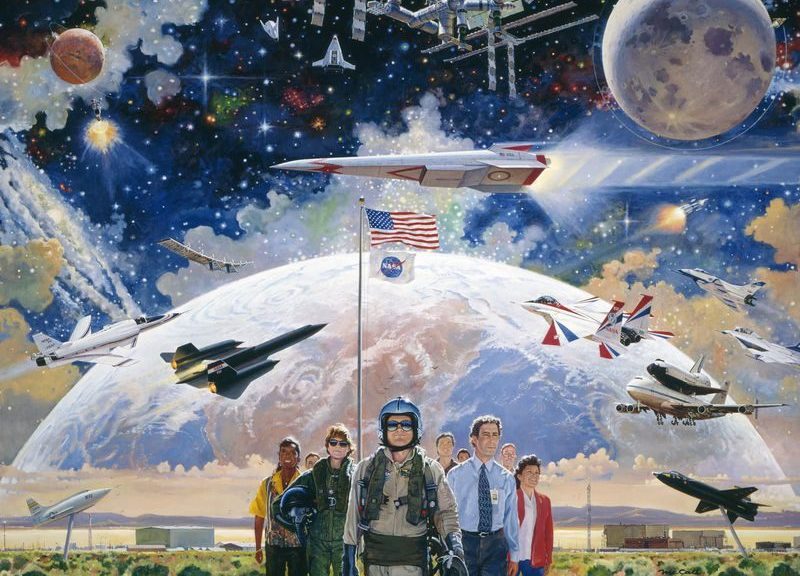
Humanity’s progress into air and space is dramatically illustrated by artist Bob McCall. Does the Moon exist to aid our progress into space? (NASA Armstrong Flight Research Center)
One of the most remarkable books of the last 30 years is The Anthropic Cosmological Principle by John Barrow and Frank Tipler. The “principle” is really nothing more than a statement that the laws governing how the universe operates seem to be arranged so as to require our existence and participation. In other words, the human race is not some accidental byproduct of creation, but an essential component of the way the universe is put together. This philosophical gem came up recently during a wide-ranging discussion of ideas at a post-lecture dinner with media/journalism honors students and their advisors at the University of Texas at Tyler. Though we discussed many things, the anthropic principle came up during questions regarding lunar development. And as good conversation always does, it made me think deeper.
I hadn’t previously connected the Barrow-Tipler principle with a quote (in the same vein) that I use in my lunar development talks. This quote comes from Krafft Ehricke, a member of Wernher von Braun’s original rocket design team from Peenemunde. Ehricke spent a lifetime thinking about the broader, philosophical aspects of space travel and the colonization of other worlds. Ehricke remarked in 1984 that, “If God wanted man to become a spacefaring species, He would have given man a Moon.” Ehricke’s quote distills down to its essence the truth about the Moon’s utility—its singular value in developing new spaceflight capabilities and our ability to travel throughout space. I’m tempted to call Ehricke’s statement “the lunar anthropic principle.”
I’ve detailed in previous writings the Moon’s value. The Moon’s proximity to Earth and its material and energy resources make possible the construction of a permanent spaceflight transportation infrastructure, thereby giving us the means to live and work on another world for extended periods of time. Because the Moon is close (in orbit around the Earth, 400,000 km away) we can travel to and from the Moon at will—launch windows are continuously open. There is no other extraterrestrial body for which this is true.
Our closeness to the Moon (three-second round-trip light travel time) also permits near-real-time control from Earth of machines located on the lunar surface—an amazing advantage in that much of the hard, repetitive or difficult work on the Moon can be accomplished using teleoperated robots. This capability positions humans for more creative pursuits, such as surface exploration, while limiting our exposure to harsh environments, as we build up our knowledge about our new surroundings—valuable information for those planning to venture further out into space.
The Moon’s resources come in two forms: energy and materials. The energy actually comes from the Sun—the Moon provides a place on its surface to collect solar photons nearly continuously. This illumination can be converted into electrical power via solar arrays. The poles offer multiple locations where the Sun can be seen for more than 80-90 percent of the year. The periods of darkness are short, from a few hours to a few tens of hours. We can bridge these dark periods with fuel cells that combine hydrogen and oxygen to generate electrical power, producing water as a byproduct. When the Sun is visible, the power generated by solar arrays can be used to crack stored water into its component hydrogen and oxygen gases. Thus, water becomes a medium of energy storage and permits the continuous generation of power, an essential condition for human habitation and productive work off the Earth.
Fortunately, the other side of the resource coin offers us the feedstock for this power system. The latest round of robotic spacecraft mapping the Moon have found significant quantities of water ice at both poles. The exact amounts and physical state of this water is still uncertain (we need to send robotic landers down to the surface to characterize the deposits in detail), but there is no doubt that the quantities of water present are significant, as much as 10 billion tons of water at each pole.
Thus, there are two areas of the Moon where resources (water and sun) are placed side-by-side: the poles, where the Moon’s axial tilt creates just the right conditions for light (solar energy) and darkness (water ice-traps). Before humans return to the Moon, we must send numerous small robotic probes to the poles to map and survey potential prospects. Such strategic knowledge is critical to selecting the optimum site for a permanent outpost.
The illuminated rim crest of the crater Shackleton, located near the south pole of the Moon. Points on the rim of this crater are illuminated by the Sun for more than 90% of the year, permitting the generation of nearly continuous electrical power. (NASA/ASU LROC)
Considering all of these fortunate coincidences, Ehricke’s conjecture is not far off the mark. No other space destination brings together such enabling proximity and utility as does the Moon. So why is the idea of resource utilization on the Moon still met with resistance by some? Over my long career in lunar studies, I’ve learned that part of this resistance comes from the reluctance of some engineers to consider the use of extraterrestrial materials. We have used solar energy on spacecraft for almost 60 years—it is a proven and well-founded technology. Extracting materials from space-based sources and forming them into useful spaced-based products is another matter. Since this has never been done, it carries with it the undeserved suspicion of being excessively risky. In truth, processing lunar material requires technology no more advanced than 19th-century industrial chemistry. Melt the ice, fractionally distill it to remove impurities, crack it into its component hydrogen and oxygen, then cryogenically freeze those gases for use as rocket propellant.
The Moon is ideally placed and provisioned to provide us what we need to build a permanent transportation and habitation system in space. In that sense, it is a form of the anthropic principle, and it requires human ingenuity to take advantage of what the Moon has to offer. It is a body ideally placed for our use and benefit—a “stepping stone,” if you prefer to see it that way. Of course, all this is enabled by our ability to perceive and decipher the physical laws that make spaceflight possible, again circling back to the original cosmological anthropic principle—that how the universe operates seems to be arranged so as to require our existence and participation.
The ability to simply fly into space and back is somewhat miraculous in itself. What Don Pettit explains as the “Tyranny of the Rocket Equation,” describes how getting into orbit is not only extremely difficult, but barely possible—as most of the mass of a rocket is propellant (what he identifies as “dumb mass”), leaving only a small fraction (usually less than 10 percent) available for the deliverable (“smart mass”) payload. In fact, as Pettit explains, if the radius of the Earth were 50 percent greater, spaceflight would not be possible—there is simply not enough energy in the chemical bonds of known propellants to get a payload to orbit. Again, it appears that our universe is constructed in a way that allows us to venture off the planet, but only “just”—and even then, only with great difficulty.
We can break the Tyranny of the Rocket Equation once we learn how to use what we find in space—first on the Moon, using lunar resources to provision and fuel spacecraft and habitation systems. By utilizing the Moon and its assets over time, flights between Earth and Moon, and all points in between, will become affordable, profitable and routine. Through the development of this new system, we will finally move from an Earth-based to a space-based operational template, one holding huge economic and national security benefits. It’s as if the Moon was created for our use and benefit. To ignore its value and importance to our future would be extremely shortsighted.
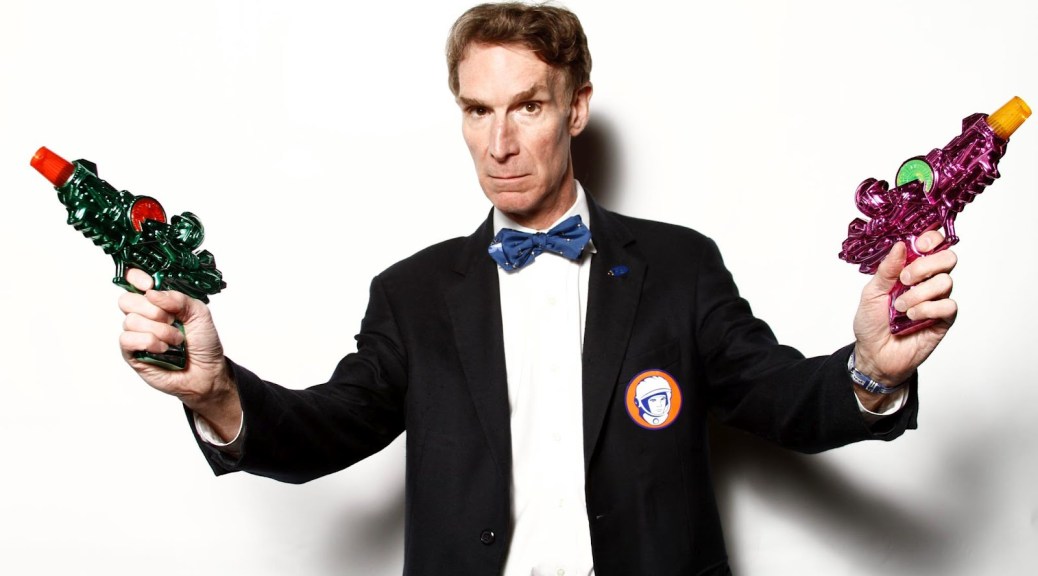
Bill Nye Does Not Speak for Us and He Does Not Speak for Science
By attending the State of the Union with NASA administrator nominee Jim Bridenstine, the Science Guy tacitly endorses climate denial, intolerance and attacks on science
But by attending the SOTU as Rep. Bridenstine’s guest, Nye has tacitly endorsed those very policies, and put his own personal brand over the interests of the scientific community at large. Rep. Bridenstine is a controversial nominee who refuses to state that climate change is driven by human activity, and even introduced legislation to remove Earth sciences from NASA’s scientific mission. Further, he’s worked to undermine civil rights, including pushing for crackdowns on immigrants,a ban on gay marriage, and abolishing the Department of Education.
As scientists, we cannot stand by while Nye lends our community’s credibility to a man who would undermine the United States’ most prominent science agency. And we cannot stand by while Nye uses his public persona as a science entertainer to support an administration that is expressly xenophobic, homophobic, misogynistic, racist, ableist, and anti-science.
Scientists are people, and in today’s society, it is impossible to separate science at major agencies like NASA from other pressing issues like racism, bigotry, and misogyny. Addressing these issues should be a priority, not only to strengthen our own scientific community, but to better serve the public that often funds our work. Rather than wield his public persona to bring attention to the need for science-informed policy, Bill Nye has chosen to excuse Rep. Bridenstine’s anti-science record and his stance on civil rights, and to implicitly support a stance that would diminish the agency’s work studying our own planet and its changing climate. Exploring other worlds and studying other planets, while dismissing the overwhelming scientific evidence of climate change and its damage to our own planet isn’t just dangerous, it’s foolish and self-defeating.
Further, from his position of privilege and public popularity, Bill Nye is acting on the scientific community’s behalf, but without our approval. No amount of funding for space exploration can undo the damage the Trump administration is causing to public health and welfare by censoring science. No number of shiny new satellites can undo the racist policies that make our Dreamer colleagues live in fear and prevent immigrants from pursuing scientific careers in the United States. And no new mission to the Moon can make our LGBTQ colleagues feel welcome at an agency run by someone who votes against their civil rights.
As women and scientists, we refuse to separate science from everyday life. We refuse to keep our heads down and our mouths shut. As someone with a show alleging to save the world, Bill Nye has a responsibility to acknowledge the importance of NASA’s vast mission, not just one aspect of it. He should use his celebrity to elevate the importance of science in NASA’s mission—not waste the opportunity to lobby for space exploration at a cost to everything else.
The true shame is that Bill Nye remains the popular face of science because he keeps himself in the public eye. To be sure, increasing the visibility of scientists in the popular media is important to strengthening public support for science, but Nye’s TV persona has perpetuated the harmful stereotype that scientists are nerdy, combative white men in lab coats—a stereotype that does not comport with our lived experience as women in STEM. And he continues to wield his power recklessly, even after his recent endeavors in debate and politics have backfired spectacularly.
In 2014, he attempted to debate creationist Ken Ham—against the judgment of evolution experts—which only served to allow Ham to raise the funds needed to build an evangelical theme park that spreads misinformation about human evolution. Similarly, Nye repeatedly agreed to televised debates with non-scientist climate deniers, contributing to the false perception that researchers still disagree about basic climate science. And when Bill Nye went on Tucker Carlson’s Fox News show to “debate” climate change in 2017, his appearance was used to spread misinformation to Fox viewers and fundraise for anti-climate initiatives.
Bill Nye does not speak for us or for the members of the scientific community who have to protect not only the integrity of their research, but also their basic right to do science. We stand withothers who have asked Bill Nye to not attend the State of the Union. Nye’s complicity does not align him with the researchers who have a bold and progressive vision for the future of science and its role in society.
At a time when our ability to do science and our ability to live freely are both under threat, our public champions and our institutions must do better.
The views expressed are those of the author(s) and are not necessarily those of Scientific American.
ABOUT THE AUTHOR(S)
500 Women Scientists
500 Women Scientists is a grassroots organization started by four women who met in graduate school at CU Boulder and who maintained friendships and collaborations after jobs and life took them away from Boulder. Immediately following the November 2016 election, we published an open letter re-affirming our commitment to speak up for science and for women, minorities, immigrants, people with disabilities, and LGBTQIA. The mission of 500 Women Scientists is to serve society by making science open, inclusive, and accessible.
What’s the most valuable item you’ve ever transported? We usually associate value with an expensive physical possession, but Tychicus brought something far more precious than gold from a Roman prison to the church in Ephesus. He carried God’s Word, written under the inspiration of the Holy Spirit by the apostle Paul while he was imprisoned.
Tychicus is one of those behind-the-scenes people who worked with Paul. His home was originally in Asia Minor (Acts 20:4), and he is mentioned five times in the New Testament. In all but one of these passages, he is sent somewhere by Paul. Running errands may not seem like a glorious job, but his service for Christ was essential: He delivered Paul’s letters to the Ephesian and Colossian churches along with encouragement and information about the apostle’s circumstances (Col. 4:7-8).
These letters have been instructing, challenging, and encouraging Christians throughout the world ever since. And the job Tychicus had—to deliver Scripture—is a task still entrusted to believers today. God has given us His Word for our benefit but also so we can share it with others. It’s the only sure source of absolute truth because it came directly from God through men who were inspired by His Spirit.
The Bible is our most precious possession. We should treat it with care and share it with fellow believers as well as those who need to know our great God and Savior. The next time you open the Scriptures, ask the Lord to make you like Tychicus, a faithful messenger of His Word.
Shall we accept good from God, and not trouble?—Job 2:10
“It’s cancer.” I wanted to be strong when Mom said those words to me. But I burst into tears. You never want to hear those words even one time. But this was Mom’s third bout with cancer. After a routine mammogram and biopsy, Mom learned that she had a malignant tumor under her arm.
Though Mom was the one with bad news, she had to comfort me. Her response was eye-opening for me: “I know God is always good to me. He’s always faithful.” Even as she faced a difficult surgery, followed up by radiation treatments, Mom was assured of God’s presence and faithfulness.
How like Job. Job lost his children, his wealth, and his health. But after hearing the news, Job 1:20 tells us “he fell to the ground in worship.” When advised to curse God, he said, “Shall we accept good from God, and not trouble?” (2:10). What a radical initial response. Though Job later complained, ultimately he accepted that God had never changed. Job knew that God was still with him and that He still cared.
For most of us, praise is not our first response to difficulties. Sometimes the pain of our circumstances is so overwhelming, we lash out in fear or anger. But watching Mom’s response reminded me that God is still present, still good. He will help us through hard times. —Linda Washington
Lord, prepare me for the times when praise is most difficult to utter.
Is someone hurting? See this special edition of Our Daily Bread: Hope and Strength in Times of Illness at odb.org/hopeandstrength.
Even at our lowest point, we can lift our eyes to the Lord.
INSIGHT: When we suffer we often ask why? But this might not be the best question. When Job’s friends tried to explain away Job’s pain, they angered God (42:7). A better question is Who do we turn to? Job never received an explanation for his pain, but he found that seeing God was answer enough (v. 5).
How has God shown His presence in your pain? Monica Brands
Returning to graduate school in mid-life has re-introduced to me the importance of asking questions. There are the all-important pragmatic questions that involve the mechanics and the specifics of various assignments. Should one use a particular style guide in writing papers, for example, or what material will be covered on the next exam? There are the questions of curiosity about a particular topic or subject, and there are research questions intended to take a student more deeply into the minutiae of her course of study. I often find that questions beget other questions, and many are not as easily answered as when I first began “formal” education. Instead, I am often led from one question to another on this journey of inquiry that is often only tangentially related to the original question.
When this happens, I wonder whether or not I am in fact asking the “right” questions which would generate answers. Perhaps inquiring into the motivation behind the questions is an even more important task. Do I simply ask out of curiosity? Or am I asking in order to fill my head with as many possible answers as there are question? Or do I continually ask questions as a way of blocking answers—answers that I may not want to hear, or to receive. Of course, asking questions is one of the wonderful qualities of being human. And anyone who has spent even a small amount of time around young children knows that asking questions about every possible subject preoccupies their early verbal expressions.










 DAILY DEVOTIONS, NEWS AND INFORMATION