In Antioch the disciples were first called Christians. (v. 26)
Despite Jesus’ instruction to go out in the power of the Spirit as witnesses to the ends of the earth (Acts 1:8), the apostles seemed quite content to hang around Jerusalem. Things were going well for the church there. They had a few problems, to be sure, but they saw great growth as well. It took the persecution that broke out with Stephen’s martyrdom to get the church moving outward. Those who fled Jerusalem began to witness wherever they went, though at first they only shared the gospel with their fellow Jews. But then some anonymous believers from Cyprus and Cyrene took the momentous step of speaking directly to Gentiles about the Lord, in the city of Antioch in Syria, one of the major urban centers of the Mediterranean world. As a result a church sprang up there and began to grow rapidly.
The clue to this success is found in a nickname. Antioch was where the disciples were first called “Christians.” Christos is the Greek word for “Messiah,” or “Anointed One.” In Antioch these early believers kept talking about Jesus, their Messiah. Jews knew all about the Messiah, but it was a foreign term for Gentiles—so much so that they took it as a proper name. So Jesus the Messiah became Jesus Christ. And his followers became known as the Christianoi—the Christians. They talked so much about Jesus that his title became their name. And so the church increased. —David Bast
Prayer: Lord, I claim your title as my name. Anoint me with your Spirit to live for you.
What is your response when you read that David was a man after God’s own heart? (See 1 Samuel 13:14.) Many of us look up to him as a spiritual giant and think to ourselves, I could never be like that.
But the Lord hasn’t reserved this title for just one man. He wants all of us to seek Him as David did. One of our problems is the tendency to focus on just part of his story. We tend to forget that the scriptural account gives a record of David’s lifetime. He had to begin pursuing the Lord the same way we do—one step at a time.
A hunger for the heavenly Father doesn’t ordinarily appear all of a sudden, fully matured, in one’s heart. Most of the time, it’s something that must be cultivated, and the best place to begin is the Bible. That’s where we listen to the Lord as He speaks to us in His Word.
Another essential element is prayer. As you read His words, start talking to Him. If it all seems dry and meaningless, ask Him to work in your life to make Scripture come alive. He loves to answer prayer in accordance with His will.
The next step is meditation. Don’t “put in your time” so you can say you’ve read your Bible. Slow down and deliberately think about what you’ve read, asking, What am I discovering about God?
The last step is to commit. A hunger for God may not develop right away, but remember, you’re working for a changed heart that will last a lifetime, not a fleeting emotional experience. Continue to fill up with the fuel that brings transformation—the Word, prayer, and meditation.
If one part suffers, every part suffers with it; if one part is honored, every part rejoices with it. 1 Corinthians 12:26
When a coworker called in sick due to extreme pain, everyone at the office was concerned. After a trip to the hospital and a day of bed rest, he returned to work and showed us the source of that pain—a kidney stone. He’d asked his doctor to give him the stone as a souvenir. Looking at that stone, I winced in sympathy, remembering the gallstone I had passed years ago. The pain had been excruciating.
Isn’t it interesting that something so small can cause a whole body so much agony? But in a way, that’s what the apostle Paul alludes to in 1 Corinthians 12:26: “If one part suffers, every part suffers with it.” Throughout chapter 12, Paul used the metaphor of a body to describe Christians around the world. When Paul said, “God has put the body together” (v. 24), he was referring to the entire body of Christ—all Christians. We all have different gifts and roles. But since we’re all part of the same body, if one person hurts, we all hurt. When a fellow Christian faces persecution, grief, or trials, we hurt as if we’re experiencing that pain.
If one part suffers, every part suffers with it; if one part is honored, every part rejoices with it. 1 Corint
My coworker’s pain drove him to get the help his body needed. In the body of Christ, someone’s pain ignites our compassion and moves us toward action. We might pray, offer a word of encouragement, or do whatever it takes to aid the healing process. That’s how the body works together.
Lord, please give peace to those who are persecuted or in pain. Your family is my family too.
We’re in this together.
By Linda Washington
INSIGHT
Paul often uses the metaphor of the body to represent the church (see Romans 12:3–5; Ephesians 1:22–23; 4:12–13; Colossians 1:18; 2:19). In today’s passage he makes the observation that we’re not only to share each other’s pain but also to rejoice in the blessings other believers receive. Surprisingly we may find that more difficult.
Do you find it easier to share in others’ pain or in their joy?
For one family in Venezuela, the space between death and life was filled with more shock than usual. After a serious car accident, Carlos Camejo was pronounced dead at the scene. Officials released the body to the morgue and a routine autopsy was ordered. But as soon as examiners began the autopsy, they realized something was gravely amiss: the body was bleeding. They quickly stitched up the wounds to stop the bleeding, a procedure without anesthesia which, in turn, jarred the man to consciousness. “I woke up because the pain was unbearable,” said Camejo.(1) Equally jarred awake was Camejo’s wife, who came to the morgue to identify her husband’s body and instead found him in the hallway—alive.
Enlivened with images from countless forensic television shows, the scene comes vividly to life. Equally vivid is the scientific principle utilized by the doctors in the morgue. Sure, blood is ubiquitous with work in a morgue; but the dead do not bleed. This is a sign of the living.
Thought and practice in Old Testament times revolved around a similar understanding—namely, the life is in the blood. It is this notion that informs the expression that “blood is on one’s hands” when life has wrongfully been taken. When Cain killed his brother Abel, God confronted him in the field, “Listen! Your brother’s blood cries out to me from the ground.” For the ancient Hebrew, there was a general understanding that blood is the very substance of our createdness, that in our blood is the essence of what it means to be alive. There is life in the blood; there is energy and power.
And let us not lose heart and grow weary and faint in acting nobly and doing right, for in due time and at the appointed season we shall reap, if we do not loosen and relax our courage and faint. — Galatians 6:9 (AMPC)
“I’ve been a Christian for twenty-three years,” Cheryl said. “I’m just not getting anywhere. I’m as weak as I was when I first accepted Christ as my Savior. I still fail. I just don’t know if it’s worth it.”
Tears streamed down her cheeks as she continued to talk about her failures. “By now I know all the right things to do, but I don’t do them. Sometimes I deliberately do something mean-spirited or unkind. What kind of Christian am I?”
“Probably a growing Christian,” I said.
A startled look appeared on Cheryl’s face. “Growing? Did you hear—?”
“Yes, I heard. But if you weren’t growing, you wouldn’t lament your failures. You’d be satisfied about your spiritual level or tell yourself how good you are.”
“But I’m so discouraged, and I fail God so many times.”
I went on to tell Cheryl she was correct—that she had failed. All of us do at times. None of us is perfect. If we’re not careful, we allow Satan to point to what we haven’t accomplished and where we have been weak. When that happens, it’s easy to feel bad or want to give up.
That’s not the way of the Spirit. No matter how we mess up our lives, God doesn’t give up on us. The Spirit constantly nudges us.
We can allow our thoughts to dwell on what we haven’t done, why we ought to be more spiritual, or how spiritual we ought to be after all these years in our Christian faith. That’s a trick of the enemy—to make us think of our defects and shortcomings. If we focus on what we’re not or what we haven’t accomplished, we are allowing Satan to make advances on the battlefield of our minds.
The fact that my troubled friend was upset was a healthy sign, even though she didn’t see it that way. With the Holy Spirit’s help, she can push back the enemy. She can regain the territory Satan has stolen from her.
Cheryl seemed to think that holy, victorious living came from one major victory after another. Yes, we do have times when we have great breakthroughs; however, most of our victories come slowly. They come little by little. It’s as if we inch forward.
Because we move slowly in our spiritual growth, we are often unaware of how far we have moved. If the enemy can make us think that we must have one decisive spiritual victory after another or we’re losers, he has gained an important stronghold.
My advice to Cheryl, and to all Christians who face those dark moments, is to listen to the words of the apostle Paul. He exhorted us not to grow weary, or as another translation says it, “not to lose heart.” He’s saying, “Don’t quit. Keep fighting.”
Life is a struggle, and Satan is determined to defeat and destroy us. We don’t ever reach the place where we never have to fight. But it’s not just our fight. Jesus is not only with us, but He is for us. He’s at our side to strengthen us and to urge us onward.
My friend kept remembering the times she had failed, but I reminded her of the times she had succeeded. “You think the enemy is in control, but that’s not true. You have failed, but you have also succeeded. You have stood your ground and you have made progress.”
“Don’t quit. Don’t give up.” That’s the message we need to hear. I think of the words of Isaiah: “Fear not, for I have redeemed you…; I have called you by your name; you are Mine. When you pass through the waters, I will be with you, and through the rivers, they will not overwhelm you. When you walk through the fire, you will not be burned or scorched, nor will the flame kindle upon you” (Isaiah 43:1b–2).
This is God’s promise. He doesn’t promise to take us completely out of troubles or hardships, but He does promise to be with us as we go through them. “Fear not,” He says. That’s the message we need to ponder. We don’t need to fear because God is with us. And when God is with us, what is there to worry about?
Prayer Starter: God, despite my failures, I know You are with me, encouraging me to never give up. Please help me to focus on how far I have come and strengthen me to keep moving forward and make progress, even in the tough times. Thank you for never giving up on me. In Jesus’ Name, Amen.
“That out of His glorious, unlimited resources He will give you the mighty inner strengthening of His Holy Spirit” (Ephesians 3:16).
In Christ are all the attributes and characteristics promised to His children as the fruit of the Spirit. And the Holy Spirit was given to glorify Christ.
Do you need love?
The Lord Jesus Christ is the incarnation of love. Paul prays that our roots may “go down deep into the soil of God’s marvelous love; and may you be able to feel and understand, as all God’s children should, how long, how wide, how deep and how high His love really is; and to experience this love for yourselves (though it is so great that you will never see the end of it, or fully know or understand it”) (Ephesians 3:17-19).
Do you need peace?
Christ is the “Prince of Peace.” “I am leaving you with a gift,” said Jesus, “peace of mind and heart! And the peace I give isn’t fragile like the peace the world gives” (John 14:27).
I’m sure you’ve had an appliance you may have tried to fix, but with no success. So you took it to the specialist. You explained the problem and then…offered to stay and help fix it? or hovered at the workbench asking questions about the progress? How about threw a sleeping bag on the floor so you could watch the repairman at work? If you did any of these things, you don’t understand the relationship between client and repairman. The arrangement is uncomplicated. Leave it with him to fix it!
Our protocol with God is equally simple. Leave your problem with him. God doesn’t need our help, counsel, or assistance. Please repeat this phrase: I hereby resign as ruler of the universe. When God is ready for us to re-engage, he will let us know. Until then, replace anxious thoughts with grateful ones. God takes thanksgiving seriously!
Read more Anxious for Nothing
For more inspirational messages please visit Max Lucado.
Welcome to the first Friday the 13th this year. (You can look forward to another one in July.) If you’re afraid of today, you might have “paraskevidekatriaphobia” (from the Greek words for “Friday” and “thirteen”).
If so, you’re not alone.
The Stress Management Center and Phobia Institute estimates that seventeen to twenty-one million people in the US are afraid of this day. Some avoid doing business, taking flights, or even getting out of bed. As much as $900 million is lost in productivity as a result.
Here’s the good news: studies seem to indicate that fewer calamities occur on this day, perhaps because people are more careful or choose to stay home.
“Unease and fears of misfortune”
I can see why people would feel afraid today.
France’s President Emmanuel Macron says he has “proof” that the Syrian government used chemical weapons to attack the town of Douma last weekend. According to today’s BBC News, Russia is warning the US that retaliatory air strikes in Syria could spark a war between the two countries.
Today’s Wall Street Journalreports that the White House plans to escalate trade pressure against China. In response, the Chinese are aligning countries against the US, especially in Europe.
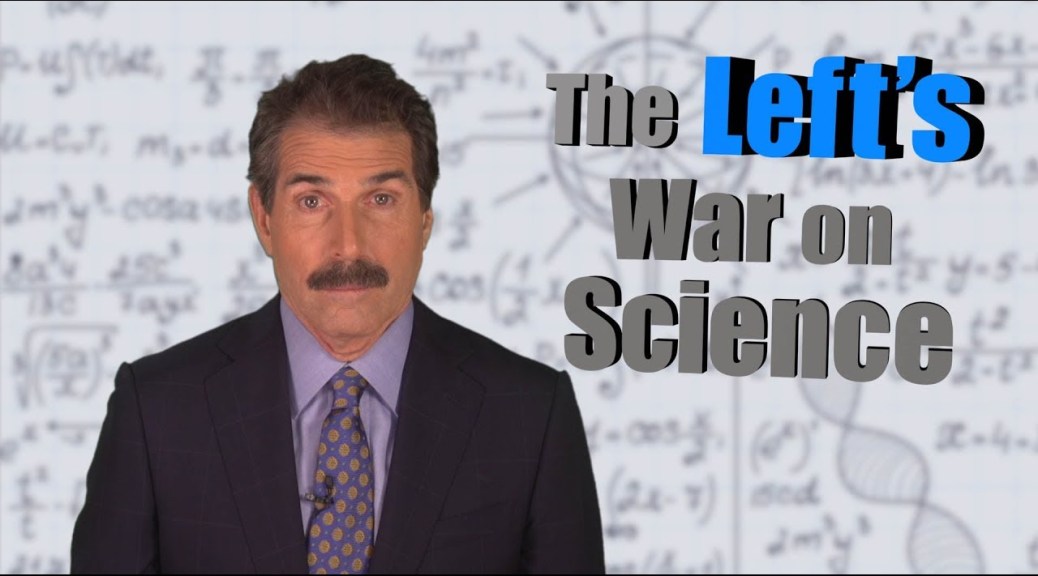
We’ve been told conservatives don’t believe in science and that there’s a “Republican war on science.”
But John Tierney, who’s written about science for The New York Times for 25 years and now writes for the Manhattan Institute’s City Journal, told me in my latest online video, “The real war on science is the one from the left.”
Really? Conservatives are more likely to be creationists — denying evolution.
“Right,” says Tierney. “But creationism doesn’t affect the way science is done.”
What about President George W. Bush banning government funding of stem cell research?
“He didn’t stop stem cell research,” Tierney reminds me. “The government wouldn’t fund it. It turned out that it really didn’t matter much.” Private funding continued and, so far, has not discovered much.
“People talk about this Republican war on science, but if you look around, my question is, where are the casualties? What scientists lost their jobs?” asks Tierney. “I can’t find examples where the right wing stopped the progress of science, whereas you can look on the left and you see so many areas that are taboo to research.”
Some research on genetically modified foods became taboo because of protests from the left. That may have prevented a second Green Revolution to feed Africa.
Scientists can’t even talk about whether genes affect intelligence without being threatened by the left. Political scientists who continued to investigate the topic are screamed at on college campuses, the way Charles Murray, author of “The Bell Curve,” has been.
Tierney adds, “The federal government stopped funding IQ research decades ago.”
Likewise, researching gender differences is dangerous to your career.
“You can’t talk about sexual differences between men and women, (although) it’s OK if they favor women,” laughs Tierney. “You can say men are more likely to commit crimes, but you can’t suggest that there might be some sexual difference that might predispose men to be more interested in a topic.”
Google fired engineer James Damore merely for suggesting that sex differences might explain why more men choose to work in tech.
“Damore just pointed out very basic scientific research about differences between the sexes,” argues Tierney. “The experts in this, as soon as he published that memo, said, yes, he basically got the science right.”
It’s not as if women aren’t doing well in life, says Tierney.
In universities, “women dominate virtually every extracurricular activity, but all the focus has been: ‘Why aren’t there more women physicists and mathematicians, and of course in the sports area, too?'” says Tierney. “There’s this idea that they’re being discriminated against, (but) there have been enormous studies of who gets grants, who gets tenure, who gets interviews for jobs, and women get preference.”
However, one group does get discriminated against in colleges: conservatives.
“In the social sciences, Democrats outnumber Republicans by at least eight to one. In fields like sociology it’s 44 to one. Students are more likely to be taught in sociology by a Marxist than by a Republican,” says Tierney. “It’s gotten worse and worse.”
Why does this happen at colleges that claim they “treasure diversity”? Because people on the left believe diversity just means race and gender, not thought. And even schools that want some diverse thought reach a sort of political tipping point.
“Once an academic department gets a majority of people who are on the left, they start hiring people like themselves, and soon the whole department is that way,” says Tierney. “They start to think that their opinions and that their interests are not only the norm, but the truth.”
That’s how we get “scientific” studies that “prove” conservatives are stupid.
One such study asked people if they agree with the statement “Earth has plenty of natural resources if we just learn how to develop them.” The researcher called a “yes” answer an “irrational denial of science.” But anyone who’s studied economics knows the statement has repeatedly been proven true.
Finally, millions of people die of malaria today partly because many countries believed leftist junk science and needlessly banned DDT. Many were influenced by Rachel Carson’s scientifically challenged book “Silent Spring.”
There is a war on science. But most of it doesn’t come from the right.
What is your response when you read that David was a man after God’s own heart? (See 1 Samuel 13:14.) Many of us look up to him as a spiritual giant and think to ourselves, I could never be like that.
But the Lord hasn’t reserved this title for just one man. He wants all of us to seek Him as David did. One of our problems is the tendency to focus on just part of his story. We tend to forget that the scriptural account gives a record of David’s lifetime. He had to begin pursuing the Lord the same way we do—one step at a time.
A hunger for the heavenly Father doesn’t ordinarily appear all of a sudden, fully matured, in one’s heart. Most of the time, it’s something that must be cultivated, and the best place to begin is the Bible. That’s where we listen to the Lord as He speaks to us in His Word.
Another essential element is prayer. As you read His words, start talking to Him. If it all seems dry and meaningless, ask Him to work in your life to make Scripture come alive. He loves to answer prayer in accordance with His will.
The next step is meditation. Don’t “put in your time” so you can say you’ve read your Bible. Slow down and deliberately think about what you’ve read, asking, What am I discovering about God?
The last step is to commit. A hunger for God may not develop right away, but remember, you’re working for a changed heart that will last a lifetime, not a fleeting emotional experience. Continue to fill up with the fuel that brings transformation—the Word, prayer, and meditation.
Read: 1 Thessalonians 1:1–3 | Bible in a Year: 1 Samuel 19–21; Luke 11:29–54
We always thank God for all of you. 1 Thessalonians 1:2
For ten years, my Aunt Kathy cared for her father (my grandfather) in her home. She cooked and cleaned for him when he was independent, and then took on the role of nurse when his health declined.
Her service is one modern example of the words of Paul who wrote to the Thessalonians that he thanked God for “your work produced by faith, your labor prompted by love, and your endurance inspired by hope in our Lord Jesus Christ” (1 Thessalonians 1:3).
Be encouraged as you do the work God has called you to do.
My aunt served in faith and love. Her daily, consistent care was the result of her belief that God called her to this important work. Her labor was borne out of love for God and her father.
She also endured in hope. My grandfather was a very kind man, but it was difficult to watch him decline. She gave up time with family and friends, and limited travel to care for him. She was able to endure because of the hope that God would strengthen her each day, along with the hope of heaven that awaited my grandfather.
Whether it is caring for a relative, helping a neighbor, or volunteering your time, be encouraged as you do the work God has called you to do. Your labor can be a powerful testimony of faith, hope, and love.
Lord, may I this day have eyes to see others’ needs, direction from You on any ways I might help, and the Spirit’s power to obey. May I live out the faith, love, and hope You’ve given to me.
The glory of life is to love, not to be loved; to give, not to get; to serve, not to be served.
By Lisa Samra
INSIGHT
The Thessalonian church was a “model” church known for her “faith in God” (1 Thessalonians 1:7–8). The church was commended for her “faithful work, [her] loving deeds, and . . . enduring hope” (v. 3 nlt). This trilogy of faith, love, and hope is a mark of spiritual growth and maturity. The work God has called us to do is characterized by our love for God and our neighbor (Luke 10:27). To love is hard work, for it is something we have to learn to do. And we “have been taught by God to love each other” (1 Thessalonians 4:9). Paul aptly calls it a “labor of love” (1:3 esv, emphasis added). Highlighting Christ’s second coming at the end of each chapter (1:10; 2:19; 3:13; 4:15; 5:23), Paul speaks of our “endurance inspired by hope in our Lord Jesus Christ” (1:3). Speaking of this trilogy of “faith, love, and hope” elsewhere, Paul says, “Three things will last forever—faith, hope, and love—and the greatest of these is love” (1 Corinthians 13:13 nlt).
Is your life characterized by faithful work, loving deeds, and enduring hope?
There is something deeply unsettling about biological threats. The very idea of unseen but deadly toxins or viruses is a modern nightmare. The sad thing is that we have too many actual examples to fuel our fears. For multitudes in the industrial town of Bhopal, India, a normal working day turned into a catastrophe of biblical proportions as people were poisoned and killed by gas leaking from a local factory. Similarly catastrophic, the events surrounding the reactor at the Chernobyl Nuclear Power Plant in Ukraine combined the worst of leftover Soviet era paranoia and secrecy with a calamity of truly mind-boggling proportions. Hundreds of young men were ushered in to fight a fire, knowing nothing of the deadly radiation saturating the area, and as a result, thousands died. And of course, the recent chemical attacks in Syria were heartrending.
The weight and power of these deadly issues grips us. We feel it acutely. There are things in our universe that are invisible, but real and sometimes deadly. And there are few guaranteed fail-safe mechanisms to protect us, in all circumstances, from harm. This feeling of vulnerability, this sense that there are things beyond our control, this notion of powerlessness is something the modern mind finds repulsive. We want security, we demand certainty, and we feel entitled to assurance. But what is this assurance, and where is it to be found?
For God did not give us a spirit of timidity or cowardice or fear, but [He has given us a spirit] of power and of love and of a sound judgment and personal discipline [abilities that result in a calm, well-balanced mind and self-control]. — 2 Timothy 1:7
Brave: Courageous; bold; daring; intrepid; fearless of danger; as a brave warrior.
The only way to conquer fear is to confront it and to do the thing you are afraid of. If you don’t, you will be a prisoner all your life.
When we do confront things, we always think that the worst part of the fear was in our minds, and the reality of the thing wasn’t as bad as we had imagined.
If you truly want to be free, understand that facing a fear is better than being afraid all your life. Fear is a terrible burden to live with.
Bravery to overcome life’s fears comes when you ask God for His help, trust He is with you, and face that fear head-on.
Prayer Starter: Father, Your Word tells me to “fear not.” Help me today to place my trust in You and face the fears that are holding me back. Help me to step out…even if I have to “do it afraid.” In Jesus’ Name, Amen.
“Abide in Me, and I in you. As the branch cannot bear fruit of itself, except it abide in the vine; no more can ye, except ye abide in Me. I am the vine, ye are the branches: He that abideth in Me, and I in him, the same bringeth forth much fruit: for without Me ye can do nothing” (John 15:4,5, KJV).
As a young man in college and later in business, I used to be very self-sufficient – proud of what I could do on my own. I believed that a man could do just about anything he wanted to do through his own effort, if he were willing to pay the price of hard work and sacrifice, and I experienced some considerable degree of success.
Then, when I became a Christian, the Bible introduced me to a whole new and different philosophy of life – a life of trusting God for His promises. It took me a while to see the fallacy and inadequacy of trying to serve God in my own strength and ability, but that new life of faith in God finally replaced my old life of self-sufficiency.
Now, I realize how totally incapable I am of living the Christian life, how really weak I am in my own strength, and yet how strong I am in Christ. God does not waste our ability and training. We do not lay aside our God-given gifts and talents. We give them back to Him in service, and He multiplies them for His glory.
As Paul says, “I can do all things through Him [Christ] who strengthens me” (Philippians 4:13, NAS). In John 15, the Lord stresses the importance of drawing our strength from Him:
“Take care to live in Me, and let Me live in you. For a branch cannot produce fruit when severed from the vine. Nor can you be fruitful apart from Me. Yes, I am the vine; you are the branches. Whoever lives in Me and I in him shall produce a large crop of fruit. For apart from Me, you can’t do a thing” (John 15:4,5). Our strength, wisdom, love and power for the supernatural life come from the Lord alone.
Bible Reading:John 15:6-11
TODAY’S ACTION POINT: I will make it a special goal to abide in Christ so that His life-giving power for supernatural living will enable me to bear much fruit for His glory.
Is God sovereign over your circumstances? Is he mightier than your problem? Does he have answers to your questions? The Bible says yes, yes, and yes! “God is the blessed controller of all things, the king over all kings and the master of all masters” (1 Timothy 6:15 Phillips).
Rejoice in the Lord. This is step one. Don’t hurry past it. Face God before you face your problem. Then you will be ready to “let your requests be made known to God” (Philippians 4:6).
Fear triggers either despair or prayer. Choose wisely. Jesus said, “Ask, and it will be given to you; seek, and you will find; knock and it will be opened to you” (Matthew 7:7). There’s no uncertainty in that promise. Jesus states unflinchingly that when you ask, he listens. So ask!
Read more Anxious for Nothing
For more inspirational messages please visit Max Lucado.
House Speaker Paul Ryan announced yesterday that he would not run for reelection this fall and would retire in January. He has three teenage children; the oldest just turned sixteen, the age Ryan was when his father died.
“My kids aren’t getting any younger,” Ryan said, “and if I stay, they’ll only know me as a weekend dad. That’s it right there.”
It didn’t take long for critics to respond.
One of the Democrats running for Ryan’s House seat immediately posted a fundraising message: “We repealed Paul Ryan—now it’s time to replace him with Randy Bryce.” Another Democrat called him “the first casualty of the 2018 midterm election.” While a Democrat who disagreed with Ryan on policy issues “found him to be a good man with a kind heart,” a scathing article called him “the biggest fraud in American politics.”
I sometimes like to walk through a cemetery and read the epitaphs. It’s interesting to see the words that have been chosen to sum up a person’s life. This may seem like a morbid pastime, but it’s actually a helpful way to reassess one’s own life. We’re each going to leave a testimony of some kind when we die. Have you ever wondered what your loved ones will remember about you? What words do you want inscribed on your gravestone?
In today’s passage, the apostle Paul tells us how God saw David—as “a man after My heart, who will do all My will” (Acts 13:22). What an awesome testimony of a life well lived! Though David wasn’t a perfect man, he was one whose life was centered on God’s interests and desires.
David’s many psalms attest to the fact that his relationship with the Lord was the most important aspect of his life. His passion was to obey God and carry out His will. However, that doesn’t mean he was always obedient. Who can forget his failure with Bathsheba? But even when he sinned by committing adultery and murder, his heart was still bent toward God. The conviction he felt and his humble repentance afterward proved that his relationship with the Lord was still his top priority.
If God wrote a summary of your life, how would He describe you? Does your heart align with His, or have you allowed it to follow the pleasures and pursuits of this world? Unless we diligently pursue our relationship with the Lord, we will drift away from Him. Maybe it’s time for a course correction.
How long, Lord? Will you forget me forever? How long will you hide your face from me? Psalm 13:1
In Lewis Carroll’s classic Alice in Wonderland, Alice asks, “How long is forever?” The White Rabbit responds, “Sometimes, just one second.”
That’s how time felt when my brother David suddenly died. The days leading to his memorial dragged on, intensifying the sense of loss and grief we felt. Every second seemed to last forever.
In our seemingly endless moments of struggle, His unfailing love will carry us.
Another David echoed this sentiment, singing, “How long, Lord? Will you forget me forever? How long will you hide your face from me? How long must I wrestle with my thoughts and day after day have sorrow in my heart? How long will my enemy triumph over me?” (Psalm 13:1–2). Four times in just two verses he asks God, “How long?” Sometimes the pains of life seem as though they will never end.
Into this heartache steps the presence and care of our heavenly Father. Like King David, we can honestly go to Him with our pain and loss, knowing that He will never leave us or forsake us (Hebrews 13:5). The psalmist discovered this as well, allowing his lament to move from a mournful minor key to a triumphant declaration: “But I trust in your unfailing love; my heart rejoices in your salvation” (Psalm 13:5).
In our seemingly endless moments of struggle, His unfailing love will carry us. We can rejoice in His salvation.
For more insight, download the Discovery Series booklet Out of the Ashes: God’s Presence in Job’s Pain at discoveryseries.org/q0735.
In times of pain and loss, the timeless God is our greatest comfort.
By Bill Crowder
INSIGHT
Scholars disagree on the circumstances that prompted David to write Psalm 13. Some say that David’s enemy was Saul, who continually pursued David, seeking to kill him (v. 2). Others see the enemy as David’s son Absalom who conspired to drive David from the throne and take over as king (2 Samuel 15). Either way, the heartache David feels is real—driving him to God for help. David’s first response to these pressures is to complain about God’s seeming lack of response on his behalf, found in the repeated question “How long?” in Psalm 13:1–2. As David reflects on God’s past expressions of faithful love (v. 5), he finds reason to trust God even in his confusion and doubt. The closing note of praise (v. 6) expresses that trust—and anticipates God’s rescue.
When overwhelmed with the circumstances of life, do you find yourself wondering where God is? As you reflect on God’s faithfulness to you in the past it can remind you that He is worthy of your trust—even when you suffer and don’t know why.
Though there are no doubt those among us who would not believe on any amount of evidence that something so unusual as the resurrection could happen, there are countless others who are asking perceptive questions: What happened on that first Easter morning? Why would the disciples go to their deaths making such an outrageous claim? And why does the rise of Christianity remain a challenge unanswered?
Such questions are a good starting point for anyone, and often—like the resurrection for those who first beheld it—the questioner is moved quickly from historical matters below to matters far above. As N.T. Wright notes:
“[T]he challenge [of the resurrection] comes down to a much narrower point, not simply to do with worldviews in general, or with ‘the supernatural’ in particular, but with the direct question of death and life, of the world of space, time and matter and its relation to whatever being there may be for whom the word ‘god,’ or even ‘God,’ might be appropriate. Here there is, of course, no neutrality.”(1)
The earliest creeds confess Jesus as one who “suffered under Pontius Pilate, was crucified, died, and was buried…. [And] on the third day he rose again.”(2) The writers of these creeds confessed the suffering of Jesus as a datable event, his crucifixion as an occurrence in history. Even “three days later” is a confession of a historical, quantifiable occasion—albeit an occasion wholly unprecedented.
Behold, here is what I have seen to be good and fitting: to eat and drink, and to find enjoyment in all the labor in which he labors under the sun during the few days of his life which God gives him—for this is his [allotted] reward. — Ecclesiastes 5:18
If we do the same thing over and over, sooner or later we’re going to get bored. We don’t have to wait for something nice to happen to us, we can be aggressive and do something nice for ourselves. For many of you, I know this is a new thought that may seem foreign and even unspiritual. But I can assure you that it is part of God’s plan. You can create variety, and it will keep your life more exciting.
I sat with my computer on my lap for about four hours this morning and then stopped for a while to do some other things I needed to do. When I went back to my writing, I decided to sit in a different part of the house just for variety. I chose a place that had plenty of light where I could look out the window. Simple little things like this cost nothing, but they are very valuable.
No day needs to be ordinary if we realize the gift God is giving us when He gives us another day to live and enjoy. An extraordinary attitude can quickly turn an ordinary day into an amazing adventure. Jesus said He came so that we might have and enjoy life (see John 10:10). If we refuse to enjoy it, then it’s no one’s fault but our own.
I would like to suggest that you take responsibility for your joy and never again give anyone else the job of keeping you happy. Add a little variety to your life—break up your routine, do something different, and so on. When you do, expect God to meet you and help make your ordinary…extraordinary!
Prayer Starter: Father, thank You for Your unconditional love. Help me to receive Your love and see myself the way You see me. Please allow Your love to flow to me and through me to other people. In Jesus’ Name, Amen.









 DAILY DEVOTIONS, NEWS AND INFORMATION