Max Lucado – Sculpted From Nothing Into Something


Listen to Today’s Devotion

You are more than statistical chance, a marriage of heredity and society. Thanks to God, you have been “sculpted from nothing into something.” (Psalm 139:15). He made you you-nique. Secular thinking, as a whole, doesn’t buy this. Society simply says, “You can be anything you want to be.” But can you?

God never prefabs or mass-produces people. “I make all things new,” he declares! Revelation 21:5). So, you can do something no one else can do in a fashion no one else can do it.  “Make a careful exploration of who you are and the work you have been given, and then sink yourself into that” (Galatians 6:4). When you do the most what you do the best, you put a smile on God’s face. What could be better than that?

Read more Cure for the Common Life

For more inspirational messages please visit Max Lucado.

Home

Denison Forum – Man bitten by severed head of rattlesnake

A man in Texas nearly died when he was bitten by the severed head of a four-foot rattlesnake.

Jennifer Sutcliffe told a Corpus Christi news station that her husband had been clearing their yard over Memorial Day weekend when he saw and decapitated the snake. When he picked up the dead rattlesnake to dispose of it, the head bit him and released an almost fatal amount of venom.

He was flown to a hospital and treated with twenty-six doses of antivenom.

“When poisons become fashionable”

Like the dead rattlesnake, our crucified “old self” can still attack us.

Paul declared, “We know that our old self was crucified with [Christ] in order that the body of sin might be brought to nothing, so that we would no longer be enslaved to sin. For one who has died has been set free from sin” (Romans 6:6–7).

And yet the apostle admitted, “I know that nothing good dwells in me, that is, in my flesh. For I have the desire to do what is right, but not the ability to carry it out. For I do not do the good I want, but the evil I do not want is what I keep on doing. Now if I do what I do not want, it is no longer I who do it, but sin that dwells within me” (Romans 7:18–20).

Is his dilemma familiar to you? It is to me.

Some sins in the news are beyond our comprehension. For instance, an Arkansas man admitted in court this week that he intentionally contracted HIV so he could expose others to the virus. He also pled guilty to several other heinous crimes.

Continue reading Denison Forum – Man bitten by severed head of rattlesnake

Charles Stanley – Running With Endurance


Hebrews 12:1-3

A marathon is a taxing race. The runner must overcome muscle cramps, blisters, and the urge to quit. But each step reaffirms his commitment to keep going until he triumphantly crosses the finish line.

In many ways, this is what the Christian life is like. It’s not a fast sprint to heaven but a long, obedient marathon. There are obstacles that could cause us to stumble and burdens we need to lay aside so we can run unencumbered.

The one word that summarizes our earthly race is endurance. This term implies going through something difficult without quitting. It includes the concept of abiding under hardship with patient, sustaining perseverance. Christ hasn’t promised us an easy life. In fact, He told His disciples, “In the world you have tribulation” (John 16:33).

How can we keep going? The answer is to fix our eyes on Jesus, not on the hardships and obstacles in our life. He set the pattern for us by enduring the cross for the joy set before Him. To focus on the Lord, we must read the Scriptures. Then we’ll be able to see what He would have us do, how we’re to respond to various situations in life, which resources He’s provided to help us, and what He has promised us at the finish line.

The joy set before us includes an imperishable, undefiled inheritance reserved for us in heaven (1 Peter 1:4) and an eternal weight of glory far beyond comparison to our earthly suffering (2 Corinthians 4:17). But best of all, when we finally cross the finish line, we will enter into Christ’s presence to be with Him forever.

Bible in One Year: Job 26-30


http://www.intouch.org/

Our Daily Bread — And in Truth


Read: Zephaniah 1:1–6; 2:1–3 | Bible in a Year: 2 Chronicles 28–29; John 17

In his love he will no longer rebuke you, but will rejoice over you with singing. Zephaniah 3:17

Years ago, I attended a wedding where two people from different countries got married. Such a blending of cultures can be beautiful, but this ceremony included Christian traditions mixed with rituals from a faith that worshiped many gods.

Zephaniah the prophet pointedly condemned the mixing of other religions with faith in the one true God (sometimes called syncretism). Judah had become a people who bowed in worship to the true God but who also relied on the god Molek (Zephaniah 1:5). Zephaniah described their adoption of pagan culture (v. 8) and warned that as a result God would drive the people of Judah from their homeland.

Yet God never stopped loving His people. His judgment was to show them their need to turn to Him. So Zephaniah encouraged Judah to “Seek righteousness, seek humility” (2:3). Then the Lord gave them tender words promising future restoration: “At that time I will gather you; at that time I will bring you home” (3:20).

It’s easy to condemn examples of obvious syncretism like the wedding I attended. But in reality, all of us easily blend God’s truth with the assumptions of our culture. We need the Holy Spirit’s guidance to test our beliefs against the truth of God’s Word and then to stand for that truth confidently and lovingly. Our Father warmly embraces anyone who worships Him in the Spirit and in truth (see John 4:23–24).

When I am in trouble, where do I turn? A crisis reveals where I put my trust. Is my faith completely in God? What do I need to give over to Him today?

God is always ready to forgive and restore.

By Tim Gustafson

INSIGHT

God’s judgment is the theme of Zephaniah and is predicted because the people “neither seek the Lord nor inquire of him” (1:6). Several groups are targeted: the priests, who thought they could worship God and false gods (v. 6); the royal family, “who fill the temple of their gods with violence and deceit” (v. 9); “merchants,” who exploit the poor (v. 11); and the “complacent” (v.12), who live comfortably while doing nothing to change their corrupt culture. When we mix God’s truth with error, as the idolatrous priests did, judgment is inevitable.

Tim Gustafson


http://www.odb.org

Ravi Zacharias Ministry – Why Isn’t God More Obvious?

Why is it that God does not seem to approach in a much more obvious way? One answer has been that God’s existence is not a matter of reality and facts. Isn’t it more of a faith position, anyway? Isn’t it more about a leap in the dark than an embrace of evidence?

I would agree that God isn’t “forcefully obvious,” but I don’t think that this confines God to being a “take-it-or-leave-it” matter of faith. I think it makes more sense to see God as clearly visible, whilst not being forcefully obvious.

Did you know that the Bible actually recognizes the validity of this question? First, we see passages that affirm the human perception that God seems hidden. In Job 23:8-9 we read, “But if I go to the east, he is not there; if I go to the west, I do not find him. When he is at work in the north, I do not see him; when he turns to the south, I catch no glimpse of him.”

Interestingly, there are also many examples of God appearing as if veiled in darkness, whilst still simultaneously offering his presence.(1) For instance we read that, “The people remained at a distance, while Moses approached the thick darkness where God was.” Jesus, too, invites people to trust in him and then leaves and hides himself. In John we find the story of a paralytic man who is healed, but then Jesus slips away into the crowd. Luke records that as news about Jesus spread, “he often withdrew to lonely places.” Later, Jesus tells the disciples that, “Before long, the world will not see me any more, but you will see me.” Interestingly in many of these cases, God provides a clear sense of presence, while at the same time veiling the fullness of that presence.

Continue reading Ravi Zacharias Ministry – Why Isn’t God More Obvious?

Joyce Meyer – Realistic Expectations


Each time he said, “My grace is all you need. My power works best in weakness.” So now I am glad to boast about my weaknesses, so that the power of Christ can work through me.

— 2 Corinthians 12:9 (NLT)

How we treat ourselves is often how we treat others. For example, if you receive God’s mercy, then you will be able to give mercy to others, but if you are demanding and never satisfied with yourself, you will be the same way with others.

We need to learn to be good to ourselves and yet not be self-centered. You should respect and value yourself; you should know what you are good at and what you are not good at and realize God’s strength is perfected in your weaknesses. We stress over our faults and yet everyone has them. If you had no faults, you would not need Jesus, and that is never going to happen!

Prayer Starter: Father, help me to have realistic expectations of myself and others, knowing we all have weaknesses and need Your daily support. In Jesus’ Name, Amen.


http://www.joycemeyer.org

Campus Crusade for Christ; Bill Bright – Faith Can Grow


“His lord said unto him, Well done, thou good and faithful servant: thous has been faithful over a few things, I will make thee ruler over many things: enter thou into the joy of thy lord” (Matthew 25:21, KJV).

At one stage of my spiritual growth, I was able to trust God for a soul – and He answered that prayer by leading me to one person whose heart He had prepared. Through the years God has increased my faith to trust Him for 6 souls then 20, 50, 100, 1000, 1 million, 100 million souls! Always He has honored my faith and obedience. Now I pray for a billion souls and by faith I believe that a billion will be harvested for the glory of God.

God has not changed; I have changed.

I believe that God deals with us in a similar way with regard to spiritual fruit. As we continue to trust God to develop in us all the various love traits, He honors that faithfulness because we are obeying Him by doing what He commands us to do.

Faithfulness is that trait of the Holy Spirit (faithfulness- love) that makes faith a living reality every day in the life of the believer who is living supernaturally. As we continue to walk in the power, love and wisdom of the Holy Spirit, we learn to develop greater confidence in the Lord Jesus Christ, in His Word, in our rights as children of God and in the ability of the indwelling Holy Spirit to empower and control our lives.

Faithfulness can be compared to an athlete’s conditioning. A marathon runner does not begin training by running great distances. Instead, he starts with short runs. Then, as his body becomes more conditioned, he increases the distance of his runs until he reaches the full distance of the marathon.

Faithfulness in the life of a Christian also develops over an extended period of time spent in “conditioning.” As we learn to trust God in small things, our faith grows and grows until we are able to trust Him in greater things.

God rewards us for our faithfulness, and each time we see Him respond favorably, He reaches out to us through His Holy Spirit and increases our faith to trust Him for even greater things.

Bible Reading:Matthew 25:14-20

TODAY’S ACTION POINT: I will seek to cultivate this fruit of the Spirit by being faithful to the calling God has entrusted to me.


http://www.cru.org

Max Lucado – The Big Idea


Listen to Today’s Devotion

Scripture says “There is nothing better for a man than to eat and drink and tell himself that his labor is good” (Ecclesiastes 2:24).

I just heard a groan. “But Max, my work is simply that—work! It pays my bills.” “Job satisfaction? I have no clue how to find my skill.” “Honor God? After the mess I’ve made of my life?”

Here’s the big idea: Use your uniqueness to make a big deal out of God every day of your life. At the convergence of all three– what you do; why you do it; and where you do it– is the cure for the common life. It’s your sweet spot! You have one, you know. Your life has a plot; your years have a theme. You can do something in a manner that no one else can. And when you find it and do it, another sweet spot is discovered!

Read more Cure for the Common Life

For more inspirational messages please visit Max Lucado.

Home

Denison Forum – The day that changed my life forever

Today is my thirty-eighth wedding anniversary. I am to be congratulated. According to my friends, my wife is to be consoled.

I cannot imagine my life without Janet. The world knows what an amazingly gifted teacher, writer, and minister she is. Our family knows that she is the very same person in private that she is in public. Her passionate commitment to her Lord, her family, and her calling animates everything she does.

I remember well the moment I first saw her: she walked into our sophomore English class at Houston Baptist University, smiling. I’d not seen that done before.

I had to know more but soon discovered that she had boyfriends. One after the other. I was finally able to get in line for a date. Two years later, we were married.

“If any of you lacks wisdom”

I will spend eternity thanking God for leading us to each other. But I cannot tell you precisely how he did. He used feelings, circumstances, and other people. There came a time when we simply knew that we knew we were to be married.

If I had to prove to her that she should marry me, I’d still be single.

We are facing many dilemmas today for which we need God’s direction. For instance, the American Bible Society is being criticized for requiring employees to affirm a statement of moral commitments. Among them: “I will seek to refrain from sexual activity outside of the marriage covenant prescribed and exemplified in the Bible: ‘a man will leave his father and mother and unite with his wife, and the two will become one,’ symbolizing the relationship between Christ and His Church (Matthew 19:5; Ephesians 5:31).”

Continue reading Denison Forum – The day that changed my life forever

Charles Stanley – The Unavoidable Appointment


Hebrews 9:27-28

There are many options in life, especially for those who live in a relatively free country. Where we live, whom we marry, and what kind of career we pursue—all these are very much influenced by our desires and choices. But there is one event over which we have no control, and that’s our appointment with death.

Adam and Eve, the very first human beings, actually did have a choice regarding life and death. When God gave Adam the command not to eat of the tree of the knowledge of good and evil, He said, “for in the day that you eat from it you will surely die” (Gen. 2:17). But Adam and Eve did eat of the forbidden tree, and sin and death became a constant companion of the human race from that day forward. In the genealogy of mankind, as recorded in Genesis 5, one phrase repeatedly drives this point home: “and he died.”

Although we can no longer choose whether to live or die, there was one other man who could. His name was Jesus Christ. In the book of John, He said, “I lay down My life so that I may take it again. No one has taken it away from Me” (John 10:17-18). Jesus, the eternal Son of God and source of all life, chose to take on human flesh in order to die on the cross as a sacrifice for the sins of mankind.

Because Jesus chose death, man can now have life eternal by believing in Him. Our human bodies will one day die, but if we’ve trusted in Christ’s death as the payment for our sins, we’ll be resurrected as He was and enter heaven to be with Him forever.

Bible in One Year: Job 22-25


http://www.intouch.org/

Our Daily Bread — Side by Side


Read: Nehemiah 3:1–12 | Bible in a Year: 2 Chronicles 25–27; John 16

Two are better than one, because they have a good return for their labor. Ecclesiastes 4:9

In ancient times, a city with broken walls revealed a defeated people, exposed to danger and shame. That is why the Jews rebuilt the walls of Jerusalem. How? By working side by side, an expression that can well describe Nehemiah 3.

At first glance, chapter 3 might appear to be a boring account of who did what in the reconstruction. However, a closer look highlights how people worked together. Priests were working alongside rulers. Perfume-makers were helping as well as goldsmiths. There were some who lived in nearby towns and came to give a hand. Others made repairs opposite their houses. Shallum’s daughters, for example, worked alongside the men (3:12), and some people repaired two sections, like the men of Tekoa (vv. 5, 27).

Two things stand out from this chapter. First, they all worked together for a common goal. Second, all of them are commended for being part of the work, not for how much or little they did as compared to others.

Today we see damaged families and a broken society. But Jesus came to build the kingdom of God through the transformation of lives. We can help to rebuild our neighborhoods by showing others they can find hope and new life in Jesus. All of us have something to do. So let us work side by side and do our part—whether big or small—to create a community of love where people can find Jesus.

Dear Lord, help me to work with others, side by side, by showing love and pointing others to Jesus.

Let’s work together to build the kingdom of God.

By Keila Ochoa |


http://www.odb.org

Ravi Zacharias Ministry – Love Your Neighbor

I was recently in Chennai for two weeks with a class of twenty aspiring apologists from all across the country. There was something peculiar about this bunch that caught my attention from day one. It is not very surprising in such settings to find people who are extremely intellectual and focused, often pulling out a trick or two to impress the others with their academic rigor. But this particular bunch, much to my surprise, was far less interested in impressing one another with their logical skills than they were with their impressive efforts in being dil-logical—”dil” is the Hindi word for “heart.”(1) This particular class never let an opportunity to love one another pass by in vain. They jumped in unison at every chance to care for one another.

All of this came powerfully to mind this week in a reading of John 13:34. Mandatum novum, as it reads in Latin. A new command I give you, says Jesus: Love one another. As I have loved you, so you must love one another. By this everyone will know that you are my disciples, if you love one another.

Almost all of us have an intense fascination and excitement for most things new: a new day, a new thought, a new essay from A Slice of Infinity, a new phone, a new car, a new home, and so on. Interestingly, the very old thing about our fascination with the new thing is its unbelievably transient shelf-life. The charm of the new is fleeting and sooner than later always fades away.

But as I read these words of Jesus, I was imagining a war-torn nation and its ravaged people who had been waiting for something new for hundreds of years. It had been 1400 years since God had given them the commandments. It had been 400 years since God had last spoken through one of the prophets. A new word from God, a new messiah, a new leader, a new king—a new something, please. To break the monotony of the old, to liberate them from the age-old despair of silence, anything new any day would surely have been most welcome. And here is Jesus with a new command!

Continue reading Ravi Zacharias Ministry – Love Your Neighbor

Joyce Meyer – Choose Life!


I call heaven and earth as witnesses against you today, that I have set before you life and death, the blessing and the curse; therefore, you shall choose life in order that you may live, you and your descendants. — Deuteronomy 30:19

Adapted from the resource New Day New You Devotional – by Joyce Meyer

We will never enjoy life unless we make a quality decision to do so. Satan is an expert at stealing and our joy is one of his favorite targets. Nehemiah 8:10 tells us that the joy of the Lord is our strength. In John 10:10 we are told that “the thief ” comes to kill, steal, and destroy, but that Jesus came that we might have and enjoy life. Satan is the thief, and one of the things he seeks to steal is our joy. If he can steal our joy from us, we will be weak; and when we are weak, the enemy takes advantage of us.

Weak believers are no threat to him and his work of destruction. In order to live as God intends for us to live, the first thing we must do is truly believe that it is God’s will for us to experience continual joy. Then we must decide to enter into that joy.

Experiencing enjoyment in our souls is vitally important to our physical, mental, emotional, and spiritual health. Proverbs 17:22 (AMPC) says, A happy heart is good medicine and a cheerful mind works healing, but a broken spirit dries up the bones.It is God’s will for us to enjoy life! Now it is time to decide to enter into the full and abundant life that God wills for us.

Joy and enjoyment are available just as misery is available. Righteousness and peace are available and so are condemnation and turmoil. There are blessings and curses available, and that is why Deuteronomy 30:19 tells us to choose life and blessings.

Prayer Starter: Father, help me to enjoy this day to the fullest—help me to “choose life” and make the most of what You have given me. In Jesus’ Name, Amen.


http://www.joycemeyer.org

Campus Crusade for Christ; Bill Bright – Everything Is Possible


“Jesus looked at them intently, then said, ‘Without God, it is utterly impossible. But with God everything is possible'” (Mark 10:27).

“An hour in prayer can give the believer enough power to overcome the second most powerful force in the universe,” sagely declared an anonymous observer.

God’s Word gives us many “exceeding great and precious promises” that confirm the truth of this wise observation – and the truth of the scriptural promise that with God everything is possible. One of these precious promises declares, “They that wait upon the Lord shall renew their strength” (Isaiah 40:31,KJV).

Sometimes renewed strength – spiritual strength, God’s strength – is all we need to face the problem or difficulty or testing or trial that confronts us.

In the gigantic tasks God has given us to do in the work of Campus Crusade for Christ, often it is the confirmed realization that with God everything is possible that keeps us going on, trusting God to do that which no man could possibly do.

God’s indwelling Holy Spirit, making possible the supernatural life, constantly empowers and enables us to reach out and attempt great and mighty things for God – always an outreach that involves the needs of others more than our own personal needs, as great as they may seem to be at times.

Bible Reading:Mark 10:23-27

TODAY’S ACTION POINT: “Dear Lord, give me a heart like Yours – one that reaches out to the ends of the earth, and the end of the block, with the good news of the gospel, always believing that nothing is impossible with Your help.”

http://www.cru.org

Max Lucado – Your Work Matters to God


Listen to Today’s Devotion

God views your work worthy of its own engraved command. “You shall work six days, but on the seventh day you shall rest” (Exodus 34:21).

Whether you work at home or in the marketplace, your work matters to God. And your work matters to society. Cities need plumbers. Bones break. We need people to repair the first and set the last. Someone has to raise kids, raise cane, and manage the kids who raise cane. Whether you log on or lace up for the day, you imitate God. Jesus said, “My Father never stops working, and so I keep working, too” (John 5:17).

Your career consumes half of your lifetime. Shouldn’t it broadcast God? Don’t those forty to sixty hours a week belong to him as well?

Read more Cure for the Common Life

For more inspirational messages please visit Max Lucado.

Home

Denison Forum – Pastor killed by crocodile while baptizing

Kate Spade, famous for her handbag line and other fashion designs, was found dead in her New York City apartment yesterday from an apparent suicide. She suffered from depression, according to her sister. She is survived by her husband, Andy, who is the brother of comedian David Spade, and their daughter, Frances.

In other news, a man who killed himself when confronted by police on Monday has now been linked to six victims. Among them was renowned psychiatrist Dr. Steven Pitt, who became famous for his role in investigating the death of JonBenet Ramsey in 1996.

Meanwhile, a pastor who made no headlines by his life has made global news by his death.

Last Sunday, Pastor Docho Eshete was baptizing at Lake Abaya in southern Ethiopia. He had baptized the first person when, according to a local resident, “a crocodile jumped out of the lake and grabbed the pastor.”

Despite efforts from the congregation, fishermen, and residents, Pastor Eshete died from injuries to his back, legs, and hands. The crocodile escaped as the group used fishing nets to keep it from taking the pastor’s lifeless body.

Continue reading Denison Forum – Pastor killed by crocodile while baptizing

The Spiritual Battle on D-Day: ‘This Great and Valiant Struggle’

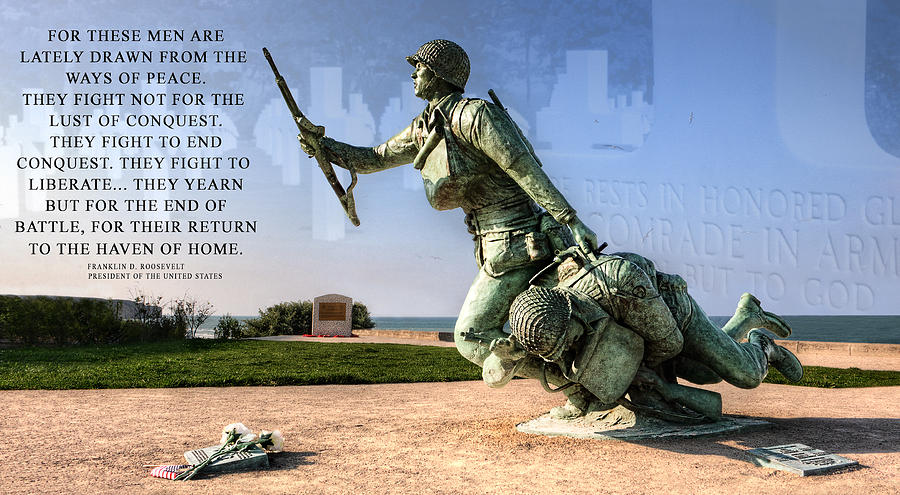
A tense and tired world is awaiting word of an Allied invasion of Western Europe, crushed for years under the jackboots of the Nazi war machine.

In the early morning hours of June 6, the news flashes over American radios: The greatest amphibious invasion in history has begun on the beaches of Normandy, France. As paratroopers leap from their planes and landing craft speed toward the coast, another great battle is being waged at home: a prayer battle, imploring God for victory over the dark forces of fascism.

It’s almost impossible to exaggerate the importance of the D-Day invasion. As one historian notes, “Without question, a failed invasion of France would constitute a calamity of incalculable proportions for the Western allies.” Who knows how long it would have taken to organize a second invasion attempt—time that might have allowed a German victory.

So as word of the assault trickled out, Americans began to pray. Stores closed, and prayer services were swiftly organized in small towns and big cities.

Photographs taken on June 6 show just how widespread these prayers were. One picture shows a sign in the window of a novelty button shop reading, “Sorry, no covered buttons today. We are praying for the success of the invasion.” A sign in front of a church reads, “Come in and pray for Allied victory: Hourly intercessions on the hour.” Another photo shows Americans in a synagogue, bowing their heads in prayer. At a noon Mass, we see men and women on their knees, fervently praying.

New York City Mayor Fiorello La Guardia took to the airwaves, urging citizens to “send forth [their] prayers to Almighty God . . . to bring total victory . . . in [this] great and valiant struggle . . .”

In Washington, President Roosevelt, who had sons in uniform, urged Americans to join him in prayer for all the nation’s sons: “With Thy blessing,” he prayed, “We shall prevail over the unholy forces of our enemy.”

And, by heaven, prevail they did. On D-Day, and in the bloody days that followed, allied soldiers brought to vivid life the words of Winston Churchill: “We shall fight in France . . . We shall fight on the beaches, we shall fight on the landing grounds, we shall fight on the fields and in the streets . . . We shall never surrender.”

As President Reagan put it 40 years later, speaking at Normandy to surviving Army Rangers: “These are the men who took the cliffs. These are the heroes who helped end a war.”

Today, I can’t help wondering: How much did the prayers of their loved ones back home have to do with this great victory?

War correspondent Ernie Pyle, who arrived at Normandy on June 7, observed that the Allies achieved victory “with every advantage on the enemy’s side and every disadvantage on ours.” Despite this, he wrote, the total Allied casualties “were remarkably low—only a fraction, in fact, of what our commanders had been prepared to accept.”

“Now that it is all over,” Pyle finished, “it seems to me a pure miracle that we ever took the beach at all.”

Yes, it WAS a miracle—a miracle backed up by millions upon millions of believers assaulting the gates of heaven.

We must never forget what the Allies gallantly sacrificed for the world on D-Day. Today—the 74th anniversary of that invasion—we should set aside time to remember what they did. And then we should pray for the safety of our soldiers, airmen, sailors, and marines who are serving across the globe today—men and women fighting and sacrificing for the freedoms we—and others—enjoy.


BreakPoint is a Christian worldview ministry that seeks to build and resource a movement of Christians committed to living and defending Christian worldview in all areas of life. Begun by Chuck Colson in 1991 as a daily radio broadcast, BreakPoint provides a Christian perspective on today’s news and trends via radio, interactive media, and print. Today BreakPoint commentaries, co-hosted by Eric Metaxas and John Stonestreet, air daily on more than 1,200 outlets with an estimated weekly listening audience of eight million people. Feel free to contact us at BreakPoint.org where you can read and search answers to common questions.

Eric Metaxas is a co-host of BreakPoint Radio and a best-selling author whose biographies, children’s books, and popular apologetics have been translated into more than a dozen languages.

Charles Stanley – God’s Compass for the Heart and Mind


Proverbs 3:7-12

Yesterday we discussed the importance of depending on Scripture as our compass throughout life. Following God’s directions will change our behavior and challenge our attitudes, desires, and thought processes. He leads us to think differently about ourselves, our values, and even the difficulties facing us.

We naturally want to determine our own course in life. It seems like the only logical way to get where we want to go. But being wise in our own eyes is pride. To combat this tendency, the Lord instructs us to fear Him and turn away from evil (Prov. 3:7). This “fear” is not a horrified dread of the Father, but an attitude of respect that motivates us to obey Him for both our good and His glory.

We naturally want to keep our money for ourselves. A desire for a better lifestyle or fear of not having enough leads us to hang on to everything we get. But our compass directs us to honor God by giving Him the first part of all we have, trusting Him to provide for our needs (Prov. 3:9-10).

We naturally dislike God’s discipline. His painful reproofs seem to imply that He doesn’t care about us. But our heavenly Father says His discipline is evidence of His love and delight in us as His children (Prov. 3:11-12).

Sometimes in our desire to follow the Lord, we focus on obedient actions—doing what He says—yet miss His directions concerning our attitudes and thought patterns. To stay on God’s path for our lives, we must make course corrections not only in our behavior but also in our heart and mind.

Bible in One Year: Job 17-21


http://www.intouch.org/

Our Daily Bread — A Blind Man’s Plea


Read: Luke 18:35–43 | Bible in a Year: 2 Chronicles 23–24; John 15

Jesus, Son of David, have mercy on me! Luke 18:38

Some years ago a traveling companion noticed I was straining to see objects at a distance. What he did next was simple but life changing. He took off his glasses and said, “Try these.” When I put his glasses on, surprisingly my blurred vision cleared up. Eventually I went to an optometrist who prescribed glasses to correct my vision problem.

Today’s reading in Luke 18 features a man with no vision at all, and living in total darkness had forced him to beg for a living. News about Jesus, the popular teacher and miracle worker, had reached the blind beggar’s ears. So when Jesus’s travel route took Him by where the blind man was sitting, hope was ignited in his heart. “Jesus, Son of David, have mercy on me!” (v. 38) he called. Though without sight physically, the man possessed spiritual insight into Jesus’s true identity and faith in Him to meet his need. Compelled by this faith, “He shouted all the more, ‘Son of David, have mercy on me!’” (v. 39). The result? His blindness was banished, and he went from begging for his living to blessing God because he could see (v. 43).

In moments or seasons of darkness, where do you turn? Upon what or to whom do you call? Eyeglass prescriptions help improve vision, but it’s the merciful touch of Jesus, God’s Son, that brings people from spiritual darkness to light.

Father, open the eyes of my heart to clearly see who Jesus is and what He can do.

The Father’s delight is to give sight to those who ask Him.

By Arthur Jackson

INSIGHT

From the gospel of Mark we learn the blind man’s name is Bartimaeus (10:46). Bible scholar Kenneth Bailey, in Jesus Through Middle Eastern Eyes, tells us that Bartimaeus’s story is best understood in the context of what happens next—Jesus’s encounter with Zacchaeus, the chief tax collector of Jericho (Luke 19). With these two men, Jesus is reaching out to the extremes of the social context of first-century Israel—a blind beggar and a wealthy publican. Christ shows profound grace to both by giving Bartimaeus his sight and bringing salvation to the house of Zacchaeus (19:9–10).

A key element that connects these stories is the word son. Bartimaeus calls Jesus “Son of David,” a title identifying Jesus as the Messiah that Israel had longed for. Jesus calls Zacchaeus a “son of Abraham” (v. 9). This was not an ethnic description but an affirmation that Zacchaeus had come to faith (Galatians 3:7). The stories close with Jesus’s self-identification as “the Son of Man”—another title with Messianic implications (Luke 19:10).

On the cross Christ would complete His work of seeking and saving those who are lost—like Bartimaeus, Zacchaeus, and us.

Bill Crowder


http://www.odb.org

Ravi Zacharias Ministry – To Love a Flower

The poet Emily Dickinson loved her garden. Though famously reclusive, she spent countless hours admiring and caring for her garden of flowers. Many of her poems reflect on her love of the outdoor world even if it only consisted of the wonders of her own yard. She writes whimsically of bees, clover, honey, and the summer grasses that grew green and lush around her Amherst, Massachusetts home. One of Dickinson’s most well-known poems speaks of her garden as the location of worship—with church, preaching, and heaven all represented by creatures in the natural world:

Some keep the Sabbath going to church

I keep it staying at home,

With a bobolink for a chorister,

And an orchard for a dome….

So instead of getting to heaven at last

I’m going all along!(1)

For Dickinson, the kingdom of God was as close as the bird’s song in her yard. The experience of heaven was not something awaiting her after death, but an experience available to her as she worshipped God in her orchard sanctuary. Her poems often affirmed God’s presence and grace communicated through the beauty and wonder of the natural world.

Continue reading Ravi Zacharias Ministry – To Love a Flower