Our Daily Bread — The Greater Glory


Read: John 17:1–5, 20–24 | Bible in a Year: Genesis 16–17; Matthew 5:27–48

In those days Caesar Augustus issued a decree that a census should be taken of the entire Roman world. Luke 2:1

Caesar Augustus is remembered as the first and greatest of the Roman emperors. By political skill and military power he eliminated his enemies, expanded the empire, and lifted Rome from the clutter of rundown neighborhoods into a city of marble statues and temples. Adoring Roman citizens referred to Augustus as the divine father and savior of the human race. As his forty-year reign came to an end, his official last words were, “I found Rome a city of clay but left it a city of marble.” According to his wife, however, his last words were actually, “Have I played the part well? Then applaud as I exit.”

What Augustus didn’t know is that he’d been given a supporting role in a bigger story. In the shadow of his reign, the son of a carpenter was born to reveal something far greater than any Roman military victory, temple, stadium, or palace (Luke 2:1).

But who could have understood the glory Jesus prayed for on the night His countrymen demanded His crucifixion by Roman executioners? (John 17:4–5). Who could have foreseen the hidden wonder of a sacrifice that would be forever applauded in heaven and earth?

It’s quite a story. Our God found us chasing foolish dreams and fighting among ourselves. He left us singing together about an old rugged cross.

Father in heaven, please help us to see through and beyond the passing glory of everything but Your love. 

The glory we need is the glory of the cross. 

By Mart DeHaan

INSIGHT

The word glory (or glorify) is very prominent in John’s gospel. In John 17 alone it’s used nine times. It’s derived from the base word doxa, which means “glory,” “honor,” or “praise.” Our word doxology (a short hymn of worship) comes from this term. In John, the word glory surfaces first in chapter 1, verse 14. The second time is in John 2:11 where at Cana we read that Jesus “revealed his glory” by turning water into wine. Through the life, death, and resurrection of Jesus, God was and is honored or glorified.

Arthur Jackson


http://www.odb.org

Joyce Meyer – The Written Word of God


Blessed are those who keep his testimonies, who seek him with their whole heart — Psalms 119:2

Adapted from the resource Power Thoughts Devotional – by Joyce Meyer

In order to know God—what to expect from Him and what He expects from you—you must know His Word. It’s not possible for God to say one thing but do another. He cannot lie, and He’s always faithful to perform what He has promised.

I know many people who have studied God’s Word diligently and whose lives have been changed, but I also know many who, although they would like their lives to improve, won’t discipline themselves to study and learn the Word or to speak the Word.

Spending time with God by studying the Word is your choice, and only you can make it. When you make that choice to seek Him with your whole heart, it won’t take long before the desire to really know God and His Word becomes a natural response.

Prayer Starter: Lord, help me to take steps today to make Your Word a priority in my life. As I move forward, give me a true hunger and desire to know You more intimately. In Jesus’ Name, Amen.


http://www.joycemeyer.org

Campus Crusade for Christ; Bill Bright – Strong Love Is the Proof


“And so I am giving a new commandment to you now – love each other just as much as I love you. Your strong love for each other will prove to the world that you are My disciples” (John 13:34,35).

A Navajo Indian woman who had been healed of a serious ailment by a missionary doctor was greatly impressed by the love he manifested.

“If Jesus is anything like the doctor,” she said, “I can trust Him forever.”

The doctor was a living example of the above promise. When Jesus spoke these words, the entire known world was filled with hate, war and fear. The Jews and the Gentiles hated each other. The Greeks and the Romans hated each other.

But with the resurrection of the Lord Jesus and the day of Pentecost came a breath of heavenly love. Those who received Jesus, the incarnation of love, into their lives and who chose to obey His command began to love one another. The pagan world looked on in amazement and said of the believers, “How they love one another!”

Within a few years following this command to love one another, the gospel had spread like a prairie fire throughout the known world. The miracle of God’s love, His supernatural agape, had captivated multitudes throughout the decadent, wicked Roman Empire.

Tragically, today one seldom hears “How they love one another!” about Christians. Instead there is far too much suspicion, jealousy, criticism and conflict between Christians, churches and denominations. The unbelieving world often laughs at our publicized conflicts.

But those individuals who do demonstrate this supernatural love are usually warmly received by nonbelievers as well as believers. The churches that obey our Lord’s command to “love one another” usually are filled to overflowing and are making a great impact for good and for the glory of God. They represent a highly desirable alternative to secular society.

How does one love supernaturally? By faith. God’s Word commands us to love (John 13:34,35). God’s Word promises that He will enable us to do what He commands us to do (John 5:14,15).

Bible Reading:1 John 3:14-19

Today’s Action Point: Through the enabling of the Holy Spirit, I will by faith love others and thus prove that I am a true disciple of the Lord Jesus.


http://www.cru.org

MAGA: First Real US Household Income Gain Since 2000


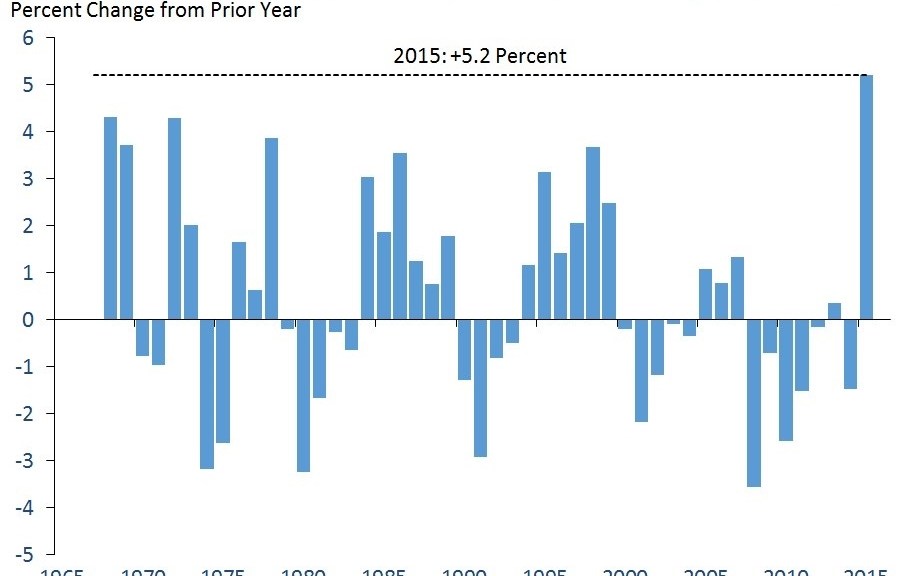
Donald Trump just delivered a record for U.S. median household income and the first full year of higher real incomes since 2000.

President Trump’s ‘Make America Great Again’ economic policies that favor Main Street over Wall Street just delivered a record for U.S. median household income and the first full year of higher real incomes since 2000.

The median household income hit an all-time high of $63,554 in November 2018, based on an analysis of the Census Bureau’s Current Population Survey by Sentier Research. The real, after-inflation, median household income was 3.2 percent above the $61,612 for November 2017; up 5.5 percent above the $60,231 in December 2007; up 15.4 percent from $55,083 in June 2011; and 4.3 percent higher than January 2000.

Despite almost two decades of income stagnation for 99 percent of Americans, establishment economists on the left and the right have viciously attacked the Trump Administration’s ‘Make America Great Again’ (MAGA) policies for cutting taxes, deregulating the economy, maximizing oil and gas production, ending foreign entanglements, renegotiating blatantly unfair trade deals, and slapping China with tariffs.

The Nation published an article in June warning that, ‘Donald Trump’s Trade Wars Could Lead to the Next Great Depression.’ Progressive former senior strategist at bankrupt Bear Sterns and Lehman Brothers Naomi Prins hyperventilated that Donald Trump’s attacking foreign exporting nations for using America as “the world’s piggy bank” was “making the world a less stable, less affordable, and more fear-driven place.”

In the same month, Never-Trump’ conservatives at the Weekly Standard sneeredat MAGA policies in ‘Trumpenomics for Dummies.’ British economist Irwin Stelzer lashed out at Trump for trying to “protect our 19th and 20th Century industries” basic industries, instead of backing “brain replacing brawn as the basis of American economic prosperity.”

In response to MAGA’s unorthodox economic policies that delivered big income gains and drove unemployment down to its lowest levels in almost 50 years, the Trump Administration has had to weather seven interest rate hikes based on the Federal Reserve’s orthodox economic theory that wage growth must be restrained to prevent future inflation.

The Fed had no problem slashing interest rates 19 notches early in the Obama Administration, and then keeping interest rates substantially below inflation in order to create asset bubbles that drove up U.S. rents and home prices. According to an EPI study, Incomes for the top 1-percent spiked to an all-time high average of $1,316,985 in 2015, a multiple of 26.3 times the average income for the other 99 percent of Americans.

While the Federal Reserve has been trying to protect the average American from too much personal income growth, its own Inflation Expectation Rate for the next five years has actually fallen by 20 percent since President Trump took office in January 2017.

Managing Director David Hoffman of Brandywine Global Asset that manages $74 billion recently observed that before the Fed raised the U.S. policy interest rate on December 19th and crashed the stock markets, the Fed Funds target interest rate when adjusted for inflation was already above zero. He warned that the Fed’s policy for the first time in a decade is “no longer broadly promotive of continued strong growth.”

The Fed and critics on both the left and right have fully embraced Keynesian economic theories that argue for government using “targeted” fiscal spending and monetary credit policies to steer the U.S. economy to optimum performance. With the top “1-percenters” controlling the bureaucratic deep state over the last 40 years, they have manipulated those Keynesian “targets” to optimally enhance their own incomes.

Because MAGA economics rejects fiscal and monetary targeting as inherently corrupt, the “1-percenters” understand their entitlement is at existential risk of going away. They must fight, obstruct and slow down MAGA policies before the redistribution of income back to the 99-percent becomes overwhelmingly obvious to most American voters.

The Fed’s interest rate spikes have hammered Wall Street with a global stock market selloff that resulted in the worst December U.S. stock performance since 1931, with the Dow Jones Index down 9.7 percent for the month. After the market value of Apple Computer collapsed by $75 billion after warning of lower earnings due to China’s economy slowing, Dow Index entered a “Bear Market” Dow down 20 percent from its September high.

But “Main Street” is booming, according to the latest Bureau of Labor statistics, with 7.1 million job openings on the last business day of October. The latestSmall Business Optimism Index reported its highest percentage since 1989 of companies under 250 workers planning to raise compensation in 2019 in “response to persistently high levels of unfilled open positions.”


Source: MAGA: First Real US Household Income Gain Since 2000

Charles Stanley –An Exercise in Casting Cares


Psalm 55:16-22

God’s shoulders are wide enough to carry your burdens. He’s sovereign over the universe, so He is certainly capable of working out problems and meeting needs. Today I want to give you an exercise that will help make casting your cares on Him a practical act.

First, take a piece of paper and write the things that cause your anxiety. Once you start, you may discover there’s a list of items that cheat you out of peace.

Next, pray each issue into God’s care. Recall Psalm 18:35, which promises that He lovingly upholds believers.

Finally, as you pray, visualize placing the situation into God’s omnipotent hands. For example, imagine handing over to the Lord the debts you owe, while saying, “Father, I give You my financial anxiety. I know You’ll show me how to get out of debt. You are more than sufficient to handle it, and I trust You to guide me.”

Some people may resist this suggestion because certain pseudo-spiritual movements have a method they call visualizing. But here the term refers to the beautiful word pictures throughout the Bible, which God intended to help us understand our relationship with Him. This type of visualizing creates a mental snapshot of God doing what He says He’ll do (Psalm 55:22; Matt. 6:25-26).

When you have transferred all of your worries to God’s hands, wad up the paper and then destroy it. In doing so, you symbolize the transaction that just took place: Your cares are no longer yours—every one of them belongs to the Lord. Then walk away in perfect peace.

Bible in One Year: Genesis 16-19


http://www.intouch.org/

Our Daily Bread — Transformed & Transforming


Read: 2 Chronicles 33:9–17 | Bible in a Year: Genesis 13–15; Matthew 5:1–26

Then he restored the altar of the Lord. . . and told Judah to serve the Lord, the God of Israel. 2 Chronicles 33:16

Tani and Modupe grew up in Nigeria and went to the UK to study in the 1970s. Having been personally transformed by God’s grace, they never imagined that they would be used to transform one of the most deprived and segregated communities in England—Anfield in Liverpool. As Drs. Tani and Modupe Omideyi faithfully sought God and served their community, God restored hope to many. They lead a vibrant church and continue to run numerous community projects that have led to the transformation of countless lives.

Manasseh changed his community, first for evil and then for good. Crowned king of Judah at the age of twelve, he led his people astray and they did great evil for many years (2 Chronicles 33:1–9). They paid no attention to God’s warnings and so He allowed Manasseh to be taken prisoner to Babylon (vv. 10–11).

In his distress, the king humbly cried out to God who heard his plea and restored him to his kingdom (vv. 12–13). The now-reformed king rebuilt the city walls and got rid of the foreign gods (vv. 14–15). “He restored the altar of the Lord and . . . told Judah to serve the Lord, the God of Israel” (v. 16). As the people observed the radical transformation of Manasseh, so too were they transformed (v. 17).

As we seek God, may He transform us and so impact our communities through us.

Heavenly Father, transform our lives that we may be used by You to bring transformation to others.

Welcome to Ruth O’Reilly-Smith! Meet all our authors at odb.org/all-authors.

Your transformation by God brings transformation to others.

By Ruth O’Reilly-Smith

INSIGHT

Second Kings 21:1–18 parallels 2 Chronicles 33:1–20, but the version in 2 Kings curiously omits Manasseh’s repentance. Both accounts share how Manasseh rebuilt the obscene shrines his father Hezekiah had destroyed, desecrating God’s holy temple and sacrificing his own son. Second Kings prophesies Jerusalem’s coming judgment (21:10–15), while 2 Chronicles shows us a larger story—the fulfillment of that prophesy and God’s hand in bringing Judah’s worst king to eventual repentance (33:10–17).

Tim Gustafson


http://www.odb.org

Streams in the Desert for Kids – Finding God’s Help


Mark 11:24

Have you ever wanted something so much that you kept begging and begging your parents to get it for you? Perhaps they think you are not quite ready for whatever it is. But you want it so much you keep on bugging them for it. Finally, after a long while, you give up and figure you are never going to get it. You have lost hope. You have lost faith that what you want will ever be yours.

Sometimes the same thing happens when we pray to God. We want something so much that we beg him for it. When God doesn’t grant us our request, we think he’s not listening. We think he doesn’t care. We pray so long and so hard that we pray ourselves right out of faith. But the Bible teaches that God always hears our prayers. Like your parents, he may not think you’re ready for whatever you are asking. Or maybe he knows it would not be best for you. Or maybe he fully intends to answer your prayer, but it just isn’t the right time.

Now is the time to simply trust God and believe he knows what he’s doing. We have to let our prayer rest with him until he is ready to make it happen.

Dear Lord, I believe that you will answer my prayers in your way and your time. Help me to learn what it means to let my prayer rest in your hands. Amen.


Joyce Meyer – Giving Aggressively


Give, and [gifts] will be given to you; good measure, pressed down, shaken together, and running over, will they pour into [the pouch formed by] the bosom [of your robe and used as a bag]. For with the measure you deal out [with the measure you use when you confer benefits on others], it will be measured back to you. — Luke 6:38 (AMPC)


Adapted from the resource New Day New You Devotional – by Joyce Meyer

When you and I give, we are to give generously and aggressively. Because the way we give is the way we receive. When we look into our wallet or purse, we are not to pull out the smallest bill we can find. Instead, we are to give as God gives—abundantly.

Now, I realize that no offering is too small and none is too great. But at the same time, we have got to learn to be as aggressive in our giving as we are in any other aspect of our Christian life. I seek to be a giver. I desire to give all the time.

One time I was in a Christian bookstore and saw a little offering box for one of those ministries that feeds hungry children. There was a sign beside it that read, “For fifty cents two children can eat for two days.”

I started to open my purse and make a donation when a voice inside said to me, “You don’t need to do that; you give all the time.”

I immediately got violent—spiritually violent! No one could tell on the outside, but I was aroused on the inside. I reached into my purse, pulled out some money, and placed it in the box just to prove I could give as an act of my free will!

You can do the same. Whenever you are tempted to hold back, give more! Show the devil you are an aggressive giver!

Prayer Starter: Father, You give to us so generously—help me to be like You! Show me ways today and every day that I can establish a lifestyle of giving in ways big and small. In Jesus’ Name, Amen.


http://www.joycemeyer.org

Campus Crusade for Christ; Bill Bright – An Infusion of Power


“Even the youths shall be exhausted, and the young men will all give up. But they that wait upon the Lord shall renew their strength. They shall mount up with wings like eagles; they shall run and not be weary; they shall walk and not faint” (Isaiah 40:30,31).

I flew all night from Los Angeles to New York for a very important meeting with the president of one of the major television networks, and after only three hours in New York flew back across the continent to Portland, Oregon, to speak that night at a conference of several hundred pastors.

Every fiber of my being ached with fatigue as I waited for my luggage in the Portland airport. In only 30 minutes I would be speaking to the pastors, yet I felt about as spiritual as a head of cabbage. Suddenly I felt impressed to pray, “Lord, do You have something You would like to share with me?”

Immediately I felt a leading to turn to the 40th chapter of Isaiah. As I read those familiar words, which at that instant had new, inspiring meaning for me, I sensed a surge of strength, energy, and power flow into and through my body. I suddenly felt that I could have thrown my luggage over the building and run to the meeting several miles away.

I could hardly wait to stand before those servants of God and proclaim to them the wonder and majesty, the glory and power, the faithfulness and love of our God. Within a half hour or so, I did have that privilege and God empowered and anointed me for the occasion in a most unusual and marvelous way.

Bible Reading:Isaiah 40:25-29

Today’s Action Point: As I discover a need for renewed strength today, I will say with the psalmist, “I will go in the strength of the Lord God” (Psalm 71:16a, KJV). I will repeat that solemn declaration throughout the day, and by faith will claim His supernatural strength for my every physical and spiritual need.


http://www.cru.org

Charles Stanley – Jesus: Our Intimate Friend


Matthew 26:47-50

I’ve counseled plenty of people who argue that they are not worthy of God’s love. Of all the passages I could point to that describe the Lord’s devotion, today’s is the one I think best showcases the unqualified friendship He offers His followers—even when they become wayward.

The night before His crucifixion, Jesus was praying at Gethsemane when Judas Iscariot approached with a band of men. The betrayer stepped forward and kissed the Lord. And what was Jesus’ response? According to Matthew, one of the other disciples, the Lord called the man “friend.” (See Matt. 26:50.)

Judas expected Jesus to establish His kingdom on earth and drive the Romans out of Israel—surely anyone who could calm a storm at sea could easily remove an oppressive government! But Judas’s interest in Jesus was more personal and political than spiritual. In fact, John reported that his fellow disciple stole from the money box (John 12:6). Today the man’s name is synonymous with those who betray others for personal gain.

In spite of Judas’s greed, blind ambition, and betrayal, Jesus never stopped loving him—and still used the word “friend” to address the disciple. The Lord does not place conditions on His love or reject people who fail to meet certain standards. He simply cares for us as we are.

We cannot earn Jesus Christ’s love and friendship. He takes the initiative, reaches out, and draws into fellowship those who are willing. None of us are worthy, but we are privileged to live in His love anyway. In the Lord, we find a friend who sticks closer than a brother (Prov. 18:24).

Bible in One Year: Genesis 12-15


http://www.intouch.org/

Our Daily Bread — Walking in the Light


Read: Hebrews 12:18–24 | Bible in a Year: Genesis 10–12; Matthew 4

In him was life, and that life was the light of all mankind. John 1:4

Darkness descended on our forest village when the moon disappeared. Lightning slashed the skies, followed by a rainstorm and crackling thunder. Awake and afraid, as a child I imagined all kinds of grisly monsters about to pounce on me! By daybreak, however, the sounds vanished, the sun rose, and calm returned as birds jubilated in the sunshine. The contrast between the frightening darkness of the night and the joy of the daylight was remarkably sharp.

The author of Hebrews recalls the time when the Israelites had an experience at Mount Sinai so dark and stormy they hid in fear (Exodus 20:18–19). For them, God’s presence, even in His loving gift of the law, felt dark and terrifying. This was because, as sinful people, the Israelites couldn’t live up to God’s standards. Their sin caused them to walk in darkness and fear (Hebrews 12:18–21).

But God is light; in Him there’s no darkness at all (1 John 1:5). In Hebrews 12, Mount Sinai represents God’s holiness and our old life of disobedience, while the beauty of Mount Zion represents God’s grace and believers’ new life in Jesus, “the mediator of a new covenant” (vv. 22–24).

Whoever follows Jesus will “never walk in darkness, but will have the light of life” (John 8:12). Through Him, we can let go of the darkness of our old life and celebrate the joy of walking in the light and beauty of His kingdom.

If you’re a believer in Jesus, how has your life changed since He came into it? What are some ways you’d like to grow in your faith?

Thank You, Lord Jesus, for bringing me out of darkness into Your marvelous light. Help me to avoid the darkness to continue walking in the light toward eternity.

By Lawrence Darmani

INSIGHT

No author is identified for the book of Hebrews. Scholarly speculation regarding potential authors ranges from Paul to Barnabas to Luke to Apollos, and even to Aquila and Priscilla. What are we to conclude about this ongoing, centuries-old debate? First, the very fact that there is so much speculation clearly reveals that no particular view can be totally proven. Second, human authorship is less of a problem if we understand that, by means of the inspiration of Scripture, the ultimate author is in fact the Holy Spirit who inspired it (2 Timothy 3:16; 2 Peter 1:20–21).

For more on Bible background, check out Beyond Reasonable Doubt: The Truth of the Bible at discoveryseries.org/q0411.

Bill Crowder


http://www.odb.org

Ravi Zacharias Ministry – The Best of Times

The opening lines of A Tale of Two Cities have given the literary world one of the greatest precursory statements of all time. “It was the best of times, it was the worst of times, it was the age of wisdom, it was the age of foolishness, it was the epoch of belief, it was the epoch of incredulity, it was the season of Light, it was the season of Darkness, it was the spring of hope, it was the winter of despair…” These famous words of Charles Dickens mark some of the best-known lines of literature, skillfully reflecting the novel’s central tension between opposing pairs and the ebbs and flows of an era.

In this occasion of the New Year we, too, are inclined to pause and reflect, to look back and look forward with thoughts and words that help us sift through the stories unfolding before us. Significant dates and holidays, birthdays and anniversaries, naturally lend themselves to times of reflection, the first of the year being perhaps the most confronting date (and certainly the best marketed) that calls us to reflect. That we have before us the month that marks another beginning of another year is unavoidable, even if merely seen as time to buy a new calendar or join another health club.

Armed with resolutions and lofty goals, many stare into the 365 days ahead of us with hope and expectation, sometimes with fear, sometimes with determination, other times with excitement. And we look at the days behind us with a careful eye for what is past, at times with nostalgia for all that has gone by, or heaviness for all we longed to see turn out differently, but hopefully with wisdom to carry into days to come. What were the year’s successes and failures? What will I accomplish this year? Where have I been? How far have we come along?

But the New Year is also a time to ask perhaps with a greater sense of existential angst, “Where am I going?” Or maybe even “Where did we come from?” In the pages of one major newspaper on New Year’s Day were articles discussing several up and coming self-improvement, self-discovery books for the New Year. In between advice for learning to embrace your life fully and tips for rehabilitating your sense of style, the author herself noted the inconsistency of the well-marketed, self-help world of reflecting. “If all these books are out there,” she asked, the question remains: “Why aren’t we well?” Such are inquiries worthy of the season.

Continue reading Ravi Zacharias Ministry – The Best of Times

Joyce Meyer – Living Large


And God is able to make all grace abound to you, so that having all sufficiency in all things at all times, you may abound in every good work. — 2 Corinthians 9:8

Adapted from the resource My Time with God Devotional – by Joyce Meyer

When I feel like my “get up and go” has got up and gone, I purposely stir myself up through aggressive expectation!

God is the God of abundance, the one who wants us to live a large, free, and full life.

Dare to have big faith, big plans, and big ideas, because God is able to do exceedingly, abundantly, above and beyond all that you can ever dare to hope, ask, or think (see Ephesians 3:20 AMPC).

It is time to start asking God to do greater things! Have great expectations!

Don’t be afraid to ask God for big things. The truth is that you cannot ask for too much as long as your heart is right and you are willing to not only be blessed by God, but also be a blessing everywhere you go.

The Bible says God is searching for those in whom He can show Himself strong (see 2 Chronicles 16:9), and it can be you if you are willing to believe. You don’t need a perfect performance to qualify for God’s best; just love Him with all your heart. Don’t settle for less than the best life that you can have.

Prayer Starter: Amazing heavenly Father, I am humbled that You want to offer me an abundant life. I know that I don’t deserve Your goodness, but I do ask in faith that You would do great things for and through me. Thank You! In Jesus’ Name, Amen.


http://www.joycemeyer.org

Campus Crusade for Christ; Bill Bright – Anything at All


“Yes, ask anything, using my name, and I will do it!” (John 14:14).

“What is the most important thought your mind has ever entertained?” someone once asked Daniel Webster, one of the greatest intellects in American history.

“My accountability to God,” he replied.

In John 14:14 we find a marvelous promise, one that surely gives ample reason for our accountability to God!

Yet, in the face of those overwhelming words, most Christians do not live joyful and fruitful lives. Why? Because they have a limited view of God. Most of us sit at God’s banquet table of blessing and come away with crumbs – simply because of our lack of knowledge of God and faith to trust and obey Him.

Nothing is so important in the Christian life as understanding the attributes of God. No one can ever begin to live supernaturally and have the faith to believe God for “great and mighty” things if he does not know what God is like, or if he harbors misunderstandings about God and His character.

Would you like to live a joyful, abundant and fruitful life – every day filled with adventure? You can!

What is God like to you? Is He a divine Santa Claus, a cosmic policeman, a dictator or a big bully? Many people have distorted views of God and as a result are afraid of Him because they do not know what He is really like.

Our heavenly Father yearns for us to respond to His love. It is only as we respond to a scriptural view of God that we are able to come joyfully into His presence and experience the love and adventure and abundant life for which He created us and which He promised us.

Bible Reading:Mark 11:22-26

Today’s Action Point: I will meditate upon John 14:14 throughout the day, and I will claim His provision for a need I have or know that someone else has.

http://www.cru.org

Max Lucado – We Can Fear Less Tomorrow


Listen to Today’s Devotion

In Matthew 8:26, Jesus asks, “Why are you fearful, O you of little faith?”  That’s a good question.  Sometimes fear is healthy.  It can keep a child from running across a busy road.  It’s the appropriate reaction to a burning building or a growling dog.

Fear itself is not a sin.  But it can lead to sin.  If we medicate fear with angry outbursts, sullen withdrawals, or viselike control, we exclude God from the solution.  Fear may fill our world, but it doesn’t have to fill our hearts.  It will always knock on the door.  Just don’t invite it in for dinner.  The promise of Jesus is simple.  We can fear less tomorrow than we do today.

Read more Fearless

For more inspirational messages please visit Max Lucado.

Home

Denison Forum – Was George Washington a failure?

Poverty around the world is plummeting; half the world is now middle class; and illiteracy, disease and deadly violence are receding.” So reports the Wall Street Journal, probably to the surprise of many.

We might wonder if optimists are reading the same news as the rest of us. The stock market plunged yesterday after Apple warned it would miss its quarterly sales forecast due to weakening growth in China. The standoff over the partial government shutdown continues, with few predicting that today’s talks will make significant progress.

It even turns out that, according to The Smithsonianthe world’s oldest woman might have been her daughter masquerading as her mother.

Was George Washington a failure?

But, as Rick Newman points out in his book, Rebounders, the key to success is not a lack of failure but our response to it. Examples:

  • George Washington “lost more battles than he won during the Revolutionary War.”
  • Norman Vincent Peale’s wife rescued the manuscript of The Power of Positive Thinking from the trash after it had been rejected repeatedly by New York publishers; it became an all-time bestseller.
  • A 1914 fire destroyed Thomas Edison’s manufacturing operations, but the sixty-seven-year-old rebuilt and modernized factories that revolutionized technology.

According to Newman, “A whole body of scientific research has shown that overcoming setbacks can make people stronger, smarter, and more durable.”

Continue reading Denison Forum – Was George Washington a failure?

Charles Stanley – Called to Edify One Another


Colossians 3:12-17

Your spiritual growth isn’t just about you—it affects your entire church. Consider this: What would your church be like if everyone in it was as hungry for God’s Word as you are? I’m not saying we must all be spiritual giants, but we should all be growing and increasing in our knowledge and love for Christ, as well as in our love for each other.

One of our responsibilities as members of Christ’s body is to edify each other in the faith. Sometimes we think this is just the role of those in ministry and assume the rest of us can sit back and take it easy. But today’s passage clearly says to “let the word of Christ richly dwell” in us so we can teach and admonish one another with wisdom (Col. 3:16).

Opinions and advice are often casually dished out without much thought, but as believers, we’re called to give wise counsel based on God’s Word. There is no other source that’s as sound, because Scripture alone is absolute truth. Building others up could simply be a matter of pointing out a passage that speaks to an issue they are facing, or it could involve admonishing or warning against an action or attitude the Bible condemns.

To some people, this kind of care for one another may seem unwanted or intrusive, but it’s actually an act of obedience to the Lord. It demonstrates our love for others and our desire to see them become the people that the Lord designed them to be—believers who accomplish what He’s called them to do. And if we are on the receiving end of such care, it helps us develop a humble, teachable attitude.

Bible in One Year: Genesis 8-11


http://www.intouch.org/

Our Daily Bread — Eyes Tightly Shut


Read: Genesis 3:1–10 | Bible in a Year: Genesis 7–9; Matthew 3

They hid from the Lord God among the trees of the garden. Genesis 3:8

He knew he shouldn’t have done it. I could clearly see he knew it was wrong: it was written all over his face! As I sat down to discuss his wrongdoing with him, my nephew quickly squeezed his eyes shut. There he sat, thinking—with three-year-old logic—that if he couldn’t see me, then I must not be able to see him. And if he was invisible to me, then he could avoid the conversation (and consequences) he anticipated.

I’m so glad I could see him in that moment. While I couldn’t condone his actions, and we needed to talk about it, I really didn’t want anything to come between us. I wanted him to look fully into my face and see how much I love him and was eager to forgive him! In that moment, I caught a glimmer of how God might have felt when Adam and Eve broke His trust in the garden of Eden. Realizing their guilt, they tried to hide from God (Genesis 3:10), who could “see” them as plainly as I could see my nephew.

When we realize we’ve done something wrong, we often want to avoid the consequences. We run from it, conceal it, or close our eyes to the truth. While God will hold us accountable to His righteous standard, He sees us (and seeks us!) because He loves us and offers forgiveness through Jesus Christ.

Father, thank You for seeing me and loving me even when I do wrong.

God views us through eyes of love.

By Kirsten Holmberg

INSIGHT

As the book of beginnings, Genesis gives us our first look at how God responds to our sin with a just balance of mercy and consequence. Our Father’s ability to judge sin while loving the sinner shows up in the garden of Eden (Genesis 3:14–21) and later when Cain kills his brother (4:8–16). We see it again and again in a pattern that leads through Sinai (Exodus 34:5–7), the songs of Israel (Psalm 99:8), and most completely in the crucifixion of Jesus (Luke 23:34).

Mart DeHaan


http://www.odb.org

Ravi Zacharias Ministry – Confirmation Bias 

Shankar Vedantam is the host of NPR’s show The Hidden Brain. The show explores the unseen, largely unconscious, cognitive processes that often shape our decisions, impact our emotions, and inform our thinking. Vedantam began his exploration into the social sciences by examining research on implicit bias—and it was from this study that he wrote his book on the subject—also called The Hidden Brain. Psychologists posit that implicit biases are influenced by experience and are often formed as a result of learning associations between qualities and categories including race and gender.(1)

There are many ways in which implicit biases function in our lives. Confirmation bias, for example, is the tendency to search for, interpret, focus on, and remember information in a way that confirms one’s preconceptions.(2) People tend to react more favorably to information that supports their own point of view. Another example of a more insidious bias is the fundamental attribution error in which an observer ascribes to a subject fundamental or inherent deficiencies rather than to situational contexts that might also be at work. In addition, the observer is more likely to attribute his or her own deficiencies to circumstances or situational contexts, rather than to his or her own personal short-comings.

Many authors attribute the fundamental attribution error to a lack of empathy or the inability to take another person’s perspective. How does this cognitive error play out in real life? In a CBS News article from 2016, Stephanie Pappas reported on the widespread tendency to blame, rather than to empathize with individuals, when accidents happen.(3) She cites the horrific news story of the two-year old who died by alligator attack while playing next to a pond at Disney World. While she notes that there was some initial sympathy for the parents, the overall tone quickly moved to blame them for negligence. Clearly, it was their fault that their son had died. People ignored the numerous reports of the parents being right next to the child and of the father’s desperate attempts to pry his son from the alligator’s jaws. Rather than looking at broader circumstances or explanations—namely, that accidents do happen—most blamed the event on the inherent flaws of the parents.

Continue reading Ravi Zacharias Ministry – Confirmation Bias 

Joyce Meyer – The Power to Do Good


Give justice to the weak and the fatherless; maintain the right of the afflicted and the destitute. Rescue the weak and the needy; deliver them from the hand of the wicked. — Psalm 82:3-4

Adapted from the resource Love Out Loud Devotional – by Joyce Meyer

I heard a story about former New York City mayor Fiorello LaGuardia. One winter night in 1935, LaGuardia paid a visit to night court in the poorest section of the city. He told the judge to take the night off, took his seat on the bench, and presided over the night’s cases himself.

Soon a tired, despondent elderly woman appeared before him because she had been charged with stealing a loaf of bread. In her own defense, she said, “My daughter’s husband left her. She is sick, and her children are hungry.”

The storekeeper had no mercy. With a sigh, LaGuardia said to the woman, “The law is clear. I have to punish you.” He fined her ten dollars. As he was pronouncing the woman’s sentence, LaGuardia was simultaneously reaching into his pocket to pull out a ten-dollar bill. He dropped it into his hat and said:

“Here’s the ten-dollar fine, which I now remit, and furthermore, I’m going to fine everyone in this courtroom fifty cents for living in a town where a person has to steal bread so her grandchildren can eat. Mr. Bailiff, collect the fines and give them to the defendant!”

The total collected for the grandmother was $47.50.

I like the fact that the mayor of New York City used his position of authority to influence others to help the poor grandmother. Any time we can inspire or provoke others to do good, we need to do so.

Prayer Starter: Lord Jesus, help me to use my influence to help others to do good. Let my heart break with compassion for those in need. Help me to always stand up for the rights of the innocent. In Jesus’ Name, Amen.


http://www.joycemeyer.org