

Denison Forum – US House passes bill protecting same-sex marriage

The US House of Representatives passed a bill this week protecting the right to same-sex marriage. It prohibits anyone from denying the validity of a marriage based on the race or sex of the couple. The fate of the legislation is uncertain in the US Senate.

Those who drafted the bill were politically astute to link interracial marriage with gay marriage since people like me who object to the latter on biblical and moral grounds support the former on the same grounds.

I have written often that racism is sin and that God views us all as members of the same human “race” (cf. Galatians 3:28). Consequently, interracial marriage is absolutely acceptable from ethical and Scriptural perspectives (cf. Numbers 12:1). By contrast, I have also written that God defines marriage as the lifelong covenant of one man and one woman, making same-sex marriage indefensible on the same grounds.

Should adultery be illegal?

The “culture wars” can be difficult to win in large part because they can be so complex. Adultery is immoral (Exodus 20:14), for instance, but should it be made illegal? Elective abortions are grievously wrong, but what legal consequences (if any) should women who choose them face? Does allowing a terminally ill patient to die make us complicit in their death? When do genetic advances to diagnose and treat disease cross the line into eugenics?

The good news is that we have an omniscient Father whose Spirit will guide us into “all the truth” (John 16:13) and empower us to make a transformative difference where he calls and equips us to serve (1 Peter 4:10).

In addition, our Creator is still active in his creation. He is no deistic clockmaker watching the world he made “run down.” To the contrary, he “knows everything” that is happening in our lives and our world (1 John 3:20) and holds us all accountable for what we have done and left undone (cf. 2 Corinthians 5:10).

His word is clear: “Do not be deceived: God is not mocked, for whatever one sows, that will he also reap” (Galatians 6:7).

Judgment in two phases

This week, we have explored reasons to trust God’s will in uncertain times. Today let’s choose to live biblically by remembering this urgent truth: “the Lᴏʀᴅ is a God of justice” (Isaiah 30:18).

As I have written, God’s judgment comes in two phases: permissive and proactive. His permissive judgment is a consequence of unrepented sin when he is forced to withdraw his hand of provision lest he bless that which harms his children and violates his word. I believe this is where our culture is today.

As David French notes in a recent article, “culture wars end with consequences.” He surveys a growing number of articles published by elite media and from within secular feminism decrying the consequences of ubiquitous pornography and transactional sex. French wisely concludes, “You can fight reality, but reality always wins.”

If we still refuse to repent, God must then respond proactively with judgments such as we see in the exodus from Egypt and in the book of Revelation. I do not believe we are there, yet. But we are clearly experiencing grave challenges, from a pandemic which shows no signs of slowing to deep political divisions and rancor, grave economic challenges, and rising geopolitical threats.

When we are not experiencing God’s best, we should always ask why.

Five reasons to seek God’s pardon

In a day of sin and judgment, God called his people: “Run to and fro through the streets of Jerusalem, look and take note! Search her squares to see if you can find a man, one who does justice and seeks truth, that I may pardon her” (Jeremiah 5:1). The people needed God’s “pardon” for five reasons:

  1. False religion: “Though they say, ‘As the Lᴏʀᴅ lives,’ yet they swear falsely” (v. 2).
  2. Immoral religion: Jeremiah turned to those who “know the way of the Lᴏʀᴅ, the justice of their God” (v. 5a), but “they all alike had broken the yoke; they had burst the bonds” (v. 5b).
  3. Sexual sin: the Lord “fed them to the full,” but “they committed adultery and trooped to the houses of whores” (v. 7).
  4. Callousness toward people in need: “They judge not with justice the cause of the fatherless, to make it prosper, and they do not defend the rights of the needy” (v. 28).
  5. False religious leaders: “An appalling and horrible thing has happened in the land: the prophets prophesy falsely, and the priests rule at their direction; my people love to have it so” (vv. 30–31).

How relevant are these issues to our day?

Religion is a deceptive substitute for a true relationship with God in any church or culture. When religious people and clergy engage in sexual abuse and other personal immorality, they grieve their Lord and defame their faith. Sexual sin and callousness toward the needy are both epidemic in our society. And ministers who sanction homosexual behavior and same-sex marriage, bless abortion clinics, and refuse to advocate for the poor and marginalized “prophesy falsely.”

A personal question

I believe God is still looking for “one who does justice and seeks truth” (Jeremiah 5:1). The prophet declared, “The eyes of the Lᴏʀᴅ run to and fro throughout the whole earth, to give strong support to those whose heart is blameless toward him” (2 Chronicles 16:9).

God is a loving Father who wants only the best for his children. It is not a heretical prosperity gospel to assume an abundance mentality with our Lord, to know that he loves us and wants to bless us.

This does not guarantee health and wealth—his blessing may not be material but spiritual and may come in spite of material hardships (cf. John 16:332 Corinthians 12:10). However, as I noted earlier, if we are not experiencing God’s best, we should always ask why.

So, I’ll close with a personal question: Are you experiencing God’s best today?

NOTE: For more on having an “abundance mentality” with God, please see my latest personal blog, “Doughnuts that taste like ice cream.”

Denison Forum
Four Simple Words to Save America

Four Simple Words to Save America

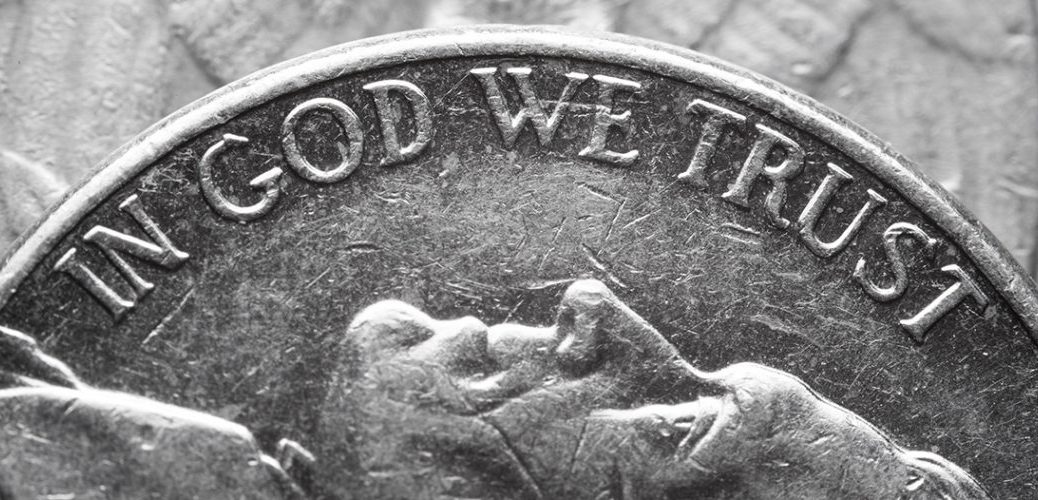
In – God – We – Trust

“100-year-old veteran breaks down crying: ‘This is not the country we fought for.'” Fox13, 7/1/22

“City of Orlando fireworks promo says folks ‘probably don’t want to celebrate’ hate-filled US: ‘We can’t blame them.'” —BizPacReview, 7/3/22

“From Portland to San Francisco, How ‘Open-Air Drug Markets’ Turned Liberal Dreams into Residents’ Nightmare … Widespread Addiction and Homelessness Across the Cities.” —6/17/22

The wreckage of an America broken is strewn street to street.

So many of us feel it, beyond unease, far beyond disquiet, a sense of doom and horror. Something important is very wrong.  A keystone has crumbled or gone missing.  The country is unmoored.

Every terrible headline conveys with it foreboding: a warning that a kind of curtain is descending across the nation.  It’s an insatiable, sadistic force, relentless and repulsive, sucking life out of the air.

The awful thing sweeping our land is a predatory menace fed by dark hearts whose bounty is captive souls.  It is disordered, brutal, thieving, violent.  Where it rules — and it aims to rule us from sea to sea — there is no justice, but injustice; no law, but abuse.  There are only oppression, addiction, cruelty, and death.

It has an ancient name: wickedness.

Deadly sins are given joyless parades and pharmacology, whose lies bring despair and unreason.  Heartsickness.  Corruption in high places and low spreads with it an icy fear that whispers, “The worst is yet to come.”

I am not telling you anything you don’t already know.  Those of us chilled at the encroaching ill wind ask each other how we fight it.  What should we do?  Although there are millions of us, our desire to somehow battle the diabolical has not yet found its political response.  The current knot of savagery and hatreds, this tangle of tribalism and lawlessness as old as humankind, cannot be straightened through electoral means.  Instead, as most of us have rightly said, America’s problem is spiritual.

True as that is, there has not emerged a unified spiritual response, either.

As a child of the 1950s, I was raised in what seems in retrospect to have been a spiritual nation.  Or at least a faith-friendly one.  Religion was, well, intersectional in America in those days.  Talk of God was nonsectarian and nonpartisan.  It was also commonplace and unremarkable — the connective tissue of civic culture in the wake of World War II.  But my first year of public school was the last year we prayed together there, as we kindergartners folded our hands before our milk and cookies and said: “God is great, God is good, and we thank Him for this food.”  The sweetness of the memory catches in my throat.

Then law changed, and with it began the long recession of public God appreciation, which went out like a tide over many decades, at first slowly and then at super speed.  Now you’re fired for praying alone on an empty field as a high school coach.  You’re viciously pilloried for offering “thoughts and prayers” in condolence.

But this is not yet another gloomy review of our dire condition.  Because there abides in the living recall of my generation — and among the widely scattered remnants of the traditional America that yet survives — one of the greatest spiritual weapons we can wield: our national motto.

I was not yet two years old when both Houses of Congress passed a joint resolution declaring “IN GOD WE TRUST” the official motto of the United States.  There was no debate, nor a single dissenting vote.  By law, it remains America’s watchword to this day, Public Law 84-851, signed by President Dwight D. Eisenhower on July 30, 1956.

Few remember, but the Senate officially reaffirmed the motto in 2006, as did the House just eleven years ago — with nine dissenting Democrats.  Some of them, including Reps. Jerry Nadler (D-N.Y.), Bobby Scott (D-Va.), and Judy Chu (D-Calif.), still sit in the House chamber that displays the motto in huge gold letters high on the wall behind the speaker’s chair.  The declaration IN GOD WE TRUST is literally written in stone.

Despite Democrat objections, the 2011 Congressional reaffirmation goes even farther than the original 1956 text, this time also “supporting and encouraging the public display of the national motto in all public buildings, public schools, and other government institutions.”  You can find the stark four words of the motto in bronze atop cast-metal depictions of the Great Seal on plaques scattered among federal offices, including the U.S. Capitol, the Longworth House Office building, and the Dirksen Senate Office Building.  Virtually our entire government, elected and unelected, daily passes by these declarations of trust in God.

The words go mostly unnoticed.  It is law that they appear on all U.S. currency, but as fewer and fewer Americans handle cash, the tangible national reminder of Whom we trust is vanishing.  Our motto does not grace digital commerce.  God is not the “Master” referenced on MasterCard, nor does His name appear on any other plastic to which we entrust our accounts.  Crypto-currencies like bitcoin, ethereum, dogecoin, tether are untethered to the federal “In God We Trust” requirement.

Coincidentally, we drifted from our anchor as our money went godless, so to speak.  If our national motto was remembered at all, it was reduced to a trivia question.  I’d wager less than 30 percent of Americans know we have a national motto, beyond the old one-liner “In God we trust, all others pay cash.”  After all, is there a duller term than “national motto”?  The eyes glaze over.

So the four simple words have been dormant, awaiting renewal, their power shrouded for a time.  Until now.  These words are lightning, ready to be let loose.

Because here is the truth.  America’s explicit trust in the living God is the scarlet cord that runs from before the Revolution through the Civil War, both World Wars, through the Cold War and beyond.  To examine this record is to open the forgotten history of America, a narrative inconvenience deliberately suppressed.  Here is a tiny sample of the long and complex lineage of our motto, unbroken from the Founders to you:

•1753: “Remember that God is our only sure trust.”—Mary Washington to her son George as the young soldier left home; he ever after credited Providence for America’s miraculous military victories and national formation.

•1814: Blessed with victory and peace may the heaven-rescued land
Praise the power that hath made and preserved us a nation!
Then conquer we must, when our cause it is just,
And this be our motto — “In God is our trust.” 
—Francis Scott Key, last verse of “The Star Spangled Banner,” inspiration for our national motto.

•1861: “No nation can be strong except in the strength of God, or safe except in His defense.  The trust of our people in God should be declared on our national coins.” —Salmon P. Chase, secretary of the Treasury, as the motto was shortened to four words for U.S. coinage

•1955: “At the base of our freedom is our faith in God and the desire of Americans to live by His will and His guidance. As long as this country trusts in God, it will prevail.”—Rep. Charles Bennett (D-Fla.), who fought to put “In God We Trust” on all U.S. paper currency.

•1955: “Without God there could be no American form of government, nor an American way of life.  Recognition of the Supreme Being is the first — the most basic — expression of Americanism.  Thus the Founding Fathers saw it, and thus, with God’s help, it will continue to be.”—President Dwight Eisenhower.

•1956: “The national motto of the United States is hereby declared to be ‘In God We Trust.'”

And so it remains.

In their long march through American institutions, our enemies have stomped many of our traditions and societal structures.  But here’s the thing.  Our trust is not in institutions or traditions or structures.  Our trust is not in government or presidents.  The profound truth lives in a national proclamation that was formulated as a retort from the beginning.  The wording is unusual; it implies a “No.”  No, it is not in coins we trust, not in currency.  No, it is not in horses, not in arms, not in people nor in any human design.  “No,” it cautions, “not those.  In God we trust.”

Listen, Americans, to the message from the Americans before us.  Four plain words form the perfect answer to our desperate plea for our nation: “What should we do?”

“In God we trust.”

Yes, here’s what we do: we deploy our national motto, unfurl it as our banner.  It’s time to reactivate our Superpower.  Trust in God is where the battle is transformed.  Our opponents cannot take this ground — they cannot even fight here.  (They’ve already surrendered: as a New York Times columnist put it, “In This Time of War, I Propose We Give Up God.”  Fine.  You lose.)

My sister and I have started using the four simple words as a greeting, a call-and-response that echoes across the years, across the miles, every time we speak, “In God we trust!”  It is a joy and a delight to say and to hear.  It is so delicious to remind each other who we are as Americans, and Whom we trust.  I can attest to the power the words radiate, every time.  They instantly encourage.  Giving God the trust due Him stirs the heart.

These are not magic words, but they are majestic ones.  The motto is not an incantation; it’s an invitation to all who want to join with the “we”; let those who trust in God say so.  There are millions of us who have tested God’s unshaken Name and proved it sure.  To declare together “In God We Trust!” right in the ugly face of the wicked Spirit of the Age is more than glorious dissent.  It is an unstoppable advancing force.

People who pronounce America dead forget the source of our power.  You want to watch the old republic emerge from its chrysalis?  Trust God, together with your countrymen who know that God is our hope and freedom.  There may well be a smaller number of believers now than there were when I was a child.  But with God, even a few are a majority — who can be against us?

Will you be viciously pilloried if you go around saying the national motto?  Yes.  Especially if more and more of us do.  To our enemies, it’s intolerable.  But here’s the reality.  There’s not a blessed thing they can do about it.  You are completely free to utter our national motto in public or private, in the streets and from the mountains and yes in any government building or meeting or school.  What liberation!  Say it!  Write it!  In GOD we trust!

I declare myself a happy IGWT warrior, and I intend to go all swashbuckler with it.  The motto has the protection of law, but there’s no requirement of any kind.  It’s an offer.  Come join us!  In God we trust, and you can, too.  It costs nothing.  Say it!  Write it!  And every time you do, you will find it straightens the shoulders, warms the heart, and fortifies the soul.  When we say it together, it becomes a prayer to our God who alone can save America.

By Diana Allocco

Ms. Allocco was managing editor of The Limbaugh Letter for its entire 29-year run.  Before that, she was senior staff editor at Reader’s Digest.

Source: Four Simple Words to Save America – American Thinker