

Denison Forum – If China invades Taiwan, will the world sit idly by?

In yesterday’s article, we discussed the possible impact of protests in Europe on China’s willingness to invade Taiwan, with the takeaway that it seems increasingly unlikely that many of America’s traditional allies would be willing to take the same measures in defense of Taiwan that have proved so important to the defense of Ukraine. That reality is of imminent importance to the United States because recent events make it seem as though we are on a collision course with the Asian superpower.

What is even more troubling, though, is neither side really seems interested in avoiding that fate.

As Ben Werschkul notes, the US and China have been in something of a cold war for a number of years now, but there was a basic understanding that it was in neither side’s best interests for that conflict to escalate beyond bickering and trade disputes. However, recent events have started to portray a different picture.

The two nations have begun to “uncouple on fronts from trade to the movement of labor to technology.” The White House, for example, recently passed a number of new restrictions designed to limit China’s ability to access various American technologies needed for semiconductor development, artificial intelligence, and advanced computing.

As Klon Kitchen, a senior fellow at the American Enterprise Institute, warns, “these new actions show the United States is not trying to slow China’s technological advancement, but to arrest and to contain it” (emphasis his).

Likewise, Xi Jinping repeatedly emphasized the need for his nation to become more self-reliant during his opening address at this week’s Party Congress, right alongside warnings against Western “hegemonism and power politics.” At several points, he spoke of the need for stability, with greater independence from the West as a key component to attaining that end.

However, control over Taiwan could be just as important.

Why Taiwan is so important

China and Taiwan have had a testy relationship over the years, as one might expect given that the Chinese government considers the independent island part of its Republic. But despite those issues, the two have developed a great deal of economic interdependence. China and Hong Kong account for roughly 42 percent of Taiwan’s exports and 22 percent of the country’s imports. In comparison, the US comprises 15 percent of Taiwan’s exports and 10 percent of its imports.

Moreover, many of Taiwan’s largest companies maintain factories in mainland China, including the world’s largest producer of semiconductor chips: Taiwan Semiconductor Manufacturing Co (TSMC). Those chips are needed for products like cell phones, cars, and—most notably—a wide range of “military-grade” devices from fighter planes to defense systems.

TSMC is currently in the process of building one of its most advanced factories in Arizona, and the company’s Chairman, Mark Liu, warned that they would shut down rather than fall under Chinese control in the event of an invasion.

However, the degree to which Beijing believes that threat remains to be seen. And, even if they do, it is possible that they would rather see the factories close than supply the West with the kinds of semiconductors we cannot yet produce on our own.

All that to say, while both the United States and China have a clear need to maintain economic ties to Taiwan, the latter has also indicated an increased willingness to monopolize that relationship. And, should they try, President Biden has already promised to come to the island’s aid to an even greater extent than the support America has given Ukraine by committing troops and military personnel to the effort.

Unfortunately, as we discussed yesterday, should that come to pass, America may do so alone.

And therein lies the greatest danger, as well as one of the most likely reasons for the recent increase in Chinese aggression toward Taiwan.

A fight we may not win

China has long desired to be the most dominant country in the world. But for some time, those aspirations have been held in check by the US-led alliances that have often set the ground rules for how nations interact with one another. However, the mutual recognition that it would be foolish for one nation to go to war against the world seems increasingly less likely to apply to any conflict over Taiwan.

While NATO’s Article 5 defense commitment, for example, binds nations to defend one another when attacked, Article 6 limits the scope of that commitment to attacks that take place in Europe, North America, or on islands “under the jurisdiction of any of the Parties in the North Atlantic area north of the Tropic of Cancer.”

If the US and China go to war in the South Pacific, none of America’s traditional allies would be required to join the fight. And many seem increasingly unlikely to do so.

China, however, is unlikely to have that problem. Given friendly relations with countries like Iran, Russia, and several others that are not exactly fans of the US, it is possible that America is steadily marching toward a fight we may not win.

“The proper estimate of oneself”

As we discussed yesterday, counting the cost as Jesus commands requires a calculation based on what we’re willing to pay rather than what we expect or hope to pay. Both nations and individuals get into trouble when they make decisions based on the latter of those prices.

One of the most indispensable helps in avoiding that mistake is the self-awareness to fully appreciate the fact that we often do not get to dictate what that price will be. And that self-awareness is especially difficult to maintain when one becomes accustomed to acting from a position of strength.

Throughout history, one of the primary reasons that nations fall from greatness is the inability to recognize when the reasons for their prior success no longer apply to their current situation. Allegiances can shift, strength can wane, opposition can grow stronger, and each can occur in ways that are easy to miss if we’re not paying attention.

What is true of nations can be equally true for each of us.

Whether it’s in our walk with the Lord, our relationships with other people, or any other facet of our lives, when we act as though past success guarantees success in the present, we’re setting ourselves up to fail.

Fortunately, God stands ready to help if we’re willing to ask.

So, as Paul advised, pray for the “sober judgment” needed to make an honest evaluation of your life today (Romans 12:3). Ask the Holy Spirit to show you any areas where you might be thinking more highly of yourself than you should, as well as any areas where that problem is reversed.

After all, God isn’t interested in false humility but rather, as Charles Spurgeon described it, “the proper estimate of oneself.”

Will you ask the Holy Spirit to help you make such an estimate today?

Denison Forum
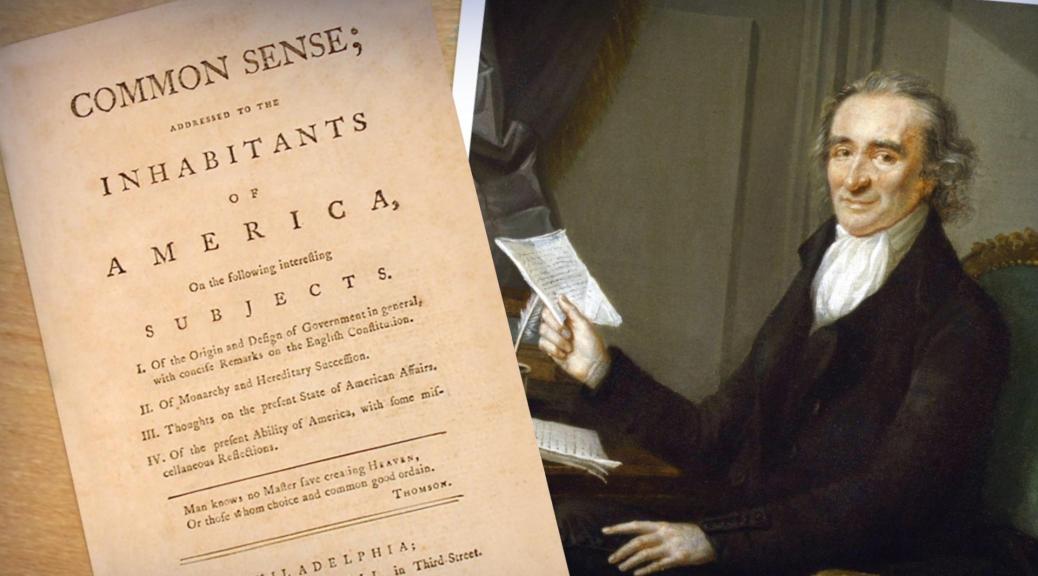
The timeless wisdom of Thomas Paine’s ‘Common Sense’


The timeless wisdom of Thomas Paine’s ‘Common Sense’


PERHAPS the sentiments contained in the following pages, are not yet sufficiently fashionable to procure them general favor; a long habit of not thinking a thing wrong, gives it a superficial appearance of being right, and raises at first a formidable outcry in defence of custom. But tumult soon subsides. Time makes more converts than reason.

—Thomas Paine, introduction to Common Sense

It would behoove us all to review the text of Thomas Paine’s 48-page pamphlet, which he published anonymously (fearing reprisal) in February 1776. Paine’s wisdom applies as well today as it did back then, not because of his argument against the monarchy, but as a reminder that the self-government we championed then—and are losing now—carries responsibilities.

Paine donated the profits from the astounding 500,000 copies sold (when the US population was only 2.5 million) to Washington’s army. Looking at his ideas reminds us that it was influential for a profound reason. Let it be so again, as part of the guidance we need to follow out of the current morass.

Paine was British by birth and had no formal higher education, having dropped out of school at age 13. Therefore, he wrote simply, using accessible and resonant words. From the opening paragraphs:

Society is produced by our wants, and government by our wickedness; the former promotes our happiness positively by uniting our affections, the latter negatively by restraining our vices. The one encourages intercourse, the other creates distinctions. The first is a patron, the last a punisher.

Paine aptly describes how a government must be formed, to have an orderly society

…because as the elected might by that means return and mix again with the general body of the electors in a few months, their fidelity to the public will be secured by the prudent reflection of not making a rod for themselves. And as this frequent interchange will establish a common interest with every part of the community, they will mutually and naturally support each other, and on this (not on the unmeaning name of king) depends the strength of government, and the happiness of the governed.

Clearly, we’ve grown away from that simplicity. A small populace governed by elected representatives people has become 340 million people governed by a nameless bureaucracy, plus a few elected officials who rarely aspire to represent most of their constituents. That part of Paine’s writing devoted to arguing against the concept of hereditary, kingly rule resonates now that we have what was then unimaginable: an ingrained, bureaucratic inflexibility of rule.

Do we have a president in the sense our Founders conceived? On the face of it, the president today can, by fiat, change any rule. The executive order that put a halt to the Keystone pipeline, and started our descent into energy helplessness is an example. He (or, in Biden’s case, his minions) can direct a corrupt bureaucracy to trample on the rights of the people he so inadroitly governs—a stark example is Biden’s continued imprisonment, without trial, in horrific conditions, of people who walked into the Capitol building nearly two years ago.

Paine’s writing reminds us that

Men who look upon themselves born to reign, and others to obey, soon grow insolent; selected from the rest of mankind their minds are early poisoned by important; and the world they act in differs so materially from the world at large, that they have but little opportunity of knowing its true interests, and when they succeed to the government are frequently the most ignorant and unfit of any thoughout the dominions.

While that last was again written as an argument against the throne, it holds true now, perfectly describing Biden. Paine further asks this question:

Is the power who is jealous of our prosperity, a proper power to govern us?

Such a simple question. It is demonstrably true that those now in power work against our prosperity. We see this in our wealth’s diminution through predictable inflation caused by blatantly bad fiscal and social policy. We, and our government, forget that, as Paine quotes Dragonetti, on Virtue and Rewards,

The science of the politician consists in fixing the true point of happiness and freedom. Those men would deserve the gratitude of ages, who should discover a mode of government that contained the greatest sum of individual happiness, with the least national expense. (Emphasis mine.)

Paine further says that

The more men have to lose, the less willing they are to venture. The rich are in general slaves to fear, and submit to courtly power with the trembling duplicity of a spaniel.

It is time, I think, to stop trembling and watching our freedom slip away. In much of the country, this election matters more than any before it, and we must consider it a start toward reversing America’s downward spiral. Keeping the feet of those whom we elect to the fire is step two. Complacency is no longer an option.


Source: The timeless wisdom of Thomas Paine’s ‘Common Sense’ – American Thinker

In Touch Ministries; Charles Stanley – The Good Things in Life

Knowing and pursuing God gives us our best life.

Psalm 34:1-22

How do we achieve the good life? Well, it depends on what you pursue and what you consider “good.” The world defines good things as items and experiences that make us happy. But from the Lord’s perspective, the good things in life are those that fit into His purpose and plan for us. 

God’s will could include material prosperity, health, and opportunities, but He also considers periods of trouble, need, and suffering as valuable. The Lord prioritizes our spiritual well-being over physical or material comfort and ease. 

Our Father wants us to seek Him rather than the treasures and pleasures of this life. If we do this, He promises we’ll “not lack any good thing” (Ps. 34:10).  We’re told to ask the Lord to meet our needs, but we should also come to Him with an open heart that seeks to know and love Him more. 

God Himself is the highest good we could possibly seek. Everything that He gives, whether much or little, is a good and perfect gift from Him (James 1:17). When our pursuit is the Lord rather than the things of this world, we’ll be content with whatever we have (Psalm 37:4). 

Bible in One Year: Mark 13-14

http://www.intouch.org/

Our Daily Bread — Beyond Words

Bible in a Year:

This man . . . heard inexpressible things, things that no one is permitted to tell.

2 Corinthians 12:3–4

Today’s Scripture & Insight:

2 Corinthians 12:1–10

Thomas Aquinas (1225–1274) was one of the church’s most celebrated defenders of the faith. Yet just three months before his death, something caused him to leave unfinished his Summa Theologica, the massive legacy of his life’s work. While reflecting on the broken body and shed blood of his Savior, Aquinas claimed to see a vision that left him without words. He said, “I can write no more. I have seen things that make my writings seem like straw.”

Before Aquinas, Paul too had a vision. In 2 Corinthians, he described the experience: “[I]—whether in the body or apart from the body I do not know, but God knows—was caught up to paradise and heard inexpressible things” (12:3–4).  

Paul and Aquinas left us to reflect on an ocean of goodness that neither words nor reason can express. The implications of what Aquinas saw left him without hope of finishing his work in a way that would do justice to a God who sent His Son to be crucified for us. By contrast, Paul continued to write, but he did so in the awareness of what he couldn’t express or finish in his own strength.

In all the troubles Paul encountered in service to Christ (2 Corinthians 11:16–3312:8–9), he could look back and see, in his weakness, a grace and goodness beyond words and wonder. 

By:  Mart DeHaan

Reflect & Pray

What problem have you had that seemed like a curse? How have you seen God show Himself good to you in ways you can’t describe?

Father in heaven, please give me the courage today to look for an inexpressible sense of Your presence and strength in my weakness.

http://www.odb.org

Grace to You; John MacArthur – God’s Transforming Word

“The law of the Lord is perfect, restoring the soul” (Ps. 19:7).

God can transform you through His Word into the person He wants you to be.

Many today doubt the power of Scripture in dealing with the deeper aspects of the human heart and mind. The Bible may be helpful for certain superficial or “spiritual” problems, they say, but it’s too simplistic and inadequate for the more complex psychological issues of modern man. The truth is, however, the best psychology can do is modify external behavior. It cannot redeem and transform the soul. Only God can do that through the power of His Word.

That’s the truth behind Psalm 19:7, which calls Scripture “the law of the Lord,” thus emphasizing its didactic nature. It is the sum of God’s instruction to man, whether for creed (what we believe), character (what we are), or conduct (what we do).

The law of the Lord is “perfect.” That represents a common Hebrew word that speaks of wholeness, completeness, or sufficiency. Commentator Albert Barnes wrote that Scripture “lacks nothing [for] its completeness; nothing in order that it might be what it should be. It is complete as a revelation of Divine truth; it is complete as a rule of conduct. . . . It is absolutely true; it is adapted with consummate wisdom to the [needs] of man; it is an unerring guide of conduct. There is nothing there which would lead men into error or sin; there is nothing essential for man to know which may not be found there” (Notes on the Old Testament: Psalms, Vol. 1 [Grand Rapids: Baker, 1974], p. 171).

Man’s reasoning is imperfect, but God’s Word is perfect, containing everything necessary for your spiritual life. It is so comprehensive that it can restore your soul. That is, convert, revive, refresh, and transform every aspect of your being to make you precisely the person God wants you to be.

Don’t look to impotent human alternatives when God’s Word stands ready to minister to your every need. Spiritual warfare is fought with spiritual weapons, not fleshly techniques, theories, or therapies (2 Cor. 10:4).

Suggestions for Prayer

Ask God to keep you focused on His counsel regarding every situation you face today.

For Further Study

Memorize 2 Corinthians 9:8 as a reminder of God’s super- abounding grace to you.

From Drawing Near by John MacArthur

http://www.gty.org/

Joyce Meyer – Remind Yourself of Everything God Has Done for You

That is why I would remind you to stir up (rekindle the embers of, fan the flame of, and keep burning) the [gracious] gift of God, [the inner fire] that is in you…. For God did not give us a spirit of timidity (of cowardice, of craven and cringing and fawning fear), but [He has given us a spirit] of power and of love and of calm and well-balanced mind and discipline and self-control.

— 2 Timothy 1:6–7 (AMPC)

It doesn’t matter what kind of problem we have in our lives; we need self-control and discipline to gain and maintain the victory. I believe this is especially true regarding our thought life and the battle for our mind. What begins in the mind eventually comes out of the mouth, and before we know it, we’re telling anyone who will listen how we feel. We must discipline our mind, our mouth, our feelings, and our actions so that they are all in agreement with what the Word of God says.

Every quality of God that is in you and me, God Himself planted in us in the form of a seed the day we accepted Christ (see Colossians 2:10). Over time and through life’s experiences, the seeds of Christ’s character begin to grow and produce the fruit of His Spirit: love, joy, peace, patience, kindness, goodness, faithfulness, gentleness, and self-control (see Galatians 5:22–23).

I have found that it is virtually impossible to operate in any of the other eight fruit of the Spirit unless we are exercising self-control. How can you and I remain patient, for example, during an upsetting situation unless we exercise restraint? Or how can we walk in love and believe the best of someone after they have repeatedly hurt us unless we use the fruit of self-control?

As Christians, we have the fruit of the Spirit in us, but we must purposely choose to exercise them. Not choosing to exercise the fruit of the Spirit is what produces carnal Christians—those who are under the control of ordinary impulses and walk after the desires of the flesh (see 1 Corinthians 3:3). Whatever we exercise the most becomes the strongest.

Our thoughts and words are two areas in which the Holy Spirit is constantly prompting us to exercise self-control. The Bible says that …as [a man] thinks in his heart, so is he, and out of the abundance (overflow) of the heart his mouth speaks (Proverbs 23:7; Luke 6:45b AMPC). The devil is constantly trying to get us to accept wrong thoughts about everything from God’s love for us (or the lack of it) to what terrible thing is going to happen to us next. Why? Because he knows that once we start accepting and believing his lies, it is just a matter of time until we begin to speak them out of our mouths. And when we speak wrong things, we open the door for wrong things to come into our lives (see Proverbs 18:20–21).

What if, instead of allowing our minds to go over all the things that have hurt us, we would remind ourselves to think about all the good things God has brought into our lives? When we allow Satan to fill our minds with worry, anxiety, and doubt, we wear out our ability to make good decisions. Worry is also thankless by nature. I’ve noticed that people who worry rarely see much good in life. They talk about tragedy, failures, sickness, and loss. They seem unable to focus on the good things that they still have in life.

Try this: Each day, focus on the things God has done for you in the past. This will make it easier for you to expect good things in the future. As I wrote those words, I thought of the memorials mentioned in the Old Testament. Often the people stacked up heaps of stones as reminders that God had delivered them or appeared to them. As they looked backward and remembered, they were able to look forward and believe.

The psalmist wrote, O my God, my life is cast down upon me [and I find the burden more than I can bear]; therefore will I [earnestly] remember You from the land of the Jordan [River] and the [summits of Mount] Hermon (Psalm 42:6 AMPC). He was reminding himself of past victories. When he was having problems, he recalled God’s great work in the lives of the people.

When doubts try to sneak in, you can do what the psalmist did: You can look back and remember that God has always been with His people. All of us have had times when we wondered if we’d make it. But we did. So will you.

Prayer of the Day: Father God, forgive me for allowing the little things of life to distract me and to take my thoughts away from You. Through Jesus Christ, help me always to remember that You are with me in the good times and in the bad times, amen.

http://www.joycemeyer.org

Truth for Life; Alistair Begg – Preparing for Action

Preparing your minds for action, and being sober-minded, set your hope fully on the grace that will be brought to you at the revelation of Jesus Christ.

1 Peter 1:13

Training to become a pilot involves hours and hours of intense preparation. Some of this training takes place in simulators where the intensity is high enough to induce sweating and stress. Why are pilots subjected to such rigorous training? So they can learn to make the right decisions when it really matters!

When it comes to purity, it is often the case that people fall into sin because they try to make vital decisions in the heat of the moment. That just won’t cut it. If we are going to maintain purity, we need to make choices in advance and on the basis of God’s word.

This is why Peter tells us to prepare our “minds for action … being sober-minded.” The King James Version translates this verse, “Gird up the loins of your mind.” In other words, we are to keep control of our minds—to get a grip of our thought processes—so that we’re able to run after what is good and flee from what is evil.

If we do not prepare our minds for action, then we will be easily seducible and prone to tragedy. We will tend to make difficult, life-altering decisions in the heat of the moment when our emotions are engaged and our desires are shouting at us. But a life of purity does not happen by accident; it is an act of absolute determination prompted by God’s Spirit, guided by His word, and enabled by His power.

We need to make a commitment to purity, as the psalmist did when he said, “I have sworn an oath and confirmed it, to keep your righteous rules” (Psalm 119:106). Make your commitment before it’s too late.

And here’s a suggestion for the kind of commitment to make: determine to live in the center of the narrow way, not on the edge. The young man in Proverbs 7 who fell prey to the temptation of a “forbidden woman” was living on the edge; he was “passing along the street near her corner, taking the road to her house in the twilight” (Proverbs 7:5, 8-9). The Bible’s lesson is clear: don’t get yourself in the wrong place at the wrong time.

There is nothing to be gained from living on the edge when it comes to purity. Make your commitment before the temptation confronts you, so that when the evil day comes, you will be ready to say, “No, I already made that decision.” Keep your life in the center of the narrow way and determine to stay there. On the day when Christ Jesus returns and by grace His people stand around His throne, none of us will say that the pursuit of holiness was not worth the effort.

GOING DEEPER

Proverbs 7

Topics: Christian Thinking God’s Word Purity Temptation

Devotional material is taken from the Truth For Life daily devotional by Alistair Begg, 

http://www.truthforlife.org

Kids4Truth Clubs Daily Devotional – God Never Changes

“For I am the LORD, I change not” (Malachi 3:6).

Mrs. Beecher hurried to the living room where she found Billy and Sarah shouting at each other.

“You promised!” Billy said.

“That was yesterday!” Sarah yelled back.

“That’s enough,” Mrs. Beecher said, pulling Billy away from his sister. “Sarah, what’s going on?”

Sarah crossed her arms in front of her. “He wants to come with me to the park, and he’ll only get in the way.”

“She promised!” Billy said again.

“Did you promise?” Mrs. Beecher asked Sarah.

“I said yesterday if he walked the dog for me, he could come, and I took him—”

Billy interrupted again. “And I walked him again today, and she won’t take me!”

Mrs. Beecher led her children to the couch, where they sat down. “This is just a misunderstanding,” she said. “Sarah, Billy thought you meant you would take him every day if he kept walking the dog for you.

“Well, I don’t want to do it anymore.”

Before Billy could protest again, Mrs. Beecher said, “Billy didn’t understand you, though. Since he already walked Dobby for you, you need to keep up your end of the deal. Even if you changed your mind, you did promise.”

Sarah frowned and looked at her brother. “It doesn’t seem fair because it’s his fault.”

“Sarah,” Mrs. Beecher said gently, “Billy’s younger than you. And even if he weren’t, you need to understand how important it is for you to keep your promises. They don’t change from day to day. The Bible says that God never changes. He’s the same as He was yesterday and He always will be. We need to follow God’s example and stay true each day, just like He does.” She turned to Billy. “And you could ask your sister a little more nicely.”

“Will you please take me, Sarah?” Billy asked.

“Okay.” Sarah smiled a little. “But tomorrow I’ll walk Dobby myself, all right?”

Billy nodded. “Okay, I promise.”

At times it is hard to keep promises, and we forget what we are supposed to do. But God never changes, and He always keeps His promises.

My response:

» What is something God does for me that will never change?

» Do I know a verse in the Bible that is a promise from God? How has He kept that promise?

Denison Forum – Why protests in Europe could mean trouble for Taiwan

Tens of thousands of people took to the streets in Paris on Sunday in protest over the rising cost of living, a shortage of key supplies, and fears that their circumstances will only get worse as winter looms just over the horizon.

Those who spent their weekend marching through the streets of the French capital are hardly alone in their fear and anger.

The stress and angst that boiled over in the protests has been building for quite some time and was preceded by strikes at oil refineries that further exacerbated the problems. Almost a third of the country’s gas pumps are either fully or partly dry, and additional strikes are expected in the days to come.

Similar protest movements have begun in Germany, Italy, Belgium, and a host of other European countries as well. But while the inflation and shortages at the heart of these protests have a multitude of causes, the focus for many is the war in Ukraine.

When Russia began its invasion back in February of this year, most of the Western world was united in its opposition to Putin and his attacks. Officially, that stance has not changed. Both NATO and the European Union maintain their support for Ukraine and the measures that have been taken to fight back against Russia.

But as the cost of those measures—particularly the economic sanctions and energy shortages—have mounted, large swaths of the general public throughout Europe have started having second thoughts.

And there is perhaps no country paying closer attention to this development than China.

What if China invades Taiwan?

While one could argue that Russia stands to gain the most from any discontent among the European nations that oppose their invasion of Ukraine, circumstances have likely progressed too far for NATO or the EU to change course now. Those nations that stand against Putin’s government will continue to do so until the situation in Ukraine is resolved.

As such, the more pertinent question is whether those European nations can afford to take a similar approach should China invade Taiwan.

From the moment Russia started sending troops across their western border, many have seen similarities between Taiwan and Ukraine. As the latter denied Russia the quick victory that many inside the Kremlin forecasted, it gave hope to those in Taiwan that they too would be able to ward off any incursions by their much larger foe. And it would appear that China shared that apprehension, at least initially.

CIA Director William Burns told a House Intelligence Committee in March that Beijing had been “surprised and unsettled” by both Ukraine’s resistance and the Western response.

However, Chinese leader Xi Jinping’s tone and comments were anything but apprehensive and unsettled on the subject of Taiwan during his opening remarks at this week’s Party Congress. Wen-Ti Sung, a political scientist with the Australia National University’s Taiwan Studies Program, noted that Xi’s approach to the subject shifted from previous speeches and conveyed a “newfound urgency on making progress on the Taiwan issue.”

In fact, the delegates in attendance rendered their loudest applause of the night whenever Xi spoke on his hope for a “peaceful reunification” coupled with the resolve to “reserve the option of taking all measures necessary” to see that reunification come to pass.

In short, it would appear that any fears he had back in March have been assuaged in the months since. And while there are several plausible explanations for how that shift may have occurred, the most likely is the belief that the united Western support that has proved so crucial to the defense of Ukraine will not be extended to Taiwan.

The cost of commitment

We will discuss the implications of that reality for the United States in particular in tomorrow’s Daily Article. But before we do, there’s an important lesson from the European response that we need to consider.

Towards the end of Christ’s ministry, he cautioned his followers against underestimating the level of commitment required to be his disciple. To drive the point home, he compared that commitment to the way a builder counts the cost before beginning to construct a tower and to a king who measures the strength of his army against the enemy’s forces before engaging in battle (Luke 14:25–33).

This teaching was important because Jesus understood that maintaining one’s commitment is much more difficult when it begins to cost us more than we would prefer to pay.

Christ commanded total commitment from his disciples—above their commitment to family, friends, and most of all themselves—because he knew they could not comprehend what it would cost to follow him. As such, weighing that cost was less about what they would have to pay than about what they were willing to pay.

Understanding that distinction is just as important for us today as it was for his disciples nearly two thousand years ago.

How much are you truly willing to sacrifice?

Many of the protests in Europe are the result of countries hoping that the war in Ukraine would cost less than they’re currently having to pay. As such, their citizens are less likely to sanction a similar wager if China invades Taiwan, and Beijing appears to have reached a similar conclusion.

As the cost of following Christ in our culture continues to rise, let’s learn from their example.

For a long time, Christians in America have had the luxury of knowing that the true cost of what we could expect to pay for following Jesus was unlikely to exceed what we were willing to pay. But as circumstances change and that cost becomes less certain, many have already begun to waver in their commitment to the Lord. And while it’s unlikely that the price to follow Jesus will rise to the point of death, only God knows where it will ultimately fall.

So take some time today to ask the Holy Spirit to help you examine by which measure you’re counting the cost of discipleship.

Have you put limits on how much you’re willing to pay to follow Jesus?

Is your commitment based on what you want it to cost or on what Christ says it could cost?

It’s all right to hope for the former so long as you are prepared to pay the latter.

Are you?

Denison Forum

In Touch Ministries; Charles Stanley – God-Centered Prayer

When fear strikes, choose to focus on our almighty and faithful God instead of the situation.

2 Chronicles 20:1-18

Once, when someone once asked if I’d ever heard myself pray, I decided to record my voice as I prayed about a matter of deep concern. After listening to the recording, I realized it was filled with negative descriptions of how bad the situation was and how discouraged I felt. My focus was all wrong. 

On encountering a fearful situation, Jehoshaphat chose a different approach: God-centered prayer. Instead of coming to the Lord with a “woe is me” attitude, Jehoshaphat began by focusing on God’s power and sovereignty (2 Chron. 20:6), His past faithfulness to Judah (2 Chron. 20:7-8), and His promise to hear and deliver His people (2 Chron. 20:9). Only after strengthening his faith through these reminders of God’s adequacy did the king make his petitions (2 Chron. 20:10-12). 

In prayer, we can choose to magnify either the Lord or our difficulty. Are you concentrating on the faithfulness of almighty God or your overwhelming problem and negative feelings? Let’s keep our eyes on Him and wait with complete confidence until we see the great things He’ll do for His glory and our good. 

Bible in One Year: Mark 10-12

http://www.intouch.org/

Our Daily Bread — God Spoke

Bible in a Year:

God said, “Let there be light,” and there was light.

Genesis 1:3

Today’s Scripture & Insight:

Genesis 1:1–4

In 1876, inventor Alexander Graham Bell spoke the very first words on a telephone. He called his assistant, Thomas Watson, saying, “Watson, come here. I want to see you.” Crackly and indistinct, but intelligible, Watson heard what Bell had said. The first words spoken by Bell over a phone line proved that a new day for human communication had dawned.

Establishing the dawn of the first day into the “formless and empty” earth (Genesis 1:2), God spoke His first words recorded in Scripture: “Let there be light” (v. 3). These words were filled with creative power. He spoke, and what He declared came into existence (Psalm 33:69). God said, “let there be light” and so it was. His words produced immediate victory as darkness and chaos gave way to the brilliance of light and order. Light was God’s answer to the dominance of darkness. And when He had created the light, He saw that it “was good” (Genesis 1:4).  

God’s first words continue to be powerful in the lives of believers in Jesus. With the dawning of each new day, it’s as if God is restating His spoken words in our lives. When darkness—literally and metaphorically—gives way to the brilliance of His light, may we praise Him and acknowledge that He’s called out to us and truly sees us.

By:  Marvin Williams

Reflect & Pray

When dawn breaks through the darkness, how will you celebrate God’s love and faithfulness? How has God’s light opened your eyes to see Him?

Creator of Light, I praise You for dispelling the darkness of this world—opening my eyes to You and Your presence in my life.

http://www.odb.org

Grace to You; John MacArthur – A Psalm of Sufficiency

“The law of the Lord is perfect, restoring the soul; the testimony of the Lord is sure, making wise the simple. The precepts of the Lord are right, rejoicing the heart; the commandment of the Lord is pure, enlightening the eyes. The fear of the Lord is clean, enduring forever; the judgments of the Lord are true; they are righteous altogether.

“They are more desirable than gold, yes, than much fine gold; sweeter also than honey and the drippings of the honeycomb. Moreover, by them Thy servant is warned; in keeping them there is great reward.

“Who can discern his errors? Acquit me of hidden faults. Also keep back Thy servant from presumptuous sins; let them not rule over me; then I shall be blameless, and I shall be acquitted of great transgression.

“Let the words of my mouth and the meditation of my heart be acceptable in Thy sight, O Lord, my rock and my Redeemer” (Ps. 19:7-14).

God’s Word addresses the soul’s every need.

King David was a man of stark contrasts. He knew the humility of shepherding a flock and the prestige of reigning over a nation. He experienced glorious triumphs and bitter defeats. He sought after God, yet also suffered immense guilt and pain from immorality and murder. That led to even his own son’s seeking to take his life. Some of his psalms reflect great hope and others, despair. But through it all he continued to look to God, being assured of God’s sovereignty and the sufficiency of His divine resources.

In Psalm 19 David penned the most monumental statement ever made on the sufficiency of Scripture. As we study it in the days ahead, keep in mind that every need of your soul or inmost being is ultimately spiritual, and God has supplied sufficient resources to meet those needs completely. That was David’s confidence. May it be yours as well.

Suggestions for Prayer

Throughout our study of Psalm 19, ask God to give you fresh insights that will enable you appreciate and rest more fully in His gracious provisions.

For Further Study

Reread Psalm 19:1-14.

  • What terms did David use for God’s Word?
  • What benefits does the Word bring to believers?
  • Are you enjoying those benefits?

From Drawing Near by John MacArthur 

http://www.gty.org/

Joyce Meyer – The Most Excellent Way

And now these three remain: faith, hope and love. But the greatest of these is love.

— 1 Corinthians 13:13 (NIV)

The Bible teaches us that walking in love is the most excellent way to live (see 1 Corinthians 12:31). God is love, and when we walk in love, we are walking and living in Him (see 1 John 4:16). Love is more than a word we use when speaking to other people. It is seen in our actions, especially in how we treat other people.

Jesus gave us one new command, which is for us to love one another just as He loves us. As we show that love, others will know that we are His disciples (see John 13:34–35). God’s love for us required Him to sacrifice His only Son, and if we truly want to love people, there will be times when we will also need to sacrifice for them.

According to 1 Corinthians 13:4–8, love is not self-seeking; it is patient, kind, humble, and not envious. It does not dishonor others, is not easily angered, keeps no record of wrongs, and doesn’t delight in evil. It rejoices with the truth. It always believes the best of everyone, and it never fails. If we focus on loving God and loving other people, we will live the life that He desires for us to live.

No matter what so-called good works we may do, if we don’t have love, we simply make a lot of noise and amount to nothing (see 1 Corinthians 13:1–3).

Prayer of the Day: Father, I want to walk in the kind of love You show to me, but I need Your help. Teach me what love is and how to show it to other people. In Jesus’ name, amen.

http://www.joycemeyer.org

Truth for Life; Alistair Begg – Our Patient Teacher

They did not understand the saying, and were afraid to ask him.

Mark 9:32

Imagine a student sitting in a classroom, staring at a formula on the board. The formula’s symbols are complete gibberish to her, but she is afraid to raise her hand to ask a clarifying question. Many of us have likely experienced a similar situation, caught in a dilemma: on the one hand we’re in fear of being shown up or of where the answer will lead if we ask, but on the other hand we know we’ll be impossibly stuck if we don’t.

Although the disciples lived in the company of Jesus, regularly listened to His teaching, received His instructions, and saw His miraculous deeds, they still struggled to understand the bigger picture of His ministry. Many times, Jesus spoke plainly with them about all that lay before Him—His betrayal, death, and resurrection. Yet they faced the worst of predicaments: “They did not understand the saying, and were afraid to ask him.”

Peter, James, and John had just witnessed Jesus’ transfiguration (Mark 9:2-8). They knew He was the Son of God. But the sincerity of the disciples’ belief in Jesus as Messiah wasn’t matched by their understanding of what it meant for Him to actually be the Messiah. Their perception of the Messiah was blurred and incomplete, causing confusion and fear. Perhaps they did not ask Jesus to explain further because they did not want to admit their ignorance; or perhaps because they were unwilling to confront the implications of what He was telling them, both for Himself (v 30-31) and for them (8:34-35).

Even after Jesus’ death and resurrection, the two disciples on the road to Emmaus needed Him to take them back through the whole panorama of the Bible in order that they might understand His suffering and put everything together (Luke 24:26-27). Immediately before His ascension to heaven, the disciples were still unsure of the nature of Christ’s kingdom. This time, though, they asked Jesus for answers; and Jesus didn’t say, Are you back again with that same question? How many times are you going to ask? Instead, He graciously explained that His kingdom would not come by the re-establishment of the temple in Jerusalem but would advance through the work of the Holy Spirit in each of the disciples (Acts 1:8).

Maybe you find yourself identifying with the disciples here, finding it difficult to understand all that is taught in God’s word or unsure that you really want to confront the implications of what you have begun to understand. But your situation need not be filled with fear. How good that Jesus is such a kind and patient teacher—so kind and patient with His disciples, so kind and patient with you and me. And how good that the Holy Spirit dwells within you, enabling you to do all that your Lord calls you to do (Ezekiel 36:26-27; Galatians 5:16). Today, then, if you find yourself lacking wisdom and understanding, simply ask God, “who gives generously to all without reproach” (James 1:5).

GOING DEEPER

1 Corinthians 2:1-16

Topics: Christian Thinking Fear Jesus Christ Patience

Devotional material is taken from the Truth For Life daily devotional by Alistair Begg, 

http://www.truthforlife.org

Kids4Truth Clubs Daily Devotional – God Has a Will for You

“That ye would walk worthy of God, who hath called you unto his kingdom and glory” (1 Thessalonians 2:12).

“Wherefore be ye not unwise, but understanding what the will of the Lord is” (Ephesians 5:17).

William Law, who was born in 1686 and died in 1761, wrote this: “From morning to night keep Jesus in thy heart, long for nothing, desire nothing, hope for nothing but to have all that is within thee changed into the spirit and temper of the holy Jesus.”

Is it your desire to learn God’s will for you? Christians should have a deep yearning to know what God wants them to do while on this earth. For us to accept Christ as Savior but to never think about Him, read the Bible, pray to Him, or tell others about Him must be a huge disappointment to Him. We are to be the light of the world so we can glorify God.

God has called many people to His service. He doesn’t call everyone to be pastors or missionaries, yet wherever we are, He wants us to represent Him.

God’s will for you is that you live to serve Jesus each and every day.

My response:

» How can I represent God?

» When do I fail to represent God, or when do I represent Him badly?

» Do I live my life to serve Jesus? Or to serve myself?

Denison Forum – Why the National Congress of the Chinese Communist Party is so relevant to your world

The twentieth National Congress of the Chinese Communist Party (CCP) is a weeklong event that opened yesterday in Beijing, China. Beijing is 6,980 miles from Dallas, Texas, where I live. Why should I care what happens there?

Why should you?

According to the US Department of State, the Chinese Communist Party seeks to set up “a new international order dominated by the CCP.” It therefore “threatens the world’s economy and public health by unsustainably exploiting natural resources and exporting its reckless disregard for the environment.”

Meanwhile, the CCP “silences dissent and restricts the rights and freedoms of Chinese citizens to include forced population control, arbitrary detention, censorship, forced labor, violations of religious freedom, and pervasive media and internet censorship,” all while it “manipulates international organizations, democratically elected governments, and companies to mask its human rights abuses at home and abroad.”

The FBI says confronting the economic espionage threats emanating from the CCP is its “top counterintelligence priority.” It warns that “the Chinese government is seeking to become the world’s greatest superpower through predatory lending and business practices, systematic theft of intellectual property, and brazen cyber intrusions.”

And our Christian brothers and sisters in China face some of the most oppressive and sophisticated surveillance and persecution in the world. It is illegal for those under eighteen years of age even to attend church. Christian leaders who are seen as threats to the government have been abducted.

Why we are the enemy

When I was growing up, the Soviet Union was the major threat to the West and to global stability. Now, despite Russia’s horrific crimes against Ukraine, China has risen to become our greatest threat. Why?

The foundational answer consists of two names: Karl Marx and Xi Jinping.

Xi is expected to be reelected this week to an unprecedented third term as China’s leader. He more than any other individual or factor has led China to threaten the West as it does.

The reason is simple: he is following the ideology of Karl Marx. Often called the Father of Communism, Marx emphasized the importance of class struggle in every historical society. He sought to foment working-class revolutions throughout the capitalist world that would lead, he claimed, to a classless society and a socialist utopia.

In Marx’s view, the individual is a means to the advancement of society, which in turn (he claimed) will benefit the individual. He wanted the state to govern every dimension of life as a means to this end and saw Western capitalism, with its emphasis on the value and rights of the individual, as the enemy of such “progress.”

So does Xi Jinping.

Chinese Marxism and American materialism

Kevin Rudd is president of the Asia Society in New York and a former prime minister and foreign minister of Australia. Writing for Foreign Affairs, he notes that Marxism has been China’s official ideology since 1949. However, he states, Xi Jinping “has developed a new form of Marxist nationalism that now shapes the presentation and substance of China’s politics, economy, and foreign policy.”

As a result, he has “reasserted the influence and control the CCP exerts over all domains of public policy and private life” and “stoked nationalism by pursuing an increasingly assertive foreign policy, turbocharged by a Marxist-inspired belief that history is irreversibly on China’s side and that a world anchored in Chinese power would produce a more just international order.”

In direct contrast to Xi Jinping’s ideology that makes the individual the servant of the state, the United States stands on the declaration that “all men are created equal” and a consequent belief in “government of the people, by the people, for the people,” as Abraham Lincoln stated so eloquently.

However, as Anglican priest Tish Harrison Warren notes in yesterday’s New York Times, Americans are increasingly experiencing life as “machines” who exist as a means to materialistic ends.

Digital productivity monitoring has resulted in hyper-controlled work environments. Omnipresent technology means work is no longer confined to the office: nearly 40 percent of workers said they check email outside of regular hours every day. Remote work means we can work anywhere at any time. A majority of workers say it is more difficult to “unplug” from work than when the pandemic began.

A third ideology

As a result, whether we are discussing China’s oppressive Marxism or America’s oppressive materialism, we need to remember a third ideology: the biblical claim that each of us is created uniquely in the likeness of God (Genesis 1:26–27). As “image bearers” of the divine, we are people of intrinsic value and worth.

However, sin marred this image and separated us from our holy Creator, so he sent his Son to die on our cross, pay our debt, and purchase our salvation. When we trust Christ as our Savior and Lord, he makes us the children of God and gives us “abundant” life on earth and in eternity (John 1:1210:10).

This is the gospel, literally the “good news.” It is the only ideology that restores fallen humans to the transforming intimacy with our Maker for which we are intended. It is the only worldview that empowers us to love our Father and each other unconditionally (Matthew 22:37–39).

But our world will not adopt our worldview unless we do. Secularists will not love our Father more than we do. Skeptics will not believe we love our neighbor unless we love them.

St. Augustine observed, “Since love grows within you, so beauty grows. For love is the beauty of the soul.”

How beautiful will your soul be today?

Denison Forum

In Touch Ministries; Charles Stanley – The Joy of Friendship

Intentional efforts to seek and maintain friendships can bring great reward.

Proverbs 18:24

How many true friends do you have? At first, a lot of names may come to mind, but the longer you consider the question, the more likely it is that the number will dwindle. The reality is that we do not have many genuine friends—in other words, the ones who remain loyal no matter what circumstances arise. 

Most people long for intimate friendships. In fact, God created us to need relationships with one another. Without them, we can easily suffer from loneliness and depression. Yet healthy friendships don’t just happen. They require intentional effort. 

For Christians, the goal is to choose godly friends who share our faith and seek to walk obediently with the Lord. Our closest companions need to be people we can depend upon for good advice, support, and encouragement. Another important component is mutual commitment. As today’s verse says, we need “a friend who sticks closer than a brother.”

This dependable, intimate closeness is what the Lord wants for us, but it’s a rare treasure. If you have such friends, express to them your appreciation and admiration. And thank God for giving you such a valuable gift. 

Bible in One Year: Mark 3-5

http://www.intouch.org/

Our Daily Bread — Baby Boy

Bible in a Year:

[God] defends the cause of the fatherless and the widow, and loves the foreigner residing among you.

Deuteronomy 10:18

Today’s Scripture & Insight:

Deuteronomy 10:14–22

For more than a year, his legal name was “Baby Boy.” Discovered by a security guard who heard his cries, Baby Boy had been abandoned—hours old and wrapped only in a bag—in a hospital parking lot.

Soon after his discovery, Social Services called the people who would one day become his forever family. The couple took him in and called him Grayson (not his real name). Finally, the adoption was complete, and Grayson’s name became official. Today you can meet a delightful child who mispronounces his r’s as he earnestly engages you in conversation. You’d never guess he’d once been found abandoned in a bag.

Late in his life, Moses reviewed God’s character and what He’d done for the people of Israel. “The Lord set his affection on your ancestors and loved them,” Moses told them (Deuteronomy 10:15). This love had a broad scope. “He defends the cause of the fatherless and the widow, and loves the foreigner residing among you, giving them food and clothing,” Moses said (v. 18). “He is the one you praise; he is your God” (v. 21).

Whether it’s through adoption or simply through love and service, we’re all called to reflect God’s love. That loving couple became the hands and feet God used to extend His love to someone who might have gone unnoticed and unclaimed. We can serve as His hands and feet too.

By:  Tim Gustafson

Reflect & Pray

How have you sensed God extending His love to you in ways large and small? What small thing might you do today to reflect that love?

Heavenly Father, have mercy on the fatherless. Help me to be Your hands and feet today. 

http://www.odb.org

Grace to You; John MacArthur – Rallying Around the Word

“Every word of God is tested [pure, flawless]” (Prov. 30:5).

God’s Word is without error.

Inerrancy is a term that conveys the belief that the original writings of Scripture are wholly true in everything they teach— whether doctrine, history, science, geography, geology, or any other discipline or knowledge. It also applies to accurate copies of those original writings.

Inerrancy is an unpopular concept with some people because they believe it isn’t really important. But consider the implications. No Christian would deny that our relationship to Jesus Christ is of utmost importance. How can we know Him except as He is presented in the Bible? He is our Lord and we must obey His commandments (Heb. 5:9). How can we know what He commands if we doubt His Word?

Others reject inerrancy because they think it’s divisive. But inerrancy should be a rallying point for evangelicals, not a dividing point. What unifying factor do we have if we can’t agree on the truth of divine revelation?

Still others withhold judgment on the issue, thinking it’s a technical matter that is best decided by biblical scholars. On the contrary, it is the most basic of all matters. It’s nothing less than asking, “Is there a sure Word from God?”

Inerrancy isn’t simply a matter of theological debate. It’s a matter of God’s character. God cannot lie (Titus 1:2Heb. 6:18); therefore His Word is true. Jeremiah 10:10 says that the Lord is the true God or the God of truth. The apostle John said, “God is true” (John 3:33). And Jesus defined eternal life as knowing the only true God (John 17:3). Christ came so we might “know him that is true . . . the true God and eternal life” (1 John 5:20).

Don’t be shaken by those who attack the integrity of Scripture. As you have opportunity, study any problem passages so you’ll know first-hand what the issues and proposed solutions are. And remember, Scripture was given by inspiration of the Holy Spirit, who is the Spirit of Truth (John 16:13). He cannot err.

Suggestions for Prayer

If Psalm 119:12-16 reflects the intent of your heart, read it to the Lord as a prayer of praise and commitment.

For Further Study

According to Matthew 22:29 and John 17:17, what was Jesus’ view of Scripture?

From Drawing Near by John MacArthur

http://www.gty.org/

Joyce Meyer – The Steadfast and Diligent

…In the world you have tribulation and distress and suffering, but be courageous [be confident, be undaunted, be filled with joy]; I have overcome the world. [My conquest is accomplished, My victory abiding.]

— John 16:33 (AMP)

Many people live lives far short of God’s best because they expect things to always be convenient or easy. But this false expectation will always cheat us out of the rewards God has for us simply because we want to avoid difficulty.

Jesus never promised things would be easy, but He did promise us victory, because He has overcome the world. If we don’t get weary of doing what is right, we will reap great benefits.

God is a loving Father, and He wants to bless you in so many ways. Sometimes you may go through difficulties first, but there are always blessings on the other side. Remember, you can always rely on His strength to see you through, because He has overcome the world.

Prayer of the Day: Lord, please give me to keep going and not to give up. Help me overcome every challenge that comes my way, and give me Your strength to persevere, amen.

http://www.joycemeyer.org
