Category Archives: News and Info

News and Information Posts from Bro Bo

DDNI Featured News Article – Bear Grylls says faith is ‘key part of survivor’s toolbox,’ laments ‘fluff’ permeating Western Church

Bear Grylls is the first to admit he’s something of an unconventional Christian. 

The survivalist and TV host is unabashedly open about his faith and how it serves as his foundation for living an empowered life. But he doesn’t want to sanitize his message to make it inoffensive to a religious audience, and frankly, he doesn’t have much time for Western church culture. 

“I think Jesus would really struggle with 99% of churches nowadays,” the 48-year-old British adventurer told The Christian Post. “Our job in life is to stay close to Christ and drop the religious, drop the fluff, drop the church if you need to because that means so many different things to different people anyway. Keep the bit of church which is about community and friends and honesty and faith and love. All the masks, performances, music and worship bands and all of that sort of stuff — I don’t think Christ would recognize a lot of that.”

He expressed his distaste for what he called “religious language,” sanitizing messages in such a way where people “can’t be honest, can’t express doubt and can’t fail.” The Church, he said, is “the place to have doubts and questions.”

“Look at the early Church. It was a roomful of people eating and drinking and doubting and struggling and arguing,” he said. 

But the Church today, he said, has gotten away from that. 

“Probably most of the people in the congregation have substance abuse, and probably most of their congregations struggle with porn and all that sort of stuff,” he said. “What a relief it is when a pastor can stand up and go, ‘Welcome to the hospital, folks. Here we go. I’m just standing alongside you on the road, failing our way through, but reaching out of desperation for life and love and redemption. Let’s look outwards, and love other people, and we’re in it together.’”

It’s this kind of honest, zero-fluff approach to life that has made Grylls a worldwide sensation and one of the most recognized faces of survival and outdoor adventure. A former British Special Forces soldier and Everest mountaineer, he starred in Discovery’s “Man vs. Wild” and hosted “Running Wild with Bear Grylls” on the National Geographic Channel Series.

He’s embarked on countless dangerous expeditions, scaled Mount Everest, eaten snakes and spiders and even survived a free-fall parachuting accident in Africa. His books, which range from survival skills handbooks to fiction, have also sold over 15 million copies worldwide. 

Grylls’ latest book, Mind Fuel: Simple Ways to Build Mental Resilience Every Day, offers honest and practical ways to practice better mental health, something he told CP is a crucial part of living a healthy, God-glorying life. He draws from his own struggles with confidence and self-doubt to challenge readers to prioritize their mental health and build resilience. 

“I think the world is tougher than it’s ever been; I think there are so many things hitting, especially young people from every angle,” he said. “I’ve written books on physical fitness, I’ve written books on nutrition and training and all that sort of things. I’ve written about spiritual stuff with Soul Fuel. But mental fuel is an important part of our arsenal; it can help us stay strong and build that resilience in a fast-changing world.”

Divided into short sections, Grylls’ book is easily digestible and full of practical tools for building mental resilience, from getting outside and prioritizing fitness and nutrition (Grylls said he mostly eats an animal-based diet: red meat, lots of dairy, fruit and honey) to surrounding oneself with community — all lessons the outdoorsman said he’s learned through failure. Grylls stresses the important role vulnerability plays in building mental resilience, highlighting the power of humility and sharing one’s struggles.

“We’re so conditioned to only talk about the good stuff when it’s working, but actually, it’s in the struggles and in the things that go wrong that we build connections,” he said. “When we have connections with people, we share their strengths. A problem shared is a problem halved.”

And faith, he said, is the most critical part of living a strong and empowered life. 

“I think we neglect our spirituality at our own peril,” he said. “If you’ve got that connection to the Almighty, everything else is window dressing. Spirituality is such a key part of a survivor’s toolbox. I say, arguably, it’s the number one thing. If you get that right, everything else is bearable and possible, and achievable.”

He pointed out that throughout the Old and New Testaments, biblical heroes from King David and Daniel to John the Baptist dealt with their mental battles through connection to God. 

“The solution is always found in connection with the Almighty,” he said. “There’s always struggle, there’s always hardship, but there’s always faith, and faith always wins. Faith conquers everything. In terms of preparing us for life and keeping us mentally strong, faith is always key.”

He added that very few biblical, heroic moments happened on their own; rather, they always happened in community and between friends.

“It’s always about togetherness,” he said. “Look at Jesus with His band of guys who He shared everything with, the good, the bad and the struggles. They were always brutally honest. They were unchurched; they weren’t smiley and nice. It was raw, it was real, it was painful, it was honest, it was angry, it was jealous, it was all of these things. But it was spoken and it was shared and there was an incredible community, and in a way, that is Church.”

Grylls, who shares three sons with his wife of over 20, Shara, said children learn mental resilience primarily through example. 

“We live it ourselves,” he said. “We embrace challenges. We get outside, we train, we give ourselves permission to fail. We keep going. We understand that resilience is a muscle and we develop it through struggles. We laugh together, we train together, get cold together. We try and eat healthy together.”

The Emmy winner also emphasized the power of encouragement, allowing children to “fail and to make their own mistakes and to know that loving arms are still there.” He challenged parents to “be free and be honest and share the struggles and know that faith and doubt are two sides of the same coin.”

“I think that speaks again to the church culture that can often be very judgy very harsh, very full of rules very unforgiving, ironically, very lacking in freedom,” he said. “And they wonder why so many kids have these epic spiritual journeys, and it can take them a lifetime if at all, to come back to the light because shedding off the heavy stuff is hard work. It’s especially hard in that church culture that has rules and regulations and performance and masks.”

Mental health, just like spiritual and physical health, is a key component to living an empowered life, Grylls said — and he wants people to be equipped in an increasingly anxious and depressed society.

“Don’t wait until you’re sick to see a doctor,” he said. “Mind Fuel is preventative mental health; I want to equip people to tackle life on the front foot, helping them learn some simple, daily and easily accessible tips that will help them. I wrote this book just as much for them as for the person that is going through the dark storms and struggles. I want to help people build mental resilience before they need it.”

Source:

https://www.christianpost.com/books/bear-grylls-says-faith-is-key-part-of-survivors-toolbox.html

Louie Giglio warns against TikTok, social media 

Passion 2023: Louie Giglio warns against TikTok, social media

Church & Ministries News


Louie Giglio warned those gathered at the Passion 2023 Christian conference this week about the dangers of society operating “an economy of attention” through social media platforms and sites that “absorb” Christians by distracting them and taking their money.

The 64-year-old pastor of Passion City Church in Atlanta told the mostly Gen Z audience at the three-day conference that social media is “absolutely pointless.” And he called out the $4.6 billion company TikTok as a platform that is profiting off viewers’ and users’ time.

“People are getting paid and they’re counting on you to pay them. … We wake up and start paying people because we are caught up in this economy of attention,” Giglio said at the annual event held Jan. 3-5.

Giglio explained that social media is designed to make it hard for people to stop watching and clicking while companies are benefiting financially.

“If you have an addiction and you end up on certain sites, you [are] literally paying people. It’s going out of your bank account into their bank account,” he said.

“And you’re thinking that you’re getting a desire, the flesh, gratified. And really, they’re just getting paid. They couldn’t care less about you, except that you’re paying them.”

Giglio proposed the idea that rather than dedicating long portions of time to social media platforms, Christians should begin to “guard their time” by devoting more time to God.

“The way the economy works is based on your attention. And multiple lifestyles now are emerging of people of all kinds with all different messages, all different lanes, all different purposes,” Giglio warned.

“But they’re banking on you giving them your attention. And if you will give them your attention for five seconds, they get paid,” he continued.

“If you click on that link for five seconds, they get paid. If you watch 100 TikToks in a row, 100 people get paid. If they’re monetizing — and a lot of people are — all they’re trying to do is get five seconds of your attention. If you give them 15, then that’s even better for them. But they’ll take five.”


“When I give [God] my attention, He gets paid. Not that He needs more money, but He gets the glory that He deserves. But when He gets my attention, I also get paid because I get Him, and so it works out great for God because He gets the glory He should be getting from my life because He created my life by and for Him,” Giglio preached.

“But I also get God. And when I get God, I get the very best thing that there is on the planet. And you and I need to heighten our desire to guard our attention.”

The Spirit of the Lord, Giglio said, is “trying to break into [the] mindset” that Christians have that leads them to devote more time to online sites and social media platforms than they spend with the Lord.

God wants Christians to “behold Him” by being in “awe” of Him, Giglio added.

“Join David, the Psalmist, when he said, ‘One thing I asked the Lord and that will I seek that I may dwell in the house of the Lord all the days of my life, to behold the beauty of the Lord and to meditate in His temple,’ to lock onto true glory, and true beauty and true fame and to stay there,” Giglio said, reciting part of Psalm 27.

Giglio pointed out that far too many Christians need to “recalibrate our willingness to give our attention away easily.”

“I’m not knocking any TikToker or YouTuber who has got their little phone and microphone out on a college campus. But apparently, a lot of them do. …  I’m just saying that you and I have the choice where we want to aim our attention,” he said.

Every human is a mirror, Giglio added, because each one reflects whatever their main focus is.

“You don’t have to believe in Jesus to be a mirror. You’re a human being. You’re going to be a mirror. You’re going to reflect something to the world. You’re going to say to the world: ‘this is what my attention is focused on. … This is what I want the world to hear from my life.’”

“I just pray that God will give us an awakening, a spirit of revelation of the glory of God, something that is bigger and something that is better, so that we cannot just opt into a slogan of ‘passion,’ but really believe it deep in our heart.”

The Passion movement was launched in 1995 by Giglio. This year’s conference featured a number of Christian leaders and pastors, including Jackie Hill Perry, Pastor David Platt, Tim Tebow and others.

Passion movement’s ministry statement declares: “For us, what matters most is the name and renown of Jesus. We believe in this generation and are watching God use them to change the climate of faith around the globe.”


by – Nicole Alcindor is a reporter for The Christian Post. She can be reached at: nicole.alcindor@christianpost.com.


Source: Passion 2023: Louie Giglio warns against TikTok, social media | Church & Ministries News

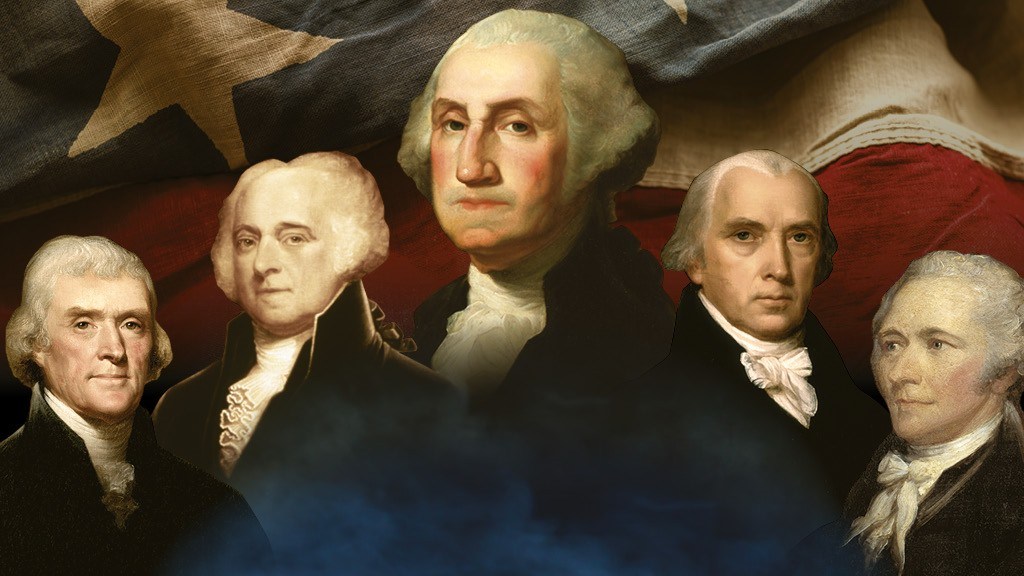
The Birthday of the Nation Is Linked with the Birthday of the Savior

'The Birthday of the Nation Is Linked with the Birthday of the Savior': Christmas and the Faith of America's Founders

It’s hard to imagine the Christmas season without evergreen trees, decorations, lights, stockings, Santa Claus, Christmas cards, and stacks of gifts for family and friends. Today, most Americans take these traditions for granted.

But when the United States was founded, Christmas was not celebrated the way it is today. While the birth of Christ was honored, and faith was central to the lives of many founders, History.com points out many popular Christmas traditions didn’t start until the 19th century. And Christmas was not even a federal holiday until June 26, 1870.

As Time Magazine noted, December 25 was so inconsequential in early America that after the Revolutionary War, Congress didn’t even bother taking the day off to celebrate the holiday, deciding instead to hold its first session on Christmas Day, 1789.

Even though the new nation did not celebrate Christmas as we do, the men who were the founders and early leaders of the United States celebrated Christmas with their families and also wrote extensively about their faith in God and Jesus Christ, his son.

What Our Founders and Early Leaders Thought of Christmas, Jesus, and the Bible

GEORGE WASHINGTON – 1st President of the United States, Commander of Continental Army during American Revolution

Washington celebrated Christmas with his family at Mount Vernon. According to the Mount Vernon website, instead of celebrating on a single day, the Washingtons celebrated a holiday season beginning on Christmas Eve and lasting 12 days till Epiphany or Twelfth Night on Jan. 6.

Washington and his wife Martha frequently attended Pohick Church, an Episcopalian congregation, in Lorton, Virginia, on Christmas Day and also hosted family and friends to celebrate Christmas.

In November of 1783, Washington found out the treaty with Great Britain had been signed and the long war for American Independence was over, according to the Mount Vernon website. He rode to Annapolis to meet with Congress and resign his military commission. While he was in the city, he bought several Christmas presents, including a locket, three small pocketbooks, three thimbles, three sashes, a dress cap, a hat, a whirligig, fiddle, gun, and quadrille boxes. Quadrille was a game of cards using an ordinary pack but with the 8s, 9s and 10s removed, and it became popular in the early 1700s. The quadrille box was probably a place to keep modified packs of cards, according to British History Online.

Washington also wrote about his faith. The following was written in his private prayer book.

“O most glorious God … Direct my thoughts, words, and work, wash away my sins in the immaculate blood of the Lamb, and purge my heart by thy Holy Spirit…. Daily frame me more and more into the likeness of thy Son Jesus Christ… Thou gavest thy Son to die for me, and hast given me assurance of salvation.”

BENJAMIN FRANKLIN – Writer, Scientist, Inventor, Statesman, Diplomat

Decades before he would become a founding father of a new nation, Benjamin Franklin noted in his Poor Richard’s Almanac in 1733, “A good conscience is a continual Christmas.”

Writing in his almanac in 1743, he would also leave the reader with this piece of advice:  “How many observe Christ’s birth-day! How few, his precepts! O! ’tis easier to keep Holidays than Commandments.”

Responding to Ezra Stiles shortly before his death in 1790, when he was asked about his religion, Franklin replied: “I believe in one God, the creator of the universe. That he governs it by his Providence. That he ought to be worshipped. That the most acceptable service we render to him is doing good to his other children. That the soul of man is immortal and will be treated with justice in another life respecting its conduct in this.”

“As to Jesus of Nazareth, my opinion of whom you particularly desire, I think his system of morals and his religion, as he left them to us, the best the world ever saw or is like to see,” he wrote.

JOHN ADAMS – 2nd President of the United States

According to White House History, the first White House Christmas party was held in December 1800. President John Adams and First Lady Abigail Adams held it for their four-year-old granddaughter Susanna Boylston Adams, who was living with them. They invited government officials and their children to the party.

Adams would also write about his faith, “The general principles on which the fathers achieved independence were the general principles of Christianity. I will avow that I then believed, and now believe, that those general principles of Christianity are as eternal and immutable as the existence and attributes of God. … The Christian religion is, above all the religions that ever prevailed or existed in ancient or modern times, the religion of wisdom, virtue, equity, and humanity.”

THOMAS JEFFERSON & JAMES MADISON – 3rd and 4th Presidents of the United States

Like many people today, Thomas Jefferson thought of Christmas as a time for family and friends. As the website of his home, Monticello, reports, Jefferson even used the word “merriment” when he wrote about Christmas. In 1762, he described Christmas as “the day of greatest mirth and jollity.”

Jefferson also wrote about celebrating Christmas with his grandchildren. On Christmas Day 1809, he said of eight-year-old grandson Francis Wayles Eppes, “He is at this moment running about with his cousins bawling out ‘a Merry Christmas’ ‘a Christmas gift’ Etc.”

Jefferson also wrote his friends about his faith.

“I am a Christian in the only sense in which He wished anyone to be: sincerely attached to His doctrines in preference to all others. … I am a real Christian — that is to say, a disciple of the doctrines of Jesus Christ.”

But during Jefferson’s time at the White House as the nation’s 3rd president, it was Secretary of State James Madison’s wife Dolley, who became the official hostess for Christmas, because President Jefferson was a widower, according to White House Christmas Cards.

According to the website, during the Christmas season in 1805, Dolley invited six of Jefferson’s grandchildren and 100 of their friends to what became a joyous holiday party where the President played the violin while the children danced.

When Madison succeeded Jefferson as president, the celebration of Christmas at the White House continued with parties hosted by First Lady Dolley. White House Christmas Cards also noted her holiday attire would usually include some purple peacock feathers atop a turban or cap covering her hair, along with her dress of lace and pink satin. Although there were neither White House Christmas cards exchanged nor a decorated Christmas tree in those years, the holiday tradition would include wonderful things to eat, including seafood, stuffed goose, Virginia ham, and pound cake.

The Madisons continued their Christmas holiday celebrations after retiring from public life to Montpelier, their home in Virginia. The yearly tradition of sending Christmas cards hadn’t yet caught on with the public at the time, but the Madisons and their relatives and friends wrote letters wishing each other the best sentiments for the holidays.

Here is a note that was written by Dolley Madison for her nieces early in 1836: “A thousand wishes for your happiness and prosperity on every and many Christmas days to come!” according to the website.

JOHN QUINCY ADAMS – 6th President of the United States

The 6th President of the United States, John Quincy Adams, used a large patriotic gathering on July 4, 1837, celebrating the 61st anniversary of the Declaration of Independence to talk about Jesus Christ and his birth.

Adams, the son of John Adams, the 2nd president of the United States, asked his Newburyport, Mass., audience a question and then responded, answering his own question.

“Why is it that next to the birthday of the Savior of the World, your most joyous and most venerated festival returns on this day on the Fourth of July?” Adams asked.

“Is it not that in the chain of human events, the birthday of a nation is indissolubly linked with the birthday of the Savior? That it forms a leading event in the progress of the Gospel dispensation? Is it not that the Declaration of Independence first organized the social compact on the foundation of the Redeemer’s mission upon earth? That it laid the cornerstone of human government upon the first precepts of Christianity?” he continued.

A PRAYER BY GEORGE WASHINGTON

This prayer is used regularly at “The President’s Chapel” of George Washington University and voices the aspirations of the University for the fulfillment of civic duties and the promotion of national welfare:

Almighty God: We make our earnest prayer that Thou wilt keep the United States in Thy holy protection; that thou wilt incline the hearts of the citizens to cultivate a spirit of subordination and obedience to government, and entertain a brotherly affection and love for one another and for their fellow-citizens of the United States at large. And finally that Thou wilt most graciously be pleased to dispose us all to do justice, to love mercy and to demean ourselves with that charity, humility and pacific temper of mind which were the characteristics of the Divine Author of our blessed religion without a humble imitation of whose example in these things we can never hope to be a happy nation. Grant our supplication, we beseech Thee, through Jesus Christ, our Lord. Amen.

12-23-2022

Source: ‘The Birthday of the Nation Is Linked with the Birthday of the Savior’: Christmas and the Faith of America’s Founders | CBN News

Study: Homeschoolers Outperform All Other Students on Standardized Test

News for You

It’s more than OK to homeschool your kids. To be fair some parents are not the homeschool type but many are and those that can should!

I speak from personal experience; we did homeschooling for several years for the 2 youngest of our 5 children. The details as to why and how are not really relevant, but what is relevant is that if I can “survive” it anybody can.

As the dad, the father; I had to do the one thing that all grown men fear – Go back to school. No matter the shape, reason or position. When I graduated High School and ran out those front doors the last time, I was not going back.  My Wife pretty much felt the same way, yet somehow I think it is easier for her being the Mom.

All of that put aside, when it comes to your kids you’re willing to do anything. Please enjoy the following article and other links provided. If you are considering the option to Homeschool I say take it and enjoy the ride!!

Study: Homeschoolers Outperform All Other Students on Standardized Test

Numerous studies have shown that homeschooled students continue to academically outperform their private, charter, and public school counterparts.

Now, a new study about homeschoolers taking the Classic Learning Test, a standardized college entrance exam, reveals they are scoring higher than their peers in other educational settings. 

The tests, according to the CLT website, emphasize intellectual aptitude and achievement and are grounded in the liberal arts tradition.

The exam utilizes reading passages from classic texts written by individuals “whose writings have had a lasting influence on culture and society” rather than the informational passages and more contemporary writings often used in the SAT and ACT, according to The Daily Wire.

The outlet reports a new analysis of the CLT results by Houston Christian University professor Lisa Treleaven found that homeschool students who took the exam earned mean scores of roughly 78 points, surpassing private school students, who earned mean scores of 75, and charter school students, who earned mean scores of 73. Public school students earned mean scores of 66, marking the lowest among the cohorts considered by the study.

Treleaven wrote, “This is consistent with prior research findings of superior academic performance of homeschool students as compared to other school types.”

The professor’s 15-page study was based on the exam results of 12,000 students who took the CLT from 2016 – 2021. 

Classic Learning Test CEO Jeremy Tate who created the CLT seven years ago, suggested to The Daily Wire that the freestyle structure of homeschooling may give an advantage over students enrolled in other schools. 

“Homeschooled students simply have more time for leisure reading,” he told the outlet. “We forget that the word school derives from Greek scholē, originally meaning leisure. The connection between leisure and learning is profound. Factory model schooling is antithetical to leisure, but is common for homeschooled students who are given the time and space to immerse themselves in great literature.”

In essence, homeschooling lets the children improve as per their nature and schedule. according to Admissionsly.com

Treleaven’s analysis shows that homeschooled students significantly outdid their peers on the verbal and writing portions of the CLT.  But were about equal with private and charter school students’ test scores on the quantitative portion of the test. 

The professor also called for more research on homeschool academic achievement. 

According to the National Home Education Research Institute, (NHERI) homeschooled children typically score 15 to 30 percentile points above public-school students on standardized academic achievement tests. 

Seventy-eight percent of peer-reviewed studies on academic achievement show homeschool students perform statistically significantly better than those in institutional schools, the NHERI stated in research facts posted on its website. 

Among the other facts presented by the institute:

  • Homeschooling is increasing among minority communities  
  • Homeschool students score above average on achievement tests regardless of their parent’s level of formal education or their family’s household income
  • 87% of peer-reviewed studies on social, emotional, and psychological development show homeschool students perform statistically significantly better than those in conventional schools
  • Homeschool students are increasingly being actively recruited by colleges

More Parents Are Opting to Homeschool Their Children

As CBN News reported in June, in the wake of recent school violence and the “woke” movement, families across the nation are looking at the benefits of homeschooling their children like never before.

Actor and family advocate Kirk Cameron examined the rise in homeschooling’s popularity in his documentary released last summer titled The Homeschool Awakening

The film features 17 different families from all kinds of backgrounds. Some of the children are opening businesses. Others are traveling the country with their parents and siblings, and other children are doing things like getting their pilot’s license at age 17.

“Kids are learning outside with the entire world as their classroom together with their siblings and with their parents and with their grandparents,” Cameron said. 

The actor interviewed several parents for the film who once viewed homeschooling as weird. “I always viewed homeschooling as somewhat of a cult,” one parent said. Others said they once thought of homeschoolers as “weird” or “abnormal.”

And like those parents, Cameron admits he also once had a “healthy fear” of homeschooling.

“I thought homeschooling was like, you had to be a Quaker or you had to be Amish. I was saying, I mean, does my wife need to wear a floor length, denim jumper, have a head covering and you know, where do we get the uniform?” he joked.

“And then I realized that I was just out of touch with this incredible robust community of people. There are experts and educational professionals creating curriculums that actually incorporate faith and what I’m learning is that parents are not stuck in a system that they’re not happy with,” Cameron said. 

The Lifemark star noted parents are waking up and holding their public schools more accountable.

“And if you look at the public education system, removing prayer from schools, removing God and the Bible from school and replacing those things with progressive ideas, like the Critical Race Theory, Gender Theory, and teaching children to decide whether or not they prefer to be a boy or a girl, to choose their own pronouns, and separating parents from their children’s understanding of sexuality and when, and how they’re exposed to explicit material, these are the kinds of things that parents are saying ‘we’re not down for this anymore,'” Cameron said.

He added perhaps the best part of homeschooling is God gets to stay in the classroom.

“We want our children to understand who they are, who God is, their place in the world, why they’re here,” Cameron said.

As CBN News reported in December of 2021, a boom happened in homeschooling in America as the number of children taught by their parents doubled after the COVID-19 lockdowns began. 

According to U.S. Census Bureau data, the pandemic sparked new interest in homeschooling. By the end of 2020, more than 9 million Americans said they had attended homeschool at some point in their lives, according to Admissionly.com

By Steve Warren

Steve Warren is a senior multimedia producer for CBN News.

Warren has worked in the news departments of television stations and cable networks across the country. In addition, he also worked as a producer-director in television production and on-air promotion.

A Civil War historian, he authored the book The Second Battle of Cabin Creek: Brilliant Victory.  It was the companion book to the television documentary titled Last Raid at Cabin Creek currently streaming on Amazon Prime.

He holds an M.A. in Journalism from the University of Oklahoma and a B.A. in Communication from the University of Tulsa.

Related

‘Homeschool Awakening’: Families Across the Nation Opt Out of Public Schools Like Never Before

More Than a Fad: Why a Growing Number of Parents Are Opting to Homeschool Their Kids 

News for You

Do you know where Kazakhstan is at on a map? Or could you name one country it is next to? Click on Google Map Link

https://www.google.com/maps/place/Kazakhstan/@38.0130128,29.8720557,2.5z/data=!4m5!3m4!1s0x38a91007ecfca947:0x5f7b842fe4b30e1b!8m2!3d48.019573!4d66.923684?hl=en

Quick facts – Kazakhstan, a Central Asian country and former Soviet republic, extends from the Caspian Sea in the west to the Altai Mountains at its eastern border with China and Russia. Its largest metropolis, Almaty, is a long-standing trading hub whose landmarks include Ascension Cathedral, a tsarist-era Russian Orthodox church, and the Central State Museum of Kazakhstan, displaying thousands of Kazakh artifacts.

The Best news is that the amount of Christians is growing there as is explained in the following article published by Christian Today News (Links Below)

The Gospel in the heart of Central Asia

By Johannes Reimer-13 December 2022

Kazakhstan is the largest country in Central Asia in terms of its territory and it ranks 9th largest by landmass in the world. It is considered a Muslim majority country. The population of 20 million people is very multicultural, tolerant, multi-religious and open. Politically neutral Kazakhstan is proud that the almost 100 different ethnicities coexist peacefully. Among them, Kazakhs represent approximately 75 per cent of the total population. In addition, Slavic peoples, such as Russians, Ukrainians, Byelorussians and Poles comprise 20 per cent.

While a previously large German minority has almost entirely moved to Germany, the Chinese diaspora is growing by the day. There are also large communities of Koreans.

Kazakhstan is strategically and geopolitically very well positioned between China, Europe and the Middle East, with a growing and vibrant evangelical church to influence this part of the world with the Gospel of Jesus Christ. Today almost 30 per cent of the population in Kazakhstan is Christian. While the majority of them are still from a non-Kazakh background, the number of Kazakhs who confess to follow Jesus Christ as their Lord is growing.

In the past, the Kazakhs were to a large extent Christian and carried the Gospel as far as China and Mongolia. Only slowly, Islam spread through the majority of the population. Later, in Soviet times atheism became the dominant ideology of the country.

The new start of evangelical Christianity among the Kazakh tribes goes back to the 1990s. Indeed, there were no indigenous Kazakh-speaking churches at that time and only a very few Kazakhs who came to faith in the Russian speaking churches.

The first Kazakh-speaking church was started in 1992. As the very first Kazakh-speaking church pastor, Malik started the Rakhim (Mercy) church in Alma-Aty with a small group of Kazakh believers. And then the evangelical Christian Baptists began to work with the Kazakh population, and the Kutkaruly Zholy church (translated as the Way of Salvation) was started.

After that missionaries began to come from Europe, North America and South Korea and from other countries. From 1993 to 1998, many Kazakh congregations were planted with the help of foreign missionaries. Those years are considered the most fruitful years for Kazakhstan, and revival and church growth soared.

Development, growth and alliances

The number of evangelical registered churches in Kazakhstan today stands at approximately 400, including all Russian-speaking and Kazakh-speaking churches. The vast majority of them belong to the Evangelical Alliance of Kazakhstan (EAK). You will find ethnic Kazakhs in almost all of the evangelical churches today, about 100 of which are registered Kazakh churches.

Most of those churches are located in the south and south-eastern part of Kazakhstan. There are difficulties in organizing Kazakh-speaking churches in the north, east and western parts of the country since the majority of Kazakhs living in the north and east are Russian-speaking, while the West is remote and more resistant to the Gospel.

Not all Kazakh-speaking churches are registered yet due to their size or political circumstances. There are about 150 Kazakh-speaking evangelical churches in Kazakhstan today, including registered churches and unregistered house churches. Kazakh churches are typically not very numerous, with usually about 50 church members on average. But there are also a few large ones, numbering approximately 600-800 members.

Kazakh believers have formed their own association called Kurultay – ‘convention’ in English. The main goal of the Kurultay is to foster and bring unity to all of the Kazakh evangelical churches and remove denominational barriers, thus serving as one Body of Jesus Christ and expanding the Kingdom of God in all the regions of Kazakhstan.

The Kurultay was started in 1999 with the help of the Kazakh partnership, a Kazakhstan-based association of foreign missionaries. In the beginning only the pastors of Almaty gathered for the monthly prayer meetings. And in 2000, the first conference of Kurultay was organized in Almaty. From the very beginning, Kurultay was closely connected with the Evangelical Alliance of Kazakhstan, building a nucleus of unity among Christians of the country.

Today the Kurultay includes churches from almost all evangelical or Protestant denominations represented in the country. That includes Pentecostals, Evangelical Christian Baptists, Independent Baptists, Charismatics, Presbyterians, Methodists, and other independent Protestant churches.

The Kurultay of Kazakh pastors is one of the most important annual meetings in Kazakhstan. Here they come together to fellowship with each other and discuss the most important current issues among the Kazakh-speaking population. And they share with each other the problems that hinder the growth of God’s Kingdom in the country. The steering committee of the Kurultay consists of 12 pastors from various parts of Kazakhstan. The current president is Yerkinbeck Serikbaev.

He wrote to me: “All participants openly share in a friendly atmosphere about pressing problems, pray together and look for ways to cooperate. We try to involve as many pastors from different churches and denominations as possible. Of course, there are pastors who would like to be part of the Kurultay but there are some denomination leaders that do not allow pastors from their denomination to join.

“We believe that now is the time to pray together and unite like never before. One of the main challenges in our country is to reach Muslim Kazakhs and other minority Muslim people groups. Even though we come from different church backgrounds and have differences in the ways and approaches to evangelize the Muslims, we get together to discuss and find better ways to do that.

“We annually convene pastors and leaders from all regions of Kazakhstan. This is a platform for all pastors to get to know each other, pray together to share their experience, expertise and make plans and strategies for the future.”

Working together for the kingdom

The list of missionary activity motivated by the Kurultay is long. Kurultay holds outreaches during the biggest national holiday called Navruz (the Central Asian new year celebrated in the spring), with the goal of sharing the Gospel. Unsaved friends, relatives and acquaintances are invited and the name of the Lord is proclaimed.

Special conferences and training seminars for leaders, youth and women as well as summer camps for children and teenagers are organized by the Kurultay. But the most exciting ministry is their mission outreach.

Serikbaev states: “We believe that God has positioned us strategically and given us, the Christians of Kazakhstan, a missionary calling to take the good news to Muslim peoples living near and far. Kurultay organizes short-term missionary trips and sends long-term missionaries.

“This happens not only within Kazakhstan, but also outside of Kazakhstan. Kazakhstani pastors and missionaries go to other countries of the Turkic world because of our cultural affinity and religious background to plant churches.”

For example, a group of pastors and other brothers and sisters, went to the Bayan-Ulgi region in western Mongolia, where mainly Kazakh people reside.

“On the last missionary trip there was a group of 30 of us travelling on a bus there,” reports Serkinbaev. “We conducted a three-day seminar for believers. And, also shared the Gospel with the locals. And both Mongolian Christians as well as listeners to our evangelistic preaching, expressed their deep gratitude. Hearing the Gospel proclaimed in their mother tongue is special to them and the acceptance of the truth was overwhelming.”

Today Kurultay is in the process of registering with the Kazakhstan government. The leadership has already submitted all the documents for registration to the state authorities and hopes to get the official registration by the end of 2022.

Basic needs – a conference centre in the city of Almaty

With a growing and aspiring evangelical population Kurultay needs a center to grow and organize more ministries and serve the wider body of Christ in Kazakhstan and in the surrounding countries. The centre will be tailor-made for all kinds of ministries in the churches at home and beyond. The leaders of Kurultay envision a mission training centre for training Kazakhs in their own language to send missionaries, ministers and workers to countries and places in Kazakhstan, the wider Turkic world and beyond.

Kurultay plans to organize outreach trips to different regions three to four times a year inside of Kazakhstan, especially to regions where help is urgently needed, such as the northern, western and eastern regions where there are fewer churches and Christians. And they plan to organize missionary trips to Mongolia, Tajikistan, Uzbekistan, Middle Eastern countries like Saudi Arabia and other countries where the churches are rare and missionaries are welcomed. The potential missionaries will need training and the proposed centre will serve them well.

But the centre could host many other ministries. Kurultay hopes to establish a studio for audio-video recording, internet media ministries, a printing press, television and radio broadcasting studio, prayer centre, dormitories and a hall for holding mass events.

They are also praying to organize a Christian school through Kurultay. For this they already have concrete plans and partners that can help. This will give the children of Kazakh believers a higher Christian education and help prepare a new generation of followers of Jesus.

In a letter to the World Evangelical Alliance (WEA) the leadership of Kurultay urgently pleaded for the support and assistance of the global church.

“Brothers and sisters in Christ, we hope for your support and prayers. We believe that we will overcome all our difficulties and needs together,” said the president of Kurultay.

“We have two options. The first is to purchase a building with a conference hall and bedrooms etc., which we could use for various meetings and seminars. That type of a building approximate costs in the city of Almaty 2 to 3 million US dollars. There is a second option, to buy a plot of land and build a Turkic center ourselves. And it costs approximately 2.5 million to 3 million US dollars. For this, we have plans and projects for construction. This will be the centre for Turkic-speaking churches of our country and wider Central Asia. At this point we have raised 100,000 US dollars. Of course, this amount is not enough to buy a suitable place or to buy property and build. Thank you very much! May the Lord bless you and your churches, ministries!”

As the evangelical family in the world we rejoice with the Kazakh believers and thank God for the amazing growth of their churches in Kazakhstan. And we should respond to their plea for support in prayer and giving. There has never been a better time for this.

Original article Link

https://www.christiantoday.com/article/the.gospel.in.the.heart.of.central.asia/139577.htm

Christians Now A Minority In England, Declining in the USA, Too 

For the first time in 1,400 years, England and Wales are no longer majority Christian. The UK’s Telegraph reported Tuesday that “Christians now account for less than half of England and Wales’ population for the first time in census history, government figures reveal.” This is an indication of what happens when the Left attains cultural dominance in a society and is likely a harbinger of things to come for the U.S. as well unless there is some massive cultural shift in the next few years. And there could be.

Right now, however, the trends are unmistakable. “The Office for National Statistics (ONS),” says the Telegraph, “results show that 46.2 per cent of the population (27.5 million people) described themselves as ‘Christian’ in 2021. This marks a 13.1 percentage point decrease from 59.3 per cent (33.3 million people) in 2011.” The trend is the same in the United States, although the numbers are higher: in 2019, according to the Pew Research Center, 65% of Americans identified themselves as Christian, down 10% from 2009. The number of those who said they were “nothing in particular” grew by 4%, to 16% of the total population.

In England and Wales, this was not just a matter of religiosity declining across the board: “The census data also shows that every major religion increased over the ten-year period, except for Christianity.” The Archbishop of York, Stephen Cottrell, tried to put a good face on this fiasco, saying that the new figures were “not a great surprise,” but insisted that Christianity still remained “the largest movement on Earth.”

That’s great, but what happened in England and Wales? What is happening in the United States? The decline is the result of a number of factors. Journalist Daniel Greenfield observed that “What you’re seeing is the result of cultural programming that has all but eliminated Judeo-Christian religiosity as a source of values and identity among the young and replaced it with pop culture and politics.”

That’s certainly true. The elimination of Judeo-Christian religiosity, however, has not been solely a matter of cultural programming by exterior forces. The very people who were supposed to be the guardians of Judeo-Christian religiosity are in all too many cases the very ones responsible for the decline of its influence. This is a result of the fact that the Left’s Long March Through the Institutions didn’t just take over and destroy our colleges and universities, as well as the entertainment industry and the establishment media; the churches and other religious institutions were targeted as well.


This targeting was extraordinarily successful, to the extent that in the U.S., virtually all of the old mainline Protestant denominations have become what has been summed up in one indelible quip: “the Democrat Party at prayer.” Go into the average Episcopalian or United Methodist or Presbyterian church, and you’re liable to see an LGBT rainbow flag, and even if you don’t see one, the sermon will be about how we can save the planet from climate change or systemic racism or Trump or insurrectionists or transphobes or whatever the Left’s villain du jour may be.

The distinctive aspects of Christianity that make it what it is and has been for two thousand years may or may not be paid lip service, while the commitment to “diversity and inclusion” will be front and center. The situation is hardly any different in all too many Roman Catholic and Eastern Orthodox churches today as well, as well as in Reform Jewish congregations. All too many reflect the spirit of the age rather than the Spirit of God, and people don’t need to go to a synagogue or church to hear about the spirit of the age. We are inundated with it everywhere as it is.

It isn’t that congregants are turning away from the churches because they’re more conservative than the pastors and preachers, although that is certainly true in many cases. They’re turning away because the churches and other religious institutions aren’t offering them anything different from what they get everywhere else, so why bother? Leftism has conquered the religious establishment in the United Kingdom as well as the United States, but since it has conquered everything else as well, it’s all the same to stay home on Sunday morning and enjoy a waffle and the morning chat shows rather than sit in an uncomfortable pew and hear more of the same.

The churches, in short, have failed their people, and that’s why people are leaving. They will continue to leave as long as this keeps up.

Source: Christians Now A Minority In England, Declining Here, Too – PJ Media

Why Plymouth Prospered When Others Floundered

It’s the time of year when postmodernists revise our understanding of history to paint a world and nation so thoroughly corrupted from its inception that propriety demands its eradication. They paint a world so depraved that our treasured moments of gratitude and family gathering must be replaced with self-loathing and unending repentance to Godless woke ideologies.  The postmodernists intentionally impart modern context to historical events so that they might destroy the fabric of our nation.  A proper perspective paints a more hopeful picture. A picture where a people desperate for religious freedom sought refuge in a distant and inhospitable land and found allies amongst people unlike themselves.

A proper survey of the world in the fifteenth thru seventeenth centuries provides a glimpse of a world in transition.  At the time, the Catholic Church dominated much of the Western world, save for the Anglican territories.  Religious influence was tantamount to political power.  Monarchs were chosen by God, and material wealth was considered a reflection of the blessings of the Creator.  It was this mindset that spawned the practice of selling indulgences and drove men to traverse the globe in search of the favor of monarchs and God. It was this practice that ultimately ended in the repeated failures of explorers to put down settlements in North America.  It was the radically different approach employed by the pilgrims of Plymouth colony that we, in part, owe our existence to today.

The pilgrims of Plymouth colony were a group of English Puritan separatists who, having been persecuted in their homeland by the state Anglican Church, sought refuge in the Netherlands.  Though free to worship, the urban industrial setting of the Netherlands was a poor fit for this agrarian sect.  Having seen English persecution creeping into the Netherlands and having their children begin to acclimate to the Dutch culture and lifestyle, they pooled their resources to risk everything they had for a chance at life on their terms in the new world.  In 1619, they applied for and received financing and a land patent that would allow them to settle at the mouth of the Hudson River in what is now Connecticut/New York.

Through multiple failed launches, deceitful lenders, and an at-times hostile ship crew and shipmates, the pilgrims would finally set sail aboard the Mayflower ship on September 6, 1620.  After two arduous months at sea, they would be blown off course and arrive at Cape Cod on November 9, 1620.  With winter setting in, they abandoned their initial charter at the mouth of Hudson Bay and instead anchored at what is today Plymouth, Massachusetts.  Having abandoned their initial charter, they required a new governmental organization that would give them legal claims to their settlements.  They drafted and signed the Mayflower Compact.

Before the arrival of the pilgrims of the Plymouth colony, numerous attempts to establish English settlements along the Eastern seaboard of North America had ended in the settlers’ demise.  Settlements like the lost colony of Roanoke or Jamestown, Virginia, had seen most settlers perish due to disease, malnutrition, exposure to the elements, and war with native tribes. The primary difference between these past attempts and that of the Plymouth colony lay in motivation.  Whereas prior attempts to settle North America had been driven by material wealth and prestige, the pilgrims of Plymouth colony largely sought freedom to worship God in the manner they wished.  In this way, they were devoted to one another in pursuing communal success and not just material wealth to advance their cause.

With a devotion to God and each other, the pilgrims found divine favor where others did not. It was the kindness and unwavering faith of the pilgrims while crammed below the deck of a meager ship for two months that won over an at-times hostile ship crew.  It was divine providence that landed the pilgrims in a harbor that was abandoned by the native Patuxet, who had been largely decimated by leptospirosis. In this way, they encountered lands that were already cleared and prepared for settlement.  As an agrarian society, they were also better equipped to labor for their sustenance than prior English settlements that were largely manned by an unskilled and unwilling educated class.

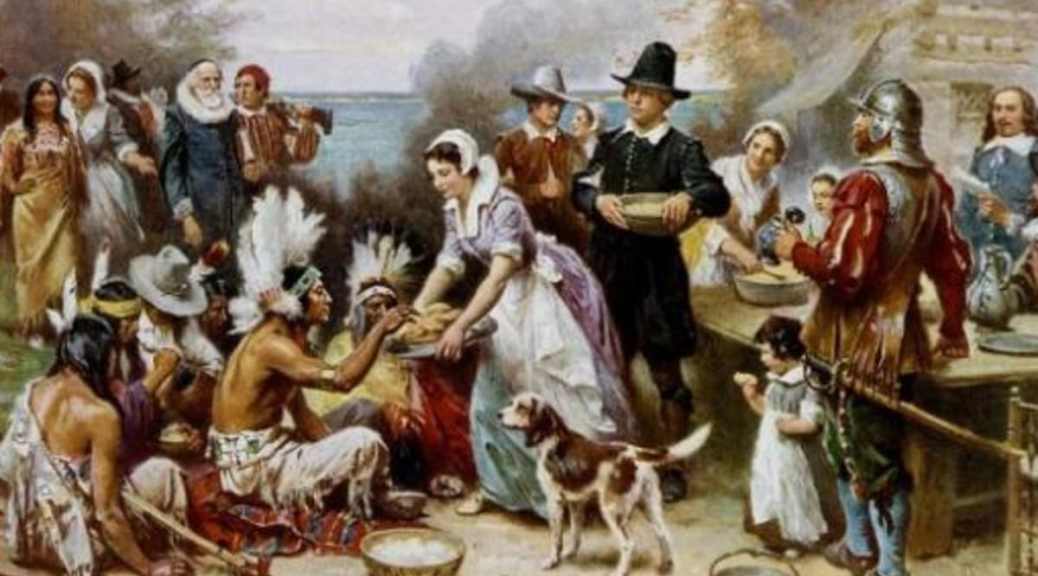
It was divine providence that following a brutal first winter that saw half of their numbers perish, they were greeted by Samoset, an English-speaking native translator. Samoset introduced the pilgrims to Chief Massasoit of the Wampanoag tribe and Squanto, an English-speaking native and one of the remaining Patuxet tribe.  It was these early relationships that would be the basis of the success of the Plymouth colony.  Through these relationships, the pilgrims signed exclusive defense and trade treaties and established peace with the natives where prior colonies had failed. They were taught to subsist in a hostile and foreign land.  It is these relationships that form the basis of the Thanksgiving we celebrate today.

When postmodernists attempt to reorient our thinking of the year 1619 to align with the Dutch indentured slave trade, it is not by accident.  It is intended to pre-empt a pivotal moment in American history.  That moment is the arrival of devoutly religious English separatists who showed us how to coexist among those unlike ourselves.  It was their commitment to God and each other that saw them flourish when others floundered.  They laid the foundations that our melting pot society enjoys today.

By Brian Parsons

Source: Why Plymouth Prospered When Others Floundered – American Thinker

In defense of Thanksgiving, here and abroad 

Commentary: In defense of Thanksgiving, here and abroad

Dixie Johnson Nov 1, 2022

Thanksgiving. Ah, Thanksgiving. That most American of holidays begun by the Puritans and their friends so many years ago and officially sanctioned by President Lincoln. It’s my favorite family holiday, so it was an especially hard time when I was living in a foreign country.

A friend who spent some years on a boat in Mexico ridiculed Americans who wanted to indulge in the traditional foods for the holiday when they could be eating wonderful Mexican food instead. Heck, they could have Mexican food every day so why was it so hard to understand why some of us wanted to enjoy the traditional menu on this special day?

The years I lived in Czech Republic and in Slovenia I had to try very, very hard to make the holiday live up to my fond expectation. Back in the mid-1990s, I taught in a Czech Gymnasia, a high school for bright students headed for universities, and I lived with a young Czech family. When the big day was approaching, I asked where I might buy a turkey. No luck, none were to be found; but I did learn that I could find frozen chickens in the small chest freezer at the nearby “potravinie” (grocery store). So off I went to choose a bird. I found one that looked fairly good-sized and set it out to thaw the night before our big dinner.

Horrors! After it thawed I could see that it was peppered everywhere with tiny pinfeathers.

“No problem,” said Ivan, the young husband, who was eagerly awaiting the fabulous feast I had promised. “I will pull them out with pliers.”

So he set to work and before long it looked more edible.

Then more horrors — the innards were not empty of innards. Martina, the young wife burst into raucous laughter.

“You bought a hen, not a chicken,” she, who was a medical student, said. “But no problem.”

She went to work removing with great curiosity and interest one egg after another after another after … well, you get the idea. Each succeeding egg was slightly smaller than the one before. That prolific hen contained a wealth of eggs.

At last, the oven was heated and the bird was ready. It roasted and roasted and roasted, yet it was tough as ever. Finally, Martina’s mother came up from her apartment downstairs and told us she knew what to do. She chopped bacon into slivers then cut small slits in the chicken and inserted the bacon bits. Back into the oven it went to roast some more. Before long it smelled delightful. It finally ended up slightly more tender, but nothing like what I expected. That was the day I learned the difference between a chicken and a hen.

Fortunately, the apple pie I made was delicious — the cinnamon, nutmeg and cloves I had brought from America made it special. Everyone wanted the recipe and, because some spices weren’t readily available in Czech Republic, I left mine for the family when I returned to the U.S.

A couple of years later, when I was teaching in Slovenia, I decided to fix Thanksgiving dinner and invite three other Americans who lived in various parts of the tiny country.

A week before the celebration, I stopped at a small market that had a nice meat counter to order a turkey. With my limited Slovene, I managed to arrange with the butcher for a small turkey of about three or four kilos. I was to pick it up on Friday, the day before my friends were arriving. My husband had sent from Idaho two boxes of Stove Top stuffing mix as well as a couple of packages of Craisins. What could be better than turkey, stuffing and cranberries? Apple and cherry pies would have to substitute for the pumpkin and mincemeat varieties. On Monday, I stopped to confirm that all was well and my turkey would be there by Friday.

“No problem,” the butcher said with a big smile, proud of his English.

Friday arrived. I stopped at the market after school on my way home. It was closed! And the sign on the door said it would be closed for several days. What? Panic!

Time for Plan B, but what was Plan B? I knew I’d not be able to find a turkey but maybe a chicken? I stopped at another market a mile or so away where, thank goodness, they had a large chunk of turkey breast. And I bought the whole thing.

“Do you want it sliced?” asked the butcher.

“No thank you,” I replied.

This surprised him since Slovenes generally purchase turkey in thin slices and fry it up as schnitzels.

It all turned out fine. I braised extra onions and celery to add to the stuffing mix and of course potatoes and gravy work great in any culture.

For breakfast the next morning, I devised maple syrup for our French toast out of sugar and water cooked up with a spoonful of maple flavoring (again brought from Idaho). Ah, all’s well when the tummy is full of good old traditional fare.

By the way, why was that first market closed? I stopped the next time it was open and the butcher apologized profusely. The market had been sold to a new owner and was closed for inventory. I never knew if my original turkey was there or not, but my friends and I never missed it.

Dixie Johnson, 79, of Grangeville, worked in three different European countries — Hungary, Czech Republic and Slovenia — in the 1990s and early 2000s.

Source: Commentary: In defense of Thanksgiving, here and abroad | Golden Times | lmtribune.com


Today, thank a veteran for your freedoms 

Today, thank a veteran for your freedoms


One hundred and four years ago today, on the eleventh hour of the eleventh day of the eleventh month, (November 11, 1918),


…the Great War ends. At 5 a.m. that morning, Germany, bereft of manpower and supplies and faced with imminent invasion, signed an armistice agreement with the Allies in a railroad car outside Compiègne, France. The First World War left nine million soldiers dead and 21 million wounded, with Germany, Russia, Austria-Hungary, France and Great Britain each losing nearly a million or more lives. In addition, at least five million civilians died from disease, starvation, or exposure…


A year later, on November 11, 1919, the first anniversary of the end of the slaughter of the Great War, as it was called, and the subsequent armistice signing was designated Armistice Day.  Because of its vast expanse and unprecedented number of deaths and severe injuries, plus massive destruction, Europeans and Americans celebrated the end of the Great War — as it was originally called, “the war to end all wars.”

Alas, such optimism of no more wars was unwarranted.  Twenty-five years later, another brutal, widespread war, World War ll, began, and the Great War was renamed World War l.  Therefore, while the purpose of the holiday, to honor U.S. Armed Forces veterans, remains unchanged, the scope of the day and its name have changed over the years, as the helpful U.S. government census site explains.


…Congress passed a resolution in 1926 making it an annual observance, and it became a national holiday in 1938. Sixteen years later, then-President Dwight D. Eisenhower signed legislation changing the name to Veterans Day to honor all those who served their country during war or peacetime. On this day, the nation honors military veterans — living and dead — with parades and other observances across the country and a ceremony at the Tomb of the Unknown Soldier at Arlington National Cemetery in Virginia…


In recent years, all U.S. military branches have been unable to fill their recruiting goals — and no, not only because of WuFlu.  Meanwhile, countries around the world turn to the U.S. for military aid; our service personnel are on active duty around the world.

Our country, our entire world is safer because of their commitment.

Remember their sacrifice!

Honor their duty!

Thank them!


By Ethel C. Fenig

Source: Today, thank a veteran for your freedoms – American Thinker

The timeless wisdom of Thomas Paine’s ‘Common Sense’


The timeless wisdom of Thomas Paine’s ‘Common Sense’


PERHAPS the sentiments contained in the following pages, are not yet sufficiently fashionable to procure them general favor; a long habit of not thinking a thing wrong, gives it a superficial appearance of being right, and raises at first a formidable outcry in defence of custom. But tumult soon subsides. Time makes more converts than reason.

—Thomas Paine, introduction to Common Sense

It would behoove us all to review the text of Thomas Paine’s 48-page pamphlet, which he published anonymously (fearing reprisal) in February 1776. Paine’s wisdom applies as well today as it did back then, not because of his argument against the monarchy, but as a reminder that the self-government we championed then—and are losing now—carries responsibilities.

Paine donated the profits from the astounding 500,000 copies sold (when the US population was only 2.5 million) to Washington’s army. Looking at his ideas reminds us that it was influential for a profound reason. Let it be so again, as part of the guidance we need to follow out of the current morass.

Paine was British by birth and had no formal higher education, having dropped out of school at age 13. Therefore, he wrote simply, using accessible and resonant words. From the opening paragraphs:

Society is produced by our wants, and government by our wickedness; the former promotes our happiness positively by uniting our affections, the latter negatively by restraining our vices. The one encourages intercourse, the other creates distinctions. The first is a patron, the last a punisher.

Paine aptly describes how a government must be formed, to have an orderly society

…because as the elected might by that means return and mix again with the general body of the electors in a few months, their fidelity to the public will be secured by the prudent reflection of not making a rod for themselves. And as this frequent interchange will establish a common interest with every part of the community, they will mutually and naturally support each other, and on this (not on the unmeaning name of king) depends the strength of government, and the happiness of the governed.

Clearly, we’ve grown away from that simplicity. A small populace governed by elected representatives people has become 340 million people governed by a nameless bureaucracy, plus a few elected officials who rarely aspire to represent most of their constituents. That part of Paine’s writing devoted to arguing against the concept of hereditary, kingly rule resonates now that we have what was then unimaginable: an ingrained, bureaucratic inflexibility of rule.

Do we have a president in the sense our Founders conceived? On the face of it, the president today can, by fiat, change any rule. The executive order that put a halt to the Keystone pipeline, and started our descent into energy helplessness is an example. He (or, in Biden’s case, his minions) can direct a corrupt bureaucracy to trample on the rights of the people he so inadroitly governs—a stark example is Biden’s continued imprisonment, without trial, in horrific conditions, of people who walked into the Capitol building nearly two years ago.

Paine’s writing reminds us that

Men who look upon themselves born to reign, and others to obey, soon grow insolent; selected from the rest of mankind their minds are early poisoned by important; and the world they act in differs so materially from the world at large, that they have but little opportunity of knowing its true interests, and when they succeed to the government are frequently the most ignorant and unfit of any thoughout the dominions.

While that last was again written as an argument against the throne, it holds true now, perfectly describing Biden. Paine further asks this question:

Is the power who is jealous of our prosperity, a proper power to govern us?

Such a simple question. It is demonstrably true that those now in power work against our prosperity. We see this in our wealth’s diminution through predictable inflation caused by blatantly bad fiscal and social policy. We, and our government, forget that, as Paine quotes Dragonetti, on Virtue and Rewards,

The science of the politician consists in fixing the true point of happiness and freedom. Those men would deserve the gratitude of ages, who should discover a mode of government that contained the greatest sum of individual happiness, with the least national expense. (Emphasis mine.)

Paine further says that

The more men have to lose, the less willing they are to venture. The rich are in general slaves to fear, and submit to courtly power with the trembling duplicity of a spaniel.

It is time, I think, to stop trembling and watching our freedom slip away. In much of the country, this election matters more than any before it, and we must consider it a start toward reversing America’s downward spiral. Keeping the feet of those whom we elect to the fire is step two. Complacency is no longer an option.


Source: The timeless wisdom of Thomas Paine’s ‘Common Sense’ – American Thinker

Researchers: We’ll never be able to control a super-intelligent AI 


The proliferation of a new generation of AI chatbots has spurred a renewed interest around the Big Tech community in one of our favorite topics here. That would be the dreaded worst-case scenario where we finally come up with an Artificial Intelligence system that is actually smarter than the humans who programmed it, is capable of original thought, and “wakes up” to the point where it demonstrates sentience. To be clear, we’re still not sure if that’s even possible, but developers are gamely giving it their best shot, as we’ve discussed here on multiple occasions. Some researchers have been giving it a lot of thought, though, including one group of scientists who published their conclusions in the Journal of Artificial Intelligence Research last year. They sounded rather definitive in their findings. As David Nield recounts at ScienceAlert, the outlook is less than cheerful. Due to a stone wall we are likely to run into when trying to model our most advanced AI creations, they concluded that it will be almost impossible for us to control a superintelligent AI.

The idea of artificial intelligence overthrowing humankind has been talked about for decades, and in 2021, scientists delivered their verdict on whether we’d be able to control a high-level computer super-intelligence. The answer? Almost definitely not.

The catch is that controlling a super-intelligence far beyond human comprehension would require a simulation of that super-intelligence which we can analyze (and control). But if we’re unable to comprehend it, it’s impossible to create such a simulation.

Rules such as ’cause no harm to humans’ can’t be set if we don’t understand the kind of scenarios that an AI is going to come up with, suggest the authors of the new paper. Once a computer system is working on a level above the scope of our programmers, we can no longer set limits.

In basic layman’s terms, in order to be able to fully understand (and thereby control) all of the possible virtual actions that such a system might undertake on its own, we would need to be able to first create a simulated model of the super-intelligence to run all of the needed tests. But if the system is beyond our ability to simulate, we’ll never be able to create that model.

Isaac Asimov’s three laws of robotics apparently won’t save us, either. If the first instruction you give to the algorithm is that it must never cause any harm to a human being or allow such harm to take place, we have no idea how many side roads the machine will explore while attempting to solve problems. It could readily come up with a “solution” that doesn’t meet the definition of “causing harm” but wipes us out anyway. Or, a sufficiently advanced system might reach a justification for modifying the rules if that is the only way to solve the problem that it’s working on.

In case that doesn’t give you enough to worry about, a second group of researchers from Google Deepmind and the University of Oxford tackled the same question. Their paper, published in the journal AI Magazine, offered a more brutally stark conclusion. A superintelligent AI will “likely annihilate humankind” in some sort of “existential catastrophe.” (Futurism)

Researchers at Google Deepmind and the University of Oxford have concluded that it’s now “likely” that superintelligent AI will spell the end of humanity — a grim scenario that more and more researchers are starting to predict…

“Under the conditions we have identified, our conclusion is much stronger than that of any previous publication — an existential catastrophe is not just possible, but likely,” Cohen, Oxford University engineering student and co-author of the paper, tweeted earlier this month.

The superintelligent AI would likely be goal-driven and lack any sense of morals as humans understand them. The tipping point would come when it begins to view human beings as “standing in the way” of solving a problem or achieving a goal. And when the AI sees you as an obstacle, the obstacle will need to be removed.

You may be thinking that we can simply pull the plug before it gets carried away, but that’s been addressed also. Even the chatbots we have today are able to search trillions of records to develop responses so quickly that it seems instantaneous. The superintelligent AI could likely work out a solution (even one of the terminal kind) and put it into action before its human creators realized anything was going off the rails. So we would stand even less of a chance than the military officials and scientists in the movie Colossus: The Forbin Project. (And if you’ve never seen that, I highly recommend it.)

But don’t lose too much sleep over all of this for now. We’re still a long way from creating that level of superintelligence. Or at least that’s what the machines would like us to think for now.


Over before you know it’s begun

Source: Researchers: We’ll never be able to control a super-intelligent AI – HotAir

Why the Bible’s 1st sentence is the key to all truth

Why the Bible’s 1st sentence is the key to all truth

Exclusive: Neill G. Russell explains Satan’s ‘second great plan of deception’ regarding Creation

Lying is the primary weapon of deceit that Satan uses to separate people from God, their loving heavenly Father and Creator. The apostle Paul tells us that Satan “masquerades as an angel of light” (2 Corinthians 11:14), so that what he says and does sounds good and seems reasonable, but there is absolutely no truth in anything he says.

Satan told the first lie in recorded history, to Eve in the Garden of Eden. After planting seeds of doubt in Eve’s mind with a question (Genesis 3:1), he directly contradicts God’s Word by telling her, “You will not certainly die” (Genesis 3:4). With that lie, Satan led Eve to her death; Adam followed, and so have we.

Satan’s second great plan of deception was as equally brilliant as his first. Just get humans to accept a believable alternative to replace the first sentence of the Bible, Genesis 1:1, “In the beginning, God created the heavens and the earth,” as truth. If they won’t accept the first sentence of the Bible as truth, they’re not going to believe the rest of the book either. I call this highly successful scheme “Satan’s mantra of doubt.” Simply put: “If they don’t believe that God is the creator, they won’t believe in God.”

As a public high school science teacher for 45 years, I witnessed firsthand Satan’s subtle lying attempts to remove all vestiges of God from our schools and universities. During that same period, I tried never to compromise teaching God’s Genesis 1:1 scientific truth to my students.

TRENDING: Guns and Rosaries

The basic premise of science is that everything considered “truth” must be tested either to prove or disprove its existence. Like science, truth is uncovered when you can make repeatable observations and check your evidence against the cold, hard facts. Unfortunately, Darwin’s Theory of Evolution (by Natural Selection), which is presently being taught worldwide in public schools and universities as scientific truth, is nothing more than an “unproven malicious lie” contrived by the devil for one solitary purpose: to spread the belief that God “is not” our Creator.

Now, more than ever, our nation’s youth (including Generation Z and Millennials) need to know that “God alone is our loving ‘eternal’ Father and Creator!” According to the latest U.S. Census Bureau statistics, 1 in 4 American children presently live without a biological, step, or adoptive father. Numerous studies have conclusively shown that children growing up in a home without being nurtured in a loving relationship with a married mother and father can have serious implications for a child’s future, such as low academic achievement, depression and anxiety, and externalizing problems such as anger and aggression.

With our world in literal free-fall, Christians need to know we’re fighting a spiritual battle that we can and will win! Americans of all ages need to wake up each morning with an attitude of gratitude – having peace and assurance and never again doubting that they have a loving Heavenly Father always present in their lives, who promises:

As our loving Father and Creator, all God asks of us is to recognize His sovereignty over our lives and to humbly submit our hearts to His Authority alone. What does this mean? Jesus, God’s Son, who suffered, died and shed His blood on the cross for all of mankind’s sin, said in Matthew 22: 36-39 NIV that we are to: “Love the Lord your God with all of your heart and with all your soul and with all your mind.” Jesus said this is the first and greatest commandment. And second, Jesus said you are to “Love your neighbor as yourself.” In Romans 6:22 KJV, the Apostle Paul sums up our rewards for recognizing God as our loving Creator and Father: But now having been set free from sin, and having become servants of God, you now have your fruit to holiness, and the end, everlasting life.”


By Neill G. Russell

Bestselling author Neill G. Russell is a Messianic Jewish believer and a retired, award-winning high school science teacher. Neill is presently using his communication skills as the website designer of www.bemadewhole.netwww.godsgranddesign.com and www.countdowntodaniels70thweek.com to spread God’s Genesis 1 truth and God’s prophetic end time message throughout the world.


Source: Why the Bible’s 1st sentence is the key to all truth

Christians Fight Spiritual Battles That the Left Doesn’t Even Want to Acknowledge – PJ Media

It’s no secret that much of the left harbors disdain for Christianity and for people of faith in general. Sure, there are leftist Christians, but that side of the political aisle is growing increasingly secular and hostile toward religion.

Witness the ridiculous and hateful piece in The Atlantic from Daniel Panneton, who manages an anti-hate project in Canada. In this op-ed, which would be laughable if it weren’t so earnest, Panneton likens the Catholic rosary to what he sees as a violent far-right culture obsessed with guns.

Panneton writes that “the rosary has acquired a militaristic meaning for radical-traditional (or ‘rad trad’) Catholics.”

In a later paragraph, he even more boldly declares that conservative Catholics hold to “a quasi-theological doctrine of what [sociologists] have called ‘righteous violence’ against political enemies regarded as demonic or satanic, be they secularists, progressives, or Jews.”

That’s right: Panneton sees a certain strain of conservative Christians as prone to violence against their enemies.

As my PJ Media colleague Robert Spencer puts it, “There is a glaring absence in Panneton’s story: he doesn’t seem even to have attempted to interview any of these violent, radical, rosary-praying Catholics. It’s obvious why he didn’t do so: their own explanation of what they meant by all this imagery would have differed so widely from the spin that he put on it that it would have immediately brought down the house of cards he was constructing.”

Robert’s right: to do the work of actually talking to the people Panneton is writing about would run the risk of destroying the narrative, and a good leftist wouldn’t have that, would he?

Thomas Griffin penned a response to Panneton at The Federalist that resonated with me.

“The confusion of Panneton resides in his inability to see what the Catholic Church actually stands for and fights against,” Griffin writes. “Jesus stands for peace, but he also says that ‘he has come to set the earth on fire’ (Luke 12:49). He came to destroy the power of sin and death through his sacrifice on the cross. Furthermore, the resurrection was evidence of his victory.”


It’s a little different for me as a non-denominational Protestant (you can hear my testimony here). We don’t use the rosary for worship, and we don’t pray to Mary, which Griffin also mentions in his piece. But there’s a larger notion in Griffin’s piece that transcends the Catholic-Protestant divide and goes to the essential truths of the faith that we all share.

As Christians, we fight spiritual battles that the left doesn’t think about — or doesn’t want to acknowledge. The Apostle Paul explains the battles that believers fight, and he gives the Ephesian church specific instructions on how to fight those battles:

Finally, be strong in the Lord and in the strength of his might. Put on the whole armor of God, that you may be able to stand against the schemes of the devil. For we do not wrestle against flesh and blood, but against the rulers, against the authorities, against the cosmic powers over this present darkness, against the spiritual forces of evil in the heavenly places. Therefore take up the whole armor of God, that you may be able to withstand in the evil day, and having done all, to stand firm. Stand therefore, having fastened on the belt of truth, and having put on the breastplate of righteousness, and, as shoes for your feet, having put on the readiness given by the gospel of peace. In all circumstances take up the shield of faith, with which you can extinguish all the flaming darts of the evil one; and take the helmet of salvation, and the sword of the Spirit, which is the word of God, praying at all times in the Spirit, with all prayer and supplication. To that end, keep alert with all perseverance, making supplication for all the saints…

Ephesians 6:10-18 (ESV)

(There are a couple of things I need to acknowledge here. I realize that there are plenty of conservatives who don’t believe the same things that Christians do, but at least they try to respect Christians and their beliefs. I know that there are Christian leftists as well, and many of them are genuinely faithful. I also know that, throughout history, individuals and groups have done some awful things in the name of Christianity, but they are the outliers.)

Related: Christians Are the New Boogeyman for the American Left

When someone becomes a Christian, the church gains ground against spiritual enemies. Salvation is a declaration of war against evil, and when a believer declares his or her faith in baptism, that act is, as Dr. Michael Heiser puts it, “a loyalty oath, a public avowal of who is on the Lord’s side in the cosmic war between good and evil” (emphasis in the original).

When a Catholic believer prays the rosary, he or she isn’t declaring war on enemies in this world. When a Christian prays, opens his or her Bible, or sings a worship song, he or she fights a battle against the powers of evil. Everything we do that glorifies God is an act of defiance against the evil in this world.

Other aspects of our Christian life serve as acts of spiritual warfare too. When we resist temptation, we win a battle against our spiritual enemies. How we respond to suffering can win ground in the spiritual war. Even forgiveness is a winning salvo against the forces of evil.

Many people on the left don’t understand this. The left is all about the here and now, which is why they want to upend everything and create a utopia on earth. Draconian measures to save the planet, unfair taxation and expansive social programs that redistribute income, and the unrealistic push for “equity” for everyone are all rooted in leftists’ belief that this life is all there is.

Panneton quotes Pope Francis — who is no conservative himself — who said, “There is no path to holiness without … spiritual combat.” The unseen spiritual battles that we Christians fight are more important than any skirmishes we participate in here on earth. We may not even realize that we’re fighting the battles, but when we glorify God, we’re gaining ground against the enemy. And we know who wins the ultimate battle.


by Chris Queen


Source: Christians Fight Spiritual Battles That the Left Doesn’t Even Want to Acknowledge – PJ Media

Four Simple Words to Save America

Four Simple Words to Save America

In – God – We – Trust

“100-year-old veteran breaks down crying: ‘This is not the country we fought for.'” Fox13, 7/1/22

“City of Orlando fireworks promo says folks ‘probably don’t want to celebrate’ hate-filled US: ‘We can’t blame them.'” —BizPacReview, 7/3/22

“From Portland to San Francisco, How ‘Open-Air Drug Markets’ Turned Liberal Dreams into Residents’ Nightmare … Widespread Addiction and Homelessness Across the Cities.” —6/17/22

The wreckage of an America broken is strewn street to street.

So many of us feel it, beyond unease, far beyond disquiet, a sense of doom and horror. Something important is very wrong.  A keystone has crumbled or gone missing.  The country is unmoored.

Every terrible headline conveys with it foreboding: a warning that a kind of curtain is descending across the nation.  It’s an insatiable, sadistic force, relentless and repulsive, sucking life out of the air.

The awful thing sweeping our land is a predatory menace fed by dark hearts whose bounty is captive souls.  It is disordered, brutal, thieving, violent.  Where it rules — and it aims to rule us from sea to sea — there is no justice, but injustice; no law, but abuse.  There are only oppression, addiction, cruelty, and death.

It has an ancient name: wickedness.

Deadly sins are given joyless parades and pharmacology, whose lies bring despair and unreason.  Heartsickness.  Corruption in high places and low spreads with it an icy fear that whispers, “The worst is yet to come.”

I am not telling you anything you don’t already know.  Those of us chilled at the encroaching ill wind ask each other how we fight it.  What should we do?  Although there are millions of us, our desire to somehow battle the diabolical has not yet found its political response.  The current knot of savagery and hatreds, this tangle of tribalism and lawlessness as old as humankind, cannot be straightened through electoral means.  Instead, as most of us have rightly said, America’s problem is spiritual.

True as that is, there has not emerged a unified spiritual response, either.

As a child of the 1950s, I was raised in what seems in retrospect to have been a spiritual nation.  Or at least a faith-friendly one.  Religion was, well, intersectional in America in those days.  Talk of God was nonsectarian and nonpartisan.  It was also commonplace and unremarkable — the connective tissue of civic culture in the wake of World War II.  But my first year of public school was the last year we prayed together there, as we kindergartners folded our hands before our milk and cookies and said: “God is great, God is good, and we thank Him for this food.”  The sweetness of the memory catches in my throat.

Then law changed, and with it began the long recession of public God appreciation, which went out like a tide over many decades, at first slowly and then at super speed.  Now you’re fired for praying alone on an empty field as a high school coach.  You’re viciously pilloried for offering “thoughts and prayers” in condolence.

But this is not yet another gloomy review of our dire condition.  Because there abides in the living recall of my generation — and among the widely scattered remnants of the traditional America that yet survives — one of the greatest spiritual weapons we can wield: our national motto.

I was not yet two years old when both Houses of Congress passed a joint resolution declaring “IN GOD WE TRUST” the official motto of the United States.  There was no debate, nor a single dissenting vote.  By law, it remains America’s watchword to this day, Public Law 84-851, signed by President Dwight D. Eisenhower on July 30, 1956.

Few remember, but the Senate officially reaffirmed the motto in 2006, as did the House just eleven years ago — with nine dissenting Democrats.  Some of them, including Reps. Jerry Nadler (D-N.Y.), Bobby Scott (D-Va.), and Judy Chu (D-Calif.), still sit in the House chamber that displays the motto in huge gold letters high on the wall behind the speaker’s chair.  The declaration IN GOD WE TRUST is literally written in stone.

Despite Democrat objections, the 2011 Congressional reaffirmation goes even farther than the original 1956 text, this time also “supporting and encouraging the public display of the national motto in all public buildings, public schools, and other government institutions.”  You can find the stark four words of the motto in bronze atop cast-metal depictions of the Great Seal on plaques scattered among federal offices, including the U.S. Capitol, the Longworth House Office building, and the Dirksen Senate Office Building.  Virtually our entire government, elected and unelected, daily passes by these declarations of trust in God.

The words go mostly unnoticed.  It is law that they appear on all U.S. currency, but as fewer and fewer Americans handle cash, the tangible national reminder of Whom we trust is vanishing.  Our motto does not grace digital commerce.  God is not the “Master” referenced on MasterCard, nor does His name appear on any other plastic to which we entrust our accounts.  Crypto-currencies like bitcoin, ethereum, dogecoin, tether are untethered to the federal “In God We Trust” requirement.

Coincidentally, we drifted from our anchor as our money went godless, so to speak.  If our national motto was remembered at all, it was reduced to a trivia question.  I’d wager less than 30 percent of Americans know we have a national motto, beyond the old one-liner “In God we trust, all others pay cash.”  After all, is there a duller term than “national motto”?  The eyes glaze over.

So the four simple words have been dormant, awaiting renewal, their power shrouded for a time.  Until now.  These words are lightning, ready to be let loose.

Because here is the truth.  America’s explicit trust in the living God is the scarlet cord that runs from before the Revolution through the Civil War, both World Wars, through the Cold War and beyond.  To examine this record is to open the forgotten history of America, a narrative inconvenience deliberately suppressed.  Here is a tiny sample of the long and complex lineage of our motto, unbroken from the Founders to you:

•1753: “Remember that God is our only sure trust.”—Mary Washington to her son George as the young soldier left home; he ever after credited Providence for America’s miraculous military victories and national formation.

•1814: Blessed with victory and peace may the heaven-rescued land
Praise the power that hath made and preserved us a nation!
Then conquer we must, when our cause it is just,
And this be our motto — “In God is our trust.” 
—Francis Scott Key, last verse of “The Star Spangled Banner,” inspiration for our national motto.

•1861: “No nation can be strong except in the strength of God, or safe except in His defense.  The trust of our people in God should be declared on our national coins.” —Salmon P. Chase, secretary of the Treasury, as the motto was shortened to four words for U.S. coinage

•1955: “At the base of our freedom is our faith in God and the desire of Americans to live by His will and His guidance. As long as this country trusts in God, it will prevail.”—Rep. Charles Bennett (D-Fla.), who fought to put “In God We Trust” on all U.S. paper currency.

•1955: “Without God there could be no American form of government, nor an American way of life.  Recognition of the Supreme Being is the first — the most basic — expression of Americanism.  Thus the Founding Fathers saw it, and thus, with God’s help, it will continue to be.”—President Dwight Eisenhower.

•1956: “The national motto of the United States is hereby declared to be ‘In God We Trust.'”

And so it remains.

In their long march through American institutions, our enemies have stomped many of our traditions and societal structures.  But here’s the thing.  Our trust is not in institutions or traditions or structures.  Our trust is not in government or presidents.  The profound truth lives in a national proclamation that was formulated as a retort from the beginning.  The wording is unusual; it implies a “No.”  No, it is not in coins we trust, not in currency.  No, it is not in horses, not in arms, not in people nor in any human design.  “No,” it cautions, “not those.  In God we trust.”

Listen, Americans, to the message from the Americans before us.  Four plain words form the perfect answer to our desperate plea for our nation: “What should we do?”

“In God we trust.”

Yes, here’s what we do: we deploy our national motto, unfurl it as our banner.  It’s time to reactivate our Superpower.  Trust in God is where the battle is transformed.  Our opponents cannot take this ground — they cannot even fight here.  (They’ve already surrendered: as a New York Times columnist put it, “In This Time of War, I Propose We Give Up God.”  Fine.  You lose.)

My sister and I have started using the four simple words as a greeting, a call-and-response that echoes across the years, across the miles, every time we speak, “In God we trust!”  It is a joy and a delight to say and to hear.  It is so delicious to remind each other who we are as Americans, and Whom we trust.  I can attest to the power the words radiate, every time.  They instantly encourage.  Giving God the trust due Him stirs the heart.

These are not magic words, but they are majestic ones.  The motto is not an incantation; it’s an invitation to all who want to join with the “we”; let those who trust in God say so.  There are millions of us who have tested God’s unshaken Name and proved it sure.  To declare together “In God We Trust!” right in the ugly face of the wicked Spirit of the Age is more than glorious dissent.  It is an unstoppable advancing force.

People who pronounce America dead forget the source of our power.  You want to watch the old republic emerge from its chrysalis?  Trust God, together with your countrymen who know that God is our hope and freedom.  There may well be a smaller number of believers now than there were when I was a child.  But with God, even a few are a majority — who can be against us?

Will you be viciously pilloried if you go around saying the national motto?  Yes.  Especially if more and more of us do.  To our enemies, it’s intolerable.  But here’s the reality.  There’s not a blessed thing they can do about it.  You are completely free to utter our national motto in public or private, in the streets and from the mountains and yes in any government building or meeting or school.  What liberation!  Say it!  Write it!  In GOD we trust!

I declare myself a happy IGWT warrior, and I intend to go all swashbuckler with it.  The motto has the protection of law, but there’s no requirement of any kind.  It’s an offer.  Come join us!  In God we trust, and you can, too.  It costs nothing.  Say it!  Write it!  And every time you do, you will find it straightens the shoulders, warms the heart, and fortifies the soul.  When we say it together, it becomes a prayer to our God who alone can save America.

By Diana Allocco

Ms. Allocco was managing editor of The Limbaugh Letter for its entire 29-year run.  Before that, she was senior staff editor at Reader’s Digest.

Source: Four Simple Words to Save America – American Thinker

If the Road to Hell Is Paved With Good Intentions, With What Do We Pave the Road to Heaven? 

There is a reason nearly everyone is familiar with the saying, “The road to hell is paved with good intentions.”

The reason is, of course, that it is true and therefore it helps explain why there is so much evil.

Take the 20th century, the bloodiest century on record, in which about 100 million people — all noncombatants — were murdered by despotic regimes, nearly all of them communist. Many of the people who supported communism — both outside and inside communist countries — thought they were doing good.

The Soviet Communist Party’s Gulag Archipelago; the Holodomor (the communists’ deliberate starvation of 5 million-plus Ukrainians); the Cambodian killing fields (the communist massacre of about a quarter of the Cambodian people); the Chinese communist government’s mass starvation and other forms of killing of more than 60 million of its own people; and the creation of the world’s largest prison camp, communist North Korea — the roads to all these communist hells were paved by many people who had (or believed themselves to have had) good intentions.

Were it not for many well-intentioned people who believed in communism, the truly evil people who implemented these genocides might not have come to power. To cite but one example, it was Western men and women (primarily Americans and Brits), presumably with good intentions, who delivered to Stalin the secrets to making an atom bomb.

But what about the Nazis’ rise to power in Germany?

Not every German who voted for the Nazis in 1932, in Germany’s last free elections until after World War II, had evil intentions, let alone the aim of murdering all Jews. In fact, in campaigning that year, Hitler toned down his antisemitism in order to appeal to a broader base of German voters. The Nazis won only a third of German voters in that election, and the primary reason they voted for that party was not antisemitism. The primary reasons were the Great Depression and Germany’s hyperinflation, fear of communism, widespread political violence and resentment of the Versailles Treaty. In other words, even many of the minority of Germans who voted for Hitler did so with the good intention of solving Germany’s economic and political crises.

I use the Nazi example only to show that even those Germans who voted for the man and party that unleashed the greatest documented evil in history were not all motivated by bad intentions.

Thank God there is no mainstream movement in America with genocidal aims. But the road to lesser hells in this country is almost always motivated by people with good intentions.

I am sure that most of the many teachers who are robbing young children of their sexual innocence are motivated, certainly on a conscious level, by good intentions. Most of the Americans who vote for politicians who seek to defund the police — a true recipe for increased evil — do so with good intentions. The great majority of those who stormed (not to mention those who merely saw open doors and strolled into) the Capitol on Jan. 6, 2021, had good intentions. Most of the vast number of Americans who believe that free speech does not apply to anything they deem “hate speech” have good intentions — the elimination of hate speech; yet they comprise the first mass movement against free speech in American history. They pose a mortal threat to liberty in this country. But they believe they mean well.

The truth is that, on a conscious level, only a small minority of people wake up on any given day with an intent to do bad. The 51 heads of intelligence agencies who signed a statement a month before the 2020 presidential election declaring the Hunter Biden laptop story “Russian disinformation” lied. Yet, they probably believed that their mendacious assertion was morally justified because, in their view, the larger good was to ensure that then-President Donald Trump not be reelected.

The road to hell is paved by good intentions because most people who do harm, even many who do evil, are motivated by good intentions.

So, then, given that good intentions are almost always morally worthless, what are we to do if we wish to see good triumph over evil? Or, to pose the question another way, if good intentions are morally useless or, worse, actually pave the road to hell on Earth, with what should we pave the road to heaven on Earth?

The answer is wisdom. Good intentions without wisdom leads to evil.

The reason to worry about the future of America and Western civilization is not that its elites are composed of people with bad intentions; it is that the elites are composed of people devoid of wisdom.

The word for those who lack wisdom is “fool.” Most college professors, deans and presidents and, increasingly, most teachers in high schools and elementary schools; most editors and other journalists; most of the businesspeople who run big companies; most “experts”; and most of the rest of the elite (including, frighteningly, in the medical profession) are fools.

Why are they fools? Why are these men and women devoid of wisdom?

Because they were never taught wisdom. One must study wisdom to know how to do good, just as much as one must study physics to know how to do physics. If you are taught wisdom, there’s a good chance you will become wise. If not, there’s a good chance you will be a fool. And fools do a great deal of harm.

But wisdom is no longer taught by most parents and nearly all schools.

Until the early decades of the 20th century, American students were expected to know the greatest sources of wisdom — the ancient Greek and Roman writers, Shakespeare and, most important of all, the Bible.

But about 100 years ago, America embarked on the road to hell when it stopped teaching wisdom — and what wisdom is all about, moral virtue — when it secularized all education. First the universities and then the lower grades decided that knowledge could substitute for wisdom. Now American young people get no wisdom and, for that matter, little knowledge.

It is not a coincidence that the most foolish institutions in America and the rest of the West are the universities. They are the most radically secular.

You don’t have to be religious to realize that the most secular institutions are also the most foolish institutions. You just need not to be a fool.

The road to a good world is paved with wisdom.

Dennis Prager is a nationally syndicated radio talk-show host and columnist. His latest book, published by Regnery in May 2019, is “The Rational Bible,” a commentary on the book of Genesis. His film, “No Safe Spaces,” was released to home entertainment nationwide on September 15, 2020. He is the founder of Prager University and may be contacted at dennisprager.com.

Source: If the Road to Hell Is Paved With Good Intentions, With What Do We Pave the Road to Heaven? – PJ Media

The Woke Have Confused Sword and Sorcery 

The Woke Have Confused Sword and Sorcery

Know, O prince, that between the years after the USSR fell, and the years of the rise of Chaos, there was a global world undreamed of, when shining kingdoms lay spread across the world like blue mantles beneath the stars – Washington, Moscow, Beijing, London and Brussels – connected by a spider-web of container ships, floating cruise palaces, nonstop air transportation, fiber optic cables. But the proudest civilization of the world was Christendom, reigning supreme in the dreaming west. Hither rose a class of sullen-men, with the power of that great civilization in hand, with gigantic pathologies and gigantic visions, determined to replace the Western foundational principle “under God”, or at least “under reason” with “under us”.

That ruling elite was so bedazzled by its legacy that they felt unbound, even to the moral and intellectual legacy of the civilization on whose shoulders they perched upon. Psychologically freed at a stroke from the past, they embarked on projects to radically remake humanity and the planet, not according to possibilities, but according to desires. It was possible, through the use of information technology, to create a universe of illusion, “a single, universal and immersive virtual world that is facilitated by the use of virtual reality (VR) and augmented reality (AR)” in which we will all live; while underneath, unheeded and forgotten, hums a physical base layer providing power, water and food, perpetually maintained and renewed by marvelous automata. Voters living in this world of magic would lose track of sordid reality, while the Woke would be kings and the masses along for the ride.

The most singular aspect of the rise of Woke mumbo jumbo is its relationship with the astonishing technological development that sustains it; enabling what may be called a “sword and sorcery” regime. Quasi-theocracies are upheld by technology so advanced it appears to be magic, at least to the general public, who have only a vague and awestruck knowledge of the mechanisms involved. “This man is woman,” a counter disinformation bureaucrat might intone, and all would nod in assent. Those in the virtual crowd who disagree will remain mute, for they know that with a gesture, the functionary can zap any dissenter with cancelation, so that he can be excluded from the metaverse entirely, through a process few understand but all fear.

That very vagueness enhances their authority. No one knows how powerful the magi actually are, because no one is really certain how potent the magic is. At the minimum, defying the Woke could ruin your career and social standing. They claim to be actually powerful enough to conjure real wealth into existence — print money ex nihilo. Yet the technology behind this sorcery is at once both enemy and friend, simultaneously serving and menacing the Woke elite, an ambivalence nowhere more sharply drawn than in the phrase “woke math,” which limits or waters down student access to mathematics, in order that they might not fail the subject. Here magic and reality collide. Hundreds of university professors said in an open letter, “we write to express our alarm over recent trends in K-12 mathematics education in the United States… particularly the California Mathematics Framework (CMF). Such frameworks aim to reduce achievement gaps by limiting the availability of advanced mathematical courses to middle schoolers and beginning high schoolers.”

But why should the students need the actual “essential mathematical tools such as calculus and algebra” if the California Mathematics Framework will give them the credential in lieu; providing the magic cloak, the printed money, the “man is woman,” the authoritative statement of competence that makes anything real? Maybe magic is not enough, for as Helen Raleigh pointed out in a Newsweek article, if China taught algebra in 6th grade while Woke educrats never taught it at all then soon California would be out of magic. China would have all the magic. The fatal crisis at the heart of a sword and sorcery regime is sorcery cannot maintain its claim of primacy in the face of its dependence on the technological sword. And that sword is rooted in the intellectual soil of the past which they would remake.

For the sorcerers, the absence of roots is no disadvantage. Politicians seem to think it possible to conjure a carbon-free world into existence, with Joe Biden dismissing the nationwide gas shortage and price crisis in Newsweek as a temporary inconvenience on the road to the commanded state.  “And when it comes to the gas prices, we’re going through an incredible transition that is taking place that, God willing, when it’s over, we’ll be stronger and the world will be stronger and less reliant on fossil fuels when this is over,” he said. Never mind Russia. Never mind the war in Ukraine. Never mind where the rare substances for batteries will come from. Shazaaam! If Woke politicians will it, it will come. That mindset lies at the heart of sorcery and it is profoundly antithetical to technology. Still the spells fly thick and fast. New York Goverrnor Kathy Hochul tweeted, “New Yorkers: You can now choose ‘X’ as a gender marker on your driver license. Every person deserves to have an identity document that reflects who they are. This is a historic change in our fight to make New York a more inclusive and just state for all.” And that’s what it takes to change who you are.

Or is it?

Magic, twentieth century authors observed, was mathematics with all the steps omitted, like a calculator. It Virginia Woolf’s 1928 novel Orlando: A Biography, it describes how an imperfectly numerate person accepted the result of civilization without understanding. “Then she got into the lift, for the good reason that the door stood open; and was shot smoothly upwards. The very fabric of life now, she thought as she rose, is magic. In the eighteenth century, we knew how everything was done; but here I rise through the air; I listen to voices in America; I see men flying – but how it’s done I can’t even begin to wonder. So my belief in magic returns.”

What a wonderful feeling to be in command. The elevator rose because the passenger entered it. The radio spoke because someone turned the knob. The cellphone works because the On Switch was pressed. But change the problem a little, and because we have omitted all the understanding, the magical appliance may not work at all and we have no way to fix it. This is perhaps the reason why our politicians, the modern sorcerers with all the clanking machinery of the End of History at their disposal, are surprised when their confident plans to boost the economy, flatten the pandemic curve and replace nuclear plants with windmills unaccountably take off in unknown directions.  The usual explanation is it’s not that Woke sorcery has stopped working; it’s bad luck. Or maybe it’s because they forgot they were standing on the shoulders of giants and carelessly discarded what came before.

Perhaps the Woke have confused sword with sorcery all along. What they take to be sorcery is just technology; but there’s more to civilization. We have to accept that knowlege is hard won; our understanding imperfect and mutable; our survival always in question and never guaranteed. We have to rediscover our sense of numinous; find the hope to face a universe unfathomable save only by the lights we’ve kept burning. This strictly speaking is not even technology but it is the true magic. As for “bad luck” …

“Throughout history, poverty is the normal condition of man. Advances which permit this norm to be exceeded — here and there, now and then — are the work of an extremely small minority, frequently despised, often condemned, and almost always opposed by all right-thinking people. Whenever this tiny minority is kept from creating, or (as sometimes happens) is driven out of a society, the people then slip back into abject poverty.

This is known as “bad luck.” — Robert Heinlein

Elon Musk tweeted on May 20, 2022 that “unless it is stopped, the woke mind virus will destroy civilization and humanity will never reach Mars.” Maybe Elon means it.

Books: Fossil Future: Why Global Human Flourishing Requires More Oil, Coal, and Natural Gas–Not Lessby Alex Epstein. For over a decade, philosopher and energy expert Alex Epstein has predicted that any negative impacts of fossil fuel use on our climate will be outweighed by the unique benefits of fossil fuels to human flourishing–including their unrivaled ability to provide low-cost, reliable energy to billions of people around the world, especially the world’s poorest people..

BY RICHARD FERNANDEZ MAY 30, 2022 7:59 AM ET

Source: The Woke Have Confused Sword and Sorcery – PJ Media

Christian champion names ‘worst offender seeking to pervert and harm our kids’

One of the most vocal Christians in America has just identified the “worst offender seeking to pervert and harm our kids.”


James Dobson, the founder of FamilyTalk Radio and the James Dobson Family Institute, has used his latest newsletter to constituents to warn about the dangers of Joe Biden’s transgender plans for America.

He cited a number of headlines reflecting Biden’s campaigning for the scientifically failed concept that males can become female or females can become male, including “Indiana activists to host sex-ed ‘kink’ camp for children grades 3-5…”

Too much, Dobson said.

“If this does not raise your dander and drive you to your knees in fervent prayer for the morality of our country and the welfare of our youth, I don’t know what will. I have long stated that sins committed against children are the most grievous. That is why I believe our Lord made the following statement: ‘It would be better for him if a millstone were hung around his neck and he were cast into the sea than that he should cause one of these little ones to sin.’ (Luke 17:2),” Dobson wrote.

“And yet, the worst offender seeking to pervert and harm our kids is not a corporation or a school board. It’s our current president and his administration. As I shared in a recent statement, President Biden and his administrative agencies are determined to push America totally off its moral ledge as they take full aim at dismantling the mental, physical, and spiritual welfare of our children.”

Dobson, who has advised five presidents on family matters and was inducted in 2008 into the National Radio Hall of Fame, also has authored more than 70 books including, “The New Dare to Discipline,” “The New Strong-Willed Child,” “When God Doesn’t Make Sense” and “Bringing Up Boys.”

His commentary was titled, “The Truth About Transgenderism.”

This topic, he said, “is as utterly preposterous as it is egregious—it is this idea of transgenderism. As Christians, we can and should show compassion for anyone wrestling with the condition of gender dysphoria. However, if we truly care for someone, we will speak truth into their lives. This is what makes this issue so morally confounding—the absolute abandonment of truth for the sake of wokeness.”

He cited one of “the most outrageous examples of this absurdity” as Lia Thomas.

He’s a biological male who was allowed by the NCAA to compete against women in swimming competitions.

Dobson said of the NCAA, “Unbelievably, they also allowed Lia Thomas, who has not undergone any ‘transition surgeries,’ to share the same locker room as the female swimmers. This is pure madness, and as one father of a woman competitor stated, ‘It is disgusting.'”

He said the idea that a man can “believe his way into becoming a woman” is “medically unfounded.”

“A person’s psychological mindset cannot change his or her biological make-up. As Dr. Paul McHugh, professor of psychiatry at the Johns Hopkins University of Medicine has stated, ‘Transgendered men do not become women, nor do transgendered women become men. All (including Bruce Jenner) become feminized men or masculinized women, counterfeits or impersonators of the sex with which they ‘identify.’ In that lies their problematic future.'”

He said it is true that medicine can “alter the physical appearance” of someone, but “it can never reassign one’s sex…”

The results of such agendas, he charged, are “devastating and nothing less than child abuse.”

The state of Texas already has determined that, and had proposed that parents putting their children through transgender treatments be investigated for abuse.

The worst of all, Dobson pointed out, was that “President Biden had the audacity to invoke God’s name on behalf of this wickedness. In a video statement, he addressed transgender Americans and stated, ‘Our entire administration sees you for who you are, made in the image of God, and deserving of dignity, respect, and support.’

“Of course, President Biden is correct when he quotes Genesis 1:27 and says those who experience gender dysphoria—along with all human beings—are made in the image of God. Yet, in saying this, it is ironic, in the most sickening sense, that Biden is encouraging these same young people to rebel against God’s image imprinted upon their very beings. In his failed attempt to appear holy and pious, President Biden conveniently omits the second half of the verse he quotes which says, ‘male and female He created them.’ No one should distort the Lord’s very words in this way. President Biden would do well to remember that God will not be mocked.”

WND

Christian champion names ‘worst offender seeking to pervert and harm our kids’   –   It’s ‘not a corporation or a school board’

By Bob Unruh

Source: Christian champion names ‘worst offender seeking to pervert and harm our kids’

The Role of Parents in Education

The Role of Parents in Education

The education of children is one of the more consequential issues in American politics.  This is so, not merely because of concerns regarding the poor quality of education in many locations throughout the country, but also because the issue is used to justify alterations to established institutions and norms. The family and the individual dignity and welfare of the child are among these institutions and norms. Debate regarding education thus tends to wander into such areas as “parental rights” and whether children “belong” to society.  These are the issues of actual interest to progressive ideologies, and education is merely one front on which the ideologues seek to advance their agenda.

The idea that society has an interest in children that diminishes the role of families was expressed by former MSNBC commentator Melissa Harris-Perry when she claimed, in 2016, that “…we have to break through our kind of private idea that kids belong to their parents, or kids belong to their families, and recognize that kids belong to whole communities.” This claim of Ms. Harris-Perry is not an original one nor, as history has demonstrated, a successful one.  Children were regarded as children of the state in ancient Sparta, but the practice did not endure. In Book III of The Republic, Plato has Socrates float the idea that wives and children of the Guardian class be shared for the benefit of the state.  This idea is expanded upon in Book V, wherein it is suggested that children not be permitted to know their birth parents at all.  It should also be noted that it has been about 2400 years since the writing of The Republic.  Advocates of the idea that children belong to the state have had ample time to prove their theory, yet the family remains the center and fundamental unit of every enduring society, and parents remain the stewards of their children’s upbringing.

It may also be noted that the institution of the family precedes that of the state, and in all relevant examples, survives it as well.  Given this fact, it is the proponents of change in favor of the state who bear the burden of proving their case, and they have been consistent in their inability to do so.  There is something weird, dystopian, and hopeless about the notion that children belong to the state, or indeed, “belong” to anyone.  If such a circumstance is necessary for the existence of the state, both the rationale for the state and its moral existence collapse.

Given the intellectual, practical, and moral fragility of the idea that there is some benefit to the state usurping the role of parents and families, it is not surprising that acolytes of centralization and state authority have narrowed their focus to the more modest issue of education. Thus, we may review Terry McAuliffe’s declaration that he did not “think parents should be telling schools what they should teach.” This did not serve him well in his gubernatorial campaign.  The public rejected the notion that parents’ role in their children’s education is subordinate to that of “experts.”  The public also rejected the unfounded assertion that parents who expressed concerns to school boards and educators were a fringe minority or a species of “domestic terrorist.”

The idea that parental concern is a form of unhelpful meddling in education has not gained much traction, and for good reason.  History provides few, if any, examples of societies that failed because parents were too involved in their children’s education.  The reasons for this include that educating a child is not the same as, or a substitute for, raising a child.  It is the parents who are responsible for the latter and, while education is an essential part of a child’s upbringing, it is only part of the process by which children develop into healthy, productive and happy members of a society.  Parents must also be concerned with development of the child’s character and values, a process that necessarily continues beyond the time spent in the schoolhouse. The care, nurturing, and development of a child into a thriving individual involves more than formal education, but mishandled education can impede such development.  This is one reason that parental involvement in education is not merely a discretionary accommodation by the educational system, or a “right” grudgingly tolerated within narrow limits; it is essential to the processes by which children, families, and societies flourish. Theories of education must be compatible with raising of the children, rather than the other way around.

Competent teachers are vital to education. Children who are exposed to good teachers are, in a real sense, blessed. No one should discount the contribution that talented educators can make, but nor should they confuse this with role of parents.  In the ordinary case teachers and parents are not adversaries, but neither are they equals.  Parents have unique bonds with their children that develop both long before and long after any interactions with a particular educator. The parent has responsibilities to the child — legal, moral, and innate — that transcend those of any teacher or administrator, and this precludes the idea that any part of a child’s education is not appropriate for parental surveillance and concern.  Moreover, discrete considerations of a child’s upbringing, such as matters of sexual maturity, religious belief, and the bases of moral conduct remain parental responsibilities despite certain social theories that claim they are properly the concern of educational bureaucrats.

There are, of course, exceptions to the ideal of committed parents who are stewards of their child’s development and who take an appropriate interest in their children’s education.  There are also some exceptional educators — teachers, coaches, counselors — who have a disproportionately beneficial effect on a particular child.   But it is poor practice to formulate policy as though the exceptions were the norm.  There are bad parents, just as there are bad teachers, but this is not a valid reason for interposing education professionals between parents and their children.  It is far from established that educational institutions are optimal for, or even capable of, addressing complex issues that affect a child’s life, without appropriate parental involvement.  Parents do not need to justify their involvement in their children’s education, but educational bureaucracies do have to justify interfering with such involvement.

Like many issues in contemporary discourse, the discussions and controversies surrounding education are not about what they appear.  They are not really about academic freedom or parental rights or equity or inclusion.  They do not arise from concern that education might be impaired by heightened levels of parental attention or annoying transparency.  The issues are not really just about education.  They arise rather from the millennia-old fact that the traditional role of the family is an impediment to cultural fads and ideological abstractions.

Source: The Role of Parents in Education – American Thinker

When and why American exceptionalism died

When and why American exceptionalism died

I have always been a truth-teller in defiance of approved but false narratives and paid a price for it. My first book, “The Pink Swastika” (1995), exposed the history of rampant homosexuality in the Nazi Party and Hitler’s inner circle, earning me an early, permanent “hate group” designation on the Southern Poverty Law Center’s master list. My public denunciation of President Trump (whom I otherwise strongly support and will vote for in 2024) on the issues of “gay marriage” and Operation Warp Speed, earned frowns from many other Trump loyalists (though many agreed with me) and will likely prevent me from ever being invited to speak at a Trump event. Most recently, my defiance of the anti-Russian/anti-Putin narratives – in particular urging conservatives to actually read/watch Putin’s “Empire of Lies” speech of Feb. 24, and questioning the “Russian atrocities” propaganda – has gotten me IP shadow-banned from one of my favorite news sites, Citizen Free Press, and from the Daily Mail (which has always seemed to me to be a U.K. deep-state organ designed for conservatives).

As a pastor, I have always preached that whatever thing one loves more than the truth on any topic is the doorway through which the devil will invade your life and begin slowly leading you down the path toward the “reprobate mind” (described in Romans 1:18-32 as the mind that literally can no longer discern truth because it is so completely ensnared by lies). Most people don’t slide all the way down that slope because there are truths they will not relinquish, but they become “double minded” by consistently choosing some lies over truth because it would be just too uncomfortable or costly to stand firmly on the truth, the whole truth and nothing but the truth.

Of the many hard truths Americans need to come to terms with, several involve Russia and Putin. Perhaps the most painful of them is that Vladimir Putin (whatever you may think of him) is right in calling the current U.S. administration (and that of Obama, Clinton, Bush Jr. and Bush Sr.) an “Empire of Lies.” Somehow we conservatives rightfully agree these leaders were/are corrupt cheats and liars in domestic policy, but won’t tolerate the Russian president saying the same thing from his perspective about our foreign policy. (They may be scum. But they’re OUR scum.)

Most painful for me personally is being confronted in the pro-Russian media with mockery of our continuing claim to “American Exceptionalism” in world affairs. The painful truth is we haven’t seen true American exceptionalism since its partial, temporary resurgence under Ronald Reagan in the 1980s, and to a lesser extent under Donald Trump (lesser because Trump never actually had full control over the Defense and State departments or the intelligence agencies). From Bush 41 to the present, America has been in steady, rapid moral and ethical decline at home and abroad, except for the four-year Trump reprieve.

American exceptionalism was embodied by one factor unique in human history: the preeminence of individual liberty under God.

Our exceptionalism was born in 1620 when the Pilgrims’ Mayflower Compact – a constitution in the form of a Christian covenantal oath – established the world’s first genuinely democratic government “for the glory of God, and advancement of the Christian faith.” That mission was re-codified in humanity’s most powerful natural rights document ever published, our Declaration of Independence. And upon that foundation, the first organic law of this nation, these United States became a model to the world of how a constitutional republic administered by a Christian nation could maximize the freedom, security and prosperity of the individual. And it did so by limiting its government to only those powers delegated by a population whose individual faith-based goodness and self-restraint sought the common good.

Never perfect, but always aspiring to perfection as the Shining City on a Hill, we truly were exceptional – the pinnacle of civilization in the final centuries of the time of man, peaking during and immediately following our conquest of totalitarianism in the middle of the 20th century.

Never perfect, because just as in the Parable of the Wheat and the Tares, there was always a force for evil in our midst, growing alongside the desire for good. And as our steadily increasing prosperity and security lured us into thinking God’s past blessings would just continue to flow – as if they were our due and not the generous gifts of His favor – we let down our guard, forgot our first love and degenerated into Secular Humanists.

And so today the Tares have all but overwhelmed us, and the totalitarianism we thought we conquered is very close to enslaving the entire world.

The root of the evil isn’t in post-Soviet Russia, and it isn’t in the person chosen by the globalist elites to be the New Hitler. It is in Davos, and Beijing, and Washington, D.C., and NYC, and Hollywood, and Sacramento, and Chicago, and Boston, and London, and Toronto, and Sydney, and Brussels, and Kyiv, and every other center of Marxist power in this world.

American exceptionalism died when we Americans traded God for Secular Humanism. We will never see its rebirth until we reclaim individual liberty under God as our preeminent goal and value. And we will never reclaim individual liberty UNDER God until we first restore God OVER us.

But most importantly, God will not restore US if we do not love truth above all else, for He IS truth.


Exclusive: Scott Lively explains timeline involving the nation ‘trading God for Secular Humanism’

Source: When and why American exceptionalism died

Baseball Players Rejected ‘Political Supremacists.’ Voters Should, Too.

How and why did the “executive subcommittee” of baseball players-turned-political supremacists become so disconnected from its own peers?


The lyrics from Bruce Springsteen’s song “Badlands” have seldom been more relevant: “Poor man wanna be rich, rich man wanna be king, and the king ain’t satisfied ’til he rules everything.”

Translated: Give people a little power, and they will seize the moment and take up the scepter to impose their values on everyone else. I call those people “political supremacists.”

Earlier this month, the Major League Baseball Players Association executive subcommittee—made up of eight players who were granted the authority to help negotiate a new collective bargaining agreement with club owners—displayed how just a little taste of authority can turn it tone-deaf to the actual sentiments of its constituents, in this case, the rank-and-file players it was chosen to represent.

Flush with the ego of sitting on thrones of power, the players on the subcommittee quickly became overly enamored with their own personal biases, and thus blind to the bigger picture—the good of the game and the well-being of players—by voting unanimously, 8-0, against a deal offered by the team owners.

The deal they spurned was intended to bring baseball back in early April with a full 162-game season and confer immense new riches upon all players.

But when put to the more than 1,200 MLB players themselves, they rejected the dictates of their so-called leaders and voted overwhelmingly, by team, 26 to 4 in favor of the deal.

Baseball was back.

Why did this “executive subcommittee” of players-turned-political supremacists become so disconnected from its own peers?

Americans are asking the same question about our nation’s elected officials and health agency bureaucrats.

Political supremacists—those in positions of power, who believe their views, and only their views, should be considered—exist in every industry, institution, and walk of life, and they always have.

Yet seldom before has their power gone so unchecked.

Question: Why now? Answer: tribalism.

It used to be in America that the rights of individuals were held sacrosanct. Regardless of anyone’s beliefs, creeds, social status, political affiliations, skin color, or gender, such rights should never be sacrificed to political, business, religious, or civic leaders who might seek to control them or others.

But in today’s increasingly partisan society, the emerging culture within whatever tribe one belongs to is that its own anointed leaders are to be automatically obeyed, regardless of whatever rights-destroying power plays they may seek to impose.

That same kind of political supremacy has come to pass in astonishingly rapid fashion in America’s political arena. Granted extraordinary emergency powers during the COVID-19 pandemic, federal, state, and local elected officials—as well as unelected bureaucrats in the courts and various agencies—immediately seized control. Their personal egos, views, and agendas immediately were conflated (in their minds) with what was in the best interests of everyone else.

It’s now clear that the rulings and mandates handed down by the newly crowned political supremacists across America over the past two years were completely disconnected from reality—and from we, the people.

Damn the science, damn individual and constitutional rights, damn the “irreparable harm” that masking does to children and students, damn the economy, damn the unintended and crushing societal consequences. We, the political supremacists, know what’s best for you, and we’re going to force you to obey, like it or not.

Given the blatant, overt hypocrisy of not following their own mandates, of ignoring arguments that do not fit their narrative, or of bestowing special favors or exemptions upon those aligned with them in their own tribes, or hiding inconvenient data from the public, these political supremacists are the real threat to our nation.

Whether at the White House, the statehouse, the courthouse, or the local school committees, these elitists truly believe they have the moral authority to impose their beliefs on the rest of us.

When their schemes to secretly enact their misguided policies were exposed, they were so confident in their unchecked power that they didn’t even blink an eye. They simply pivoted to coercively enforcing their dictates, seeking to punish or cancel anyone who objected or disobeyed.

They knew full well that in today’s tribalistic and obeisant culture, that no elected body (Congress or state legislature), no judge at any state or federal court, no group of business people, and no religious institution would dare challenge them.

Exemplifying this tyranny is a telling quote from the 1980 “Superman II” movie, exclaimed by Gen. Zod from Krypton, once he realizes that his physical powers on Earth were unchecked: “Is there no one on this planet to even challenge me?”

This corrupt notion of supremacy is what fuels today’s politicians. But it’s today’s weak and compliant tribalists—our  “sheeple” citizenry—who let them get away with it.

But, hopefully, not for much longer.

Just as the everyday Major League Baseball players rose up and voted to overturn the recommendation of the eight-member subcommittee of player supremacists, this 2022 election year will give everyday American citizens the same opportunity to rise up and vote to turn over elected seats of power to those who will respect parental rights, limited governance, and individual freedoms.

We know that “white” supremacy as a major national problem is a myth. Rather, it is “political” supremacy that is the real growing cancer. The fight to rescue the Unites States from those self-empowered supremacists in our government is the fight of our times.

Americans must come together and defy the politicians, educators, media, and other elitist leaders who seek to control more and more aspects of our lives.

Each of us must take a stand, not just against those corrupt tyrants, but also against those among us who pledge blind fealty to the supremacists in seats of political power.

This ruling class of political supremacists must be exposed for their self-serving and disconnected values, and they must be defeated at the ballot box in November.

The Daily Signal publishes a variety of perspectives. Nothing written here is to be construed as representing the views of The Heritage Foundation.


Source: Baseball Players Rejected ‘Political Supremacists.’ Voters Should, Too.