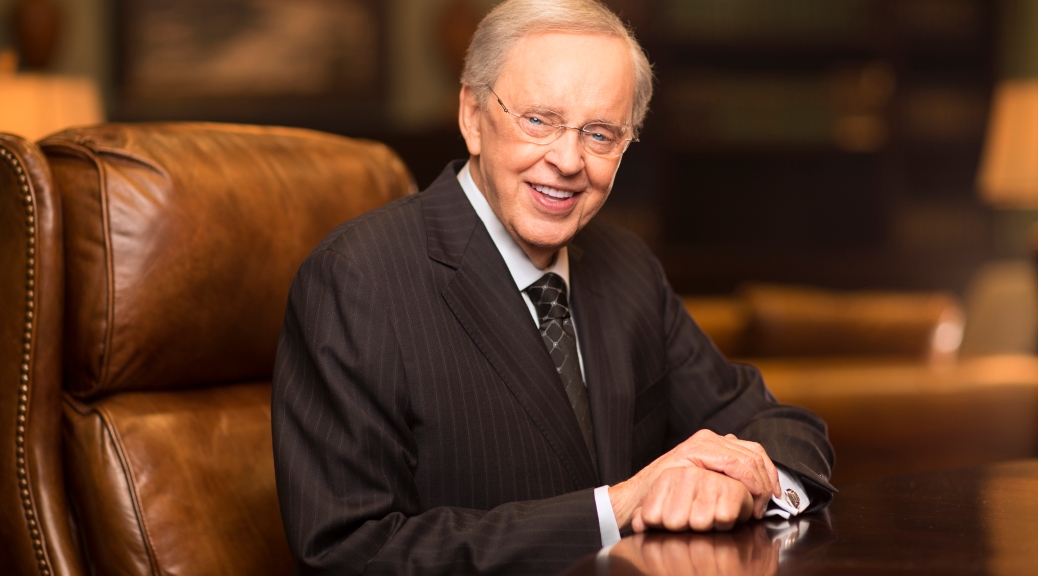
Charles Stanley – The Impact of Salt


Matthew 5:13

In today’s verse from the Sermon on the Mount, Jesus called His followers “the salt of the earth.” It was a way to describe how we as Christians are to influence the society around us. Who we are, what we say, and the things we do in the world can be compared to the role and effect of salt.

Salt flavors. Have you ever eaten a baked potato without salt? It probably tasted bland, didn’t it? Whenever salt is added to food, the taste is enhanced, and that’s how Christlike character, words, and actions can flavor our witness and open the door for people to hear our message.

Salt preserves. In biblical times, salt was used to preserve food so it wouldn’t spoil. In the same way, our lifestyles offer an alternative to the corrupting ways of the world and point people to Jesus for salvation.

Salt impacts what it touches. The chemical reactions caused by salt may be invisible, but the changes it brings are evident. We never know how a timely word, an act of kindness, or a stand for righteousness may affect someone.

Salt causes thirst. When those who don’t know Christ see how we handle suffering with calmness, endurance, and hope, they will thirst to know how we do it. Telling them of our reliance on God and His sufficiency could lead them to our Savior.

Do the people around you sense something special about you and thirst to know what it is? Becoming salt of the earth isn’t simply a matter of being good; it’s the work of the Holy Spirit. When His fruit is produced in us (Gal. 5:22-23), our life will bear the flavor of Christ.

Bible in One Year: Numbers 8-10

 

http://www.intouch.org/

Our Daily Bread — Fault Lines


Read: Acts 6:1–7

Bible in a Year: Leviticus 11–12; Matthew 26:1–25

They presented these men to the apostles, who prayed and laid their hands on them. So the word of God spread.—Acts 6:6–7

An influx of refugees to our community has led to new growth in area churches. That growth brings challenges. Church members must learn how to welcome these newcomers as they adjust to a strange culture, new language, and different worship styles. All this change can create some awkward situations.

Misunderstandings and disagreements occur everywhere we find people. Church is no exception. If we don’t handle our differences in a healthy way, they can harden into divisions.

The early church in Jerusalem was growing when a dispute arose that broke along a cultural fault line. The Greek-speaking Jews (the Hellenists) had a complaint against those Jews who spoke Aramaic. The Hellenist widows “were being overlooked in the daily distribution of food” (Acts 6:1). So the apostles said, “Choose seven men from among you who are known to be full of the Spirit and wisdom” (v. 3). The seven chosen all had Greek names (v. 5). In other words, they were Hellenists, members of the group being neglected. They best understood the problem. The apostles prayed over them and the church thrived (vv. 6-7).

Growth brings challenges, in part because it increases interactions across traditional barriers. But as we seek the Holy Spirit’s guidance, we’ll find creative solutions as potential problems turn into opportunities for more growth. —Tim Gustafson

Father, help us to recognize the barriers that keep us from living in the unity You desire for Your church.

Coming together is a beginning; keeping together is progress; working together is success.

INSIGHT: Spirit-filled people are needed when dealing with issues in the church. It was Spirit-filled men who got the call when a challenge arose within the new community of believers in Acts 6. When we think of the “filling of the Spirit” we may think of empowerment to speak about Christ or some other gospel-related witness. Yet the primary characteristic of those who were tasked with resolving the conflict surrounding the distribution of food was “to be full of the Spirit and wisdom” (v. 3). This situation called for those whose lives displayed the fruit of the Spirit: “love, joy, peace, forbearance, kindness, goodness, faithfulness, gentleness and self-control” (Galatians 5:22-23). Being Spirit-filled means being under the Spirit’s control. The Spirit helps us navigate situations that can get out of hand and be costly in terms of time and energy.


http://www.odb.org

Moody Global Ministries – Today in the Word – JESUS THE EVANGELIST

Mark 10:17–31

One useful technological development in recent years is the Global Positioning System, or GPS. Drivers who are directionally challenged can tell their smartphones where they would like to go, and GPS will identify their current location, orient them in the correct direction, and guide them to their goal.

The man in today’s passage was in need of direction. He came to Jesus with a question: “What must I do to inherit eternal life?” (v. 17), and Jesus’ kind answer reoriented him. The man was mainly interested in himself—how he had kept the law in the past and how he could be assured of an eternal reward in the future. But instead of giving him directions to heaven, Jesus had compassion on him and showed him that his greater need was to know and serve God.

At first glance, it might seem strange that Jesus evangelized by using the Ten Commandments. He certainly wasn’t saying that the man could earn his salvation by keeping the Law! Rather, the Law should have caused the man to confront God’s holiness and his own shortcomings. As the Puritan Thomas Watson said, “Until sin be bitter, Christ will not be sweet.”

Furthermore, the Law showed the man that following Christ was not simply a quick road to heavenly bliss. The Christian life requires each of us to deny self and take up our cross (see Matt. 16:24). And it is when we give up our own interests that we receive God’s gracious repayment (vv. 29–31).

Jesus’ conversation provides a model for our own evangelism. We too can have compassion, apply God’s Word to their hearts, cause them to count the cost of discipleship, and hold out the promise of heavenly treasure and a new life following Him.

APPLY THE WORD

If we are intent on evangelizing like Jesus did, we must grow in our own knowledge of God and His Word. As you study Scripture, consider how each passage shows you God’s holy and gracious character. Thank God for revealing Himself in the Bible, and be ready to bring those precious truths into your conversations with unbelievers.


http://www.todayintheword.org

Joyce Meyer – Taking Care of Your Body


You were bought with a price [purchased with a preciousness and paid for, made His own]. So then, honor God and bring glory to Him in your body.— 1 Corinthians 6:20 (AMPC)

Some of us haven’t learned to love our bodies enough to properly care for them. To change that, we must confront the three biggest obstacles to healthy living.

We don’t know how to care for our bodies. Bad diets, misinformation, and fast foods have confused people about what a wholesome diet is and how to eat the right foods in proper amounts.

Our view of body image is skewed by media and advertising. We’re bombarded with unattainable ideals of beauty, while obesity is so prevalent that it’s almost considered normal. We need to rediscover what a healthy person looks like.

Exercise is nearly obsolete. We’ve invented enough conveniences that we often live completely void of exercise. We don’t even walk anywhere if we don’t have to! But the truth is, a good deal of our well-being is dependent on exercising our bodies.

If you struggle with these obstacles, make a decision today that you will not be defeated. God tells us to treat our bodies well, and He will always help us do the things He tells us to do. So make a decision to rely on God’s strength and live a healthier lifestyle.

Prayer Starter: God, I want to honor You by taking care of my body and living a healthy life. I believe that I can make changes through Your power that is at work in me.


http://www.joycemeyer.org

Campus Crusade for Christ; Bill Bright – Wait and He Will Help


“Don’t be impatient. Wait for the Lord, and He will come and save you! Be brave, stouthearted and courageous. Yes, wait and He will help you” (Psalm 27:14).

Our surveys of hundreds of thousands of Christians throughout the world indicate that most Christians do not witness because of their fear. Even Timothy seems to have had the same problem.

His father in the faith, the apostle Paul, reminded him, as recorded in 2 Timothy 1:7, “For God hath not given us the spirit of fear; but of power, and of love, and of a sound mind” (KJV). That is the reason our Lord promised, in Acts 1:8, “Ye shall receive power, after that the Holy Ghost has come upon you: and ye shall be witnesses” (KJV).

The Holy Spirit is the only one who can enable us to overcome fear. So, as we claim the promises of God and appropriate the fullness and power of His Holy Spirit, we can know that courage.

A Japanese schoolboy once showed his courage in a way that puts many of us to shame.

“He belonged to a school in Nagasaki containing 150 boys, and he was the only Christian among them all. He brought his lunch to school, as he lived at a distance, and he dared to fold his hands and ask a blessing every day before he ate.

He had some enemies among the boys who went to the master of the school and accused him of ‘doing something in the way of magic’ The master thereupon called the lad before the school and asked him what he had been doing.

“The little fellow spoke up bravely, explaining that he was a Christian, and that he had been thanking God and asking Him to bless the food. At once the master burst into tears, putting his head down on the desk.

“‘My boy,’ he said, ‘I too am a Christian; but I was afraid to tell anyone. Now, with God’s help I will try to live as a Christian ought to live.’ ”

Bible Reading: Isaiah 40:27-31

TODAY’S ACTION POINT: Today I shall, through the enabling of the Holy Spirit, be brave, stouthearted and courageous as I go forth to tell others about the Lord Jesus Christ.


http://www.cru.org

Streams in the Desert for Kids – Determined


Luke 18:1

David Livingstone was one of the greatest missionary doctors who ever lived. But when he was struggling on his expeditions, he didn’t look so great. His exploration of the River Zambezi was a failure—the river could not be navigated. He kept trying to find a way until the British government ordered him home. After that, no one wanted to give him more money to return for more explorations.

After a while, he somehow found the money to return to Africa. Once he got there, no one heard from him for six years. Many thought he was dead, but he was not. Although he was seriously ill, he was determined to stay in Africa until his mission was complete. He stubbornly continued to explore. Finally, he died and his friends carried his body a thousand miles to the coast so that he could be returned to England and honored with a proper burial.

At the time he died, many people thought Livingstone’s whole life was a failure. But now, many years later, we know he traveled 29,000 miles in Africa, and that he made important geographical discoveries for Great Britain, such as Victoria Falls and four important lakes. He explored Central Africa so missionaries could go there. He was honored by African chiefs. He spoke out against slavery. And others who knew him were inspired to build schools to educate African children. Much good has come of his life.

One of the things Livingstone said was, “I determined never to stop until I had come to the end and achieved my purpose.” That means he decided he would never give up, and it explains a lot about who he was. It also helps us understand that we must not give up praying for whatever it is we want and need from God.

Dear Lord, First help me know what I should pray for, and then make me determined never to stop praying and talking with you. Amen.

Wisdom Hunters – Faith Stretcher 


Abraham fell facedown; he laughed and said to himself, ‘Will a son be born to a man a hundred years old? Will Sarah bear a child at the age of ninety?’   Genesis 17:17

Sometimes God’s will is not logical and does not even seem possible. Abraham certainly struggled with the idea of being a parent as a centenarian and his wife conceiving at ninety years of age. It was not possible; it did not make sense. Yet in reality all things are possible with God, and this was one of them.

The Lord made a promise that was out of the ordinary. He wanted to mark this occasion with an indelible stamp of a “God thing.” Abraham tried to let God off the hook on this miraculous scheme by offering Him another plan. However, God was not interested in another plan; He was interested in setting the stage for a blessing that would validate His sovereignty, taking the faith of Abraham, Sarah, and an entire nation to a whole new level. God wants us, and He wants us to take Him at His Word.

Why is it hard to take God at His Word? Why do we struggle with believing in something that is not logical or takes us out of our comfort zone? One reason we struggle is our perception of God. We make Him so small. We bring Him down to our level rather than allowing Him to pull us up to His level! This is man-centered thinking; instead, let’s allow God to be God.

Faith allows us to travel places with God that we would never experience otherwise. Would you not rather be in the middle of a lake in a storm with Jesus than on the calm shore around a warm fire without Him? This is where faith trumps logic. We trust Him when it does not make sense; we follow Him when we are not sure of the destination.

We believe the Lord when others think we are strange, too religious, or even fanatical. Let your Savior stretch your faith, trusting Him with the opportunity in front of you. Has your laughter turned to trust and awe in God and His accomplishments?

The Bible says, “Your father Abraham rejoiced to see My day, and he saw it and was glad” (John 8:56 nasb).

Prayer: Heavenly Father, grow my faith to align with Your vision for my life, in Jesus’ name, amen.

Application: What impossibility am I facing but will trust that with God it is possible?

Related Readings: Deuteronomy 9:18–25; Psalm 126:1; Matthew 2:11; Romans 4:20


Home