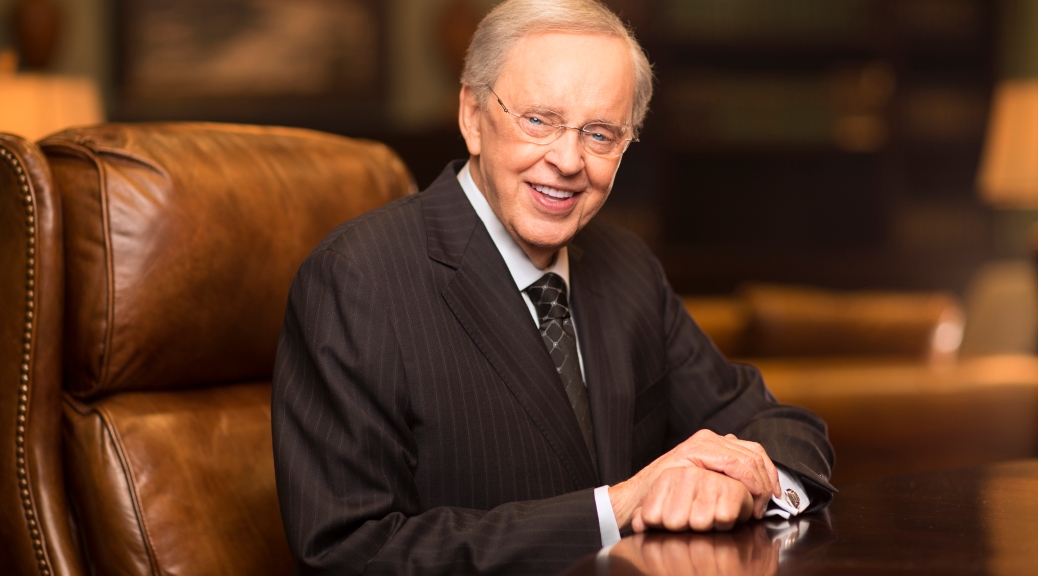
Charles Stanley – Our Circle of Influence


2 Thessalonians 2:13-17; 2 Thessalonians 3:1-5

We hear much today about being a person of influence. Although some of us may be connected to many people, there are others whose lives may seem small in comparison. However, the important issue is not numbers but faithfulness. The Lord has determined the personality and abilities of every believer, as well as our individual spheres of influence.

No matter how vast or limited our connections are, we can each be used effectively by God to influence others as we follow His instructions.

Stand firm in the truth (2 Thessalonians 2:15). We must make sure that our life is grounded in biblical truth. Otherwise, we could lead others astray.

Continue in every good work and word (2 Thessalonians 2:16-17). People watch us, and what we say and do affects them more than we may imagine. That’s why it is so important to make sure our attitude, speech, and conduct reflect Jesus Christ.

Develop a lifestyle of prayer (2 Thessalonians 3:1). Praying for others and for opportunities to share the gospel is essential for effective ministry. It prepares their hearts to hear and our minds to know what to say. The simplest words can have amazing results when the Lord is directing our efforts.

Keep obeying the Lord (2 Thessalonians 3:4). Godly influence will only be achieved if we ourselves are godly. When we are living obediently before the Lord, He will be faithful to open doors of influence according to His will (Revelation 3:8).

If you will make it your ambition to become faithful in all these ways, you can be confident that the Lord will use your life to influence others for good and for His glory.

Bible in One Year: Deuteronomy 12-14


http://www.intouch.org/

Our Daily Bread — The Spirit of Fika


Bible in a Year:Numbers 12–14; Mark 5:21–43

When he was at the table with them, he took bread, gave thanks, broke it and began to give it to them.

Luke 24:30

Today’s Scripture & Insight:Luke 24:28-35

The coffeehouse in the town near my house is named Fika. It’s a Swedish word meaning to take a break with coffee and a pastry, always with family, co-workers, or friends. I’m not Swedish, yet the spirit of fika describes one thing I love most about Jesus—His practice of taking a break to eat and relax with others.

Scholars say Jesus’s meals weren’t random. Theologian Mark Glanville calls them “the delightful ‘second course’” of Israel’s feasts and celebrations in the Old Testament. At the table, Jesus lived what God had intended Israel to be: “a center of joy, celebration and justice for the whole world.”

From the feeding of 5,000, to the Last Supper—even to the meal with two believers after His resurrection (Luke 24:30)—the table ministry of Jesus invites us to stop our constant striving and abide in Him. Indeed, not until eating with Jesus did the two believers recognize Him as the risen Lord. “He took bread, gave thanks, broke it and began to give it to them. Then their eyes were opened” (vv. 30–31) to the living Christ.

Sitting with a friend recently at Fika, enjoying hot chocolate and rolls, we found ourselves also talking of Jesus. He is the Bread of Life. May we linger at His table and find more of Him.

By Patricia Raybon

Today’s Reflection

Lord, thank You for making time and room for us to abide at Your table.


http://www.odb.org

Ravi Zacharias Ministry – Wisdom Embodied


One of the tragic casualties of our age has been that of the contemplative life—a life that thinks, a life thinks things through, and more particularly, thinks God’s thoughts. A person sitting at his or her desk staring out the window would never be assumed to be working. No! Thinking is not equated with work. Yet, had Newton under his tree, or Archimedes in his bathtub, bought into that prejudice, some natural laws would still be up in the air or buried under an immovable rock. Pascal’s Pensees, or “Thoughts,” a work that has inspired millions, would have never been penned.

What is even more destructive is the assumption that silence is inimical to life. The radio in the car, Muzak in the elevator, and the symphony entertaining callers “on hold” all add up as grave impediments to personal reflection. In effect, the mind is denied the privilege of living with itself even briefly and is crowded with outside impulses to cope with aloneness. Aldous Huxley’s indictment, “Most of one’s life… is one prolonged effort to prevent thinking,” seems frightfully true. Moreover, the price paid for this scenario has been devastating. As T.S. Eliot questioned:

Where is the life we have lost in the living?

Where is the wisdom we have lost in knowledge?

Where is the knowledge we have lost in information?

The cycles of heaven in twenty centuries

bring us farther from God and nearer to dust.

Is there a remedy? May I make some suggestions? Nothing ranks higher for mental discipline than a planned and systematic study of God’s Word, from whence life’s parameters and values are planted and Christ is made known. Paul, who loved his books and parchments, affirmed the priority of Scripture as the means to encountering Christ. And Psalm 119 promises that the God who speaks to us keeps us from being double-minded.

The average person today actually surrenders the intellect to the world, presuming Christianity to be bereft of intelligence. And many a pulpit has succumbed to the lie that anything intellectual cannot be spiritual or exciting.

Thankfully there are exceptions. When living in England, our family attended a church where preaching was taken quite seriously and one-hour sermons to packed auditoriums were the norm. Cambridge, being rife with skepticism, demanded a meticulous defense of each sermon text. When we were leaving Cambridge, our youngest child, who was nine years old, declared the preaching of this church to be one of his fondest memories. Even as a little boy he had learned that when the mind is rightly approached, it filters down to the heart. The matter I share here has far-reaching implications. We do a disservice to our youth by not crediting them with the capacity to think.

God places great value on the thought-life and its capacity to shape all of life. “As one thinks in his heart, so is he,” Solomon wrote. Jesus asserted that sin’s gravity lay at the level of the idea itself, not just the act. Paul admonished the church at Philippi to have the mind of Christ, and to the same people he wrote: “[W]hatever is true, whatever is honorable, whatever is just, whatever is pure, whatever is pleasing, whatever is commendable, if there is any excellence and if there is anything worthy of praise, think on these things” (Philippians 4:8). The follower of Christ must demonstrate to the world what it means not just to think, but to think justly. That is, in the words of aging David to his son Solomon, to “acknowledge the God of your father, and serve him with wholehearted devotion and with a willing mind, for the LORD searches every heart and understands every motive behind the thoughts. If you seek him, he will be found by you; but if you forsake him, he will reject you forever” (1 Chronicles 28:9).

With hearts, minds, and bodies, we can follow the God of creation and the Son who stepped into it. After all, it is not that I think, therefore, I am, but rather, the great I Am has asked us to think, and therefore, we must.

Ravi Zacharias is founder and chairman of the board of Ravi Zacharias International Ministries.


http://www.rzim.org/

Joyce Meyer – See Possibilities


The Lord said to Moses, “Why do you cry to me? Tell the people of Israel to go forward. Lift up your staff, and stretch out your hand over the sea and divide it, that the people of Israel may go through the sea on dry ground. — Exodus 14:15-16

Adapted from the resource The Confident Woman Devotional – by Joyce Meyer

When God called Moses to lead the Israelites out of Egypt, Moses felt very inadequate and kept telling God what he could not do and did not have.

God asked him what he had in his hand and Moses replied, “A rod.” It was an ordinary rod, used for herding sheep. God told him to throw it down, implying that Moses was to give it to Him. When God gave the rod back to Moses, it was filled with miracle-working power and was used by Moses to part the Red Sea as well as for other miracles.

If you will give God what you have, no matter how little and ineffective you may think it is, God will use it and give you back more than you gave Him.

In other words, it is not our abilities that God desires, but it is our availability He wants. He wants us to see possibilities, not problems. Don’t spend your life thinking “if only” you had something else, then you could do something worthwhile. “If only” is a thief of what could be.

Prayer Starter: Lord, I make myself available to You, just as I am. Please use me to do Your will, and help me to begin seeing possibilities everywhere I go. In Jesus’ name, Amen.


http://www.joycemeyer.org

Campus Crusade for Christ; Bill Bright – Anything You Ask


“You can get anything – anything you ask for in prayer – if you believe” (Matthew 21:22).

God’s Word reminds us that we have not because we ask not (James 4:2). Jesus said, “If ye abide in Me, and My words abide in you, ye shall ask what ye will, and it shall be done unto you” (John 15:7, KJV).

A godly widow with six children was facing great stress. The family had eaten their last loaf of bread at the evening meal. The next morning, with no food in the house, the trusting mother set seven plates on the table.

“Now, children,” she said, gathering them around her, “we must ask God to supply our need.”

Just as she finished her prayer, one of the children shouted, “There’s the baker at the door.”

“I was stalled in the snow,” the baker said, after entering the house,” and I just stopped by to get warm. Do you need any bread this morning?”

“Yes,” said the mother, “but we have no money.”

“Do you mean to say you have no bread for these children?” he asked.

“Not a bit,” said the mother.

“Well,” said the baker, “you will soon have some.” Whereupon he returned to his wagon, picked up seven loaves and brought them into the house. Then he laid one on each plate.

“Mama!” one of the children cried out. “I prayed for bread, and God heard me and sent me bread.”

“And me!” chorused each of the children, feeling that God had answered personally.

God does not require us to have great faith. We are simply to have faith in a great God.

Bible Reading: Mark 11:20-26

TODAY’S ACTION POINT: I will continue to abide in Christ and have His Word abide in my heart, so that when needs arise today – whether large or small; physical, material or spiritual – I will choose to place my simple faith in God, knowing that He is willing and able to hear and answer prayer. I will also encourage others to join me in the great adventure of prayer.


http://www.cru.org

Max Lucado – The Greenhouse of the Heart


Listen to Today’s Devotion

Proverbs 4:23 advises us, “Above all else, guard your heart, for it is the wellspring of life.” Think of your heart as a greenhouse and consider your thoughts as seed.  We must be selective about the seeds we allow to come into the greenhouse.

To have a pure heart, we must submit all thoughts to the authority of Christ.  You see, your mind is the doorway to your heart.  The Holy Spirit stands with you on the threshold, helping you manage and filter the thoughts that try to enter.  If Jesus agrees with the thought, then let it in.  If not, kick it out.  How do you know if Jesus agrees or disagrees?  You open your Bible. Armed with the opinion of Christ and the sword of the Spirit, guard the doorway of your heart. The more selective you are about seeds, the more delighted you will be with the crop.

Read more Just Like Jesus

For more inspirational messages please visit Max Lucado.

Home

Denison Forum – What the Oscars teach us about significance

In a surprise, Green Book won last night’s Academy Award for Best Picture. Rami Malek and Olivia Colman won for Best Actor and Best Actress in a Leading Role; Mahershala Ali and Regina King won for Best Actor and Best Actress in a Supporting Role.

For everyone who won an Oscar, last night’s ceremony was a pinnacle moment that will stay with them for the rest of their lives.

For the rest of us, however, the transience of awards like last night’s Oscars is noteworthy. Who won last year for Best Actor? Best Actress? Best Picture? Who won the year before that?

We’ve already had the Golden Globes, the Screen Actors Guild Awards, the Critics’ Choice Awards, and the Grammys. Do you remember who won what? We could ask the same question about past winners of the Super Bowl, the World Series, the Stanley Cup, and so on.

There’s a reason our culture pays so much attention to short-lived successes.

“Wealthy, successful and miserable”

Richard Rorty was one of America’s most influential thinkers. The longtime Princeton and Stanford professor was a leading voice for the relativism that has captured our culture. He claimed: “There is nothing deep down inside us except what we have put there ourselves.” He added that “truth is what your contemporaries let you get away with.”

If we reject the supernatural, the only prism by which to see the world is the natural. And the natural cannot see beyond itself. Like rose-colored glasses that turn everything rose-colored, we assume that all we see is all that exists.

Continue reading Denison Forum – What the Oscars teach us about significance

Charles Stanley –Brokenness: The Plan


1 Thessalonians 5:21-23

Humans are born “bent away” from the Lord. Our natural inclination is to please and serve self, which is the opposite of a God-honoring lifestyle. When we become believers, our Father begins to bend our will and ways back towards Him. But we must cooperate and yield to the process; otherwise, we are of little use to the kingdom.

The Lord wants to eradicate every thought pattern and activity promoting dependency on anything other than Him. This means that relying on oneself for security, salvation, or physical and emotional comfort are outside His will. Actions that advance a person at the expense of others are also ungodly.

In areas where we resist bending toward the Lord, He may break us by allowing pain into our life. As a result, we are driven to Him in surrender. To break a person may sound harsh, but God does this work in love. He sees beyond the hurt to the outcome—we will be more mature and faithful servants for having walked through trial (Rom. 8:28). And our loving Father takes each hard step with us, offering guidance and comfort. Seeing the benefits He has brought about through my own hardships, I can honestly thank Him for every period of brokenness I’ve experienced.

The truth is that we all have areas of self-focus that need to be bent or broken by God’s hand. When we honestly look inward to discover wrong habits and thought patterns, our heavenly Father will bring them to our mind. Then, we must surrender to His work in our lives so we can become wise and useful servants.

Bible in One Year: Deuteronomy 6-8


http://www.intouch.org/

Our Daily Bread — Living in God’s Story


Bible in a Year:Numbers 7–8; Mark 4:21–41

The night is nearly over; the day is almost here.

Romans 13:12

Today’s Scripture & Insight:Romans 13:8-14

Ernest Hemingway was asked if he could write a compelling story in six words. His response: “For sale: Baby shoes. Never worn.” Hemingway’s story is powerful because it inspires us to fill in the details. Were the shoes simply not needed by a healthy child? Or was there a tragic loss—something requiring God’s deep love and comfort?

The best stories pique our imagination, so it’s no surprise that the greatest story ever told stokes the fires of our creativity. God’s story has a central plot: He created all things; we (the human race) fell into sin; Jesus came to Earth and died and rose again to save us from our sins; and we now await His return and the restoration of all things.

Knowing what has come before and what lies ahead, how should we now live? If Jesus is restoring His entire creation from the clutches of evil, we must “put aside the deeds of darkness and put on the armor of light” (Romans 13:12). This includes turning from sin by God’s power and choosing to love Him and others well (vv. 8–10).

The specific ways we fight with Jesus against evil will depend on what gifts we have and what needs we see. Let’s use our imagination and look around us. Let’s seek out the wounded and weeping, and extend God’s justice, love, and comfort as He guides us.

By Mike Wittmer

Today’s Reflection

Father, may Your kingdom come and may it come in me.

odb.org

Joyce Meyer – Good from Bad


As for you, you meant evil against me, but God meant it for good, to bring it about that many people should be kept alive, as they are today. — Genesis 50:20

Adapted from the resource Closer to God Each Day Devotional – by Joyce Meyer

God wants to restore your soul. The closer you get to Him, the more you experience His healing, strengthening, restoring power. He’ll take you back to where your life got off track and make everything right from that moment forward.

Joseph is the classic biblical example of how God takes what was meant for evil against us and works it for our good. In that dramatic scene where Joseph is speaking in Genesis 50:20, he tells his brothers that the evil they meant to do to him (and it was truly evil), God had used for good to save them and their families and hundreds of thousands of others in a time of famine.

In my own life, I cannot truthfully say I am glad I was abused. But through the power of forgiveness and yielding my pain to God, He has healed me and made me a better, stronger, more spiritually powerful and sensitive person. He has restored my soul and driven out the fear and insecurity.

I can trust, love, forgive, and live with simplicity in my approach to life because God has restored my soul, and He can do the same thing for you.

Prayer Starter: Thank You, Father, for being a God of restoration. Right now, I commit all of my pain and disappointments to You. I ask You to take the negative things that have happened in my life—including any difficult circumstances in the present—and work them out for my good. I know You love me and that You always have my best interest in mind. In Jesus’ name, Amen.


http://www.joycemeyer.org

Campus Crusade for Christ; Bill Bright – The Kingdom of Heaven


“Happy are those who are persecuted because they are good, for the Kingdom of Heaven is theirs” (Matthew 5:10).

Have you ever been persecuted because of your faith in Christ? If so, how did you respond?

While Francis Xavier was preaching one day in one of the cities of Japan, a man walked up to him as if he had something to say to him privately. As the missionary leaned closer to hear what he had to say, the man spat on his face.

Without a word or the least sign of annoyance, Xavier pulled out a handkerchief and wiped his face. Then he went on with his important message as if nothing had happened. The scorn of the audience was turned to admiration.

The most learned doctor of the city happened to be present.

“A law which teaches men such virtue, inspires them with such courage, and gives them such complete mastery over themselves,” he said, “could not but be from God.”

Supernatural power and enablement by God’s Holy Spirit make that kind of behavior possible for every believer. Furthermore, that kind of behavior probably will do more to attract and influence an unbelieving world than words ever can.

With Christ as our example, love as our motive, and humility as our covering, let us depend on God’s Holy Spirit for the wisdom and strength required to respond to mistreatment in a Christ-like way. Then, and only then, are we in a position to reflect honor and glory to the Lord Jesus Christ.

Bible Reading: Matthew 5:7-12

TODAY’S ACTION POINT: Mindful that millions of Christians have died as martyrs getting the message of God’s good news through to men, and remembering that “all who live godly lives in Christ Jesus shall suffer persecution, “I will not shrink from whatever the Lord may have in store for me today as His witness. Drawing upon the supernatural resources of God, I will demonstrate by my words and witness that I belong to Christ


http://www.cru.org

Charles Stanley – Our Testimony


Colossians 4:1-6

Think about the last argument you had with someone. Generally, disagreements arise when two people see things differently. Part of the problem is that most issues can be seen from diverse perspectives. Therefore, it’s easy for people to take opposing sides on a subject since they make different assumptions based on the same facts.

This can present a problem when we witness to people. Our goal isn’t to start a debate but to share the gospel. If someone objects to what we say, we could become sidetracked with arguments. However, we each have one thing that no one else can refute: our personal testimony. This isn’t an issue for debate but an opportunity to explain our own experience and the results of our decision to follow Christ.

Realize that every believer has a powerful weapon in his spiritual arsenal. When you share what Christ has done in your life, no one else can say, “That’s not right,” or “That didn’t really happen.” Our testimony of faith is our own credible, first-hand, eyewitness narrative of the power of God.

That’s why it’s important that we be prepared to share our story. Opportunities often come unexpectedly, and we don’t want to let the moment pass simply because we’re not sure what to say.

This week set aside a few moments to think about your history with Christ and sketch an outline of your faith story. Then ask Him to open a door for you to share the message of Jesus Christ. Then when an opportunity comes, you’ll be ready to share what Christ has done in your own life.

Bible in One Year: Deuteronomy 3-5


http://www.intouch.org/

Our Daily Bread — He Holds Our Hand


Bible in a Year:Numbers 4–6; Mark 4:1–20

I will strengthen you and help you; I will uphold you with my righteous right hand.

Isaiah 41:10

Today’s Scripture & Insight:Isaiah 41:8-13

The little girl who navigated the stairway one Sunday at church was cute, spunky, and independent. One by one the child—who appeared to be not much older than two years—took the steps down to the lower level. Descending the stairs was her mission and she accomplished it. I smiled to myself as I pondered the daring independence of this courageous toddler. The child wasn’t afraid because she knew her caring mother’s watchful eye was always on her and her loving hand was extended to help her. This aptly pictures the Lord’s readiness to help His children as they make their way through life with its varied uncertainties.

Today’s Scripture includes two “hand” references. After cautioning His ancient people not to fear or be dismayed, the Lord told them, “I will uphold you with my righteous right hand” (Isaiah 41:10). Many anxious and fearful children have been steadied by the strength of a parent. Here God’s power comes into view. In the second “hand” reference, once again it’s the Lord who acted to secure the safety of His own. “For I am the Lord your God who takes hold of your right hand” (v. 13). While life situations and times have changed, the Lord hasn’t. We need not despair (v. 10) because the Lord still assures us with the promise of His support and with the words we desperately need to hear: “Do not fear” (vv. 10, 13).

By Arthur Jackson

Today’s Reflection

Father, thank You for always watching over me.

For help, read Navigating the Storms of Life at discoveryseries.org/hp061


http://www.odb.org

Joyce Meyer – God’s Vision for You


For I know the plans I have for you, declares the Lord, plans for welfare and not for evil, to give you a future and a hope. — Jeremiah 29:11

Adapted from the resource Battlefield of the Mind Devotional – by Joyce Meyer

God’s plan for the people of the nation of Israel was only for their good. Yet they wandered around in the wilderness for 40 years on what was actually an 11-day journey. Why? Was it their enemies, their circumstances, the trials along the way, or something entirely different that prevented them from arriving at their destination in a timely manner?

God called the children of Israel out of bondage in Egypt to go to the land He had promised to give them as a perpetual inheritance—a land that flowed with milk and honey and every good thing they could imagine—a land in which there would be no shortage of anything they needed—a land of prosperity in every realm of their existence.

But the Israelites had no positive vision for their lives—no dreams. They knew where they came from, but they did not know where they were going. Everything was based on what they had seen in the past or what they could presently see. They did not know how to see with “the eye of faith.”

We really shouldn’t view the Israelites with astonishment, because most of us do the same thing they did. We keep dealing with the same problems over and over again. The disappointing result is that it takes us years to experience victory over something that could have and should have been dealt with quickly.

I come from a background of abuse. My childhood was filled with fear and torment, and my personality was a mess! I built up walls of protection to keep people from hurting me, not realizing that while I was locking others out, I was also locking myself in. I was filled with fear and believed that the only way I could face life was to be in control so no one could hurt me.

As a young adult trying to live for Christ and follow the Christian lifestyle, I knew where I had come from, but I did not know where I was going. I felt that my future would always be marred by my past. I thought, How could anyone with a past like mine ever be all right? It’s impossible!

But Jesus had a different plan. He said, The Spirit of the Lord [is] upon Me…to preach the good news (the Gospel) to the poor; He has sent Me to announce release to the captives and recovery of sight to the blind, to send forth as delivered those who are oppressed [who are downtrodden, bruised, crushed, and broken down by calamity](Luke 4:18 AMPC).

Jesus came to open the prison doors and set the captives free—and that included me. However, I did not make any progress until I started to believe that I really could be set free. I had to get rid of my negative thinking and replace it with a positive vision for my life. I had to believe that neither my past nor my present could determine my future. Only then could Jesus free me from the bondage of my past—and free me, He did. What a marvelous miracle!

You may have had a miserable past; you may even be in current circumstances that are very negative and depressing. You may be facing situations that are so bad it seems you have no real reason to hope. But I say to you boldly: Your future is not determined by your past or your present!

Most of the generation the Lord called out of Egypt never entered into the Promised Land. Instead, they died in the wilderness. To me, this is one of the saddest things that can happen to a child of God—to have so much available and yet never be able to enjoy any of it.

Start believing that God’s Word is true. Mark 9:23 assures you that with God all things are possible. Because you serve a God who created everything you see out of the unseen realm (see Hebrews 11:3), you can give Him your nothingness and watch Him go to work on your behalf. All you have to do is have faith in Him and believe His Word—He will do the rest!

Prayer Starter: Dear Father, I thank You for loving me and having a vision—a good plan—for my life. I pray that You will help me overcome any negative thoughts of problems, past or present, that come against my mind, and make my life what You want it to be. In Jesus’ Name, Amen.


http://www.joycemeyer.org

Campus Crusade for Christ; Bill Bright – Inherit My Holy Mountain


“Let’s see if the whole collection of your idols can help you when you cry to them to save you! They are so weak that the wind can carry them off! A breath can puff them away. But he who trusts in Me shall possess the land and inherit My Holy Mountain” (Isaiah 57:13).

It was the very last week prior to our deadline for raising two million dollars to purchase the property at Arrowhead Springs for our international Campus Crusade for Christ headquarters. A dear friend had offered a $300,000 matching fund as a gift if we could raise the balance of the $2 million by a certain date.

Because of a very heavy speaking schedule at both the student and faculty conferences held at Arrowhead, I was unable to make any significant contribution to the raising of funds. And yet somehow in my heart of hearts I knew that God was going to supply our need in a miraculous way.

The late Dr. V. Raymond Edman, then president of Wheaton College, was one of the featured speakers at the conferences. At breakfast, one day Dr. Edman shared with my wife, Vonette, and me this very meaningful verse in Isaiah – a verse that God had impressed upon him that morning to share with us as he prayed about our urgent financial needs.

Now we were all the more encouraged to believe God in an even greater way than before. We truly expected to see Him provide the remaining funds – miraculously. In the evening of the day of the deadline, I was informed that we still needed $33,000 and that every possible source of revenue had been exhausted. There was nothing more, humanly speaking, we could do. Yet, through a series of circumstances between 11:00 and midnight, those funds were pledged, and we met the deadline. Exactly at midnight, the last of God’s miracles had been wrought and the goal had been reached. God had promised, “He who trusts in Me shall possess the land and inherit My Holy Mountain” – Arrowhead Springs.

Bible Reading: Isaiah 57:10-15

TODAY’S ACTION POINT: Whether the need be for funds, for health, for wisdom, or whatever, I will believe God to supply my every need as He has so wonderfully promised in His Word to those who trust in Him.


http://www.cru.org

Max Lucado – An Honest Heart


Listen to Today’s Devotion

In Acts 1:8 Jesus says, “You will be my witnesses—in Jerusalem, in all of Judea, in Samaria, and in every part of the world.”  We are God’s witnesses.  And we are to speak truthfully.  God loves the truth and God hates deceit.  But Jeremiah 17:9 tells us that “the heart is deceitful above all things.” How do we explain our dishonesty?

Well, for one thing, we don’t like the truth because the truth isn’t always fun.  The wages of deceit is death.  Not death of the body, perhaps, but death of a marriage, a conscience, a career, or faith.  But perhaps the most tragic death that occurs from deceit is our witness. Examine your heart.  Do you tell the truth…always?  If not, start today.  Be just like Jesus.  Tell the truth, the whole truth, and nothing but the truth.

Read more Just Like Jesus

For more inspirational messages please visit Max Lucado.

Home

Denison Forum – Which are the “most sinful states” in the US?


A new study has compared America’s fifty states using forty-three indicators of immorality. The data set ranges from violent crimes to excessive drinking to gambling disorders.

Unsurprisingly, Nevada ranks first, primarily because of “greed” and “lust.” Florida comes in second because of “jealousy,” “lust,” and “vanity.” The rest of the top (or bottom) ten in order: California, Texas, Tennessee, Louisiana, Georgia, Illinois, Michigan, and Arizona. The least sinful states in order are Vermont, Maine, North Dakota, Nebraska, and Idaho.

Sin may be measured collectively, but it is committed personally. And it never stays secret.

A Minnesota man was eating a hot dog at a hockey game last month. He wiped his mouth with a napkin and tossed the remains in the trash. Authorities then used DNA on the napkin to tie him to an unsolved murder from 1993.

In similar news, DNA from a genealogical database has led authorities to arrest a Colorado man for the murder of an eleven-year-old girl in 1973. Last fall, DNA evidence led to an arrest in a 1997 murder.

Meanwhile, prosecutors in the Jussie Smollett case say they have the $3,500 check used by the actor to pay two brothers to stage his assault last month. Smollett was arrested yesterday for allegedly filing a false report about the January 29 incident. After paying a $10,000 bond, he was released and is due back in court on March 14.

Chicago Police Superintendent Eddie Johnson alleged yesterday that the brothers’ motive for helping Smollett was money. “There was never a thought in their mind that we would be able to track them down,” he added.

Scripture warns us: “Be sure your sin will find you out” (Numbers 32:23).

Why temptation is so tempting today

There’s something about temptation that causes us to think this warning doesn’t really apply to us. We will get away with it. No one will know, no one will be hurt, no consequences will follow. Or so we think.

Here’s why the temptation to yield to temptation is especially tempting in our culture.

Our post-Christian, relativistic society has jettisoned the concept of absolute truth and morality. In such a worldview, “sin” is a subjective idea rather than an objective reality.

What the Bible calls a “baby” (as when Elizabeth’s “baby leaped in her womb,” Luke 1:41), Planned Parenthood calls a “product of conception.” What the Bible calls “men committing shameless acts with men” (Romans 1:27), our culture calls “marriage equality.”

As a result, sins are no longer objectively sinful. It’s easier for Satan to tempt us to sin if we don’t believe in sin.

“There is no such thing as the devil”

It’s also easier for Satan to tempt us to sin if we don’t believe in him. A Barna survey found that nearly 60 percent of American Christians believe the devil “is not a living being but is a symbol of evil.”

An article in Psychology Today was blunt: “There is no such thing as the devil, just as there is no such thing as fairies, imps, or goblins. The two largest religions in the world–Christianity and Islam–teach that there is a devil. And they are wrong. There is no evidence for such a thing. Not a shred. It is simply something that germinated from the unscientific, irrational minds of early humans.”

Of course, that’s just what the devil wants us to think.

(For more, please watch Does Satan exist?, the most recent YouTube video from our new series, “Biblical Insight to Tough Questions.”)

The two categories of sin

The first step in defeating temptation is to admit that sin exists and the tempter is real. The second is to understand his strategy.

In essence, there are two categories of sin.

The first includes those temptations you and I can defeat in our ability. For instance, I happen not to be susceptible to illegal drugs. (I’m not boasting–there are other temptations to which I am far less immune). You can name sins that are easy for you not to commit.

The second category includes those temptations you and I cannot defeat in our ability. When we face these attacks, we need to turn immediately to God for help, knowing that “he commands even the unclean spirits, and they obey” (Mark 1:27).

Here’s the problem: Satan seeks to mask these temptations so that we think they belong to the first category. That way, we’ll try to resist them in our strength rather than turning to God for his help. Satan wants to draw us into spiritual quicksand a foot at a time until we are trapped.

The solution is for us to take all temptation immediately to God, asking for his strength to refuse. Here’s how: “Submit yourselves therefore to God. Resist the devil, and he will flee from you” (James 4:7).

Submit and you can resist. Resist and you will win. Every time.

If you think you’re getting away with sin

Let’s close with two additional life principles.

One: Satan is playing the long game.

When we defeat him with God’s help, he will bring this temptation against us again later. He wants us to think we didn’t win the victory since we’re facing the same temptation.

After Jesus defeated him in the wilderness, the devil “departed from him until an opportune time” (Luke 4:13). He does the same with us. Every time we face temptation, even the same temptation, we must “submit” and “resist.”

Two: The time to repent is now.

If you think you’re getting away with sin, you’re not. The enemy might be waiting until you climb further up the ladder so that your fall will hurt even more people as you plummet down.

“Repent therefore, and turn again, that your sins may be blotted out” (Acts 3:19) is a present-tense imperative, an ongoing command for each of us.

Is it relevant for you today?


Denison Forum

Every Man Ministries – Facing Truth


 “Teach me your way, O LORD, that I may walk in your truth; unite my heart to fear your name.” Psalm 86:11

Facing up to the truth always produces a loss of some kind of income, a pastime you enjoy, your image in the community, a wrong relationship, or the companionship of certain friends.  Jesus knows a man must risk, but He also knows what’s waiting on the other side: “For whoever wants to save his life will lose it, but whoever loses his life for me and for gospel will save it” (Mark 8:35).

When we are confronted with the truth about where God wants us to go in our spiritual journey, we can choose the paths that leads to health, wholeness, and God’s glory.  Furthermore, we then have the confidence and humility to keep making the needed adjustments for Him.

God is in the business of confronting us for our benefit, to heal us from our bondage to whatever, guilt, shame, depression, and hatever brings us into self-absorption.  These surgeries of the soul require faith in the Surgeon and His promised outcomes.  Those who accept “going under the knife” often make the necessary changes to turn things around in their lives.

Winston Churchill once said, “Personally, I am always ready to learn although I do not always like to be taught.”  His point is that coming under the direction of another person has it‘s own built-in tension, despite the value of the truth to be discovered from the experience.  At least Churchill was being honest. Seeing and accepting truth requires action, but action – doing something – often produces tension.

Father, it is your will that I am free from the bondage of whatever brings me down. Tighten up my belt of truth.


Every Man Ministries.

Charles Stanley – Who Owns It All?


1 Chronicles 29:10-14

A serious error has made its way into the church. Some Christians think that their beliefs and their wallet belong in separate spheres. The truth is, obedience to God includes how we handle our finances. He owns everything (Hag. 2:8; Psalm 24:1). Cash, possessions, and ways to earn more are gifts from the Lord; we are simply stewards.

A steward oversees the use and care of someone else’s riches. A wise steward bases financial decisions upon the owner’s rules for using and multiplying material goods. In our case, God has woven financial principles into the fabric of Scripture. Since money touches nearly every aspect of life, it is mentioned hundreds of times in different contexts. For example, God urged the Israelites to stay faithful to His teachings and to avoid the trap of self-reliance. He reminded them that the power to make wealth resides with Him rather than in their own hands (Deut. 8:17-18).

The minute a steward presumes that he owns the money he manages, trouble is at hand. He stops consulting the Owner and spends as he sees fit. Even in trying to do good, the wayward steward is ruled by his shortsighted perspective rather than by God’s omniscient view and gentle guidance. He will suffer the consequences of choosing his own way over the Lord’s.

Faith and finances are intertwined. The bottom line is that we cannot keep our money out of God’s hand, because He holds it all—we simply manage it. And we are to do so in the way He directs us. A maturing believer trusts the Lord’s principles for using and growing wealth.

Bible in One Year: Deuteronomy 1-2


http://www.intouch.org/

Our Daily Bread — Living Sacrifice


Bible in a Year:Numbers 1–3; Mark 3

I urge you . . . in view of God’s mercy, to offer your bodies as a living sacrifice.

Romans 12:1

Today’s Scripture & Insight:Romans 12:1-8

My great aunt had an exciting job in advertising and traveled between Chicago and New York City. But she chose to give up that career out of love for her parents. They lived in Minnesota and needed to be cared for. Both of her brothers had died young in tragic circumstances and she was her mom and dad’s only remaining child. For her, serving her parents was an expression of her faith.

The apostle Paul’s letter to the church at Rome urged Christian believers to be “a living sacrifice, holy and pleasing to God” (Romans 12:1). He hoped they would extend Christ’s sacrificial love to each other. And he asked them not to think of themselves more highly than they should (v. 3). When they fell into disagreements and division, he called them to lay down their pride, because “in Christ we, though many, form one body, and each member belongs to all the others” (v. 5). He yearned that they would show each other sacrificial love.

Each day we have the opportunity to serve others. For instance, we might let someone go ahead of us in a line or we might, like my great aunt, care for someone who is ill. Or maybe we share from our experience as we give another advice and direction. When we offer ourselves as living sacrifices, we honor God.

By Amy Boucher Pye

Today’s Reflection

Lord Jesus Christ, You humbled Yourself and lay down Your life that I might live. May I never forget this most precious gift of grace and love.


http://www.odb.org