Billy Graham – Solving the Problem


Lord, grant us peace; for all we have and are has come from you.

—Isaiah 26:12 (TLB)

Only a few years ago children were delighted at the prospect of a trip to the wharves to see the great ships come in. Today they are blasé about helicopters and jet planes. We who once marveled at the telegraph now take for granted the far greater miracle of television. Not so long ago many of the physical diseases were termed hopeless and incurable. Today we have drugs so effective that age-old diseases are becoming rare. We have accomplished much, of that there is no doubt. But with all this progress, we have not solved the basic problem of the human race. We can build the highest buildings, the fastest ships, the longest bridges—but we still can’t govern ourselves, or live together peacefully and with equality.

Prayer for the day

In loving and being loved by You, there is all I have longed for, my Savior, Jesus Christ.


https://billygraham.org/

Guideposts – Devotions for Women – Strength in Surrender


Then Samson prayed to the Lord, “Sovereign Lord, remember me. Please, God, strengthen me just once more…”—Judges 16:28 (NIV)

Through Samson, we see the humbling transformation of a man who once relied solely on his own strength. In his final act, stripped of his power and sight, he surrendered fully to God, finding a strength that surpasses all understanding. This tale reminds us that true power doesn’t come from our talents but from our complete surrender to God.

God, in my weakness, may I find Your strength. Remind me to surrender my pride and draw from Your infinite power.


https://guideposts.org/daily-devotions/devotions-for-women/devotions-for-faith-prayer-devotions-for-women/

Our Daily Bread – The Prayers of Jesus


I have prayed for you, Simon, that your faith may not fail. Luke 22:32

Today’s Scripture

Luke 22:28-34

Apple LinkSpotify Link

Today’s Devotional

Jesus, how are You praying for me? I’d never thought to ask that question until my friend Lou shared the experience of his heart-cry to Christ when he was faced with a situation that required more wisdom and strength than he was able to muster. Hearing him voice that noteworthy question in prayer has helped me add a fresh dimension to my understanding and practice of prayer.

In Luke 22, there was no mystery as to how Jesus was praying for Simon Peter: “Simon, Simon, Satan has asked to sift all of you as wheat. But I have prayed for you, Simon, that your faith may not fail” (vv. 31-32). When Peter was battered through trial, his faith flickered. But because of Christ’s grace, it didn’t fail.

The book of Acts tells us how Jesus’ prayers for Peter—His eager but weak disciple—were answered. God used him to preach the good news about Christ to Jews and gentiles alike. And Jesus’ prayer ministry hasn’t ended. Paul reminds us that “Christ Jesus who died—more than that, who was raised to life—is at the right hand of God and is also interceding for us” (Romans 8:34). When you find yourself in the throes of trial or temptation, remember that Jesus, who prayed for His disciples, remains in prayer for those who have believed their message about Him (see John 17:13-20).

Reflect & Pray

How does remembering that Jesus is praying for you affect how you pray? In view of His prayer ministry, how might you live and serve differently?


Dear Jesus, thank You for Your prayers on my behalf. Please help me to pray and live with this awareness.

Not sure how to pray? Check out this piece from Discovery Series to learn more.

Today’s Insights

Satan had to ask Christ for permission to test Peter and was permitted to sift him “as wheat” (Luke 22:31). This would entail forceful shaking, but Satan wasn’t allowed to destroy Peter. On the contrary, this sifting would remove the chaff from his life. This is reminiscent of Satan asking for God’s permission to test Job (Job 1:9-12; 2:3-6) and Job affirming that “when [God] has tested me, I will come forth as gold” (23:10).

Jesus’ sovereignty is evident in His prayers that Peter’s faith wouldn’t fail (Luke 22:32). His courage failed, however, as he denied knowing Christ three times (vv. 54-62). But though he momentarily faltered, his faith didn’t fail. Jesus’ prayer that Peter would turn back to strengthen his brothers (v. 32) was fulfilled when he repented (v. 62). He was later restored and commissioned by Christ to pastoral ministry (John 21:15-17). We can be encouraged when we remember that Christ also prays for us.


http://www.odb.org

Joyce Meyer – God’s Word Has Self-Fulfilling Power


For as [surely as] the earth brings forth its shoots, and as a garden causes what is sown in it to spring forth, so [surely] the Lord God will cause rightness and justice and praise to spring forth before all the nations [through the self-fulfilling power of His word].

Isaiah 61:11 (AMPC)

When a farmer plants a seed in the ground, that seed contains everything needed to reproduce a plant just like the one the seed came from. The seed has self-fulfilling power. All the farmer needs to do is water the seed and keep the weeds from choking the life out of it, and the seed does the rest.

The Word of God functions the same way. It has self-fulfilling power. When it is planted in our hearts and we water it with our faith and keep the weeds (sin) out of our lives, we will see amazing things develop simply from believing God’s Word.

Faith is amazing. It is the substance of things hoped for, the evidence of things not seen (Hebrews 11:1 NKJV). God created everything we see in the world from nothing, and He will do the same for us as we believe and trust in His Word.

When we put a tomato seed in the ground, we will get tomatoes, and likewise, when we put our faith in God’s Word, we will get what it promises.

Prayer of the Day: Lord, help me plant Your Word in my heart and water it with faith. I trust in Your promises and believe You will bring them to life in me. In the name of Jesus I pray, amen.


http://www.joycemeyer.org

Denison Forum – Ghislaine Maxwell offers to testify before Congress about Epstein


The Jeffrey Epstein files saga is leading the news again.

To make a long story short, many people have believed for years that Epstein was at the heart of a child sex trafficking ring that involved blackmailing prominent people on a worldwide “client list.” Many also doubt the government’s statement that Epstein died by his own hand when he was jailed in 2019.

However, a memo by the Department of Justice and the FBI stated last week that such a client list does not exist and that no credible evidence that Epstein blackmailed prominent individuals has been found. Reaction from longtime conservatives especially has been furious. Now comes news that Ghislaine Maxwell, Epstein’s former girlfriend who is currently in prison on child sex trafficking offenses, is willing to tell Congress what she knows about Epstein.

Clearly, as many are warning, this story is not going away.

Why are people rewatching old TV shows?

Don’t you wish you could trust everyone who makes and reports the news?

According to Gallup, fifty years ago, 70 percent of Americans said they trusted the mass media. Today, less than half that number agree, an all-time low. Only 22 percent of US adults say they trust the federal government to do the right thing just about always or most of the time.

Office workers are feeling paranoid about job security, with fears of layoffs and being replaced by AI. Conversely, some are turning to AI therapy bots even though, as a Stanford study found, they fuel delusions and give dangerous advice.

As a sign of the times, The New York Times reports that many people are rewatching television shows made in the early twenty-first century. The article cites the shows’ quality and the nostalgia of watching them again. I also think they are popular in an unpredictable world because we like stories that we already know we like and know we like the way they turn out.

Numerous studies show that people value their earthly lives more today than ever before: we are willing to spend far more on healthcare, cutting back on teenage driving and motorcycles, reducing participation in extreme sports, and taking fewer social risks than ever. One explanation is especially foundational:

For most of human history, death wasn’t the end—it was a transition. Whether you believed in heaven, reincarnation, or joining our ancestors, mortality had an escape clause.

But as traditional religious belief declines, this life becomes all there is. The stakes of mortality go from high to infinite (their italics).

Putting gasoline in a diesel engine

When our boys were young, they found my father’s old manual typewriter in a closet. They pulled it out, tried to make it work, then gave up and asked me, “What is it?” If you’ve never seen one before, you might have the same question. It could function as a doorstop, a large paperweight, or a bookend. But it was designed to do what people of a certain age understand its function to be.

Why did our Maker make us? For what purpose are our lives intended?

God creates humans “in his own image” (Genesis 1:27). Like children who inherit their father’s DNA, we are made to be like our Father as members of his family.

Accordingly, he intends us to be “conformed to the image of his Son, in order that he might be the firstborn among many brothers” (Romans 8:29). Our Father wants us to have such an intimate, personal relationship with Jesus that we become like him. He forgives our sins and saves us from hell not just so we can spend eternity with him in heaven but so we can extend his family as his Christlike children. As Jesus’ best friend said of his Lord, “Whoever says he abides in him ought to walk in the same way in which he walked” (1 John 2:6).

To be like Christ is why we exist. Nothing less will give our lives purpose and joy, because this is the joyful purpose for which we were designed.

If we live for any other purpose than this, our lives fall into brokenness and grief. Like a diesel truck fueled with gasoline, our engine fails and the truck stalls. We can push it ourselves, use it as a storage closet, or park it in front of our house as a decoration, but it doesn’t do what it was made to do.

Thus the distrust and anxiety in our secularized culture.

If we want what God wants

If you and I want what God wants for us, we want to know Christ so fully that we become like him and thus make him known to the world.

We may want far less. We want God to forgive our sins and save us from hell for heaven. We want him to answer our prayers and meet our needs. We may even want him to use our lives in significant ways in the world.

But how many of us get up every morning with the goal to be more like Christ today than ever before?

Imagine a world in which every government official and every reporter covering them acted with the integrity and servant heart of Jesus. Imagine a world in which the rest of us did the same. There would be no Jeffrey Epstein scandals, no sexual immorality or crime or wars to report.

Before you dismiss such a possibility as hopelessly naïve, remember that the Holy Spirit indwells every Christian for just this purpose. As Oswald Chambers noted, “The Holy Spirit is determined that we will manifest Christ . . . in every domain of life.”

Are you saying the Spirit is incapable of doing what the Father intends him to do?

Here’s my point:

The Spirit will see to it that we become as much like Jesus as we want to be like Jesus.

He will manifest the “fruit” or character of Christ in every life that is fully yielded to him (Galatians 5:22–23Ephesians 5:18John 15:5). He will empower us to resist temptation (1 Corinthians 10:13) and live as “more than conquerors through him who loved us” (Romans 8:37).

And as with his first followers, the world will know that we have “been with Jesus” (Acts 4:13).

John MacArthur on “true discipleship”

Rev. John MacArthur, one of the best-known evangelical preachers and pastors of our generation, died last night at the age of eighty-six.

In his 1981 sermon, “Christlikeness: The Goal of Discipleship,” he quoted Jesus’ statement, “Everyone when he is fully trained will be like his teacher” (Luke 6:40). Then he defined “true discipleship” very simply: “You are a learner growing toward Christlikeness.”

Will you be a “true” disciple today?

Quote for the day:

“There are many who preach Christ, but not so many who live Christ. My great aim will be to live Christ.” —Robert Chapman (1803–1902)

Our latest website resources:


Denison Forum

Days of Praise – Learning by Example


by Henry M. Morris, Ph.D.

“But continue thou in the things which thou hast learned and hast been assured of, knowing of whom thou hast learned them.” (2 Timothy 3:14)

When Paul wrote these words to Timothy, they were in the midst of his foreboding prophecy of coming apostasy and persecution. Furthermore, he knew that he himself would soon be executed and that these might well be his final teachings to his young disciple and to others through him. It is remarkable that in such a setting the Spirit of God impelled him to use the example of his own life as the best and most fitting climax to his great ministry. “Just keep on believing and doing what I have been teaching you—that which you have seen put into practice in your own life.” These teachings and practices had just been recounted in verses 10-11, and what a remarkable summary they provide of a genuine Christian life!

Doctrine—my teachings, sound and true to God’s Word
Manner of life—my Christ-like behavior and habits
Purpose—my sole aim, to honor God and do His will
Faith—my faithfulness to His Word and its demands
Longsuffering—my patient forbearance
Charity—my showing true Christian love
Patience—my cheerful endurance in hard times
Persecutions—the unjust opposition heaped upon me
Afflictions—sufferings and tortures that I endured

The apostle Paul had maintained this strong and consistent Christian testimony for over 30 years following his conversion and could, in all good conscience and true humility, cite his own example as a true teaching aid for others to study and follow.

May Paul’s example be ours, and may our lives likewise become true examples of Christianity for any who are watching us today. HMM


https://www.icr.org/articles/type/6

My Utmost for His Highest by Oswald Chambers – Spiritual Honor


I am obligated both to Greeks and non-Greeks, both to the wise and the foolish. That is why I am so eager to preach the gospel also to you who are in Rome. —Romans 1:14-15

Paul’s obligation to others came from an overwhelming sense of his indebtedness to Jesus Christ, and he spent himself to express it. The great inspiration in Paul’s life was his view of Jesus Christ as his spiritual creditor. Do I feel this same sense of obligation to Christ, so that I preach the gospel to “Greeks and non-Greeks . . . the wise and the foolish”—to every unsaved soul? The spiritual honor of my life is to pay my debt to Jesus Christ in relation to them.

Every bit of my life that is of value I owe to the redemption of Jesus Christ. Am I doing anything to help him manifest his redemption in others’ lives? Only when the Spirit forges inside me a sense of obligation to Christ will I be able to spend myself for him.

“You are not your own; you were bought at a price” (1 Corinthians 6:19–20). If I have a sense of indebtedness, I know that I am not a superior person but a slave of Jesus Christ. Paul sold himself to Jesus Christ and became the debtor of all. “I owe something to everyone on the face of the earth because of the gospel of Jesus,” Paul is saying in Romans 1:14. “I owe it to the world to preach his word.” Paul’s sense of spiritual honor meant that he was free to be an absolute slave only. Quit worrying about yourself and be spent for others as the slave of Jesus. That is the meaning of being made broken bread and poured-out wine for him.

Psalms 13-15; Acts 19:21-41

Wisdom from Oswald

Jesus Christ reveals, not an embarrassed God, not a confused God, not a God who stands apart from the problems, but One who stands in the thick of the whole thing with man. Disciples Indeed, 388 L


https://utmost.org/

Billy Graham – Disappointment Becomes Joy


They shall see his face . . .

—Revelation 22:4 (TLB)

One of the great bonuses of being a Christian is the great hope that extends beyond the grave into the glory of God’s tomorrow. A little girl was running toward a cemetery as the darkness of evening began to fall. She passed a friend who asked her if she was not afraid to go through the graveyard at night. “Oh, no,” she said, “I’m not afraid. My home is just on the other side!” We Christians are not afraid of the night of death because our heavenly home is “just on the other side.” The resurrection of Christ changed the midnight of bereavement into a sunrise of reunion; it changed the midnight of disappointment into a sunrise of joy; it changed the midnight of fear to a sunrise of peace. Today faith and confidence in the resurrected Christ can change your fear to hope and your disappointment to joy.

Prayer for the day

Whatever I fear the most, Lord Jesus, I put into Your loving hands, knowing You will give me peace and courage.


https://billygraham.org/

Guideposts – Devotions for Women – The Light of Compassion


Do not think that I have come to abolish the Law or the Prophets; I have not come to abolish them but to fulfill them.—Matthew 5:17 (NIV)

Just as the sun rises each day, God calls us to illuminate the world with compassion. The Law and the Prophets teach us about justice, but Jesus reminds us that the true fulfillment of these teachings lies in compassion for others. Like a gentle dawn breaking the darkness, your compassion can bring hope and healing into the lives of those around you.

Lord, may my actions reflect Your teachings and bring hope to those in need.


https://guideposts.org/daily-devotions/devotions-for-women/devotions-for-faith-prayer-devotions-for-women/

The Marne Was Just the Beginning: How July 15, 1918 Marked America’s Rise on the World Stage

The River Where America Arrived

It was July 15, 1918. In the heat of a brutal French summer, German artillery opened up on Allied lines at the Marne River. A barrage unlike all others, it was Berlin’s final gamble to break the Western Front. What they didn’t count on was that a new player had arrived, and he wasn’t bluffing.

America wasn’t just sending weapons anymore. We were sending boys who would soon become men by force of fire, and in doing so, the United States proved, once and for all, that it was no longer a mere spectator on the global stage.

Modern Parallels: From the Marne to Ukraine

When Germany launched its last offensive at the Marne, they were gambling on exhaustion. They believed the Allies were too fatigued, too fractured, and too under‑resourced to withstand one final blow. But then American boots hit the dirt. More than 250,000 Americans stood in defiance—not just a token few—by the time the counterattack surged forward.

Today, in Ukraine, we see echoes of that gamble again. A significant power pushes forward under the illusion that the West has grown soft and wouldn’t respond, thinking that American strength is nothing but a bluff.

Although late to the game, the world learned in 1918 that the United States alone had the strength to alter the course of the war. Lessons learned echo in chambers deep inside the Kremlin, Beijing, and Tehran. The entire world knew then that when America commits, we don’t simply turn the tide; we bring a tsunami.

This isn’t arrogance talking. It’s the memory shared by each nation that watched the Marne become the moment the war turned.

The Grit of American Industry: Mobilization Without Hesitation

Americans were underestimated before even firing a shot. European leaders believed that a republic founded by farmers and shopkeepers was unable to manufacture the tools of war quickly enough to make a difference. They were convinced that timelines and logistics would be barriers that couldn’t be breached.

Boy, were they wrong.

Midway through 1918, the United States transformed itself from a standing army of less than 130,000 to a wartime machine capable of shipping hundreds of thousands across the ocean and, most importantly, resupplying them every week.

Everything, from munitions to uniforms, trucks, and artillery, was manufactured with fantastic efficiency.

This wasn’t just hyperbole; it was real production. The American Expeditionary Forces were fed, armed, and clothed by an industrial base without precedent in history.

Modern wars require advanced technology, including AI integration, waves of drones, and cyber dominance. The Marne reminds us of what made nations fear our industry. America didn’t need perfect conditions to succeed; it builds, adapts, and overwhelms.

It’s hard to imagine that same Marne-era mindset driving today’s society, where engineers, welders, coders, and designers are just as vital to our liberty as those who wear the uniform.

Where Blood Met Soil: Belleau Wood and Château‑Thierry

It’s one thing to read about America’s efforts in WWI, but nothing compares to listening to the veterans who were there, telling their stories.

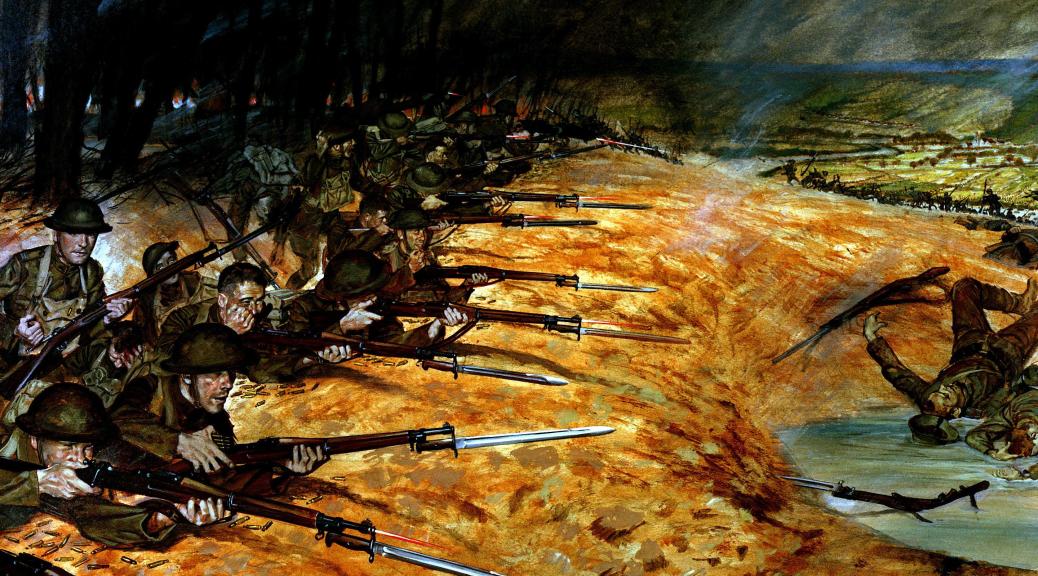
At Château‑Thierry, U.S. troops held bridges while forcing back the Germans using bayonets. The U.S. 3rd Division earned the moniker “Rock of the Marne” for a specific reason. Even when they were outgunned, they refused to retreat.

U.S. Marines didn’t stop the German offensive at Belleau Wood. They smashed it. The men fighting weren’t just veterans; they were Kansas farm boys and Pittsburgh steelworkers. Many of our boys were working through their first combat just days after arriving. They fought through poison gas, machine gun nests, and terrains from Hell.

There was one legendary man who yelled something that grew larger than he did. Gunny Sergeant Dan Daly rallied his men when he yelled, “Come on, you sons of bitches, do you want to live forever?”

What those men fought for wasn’t an empire; they fought for the men alongside them, and because liberty isn’t something inherited, it’s something that is defended.

From Isolation to Respect

It’s true that after World War I, the United States recoiled. We rejected the League of Nations. We withdrew into the comfort of distance. But the world didn’t forget what happened at the Marne.

They didn’t forget the speed of our arrival, the depth of our sacrifice, the rhythm of our industry—and they didn’t forget that the war ended in November, not years later, because America finally showed up and meant it.

We may have pulled back from international entanglements in the 1920s and ’30s, but global powers never again ignored the capabilities of the American people.

The Marne didn’t make us an empire; it made us respected.

Final Thoughts: Why We Share the Marne

Some anniversaries fill the calendar, some drift by, and others ought to be shouted from rooftops. July 15 deserves the latter.

We don’t just remember it because Americans fought. We remember it because they proved we belonged.

During an age where America’s influence is questioned, especially from within, we must remember the blood that carved our seat at the table. That seat wasn’t bought or inherited. It was earned at Château‑Thierry, Belleau Wood, and the banks of the Marne.

At some point, they’ll learn for good that the American spirit is still alive, and it’s not just something read about in our history.

Until then, let them question our wherewithal.

And then let them fear our answer.


Source: The Marne Was Just the Beginning: How July 15 Marked America’s Rise on the World Stage – PJ Media


David Manney

David Manney is a writer and thinker passionate about truth, clarity, and challenging systems that fail those they claim to serve. He brings a sharp eye, a steady voice, and a deep sense of purpose to everything he creates.

Read more by David Manney

 

Our Daily Bread – Digging for Meaning


They have forsaken me, the spring of living water, and have dug their own cisterns, broken cisterns that cannot hold water. Jeremiah 2:13

Today’s Scripture

Jeremiah 2:5-13

Listen to Today’s Devotional

Apple LinkSpotify Link

Today’s Devotional

We have a new puppy, Winston. He bites. Sleeps. Eats. (Does one or two other things.) Oh, and he digs. Winston doesn’t dig casually. He tunnels. Like he’s escaping from prison. It’s compulsive, ferocious, and filthy.

Why does that dog dig so much? I wondered recently. Then it hit me: I’m a digger too—prone to “digging” into myriad things I hope will make me happy. They’re not always even bad things. But when I fixate on finding satisfaction in something apart from God, I become a digger. Digging for meaning apart from God leaves me covered in dirt and longing for something more.

Jeremiah rebuked Israel for being diggers: “They have forsaken me,” God said through the prophet, “and have dug their own cisterns, broken cisterns that cannot hold water” (Jeremiah 2:13). God disciplined His people for neglecting to seek Him. They’d dug their own wells in an attempt to quench their deepest thirst. But God reminded them that He alone is the “spring of living water” (v. 13). In John 4, Jesus offered this living water to the woman at the well, who’d also done her share of digging elsewhere (vv. 10-26).

We’re all diggers sometimes. But God graciously offers to replace our fruitless digging with vital fulfillment with His water, which alone satisfies the deep thirst of our souls.

Reflect & Pray

Where do you tend to dig in search of meaning, hope, or satisfaction? How can you entrust this area of your life to God?

Father, please help me taste and see that You’re what my soul longs for, and to put my shovel down as I rest in You.

Today’s Insights

God told Jeremiah that Judah and Jerusalem were about to be invaded by nations from the north because His people worshiped idols (Jeremiah 1:14-16) instead of the living God who loved them. He asked, “What fault did your ancestors find in me?” (2:5). Their idolatry persisted across generations, so God would “bring charges against [them] again [and] bring charges against [their] children’s children” (v. 9). Yet He urged them, “Return, faithless people” (3:14). One day, He’d give them “shepherds after [His] own heart” who would lead “with knowledge and understanding” (v. 15). God pursues His people, and He alone provides what will truly satisfy their souls.


http://www.odb.org

Joyce Meyer – The Pain Won’t Last Forever


For this light momentary affliction is preparing for us an eternal weight of glory beyond all comparison, as we look not to the things that are seen but to the things that are unseen. For the things that are seen are transient, but the things that are unseen are eternal.

2 Corinthians 4:17-18 (ESV)

Like you, I have faced difficult times in life, and I have learned to tell myself, “This can’t last forever. This, too, shall pass.” When you are going through hardship, deep disappointment, or some struggle that seems impossible, it’s easy to be tempted to think, I cannot stand this for one more day.

The devil takes advantage of our hurts and wounds and tempts us to think several times a day that our trials are going to last forever, that we will hurt for the rest of our lives, or that the negative effect of our problems will be permanent. We think, and sometimes fear, our pain will follow us everywhere we go for as long as we live. The truth is, nothing on earth lasts forever. The only thing we have that is eternal is our life in Christ. In the context of eternity, the struggles that seem unending in this life are actually quite brief. God always wants to heal us, restore us, and deliver us.

Chances are, you can look back over the course of your life and remember other times you have been hurt. God has been faithful to bring you through those times; you can be confident you will make it through this current challenge again through Christ, who gives you strength (Phil. 4:13).

Paul’s point in 2 Corinthians 4:17–18 is that seasons of difficulty always pass. They do not last forever. Going through trials is tough, but God is always with us—helping us, encouraging us, and fighting our battles for us. He never wants us to stay in pain. He always wants to heal us.

When you are tempted to become discouraged because you feel your journey to healing in your soul is taking a long time, remember: “This, too, shall pass.” Your afflictions may not seem “light and momentary” to you right now, but from the perspective of eternity, they are. No matter how difficult your situation may look, God loves you and has a good plan for your life. Your future is bright, and He is preparing you for something great.

Romans 8:28 says that we can “know that for those who love God all things work together for good, for those who are called according to his purpose.” God can take even the hurts and wounds we endure and use them for good in our lives. They won’t last forever, and He will use them to strengthen us and to bless and help others.

Prayer of the Day: Lord, help me trust that my struggles are temporary and that You are with me, healing and restoring. Strengthen me to persevere, knowing this, too, shall pass, amen.


http://www.joycemeyer.org

Denison Forum – Did God spare Donald Trump’s life in Butler, Pennsylvania?


On July 13, 2024, a twenty-year-old sniper named Thomas Crooks fired an AR-15-style rifle from the roof of a building around four hundred feet from the stage where Donald Trump was holding a campaign rally in Butler, Pennsylvania. He killed a fifty-year-old fireman named Corey Comperatore, who died shielding his family, and critically injured two others.

The moment he fired, Mr. Trump turned his head to the right to point to a chart showing illegal border crossings. This caused a bullet to skim his right ear rather than hitting his head and killing him.

Secret Service agents tackled him to protect him, but when he stood to his feet again, he pumped his fist in the air. With blood running down his face, he shouted, “Fight! Fight! Fight.” Two days later, Mr. Trump made a triumphal entry at the Republican National Convention in Milwaukee.

The day after the shooting, Mr. Trump told journalist Salena Zito, “It was the hand of God. He was there.” A month after returning to the White House, he said, “I feel, I feel even stronger. I believed in God, but I feel much more strongly about it.”

Yesterday’s anniversary of the shooting raises again the question: Did God save Mr. Trump’s life?

The bullet that passed through Lincoln’s hat

Let’s begin with the biblical fact that he clearly could have.

The Bible proclaims, “Kingship belongs to the Lᴏʀᴅ, and he rules over the nations” (Psalm 22:28). Even a sparrow does not fall to the ground apart from his providential knowledge (Matthew 10:29). He sent an angel to free the apostles from prison (Acts 5:17–21) and to spare Peter from Herod’s execution (Acts 12:6–11).

The list of US presidents who survived assassination attempts is long. Among the most notable is a lone rifle shot fired in August 1864 by an unknown sniper that passed through Abraham Lincoln’s hat as he rode in the late evening, missing his head by inches. Another is the bullet fired by John Hinckley that lodged an inch from Ronald Reagan’s heart in March 1981.

However, we must obviously add that we have no biblical revelation by which to interpret the shooting in Butler or other assassination near-misses. We are left to employ what we do know of God’s character from Scripture as we seek to understand the events of that day or of any other.

Four approaches to divine sovereignty

One position is that God causes all that happens. The Lord declares, “I will accomplish all my purpose” (Isaiah 46:10). In this view, free will is only apparent but not real. As Solomon noted, “The king’s heart is a stream of water in the hand of the Lᴏʀᴅ; he turns it wherever he will” (Proverbs 21:1).

If this is our only approach to the events of our world, we can credit God for saving Mr. Trump in Butler, Pennsylvania, but we must blame him for the death of Mr. Comperatore. We can credit him when a natural disaster spares us, but we must blame him for the horrific July 4 floods in Central Texas.

The opposite position is that God causes nothing that happens. Deists believe that God created the universe as a clockmaker who then watches it run on its own, refusing to intervene in the natural world. Of course, the numerous miracles described in Scripture from Genesis to Revelation clearly teach otherwise.

A middle position is that God honors the free will he gives us, so the consequences of our sins are not his fault but ours (cf. Deuteronomy 30:19). But the Lord intervened to protect Peter from Herod, just as some think he intervened to protect Donald Trump from his would-be assassin in Butler.

Another middle position is that God allows nature to take its course, but he intervenes when necessary according to his providential purposes. Not every storm is his fault, but he can on occasion calm the storm (cf. Matthew 8:23–27).

The mystery at the heart of the issue

For reasons I explain in detail in a website article, I believe that both middle positions are correct: God honors our free will and the natural laws he created, but sometimes intervenes with both.

This leads to the mystery at the heart of the issue. If he spared Donald Trump or Ronald Reagan, why not Abraham Lincoln in Ford’s Theatre or John F. Kennedy in Dallas? If he rescued some at Camp Mystic and the other sites ravaged by the Central Texas floods, I don’t know why he did not rescue everyone else.

Nor would I expect to.

We know that “all Scripture is breathed out by God” (2 Timothy 3:16) as its authors were “carried along by the Holy Spirit” (2 Peter 1:21). But the Bible is now a closed canon. None of us can claim revelatory knowledge with the certainty of God’s word. I cannot say with the prophets, “Thus says the Lord . . .” Nor can you.

If I claimed that God had declared audibly to me that he spared Donald Trump’s life a year ago in Butler, you would have as much right to doubt my testimony as I would if you made such a statement. I cannot think of any way the Lord could prove that it is so, either to me or to you.

“The whole reason why we pray”

Two consequences follow.

First, beware of conforming God’s will to ours.

If you are a partisan supporter of Donald Trump, you might wish I would more definitively agree with those who are convinced God spared his life miraculously a year ago. If you are a partisan opponent of the president, you might wish for the opposite. But neither opinion changes reality. God’s ways are higher than our ways (Isaiah 55:9) and not subject to our subjective wishes.

Accordingly, the purpose of prayer is not to conform God’s will to ours, but the reverse. As Julian of Norwich noted, “The whole reason why we pray is to be united into the vision and contemplation of God to whom we pray.”

A second principle follows from the first: the purpose of life is to know God and make him known.

If we pray for him to use every circumstance and challenge we face as a means to this end, he will always answer our prayers. He may take us to heaven, where we know him as we are known (1 Corinthians 13:12). He may heal us or spare us. He may answer us by using our suffering to draw us into greater dependence on himself (cf. 2 Corinthians 12:8–10).

And God will help us know him so we can make him known to the world. Wounded healers are the most effective healers. He comforts us so we can comfort others (2 Corinthians 1:4).

As the saying goes,

“Sometimes God calms the storm, but sometimes he lets the storm rage and calms his child.”

Both are miracles.

Will you trust him for the one you need most today?

Quote for the day:

“I am certain that I never did grow in grace one-half so much anywhere as I have upon the bed of pain.” —Charles Spurgeon

Our latest website resources:


Denison Forum

Days of Praise – The Good Seed


by Henry M. Morris, Ph.D.

“Now the parable is this: the seed is the word of God.” (Luke 8:11)

The Word of God is pictured by many beautiful symbols in the Scriptures, and perhaps one of the most meaningful is that of the seed sown in the field of the world by the great sower, the Lord Jesus Christ. The first reference to seed sowing in the Bible is in the story of Isaac, who “sowed in that land, and received in the same year an hundredfold: and the LORD blessed him” (Genesis 26:12).

Now Isaac himself was the “seed” of God’s promise to Abraham, and he was a precursive fulfillment of the ultimate promised “seed, which is Christ” (Galatians 3:16). Isaac’s sowing of literal seed in the land of the Philistines is thus a type of Christ’s sowing of spiritual seed throughout the world. As Isaac’s sowing brought forth a hundredfold, so the beautiful parable of the sower indicates that at least some of the seed “fell on good ground, and sprang up, and bare fruit an hundredfold” (Luke 8:8).

Although not all seed will come to fruition, it must be sown throughout the world. Some of the seed will bear fruit, for God has said “that it may give seed to the sower, and bread to the eater: so shall my word be…it shall not return unto me void” (Isaiah 55:10-11). “Being born again, not of corruptible seed, but of incorruptible, by the word of God, which liveth and abideth for ever” (1 Peter 1:23).

The first of Christ’s parables is this parable of the sower. The second, complementing the first, indicates that the seed is not only God’s Word but also God’s children—those regenerated through the Word. “He that soweth the good seed is the Son of man; the field is the world; the good seed are the children of the kingdom” (Matthew 13:37-38). Thus, we also become sowers of the Word, witnessing to the world and bearing good fruit in His name. HMM


https://www.icr.org/articles/type/6

My Utmost for His Highest by Oswald Chambers – The Account with Persecution


If anyone slaps you on the right cheek, turn to them the other cheek also. —Matthew 5:39

The message Jesus delivers in this verse reveals the humiliation of being a Christian. When cowards don’t hit back, it’s because of fear; when Christians don’t hit back, it’s because they are manifesting the life of the Son of God. There is a vast difference between the two responses, yet in the eyes of the world they are the same.

Am I willing to be thought a coward for my Lord’s sake? The teaching of the Sermon on the Mount isn’t “Do your duty.” It’s “Do what isn’t your duty.” It isn’t my duty to go the second mile or to turn the other cheek. Yet Jesus says that if I am his disciple, I will always do these things. When I am insulted, not only must I not resent it, but I must use it as an opportunity for exhibiting the disposition of the Son of God. I cannot imitate the disposition of Jesus; either it’s inside me or it isn’t. If it is, every personal insult will become an occasion for revealing his incredible sweetness.

When I find myself being offended and saying things like, “Oh well, I can’t do anything more. I’ve been so misrepresented and misunderstood,” I hurt the Son of God. I’m insisting upon my own rights. But when I take the blow myself, I prevent Jesus from being hurt. This is what Paul means when he says, “I fill up in my flesh what is still lacking in regard to Christ’s afflictions” (Colossians 1:24). As a disciple, I must realize that it is my Lord’s honor which is at stake in my life.

We are always looking for justice for ourselves. The teaching of the Sermon on the Mount is this: Never look for justice, but never cease to give it. The only right Christians have is the right not to insist upon their rights.

Psalms 10-12; Acts 19:1-20

Wisdom from Oswald

There is no condition of life in which we cannot abide in Jesus.
We have to learn to abide in Him wherever we are placed.


https://utmost.org/

Billy Graham – An Upside Down World


Follow not that which is evil, but that which is good . . .

—3 John 11

We must get this fact firmly fixed in our minds: we live in an upside-down world. “, fight when they should be peaceful, wound when they should heal, steal when they should share, do wrong when they should do right. I once saw a toy clown with a weight in its head. No matter what position you put it in, it invariably assumed an upside-down position. Put it on its feet or on its side, and when you let go it flipped back on its head. Unregenerate people are just like that! Do what you may with them and they always revert to an upside-down position. That is why the disciples to the world were misfits. To an upside-down person, a right-side up person seems upside down. To a sinner, a righteous person is an oddity and an abnormality. A Christian’s goodness is a rebuke to the wicked; his being right-side up is a reflection upon the worldling’s inverted position.

Prayer for the day

Let me never compromise my stand for You, Lord Jesus, who gave Your sinless life for me.


https://billygraham.org/

Guideposts – Devotions for Women – Surrender to Trust


Then Jesus said to his disciples: “Therefore I tell you, do not worry about your life, what you will eat; or about your body, what you will wear.”—Luke 12:22 (NIV)

Jesus tells us not to worry about the basics of living. His words are not just a suggestion but a command, a divine assurance of His care. Let that truth sink deep into your heart and bring peace to your soul.

Dear Lord, when I worry, remind me that You are the Ultimate Provider—and I am under Your care.


https://guideposts.org/daily-devotions/devotions-for-women/devotions-for-faith-prayer-devotions-for-women/

Our Daily Bread – Life in Christ


Seek the Lord and live. Amos 5:6

Today’s Scripture

Amos 5:1-6, 10-14

Apple LinkSpotify Link

Today’s Devotional

A family who’d lost touch with their son and brother Tyler received an urn that was said to contain his cremation ashes. Just twenty-two years old, he’d apparently died of a drug overdose. For years, Tyler had dealt with the effects of drug addiction and poor choices. But prior to the reported overdose, he’d been sober after spending time in a transitional housing facility and completing an addiction recovery program. Then authorities made a shocking discovery—Tyler was actually alive! They’d mistaken him for another young man who’d died of an overdose. Later, after being reunited with family and reflecting on the death of the other young man, Tyler said, “That could have been me.”

The Israelites once learned of their death—though they were very much alive. In a song of mourning, the prophet Amos sang these words to God’s rebellious people: “Fallen is Virgin Israel, never to rise again” (Amos 5:2). These words must have gotten their attention—they were dead?! But the prophet also spoke these comforting words from God Himself: “Seek me and live” and “Seek good . . . . Then the Lord God Almighty will be with you” (vv. 4, 14). Though Israel was dead in their sins against God, He invited them to turn to Him and find life.

As we deal with our sin, let’s confess it and bring it to the one who loves us and forgives us. God lovingly leads us from death to life (John 5:24).

Reflect & Pray

How does going against God lead to death? What do you need to confess to Him?

Loving God, please help me turn from sin and find life in You.

Today’s Insights

Amos was a prophet from Judah (Amos 7:12) whom God sent to warn Israel of His judgment for their sins. Amos lamented the death of the nation (5:1-3, 16-27) but offered a message of hope for those who repented and returned to God. Though punishment was certain, Amos urged the people to repent, to “hear” the words of God (v. 1), “seek the Lord and live” (v. 6), act justly (vv. 7-10), not oppress the poor (vv. 11-13), and do good and hate evil (vv. 14-15). He provides what we need to turn from sin and find true life in Christ.


http://www.odb.org

Joyce Meyer – Confronting Fear


Do not be afraid of sudden terror, nor of trouble from the wicked when it comes; for the LORD will be your confidence, and will keep your foot from being caught.

Proverbs 3:25–26 (NKJV)

I once heard a story of a village where the children were told, “Whatever you do, don’t go near the top of the mountain. It’s where the monster lives.” One day, some brave young men decided they wanted to see the monster and defeat it. Halfway up the mountain, they encountered a huge roar and a terrible stench. Half the men ran down the mountain, screaming. The other half of the group got farther up the mountain and noticed the monster was smaller than they had expected—but it continued to roar and emit such a stench that all but one man ran away. As he took another step forward, the monster shrank to the size of a man. Another step, and it shrank again. It was still hideously ugly and stank, but the man could actually pick it up and hold it in the palm of his hand. He said to the monster, “Who are you?” In a tiny, high-pitched voice, the monster squeaked, “My name is Fear.”

If you follow God’s plan for conquering fear, you will find one day that the things that frightened you the most were really nothing at all.

Prayer of the Day: Lord, help me to begin to confront the fears I’ve been running away from. I want to silence the roars that keep me from moving ahead with my life, amen.


http://www.joycemeyer.org

Denison Forum – Would-be thieves use AI to impersonate Marco Rubio


Why AI is both a helpful tool and an existential threat

Last month, an imposter created a Signal account pretending to be US Secretary of State Marco Rubio using the display name “Marco.Rubio@state.gov.” The perpetrator then used AI to simulate Rubio’s voice and contacted three foreign ministers, a US governor, and a member of Congress. The actor left voicemails for some while sending invites to others to communicate through the Signal app.

Upon learning of the scam, the State Department sent a message warning those who may have been contacted. An official claimed that the hoax was “not very sophisticated” and had been unsuccessful, but they thought it “prudent” to raise awareness just in case.

However, this was not the first time AI has been used in an attempt to trick high-level diplomats and government representatives. A similar incident occurred in May involving Susie Wiles, President Trump’s chief of staff. While that effort was similarly fruitless, it’s only a matter of time before those behind the scams improve enough to succeed.

As Hany Farid, a professor at the University of California at Berkley who specializes in digital forensics, warns:

You just need 15 to 20 seconds of audio of the person, which is easy in Marco Rubio’s case. You upload it to any number of services, click a button that says “I have permission to use this person’s voice,” and then you type what you want him to say.

You don’t have to be the secretary of state or a member of the president’s inner circle to become the target of these attacks. Global cybercrime—much of it fueled by innovations in AI—is projected to cost upwards of $10.5 trillion this year, and that number is only going to rise as the technology improves.

But while we are increasingly aware of the risks AI poses for crime, large parts of our society seem willing—and even excited—to welcome its use in ways that could pose an even greater risk.

AI in education

The American Federation of Teachers, the second-largest US teachers’ union, announced recently that Microsoft, OpenAI, and Anthropic have invested a combined $23 million to help create an AI training hub for educators. This is the latest example of tech companies attempting to make inroads into schools and universities to help teachers and students learn how to use—and become dependent on—AI to augment their studies.

Chris Lehane, Open AI’s chief global affairs officer, hopes that AI will eventually join reading, writing, and arithmetic as a core skill everyone must learn. And, as scary as that sounds, there is something to the idea that learning how to use AI well is important given the costs of using it poorly.

For all the advances the industry has made, hallucinations and lies are still an unavoidable part of the technology. A recent study by law school professors found that AI tools made “significant” errors that posed an “unacceptable risk of harm” when asked to summarize a law casebook.

Moreover, Microsoft found that using AI chatbots to research and write could hinder critical thinking. That one of the creators of these artificial intelligence models would help to publicize such a conclusion is notable considering such tasks are how an increasing number of people, both in the classroom and outside of it, use the technology.

And that risk to critical thinking is, in my estimation, the greatest threat AI poses.

A generational threat?

Aaron MacLean, a senior fellow at the Hudson Institute, cautions, “The substitution of Large Language Models for genuine thinking is a generational threat. At stake is no less than the life of the mind.”

While that sentiment is perhaps a bit exaggerated, he makes a powerful argument for why the small, everyday ways in which AI has become a staple of people’s lives could have dramatic and devastating effects on people’s ability to reason and interact with their environment in the future.

To illustrate his point, MacLean recounts a time during his freshman year of college when a classmate told their professor, “I know what I think, I just can’t get the words down on the page,” to which the professor responded, “Well, you don’t actually know what you think, then. The act of writing the thing is the same thing as the thinking of it. If you can’t write it, you haven’t actually thought it.”

Now, you have to have a thought before you can write it down, but the professor’s point was that there is something in the struggle of taking ideas and learning to convey them in a way that makes sense that is instrumental to developing our ability to think and reason well. Taking disparate thoughts and turning them into a coherent argument requires a mastery of information that goes beyond the simple possession of data.

AI makes it possible to get to the answer—or at least something approximating it—without having to do the work, and that’s a problem.

The person God created you to be

Ultimately, for all its downsides, AI can be a helpful tool. It excels at accumulating information, though it’s far less trustworthy when it comes to knowing what to do with it. Moreover, there are a number of questions that just need a simple answer, and relying on AI for those—with the caveat that you check its sources—is fine.

But, increasingly, that’s not how it’s used.

It shouldn’t come as a surprise that people would be enticed to take the easier path. And that’s especially true when, as is the case in many circumstances, the final product can be just as good or better than what we could do on our own.

ChatGPT is going to write a better paper than most college freshmen. It may even create a better presentation or write better emails than many professionals.

What it cannot replicate are the unique thoughts and Holy Spirit-given insights that God will only give to people. Nor can it help you learn to hone and develop skills that the Lord may want to use to advance his kingdom in the future.

Even Jesus had to grow “in sophia”—the Greek word for “the art of using wisdom”—as part of the Father’s will for his life (Luke 2:52). If that was true of the incarnate God, it is most certainly true for each of us as well.

However, that process requires that we place a higher value on the people we will become by committing to the work than on the chance to finish the work quickly. And that is a difficult ask when we face a seemingly endless list of demands on our time and attention.

So, when you are next forced to make that choice, what will you do?

Again, AI has its place, and the Lord can use it to help facilitate his calling in our lives. But it must remain a tool and nothing more, or we risk becoming more reliant on artificial intelligence than on our God-given intelligence.

That is a line we cannot afford to cross, but also a line that will continue to blur as AI gets smarter and the masses who become overly reliant on it go in the opposite direction.

So please don’t settle for the person it’s easy to be rather than the person God created you to be. He has gifted and called you to something greater than that.

Will you commit to that calling today?

Quote of the day:

“I do not feel obliged to believe that the same God who has endowed us with senses, reason, and intellect has intended us to forgo their use and by some other means to give us knowledge which we can attain by them.” —Galileo

Our latest website resources:


Denison Forum