
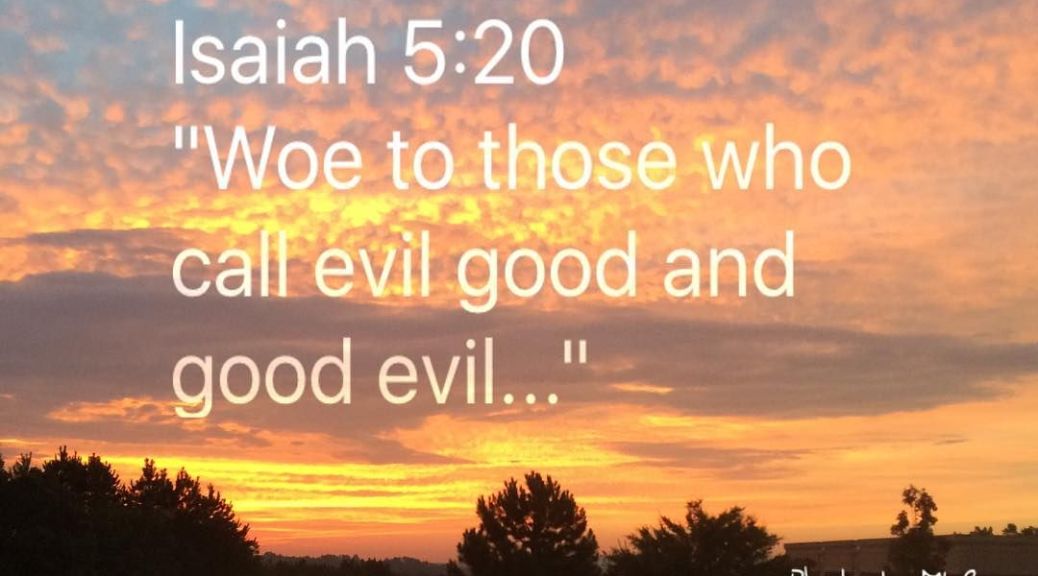
God Warned Us!

God Warned Against Calling Good Evil And Evil Good—And That Warning Still Stands Today

By Tony Perkins September 8, 2025

The prophet Isaiah warned a wayward nation: “Woe to those who call evil good, and good evil; who put darkness for light, and light for darkness.” Right was condemned as wrong, and what darkened the soul was repackaged as enlightenment. Isaiah cautioned that rejecting God’s Word would bring devastation. The warning still stands.

Two developments this past week expose the warning’s timeliness. For years, activists in media and government have advanced a gender ideology that tells even children they can choose an identity opposite of their biological reality. That confusion is not benign. In Minneapolis, a gunman opened fire during a school Mass at Annunciation Catholic Church, killing two children and injuring many others. Police identified the attacker as Robert Westman, who identified as transgender and, in notes posted before the attack, expressed regret and anger about “being trans” and deep confusion about identity.

This is not isolated. Recall the Covenant School massacre in Nashville, and now we have Minneapolis — both carried out by individuals who identified as transgender. The point is not to stigmatize anyone; it is to confront a reality our culture keeps trying to deny: ideas have consequences and masquerading a lie as the truth can be deadly. Yet rather than pause to reassess the narrative, legacy outlets scolded themselves for “misgendering.” NBC News even issued a correction after its initial report used what it called the wrong pronoun when referring to Westman as “he.” “She used female pronouns,” NBC sycophantically stated. This, despite law enforcement identifying the killer as male.

What a commentary on the press. Apologizing for mistakenly telling the truth reflects a deeper malady: trading evil for good and darkness for light. And when this deception is celebrated, children suffer. A civilization cannot protect what it refuses to name, and language becomes a veil for violence.

Still, the media is not the fountainhead of this confusion; they are its amplifiers. The deeper problem is philosophical. If truth is now established by feelings, then law must enforce the feelings. That brings us to this week’s Senate Foreign Relations Committee hearing. Virginia Senator Tim Kaine (D) berated a State Department nominee for affirming the American principle that our rights come from God, not government — calling that view “very, very troubling,” and likening it to the ideology of Iran’s theocracy. Think about that: the creed of the Declaration recast as dangerous and akin to the rule of the Ayatollahs.

Our Founders knew better. Thomas Jefferson wrote that we are “endowed by our Creator with certain unalienable Rights.” Alexander Hamilton insisted the “sacred rights of mankind” are “written, as with a sunbeam, by the hand of the Divinity itself” and cannot be erased by mortal power. Governments secure rights; they do not invent them. And when government presumes to redefine reality — whether human nature or human rights — it imperils the very people it claims to protect.

So here is the choice: return to first principles — truth over ideology, reality over rhetoric, the Creator over the state — or keep stumbling in the dark while calling it light. For the sake of our children and our country, choose the true light — and live by it.


Source: God Warned Against Calling Good Evil And Evil Good—And That Warning Still Stands Today – Harbinger’s Daily

Our Daily Bread – Embracing Christ’s Truth


Jesus answered, “I am the way and the truth and the life.” John 14:6

Today’s Scripture

John 14:1-7

Listen to Today’s Devotional

Apple LinkSpotify Link

Today’s Devotional

When my friend Connor takes pictures on his old film camera, he doesn’t bother to find attractive lighting or airbrush blemishes or crop out anything unsightly. His photos are startlingly raw. They stand out in my social media feed next to heavily edited photos of gorgeous people and places. Though unconventional, his work is beautiful because it communicates truth about how things really are.

We all long for what’s real, but sometimes the truth isn’t attractive to us. Close to the time of His death, Jesus declared, “I am . . . the truth” (John 14:6). His disciples were wondering how they could get to the Father’s house that Jesus spoke so longingly about (vv. 2-3). They failed to see that Jesus standing in front of them was the answer. They struggled to understand that He would bring victory through His own sacrifice.

Isaiah prophesied that the coming Messiah would have no beauty or majesty, “nothing in his appearance that we should desire him” (Isaiah 53:2). Much of what Jesus said was so challenging and unexpected that it turned religious people against Him (John 11:45-48). Yet He gave an open invitation to know the truth and find real life. “If you really know me,” said Jesus, “you will know my Father as well” (John 14:7). In the midst of an airbrushed and unrealistic world, we can embrace that beautiful, raw truth today!

Reflect & Pray

When and why have you sought superficial beauty instead of truth? How can you embrace Jesus’ words more and more?


Dear Jesus, I choose to follow You as the source of all truth.


Watch this video to see how Jesus is the way!

Today’s Insights

In John 13-17, we encounter a scene best viewed with reverence and awe. These chapters contain Christ’s final instructions to His disciples before His arrest and crucifixion. Immediately after Judas had departed to betray Christ, Jesus said, “Now the Son of Man is glorified and God is glorified in him” (13:31). The reality of His violent death for us was the pivot point of Christ’s entire mission. At first, the disciples couldn’t accept this. The crucifixion brought the rawest truth they would absorb. Yet His death was essential to providing restoration to our heavenly Father. Jesus promised, “My Father’s house has many rooms; if that were not so, would I have told you that I am going there to prepare a place for you?” His words “I will come back and take you to be with me” (14:2-3) convey the culmination of that raw truth—eternal joy with our Father.


http://www.odb.org

Joyce Meyer – God Opens Doors


…These are the words of him who is holy and true, who holds the key of David. What he opens no one can shut, and what he shuts no one can open.

Revelation 3:7 (NIV)

Trusting God to open the right doors and close the wrong ones for us brings much peace into our lives. I’ve tried pushing open a door I wanted to walk through, and the only result was frustration because it didn’t work. However, I have learned to trust God not only to open the right doors for me, but also to close the wrong ones.

When God opens a door for you, He makes things easy. When He closes a door, it is very difficult to continue trying to do what you have been doing. I have enjoyed many open doors in my life and ministry, but I have also had to learn that when God closes one, I need to walk away from it and trust Him for what is next.

God always has bigger and better plans for us if we will follow His lead. We don’t usually do the same thing all of our lives, because God promotes the faithful. Perhaps you are trying to hang on to something that God is finished with. If you will let it go, you will see that a new door will open and it will lead to something better than what you were trying to hold on to. God is faithful, and you can put all of your trust in Him.

Prayer of the Day: Father, I want to trust You to open right doors for me and close wrong ones. Help me recognize what You are doing in my life and follow Your guidance. In Jesus’ name, amen.


http://www.joycemeyer.org

Denison Forum – At least six killed by terrorists at bus stop in Jerusalem


At least six people were murdered and dozens were wounded when terrorists opened fire on civilians at a bus stop in Jerusalem this morning. The two attackers were killed at the scene; Hamas praised the shooting by “two Palestinian resistance fighters.”

This tragedy is especially personal for me on two levels. One is that I have led more than thirty study tours to Israel and love the country and its people. The other is that Ramot Junction, the site of the attack, is located at one of the main entry points to Jerusalem. I have traveled by it many times over the years and know that what happened there could have happened to me and to my fellow travelers.

In other news, Russia launched its largest attack on Ukraine over the weekend since the war began. At least four people were killed, including a two-month-old baby and the child’s mother. Dozens more were injured.

“I am the captain of my soul”

Queen Elizabeth II died on this day in 2022 at the age of ninety-six. Even though she was the longest-reigning monarch in British history, death found her as it will us all (unless Christ returns first).

Our very human fear of that moment is not just the threat of pain and suffering but also our innate dread of the unknown. We fear walking into a dark room or a dark forest, much less a dark future.

So we ignore the fact of human mortality when we can. I didn’t want to write about today’s tragic news from Jerusalem and Ukraine any more than you wanted to read about it. We euphemize death (people don’t die anymore, they merely “pass on”) and we seek to extend our lives through medical means.

When we fear death, we make this world our home and fight tooth and nail to stay here as long as we can. We measure success by temporal standards and drive ourselves to achieve it. And we go through life claiming, “I am the master of my fate: I am the captain of my soul.”

Therein lies the issue I want to address today.

Liberalism failed because it succeeded

Patrick J. Deneen is a political science professor at the University of Notre Dame. In his masterful book Why Liberalism Failed, he describes “liberalism” (from the Latin liber, meaning “free”) as a view that “conceived humans as rights-bearing individuals who could fashion and pursue for themselves their own version of the good life.” Over the centuries of its ascent, this view has led many of its followers to jettison everything that constrains individual freedom, including religious dogma, societal mores, and legal strictures.

Whether the topic is abortion, same-sex marriage, euthanasia, or a host of other cultural issues, Western culture has “evolved” to a place of existential freedom in the quest for a temporal utopia.

How is this working for us?

Professor Deneen notes that “some 70 percent of Americans believe that their country is moving in the wrong direction,” while “every institution of government shows declining levels of public trust by the citizenry.” After documenting a plethora of other social ills, he concludes, “Nearly every one of the promises that were made by the architects and creators of liberalism has been shattered.”

Then he draws this surprising lesson: “Liberalism has failed—not because it fell short, but because it was true to itself.” By removing barriers and constraints on human behavior built by religious teaching and legal structures, it has freed us to be our fallen selves. And when my “will to power” collides with yours, conflicts abound, terrorists attack, wars are launched, and the weak are oppressed by the strong.

Being freed from “lifelong slavery”

What is the solution?

The Bible teaches that Jesus died to “destroy the one who has the power of death, that is, the devil, and deliver those who through fear of death were subject to lifelong slavery” (Hebrews 2:14–15). We are enslaved to our fear of death unless we are set free by a power greater than death. And no other person in human history demonstrated such power except Jesus Christ.

Muslims venerate the tomb of the Prophet Muhammad in Medina. I have been to the tomb of Baháu’lláh, the founder of the Bahá’í faith, and visited the graves of some of our culture’s greatest heroes, from George Washington and Thomas Jefferson to Winston Churchill and Sir Isaac Newton. None rose physically from the tomb. Even Lazarus and others whom Jesus raised from the dead eventually died again.

Only Jesus demonstrated the power to defeat the grave. Therefore, only he can give that power to us. When we receive the gift of eternal life that he offers all who trust in him, we are freed from “lifelong slavery” to death.

But there’s a downside to the upside.

Those of us who trust in Christ as our Lord know we will “never die” (John 3:16). But we can therefore feel free to pursue whatever we want in this life, secure in the knowledge that Jesus will forgive our sins when we confess them and that nothing we do in this world can keep us from the world to come. We can even believe that our religious activities will earn God’s favor and blessing on the non-religious areas of our lives.

All of this is but a spiritual expression of our fallen “will to power.” Such a compartmentalized way of life makes Jesus a means to our ends. By seeking what we want, we forfeit what he wants for us. This grieves our Father and impoverishes us since the will of an all-knowing, all-loving God is by definition better for us than ours.

“You lead, I follow”

The solution is the simple but transforming decision to “submit yourselves therefore to God” (James 4:7), to “humble yourselves, therefore, under the mighty hand of God” (1 Peter 5:6) and to pray with Jesus, “Not my will, but yours, be done” (Luke 22:42).

In the words of a dear friend whose business and cultural influence spans the globe, it is to pray all through the day, “You lead, I follow.”

Dwight Moody counseled,

“Let God have your life; he can do more with it than you can.”

Do you agree?

Quote for the day:

“Carry the cross patiently, and with perfect submission; and in the end it shall carry you.” —Thomas à Kempis (1380–1471)

Our latest website resources:


Denison Forum

Days of Praise – Great and Precious Promises


by Henry M. Morris, Ph.D.

“Whereby are given unto us exceeding great and precious promises: that by these ye might be partakers of the divine nature, having escaped the corruption that is in the world through lust.” (2 Peter 1:4)

Scripture is full of promises, more than 2,800 in the Old Testament and more than 1,000 in the New. The first of these exceeding great and precious promises was the protevangelium (“first gospel”) of Genesis 3:15. Immediately after the fall of Adam and Eve through the temptation of Satan, God promised the coming Seed of the woman, the Savior: “And I will put enmity between thee and the woman, and between thy seed and her seed; [He] shall bruise thy head, and thou shalt bruise his heel.”

The first New Testament promise, significantly, is this same primeval promise, now made far more specific: “And she shall bring forth a son, and thou shalt call his name JESUS for he shall save his people from their sins” (Matthew 1:21).

The last promise of the Old Testament speaks of a second coming of “Elijah the prophet,” who will “turn the heart of the fathers to the children, and the heart of the children to their fathers” (Malachi 4:5-6). Then, the final promise of the Bible is the wonderful assurance of Christ concerning His glorious second coming: “Surely I come quickly” (Revelation 22:20).

Sandwiched between these great and precious promises are over 3,800 other promises. Some of these are in the form of promised warnings to the sinner but are promises nonetheless. Most promises, however, are to the obedient follower of God, and we know that “he is faithful that promised” (Hebrews 10:23). “For all the promises of God in him are yea, and in him Amen, unto the glory of God by us” (2 Corinthians 1:20). HMM


https://www.icr.org/articles/type/6

My Utmost for His Highest by Oswald Chambers – Determinedly Demolish Some Things


Demolish arguments and every pretension that sets itself up against the knowledge of God. —  2 Corinthians 10:5

Deliverance from sin isn’t deliverance from human nature. There are certain things in human nature, such as prejudice, which the Christian has to destroy by neglect; we have to flat-out refuse to give these things air. Other things we have to hand over to God, then stand still and witness the power of his salvation.

But there are also things which have to be destroyed by violence—by drawing on the divine strength imparted to us by God’s Spirit. Any theory or idea that raises itself up against the knowledge of God has to be determinedly demolished, not through fleshly effort or compromise but by drawing on his power. “The weapons we fight with are not the weapons of the world. On the contrary, they have divine power to demolish strongholds” (2 Corinthians 10:4).

Only when God has altered our disposition and we have entered into the experience of sanctification can this fight begin. Our fight isn’t against sin. We can never fight against sin; sin is Jesus Christ’s domain, and he deals with it through redemption. The war we must fight is the war of turning our natural life into a spiritual life. This is never easily done, nor does God intend it to be easily done. It’s done only through a series of moral choices. God doesn’t make us holy in the sense of instantly giving us a good character. He makes us holy in the sense of imparting innocence. It’s up to us to turn that innocence into holy character by a series of moral choices.

These choices are continually in conflict with the entrenched habits of our natural lives—the pretensions and arguments that raise themselves up against the knowledge of God. We can refuse to make the moral choice, knowing that if we do, we’ll be of no account in his kingdom. Or we can determinedly demolish every pretension, and let Jesus bring us to glory.

Proverbs 3-5; 2 Corinthians 1

Wisdom from Oswald

We must keep ourselves in touch, not with theories, but with people, and never get out of touch with human beings, if we are going to use the word of God skilfully amongst them. Workmen of God, 1341 L


https://utmost.org/

Billy Graham – Be Honest with God


God loveth a cheerful giver.

—2 Corinthians 9:7

The greatest blessing of giving is not on the financial side of the ledger but on the spiritual side. You receive a sense of being honest with God. You receive a consciousness that you are in partnership with God—that you are doing something constructive—that you are working with Him to reach the world for Jesus Christ. You are also enabled to hold on to this world’s goods loosely because the eternal values are always in view. How do you give? Is it liberally and cheerfully? Or is it sparingly and grudgingly? If you have been giving God the leftovers of your substance and your life, you have been missing the true joy and blessing of Christian giving and living.

Prayer for the day

Forgive me, almighty God, for so often giving You the leftovers. In my heart I know I can never outgive You.


https://billygraham.org/

Guideposts – Devotions for Women – God, Our Rescuer


For he will deliver the needy who cry out, the afflicted who have no one to help.—Psalm 72:12 (NIV)

God hears the cries of your heart and is ready to provide solace. Anchor your trust in His vow to uplift those who are in distress and enduring pain. Your faith serves as a lighthouse, encouraging others to turn to God in their darkest times, shining the hope that resides only in Him.

Lord, I am grateful beyond words for You being my Savior. Guide me to place unwavering trust in You.


https://guideposts.org/daily-devotions/devotions-for-women/devotions-for-faith-prayer-devotions-for-women/


