Tag Archives: Prayer

Charles Stanley – Secure Hope


Psalm 42:1-11

God wants His children to have desires and expectations that are motivating as well as enriching. However, some disappointment is inevitable in this fallen world. So how can we determine where to place our hope—and the way to respond if it is not fulfilled?

Hope is secure when it is aligned with the Lord’s desires, which are revealed in Scripture. However, many of our expectations are based on wishes or feelings. We long for job promotions, good health, or quick solutions to our problems. Though these are things we want, we have no absolute promise from the Lord that they’re part of His will for us.

Disappointment with God can occur whenever our expectations do not coincide with His plan. Even when hope is based on a scriptural promise, the Lord may not fulfill it in the way or the time that we expect. We should remember that though God may appear inactive, He is moving beneath the surface, preparing us for the future.

The key to contentment and joy lies in placing all our personal hopes under the umbrella of our ultimate hope in the Lord. God is sovereign and good. He always wants what is best for us and never makes a mistake. His ways are higher than ours and, in many ways, beyond human understanding.

From a limited and fallen perspective, we may be like a 5-year-old who wants candy at every meal. Sometimes God has to dash our hopes in order to give us what He knows is best. Ask Him to clarify and direct your desires to coincide with His way. Then rest in His goodness and keep your hope in Him.

Bible in One Year: Psalm 19-22


http://www.intouch.org/

Our Daily Bread — Quieting the Critic


Read: Nehemiah 4:1–6 | Bible in a Year: Ezra 9–10; Acts 1

Hear us, our God, for we are despised. Turn their insults back on their own heads. Nehemiah 4:4

I work with a team to put on an annual community event. We spend eleven months plotting many details to ensure the event’s success. We choose the date and venue. We set ticket prices. We select everything from food vendors to sound technicians. As the event approaches, we answer public questions and provide directions. Afterward we collect feedback. Some good. Some that is hard to hear. Our team hears excitement from attendees and also fields complaints. The negative feedback can be discouraging and sometimes tempts us to give up.

Nehemiah had critics too as he led a team to rebuild the wall of Jerusalem. They actually mocked Nehemiah and those working alongside him saying, “Even a fox climbing up on it would break down [your] wall of stones” (Nehemiah 4:3). His response to the critics helps me handle my own: Instead of feeling dejected or trying to refute their comments, he turned to God for help. Instead of responding directly, he asked God to hear the way His people were being treated and to defend them (v. 4). After entrusting those concerns to God, he and his co-laborers continued to work steadily on the wall “with all their heart” (v. 6).

We can learn from Nehemiah not to be distracted by criticism of our work. When we’re criticized or mocked, instead of responding to our critics out of hurt or anger, we can prayerfully ask God to defend us from discouragement so we can continue with a whole heart.

Help me to evaluate the good and bad in the criticism, to trust You, and to continue in my work wholeheartedly.

God is our best defense against criticism.

By Kirsten Holmberg

INSIGHT

Have you noticed how criticism seems so justified when we give it—but so wrong when we receive it?

As Jewish families returned to their homeland after seventy years of exile in Babylon, they faced strong criticism. Current residents believed it was in their own interest to resist the returning exiles. They saw the rebuilding of Jerusalem’s walls as a threat to their own homes and families.

Just as understandably, Nehemiah and his friends felt they had a God-given right to regard as enemies those who opposed their effort to rebuild Jerusalem’s broken-down walls (Nehemiah 4:4).

Nehemiah’s courageous prayer of faith is a chapter in a bigger story that leads us to even higher ground. Many years later, by His own example, Jesus calls all people on both sides of conflict to find security in more than walls of self-interest. He taught all of us to pray for those who abuse us and to bless those who curse us (Matthew 5:9–12, 44). In His kingdom, it’s a heart of mercy that Christ desires.

Mart DeHaan


http://www.odb.org

Ravi Zacharias Ministry – Into the Waste Land

“April is the cruellest month…” begins the first line of T.S. Eliot’s The Waste Land. The poem is thought to be a portrayal of universal despair, where we lie in wait between the unrelenting force of spring and the dead contrast of winter, and the casualty of the warring seasons is eventually hope. In the bold display of life’s unending, futile circles, one can be left to wonder at the point of it all. Does everything simply fade into a waste land? Is death the last, desperate word? Perhaps it was somewhere between the war of winter and spring when the prophet reeled over life’s abrupt and senseless end. “In the prime of my life must I go through the gates of death and be robbed of the rest of my years? For the grave cannot praise you, death cannot sing your praise. The living, the living—they praise you as I am doing today.”(1)

Though differing in degree and conclusions, literature is unapologetically full of a sense of this deep irony, at times expressing itself in futility. Euripides, writing in the fifth century, remarks:

“…and so we are sick for life, and cling

On earth to this nameless and shining thing.

For other life is a fountain sealed,

And the deeps below us are unrevealed

And we drift on legends for ever.”(2)

Shakespeare, on the lips of Macbeth, is struck by the monotonous beat of time and the futile story it adds up to tell:

Continue reading Ravi Zacharias Ministry – Into the Waste Land

Joyce Meyer – You Reap What You Sow


Whatsoever a man soweth, that shall he also reap. — Galatians 6:7

Adapted from the resource Ending Your Day Right Devotional – by Joyce Meyer

As God’s representative here on earth, your purpose is to do right and glorify God. When you do right, you bring God glory by manifesting His excellence in a tangible way.

One way you can bring Him glory is in the way you treat people. There are many practical ways you can be a blessing to others. You can build others up by giving them a compliment. You can express your appreciation and acknowledge people by giving them a pat on the back or writing them a note of encouragement.

You can also take advantage of opportunities to listen to people and lend a helping hand when they need it. You can believe the best of others and offer forgiveness to those who have offended you.

I encourage you to treat everybody with love and respect. You will not only glorify God, you will also receive blessings by reaping what you sow.

Prayer Starter: Father, help me to sow seeds of Your love and kindness today. Make me aware of the needs of others, and show me opportunities to offer encouragement, appreciation, forgiveness, and respect. In Jesus’ Name, Amen.


http://www.joycemeyer.org

Campus Crusade for Christ; Bill Bright – The Simple, Wonderful Message


“He brought them out and begged them, ‘Sirs, what must I do to be saved?” They replied, ‘Believe on the Lord Jesus and you will be saved, and your entire household” (Acts 16:30- 31).

The story is told of a man who was very fond of the famous general, Robert E. Lee. He was eager for his four-year-old son to admire and respect this great, southern, Civil War general as much as he did. So every day, as they strolled through the park near their home, they would stop in front of the statue of General Lee astride his beautiful horse, Traveler, and the father would say to his little David, “Say good morning to General Lee,” The little lad would dutifully wave his hand in obedience to his father’s instructions and say, “Good morning, General Lee.” Months passed and one day, as they again stood in front of the statue of General Lee, the father said, “Say good morning to General Lee,” which the boy did. But as they walked on through the park together, David asked, “Daddy, who is that man riding General Lee?”

One of the biggest problems we have in life is communication. To David’s young mind the horse was more important that the rider. We all have a tendency to filter information through our own experiences. What I say is not necessarily what you hear, and what you say may not be what I hear. This is true even in communicating the gospel.

The most joyful news ever announced is found in Luke 2:10,11:” ‘Don’t be afraid!’ the angel said. ‘I bring you the most joyful news ever announced, and it is for everyone! The Savior – yes, the Messiah, the Lord – has been born tonight in Bethlehem!'” Yet that simple message has been diluted and profaned through the centuries.

One evening, I presented this message to a very mature, intelligent layman.

“Does it make sense?” I inquired.

It was as though a light suddenly went on and, for the first time, he understood what the gospel was all about. “Of course it does,” he answered.

“Would you like to receive Christ right now?”

“Of course I would. If what you say is true, I should think everyone would want to know Christ.”

If Spirit-filled, trained communicators properly presented the gospel, the majority of people would want to receive Christ.

Bible Reading:John 1:9-14

TODAY’S ACTION POINT: I will seek to present the good news of God’s love and forgiveness through Jesus Christ in such a logical, joyful, Spirit-filled way that those who hear will want to know my wonderful Savior. And I will trust God to use me to train other Christians as well to be better communicators of the greatest news the world has ever heard.


http://www.cru.org

Max Lucado – Don’t Compare Yourself With Others


Listen to Today’s Devotion

The apostle Paul said, “Don’t compare yourself with others. Each of you must take responsibility for doing the creative best you can with your own life” (Galatians 6:4-5 MSG).

Before Thomas Merton followed Christ, he followed money, fame and society. He shocked many of his colleagues when he exchanged it all for the life of a Trappist monk. Many years later a friend visited the monastery and could see no important difference in him. “Tom,” he said, “you haven’t changed at all.” “Why should I?” Tom responded. “Here, our duty is to be more like ourselves, not less.”

God never called you to be anyone other than you. But he does call you to be the best you that you can be. The big question is, at your best, who are you?

Read more Cure for the Common Life

For more inspirational messages please visit Max Lucado.

Home

Words of Hope – Daily Devotional – Salt?


Read: Matthew 5:13-14

You are the salt of the earth. (v. 13)

The book chosen for our book club bore the title Salt. I thought, “There must be some mistake. What can be interesting to learn about salt?” Over the next few weeks of reading I was about to find out. Salt processing goes back about 6,000 years and was prized by the ancient Hebrews, Greeks, Romans, Hittites, and Egyptians. The scarcity and universal need for salt caused nations to go to war over it. At one point, salt as a trade commodity was of greater value than platinum. I could hear the author say, “So there!”

When Jesus addresses you and me as salt, it says something about the high value he places on us and our importance in our communities. Salt preserves what is valuable and adds flavor. The metaphor speaks to our calling as Christians in the surrounding culture with its ever-changing, ever the same, boring decay and corruption.

Have you ever sprinkled salt on your food and couldn’t taste any difference? Disappointing, right? Jesus expects us to make a difference in the world. We pray, “Your kingdom come, your will be done, on earth as it is in heaven” (Matt. 6:10). We must put hands and feet to that prayer every day. When we lose the tang of living out the gospel, the world suffers further spiritual decay. It’s so easy to complain about how things are getting worse. Yet, instead of faulting the world, let’s check our Christian distinctiveness. Have we lost it? —Chic Broersma

Prayer: Lord, without calling attention to myself, help me to make a difference for you and the gospel every day.


https://woh.org/

Charles Stanley – Ignoring the Conscience


1 Timothy 1:18-19; 1 Timothy 4:1-2

Are you making certain choices today that your conscience would not have allowed in the past? If so, you may have become desensitized. That is a dangerous place to be.

As we discussed yesterday, God gave us an internal sense of right and wrong to use along with the Holy Spirit’s guidance when making daily choices. The conscience serves as an “alarm system,” intervening when a Christian is about to take part in ungodly behavior. In that way, it offers protection. But sin can throw off the system’s sensitivity.

The insidious process begins if we choose to disobey and then refuse to deal with our rebellion. The conscience warns us repeatedly, but it will eventually become silenced and ineffective if we persist in ignoring the distress signal. When that happens, there are no longer any signals from the heart to point us back toward godliness—in other words, the conscience has become seared.

This situation is akin to removing all traffic lights from a busy intersection: it is a recipe for disaster. If you are at this place, get on your knees and repent, immersing yourself in God’s Word and bathing your life in prayer. Pursue accountability and fellowship with other believers. A healthy conscience is worth the effort.

Are your internal signals in good working order, or have they been stifled? Don’t delay. Scripture warns us that we have a real enemy who desires to lure us away from godliness and into destruction. God uses a clear conscience to guide, protect, and lead us into His light and peace.

Bible in One Year: Psalm 15-18

http://www.intouch.org/

Our Daily Bread — Humble Love


Read: Philippians 2:1–11 | Bible in a Year: Ezra 6–8; John 21

The greatest among you will be your servant. Matthew 23:11

When Benjamin Franklin was a young man he made a list of twelve virtues he desired to grow in over the course of his life. He showed it to a friend, who suggested he add “humility” to it. Franklin liked the idea. He then added some guidelines to help him with each item on the list. Among Franklin’s thoughts about humility, he held up Jesus as an example to emulate.

Jesus shows us the ultimate example of humility. God’s Word tells us, “In your relationships with one another, have the same mindset as Christ Jesus: Who, being in very nature God, did not consider equality with God something to be used to his own advantage; rather, he made himself nothing by taking the very nature of a servant” (Philippians 2:5–7).

Jesus demonstrated the greatest humility of all. Though eternally with the Father, He chose to bend beneath a cross in love so that through His death He might lift any who receive Him into the joy of His presence.

We imitate Jesus’s humility when we seek to serve our heavenly Father by serving others. Jesus’s kindness helps us catch a breathtaking glimpse of the beauty of setting ourselves aside to attend to others’ needs. Aiming for humility isn’t easy in our “me first” world. But as we rest securely in our Savior’s love, He will give us everything we need to follow Him.

Beautiful Savior, I am Your servant. Please help me to live in Your love and be a blessing to someone today.

We can serve because we are loved.

By James Banks

INSIGHT

Philippians 2 teaches us that how we behave is rooted in what we believe. Paul says the call to humble love and service is built on the example of Jesus. We are to be “like-minded, having the same love, being one in spirit and of one mind.” He then adds, “Do nothing out of selfish ambition or vain conceit. Rather, in humility value others above yourselves, not looking to your own interests but each of you to the interests of the others” (vv. 2–4). This type of living does not come naturally. Only when we allow the Holy Spirit to enable us can we live out the humble love expressed perfectly by Christ.

For more, get our free download, The Mind of Christ.

Bill Crowder


http://www.odb.org

Ravi Zacharias Ministry – Comprehending Darkness

Within the dark and heavy world of Victor Hugo’s Les Miserables, the coinciding stories of each character shift around themes of grace and legalism. The stories are immensely honest, such that we find ourselves somewhere in the novel, or perhaps all through it. The darkness is overwhelming because it is all too close to home, maybe as close as our own hearts. But the light is also real, and it stings our eyes and seeps into our hearts.

In this dark and honest world, life is not fair, it is not easy and the stories don’t always go where you want them to go. Yet, the words of Victor Hugo himself push further: “Will the future ever arrive?” he asks, “Should we continue to look upwards? Is the light we can see in the sky one of those which will presently be extinguished? The ideal is terrifying to behold, lost as it is in the depths, small, isolated, a pin-point, brilliant but threatened on all sides by the dark forces that surround it; nevertheless, no more in danger than a star in the jaws of the clouds.” The lives of Jean Valjean, Javert, and Cosette force us to perceive things we have maybe only half perceived, such that whatever we knew of shame and mercy and forgiveness are never the same. Their lives seemingly ask us to be aware of the brilliance of even the smallest of lights in the midst of a devastating darkness.

It is said of Christ in the Gospel of John, “In him was life and that life was the light of men. The light shines in the darkness and the darkness has not overcome it.”(1) Literally, John says that the light shines and the darkness could not “lay hold of it”; the darkness could not master it. Undoubtedly, as John penned the words that testified to the events which had unfolded before his eyes, his mind hastened back to the Cross, the darkness of that day—the unfairness, the ugliness, the confusion and regret of that overwhelming scene. And then he says boldly: Even in the jaws of darkness on the cross, the light of the world did not go out. The Light was not mastered by even the darkest moment in time.

His illustration is weighted with the reality of the waves and particles of light. Darkness cannot overpower it. It cannot catch it. It cannot comprehend it. And so John begins his testimony: Darkness could not grasp the one who is the light and life of men. In Christ is the life that death cannot understand, the light that cannot be overcome.(2)

James Stewart, the great Scottish theologian, challenged readers to ponder this: Jesus Christ is light incomprehensible by darkness. Writes Stewart, “The very triumphs of his foes Jesus used for their defeat. He compelled their dark achievements to serve his ends, not theirs. They nailed him to the tree, not knowing that by that very act they were bringing the world to his feet. They gave him a cross, not guessing that Jesus would make it a throne.”(3)

Continue reading Ravi Zacharias Ministry – Comprehending Darkness

Joyce Meyer – Self-Acceptance


For those whom the Lord loves He corrects, even as a father corrects the son in whom he delights. — Proverbs 3:12

Perhaps you have been struggling with accepting yourself. You see the areas in yourself where change is necessary. You desire to be like Jesus. Yet it is very difficult for you to think or say, “I accept myself.” You feel that to do so would be to accept all that is wrong with you, but that is not the case. We can accept and embrace ourselves as God’s unique creation, and still not like everything we do.

God will change us, but we cannot even begin the process of change until this issue of self-acceptance is settled in our individual lives. When we truly believe that God loves us unconditionally just as we are, then we will have a closeness to Him, and we will be willing to receive His correction, which is necessary for true change.

Change requires corrections—people who do not know they are loved have a very difficult time receiving correction. Correction is merely God giving us divine direction for our lives. He is guiding us to better things, but if we are insecure we will always feel condemned by correction instead of joyfully embracing it.

God does not approve of all of our actions, but He does love and approve of us as His beloved children. Be patient with yourself. Keep pressing on and believe that you are changing every day.

Prayer Starter: Father, thank You for Your unconditional love and acceptance. Help me to receive Your love and truly love myself as Your beloved child. Allow me to always view Your correction as a sign of Your love and affection for me. In Jesus’ Name, Amen.


http://www.joycemeyer.org

Campus Crusade for Christ; Bill Bright – Produce Lovely Fruit


“You didn’t choose Me! I chose you! I appointed you to go and produce lovely fruit always, so that no matter what you ask for from the Father, using My name, He will give it to you” (John 15:16).

Some time ago I asked a leading theologian and dean of faculty of a renowned theological seminary if he felt that one could be a Spirit-filled person without sharing Christ as a way of life.

His answer was an emphatic, “No!” On what basis could he make such a strong statement? The answer is obvious. Our Savior came to “seek and to save the lost” and He has “chosen and ordained” us to share the good news of His love and forgiveness with everyone, everywhere.

To be unwilling to witness for Christ with our lips is to disobey this command just as much as to be unwilling to witness for Him by living holy lives is to disobey His command. In neither case can the disobedient Christian expect God to control and empower his life.

There are those who say, “I witness for Christ by living a good life.” But it is not enough to live a good life. Many non-Christians live fine, moral, ethical lives.

According to the Lord Jesus, the only way we can demonstrate that we are truly following Him is to produce fruit, which includes introducing others to our Savior as well as living holy lives. And the only way we can produce fruit is through the power of the Holy Spirit.

Bible Reading:John 15:7-15

TODAY’S ACTION POINT: My part of the “bargain” is to share the good news which will produce lovely fruit; God’s part is to provide the wisdom, love and power, through the enabling of the Holy Spirit, to be a fruitful witness. “Lord help me to be faithful in my part, knowing You will be faithful in Yours.”


http://www.cru.org

Max Lucado – A Brand New Idea


Listen to Today’s Devotion

God made you and broke the mold! Every single baby is a brand-new idea from the mind of God. Scan history for your replica; you won’t find it. God tailor-made you. You aren’t one of many bricks in the mason’s pile or one of a dozen bolts in the mechanic’s drawer. You are it!  And if you aren’t you, we don’t get you. The world misses out.

You offer a gift to society that no one else brings. When you and I do the most what we do the best for the glory of God, the Bible says that we are “marvelously functioning parts in Christ’s body” (Romans 12:5). You play no small part, because there is no small part to be played. God “shaped each person in turn” (Psalm 33:15). We need you to be you. And YOU need you to be you!

Read more Cure for the Common Life

For more inspirational messages please visit Max Lucado.

Home

Denison Forum – Transgender man’s baby could be first person without legal mother

My father was born on this day in 1924, one day after George H. W. Bush. While my father died in 1979, Mr. Bush is now the first US president to reach ninety-four years of age.

I turned sixty earlier this year. When my father and Mr. Bush were my age, it’s hard to imagine that they could have imagined a story like this one:

A transgender man recently gave birth to a baby in the UK. British law states that those who give birth to children can only be noted as mothers on official documents. The parent has complained of discrimination. As a result, the baby could become the first person born in England and Wales not to have a legal mother.

Two verses we need today

The twenty-first century has brought remarkable advances for advancing the Great Commission. Christians can use digital technology to reach people previously inaccessible to our mission. We can use social media to win the lost and technology to disciple believers.

Continue reading Denison Forum – Transgender man’s baby could be first person without legal mother

Charles Stanley – A Clear Conscience


Acts 24:10-16

When facing hard decisions, do you pay attention to your conscience? And is it necessarily wise to trust this inner voice?

God gave everyone an internal sense of right and wrong. In fact, reflecting His truth inwardly is one way that He reveals Himself to mankind. The conscience is a divine alarm system that warns us of oncoming danger or consequences. Its primary purpose is protection and guidance.

The problem, however, is that sin warps perception and can lead us astray. So it’s important to understand the difference between following your heart and allowing a clear conscience to help with decisions. To make a determination, ask, What is the greatest influence on my morality? If the world’s system of what is acceptable has infiltrated your heart, then your conscience cannot be trusted. But if you have allowed God’s Word to permeate and transform your thinking (Rom. 12:2), that inner voice is likely trustworthy.

The Holy Spirit, along with a divinely informed conscience, guides believers. In order to keep that internal guidance system healthy, we should continually meditate on Scripture. The Ten Commandments are a solid basis for morality, and we are wise to internalize them—especially the two Jesus highlighted: to love God above all else and to love others (Matt. 22:36-40).

What would you say has the greatest impact on your belief system? Is it the truth of Scripture? Or do the world’s standards of right and wrong infect your heart? Almighty God knows what is best for you, His child—and He provided a conscience to guide you toward wise decisions.

Bible in One Year: Psalm 8-14


http://www.intouch.org/

Our Daily Bread — Called by Name

Read: John 20:11–18 | Bible in a Year: Ezra 3–5; John 20

Jesus said to her, “Mary.” She turned toward him and cried out in Aramaic, “Rabboni!” John 20:16

Advertisers have concluded that the most attention-grabbing word that viewers react to is their own name. Thus a television channel in the UK has introduced personalized advertisements with their online streaming services.

We might enjoy hearing our name on television, but it doesn’t mean much without the intimacy that comes when someone who loves us says our name.

Mary Magdalene’s attention was arrested when, at the tomb where Jesus’s body had been laid after He was crucified on the cross, He spoke her name (John 20:16). With that single word, she turned in recognition to the Teacher whom she loved and followed, I imagine with a rush of disbelief and joy. The familiarity with which He spoke her name confirmed for her beyond a doubt that the One who’d known her perfectly was alive and not dead.

Although Mary shared a unique and special moment with Jesus, we too are personally loved by God. Jesus told Mary that He would ascend to His Father (v. 17), but He had also told His disciples that He would not leave them alone (John 14:15–18). God would send the Holy Spirit to live and dwell in His children (see Acts 2:1–13).

God’s story doesn’t change. Whether then or now, He knows those whom He loves (see John 10:14–15). He calls us by name.

Loving Father, living Jesus, comforting Holy Spirit, thank You that You know me completely, and that You love me unceasingly.

The God who created the cosmos also made you, and He calls you by name.

By Amy Boucher Pye

INSIGHT

God knows us, and He loves us. That’s easy to say but harder to believe sometimes—especially when we feel crippled by grief, when we feel completely alone.

This beautiful passage (John 20:11–18) can remind us that we can be honest with God. We don’t need to pretend to be happy. We can bring our pain to Him, exactly as it is. Tell Him why we’re crying (vv. 13, 15); tell Him when He seems far away. He loves us and wants us to run to Him in our pain (1 Peter 5:7). When we do, we can experience the tender love of our Father knowing and holding us in even those most painful places (John 20:16). And we can share with others how He brought joy even out of our weeping (v. 18).

Monica Brands


http://www.odb.org

Ravi Zacharias Ministry – The Great Dichotomy

Most scholars agree that the Enlightenment or “Age of Reason,” which began in the early seventeenth century, set up a great dichotomy that persists in modern time.(1) The great “dichotomy” of the Enlightenment entailed the separation of the public and private realms. The public realm was the world of ascertained by reason alone. Missiologist Lesslie Newbigin explains, “The thinkers of the Enlightenment spoke of their age as the age of reason…by which human beings could attain (at least in principle) to a complete understanding of, and thus a full mastery of, nature—of reality in all its forms. Reason, so understood, is sovereign in this enterprise.”(2) In the realm of reason, therefore, revelation from a divine realm was not needed. Human reason could search out and know all the facts about reality, and “no alleged divine revelation, no tradition however ancient, and no dogma however hallowed has the right to veto its exercise.”(3)

The realm of religious belief was now relegated to the realm of private value and private purpose. It wasn’t that the Enlightenment dichotomy cut out God. Rather, it created a distinction between “natural” religion—God’s existence and the moral laws known by all and demonstrable by reason—and “revealed” religion—doctrines as taught by the Bible and the church. The latter realm, dominant in the Middle Ages and the Reformation, came under increasing attack and was eventually relegated to private expression and personal feelings.

Fueled by scientific and philosophical discoveries, the view of the world as the venue of God’s providence and rule, shifted to the view that sovereign reason could discover all that was necessary to advance humanity toward its highest destiny. All of Christianity’s supernatural claims and all of its revelatory content were unnecessary in a world where the Creator had endowed human beings with enough reason to discern what was important simply through the study of the natural world. As such, the autonomous, rational human became the center of truth and knowledge.

What emerged from this dichotomy was the belief that the real world was a world of cause and effect, of material bodies guided solely by mathematically stable laws. Discovering the cause of something was to have explained it in its totality. There was no need to invoke any supernatural “purpose” or “design” as an explanation any longer.

Continue reading Ravi Zacharias Ministry – The Great Dichotomy

Joyce Meyer – Reminders


For God did not give us a spirit of timidity or cowardice or fear, but [He has given us a spirit] of power and of love and of sound judgment and personal discipline [abilities that result in a calm, well-balanced mind and self-control]. — 2 Timothy 1:7

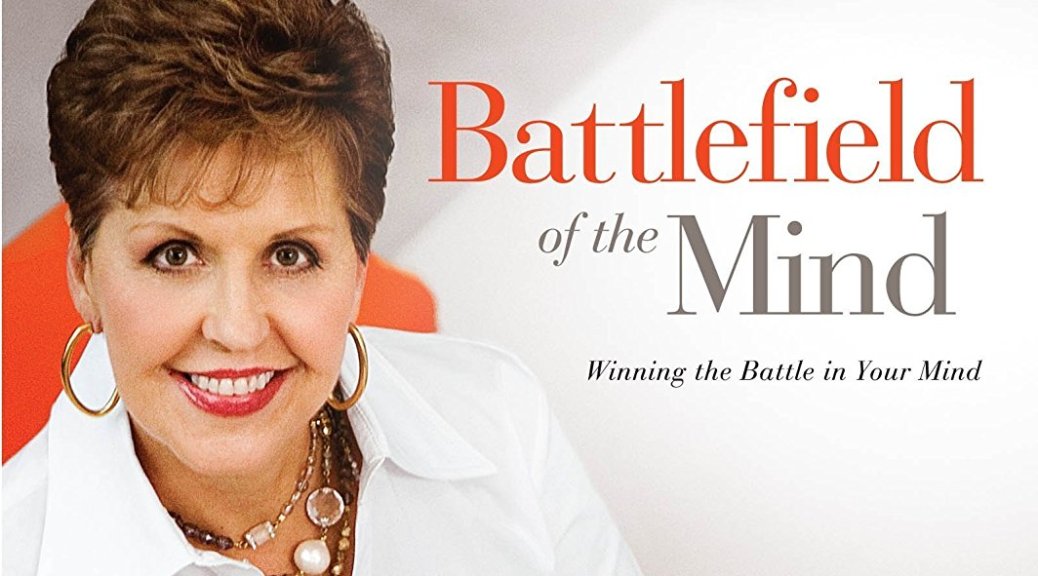
Adapted from the resource Battlefield Of The Mind Devotional – by Joyce Meyer

It doesn’t matter what kind of problem we have in our lives, we need self-control and discipline to gain and maintain the victory. I believe this is especially true with regard to our thought life and the battle for our mind. What begins in the mind eventually comes out of the mouth, and before we know it, we’re telling anyone who will listen how we feel. We have to discipline our mind, our mouth, our feelings, and our actions so that they are all in agreement with what the Word of God says.

Every quality of God that is in you and me, God Himself planted in us in the form of a seed the day we accepted Christ (see Colossians 2:10). Over time and through life’s experiences, the seeds of Christ’s character begin to grow and produce the fruit of His Spirit: love, joy, peace, patience, kindness, goodness, faithfulness, gentleness, and self-control (see Galatians 5:22–23).

I have found that it is virtually impossible to operate in any of the other eight fruit of the Spirit unless we are exercising self-control. How can you and I remain patient, for example, in the midst of an upsetting situation unless we exercise restraint? Or how can we walk in love and believe the best of someone after they have repeatedly hurt us unless we use the fruit of self-control?

As Christians, we have the fruit of the Spirit in us, but we must purposely choose to exercise them. Not choosing to exercise the fruit of the Spirit is what produces carnal Christians—those who are under the control of ordinary impulses and walk after the desires of the flesh (see 1 Corinthians 3:3). Whatever we exercise the most becomes the strongest.

Our thoughts and words are two areas in which the Holy Spirit is constantly prompting us to exercise self-control. The Bible says that “. . . as [a man] thinks in his heart, so is he,” and “out of the abundance (overflow) of the heart his mouth speaks” (Proverbs 23:7Luke 6:45 AMPC). Satan is constantly trying to get us to accept wrong thoughts about everything from God’s love for us to what terrible thing is going to happen to us next. Why? Because he knows that once we start accepting and believing his lies, it is just a matter of time until we begin to speak them out of our mouths. And when we speak wrong things, we open the door for wrong things to come into our lives (see Proverbs 18:20–21).

What if, instead of allowing our minds to go over all of the things that have hurt us, we would remind ourselves to think about all the good things God has brought into our lives? When we allow Satan to fill our minds with worry, anxiety, and doubt, we wear out our ability to make good decisions. Worry is also thankless by nature. I’ve noticed that people who worry rarely see much good in life. They talk about tragedy, failures, sickness, and loss. They seem unable to focus on the good things that they still have in life.

Try this. Each day, focus on the things God has done for you in the past. This will make it easier for you to expect good things in the future. As I wrote those words, I thought of the memorials mentioned in the Old Testament. Often the people stacked up heaps of stones as reminders that God had delivered them or appeared to them. As they looked backward and remembered, they were able to look forward and believe.

The psalmist wrote, “O my God, my life is cast down upon me [and I find the burden more than I can bear]; therefore will I [earnestly] remember You from the land of the Jordan [River] and the [summits of Mount] Hermon” (Psalm 42:6 AMPC). He was reminding himself of past victories. When he was having problems, he recalled God’s great work in the lives of the people.

When doubts try to sneak in, you can do what the psalmist did: You can look back and remember that God has always been with His people. All of us have had times when we wondered if we’d make it. But we did. So will you.

Prayer Starter: My great God, forgive me for allowing the little things of life to distract me and to take my thoughts away from You. Through Jesus Christ, help me always to remember that You are with me in the good times and in the bad times. In Jesus’ Name, Amen.


http://www.joycemeyer.org

Campus Crusade for Christ; Bill Bright – Real Freedom

“If the Son therefore shall make you free, you shall be free indeed” (John 8:36, KJV).

A dedicated, but defeated, young missionary returned from the field devastated because of his failure; first, to live the Christian life; and second, to introduce others to the Savior. He came to my office for counsel.

I explained to him that the Christian life is simply a matter of surrendering our lives to the risen Christ and appropriating the fullness of God’s Holy Spirit by faith. “Relax,” I said. “Let the Lord Jesus Christ live and love through you. Let Him seek and save the lost through your life.”

He became very impatient with me. “You dilute and distort the gospel,” he insisted. “It really costs to serve Jesus. I have made great sacrifices on the mission field. I have worked day and night. I struggled. It has cost me my health – though I am prepared to die for Christ – but you make it too easy, and I cannot accept what your are saying.” He left my office in anger.

Later he called for another appointment, saying, “I don’t agree with you, but there’s a quality in your life that I want for myself, and I’d like to talk further.”

Again I explained, “The just shall live by faith. All the supernatural resources of God are available to us by faith, not by our sacrifice and good works – though good works must follow faith, for faith without works is dead.”

As we talked, his attitude began to change. Then some days later I received a letter filled with praise, worship and adoration to God as he described the miracle that had taken place in his life. He had discovered the liberating truth of the principle that God’s grace is available to us by faith. The Christian life is supernatural. No individual is capable of living it apart from the Lord Jesus Christ. Jesus explains it in John 15:4,5: “As the branch cannot bear fruit of itself, except it abide in the vine, no more can ye, except ye abide in Me. I am the vine, ye are the branches…without Me ye can do nothing.”

It is His supernatural life, in all of its resurrection power, released through the ministry of the Holy Spirit, that enables us to live supernatural lives for the glory of God. Only then can we be free, for the Son alone can liberate us.

Bible Reading:Romans 8:1-6

TODAY’S ACTION POINT: By faith, I shall act upon my rights as a child of God and claim the supernatural power of the Son of God. Knowing that He has already set me free, through His death and resurrection, I am confident that He will enable me to experience that freedom, moment by moment, so that I may live the supernatural life to which I have been called.


http://www.cru.org

Max Lucado – Living in Your Sweet Spot


Listen to Today’s Devotion

Are you living in your sweet spot? Doing what you do well—what you’ve always loved to do? That last question trips up a lot of folks. God wouldn’t let me do what I like to do—would he?  Yes, he would. “God is working in you to help you want to do and be able to do what pleases him” (Philippians 2:13).   Scripture says, “Delight yourself in the LORD and he will give you the desires of your heart” (Psalm 37:4).

Your Father is too gracious to assign you to a life of misery. See your desires as gifts to heed rather than longings to suppress. What have you always done well and loved to do? Read your life backward. Re-relish your moments of success and satisfaction. In the merger of the two, you will find your uniqueness!

Read more Cure for the Common Life

For more inspirational messages please visit Max Lucado.

Home