Tag Archives: religion

Denison Forum – Transgender man’s baby could be first person without legal mother

My father was born on this day in 1924, one day after George H. W. Bush. While my father died in 1979, Mr. Bush is now the first US president to reach ninety-four years of age.

I turned sixty earlier this year. When my father and Mr. Bush were my age, it’s hard to imagine that they could have imagined a story like this one:

A transgender man recently gave birth to a baby in the UK. British law states that those who give birth to children can only be noted as mothers on official documents. The parent has complained of discrimination. As a result, the baby could become the first person born in England and Wales not to have a legal mother.

Two verses we need today

The twenty-first century has brought remarkable advances for advancing the Great Commission. Christians can use digital technology to reach people previously inaccessible to our mission. We can use social media to win the lost and technology to disciple believers.

Continue reading Denison Forum – Transgender man’s baby could be first person without legal mother

Charles Stanley – A Clear Conscience


Acts 24:10-16

When facing hard decisions, do you pay attention to your conscience? And is it necessarily wise to trust this inner voice?

God gave everyone an internal sense of right and wrong. In fact, reflecting His truth inwardly is one way that He reveals Himself to mankind. The conscience is a divine alarm system that warns us of oncoming danger or consequences. Its primary purpose is protection and guidance.

The problem, however, is that sin warps perception and can lead us astray. So it’s important to understand the difference between following your heart and allowing a clear conscience to help with decisions. To make a determination, ask, What is the greatest influence on my morality? If the world’s system of what is acceptable has infiltrated your heart, then your conscience cannot be trusted. But if you have allowed God’s Word to permeate and transform your thinking (Rom. 12:2), that inner voice is likely trustworthy.

The Holy Spirit, along with a divinely informed conscience, guides believers. In order to keep that internal guidance system healthy, we should continually meditate on Scripture. The Ten Commandments are a solid basis for morality, and we are wise to internalize them—especially the two Jesus highlighted: to love God above all else and to love others (Matt. 22:36-40).

What would you say has the greatest impact on your belief system? Is it the truth of Scripture? Or do the world’s standards of right and wrong infect your heart? Almighty God knows what is best for you, His child—and He provided a conscience to guide you toward wise decisions.

Bible in One Year: Psalm 8-14


http://www.intouch.org/

Our Daily Bread — Called by Name

Read: John 20:11–18 | Bible in a Year: Ezra 3–5; John 20

Jesus said to her, “Mary.” She turned toward him and cried out in Aramaic, “Rabboni!” John 20:16

Advertisers have concluded that the most attention-grabbing word that viewers react to is their own name. Thus a television channel in the UK has introduced personalized advertisements with their online streaming services.

We might enjoy hearing our name on television, but it doesn’t mean much without the intimacy that comes when someone who loves us says our name.

Mary Magdalene’s attention was arrested when, at the tomb where Jesus’s body had been laid after He was crucified on the cross, He spoke her name (John 20:16). With that single word, she turned in recognition to the Teacher whom she loved and followed, I imagine with a rush of disbelief and joy. The familiarity with which He spoke her name confirmed for her beyond a doubt that the One who’d known her perfectly was alive and not dead.

Although Mary shared a unique and special moment with Jesus, we too are personally loved by God. Jesus told Mary that He would ascend to His Father (v. 17), but He had also told His disciples that He would not leave them alone (John 14:15–18). God would send the Holy Spirit to live and dwell in His children (see Acts 2:1–13).

God’s story doesn’t change. Whether then or now, He knows those whom He loves (see John 10:14–15). He calls us by name.

Loving Father, living Jesus, comforting Holy Spirit, thank You that You know me completely, and that You love me unceasingly.

The God who created the cosmos also made you, and He calls you by name.

By Amy Boucher Pye

INSIGHT

God knows us, and He loves us. That’s easy to say but harder to believe sometimes—especially when we feel crippled by grief, when we feel completely alone.

This beautiful passage (John 20:11–18) can remind us that we can be honest with God. We don’t need to pretend to be happy. We can bring our pain to Him, exactly as it is. Tell Him why we’re crying (vv. 13, 15); tell Him when He seems far away. He loves us and wants us to run to Him in our pain (1 Peter 5:7). When we do, we can experience the tender love of our Father knowing and holding us in even those most painful places (John 20:16). And we can share with others how He brought joy even out of our weeping (v. 18).

Monica Brands


http://www.odb.org

Ravi Zacharias Ministry – The Great Dichotomy

Most scholars agree that the Enlightenment or “Age of Reason,” which began in the early seventeenth century, set up a great dichotomy that persists in modern time.(1) The great “dichotomy” of the Enlightenment entailed the separation of the public and private realms. The public realm was the world of ascertained by reason alone. Missiologist Lesslie Newbigin explains, “The thinkers of the Enlightenment spoke of their age as the age of reason…by which human beings could attain (at least in principle) to a complete understanding of, and thus a full mastery of, nature—of reality in all its forms. Reason, so understood, is sovereign in this enterprise.”(2) In the realm of reason, therefore, revelation from a divine realm was not needed. Human reason could search out and know all the facts about reality, and “no alleged divine revelation, no tradition however ancient, and no dogma however hallowed has the right to veto its exercise.”(3)

The realm of religious belief was now relegated to the realm of private value and private purpose. It wasn’t that the Enlightenment dichotomy cut out God. Rather, it created a distinction between “natural” religion—God’s existence and the moral laws known by all and demonstrable by reason—and “revealed” religion—doctrines as taught by the Bible and the church. The latter realm, dominant in the Middle Ages and the Reformation, came under increasing attack and was eventually relegated to private expression and personal feelings.

Fueled by scientific and philosophical discoveries, the view of the world as the venue of God’s providence and rule, shifted to the view that sovereign reason could discover all that was necessary to advance humanity toward its highest destiny. All of Christianity’s supernatural claims and all of its revelatory content were unnecessary in a world where the Creator had endowed human beings with enough reason to discern what was important simply through the study of the natural world. As such, the autonomous, rational human became the center of truth and knowledge.

What emerged from this dichotomy was the belief that the real world was a world of cause and effect, of material bodies guided solely by mathematically stable laws. Discovering the cause of something was to have explained it in its totality. There was no need to invoke any supernatural “purpose” or “design” as an explanation any longer.

Continue reading Ravi Zacharias Ministry – The Great Dichotomy

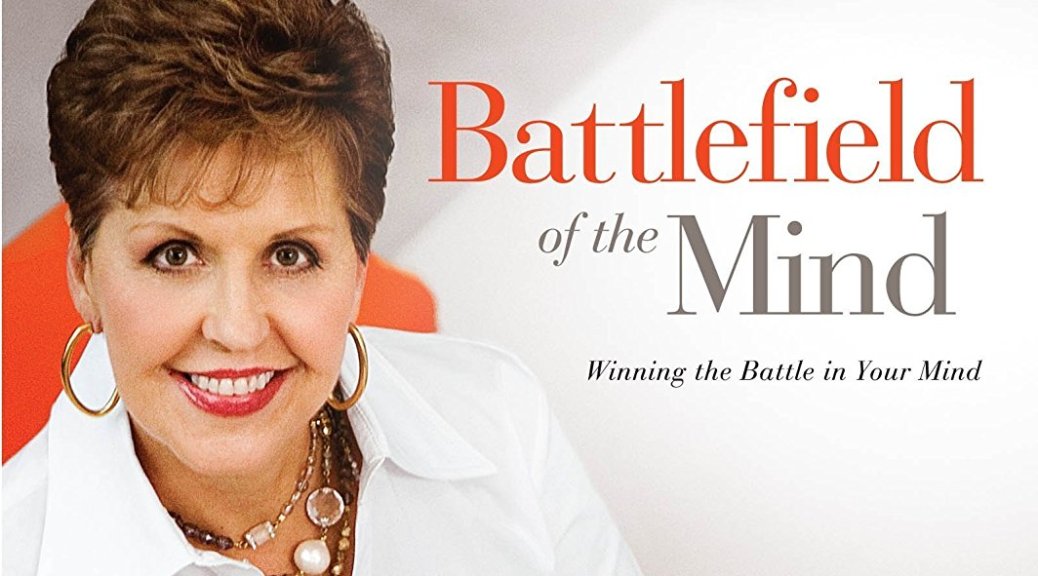
Joyce Meyer – Reminders


For God did not give us a spirit of timidity or cowardice or fear, but [He has given us a spirit] of power and of love and of sound judgment and personal discipline [abilities that result in a calm, well-balanced mind and self-control]. — 2 Timothy 1:7

Adapted from the resource Battlefield Of The Mind Devotional – by Joyce Meyer

It doesn’t matter what kind of problem we have in our lives, we need self-control and discipline to gain and maintain the victory. I believe this is especially true with regard to our thought life and the battle for our mind. What begins in the mind eventually comes out of the mouth, and before we know it, we’re telling anyone who will listen how we feel. We have to discipline our mind, our mouth, our feelings, and our actions so that they are all in agreement with what the Word of God says.

Every quality of God that is in you and me, God Himself planted in us in the form of a seed the day we accepted Christ (see Colossians 2:10). Over time and through life’s experiences, the seeds of Christ’s character begin to grow and produce the fruit of His Spirit: love, joy, peace, patience, kindness, goodness, faithfulness, gentleness, and self-control (see Galatians 5:22–23).

I have found that it is virtually impossible to operate in any of the other eight fruit of the Spirit unless we are exercising self-control. How can you and I remain patient, for example, in the midst of an upsetting situation unless we exercise restraint? Or how can we walk in love and believe the best of someone after they have repeatedly hurt us unless we use the fruit of self-control?

As Christians, we have the fruit of the Spirit in us, but we must purposely choose to exercise them. Not choosing to exercise the fruit of the Spirit is what produces carnal Christians—those who are under the control of ordinary impulses and walk after the desires of the flesh (see 1 Corinthians 3:3). Whatever we exercise the most becomes the strongest.

Our thoughts and words are two areas in which the Holy Spirit is constantly prompting us to exercise self-control. The Bible says that “. . . as [a man] thinks in his heart, so is he,” and “out of the abundance (overflow) of the heart his mouth speaks” (Proverbs 23:7Luke 6:45 AMPC). Satan is constantly trying to get us to accept wrong thoughts about everything from God’s love for us to what terrible thing is going to happen to us next. Why? Because he knows that once we start accepting and believing his lies, it is just a matter of time until we begin to speak them out of our mouths. And when we speak wrong things, we open the door for wrong things to come into our lives (see Proverbs 18:20–21).

What if, instead of allowing our minds to go over all of the things that have hurt us, we would remind ourselves to think about all the good things God has brought into our lives? When we allow Satan to fill our minds with worry, anxiety, and doubt, we wear out our ability to make good decisions. Worry is also thankless by nature. I’ve noticed that people who worry rarely see much good in life. They talk about tragedy, failures, sickness, and loss. They seem unable to focus on the good things that they still have in life.

Try this. Each day, focus on the things God has done for you in the past. This will make it easier for you to expect good things in the future. As I wrote those words, I thought of the memorials mentioned in the Old Testament. Often the people stacked up heaps of stones as reminders that God had delivered them or appeared to them. As they looked backward and remembered, they were able to look forward and believe.

The psalmist wrote, “O my God, my life is cast down upon me [and I find the burden more than I can bear]; therefore will I [earnestly] remember You from the land of the Jordan [River] and the [summits of Mount] Hermon” (Psalm 42:6 AMPC). He was reminding himself of past victories. When he was having problems, he recalled God’s great work in the lives of the people.

When doubts try to sneak in, you can do what the psalmist did: You can look back and remember that God has always been with His people. All of us have had times when we wondered if we’d make it. But we did. So will you.

Prayer Starter: My great God, forgive me for allowing the little things of life to distract me and to take my thoughts away from You. Through Jesus Christ, help me always to remember that You are with me in the good times and in the bad times. In Jesus’ Name, Amen.


http://www.joycemeyer.org

Campus Crusade for Christ; Bill Bright – Real Freedom

“If the Son therefore shall make you free, you shall be free indeed” (John 8:36, KJV).

A dedicated, but defeated, young missionary returned from the field devastated because of his failure; first, to live the Christian life; and second, to introduce others to the Savior. He came to my office for counsel.

I explained to him that the Christian life is simply a matter of surrendering our lives to the risen Christ and appropriating the fullness of God’s Holy Spirit by faith. “Relax,” I said. “Let the Lord Jesus Christ live and love through you. Let Him seek and save the lost through your life.”

He became very impatient with me. “You dilute and distort the gospel,” he insisted. “It really costs to serve Jesus. I have made great sacrifices on the mission field. I have worked day and night. I struggled. It has cost me my health – though I am prepared to die for Christ – but you make it too easy, and I cannot accept what your are saying.” He left my office in anger.

Later he called for another appointment, saying, “I don’t agree with you, but there’s a quality in your life that I want for myself, and I’d like to talk further.”

Again I explained, “The just shall live by faith. All the supernatural resources of God are available to us by faith, not by our sacrifice and good works – though good works must follow faith, for faith without works is dead.”

As we talked, his attitude began to change. Then some days later I received a letter filled with praise, worship and adoration to God as he described the miracle that had taken place in his life. He had discovered the liberating truth of the principle that God’s grace is available to us by faith. The Christian life is supernatural. No individual is capable of living it apart from the Lord Jesus Christ. Jesus explains it in John 15:4,5: “As the branch cannot bear fruit of itself, except it abide in the vine, no more can ye, except ye abide in Me. I am the vine, ye are the branches…without Me ye can do nothing.”

It is His supernatural life, in all of its resurrection power, released through the ministry of the Holy Spirit, that enables us to live supernatural lives for the glory of God. Only then can we be free, for the Son alone can liberate us.

Bible Reading:Romans 8:1-6

TODAY’S ACTION POINT: By faith, I shall act upon my rights as a child of God and claim the supernatural power of the Son of God. Knowing that He has already set me free, through His death and resurrection, I am confident that He will enable me to experience that freedom, moment by moment, so that I may live the supernatural life to which I have been called.


http://www.cru.org

Max Lucado – Living in Your Sweet Spot


Listen to Today’s Devotion

Are you living in your sweet spot? Doing what you do well—what you’ve always loved to do? That last question trips up a lot of folks. God wouldn’t let me do what I like to do—would he?  Yes, he would. “God is working in you to help you want to do and be able to do what pleases him” (Philippians 2:13).   Scripture says, “Delight yourself in the LORD and he will give you the desires of your heart” (Psalm 37:4).

Your Father is too gracious to assign you to a life of misery. See your desires as gifts to heed rather than longings to suppress. What have you always done well and loved to do? Read your life backward. Re-relish your moments of success and satisfaction. In the merger of the two, you will find your uniqueness!

Read more Cure for the Common Life

For more inspirational messages please visit Max Lucado.

Home

Denison Forum – My reflections on the Singapore Summit

“Nice to meet you, Mr. President.” With these words, Kim Jong Un shook hands with Donald Trump as the two made history in Singapore.

Before the summit, the sitting heads of the United States and the Democratic People’s Republic of Korea had never met. The summit began last night at 9 p.m. ET (9 a.m. Tuesday morning in Singapore) and lasted for four hours. The two met before a row of alternating US and North Korean flags, then sat down for a thirty-eight-minute, one-on-one meeting.

Their top advisers then joined them for another two hours of talks. The delegations concluded by sharing lunch together. Afterward, Mr. Kim announced, “The world will see a major change.”

“We’re going to have a great discussion”

Mr. Trump told reporters at the outset of the summit, “We’re going to have a great discussion. It’s my honor and we will have a terrific relationship, I have no doubt.” Mr. Kim added that “old prejudices and practices worked as obstacles in our way forward, but we overcame all of them and we are here today.”

The two signed a “joint statement” in which “President Trump committed to provide security guarantees to the DPRK, and Chairman Kim Jong Un reaffirmed his firm and unwavering commitment to complete denuclearization of the Korean Peninsula.”

Continue reading Denison Forum – My reflections on the Singapore Summit

Charles Stanley – No Longer I, But Christ


Galatians 2:20

Hudson Taylor was a missionary in China during the mid-1800s. At one point, he felt overwhelmed with financial concerns, the responsibilities of running a mission, and the ever-increasing pile of mail awaiting his attention. All the letters he wrote to friends and family were filled with defeat and discouragement.

Seeing his need, a missionary friend wrote back to him, asking, “Hudson, when you think about Jesus, does He have a furrowed brow? Is He worried and anxious because He doesn’t know what’s going to happen next or if there will be enough money?” Then he added, “When your life becomes Jesus’ life, there’s no need to worry, because it will no longer be Hudson who bears the burdens but Jesus, and He’ll never be swamped by problems.”

God changed Hudson Taylor in that moment. His circumstances were the same; in fact, the problems became greater, but there was a difference in Taylor’s response. Whereas before he was fretting and wrestling, now he was resting in the Lord and trusting with a calm, quiet, and peaceful spirit. Those who knew him could discern the dramatic change.

Sometimes we think that being crucified with Christ is all about what we give up—practicing self-denial and saying no to sin, temptations, and worldly pleasures. But it also includes living in the power of His resurrected life. Jesus Christ makes His abode in us, empowering us to overcome sin and live righteously. But He also carries our burdens and encourages our spirits to trust Him. Just as we are saved by faith, so also we live by faith, trusting the Lord day by day with all our needs and concerns.

Bible in One Year: Psalm 1-7


http://www.intouch.org/

Our Daily Bread — Advice from My Father


Read: Proverbs 3:1–7 | Bible in a Year: Ezra 1–2; John 19:23–42

Trust in the Lord with all your heart and lean not on your own understanding. Proverbs 3:5

After being laid off from an editorial job, I prayed, asking for God to help me find a new one. But when weeks went by and nothing came of my attempts at networking and filling out applications, I began to pout. “Don’t You know how important it is that I have a job?” I asked God, my arms folded in protest at my seemingly unanswered prayer.

When I talked to my father, who had often reminded me about believing God’s promises, about my job situation, he said, “I want you to get to the point where you trust what God says.”

My father’s advice reminds me of Proverbs 3, which includes wise advice from a parent to a beloved child. This familiar passage was especially applicable to my situation: “Trust in the Lord with all your heart and lean not on your own understanding; in all your ways submit to him, and he will make your paths straight” (Proverbs 3:5–6). To “make . . . paths straight” means God will guide us toward His goals for our growth. His ultimate goal is that I become more like Him.

This does not mean that the paths He chooses will be easy. But I can choose to trust that His direction and timing are ultimately for my good.

Are you waiting on God for an answer? Choose to draw near to Him and trust that He will guide you.

Lord, thank You for guiding and caring for us every step of the way. Help us to trust in You daily.

Your Father in heaven knows what’s best for you.

By Linda Washington

INSIGHT

The first nine chapters of Proverbs don’t follow the same format (pithy sayings; poetry couplets) that the rest of the book follows. The beginning chapters are a father’s encouragement to his son. The father tells his son of the benefits of wisdom, of its ability to make life more pleasant and fulfilling. Wisdom and folly are personified and invite the young man to pursue them. But why is this important? It seems obvious that wisdom is better than folly, so why go to such lengths to convince a child of the need to pursue wisdom?

The answer is experiential. You see, folly is the easier of the two, the more natural. As we read chapters 10–31, we see what the better choice is. But folly is far simpler to choose—it seems hardwired into us. Whether it’s a harsh word, a selfish action, or self-indulgence, folly is always ready to embrace us. That’s why the father takes such time to encourage his son to pursue wisdom. Wisdom isn’t restricted to big decisions, however; we need it for every action we take and every word we speak.

How can we pursue wisdom today?

J.R. Hudberg


http://www.odb.org

Ravi Zacharias Ministry – A Better Imagination


Whether compelling the visions of a child or inspiring music or architecture, the power of the imagination is often clear:

O hark, O hear! How thin and clear,

And thinner, clearer, farther going!

O sweet and far from cliff and scar

The horns of Elfland faintly blowing.(1)

But what of the mere presence of the imagination? “I do not think the resemblance between the Christian and the merely imaginative experience is accidental,” wrote Lewis. “I think that all things, in their way, reflect heavenly truth, the imagination not least.”(2) Certainly, this taste of a richer fare was sensed in the formative imaginations at which Lewis supped long before he knew he was starving for their Host. Writes Lewis:

“Chesterton had more sense than all the other moderns put together; bating, of course, his Christianity. Johnson was one of the few authors whom I felt I could trust utterly; curiously enough, he had the same kink. Spenser and Milton by a strange coincidence had it too. Even among ancient authors the same paradox was to be found. The most religious (Plato, Aeschylus, Virgil) were clearly those on whom I could really feed. On the other hand, those writers who did not suffer from religion and with whom in theory my sympathy ought to have been complete—Shaw and Wells and Mill and Gibbon and Voltaire—all seemed a little thin; what as boys we called ‘tinny.’ It wasn’t that I didn’t like them. They were all (especially Gibbon) entertaining; but hardly more. There seemed to be no depth in them. They were too simple. The roughness and density of life did not appear in their books.”(3)

And while Lewis would come to see that this “lower life of the imagination is not a beginning of, nor a step toward, the higher life of the spirit,” he is equally certain that God in God’s mercy can profoundly make it such a beginning.(4) My own encounter of the great imagination of C.S. Lewis is similar to a testimony given at his funeral, namely, that “his real power was not proof; it was depiction. There lived in his writings a Christian universe that could be both thought and felt, in which he was at home and in which he made his reader at home.”(5) I believe I probably first loved God as an untame Lion, not because the God I wished for was kinder than the God who is, but because I did not yet see that my deficient vision of God was the vision that needed a better imagination. As Lewis later wrote of his intense love of all Norse mythology, “[A]t the time, Asgard and the Valkyries seemed to me incomparably more important than anything else in my experience…More shockingly, they seemed much more important than my steadily growing doubts about Christianity. This may have been—in part, no doubt was—penal blindness; yet that might not be the whole story. If the Northernness seemed then a bigger thing than my religion, that may partly have been because my attitude toward it contained elements which my religion ought to have contained and did not.”(6)

Even so, in moments of moral crisis, we do not pause to ask what Jane Erye would do, I once heard a writer say. She had referenced the Brian Nichol’s story—the gunman who went on a shooting spree in Atlanta and ended up holding a woman hostage in her apartment where she read to him from The Purpose Driven Life and eventually convinced him to turn himself in. She then asked if this story would have turned out the same if the young girl had read to him from Moby Dick or War and Peace or any of the great classics of history. Her point was clear: the influence of art and imagination is usually not in the thick of things, but on the margins of culture; nor it is always clear and obvious, but often dense and unsettling. And yet there are quite arguably characters and stories that indeed become of moral significance, pulling us into worlds that call for attention, compassion, and consideration. Long before I had any idea about the word “allegory” or the concept of good or bad literature, Narnian kings, talking beavers, and the Queen of Glome began appearing in my dreams, beckoning me to another place. In the aftermath of death and subsequent disappointment over the miracle we did not get, it was Aslan’s empathetic tear for the grieving Digory that came to mind when all seemed lost. For Lewis, it was the bright shadow coming out of a George MacDonald book that found him mercifully in the margins. “In the depth of my disgraces, in the then invincible ignorance of my intellect, all this was given me without asking, even without consent. That night my imagination was, in a certain sense, baptized; the rest of me, not unnaturally, took longer. I had not the faintest notion what I had let myself in for by buying Phantastes.”(6) But the Spirit no doubt mercifully did.

It is quite true that a young materialist or pessimist, atheist or agnostic who wishes to stay this way cannot be too careful in choosing what to read. God is unscrupulous, as Lewis attests, willing to use our own imaginations against us, our own pens to probe the wounds. If imagination is not the property of materialism, but the playground of heaven, it is nonetheless not the thing itself. But the hopeful signs of God’s own compelling imagination are everywhere—beautiful and terrible, inviting and transforming. It is the encounter with the Gate, not the signs along the way, that transforms the entire journey. It is said that Lewis became more like himself when he finally kneeled and admitted that God was God—”as though the key to his own hidden and locked-away personality was given to him.”(7) Everything is intensified—his loves, his responses, Jack himself—as the one brought in kicking and screaming discovered in Christ and his kingdom the world of Joy he had only before heard feebly. The faint horns of Elfland give way to the resounding glory of the creator and wonders beyond our imagining.

Jill Carattini is managing editor of A Slice of Infinity at Ravi Zacharias International Ministries in Atlanta, Georgia.

(1) Lewis, C. S. Lewis, Surprised by Joy: The Shape of My Early Life (Orlando: Houghton Mifflin Harcourt, 1955), 167.

(2) Lewis, 213-214.

(3) Lewis, 167.

(4) Alan Jacobs, The Narnian: The Life and Imagination of C.S. Lewis (San Francisco: Harper, 2005), 312.

(5) Lewis, 76.

(6) Lewis, 181.

(7) Jacobs, 131.


http://www.rzim.org/

Joyce Meyer – It’s Time to Stretch


For we walk by faith…not by sight…. — 2 Corinthians 5:7

Adapted from the resource Wake Up To The Word Devotional – by Joyce Meyer

Stretch means “extended; exerted to the utmost.” When you follow God into something new in your life, you may feel stretched.

Perhaps you receive a job promotion, and you know you don’t have all the natural skills and knowledge you need to do the new job well. Then you become worried because you think you’re in over your head. The job may be over your head, but it’s not bigger than God. If He leads you into it, He will help you fulfill the responsibilities that go with it. God’s power and presence enable us to do things we can’t do on our own.

It’s important to remember God is on your side as you go into new situations, because fear and doubt will always be lying in wait to try to keep you from following Him. Don’t let those things hold you back. Remember that God is with you and He’s bigger than any problem you may face. Don’t be afraid to stretch your faith because it will give you greater capacity to fulfill your God-given potential.

Prayer Starter: Father, help me to lean on You and walk forward with faith when I feel “over my head.” Help me to stretch and be all that I can be in You. In Jesus’ Name, Amen.


http://www.joycemeyer.org

Campus Crusade for Christ; Bill Bright – How to Save Your Life


“And He said to them all, If any man will come after Me, let him deny himself, and take up his cross daily, and follow Me. For whosoever will save his life shall lose it: but whosoever will lose his life for My sake, the same shall save it” (Luke 9:23,24, KJV).

Martin Luther once told the maidens and housewives of Germany that in scrubbing floors and going about their household duties they were accomplishing just as great a work in the sight of heaven as the monks and priests with their penances and holy offices.

In the 15th century, a woman – Margery Baxter – had said the same thing couched in different terms.

“If ye desire to see the true cross of Christ,” she said, “I will show it to you at home in your own house.”

Stretching out her arms, she continued, “This is the true cross of Christ, thou mightest and mayest behold and worship in thine own house. Therefore, it is but vain to run to the church to worship dead crosses.”

Her message was plain: holiness is in our daily service.

Your life and mine are worshiping Christ today to the degree that we practice the presence of God in every minute detail of our lives throughout the day. We are taking up our cross when we shine for Jesus just where we are, obediently serving Him and sharing His good news with others.

If you and I want to save our lives, we do well to lose them in obedient service to the Lord Jesus Christ, allowing His indwelling Holy Spirit to work in us and through us.

Bible Reading:John 12:23-26

TODAY’S ACTION POINT: I will take up my cross today – shining just where He puts me at this point in my life.


http://www.cru.org

Max Lucado – The Child is Father of the Man


Listen to Today’s Devotion

“The child is the father of the man,” wrote William Wordsworth. Want direction for the future? Then read your life backward.

Job placement experts asked over seventy thousand people this question: “What things have you done in life that you enjoyed doing and believe you did well?” In every case people reverted to the same pattern of functioning. Or to put it succinctly, our past presents our future.

The Bible says,  “it is God himself who has made us what we are and given us new lives from Christ Jesus; and long ages ago he planned that we should spend these lives in helping others” (Ephesians 2:10). You are heaven’s custom design. What God said about Jeremiah, he said about you: “Before you were born, I set you apart for a special work!” (Jeremiah 1:5 NCV).

Read more Cure for the Common Life

For more inspirational messages please visit Max Lucado.

Home

Denison Forum – The Trump–Kim summit: 2 biblical imperatives

The much-anticipated summit between President Trump and Kim Jong Un is dominating global headlines this morning. The summit will be the first meeting between a sitting US president and a head of North Korea.

Their meeting is scheduled to begin at 9 p.m. ET, which is 9 a.m. Tuesday in Singapore. It will take place at the Capella Hotel on the resort island of Sentosa, off Singapore’s southern coast. More than a thousand journalists from around the world have converged on Singapore.

What will happen at the summit?

BBC News reports this morning that Mr. Kim wants to focus on rebuilding the North Korean economy and thus seeks sanctions relief and international investment. The Trump administration has made clear its focus on denuclearizing the Korean Peninsula, with a timeline and technical details for dismantling weapons and weapons-making capabilities.

The two leaders could announce an agreement to work toward the “common goal” of removing nuclear weapons, mirroring the announcement that followed Mr. Kim’s meeting with South Korea’s president in April. It is also possible that they will sign documents officially ending the Korean War, which ceased in 1953 with an armistice but no peace treaty.

Continue reading Denison Forum – The Trump–Kim summit: 2 biblical imperatives

Charles Stanley –Responding to Disappointment


Matthew 1:18-25

To find examples of wise, godly reactions to disappointment, you’re more likely to turn to Psalms than to Matthew. But the very first chapter in the New Testament tells the story of an upright man’s reaction to painful and disheartening news.

Joseph—Jesus’ earthly father—was a righteous person. A godly man wants a wife who shares his desire to honor and obey the Lord, and Scripture indicates that Mary was exactly that sort of woman (Luke 1:45-55). So imagine how stunned Joseph must have been when Mary returned from a long visit with her relative Elizabeth and told him that she was pregnant. Moreover, she was claiming no man had touched her.

No matter how Joseph looked at the situation, it appeared grim. And yet Matthew 1:20 says that he “considered”—in other words, he sought a wise, righteous response. God entered Joseph’s life in a dramatic way to confirm Mary’s story and put a stop to his plans for a quiet annulment.

The Lord turned Joseph’s mourning into great purpose. Mary had told the truth—strange and startling though it was. The couple would bear the intense public censure of a too-soon pregnancy, but Joseph stopped thinking about what others would say. God had sacred work for him: to raise the Messiah, alongside a faithful woman.

Followers of Christ should seek a godly response to disappointments they face. Since the Lord always has a plan, the wisest reaction is to anticipate the good He can do and await His timing. God certainly blessed Joseph for his willingness to seek God’s kingdom first (Matt. 6:33).

Bible in One Year: Job 39-42


http://www.intouch.org/

Our Daily Bread — A Warm Welcome


Read: 1 Peter 4:7–11 | Bible in a Year: 2 Chronicles 34–36; John 19:1–22

Offer hospitality to one another without grumbling. 1 Peter 4:9

“Who will hug everybody?”

That was one of the questions our friend Steve asked after he got the news that he had cancer and realized he would be away from our church for a while. Steve is the kind of man who makes everyone feel welcome—with a friendly greeting, a warm handshake, and even a “holy hug” for some—to adapt an application from Romans 16:16, which says, “Greet one another with a holy kiss.”

And now, as we pray for Steve that God will heal him, he is concerned that as he goes through surgery and treatment—and is away from our church for a time—we will miss out on those welcoming greetings.

Perhaps not all of us are cut out to greet one another as openly as Steve does, but his example of caring for people is a good reminder to us. Notice that Peter says to “offer hospitality to one another without grumbling,” or in a way that centers on love (1 Peter 4:9; see Philippians 2:14). While first-century hospitality included offering accommodations to travelers—even that always starts with a welcoming greeting.

As we interact with others in love, whether with a hug or just a friendly smile, we do so “that in all things God may be praised through Jesus Christ” (1 Peter 4:11).

Lord, help us to represent You to others. Guide us to show hospitality in a way that will show others Your love.

When we practice hospitality, we share God’s goodness.

By Dave Branon

INSIGHT

In 1 Peter 4, the apostle challenges the church to hospitality then reinforces that challenge with a call to service (vv. 10–11). In verse 10 he reminds believers that we’ve received gifts for that very purpose, and as we utilize those gifts in serving others we become expressions of God’s grace. It appears from these statements that Peter is giving his readers a glimpse into the realm of spiritual gifts about which Paul wrote in Romans 12 and 1 Corinthians 12.

Spiritual gifts are the Holy Spirit’s provision for equipping followers of Jesus to help one another (1 Corinthians 12:7). While Paul offers a more extended list of these gifts, Peter compresses them into two basic categories: speaking gifts and serving gifts (1 Peter 4:11). Both provide support and resources for the kind of hospitality described in today’s devotional. As we encourage people with the Scriptures and help them by acts of service, the family of God is strengthened and the hurting are helped.

For more on spiritual service, check out the free download, The Church We Need.

Bill Crowder


http://www.odb.org

Wisdom Hunters – Accurate Information… 


He [Apollos] was a learned man, with a thorough knowledge of the Scriptures. He had been instructed in the way of the Lord, and he spoke with great fervor and taught about Jesus accurately, though he knew only the baptism of John.  Acts 18:24–25

Accurate information is an expression of integrity. It is the ability to gather all the pertinent facts and communicate them clearly to all necessary parties. It is when we get in a hurry that we distort data and forget details. We need to slow down and do an accuracy audit of our information. Are the dates right? Are the details precise? Does everyone affected understand? Accurate information and comprehension create creditability.

Accuracy begins by being properly schooled and instructed, so you become a subject matter expert in the material you manage. Apollos was a student of Scripture.  He examined the mind and heart of God expressed in Holy Writ, and he allowed others to instruct him in the way of the Lord. He rightly divided the truth because he understood and applied the truth.

“Be diligent to present yourself approved to God, a worker who does not need to be ashamed, rightly dividing the word of truth” (2 Timothy 2:15 nkjv).

Have you gone to school on the subject you are seeking to master? Do you have a mentor to instruct you and hold you accountable? Excellent work requires you to be an apostle of accurate information. As you learn to love the details that matter, your work will matter more. Accurate information is extremely valuable because it is the foundation on which assumptions are built. Does your process protect you from displaying inaccurate information?

Confidence comes when there is clarity of facts and comprehension of the content. Doubt will dog you as long as the truth is tentative and details are left unaccounted for. It is better to work thoroughly on one project and get it right than to engage in a flurry of activity with only futility as its outcome.

“You must inquire, probe and investigate it thoroughly” (Deuteronomy 13:14).

Prayer: Heavenly Father, help me not jump to conclusions and instead give me a patient heart to gather and understand accurate information before I make a decision, in Jesus’ name, amen.

Application: Do I take the proper time to gather, comprehend, and communicate accurate information? Do I steward data precisely and accurately?

Related Readings: Deuteronomy 25:15; Psalm 119:140; Acts 22:3; 2 Timothy 3:17

Worship Resource: 4-minute music video- Lacey Strum: Justice and Mercy

Taken from Seeking Daily the Heart of God v.2


Home

Joyce Meyer – Four Principles for Successful Daily Living


For let him who wants to enjoy life and see good days [good—whether apparent or not] keep his tongue free from evil and his lips from guile (treachery, deceit). Let him turn away from wickedness and shun it, and let him do right. Let him search for peace…and seek it eagerly….  — 1 Peter 3:10-11 (AMPC)

Adapted from the resource Trusting God Day by Day Devotional – by Joyce Meyer

I enjoy just reading over this passage and soaking up the power from its principles for successful daily living. It gives four specific principles for those who want to enjoy life:

  1. Keep your tongue free from evil.God’s Word states clearly, the power of life and death is in the mouth. We can bring blessing or misery into our lives with our words. When we speak rashly we often get into arguments, so choose your words carefully.
  2. Turn away from wickedness. We must take action to remove ourselves from wickedness or from a wicked environment. The action we must take could mean altering our friendships; it could even mean loneliness for a period of time. But you can always trust God to be with you.
  3. Do right.The decision to do right must follow the decision to stop doing wrong. Both are definite choices. Repentance is twofold; it requires turning awayfrom sin and turning to righteousness.
  4. Search for peace. Notice that we must search for it, pursue it, and go after it. We cannot merely desirepeace without any accompanying action, but instead we must desirepeace with action. We need to search for peace in our relationship with God and with others.

When I started living by these principles, not only did my relationships improve, but so did my health, my attitude, and all areas of my life. The same will be true for you.

Prayer Starter: Father, Your Word has all of the answers for a great life. Help me to put Your principles into practice, today and every day. I can’t do it alone—I can only do it through Your strength. In Jesus’ Name, Amen.


http://www.joycemeyer.org

Campus Crusade for Christ; Bill Bright – You’ve Already Won


“Dear young friends, you belong to God and have already won your fight with those who are against Christ, because there is someone in your hearts who is stronger than any evil teacher in this wicked world” (1 John 4:4).

“I am afraid of Satan,” a young minister once told me.

“You should be afraid of Satan,” I responded, “if you insist on controlling your own life. But not if you are willing to let Christ control your life. The Bible says, ‘Greater is He who is in you than he who is in the world.'”

My friend lived in a city where one of the largest zoos in the world was located.

“What do you do with lions in your city?” I asked.

“We keep them in cages,” he replied.

“You can visit the lion in its cage at the zoo,” I explained, “and it cannot hurt you, even if you are close to the cage. But stay out of that cage, or the lion will make mincemeat out of you.”

Satan is in a “cage.” He was defeated 2,000 years ago when Christ died on the cross for our sins. Victory is nowours. We do not look forward to victory, but we move from victory, the victory of the cross.

Satan has no power except that which God allows him to have. Do not be afraid of him, but do stay away from him. Avoid his every effort to tempt and mislead you. Remember, that choice is up to you.

Bible Reading:I John 2:1-6

TODAY’S ACTION POINT: I will with God’s help, stay out of Satan’s “cage,” choosing rather to enlist God’s indwelling Holy Spirit to fight for me in the supernatural battle against the satanic forces which surround me.


http://www.cru.org