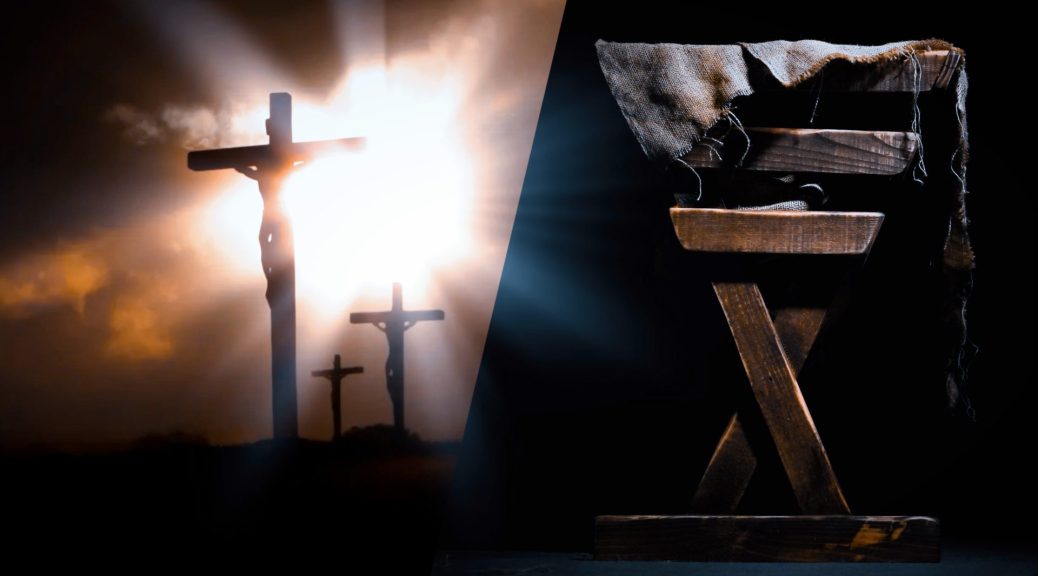
The Jesus Of Bible Prophecy: Christ Is No Longer A Little Baby Or Suffering Servant

Should you be one of the increasingly few who still remember what the real “reason for the season” is this Christmas, then you can’t help but think about Jesus. How, though, in your mind’s eye, do you actually picture Him?

The Christmas Jesus

Because the Christmas holiday celebrates the Savior’s birth, when picturing Jesus, one naturally sees a baby. Popular nativity scenes portray Luke’s description of Jesus as a tiny babe swaddled in strips of cloth and lying in an animal trough. His parents, Mary and Joseph, gaze down adoringly. Shepherds and wise men gape in amazement from their perches along stone walls. The heavenly host flies above majestically singing, “Glory to God in the highest, and on earth peace, goodwill toward men!”

While the angels add a sense of the divine to the Nativity Story, and Hollywood adds the touch of a beam of Bethlehem starlight spotlighting the little family, for the most part, the scene is rather pastoral. We see a peasant family sitting in the hay among the barnyard animals in some sort of cave. It is meant to be a very humble scene.

The Easter Jesus

Because Christmastime is also celebrated by cultural Christians and even non-Christians, the humble imagery of the baby Jesus remains in the mind’s eye. That is, until Easter. Then Jesus is portrayed altogether differently. Now He’s all grown up, fully bearded, yet frail and emaciated. His lithe body suffers from beatings and is covered in lash marks. He is nailed naked to a tree where he hangs limply, bleeding. And there Jesus remains on that cross in the mind’s eye, at least until Christmas returns to reset the mental image of Jesus back into a tiny baby again. And the circle continues.

The Popular Jesus

One of the most popular scenes from the movie Talladega Nights is when the lead character, race car driver Ricky Bobby (played by Will Ferrell), says grace with his family over a feast of fast food. He begins each praise and prayer request with “Dear Lord Baby Jesus” until his wife, Carley, impatiently interrupts with a, “Hey, you know, Sweetie, Jesus did grow up. You don’t always have to call him ‘baby.’” Incensed, Ricky responds with, “Well, I like the Christmas Jesus best, and I’m saying grace. When you say grace, you can say it to grown-up Jesus, or teenage Jesus, or bearded Jesus, or whoever you want.” Even Ricky’s father-in-law, Chip, chimes in with, “He was a man! He had a beard!” From there, the conversation degenerates as each family member describes the “Jesus” they prefer: a ninja fighting off evil samurai, a guy sporting giant eagle’s wings, or a cool fellow singing lead vocals in a band, and so on.

Christians watching this movie tend to squirm, dumbfounded over whether this scene balances closer to blasphemy or comedy. And yet, one cannot help but come away with a profound revelation: most people have created their own “Jesus.”

People see Jesus in the only way they’ve ever encountered Him, and often that’s only during Christmas and Easter. Therefore, Jesus remains to most people as either a helpless baby or a dying man.

The Prophetic Jesus

The beauty and majesty of God’s Prophetic Word introduce us to a third image of Jesus that few, if any, encounter because they never study Bible prophecy. In the prophecies concerning Jesus’ Second Coming, human frailty is stripped away, revealing Christ’s true glory—a divinity that the Apostles could only glimpse at the Transfiguration. Christ’s true form stunned James and John into silence and Peter into babbling. The Apostles had witnessed Jesus in His eternal, glorified state!

In Revelation 1:8, Jesus introduces Himself with the self-identification, “I am the Alpha and the Omega, the Beginning and the End… the Almighty,” breaking out of the box of babyhood with His claim to agelessness and ultimate power. Revelation 1 continues to describe Jesus as “One like the Son of Man,” so only resembling frail humanity in appearance. Clothed with a garment and girded with a golden band, His hair gleams bright white as wool, and His eyes blaze like flames. Jesus’ feet glow like brass refined in a furnace, and His voice thunders with the sound of many waters. Jesus’ holiness blinds with the strength of the sun. The Jesus whom the elderly apostle John encountered caused him to fall at Jesus’ feet, as if he were a dead man.

Jump ahead to Revelation 19, and you’ll stand in awe of the description of Jesus as He triumphantly returns to earth as a warrior king, dispensing righteousness, judgment, and waging total war against Satan’s forces. Jesus bursts out of the heavens riding His white war charger as the armies of Heaven trail endlessly behind Him. Jesus’ eyes blaze like fire, atop His head sit many crowns, His robe is dipped in blood, and He strikes the enemy nations dead with the sword of the Word protruding out of His mouth. Emblazoned on Jesus’ thigh is the title: “King of kings and Lord of lords.”

Often, it is more palatable to paint Jesus inside the box of one’s mind as a little baby or suffering servant, but is that the genuine Jesus? In part, yes, for they were as much a part of Jesus as our own baby, childhood, and teenage selves once were to us then, but are no longer.

Jesus eternal is the Jesus of Bible prophecy. So stand in awe of your Savior this Christmas season, and all year long!



Source: The Jesus Of Bible Prophecy: Christ Is No Longer A Little Baby Or Suffering Servant – Harbinger’s Daily

Our Daily Bread – From Fright to Delight


Do not be afraid. I bring you good news that will cause great joy for all the people. Luke 2:10

Today’s Scripture

Luke 2:8-14

Listen to Today’s Devotional

Apple LinkSpotify Link

Today’s Devotional

Many historians believe the first-ever radio broadcast of music and speech was heard by radio operators on US Navy and other ships in the Atlantic on Christmas Eve, 1906. Instead of the usual beeps and pulses to transmit codes, they listened to Reginald Fessenden play a violin solo of the Christmas carol “O, Holy Night.” Fessenden closed his broadcast by echoing the angels’ praise: “Glory to God in the highest heaven!” (Luke 2:14). The listeners must have been startled by the evocative music and statement of praise over the birth of Jesus.

The first people surprised by Jesus’ birth were the shepherds who’d been keeping to their usual business of watching their sheep at night (Luke 2:8). Then an angel appeared, shining with the glory of God and giving the shepherds a fright (v. 9). The angel urged them not to be afraid and declared: “I bring you good news that will cause great joy for all the people. Today in the town of David a Savior has been born to you; he is the Messiah, the Lord” (vv. 10-11). The shepherds left their sheep to investigate the angel’s words and found the baby lying in a manger, just as they had been told (vv. 16, 20).

The shepherds accepted this good news of great joy. May we too rejoice and share the wonders of Jesus’ birth and life.

Reflect & Pray

How do you think you would have reacted to the news the angel proclaimed? Why do you think God chose to reveal His Son’s birth to them?


Dear Jesus, Your birth was revealed to the shepherds, for You don’t despise anyone, and You came to earth to love and save me.


Discover more about the Christmas story.


Today’s Insights

In Luke 1, we read Mary’s song in which she “glorifies . . . God my Savior” (vv. 46-47). She includes herself by referring to “the humble state of [God’s] servant” (v. 48) and notes how God “has brought down rulers from their thrones but has lifted up the humble” (v. 52). In Luke 2, God lifts up the humble when the angel appears first to shepherds with the good news of Jesus’ birth (vv. 9-12). Shepherds lived “on the margins,” rendered ceremonially unclean by a job whose requirements kept them outside the city limits and outside civic norms. Shepherds found it difficult even to participate in the religious festivals and sacrifices. Yet they were the chosen eyewitnesses for the angelic celebration on a Bethlehem hillside (vv. 13-14). The angel spoke of “great joy for all the people” (v. 10)—shepherds included. We’re included too. May we celebrate the wonder of Christ’s birth.


http://www.odb.org

Joyce Meyer – Persevere in Right Thinking


For the rest, my brethren, delight yourselves in the Lord and continue to rejoice that you are in Him. To keep writing to you [over and over] of the same things is not irksome to me, and it is [a precaution] for your safety.

Philippians 3:1 (AMPC)

We must consistently choose right thinking, right words, and right action. It’s not what you choose to do right one time that’s going to change your life. It’s doing it over and over and over. I frequently tell people, “When you get so tired of doing it you think you can’t stand it, you do it again and again and again and again.” Persistence always pays off, and the Bible says that the diligent person will be successful. Don’t ever give up!

If you’re the kind of person who refuses to give up, I can assure you that you will get your breakthrough and enjoy a lot of victory in your life.

Prayer of the Day: Lord, give me strength to stay persistent in doing what’s right, even when I feel tired. Help me trust that my diligence will bring Your blessing and victory, amen.


http://www.joycemeyer.org

Denison Forum – Christmas church, mental health, and finding your purpose


Will you observe Christmas tomorrow? If so, according to a new Gallup survey, you’re in the majority: 88 percent of Americans will join you.

Will you attend church services today or tomorrow? If so, you’re in the minority: only 47 percent of Americans will join you, down from 64 percent in 2010.

Now consider two other recent Gallup headlines: “US Mental Health Ratings Continue to Worsen” and “Americans End Year in Gloomy Mood.”

I believe declining church attendance is related to declining well-being in a way that might surprise you, but will—I hope—greatly encourage you as well.

 “To run where the brave dare not go”

A recent article by clinical psychology professor Ross White advises, “Your purpose isn’t something to find, it’s something you form.” He reports that online searches for the phrase “find your purpose” have risen by more than 3,000 percent in the past three decades. However, he encourages his clients to take a different path.

In his view, our life purpose works with what and who we already are and evolves over time while serving its own ends. The goal is to form a direction that “brings meaning and vitality to our lives.”

I’m reminded of the testimony of Albert Camus, who called himself an “absurdist” and viewed the universe as meaningless: “In the depths of winter, I finally learned that within me there lay an invincible summer.”

His words stir something in me. The idea that I can form my own purpose and thus bring “meaning and vitality” to my life is viscerally attractive. I’m reminded of “The Quest,” a song I first heard as a young boy and has been performed or recorded dozens of times since:

To dream the impossible dream
To fight the unbeatable foe
To bear with unbearable sorrow
To run where the brave dare not go

To right the unrightable wrong
To love, pure and chaste, from afar
To try, when your arms are too weary
To reach the unreachable star

This is my quest, to follow that star
No matter how hopeless, no matter how far
To fight for the right without question or pause
To be willing to march into hell for a heavenly cause

And I know if I’ll only be true
To this glorious quest
That my heart will lie peaceful and calm
When I’m laid to my rest

And the world will be better for this
That one man, scorned and covered with scars
Still strove, with his last ounce of courage
To reach the unreachable star!

After all these years, I can still recite these aspirational lyrics in my mind today.

But are they true?

A nativity set missing a figure

Joseph is often called the “silent man of Christmas.” In all the biblical narratives, he speaks not a single recorded word. I remember a nativity set I once found in a store which included figurines for Jesus, Mary, shepherds, Wise Men, and even animals, but none for Joseph. If you set it out, I’m not sure how many people would notice the omission.

And yet, without someone doing what Joseph did, there would have been no Christmas.

He agreed to make his pregnant fiancée his wife, ignoring the societal scorn that would likely come as a consequence. He risked his life by embarking on a journey to Bethlehem for the birth of a baby who was not his. He risked his life again by taking the child and his mother to Egypt to escape the murderous clutches of King Herod.

He risked his future and prosperity once more when, “being warned in a dream,” he “went and lived in a city called Nazareth” (Matthew 2:2223), a town so insignificant that it is mentioned not once in the entire Old Testament.

While his words are nowhere recorded, he changed the course of human history—not just by protecting Jesus, but by modeling obedience for him. So it was that when his adopted son came to teach his disciples to pray, he began with the Aramaic word he first used for Joseph: Abba, “Father” (Matthew 6:9). Scholars tell us that Jesus was the first rabbi in Jewish history to address the Lord of heaven in such a personal way.

Now Joseph’s example is God’s invitation to us today.

“More than conquerors through him who loved us”

Isaiah foretold the coming of One who would be “Wonderful Counselor, Mighty God, Everlasting Father, Prince of Peace” (Isaiah 9:6). Yesterday, we considered Mary’s commitment to our Prince of Peace. Today, let’s emulate Joseph’s commitment to him as our Everlasting Father.

Here’s my point: we will seek and trust our Father’s purpose rather than our own to the degree that we believe he loves us more than we love ourselves.

You might think that you always want whatever is best for yourself, but I doubt it. If you’re like me, you too often succumb to temptation to make choices you know will cost more than they pay, then punish yourself with guilt for your failures. And you see yourself in the mirror of the opinion of others, valuing yourself only when and as they do. Since popularity is always fleeting, so is your esteem of yourself.

By contrast, the Christ of Christmas knows every failure of your past and future but loves you unconditionally (1 John 4:8). What’s more, he likes you. Our Lord “takes pleasure in his people” (Psalm 149:4), “delights in the welfare of his servant” (Psalm 35:27), and “richly provides us with everything to enjoy” (1 Timothy 6:17).

He is on our side so fully that “we are more than conquerors through him who loved us” (Romans 8:37). Paul adds:

Neither death nor life, nor angels nor rulers, nor things present nor things to come, nor powers, nor height nor depth, nor anything else in all creation, will be able to separate us from the love of God in Christ Jesus our Lord (vv. 38–39).

Experiencing this all-conquering love is the key to the well-being our souls long to embrace.

The choice that changes everything

Now we have a choice. We can form our own self-reliant purpose for our own ends, or we can seek and follow the purpose of an Everlasting Father who loves us more than we could ever love ourselves. We can strive to “reach the unreachable star,” or, like Joseph, we can take the hand of the Creator of the stars as he reaches down to us.

Famed missionary Jim Elliot prayed,

“Your will, Lord. Nothing more. Nothing less. Nothing else.”

Will you make his prayer yours today?

Quote for the day:

“He who obeys sincerely endeavors to obey thoroughly.” —Thomas Brooks (1608–80)

Our latest website resources:


Denison Forum

Days of Praise – Mary and the Grace of God


by Henry M. Morris, Ph.D.

“And the angel said unto her, Fear not, Mary: for thou hast found favour with God.” (Luke 1:30)

This announcement by the angel Gabriel to the virgin Mary, that she had been chosen as the mother of the coming Savior, contains the first mention in the New Testament of the Greek word for grace (charis). Mary was chosen, not for anything she had done, but because she had “found grace.”

In a remarkable parallel, certainly implying divine inspiration, the first mention of grace in the Old Testament is also associated with the coming of a new dispensation in God’s dealings with men. “But Noah found grace in the eyes of the LORD” (Genesis 6:8).

Just as Mary found grace, so Noah had found grace. Grace is not something one earns or purchases; grace is a treasure that is found! When a person finally realizes that salvation is only by the grace of God, received through faith in the saving work of Christ, he or she has made the greatest discovery that could ever be made, for it brings eternal life.

But there is an even greater dimension to the grace of God. When we do “find” grace, it is actually because God in His infinitely precious grace has found us and revealed to us the Savior of our souls. Just as God found Moses in the desert and found Paul on the road to Damascus, then saved and called them to His service, so He finds us, and then we also find His saving grace.

Mary’s discovery of God’s grace in salvation, through the coming of the “seed of the woman” into the world, is revealed in her Magnificat: “My soul doth magnify the Lord, and my spirit hath rejoiced in God my Saviour” (Luke 1:46–47). This could well have also been the testimony of Noah long ago, and it surely should be the testimony of each of us who has found grace today. HMM


https://www.icr.org/articles/type/6

My Utmost for His Highest by Oswald Chambers – The Hidden Life


For you died, and your life is now hidden with Christ in God. — Colossians 3:3

The Spirit of God witnesses to the simple, almighty security of the life that is hidden with Christ in God. This is continually brought out in the Epistles. We talk as if living the sanctified life were the most precarious thing, when actually it’s the most secure thing. The sanctified life has God in and behind it. Trying to live without God is what is precarious. If we’re born again, it is the easiest thing to live in right relationship to God and the most difficult thing to go wrong. All we have to do is heed his warnings and walk in the light (1 John 1:7).

When we think of being delivered from sin, of being filled with the Spirit and walking in the light, we picture the peak of a great mountain, very high and wonderful—a peak so removed from everyday life that we think, “I could never live up there!” But when, by God’s grace, we do get up there, we find that it isn’t a peak at all but a great plateau with ample room to live and grow: “You provide a broad path for my feet, so that my ankles do not give way” (Psalm 18:36).

When you really do see Jesus, I defy you to doubt him. When he appears to you and says, “Do not let your hearts be troubled” (John 14:1), I defy you to trouble your mind. It’s a moral impossibility to doubt when he is there. Every time you get into personal contact with Jesus, his words are real.

“My peace I give you” (v. 27). It’s a peace all over—from the crown of the head to the soles of the feet, an irrepressible confidence. “Your life is now hidden with Christ in God,” and the unshakable peace of Jesus Christ is imparted to you.

Habakkuk 1-3; Revelation 15

Wisdom from Oswald

Seeing is never believing: we interpret what we see in the light of what we believe. Faith is confidence in God before you see God emerging; therefore the nature of faith is that it must be tried.He Shall Glorify Me, 494 R


https://utmost.org/

Billy Graham – Christmas Is Not a Myth


When the fullness of the time was come, God sent forth … his Son …

—Galatians 4:4

Christmas is not a myth, not a tradition, not a dream. It is a glorious reality. It is a time of joy. Bethlehem’s manger crib became the link that bound a lost world to a loving God. From that manger came a Man who not only taught us a new way of life, but brought us into a new relationship with our Creator. Christmas means that God is interested in the affairs of people, that God loves us so much that He was willing to give His Son.

Prayer for the day

Lord Jesus, as I remember Your birth in such a lowly stable, cleanse my heart that it might be a sanctified gift for You.


https://billygraham.org/

Guideposts – Devotions for Women – The Magnitude of God’s Love


And she gave birth to her firstborn, a son. She wrapped him in cloths and placed him in a manger, because there was no guest room available for them.—Luke 2:7 (NIV)

On this holy night, as we remember Jesus’s humble beginnings, reflect on the magnitude of God’s love. The King of kings, born in a manger, teaches us that divine love knows no bounds. Ponder God’s amazing gift to the world. Bask in His holy light and remember that among all the presents and joys, mistletoe and toys, now is the time to center your heart on the rebirth of Jesus Christ in your life.

Dear God, my thoughts are on the humble birth of Your Son, Jesus, who lives and reigns forever and ever.


https://guideposts.org/daily-devotions/devotions-for-women/devotions-for-faith-prayer-devotions-for-women/