
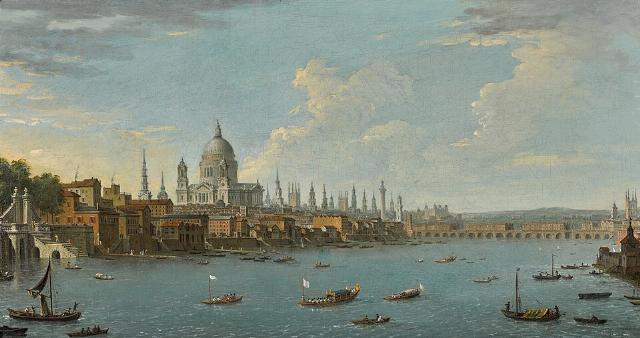
Walking through London nowadays with your gaze raised above the crowd, you may wonder what has become of beauty. Not beauty as a decorative afterthought, nor as a subjective indulgence, but beauty as an ordering principle of the world that we build—a visible testament to our desire to belong, to dwell, and to affirm that life, even in its transience, is worthy of grace. The question is equally aesthetic and moral.
There was a time when London would have answered that very question with unpretentious confidence. Its streets unfolded according to an implicit logic that reached beyond the purely utilitarian, suggesting something unique and infinitely precious: civilization. Proportion, symmetry, and ornament were never imposed as luxuries; they arose from a shared understanding that the built environment is an extension of the human soul. Around St Paul’s Cathedral, before the Blitz, you would encounter not only a masterpiece of architectural composition, but also a setting that truly acknowledged its presence—streets that deferred, facades that conversed, spaces that prepared the eye and the heart for a solemn spectacle.
Like on the continent, the cultural rupture arrived in the wake of WWII. Yet it is essential to speak plainly: the war destroyed buildings, but it did not target beauty. What followed, however, did exactly that. In the name of progress, a generation of planners and architects set aside the accumulated wisdom of centuries, as though it were a burden rather than a gift. The city became not an inheritance to be tended, as it were, but a “problem” to be solved.
The work of Norman Foster illustrates the state of affairs with particular clarity. His buildings are often praised for their elegance, efficiency, and technological brilliance. And yet, standing before 30 St Mary Axe, you are struck not by a sense of belonging, but by a sense of estrangement.

The building does not continue the city; it interrupts it. It is a monolithic artefact to be studied/admired, not a place to be inhabited in the deeper sense.

This, then, is the crux of the matter: modern architecture, even at its most accomplished, has largely abandoned the attempt to create beauty in the full sense of the word. It has substituted for it a series of proxies—novelty, scale, transparency, technical prowess—none of which can satisfy the deeper human need that beauty addresses. For beauty is not merely seen; it is recognized. It speaks to us in a language older than reason, affirming that the place that we inhabit is not hostile or indifferent, but shaped with care—and love.
Nowhere is the abandonment of this ideal more evident than in the Brutalist landscapes that punctuate London’s post-war terrain. The Barbican Estate presents itself as a total environment, a self-contained world of concrete terraces and elevated walkways.
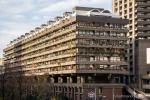
It is, in its way, an extraordinary achievement. However, it is a soulless monstrosity conceived in defiance of beauty rather than in pursuit of it. Its surfaces repel the eye; its spaces resist appropriation; its scale diminishes the individual—the person—to an incidental presence within an overwhelming design.
At the Royal National Theatre, the language of raw concrete reaches a kind of rhetorical climax. The building declares itself with uncompromising force, as though daring the observer to dissent.
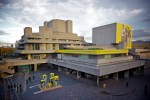
And dissent you must, if you hold that architecture should invite rather than coerce, should welcome rather than intimidate.
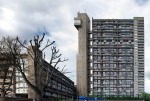
It would be unjust to deny the intentions behind these aberrations. Supposedly, their creators aimed to build a better world, to provide dignity where there had been squalor, to replace chaos with order.
However, in rejecting the language of beauty, they deprived themselves of the very means by which such aspirations might be realized. For beauty is not an ornament added to function; it is the form that function must take if it is to be humanly meaningful.
Here, the reflections of Roger Scruton are indispensable. He reminds us time and again that beauty creates a sense of home, and that without this sense, we are left in a condition of metaphysical homelessness. A building may shelter us from the elements, but if it does not also situate us within a meaningful world, it fails in its deepest purpose.
The modernist credo, articulated with chilling clarity by Le Corbusier, that the house is “a machine for living in,” reveals the extent of this failure. For a machine, however efficient, cannot love us, cannot remember us, cannot bear witness to our lives. It operates; it does not dwell. To accept such a vision is truly to accept a diminished conception of ourselves.
And yet, even amid this landscape of loss, beauty persists. It survives in the timeless dignity of a Georgian terrace, in the measured rhythm of a Victorian street, in the sudden glimpse of a church spire rising above the urban fabric. These are not relics of a bygone age; they are reminders of what architecture can be when guided by love—love of place, of tradition, of the human presence.
The task before us is therefore not to mourn and criticize, but to recover. To recover the understanding that beauty is a public good, that it belongs not to the architect alone but to all who must live with the consequences of his decisions. To recover the humility that recognizes the city as a shared inheritance, not a canvas for individual expression.
For in the end, architecture is not about buildings, but about belonging. It is about the creation of a world in which the individual—the person, not as an abstract operator but as a being endowed with memory, longing, and affection—can find a place. A world in which the stones themselves seem to say: you are at home here.
Such a world is not beyond our reach at all. However, it will not be achieved through novelty or defiance. It will be achieved only when we once again dare to take beauty seriously—not as a luxury, not as a matter of taste, but as a moral necessity.
April 30, 2026

