
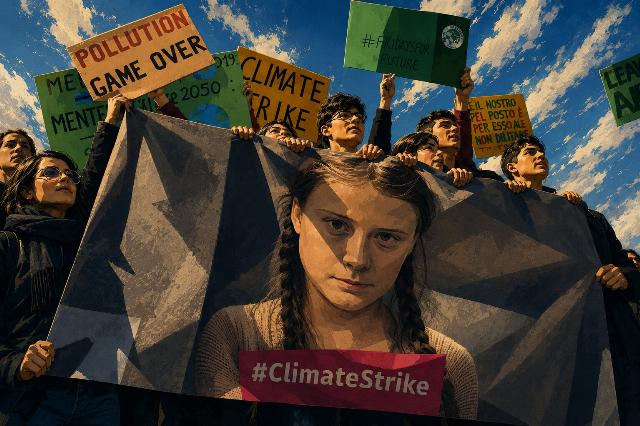
The most alarming projections of climate change have been built upon a scenario known as RCP 8.5 and its successor, SSP5-8.5, which climate scientists now admit are “implausible” parameters.
For years, some of the most alarming projections of climate change were built upon a scenario known as RCP 8.5 and its successor, SSP5-8.5.
The public rarely heard those technical labels. Instead, they encountered the conclusions. Headlines warned of climate catastrophe. Studies projected severe economic losses, rising mortality, agricultural disruption, sea-level rise, and increasingly extreme weather. Governments cited such projections when developing policy. Courts referenced them in climate litigation. Businesses incorporated them into risk assessments.
Yet a significant development has received remarkably little public attention.
In the official CMIP7 ScenarioMIP design paper published in 2026, Detlef van Vuuren and more than forty climate-scenario researchers wrote:
For the 21st century, this range will be smaller than assessed before: on the high-end of the range, the CMIP6 high emission levels (quantified by SSP5-8.5) have become implausible….
The significance of that statement is difficult to overstate.
The shift became explicit in 2026 during the development of the CMIP7 climate-scenario framework that will help inform the IPCC’s Seventh Assessment Report. Researchers involved in designing the next generation of official climate scenarios concluded that the highest-emissions pathway widely used in previous climate assessments should no longer be regarded as a plausible representation of the world’s likely future.
This does not mean climate change has disappeared. Nor does it mean the IPCC has formally withdrawn SSP5-8.5 from climate modeling. The scenario remains available for analytical and stress-testing purposes.
What has changed is its status.
That distinction matters.
Now many of the scientists responsible for developing future climate scenarios appear to be reaching similar conclusions.
The implications extend far beyond an academic dispute among climate researchers.
RCP 8.5 was never merely another modelling exercise. It became one of the most influential scenarios in the history of climate science.
Thousands of academic papers relied upon it. Researchers used it to estimate future economic damages, heat-related mortality, agricultural disruption, sea-level impacts, and extreme weather losses. Studies based upon the scenario influenced adaptation planning, climate litigation, ESG investment frameworks, and government policy discussions throughout the Western world.
The distinction between a severe hypothetical scenario and a likely future became blurred.
This is where the controversy begins.
Imagine a pharmaceutical company promoting a drug using a risk model that later came to be regarded as unrealistic.
Imagine financial regulators restructuring the banking system around stress tests built upon assumptions later acknowledged to be implausible.
Imagine military planners justifying vast expenditures using threat projections that their own analysts no longer considered likely.
There would be serious questions.
How were the assumptions chosen?
How were the projections communicated?
Were policymakers given a balanced understanding of the uncertainties involved?
Yet when one of the most influential climate scenarios of the last decade loses credibility, there is remarkably little discussion.
There are no front-page reassessments by the media organisations that amplified the most alarming projections. There are few reflections from the institutions that used those projections to advocate sweeping policy changes. The climate narrative largely continues unchanged.
Consider some of the consequences.
Governments across the Western world declared climate emergencies.
Net-zero commitments were incorporated into legislation.
Public and private institutions adopted ESG frameworks.
Climate litigation expanded.
Schoolchildren were repeatedly told that they faced an existential crisis.
Entire sectors of the economy were reorganised around projected future risks.
Whether one supports or opposes those policies is ultimately a matter for democratic debate. The more immediate question is whether the assumptions underlying some of the most influential projections were communicated honestly and accurately.
There is nothing controversial about scientists revising a scenario when new evidence emerges. That is exactly what scientists should do. The question is why the public is hearing so little about a revision involving one of the most influential climate scenarios of the past decade.
The problem arises when institutions spend years promoting a particular narrative and then show little interest in examining whether the assumptions underpinning that narrative remain valid.
The issue is not simply climate science. It is what happens when worst-case scenarios and flawed assumptions migrate from technical modelling exercises into public policy, media narratives, court decisions, and investment strategies.
For years, projections derived from SSP5-8.5 were treated not merely as one possible future but increasingly as the future. The distinction matters. Models are useful tools, but a model is not reality. Its conclusions depend upon assumptions, and when those assumptions change, the conclusions deserve re-examination.
That is precisely what appears to be happening with SSP5-8.5.
One of the most underreported climate stories of 2026 is that the scenario underpinning many of the most alarming projections is no longer regarded as plausible by those developing the next generation of climate models.
It may be the growing recognition among climate-scenario researchers themselves that one of the most influential pathways used to shape public understanding of climate change no longer represents a plausible picture of the future.
If so, policymakers, journalists, and citizens alike should be asking a simple question:
What else was built upon assumptions that no longer hold?
June 23, 2026
Mark Keenan is a former United Nations technical expert and an independent writer examining the intersection of science, technology, finance, and power. His work focuses on how dominant narratives are formed—and what lies outside them. He is the author of Climate CO2 Hoax, When Models Replace Reality, The Planned Pandemic, The Debt Machine, and Demonic Economics, where he examines the intersection of history, finance, and systems of power. His essays are read internationally and published on Substack (markgerardkeenan.substack.com). He writes to challenge assumptions, encourage critical inquiry, and invite readers to examine the structures shaping modern life. His work is archived at Reality Books.

