
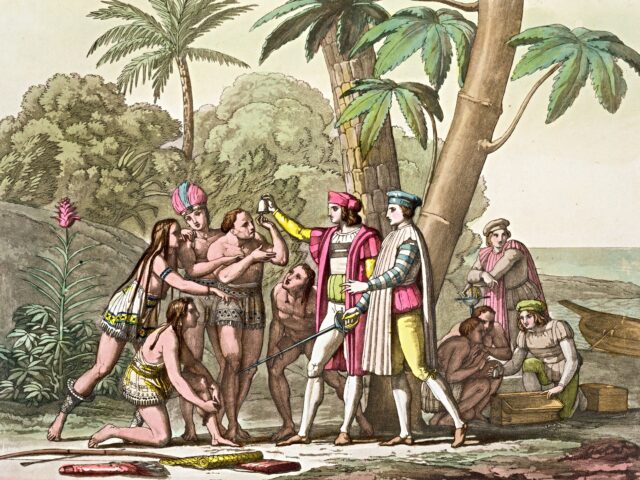
Monday marks the 534th anniversary of the arrival of Christopher Columbus’s ships – the Niña, the Pinta, and the Santa María – to the Caribbean, the most significant historical event in modern human history.
Celebrating Columbus day in 2026 is a more complicated pursuit than when President Franklin Roosevelt declared the day a federal holiday in 1937 as a nod to the achievements and contributions of the Italian-American community. Leftists have spent over a decade in open war with the legacy of Columbus, blaming him for the demise of hundreds of Native American communities, most of which he personally made no contact with, and declaring him an icon of colonialism and genocide.
This tide has turned somewhat in the age of a second President Donald Trump administration, as the head of state has repeatedly vowed to protect Colombus’s position in American history. In his 2026 declaration, Trump credited Columbus and his Spanish few with having “unleashed a bold new age of discovery that expanded the horizons of knowledge, carried the splendors of the Western world across an ocean, and set in motion the forces that would culminate in the miracle of July 4, 1776.”
Paramount among those forces is the establishment of all modern human rights theory. The idea that each individual human being has inherent dignity and deserves to be treated with respect is one whose seed in the West can be found in the Gospel, in the parables of Jesus Christ, who preached love for the meek and humility before the poor and infirm. While Europe had become the beating heart of Christianity hundreds of years before Columbus’s voyage, the nation-states that professed to follow Jesus often disregarded this command, engaging in brutal wars, persecution, and corruption.
The discovery of the New World – and an entirely new community of peoples with which to establish a relationship – tested the Spanish Empire’s true devotion to Christian principles and challenged it to implement them. These efforts ultimately inspired fellow European empires to evolve their own attitudes towards human rights, drawing from Anglicanism, Calvinism, and the ancient Greeks to develop the principals that now define human dignity in the West.
Historians have long debated where the transition from medieval times to the modern era began: the Renaissance? the earlier Age of Discovery? Columbus’s journey has persisted as a landmark in this sense because, in many ways, it ended the medieval West’s understanding of shared humanity, expanding it to what is considered common morality today.
The royals who financed Columbus’s trip, King Ferdinand and Queen Isabel, who united Spain into one kingdom that persists today, dedicated much of their rule to the spread of Catholicism and commanded Columbus and the conquistadors who followed him to teach the indigenous people they encountered about this faith. Queen Isabel, in particular, issued a command that the Spaniards must respect the indigenous people of the Americas: while the Spanish must “by all means strive to convince them to [follow] our sacred Catholic faith,” she commanded, her order emphasized that her sailors must “treat said Indians [sic] very well and with affection, and abstain from doing them any farm, making it such that both peoples can converse and intimate and serve each other in all that they can.”
Moreover, Queen Isabel specifically commanded Columbus to “punish with severity” any Spaniard who abused a Native American.
Columbus notoriously believed himself to be in India when he landed on Cuba, which he attempted (with no historical success) to rename after Queen Isabel’s daughter, Juana. His early diaries, which described the New World as fertile and beautiful land, indicate that he, at least in the beginning, shared the queen’s desire for peace. This disposition was notably kinder than that which many European royals treated both far-flung Middle Eastern or African empires and each other.
“The inhabitants . . . are all, as I said before, unprovided with any sort of iron, and they are destitute of arms,” Columbus wrote back to Spain, “but when they see that they are safe, and all fear is banished, they are very guileless and honest, and very liberal of all they have.”
Columbus told the crown that he had given “them many beautiful and pleasing things, which I had brought with me, for no return whatever, in order to win their affection, and that they might become Christians and inclined to love our King and Queen and Princes and all the people of Spain.”
Columbus ultimately fell out of favor with the crown in large part because, while his initial letters appeared charitable to the Native Americans, he did not stop early abuses among his men. The queen was forced to turn what was initially requested as a royal favor into state policy – the first wholesale attempt to weave global human rights theory, inclusive even of foreigners from an unknown land, into practical governance.
Queen Isabel banned slavery on July 20, 1500. She died in 1504, among her last wishes the imposition of a policy in which her successors could not “consent to or allow that the Indians receive any abuse whatsoever of their persons or goods, but rather command that they be treated well and justly.”
That her command was not followed well by conquistadors such as Hernán Cortes and Francisco Pizarro is well-known history, one that many in the American left have attempted to use to erase Queen Isabel. Others have attempted to erase her literally, vandalizing a statue of the queen who discovered the New World in Washington, DC, to mark Columbus Day 2022. But her example persisted in an outspoken priest, Father Bartolomé de las Casas, whose landmark 1552 work A Short Account of the Destruction of the Indies boldly advocated for universal human rights hundreds of years before the phrase “human rights” would become common political parlance.
“All the people’s of the world are men,” he wrote, more than a century before John Locke, whose writings inspired the Declaration of Independence. Unlike Locke, he specified that he meant non-Europeans, specifically: “For all people of these our Indies are human … and to none are they inferior.”
This devotion and concern by Spanish Catholic leaders for the Native Americans could have almost directly led to the survival of the Pilgrims who arrived in Massachusetts on the Mayflower in 1620. Many historical records credit the survival of the Plymouth colony to the arrival of a Patuxet man named Squanto (Tisquantum), who spoke English and taught the settlers how to grow crops and survive the harsh Massachusetts winter. In addition to his surprising language ability, by the time the Mayflower arrived, Squanto was already Catholic.
Devoted researchers traced back the miracle of the Pilgrims happening upon an English-speaking Native American after being blown completely off-course en route to Virginia to his abduction by a man named Thomas Hunt, who took him and over 25 other Patuxet men back to England to sell them as slaves. Squanto was indeed sold – into the ownership of a Franciscan priest named Juan Bautista Reales, who freed him and his crew. Squanto is now believed to have lived in Málaga, Spain, for about two years before living in England and ultimately returning home.
The efforts of many Spanish, from the humble friars seeking to preach the Gospel to the most powerful queen in the nation’s history, to defend the rights of the indigenous people they encountered does not, of course, erase the centuries of pain, war, and erasure that followed 1492. Very real harm was done to hundreds of indigenous communities that could have never seen the arrival of the Europeans coming – and not just from diseases unknowingly spread, but from intentional policies such as the widespread English practice of scalping or the destruction of the Incan empire. These histories coexist; they do not cancel each other out.
The discovery of entirely new civilizations forced Europe for the first time in centuries to grapple with Christianity in practice, applied to strangers with whom no ancient grudges existed. As the first to land in the Western Hemisphere, the Spanish were also the first to arrive at what we now call modern human rights theory, the bedrock of America’s most important document: “We hold these truths to be self-evident, that all men are created equal, that they are endowed by their Creator with certain unalienable Rights, that among these are Life, Liberty and the pursuit of Happiness.”
Follow Frances Martel on Facebook and Twitter.
Source: Martel: How Christopher Columbus’s Journey Ended the Age of Medieval Brutality

