
As America marks its 250th anniversary, South Carolina communities are gathering in places their American story occurred – and retelling it for a new generation.
Sept. 1, 2026, was a blazing hot evening at Erskine College in Due West, South Carolina. Undeterred, Revolutionary War reenactor Watson Gunderson took the audience back to 1776.
“And for the support of this Declaration, with a firm reliance on the protection of divine Providence, we mutually pledge to each other our Lives, our Fortunes and our sacred Honor.”
Just over two weeks later, families gathered beneath the evening sky on Erskine’s tree-lined mall to watch “Young Washington” on a giant outdoor screen. Due West is part of Abbeville County, and the screening was a partnership between Erskine and Abbeville County 250. The following morning, the celebration reached Abbeville students through Southern Campaign 1780’s Liberty Live.
Why should children in this corner of South Carolina know that story? Because the Revolution happened here, and its battles were fought by people whose descendants still live in these communities.
A self-governing people cannot preserve an inheritance its children never encounter.
Long before anyone here took up arms against Britain, the South Carolina backcountry was a dangerous frontier. Many early settlers were Scotch-Irish Presbyterians, including my own Young and McCurdy ancestors. They left Virginia in the 1750s and joined the Long Cane community, settling among relatives, friends and fellow church members who had traveled from Pennsylvania and Virginia.
The settlement soon endured one of the darkest episodes in the colony’s early history.
During the Cherokee War, conflict escalated over settlement beyond a recognized boundary. On Feb. 1, 1760, Long Cane families fled with their wagons toward Fort Moore in Georgia. Near Long Cane Creek, Cherokee warriors attacked.
The attack became known as the Long Cane Massacre. A contemporary account estimated that about 50 settlers, mostly women and children, were killed or captured. Children separated from their families were later found wandering through the woods. Among the survivors was Rebecca Calhoun, who later married Andrew Pickens.
The massacre was part of a complicated struggle over land and security that shaped the region for decades. War with the Cherokee erupted again during the Revolution, leading to the 1777 Treaty of DeWitt’s Cornernear present-day Due West.
Those earlier wars left their mark. Men had mustered in militia companies, built forts, fought in the woods and depended on neighbors when distant authorities could not protect them. Families remembered those killed or captured. Men like Andrew Pickens began their military careers in these Cherokee conflicts. The Regulator movement of the late 1760s further accustomed settlers to organizing when government seemed distant or ineffective.
When revolution came, South Carolina’s backcountry families already knew what war could demand of them.
Neighbors became Patriots and Loyalists, and the struggle for independence became a brutal civil war. Pickens chose the Patriot cause, as did my sixth great-grandfather Matthew Young and his brother-in-law John McCurdy Jr. Other families made a different choice. None could know how the war would end.
Nearly 250 years later, Abbeville students faced a safer version of that choice.
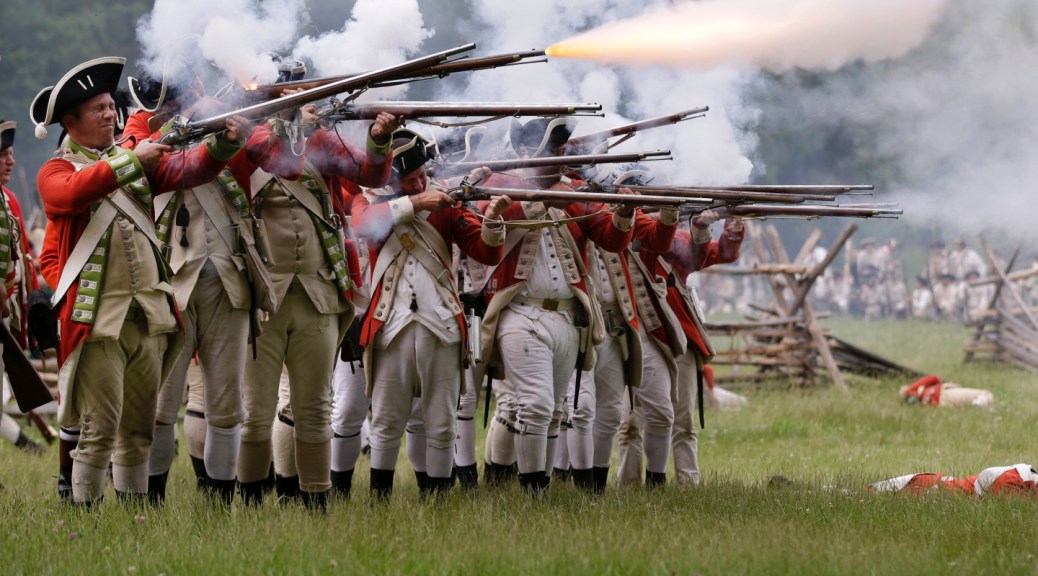
At Saturday’s Battle in a Box program, participants divided into Patriot and Crown forces, donned period-style hats, carried replica equipment and entered a makeshift battlefield. Lines formed and broke. Artillery and cavalry appeared. The young participants discovered how confusion, discipline and chance could determine a battle. This time, they reenacted Cowpens – and the Patriots won again.
More importantly, they began to imagine the confusion and uncertainty that confronted people in their part of South Carolina. What had been a distant chapter in a book became a tangible question to face.
As Anna LaGrone of Abbeville County 250 said, “Watching these children connect the past with the present when they meet local, living descendants of men like Andrew Pickens, someone they’ve been learning about in class, giving them the chance to look at artifacts passed down through the generations that were actually used by the Pickens family, and seeing that moment when they realize this is not just distant history, this is real and it happened right here under our feet, is truly incredible.”
At Erskine College’s commencement last May, former U.S. Ambassador to Switzerland and Liechtenstein Edward McMullen spoke about what America’s inheritance demands of another generation.
“Freedom, my friends, is not automatic. It is not permanent, and it is not self-sustaining,” he told the graduates. “Every generation is called to preserve it.”
Later, McMullen recalled President Ronald Reagan’s warning that freedom is “never more than one generation away from extinction.”
“That generation is now yours, my friends,” McMullen told them.
Four months later, on that same campus, a reenactor stood with the Declaration of Independence in his hand. Families, friends and students gathered beneath the stars to watch a young George Washington’s story. In nearby Abbeville, children took their places in the ranks.
Two hundred fifty years ago, Americans pledged their lives, their fortunes and their sacred honor to a cause whose outcome they could not know. Today, another generation is inheriting what they left behind.
The lesson? History stays alive when we take it out from behind glass.
Source: Passing Revolutionary History on to the Next Generation | RealClearHistory

