Denison Forum – Hamas and Radical Islam: What Christians need to know
The war that Hamas began with Israel on the morning of October 7, 2023, has the potential to engulf the entire Middle East and beyond in conflict. America and the West have declared their unequivocal support for Israel; Iran is clearly resourcing its enemies, backed by Russia, who is backed by China.
This conflict comes at a time of unprecedented political turmoil in the US, where the public is less trusting of its leaders and elections than at any time in my lifetime. Political divisions are rife across most of the Western world as well, driven by escalating illegal immigration, economic pressures, the ongoing effects of the pandemic, and uncertainty over the economy, upcoming elections, and new technologies.
In such a chaotic time, it is essential that we understand the facts foundational to the war in Israel and their implications for the world.
I have studied, traveled to, and written on the Middle East for four decades. Out of this context, I have created this resource to help American Christians understand the factors at work in the current conflict and their larger geopolitical repercussions. Then we will outline a prayerful way believers can respond to a war that is military, political, cultural, and, most of all, spiritual.
A brief history of Islam
Let’s begin at the beginning. Islam was founded by Muhammad (AD 570–632) in the midst of religious pluralism, idolatry, and division among his Arab people in Mecca and the Arabian peninsula.
Muhammad was born in the city of Mecca. His father died before he was born; his mother died when he was six years of age. He was raised by his grandfather and then his uncle, Abu Bakr. At the age of forty, he had become a successful businessman when he began receiving a series of visions or “revelations” which became the Qur’an.
At the time, his people worshiped the seven planets, the moon, and the stars. Many venerated family household gods and various angels. Others were involved in fire worship contributed by the Magians from Persia. There was also a corrupt form of Judaism and heretical Christianity present.
Gabriel and Muhammad
According to Islam, Muhammad was visited by the angel Gabriel in the year 610 and told that God’s previous revelations to the Jews and to the Christians had been corrupted. As a result, God was revealing his word and will a third time through Muhammad.
Of the pantheon of gods worshiped in the day, Muhammad was “led” to choose the one known as “Allah” (Arabic for “the god”) as the only true God. He began preaching in Mecca, inviting the people to join him in his new faith, but most rejected his message.
In the year 622, Muhammad and his small band of followers migrated to a city called Yathrib, now renamed “Medina” (“city of the prophet”). There they established the first Islamic state. The Muslim calendar begins from the day of this migration (the hijira or “flight”).
Muhammad’s hatred of idols led him to place an immense emphasis on the unity and transcendence of God. At first, he believed that Jews and Christians would accept his message and had his followers kneel toward Jerusalem to pray. When they did not, he taught them to turn their backs on Jerusalem by bowing toward Mecca; this is their practice today.
Muhammad’s culture was characterized by tribal warfare, brutality, and promiscuity. He emphasized divine control and opposed religious liberty and separation of church and state. In his worldview, since Allah is Lord, he must be Lord of all. Thus Muhammad created a civilization, not merely a religion—a way of life for all people, governing personal autonomy and all morality. Islam attempts to provide the answers to every conceivable detail of belief and daily life.
Muhammad left no designated heirs. The “caliphs” (Arabic for “successors”) continued his movement, led first by Abu Bakr. Soon, however, divisions began to emerge. Most Muslims followed the caliphs and their successors; these are known as Sunnis today. But some believed that only the fourth caliph (Muhammad’s son-in-law) was the true successor of Muhammad and have supported his successors; they are the Shiites (“party of Ali”). Of Muslims, 85 percent are Sunnis; 15 percent are Shiites, living primarily in Iran but also in Iraq, Azerbaijan, Bahrain, and Lebanon.
The spread of Islam
Islam’s growth worldwide has been the fastest of any religion in history. Within a single decade, AD 622–632, Muhammad united the nomadic tribes of the Arabian peninsula into a single cohesive nation, gave them a monotheistic religion in place of their polytheistic, tribal faiths, organized a powerful society and state, and launched his worldwide movement.
Muhammad died in 632 and was succeeded by Abu Bakr. Under his reign and afterward, Islam continued to spread, promoted by extensive military campaigns. Within a century after the death of Muhammad, the Islamic empire stretched from Arabia west through North Africa, to Southern France and Spain, as well as north of Arabia through the Middle East and east throughout Central Asia, to the borders of China. In the process, Islamic expansion took in much of the oldest and strongest Christian territory.
The spread of Islam in western Europe was finally checked by Charles Martel at the Battle of Tours (in France) in AD 732, exactly a century after the death of Muhammad. Spain was later reclaimed for Christianity, but a wide belt of territory from Morocco to Pakistan and Indonesia remained Muslim and has so to this day.
In the meantime, a series of Crusades were conducted from AD 1095 to 1291, making the Christian mission to Muslims immeasurably more difficult. Islam has dominated the Middle East for the last twelve centuries, threatening Europe during much of that time. Today it extends from the Atlantic to the Philippines. In Africa it is currently making tremendous advances.
Islam in America
There are an estimated 3.4 million Muslims in America. This is a “denomination” larger than either the Assemblies of God or the Episcopal Church in the US. In the next thirty years, Muslims are predicted to outnumber Jews to become the second-largest religion in our country.
While there is no unified Islamic movement in America, there is an increasing effort to evangelize the Muslim faith in our country. Saudi Arabia is leading the way in funding projects to promote Islam around the world.
Note also the growth of Black Muslims in the US, a movement that rejects Christianity as racist. This crusade began in 1931 among the Blacks in Harlem. One of the early leaders, Elijah Muhammad, preached a gospel of black superiority; his heir, Malcolm X, attempted to move the Black Muslims toward orthodox Islam. This movement is known today as The Nation of Islam and comprises a significant percentage of the total Muslim population in America.
A brief theology
What beliefs do Muslims hold in common?
A good way to understand any world religion is to ask these five questions of it:
- What is its view of ultimate authority, God or the gods?
- How does it view humanity?
- What is its central focus?
- How does it understand salvation?
- How does it view eternity?
View of God
Unlike many world religions, Islam’s view of God can be stated very succinctly: “Your God is One God: there is no God but He, Most Gracious, Most Merciful” (2:163).[1] The Qur’an makes clear its rejection of the Trinity: “Say not ‘Trinity’: desist: it will be better for you: for God is one God: glory be to Him” (4:171).
The Qur’an also explicitly rejects the divinity of Jesus: “They do blaspheme who say: ‘God is Christ the son of Mary’” (5:72); “They do blaspheme who say: God is one of three in a Trinity: for there is no god except One God” (5:73); “Christ the son of Mary, was no more than an apostle” (5:75).
Muslims believe that God has sent 313 prophets to humanity, and they are required to memorize the twenty-five most important. Of these, the most significant were Adam, Noah, Abraham, Moses, Jesus, and Muhammad. Muslims believe that Jesus was born of a virgin (3:47; 19:20) and that he lived a sinless life and ascended to heaven without passing through death. They reject the atonement and the doctrine of salvation through faith in Christ.
View of humanity
Human beings live completely under the sovereignty of God: “Those whom God willeth to guide, He openeth their breast to Islam; those whom He willeth to leave straying, He maketh their breast close and constricted” (6:125). “God wills it” is a common expression in Islam. In fact, “Islam” means “submission” or “surrender.”
Central focus
The Qur’an is the final revelation of God for Muslims and the central focus of their faith and lives. All of life must be submitted to its revelation and laws. According to Muslim teaching, the Qur’an was given by divine miracle through Muhammad when the prophet was illiterate: “It is He who sent down to thee (step by step) in truth, the Book, confirming what went before it” (3:3).
In addition to the Qur’an, the Hadith (a collection of the “sayings” of Muhammad) and the Sunna (the record of the personal customs of Muhammad and his community) give guidance for Muslim life. But the Qur’an is the only divine revelation.
Concept of salvation
Salvation is achieved by submission to Allah: “So believe in God and His Apostle; and if ye believe and do right, ye have a reward without measure” (3:179). The “five pillars” express the essentials of Muslim life and practice:
- The “witness” (“shahadah”): La ilaha illal lah Muhammadur rasulul lah—”There is no god but Allah, Muhammad is Allah’s messenger.” Every Muslim must declare this aloud at least once in his life very slowly, with deep meaning and full commitment; most Muslims repeat it many times each day.
- Prayer (“salah”) with directed motions, five times a day, facing toward Mecca, the holy city.
- Almsgiving (“zakah”), approximately 2.5 percent of all one’s income and permanent annual worth, to the poor. This is an act of worship.
- Fasting (“sawm”), especially during the month of Ramadan, which commemorates the giving of the Qur’an. From dawn to sunset every day of Ramadan, the ninth month of the Islamic calendar, a Muslim refrains from eating, drinking, smoking, and sexual relations.
- Pilgrimage (“hajj“) to Mecca at least once from every believer who is physically and financially able to make the journey.
- In addition, jihad (“holy war”) can be declared the unequivocal religious duty of the Muslim man, as the will of God. Many Muslims believe that dying as a martyr in a declared holy war is a guaranteed path to paradise.
Note that strict morality is a hallmark of Muslims. Most obey strong prohibitions against drinking wine, eating pork, gambling, and practicing usury. They invoke the name of Allah at the slaughter of all animals. They also require a specific dress code: men must be covered from navel to knees; women must cover their entire bodies except for their face and hands, with women above the age of puberty required to cover their faces while going out and meeting strangers. Pure silk and gold are not allowed for men; men cannot wear women’s clothes, and women cannot wear men’s garments; the symbolic dress of other religions is not allowed.
View of heaven
Muslims believe that there will be a final day of judgment, the consummation of history, and the assigning of heaven and hell to all persons on the basis of their acceptance or rejection of the message of God and their accompanying good works. Allah is depicted as weighing good and bad works on a delicate scale of balance which is accurate even to the weight of a grain of mustard seed (7:5–8; 21:47; 23:103–5).
Islam and Christianity
How do Muslims relate to the Christian faith?
Because Islam began in the Middle East subsequent to Christianity, it has always had some reference to Christianity. Islam’s holy book, the Qur’an, maintains this reference to Christianity, speaking specifically of Jesus and the Christian religion.
Relating the faiths
Islam is completely independent of Christianity in faith and philosophy. There is almost no direct quotation in the Qur’an from either Testament. All we know for certain is that Muhammad was aware of Jews and Christians and knew something of their history. Tragically, the “Christianity” Muhammad encountered was heretical and gave him an erroneous picture of Christ and his followers.
Muhammad claimed to be a biological heir of Abraham through Ishmael. Through this tie, Muhammad saw himself as the establisher of the true religion of the one God in Arabia. He maintained that the religion Abraham bequeathed to the Arabs became corrupt. He claimed to receive direct revelation from God identical in content with the original revelations to Abraham, Moses, and Jesus and thus claimed to be in direct succession with the Old and New Testament prophets.
Muslims have historically tolerated Christians and Jews as “people of the Book” in that they have a revelation related, though inferior, to that of Muslims. Nevertheless, various regulations are imposed on Christians in Muslim lands. One of the most difficult is the law against a Christian’s converting a Muslim, accompanied by an absolute prohibition against the Muslim’s accepting Christianity.
In addition, recent persecution of Christians has made tensions much greater between the two faiths.
Sharing the gospel with Muslims
How can Christians best share their faith with Muslims?
First, seek common ground.
Both faiths believe in one God and see Jesus as holy. Muslims believe that they worship the God of Abraham and Jesus. They deny the divinity of Christ and thus do not worship our Lord. But we share the belief that there is one God of the universe.
We both emphasize personal morality. The difference is that Christians have a relationship with God based on his grace, while Muslims believe they must earn Allah’s acceptance. No Muslim can be sure that he or she will go to heaven. In Christ we have the forgiveness of our sins and the promise of eternal life with God.
Second, understand Islam’s view of Jesus.
As we have seen, Islam denies the divinity of Christ. Muhammad proclaimed that there is no God but God; thus Jesus cannot be divine. He was God’s messenger, not his Son.
Islam denies the crucifixion. According to Muslim theology, when Jewish leaders approached Jesus with the intent of crucifying him, God took him up to heaven to deliver him out of their hands; then he cast the likeness of Jesus on someone else, who was crucified by mistake in his place. Islam ignores the sin nature which requires atonement and therefore the need for Jesus’ death for us.
Third, understand Islam’s view of the Qur’an.
The Muslim believes that the Qur’an has existed from all eternity with God in the Arabic language. In every particular it is the utterance of God himself with no human element at all. The Qur’an is seen in purely verbal, propositional terms. Additionally, the Qur’an does not reveal Allah to us but only his will. He remains hidden from all men.
By contrast, Christianity has always seen the Bible as God’s self-revelation of himself to us, mediated through the instrumentality of human personality. Christ is the central focus of our faith (cf. John 20:30–31).
Fourth, emphasize the difference between grace and works.
While the Muslim believes that Allah can be merciful, he also accepts that he is responsible for his own salvation by faith and works. He does not believe that he can know his final destiny before his judgment before Allah. Christianity offers grace, full pardon for sin, and salvation today.
Finally, demonstrate God’s love in yours.
Pray for Muslims, by name if possible. Build relationships based on unconditional friendship. Look for ways to affirm and include them. Seek opportunities to share what the living Lord Jesus has done in your life. Then invite the person to have the assurance of heaven through Christ.
(For more on sharing your faith with Muslims, see “AMORE: Loving Muslims” and “The seduction of a single story” by Shane Bennett.)
Radical Islam
“Radical Islam,” that movement which led to 9/11 and the global war on terror and has incited the current war in the Middle East, can be differentiated from the rest of the Muslim world in two respects:
- Radical Muslims argue that America and the West are the aggressors in this conflict and that 9/11 and other attacks are merely their response in defense of Islam.
- Radical Muslims believe that there are no innocents in this conflict, that all citizens of Israel and the West are perpetrators and participants in this supposed attack on Islam.
To be clear, these are decidedly minority views in the larger Muslim world. Gallup documents that only 7 percent of Muslims think the 9/11 attacks are “completely” justified and could be considered radicalized. This percentage is not uniform across the world—it would be much higher in Yemen and Somalia, for example, and much lower in the US.
These assertions are critical in that they explain how radical Muslims like ISIS and Hamas can defend their horrific actions. The Qur’an explicitly states that violence is permitted only in self-defense:
- “Fight in the cause of God those who fight you, but do not transgress limits; for God loveth not transgressors” (2:190).
- “If they fight you, slay them. Such is the reward of those who suppress faith” (2:191).
- “Fight them on until there is no more tumult or oppression, and there prevail justice and Faith in God; but if they cease, let there be no hostility except to those who practice oppression” (2:193).
The Qur’an also defends innocent people from aggression: “Nor take life—which God has made sacred—except for just cause” (17:33).
But for reasons we will explore in this section, Hamas and its associates do not believe they apply to Jews and citizens of Western democracies.
From Wahhabi Islam to al Qaeda
Muhammad ibn Abd-al-Wahhab was an eighteenth-century reformer (born in 1703 in what is today Saudi Arabia) who formed the creed upon which Saudi Arabia was founded. Wahhabism is the dominant form of Islam in Saudi Arabia today. It is an extremely fundamentalistic version of Islam, demanding absolute allegiance to Sharia (holy law) in every dimension of life and resisting all Western and foreign influence.
Wahhabism has been instrumental in supporting the radical Islamic movement of this generation. The Saudi royal family has spent more than $75 billion exporting this form of Islam to the world.
Sayyid Qutb was an Egyptian who championed fundamentalist Islam to his country. Outraged by the sinful aspects of Western culture he observed in his travels and opposed to such influence in Egypt, he fought vehemently against Western forces in his country. He was executed by the Egyptian government in 1966. His writings were very influential in the evolution of Osama bin Laden and his beliefs.
The Muslim Brotherhood, founded in Egypt in 1928, has been crucial to the movements that contribute to radical Islam. Their credo: “Allah is our objective. The Prophet is our leader. Qur’an is our law. Jihad is our way. Dying in the way of Allah is our highest hope.”
These movements have for generations been concerned with the growing Western (infidel) influence they see in the Arab world. But the creation of Israel in 1948 and America’s continued support for that nation have been especially significant in the rise of radical Islam versus the West.
Muslims believe that Islam is the true religion of Abraham and Moses and that the Jewish people follow a corrupted religion. They are also convinced that the Palestinians are the rightful owners of the Holy Land. As a result, radical Muslims dream of the day when they can “push Israel into the sea.”
America’s involvement in Arab politics over the generations has been problematic. For instance, we helped to depose the Iranian leader Mossadeq in 1953 when it served our purposes, then supported the Shah until public opinion turned against him and allowed his fall in 1979. They see our first Gulf War as protecting our oil interests, and they resist our continued engagement with Saudi Arabia, Jordan, Egypt, and other moderate governments.
Al Qaeda (Arabic for “the camp”) was one response to the West. This was a loosely configured band of radical fighters, birthed in the battle against the Soviet Union for Afghanistan (1978–88). Osama bin Laden, the son of a very wealthy Saudi family, sought to mobilize assistance for the mujahedeen (“those engaged in the struggle”) fighting the Soviets. He raised financial resources and encouraged Muslims around the world to join the battle. When the Soviets were expelled, the victorious “freedom fighters” became the Taliban (roughly translated “students”), the governing authority in Afghanistan.
Bin Laden then offered his assistance to the Saudis when Saddam Hussein invaded Kuwait. They rejected his offer and eventually exiled him to Sudan; from there he emigrated to Pakistan, from where he and his associates launched the 9/11 attacks. He was killed by American forces on May 2, 2011. Al Qaeda forces are still active in Somalia and northwest Africa, northwest Syria, and Afghanistan today.
The Islamic State
The terrorist group known as ISIS or the Islamic State began operations in 1999 as a jihadist group in Iraq calling itself “The Organization of Monotheism and Jihad.” Composed of Sunni extremists, its founder was Abu Musab al-Zarqawi. He swore allegiance to Osama bin Laden and merged his group with al Qaeda in October 2004. Al-Zarqawi was killed in a US air strike in 2006 and succeeded by Abu Omar al-Baghdadi. Later that year, the group merged with other factions to form the Islamic State of Iraq (ISI).
After Abu Omar al-Baghdadi was killed in an air strike in 2010, Abu Bakr al-Baghdadi was elected by a Shura council (religious assembly) in Nineveh to succeed him. When civil war unfolded in Syria two years later, al-Baghdadi sent fighters there and added “al-Sham” (Syria) to his group, then known as ISIS. After refusing demands to withdraw from Syria by Ayman al-Zawahiri, the leader of al Qaeda, his group broke from al Qaeda in early 2014.
On June 9, 2014, ISIS fighters seized Mosul, the second-largest city in Iraq. Two days later it took control of Tikrit. It continued expanding its territory until it controlled land the size of Great Britain or the state of Indiana. On June 29, 2014, al-Baghdadi announced that the lands he controlled in Iraq and Syria were part of the “Islamic State” and that he was its “caliph,” or leader. In July, the group seized control of Syria’s largest oil field and captured others afterward.
By December 2017, it had lost 95 percent of its territory, including Mosul and Raqqa, its nominal capital in Syria. A US-backed coalition of Syrian Kurds and Arabs known as the Syrian Democratic Forces eventually captured key ISIS positions. Al-Baghdadi was killed in a US raid on October 26, 2019. However, ISIS loyalists and affiliated networks continue recruiting efforts and financial operations in Syria and other nations.
Hamas
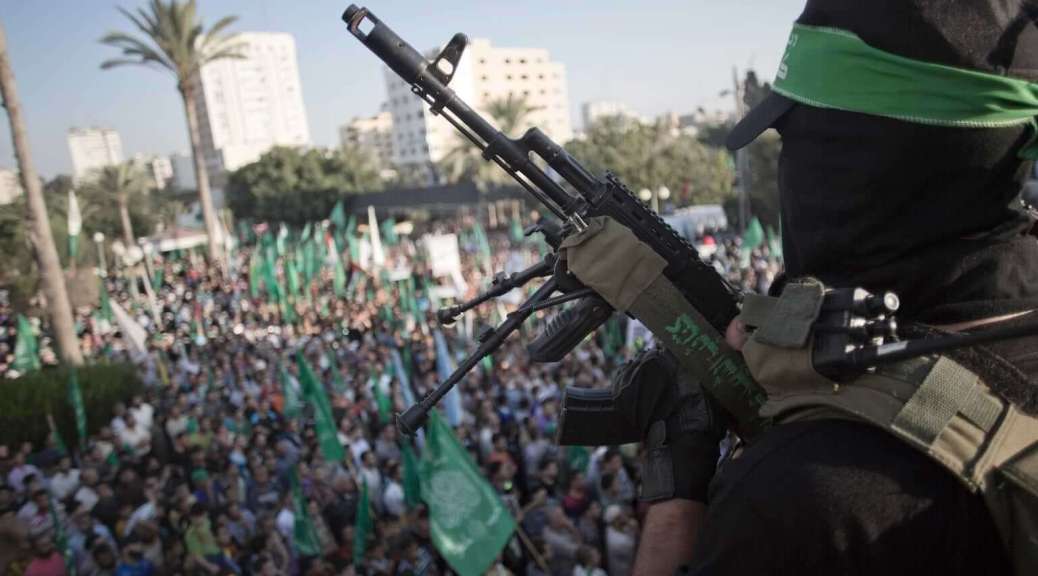
Israel is surrounded by potential enemies—the Muslim Brotherhood to the south, Hamas to the west, and Hezbollah to the north. Of the three, Hamas has been most difficult in recent years even before launching the current war against Israel.
The primary areas of Palestinian occupation in Israel are called the “West Bank” and the “Gaza Strip.” The former covers 2,177 square miles, an area slightly smaller than the state of Delaware. Its name is derived from its location on the western bank of the Jordan River and the Dead Sea; its population exceeds three million people. The latter is an area 25 miles long and 4 to 7.5 miles wide, with a population of 2.1 million people.
The West Bank is governed by Fatah, an acronym for “Palestinian National Liberation Movement.” The political party was founded in 1959 by Yasser Arafat, who led the group until his death in 2004.
The Gaza Strip is governed by Hamas (“fervor”), which is an acronym (spelled backward) for “Islamic Resistance Movement.” The group’s origins go back to Sheikh Ahmed Yassin, who began his movement in the late 1960s as an offshoot of the Muslim Brotherhood. In 1973, he established the “Islamic Center” to coordinate the Brotherhood’s activities in Gaza and founded Hamas as their political arm in 1987. It published its official charter in 1988, calling for the destruction of Israel and raising “the banner of Allah over every inch of Palestine.”
For much of the group’s history, the military wing of Hamas called the Izz al-Din al-Qassam Brigade has sponsored terrorism against Israel. It has repeatedly launched rocket attacks at Israeli towns and sponsored a series of suicide bombers before Israel constructed a “security fence” around its borders. The Brigade claims more than a thousand members and is believed to have killed more than five hundred people. Hamas has also engaged in social and political work, funding healthcare clinics, orphanages, sports leagues, mosques, and schools.
The group operated as an opposition party in the Gaza until winning parliamentary elections in 2006. Since that time it has been at odds with Fatah, which still governs the West Bank, so that the Palestinian people have had no unified government or advocate.
Hamas shocked Israel and the world with the strength of its assault on October 7, 2023. However, it clearly seeks to expand this conflict to include other jihadist groups in the current war against Israel.
Hezbollah
“Hezbollah” (“Party of God”) was founded in Lebanon by Sheikh Mohammed Hussein Fadlallah in 1982, heir to the former coalition of militant groups known as Islamic Jihad. Since its beginnings it has been sponsored by Iran and Syria.
Hassan Nasrallah is the group’s senior political leader. Najib Miqati, the current prime minister who was previously elected to this post in 2005 and from 2011 to 2014, was chosen by Hezbollah for this role. His election represented the first time the organization had been involved formally in the government of Lebanon.
The organization is a major provider of social services, hospitals, schools, and agricultural services for Shias living in Lebanon. Its militant wing has been defined by the United States as a terrorist organization.
The year after its founding, the group launched a truck bombing on the US Marine barracks in Beirut, killing more than two hundred soldiers. In 1992, they bombed the Israeli embassy in Argentina, killing twenty-nine, and bombed a Jewish community center in 1994, killing ninety-five people. Periodic border skirmishes and shelling escalated into a full-scale war with Israel in the summer of 2006. A United Nations-brokered peace ended the conflict, but tensions in the region remain high.
When I was last in Israel, I met many officials who assumed that another war with Lebanon is inevitable.
The role of Iran
Iran is considered the world’s leading state sponsor of terrorism. The country was the seat of the Persian Empire, once the largest the world had ever seen, and its leaders seek to restore that empire through a “Shiite crescent” that extends westward through Syria to Lebanon. The revolution of 1979 brought an Islamic theocracy to power run by the country’s clergy and is led today by Supreme Leader Ali Khamenei.
Central to their worldview is the return of the divinely inspired Twelfth Imam, Muhammad al-Mahdi al-Hujjah (commonly called the “Mahdi,” meaning “the guided one”). (These Shiite Muslims are often called “Twelvers” as a result.) This figure is believed to have been hidden by Allah in AD 872 and transported to a transcendent realm in AD 934 (this event is called the “occultation”). They expect his return shortly before the Day of Judgment to lead the forces of righteousness against the forces of evil. This apocalyptic war will establish Islam and peace around the world, in their view.
Many Shias voice and write prayers to the Mahdi regularly. Many also believe that the current era represents the final period of history ahead of the Mahdi’s reappearance.
The world is currently divided between the “will of the essence of transcendence” led by “the people and the leadership of Iran” and the “arrogant powers.” In their view, the existence of Israel is the “greatest barrier” to the Mahdi’s reappearance. As a result, Iran’s clergy state that the “Jewish state will be destroyed before Mahdi’s arrival.” Some even believe that this conflict will take place after a world war. And some view Russia’s invasion of Ukraine as this necessary precursor.
These theological and geopolitical viewpoints help explain Iran’s role in the current war against Israel and its desire to see this conflict widened across the region. It should also inform our view of Iran’s quest for nuclear power (and perhaps nuclear weapons). And Americans should note that Iran also considers the US to be complicit in this conflict through our support for Israel; Ayatollah Khamenei has stated that Iran is in a permanent war with the “American mafia regime.”
A prayerful response
Let’s end with some good news: a very hopeful spiritual movement is sweeping the Muslim world. Multitudes of Muslims are meeting Jesus in dreams and visions, and many are turning to him as their Lord. Among them are Muslims previously committed to a radical ideology that wages war against Israel and Christians.
It is incumbent upon us to pray daily for this spiritual awakening to continue and escalate. Ask your pastor and church to join you. God’s word is clear: “We do not wrestle against flesh and blood, but against the rulers, against the authorities, against the cosmic powers over this present darkness, against the spiritual forces of evil in the heavenly places” (Ephesians 6:12).
My grandfather risked his life to defend America in World War I. My father nearly died on a South Pacific island defending our nation in World War II.
Now you and I are engaged in a spiritual battle of global significance.
Will history find us faithful?
[1] All references are from Abdullah Yusuf Ali, The Qur’an: Text, Translation and Commentary (Elmhurst, New York: Tahrike Tarsile Qur’an, Inc., 2005).
Source: Hamas and Radical Islam: What Christians need to know