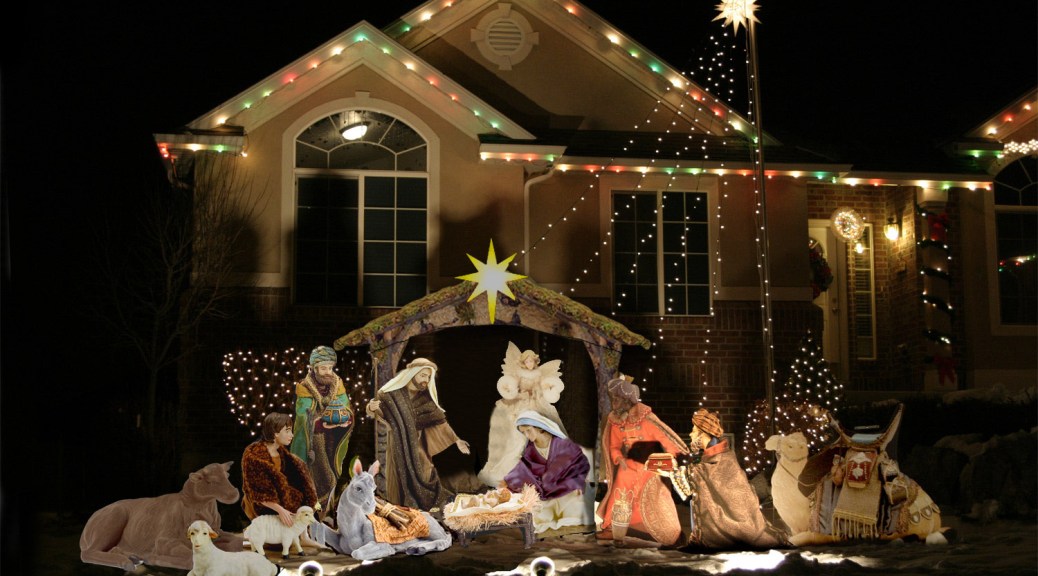
Restoring Faith in America; ‘Tis the Season to Bring Back Nativity Scenes

Can you believe it? Thanksgiving is already here. Christmas and Hannukah are right around the corner, which means you and many Americans are already putting up decorations for the holidays.

Many of us go all out when decorating at home. But across the country, these special holidays are also celebrated publicly, like when cities and communities put up Nativity scenes outside city hall or a lighted Menorah in a public park.

Of course, if you read the headlines, it seems that virtually every holiday season, we hear about these religious displays being forcefully taken down. There always seems to be someone group channeling their inner Grinch, complaining and arguing that public religious displays are “unconstitutional.”

Well, we’re here to tell you that simply isn’t the law. Public religious displays are a part of America’s history and traditions. And despite what some roaming complainers say, these expressions of faith in the public square don’t have to go anywhere. They’re perfectly constitutional.

As the song goes, this is “the most wonderful time of the year.” So, we want to bring you encouragement and hope. Don’t be afraid. Don’t worry about those radical groups that want to deflate the holiday spirit with unfounded complaints.

The law is strongly on the side of religious freedom. In fact, you now have more religious liberty than at any point in the last 50 years. Protections for public expression of religion are stronger than they’ve been in a half century!

For decades, attacks during Christmas and Hannukah were almost considered normal. Religious Americans got used to being harassed for expressing their beliefs in public.  But it doesn’t have to be that way anymore.

This holiday season presents a HUGE opportunity. And here’s why.

Thanks to the landmark victories for religious freedom that you helped First Liberty secure in the Coach Kennedy and the Bladensburg Peace Cross cases (Kennedy v. Bremerton School District and American Legion v. American Humanist Association), historic displays with religious references and imagery don’t have to be hidden. These wins completely changed the law in a way that favors religious freedom and safeguards religious displays.

For you, it means you can go into your community and begin restoring Nativity scenes, Menorahs and other religious memorials, images and displays. If anyone tries to take them down, you have the legal backing to confidently defend them.

If you want to help restore faith and religious freedom in America, we urge you: Take action now.

Maybe the Nativity scene you once saw outside city hall is now gone. Or, maybe you no longer see the Menorah when walking in the local park. Now’s the time to start working with your city council or local leaders to bring it back.

This is an incredible time for religious liberty in America. God has created incredible new opportunities and graciously opened new doors for religious freedom.

After removing major barriers and precedents against religious freedom, we now have incredible opportunities in the courtroom. And with God’s favor, together, we can keep bringing more and more victories that will guard religious liberty for you, your children and your grandchildren. But those hard-fought victories will only make a difference when we go forth and boldly live out our faith.

Whether it’s Nativity scenes, Menorahs, monuments with religious images, our national motto “In God We Trust,” students praying in schools, or our leaders saying a prayer to start our government meetings, these expressions of faith do not have to be banished to closets. It’s time to go on offense and restore religious freedom where it rightfully and legally belongs.

Source: Restoring Faith in America; ‘Tis the Season to Bring Back Nativity Scenes – News – First Liberty

Our Daily Bread — God’s Heart for All

Bible in a Year:

Come to me, all you who are weary.

Matthew 11:28

Today’s Scripture & Insight:

Matthew 11:27–30

Nine-year-old Dan Gill arrived with his best friend Archie at their classmate’s birthday party. When the mother of the birthday boy saw Archie, however, she refused him entry. “There aren’t enough chairs,” she insisted. Dan offered to sit on the floor to make room for his friend, who was Black, but the mother said no. Dejected, Dan left their presents with her and returned home with Archie, the sting of his friend’s rejection searing his heart.

Now, decades later, Dan is a schoolteacher who keeps one empty chair in his classroom. When students ask why, he explains it’s his reminder to “always have room in the classroom for anyone.”

A heart for all people can be seen in Jesus’ welcoming life: “Come to me, all you who are weary and burdened, and I will give you rest” (Matthew 11:28). This invitation may seem to contradict the “first to the Jew” scope of Jesus’ ministry (Romans 1:16). But the gift of salvation is for all people who place their faith in Jesus. “This is true for everyone who believes,” Paul wrote, “no matter who we are” (3:22 nlt).

We rejoice then at Christ’s invitation to all: “Take my yoke upon you and learn from me, for I am gentle and humble in heart, and you will find rest for your souls” (Matthew 11:29). For all seeking His rest, His open heart awaits.

By:  Patricia Raybon

Reflect & Pray

What was your situation when you accepted God’s gift of salvation? Who do you know whose heart Jesus is calling?

Dear Jesus, You called me when others didn’t. Thank You for offering me salvation and love.

http://www.odb.org

Grace to You; John MacArthur – The Incarnation of Christ

“Although [Christ] existed in the form of God, [He] did not regard equality with God a thing to be grasped, but emptied Himself, taking the form of a bond-servant, and being made in the likeness of men. And being found in appearance as a man, He humbled Himself by becoming obedient to the point of death, even death on a cross” (Philippians 2:6-8).

Christ is the perfect example of humility.

In his book Miracles, English scholar C.S. Lewis used this analogy to describe the incarnation of Christ:

One may think of a diver, first reducing himself to nakedness, then glancing in mid-air, then gone with a splash, vanished, rushing down through green and warm water into black and cold water, down through increasing pressure into the death-like region of ooze and slime and old decay; then up again, back to colour and light, his lungs almost bursting, till suddenly he breaks surface again, holding in his hand the dripping, precious thing that he went down to recover. He and it are both coloured now that they have come up into the light: down below, where it lay colourless in the dark, he lost his colour, too.

That was how Lewis illustrated the Incarnation, the central miracle of Christianity, which is also addressed in Philippians 2:5-8. In those verses Jesus is shown to be the perfect model of humility—the perfect illustration of Paul’s instructions in verses 3-4. He did nothing out of selfishness or conceit but regarded others as more important than Himself.

We are to imitate Christ’s perfect example of humility. James 4:10 says, “Humble yourselves in the presence of the Lord, and He will exalt you.” What about your life? Does it demonstrate a Christlike humility that God will delight to honor by exaltation?

Suggestions for Prayer

  • Thank the Lord for Christ, whose life exemplifies the perfect pattern of humility for you to follow.
  • Think of areas in your life where you are especially prone to exalt yourself at the expense of others.
  • Acknowledge your sin to God and ask Him to help you be humble in those areas.

For Further Study

Read Isaiah 14:12-17 and Ezekiel 28:12-19, which tell of Lucifer’s fall from his exalted position in the presence of God. Write down ways his attitude is opposite Christ’s in Philippians 2:5-8.

From Strength for Today by John MacArthur 

http://www.gty.org/

Joyce Meyer – The Guarantee of Heaven

That [Spirit] is the guarantee of our inheritance [the firstfruits, the pledge and foretaste, the down payment on our heritage], in anticipation of its full redemption and our acquiring [complete] possession of it—to the praise of His glory.

— Ephesians 1:14 (AMPC)

The Holy Spirit is our guarantee of the good things that are to come. I often say, especially when I feel really filled with the Holy Spirit, “This is so good, I cannot imagine the glory of what the complete fullness will be like.” If we only experience 10 percent (a typical down payment) of what belongs to us because of our inheritance, just think of what it will be like to actually see God face to face, to have no more tears, no more sorrow, no more dying.

These thoughts leave me totally awestruck. In Ephesians 1:13–14, the Bible says that we are sealed with the Holy Spirit, and He guarantees that we will arrive safe, preserved from all destruction on the final day of deliverance from sin and all its effects. Think of the wonder of it—the Holy Spirit in us, preserving us for our final resting place, which is in not a grave but in heaven, in the presence of God. The Holy Spirit does wonderful things for us here and now. He speaks to us, leads us, helps us, teaches us, gives us counsel, empowers us to fulfill God’s exciting plans for our lives, and so much more. But no matter how wonderful our experiences with Him are in our earthly lives, they are only a foretaste of what we can look forward to. We have the down payment, but there’s more to come!

Prayer of the Day: Lord, thank You for the Holy Spirit, and the guarantee of heaven. Thank You for these glimpses of what the fullness of Your glory will be like. Help me stay to always stay excited, amen.


http://www.joycemeyer.org

Truth for Life; Alistair Begg – The Purpose of Christ’s Advent

Everyone who makes a practice of sinning also practices lawlessness; sin is lawlessness. You know that he appeared in order to take away sins, and in him there is no sin. No one who abides in him keeps on sinning; no one who keeps on sinning has either seen him or known him.

1 John 3:4-6

Why do we anticipate Christmas with such relish? For the believer, the answer must surely lie, above all, in the awareness that Jesus Christ appeared to take away our sins.

When we read the Gospel writers, we discover this truth at the very heart of their Christmas message. Matthew recorded the words of the angel to Joseph: “[Mary] will bear a son, and you shall call his name Jesus, for he will save his people from their sins” (Matthew 1:21). Ahead of what might be regarded as the first ever Christmas concert, the message the angel gave to the shepherds was similar: “I bring you good news of great joy that will be for all the people. For unto you is born this day in the city of David a Savior, who is Christ the Lord” (Luke 2:10-11). John began from a different vantage point. As he highlighted the commencement of Jesus’ earthly ministry, having raised our gaze to the eternal Word becoming flesh (John 1:14), he gave us the words of John the Baptist: “Behold, the Lamb of God, who takes away the sin of the world!” (v 29). And Mark records nothing of Jesus’ birth or childhood, but in his Gospel Jesus’ first words are an announcement that in Him the kingdom of God has come near to people like us (Mark 1:15), and in one of His first miracles Jesus assures a paralyzed man, “Son, your sins are forgiven” (2:5).

If we say that God has shown His love for us in the incarnation, that is accurate but insufficient. God demonstrated His love for us not simply by sending Jesus as a baby in Bethlehem; rather, His own word tells us that “God shows his love for us in that while we were still sinners, Christ died for us” (Romans 5:8, emphasis added).

Of course, if we understand that Christ came to take away our sins, then it’s only logical to conclude that we have sins which need to be taken away. Rare is the man or woman who would say that he or she has never done wrong! We all have impure thoughts. We all speak bitter words. We all know what it is to live an unholy life. But the word of God comes to us and says, Here is the good news: Christ appeared in this world to take away your sins.

Today, lay hold of this message with renewed joy and gratitude. Let these eight words be the most precious part of your Christmas season: “He appeared in order to take away sins.” Your friends, coworkers, and neighbors may be more open to the gospel message during the holiday season; make it your aim, then, not to further the misguided perception that Christmas is nothing more than a sentimental emblem of God’s love, as though His Son lay gurgling in the manger but never hung in agony on the cross. God’s love can only be fully explained in the purpose of Christ’s coming: to take away our sins. This, and this above all, is what gives our hearts bountiful cause for celebration!

Questions for Thought

How is God calling me to think differently?

How is God reordering my heart’s affections — what I love?

What is God calling me to do as I go about my day today?

Further Reading

Matthew 1:18-25

Topics: The Cross Incarnation of Christ Love of God

Devotional material is taken from the Truth For Life daily devotionals by Alistair Begg

http://www.truthforlife.org

Kids4Truth Clubs Daily Devotional – God Is Kind to Sinners

“For we ourselves were sometimes foolish, disobedient…but after that the kindness and love of God our Saviour toward man appeared.” (Titus 3:3a, 4)

Have you disobeyed your parents recently? How did they treat you the next day, after you disobeyed? They probably gave you food to eat, provided you with clothing to wear, and allowed you to keep living under their roof, at the very least. They may have even done something especially nice for you, like served one of your favorite foods or fixed one of your toys that was broken. Your parents’ love for you does not change after you disobey them. Your parents continue to show love and kindness to you, day after day, even when you disobey or disappoint them. That’s because loving you is natural for them. You are in their family. Loving you is part of who they are as your parents.

The Bible tells us that God loved us even when we were not in His family. Romans 5:8 tells us that He showed His love for us while we were outside His family, still lost in our sins. Titus 3:3-4 tells us that He loved us even after we had been foolish, disobedient, and hateful. If you are saved today, God loved you and showed mercy to you after you had sinned against Him thousands of times. He brought you into His family and made you an heir of eternal life (Titus 3:7). He saved you just because of His mercy. He showed kindness and love to you – because that is His nature. It is part of Who He is. God is kind to sinners.

Are you ever tempted to think that God is not kind? Have you ever thought that, because He has not given you some of the things you want, He does not love you? God has already proven His love and kindness toward you. He has already shown you much greater love and kindness than you could ever hope to deserve. He will not keep back His kindness from you now. Sometimes God waits to give us good things, and sometimes He refuses to give us things because they would harm us. When you are tempted to doubt God’s kindness and love, just look back to the day that He saved you. He loved you when you were still a sinner – and He will always love you. It is part of Who He is.

God is kind and loving toward sinners.

My Response:
» Have I remembered God’s gift of salvation today?
» Have I thanked Him for His love and kindness?

Denison Forum – In “The Great Red vs. Blue State Debate,” DeSantis and Newsom personify a divided America

Last night Florida governor and presidential hopeful Ron DeSantis debated California governor Gavin Newsom in what was billed as “The Great Red vs. Blue State Debate.”

But while the given purpose was to provide both governors a platform to contrast the approaches they’ve taken to leading their respective states, the amount of bad blood that has built up between the two men over the last few years seemed to elevate the stakes beyond their respective approaches to governance.

Both governors came into office in 2018, and both were reelected in 2022 by decisive margins. More importantly, though, both were also in charge of leading their states through the Covid crisis, and much of their mutual resentment stems from that time. Their resulting rise in the national profile served to heighten their exposure on other subjects as well, and neither has been shy about pointing to the other as essentially everything that is wrong with the opposing party.

Consequently, when they met last night on Fox News for the debate, it quickly moved beyond the rivalry between their states to focus more on competing visions for the country. And, given the size and national significance of both California and Florida—the first- and third-most populous states in the nation respectively—framing the conversation in those terms made some sense.

Ultimately, the debate between Newsom and DeSantis was a chaotic and intense event that covered some important ground but also devolved into name-calling and contrasting claims that likely led to a restless night for those with the unenviable task of fact-checking the myriad statements made by both men.

However, my most enduring takeaway from the debate had less to do with their approach to any particular subject than with the general feel of the event. And, as we’ll discuss shortly, there’s an important lesson in there for us today regardless of where you fall along the political spectrum.

Revealing the wide gap in American politics

While President Biden is technically not running unopposed, his team has acted as though he is. It is unlikely he will appear on a debate stage until next September. As such, the only presidential debates that have taken place so far have been on the Republican side. Moreover, none of those have included former President Trump, who still has a large lead in the polls.

Consequently, while there have been some contentious moments, for the most part the candidates have been largely debating the best method to accomplish the same goals. With a few exceptions, their general approach to governance and their beliefs on the more significant issues are fairly aligned.

That was not the case last night.

What stood out most in the debate between DeSantis and Newsom was the vastly different ways in which each approached not only leading the country but also their vision for what the country should be in general. There was little to no agreement on any major policy throughout the evening, and seeing their views expressed in such stark contrast was a good reminder of just how wide the gap has become in politics—at least when expressed by politicians.

In contrast, the differences between candidates within either party seem—while not insignificant—relatively minor by comparison. And therein lies the lesson for us today.

Division vs. unity

When the majority of our conversations take place in contexts where everyone involved agrees on the big issues, then the little stuff starts to seem more important and divisive than it really is. And while that’s true in most areas of life, it’s especially relevant when it comes to our faith.

As Christians, it’s important to remember that what divides us is typically of far less importance than what unites us. Yet it can be easy to lose sight of that fact when most of our conversations take place with other Christians. That’s why, historically, the greatest periods of fighting amongst believers often occur in situations where most people at least claim to be Christian.

In the fourth and fifth centuries, for example, most of the debates and fights among believers occurred in the Eastern Roman Empire, where the church experienced relative peace and prosperity. However, in the western half of the Empire, where barbarians invaded and Roman society largely collapsed, a sense of community developed there even among factions of the faith that, less than a hundred years prior, thought the other side was going to hell.

And the same basic pattern plays out throughout much of Christian history.

The gravity of the issues that we allow to divide us is often directly linked to the degree to which we understand our need for other people. If Christians are in short supply and persecution seems imminent, the circle of whom we’re willing to work with gets much bigger. By contrast, if we have the option of going to church each Sunday with people who think and act like us, then that circle tends to shrink.

Are Christians “one”?

My purpose in bringing this up today is not to condemn the impulse to prefer the company of people with whom you have much in common. That’s natural, and such friendships can be greatly beneficial. Rather, my purpose is to challenge all of us—myself included—to be more intentional about stepping outside those smaller circles to engage with people who don’t share our beliefs.

That could include a lost coworker or neighbor, someone from a different denomination, or even just a person with whom you’ve never really had more than surface-level conversations.

One of Christ’s final prayers before the crucifixion was that his followers “may be one, even as we are one” (John 17:11). When we are intentional about making room in our lives for people who think differently than we do, it can help us become the answer to that prayer by reminding us of all that we have in common with our fellow Christians.

So whom can you reach out to today? Is there a person God has already brought into your life who would fit that description?

If not, will you pray right now that he would?

Denison Forum

Hagee Ministries; John Hagee –  Daily Devotion

I am the vine, you are the branches. He who abides in Me, and I in him, bears much fruit; for without Me you can do nothing.

John 15:5

Jesus knew what was coming as He gazed into the circle of dear, familiar faces glowing in the lamplight. These were the final words He would share before He was betrayed.

What a ragtag group they were – men with callouses on their hands and hearts, cheaters, liars, betrayers, and doubters! Jesus saw what others could not. His heart was tender towards these vagabonds who would undertake His earthly ministry to carry the Gospel to the ends of the earth.

The words that He spoke into their ears that fateful evening are the same ones He whispers to us today: “…apart from Me you can do nothing.” He wanted them to understand that if they chose to go it alone – to work hard to generate results on their own – all of their efforts would be in vain. No matter how well-intentioned, they would produce nothing of enduring worth.

How freeing to realize that it is not up to us! Only He is the Prince of Peace. Only in His presence can we find the fullness of joy. When the enemy rushes in like a flood, only He can raise a standard against him.

Outside of Jesus is barrenness and brokenness. With Him, our lives blossom and bloom in the beauty of God.

Blessing

May the Lord bless you and keep you. May the Lord make His face to shine upon you and be gracious unto you and give you His peace. May you abide in the True Vine. Apart from Him, you can do nothing. With Him, all things are possible for you!

Today’s Bible Reading: 

Old Testament

Daniel 8:1-27

New Testament 

1 John 2:1-17

Psalms & Proverbs

Psalm 120:1-7

Proverbs 28:25-26

https://www.jhm.org

Turning Point; David Jeremiah – A Happy Nation

But you are a chosen generation, a royal priesthood, a holy nation, His own special people, that you may proclaim the praises of Him who called you out of darkness into His marvelous light.
1 Peter 2:9

 Recommended Reading: 1 Peter 2:9-12

Finland has been ranked the happiest nation in the world for six years in a row by the World Happiness Report.1 But is it really? What about those whom the Bible calls “a chosen generation…a holy nation, His own special people”?

Our happiness and joy come from our relationship with God through Christ. He has provided for all of our needs, reassured us in all our fears, and guided us in all our ways. He has solved the problem of death, and He has told us about our eternal home. He has reserved eternity for us!

Jesus always loves you. He loved you so much He gave His life for you and is now preparing a place for you to live with Him forever. You’re part of the holiest and happiest nation on earth! Let’s proclaim the praises of Him who called us out of darkness and into His marvelous light.

[God] loves us all with a mighty love that has no beginning and can have no end.
A.W. Tozer

  1. “Happiest Countries Prove Resilient Despite Overlapping Crises,” World Happiness Report, March 20, 2023.

https://www.davidjeremiah.org

Harvest Ministries; Greg Laurie – Christmas From Heaven’s Perspective

For a child is born to us, a son is given to us. The government will rest on his shoulders. And he will be called: Wonderful Counselor, Mighty God, Everlasting Father, Prince of Peace. 

—Isaiah 9:6

Scripture:

Isaiah 9:6 

In Shakespeare’s play Romeo and Juliet, Juliet famously asked, “What is in a name? That which we call a rose by any other word would smell just as sweet.”

That may be true for flowers. But for people, names make a difference.

In the Bible, names mean something. Parents often named their children in honor of events that took place at the time of their birth. Or, they named their children for their unique physical characteristics.

For example, the name of the first man, Adam, means “earth” because God formed him from the dust of the earth. Esau’s name means “hairy” because he was hairy. His twin brother, who hung on to Esau’s heel as he was born, was named Jacob, which means “heel catcher.”

One woman went into labor when she heard that her father-in-law and husband had died and the Philistines had captured the ark of the covenant. She named her child Ichabod, which means “Where is the glory?” (1 Samuel 4:21).

Yet the name that is above all names is the name of Jesus. The prophet Isaiah told us some important things about the name of the Messiah who was to come and also gave us some insights into the character of Jesus: “For a child is born to us, a son is given to us. The government will rest on his shoulders. And he will be called: Wonderful Counselor, Mighty God, Everlasting Father, Prince of Peace” (Isaiah 9:6 NLT).

Each name Isaiah used to describe Jesus portrays a different aspect of the work that God wants to do in our lives. “Wonderful Counselor” means that we no longer have to look to the cheap substitutes this world offers to bring us fulfillment because Jesus Christ makes life wonderful. The problems we face in life do not need to baffle us; we know that God will reveal His will to us because Christ is our Counselor.

“Mighty God” takes care of the demands of life that can overwhelm us. “Everlasting Father” means that because Christ came to Earth to die on the cross, pay for our sins, and rise from the dead, we have an everlasting Father who will be with us forever. “Prince of Peace” takes care of the disturbances of life. And how we need that peace in these frightening times.

At Christmas we celebrate the birth of Jesus. In one sense, it was that. But in another sense, Jesus never was technically born. In one sense, He was born as a human and died some thirty-three years later on a Roman cross. But in another sense, Jesus has neither a beginning nor an end.

Jesus is God. He is eternal. He is part of the Trinity: the Father, Son, and Holy Spirit.

To us, Christmas represents the entrance of Jesus to Earth. For God, it meant the departure of His Son from Heaven. “A child is born to us.” That is Earth’s perspective. “A son is given to us.” That is Heaven’s perspective.