For this very reason, adding your diligence [to the divine promises], employ every effort] in exercising your faith to develop virtue (excellence, resolution, Christian energy), and in [exercising] virtue [develop] knowledge (intelligence).
Sometimes we have to make a few adjustments in our lifestyle to follow wisdom. We may have to say no to too much activity. Hebrews 11:1 teaches that faith is the assurance of things we do not see now. But, like God, we can call “those things that be not, as though they are” (see Romans 4:17). This spiritual principle applies in the negative realm as well as in the positive realm. So, we may need to make some adjustments to the things we say.
If you feel that it is hard to get up in the morning, don’t say, “I am too tired.” Get all of that weak, tired, wimpy, quitter, give-up talk out of your vocabulary. Instead, say, “Because the Lord is my strength, I can do whatever I need to do today.”
Prayer of the Day: Lord, help me to follow wisdom and make whatever adjustments to my lifestyle that need to be made. Help me to speak words of faith and trust in Your strength to overcome any challenges that come my way, amen.
“The LORD is King for ever and ever: the heathen are perished out of his land.” (Psalm 10:16)
“I’m king of the mountain!” shouted Sammy, as his younger siblings scrambled up the huge mound of dirt to dethrone him. The Rettus children were spending an afternoon playing King of the Mountain. To be king of the mountain, one person had to stand on the top of a designated mountain (a pile of snow, a sand dune, or a mound of dirt) without letting his siblings push him down. Whoever was the lone person on top of the mountain was king, ruling over all the others.
Scripture tells us that God is King. He is King of all the earth (Psalm 47:7); He is King above all gods (Psalm 95:5); He is King forever (Psalm 10:16); He is King of Kings and Lord of Lords (Revelation 19:16). God reigns over all, and no man can overthrown His rule.
When playing King of the Mountain, the younger Rettus children would plot to overthrow Sammy. Danny and Joey would use dirt bombs and large reeds to distract him, while the Jon would charge up to overthrow the king. But no matter how hard they tried, Sammy usually ended up on the top of the mound shouting, “I’m king of the mountain!”
Wicked men live their lives as though God could be overthrown. It’s like they’re throwing dirt bombs and using sticks to try to defeat God – the King over all. They attempt to fight against God. But in the end, God will always be king, and the wicked will perish for eternity.
Do you serve God as your King? Or do you live in rebellion under His rule? Do you humbly follow His commands in Scripture to obey your parents (Ephesians 6:1), to love your enemies (Matthew 5:44), and to submit to authority (Hebrews 13:17), or do you ignore His Word? Each day you have a choice: you can live in submission to God your King, or you can live in rebellion against the King of all the earth.
Because God is king, you must submit to His rule.
My Response: » Do I obey God as my King? Do I follow all of His commandments?
But the mercy of the LORD is from everlasting to everlasting on those who fear Him, and His righteousness to children’s children, to such as keep His covenant, and to those who remember His commandments to do them.
God has given us the gift of borders. As long as we live within the boundaries He has designated in His Word, we receive His blessings, His provision, and protection. The moment that we step across and outside of those borders, we stand against His will and undefended.
Before a mother even knows that she is pregnant, the child has blood. God told Jeremiah, “Before I formed you in the womb I knew you” (Jeremiah 1:5). Before the man and woman ever conceived a child, before the mother even knew that she was carrying a baby, God knew that child.
Before a child ever draws a breath, God sees in them his image. God has chosen us to be the light of the world, to be the salt of the earth, right here and right now. The King of Glory has forgiven us, the debt of our sin. He paid the price to set us free when we had no ability to do so ourselves. Choose to live within the border of blessing. Tear down the barricade between yourself and God to restore His ultimate purpose in your life.
Blessing:
May the Lord bless you and keep you. May the Lord make His face to shine upon you and give you His peace. May God take you through the problem to the provision. May you, with bold relentless faith, go straight through the problem and receive the promise of God. Let this day and the days that follow be days of triumph and victory because God is a faithful God who will never fail you. In Jesus’ name, we receive the answer, Amen.
Then Samuel took the horn of oil and anointed [David] in the midst of his brothers; and the Spirit of the Lord came upon David from that day forward. 1 Samuel 16:13
On the day of His ascension to heaven, Jesus prepared His disciples for the task that was before them. He explained the Old Testament Scriptures to them (Luke 24:45), He outlined their mission (Luke 24:47), and He told them they would receive “power from on high” (Luke 24:49) from the Holy Spirit (Acts 1:8). Thus, He revealed the two dynamics that would equip all who would follow Him: Word and Spirit.
The equipping of believers by the Word of God and the Holy Spirit became the hallmarks of Christian discipleship. By the Spirit, we are given gifts, abilities, and traits to manifest the ministry of Christ in the world (Romans 12; 1 Corinthians 12; Galatians 5). And by the Word of God we are taught, challenged, corrected, and trained so we “may be complete, thoroughly equipped for every good work” (2 Timothy 3:16-17).
Do you want to be useful to God in ministry? Yield to the Spirit of God and live in the Word of God, and you will be thoroughly equipped.
Every man who is divinely called to the ministry is divinely equipped. A. W. Pink
It isn’t that unusual anymore to hear about another rock star who overdosed or another Hollywood celebrity who has checked into a drug rehab unit—or, tragically, has committed suicide.
It’s hard for us to understand how people living in a Tinseltown world could be miserable. But they have the same problems we have. The difference is they have a lot of the things that we dream of, yet they see the emptiness and futility of it all.
Solomon saw this as well. He wrote, “Everything is wearisome beyond description. No matter how much we see, we are never satisfied. No matter how much we hear, we are not content. History merely repeats itself. It has all been done before. Nothing under the sun is truly new” (Ecclesiastes 1:8–9 NLT).
It’s the conclusion that everyone will come to eventually. Of course, we can discover it the hard way, or we can discover it the easy way. We can take God’s word for it, or we can foolishly chase after all the things that, in the end, will leave us empty.
And some people who go down that road will lose their lives in the process.
You don’t have to find out the hard way. You can come to God, and He will fill the void in your life. We all were born with an emptiness inside. No earthly relationship will fill it. No amount of sex or possessions will fill it. Nor will knowledge or morality or even good, clean living.
We were designed to know God. And until you come into a relationship with Him, you will keep coming up empty, time and again, just as Solomon did.
When you turn to God in faith and let Him forgive your sins, He will fill the void in your life—a void that only He can fill.
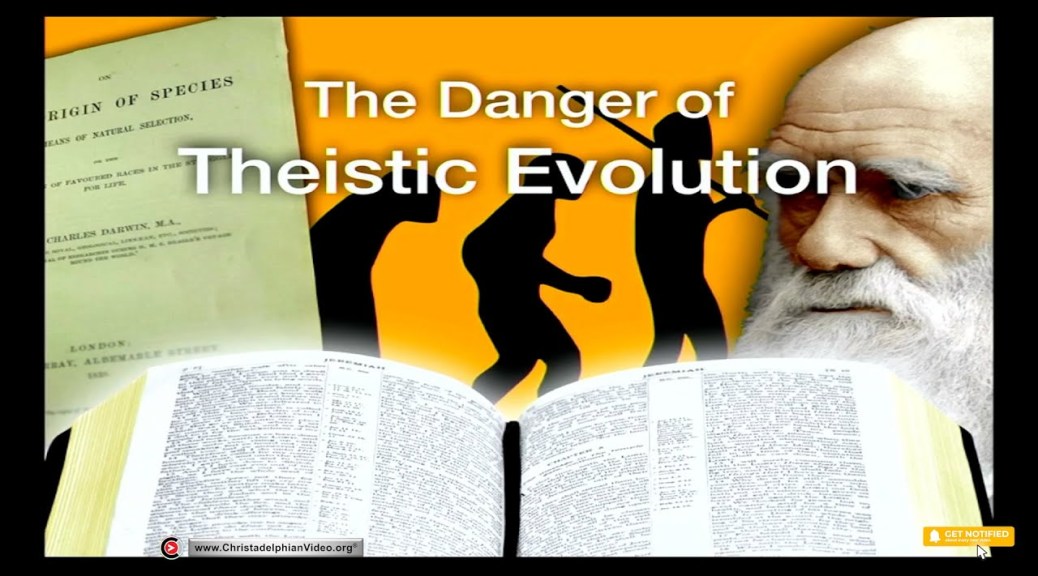
There were two frustrating aspects of megachurch pastor Andy Stanley’s recent advocacy of theistic evolution.
The first, as already documented on these pages, was that Stanley’s position is at odds with the biblical story of creation, which he, as a pastor, is charged to defend. While the Northpoint Church Community head tried his hardest to synchronize Genesis with Darwin, the plain reading of Scripture doesn’t allow such a harmonization to take place.
The second frustrating aspect, which will be the focus of this article, is that those who preemptively disavow the creation account so as not to be seen in conflict with “the science,” are, ironically, not keeping up with the “the science” themselves as it pertains to evolutionary claims.
Far from discrediting theism, the latest scientific literature continues to drive a stake through the heart of Darwin’s original hypothesis.
This new evidence comes by way of an international journal called Progress in Biophysics and Molecular Biology, which is a peer-reviewed publication established in 1950. It seeks to offer “informative and critical reviews of recent advances in different aspects of biophysics and molecular biology.”
We’re not talking about Internet randos posting on Wikipedia.
The journal published a paper not too long ago with this title: “Neo-Darwinism Must Mutate to Survive.” It was penned by one scholar at the University of Missouri-Columbia and another at the University of Texas at Arlington.
The authors waste no time in getting to their main idea:
“Darwinian evolution is a 19th century descriptive concept that itself has evolved. Selection by survival of the fittest was a captivating idea. Microevolution was biologically and empirically verified by discovery of mutations.
“There has been limited progress to the modern synthesis. The central focus of this perspective is to provide evidence to document that selection based on survival of the fittest is insufficient for other than microevolution.”
As a reminder, “microevolution” concerns the variation that exists within a particular species. It could be the result of environmental factors, like impacts on a local climate, or it could be man-made, as is the case with animal breeding.
The point is that this variation takes place within a specific group. Microevolution does not account for an entirely new species. Fish classifications are numerous, for instance, but they remain fish; they don’t mutate into frogs, crocodiles, or birds.
With that background, why do Olen Brown, who holds a Ph.D. in microbiology, and David Hullender, who is a professor of mechanical and aerospace engineering, assert that “selection based on survival of the fittest is insufficient for other than microevolution?”
In short, it’s mathematically preposterous to infer macroevolutionary developments from microevolutionary observations.
They write that macroevolution has “shown to be probabilistically highly implausible (on the order of 10-50) when based on selection by survival of the fittest.”
Now, if you’re like me and still have no idea how you passed your high school precalculus class, you see a number like 10-50 and your brain shuts off in protest. Yet unlike my high school days, there are currently online tutorials that put the concept of negative exponents in layman’s terms.
You can see for yourself how many zeroes are to the right of the decimal point when calculating ten to the power of negative 50 as a possible outcome; basically, it’s a prospect that we non-mathematicians would call a … ridiculously absurd likelihood.
Brown and Hullender are distinguished university employees, so their conclusion is more academic sounding. But if you read the following paragraph carefully, you certainly get that ridiculously absurd likelihood vibe:
“Any overall mechanistic explanation of the origin and evolution of life ultimately must satisfy two challenges: the transition from non-life to life, and the blossoming of life forms that is so extreme as to appear outrageous.
“Evolution of a few flowers on a hillside is reasonably explained by mutation and selection; it stretches logic to explain the millions of extremely diverse species seen currently and in the fossil record.”
The duo note that such “probability assessment has largely been overlooked” for the simple fact that “evolution is generally accepted as scientifically established.”
The consensus attitude is, “It happened, we are here, so the probability is one.”
Expressed differently, today’s scientific community has assumed Darwinian evolution to be true because they are philosophically hostile to a theistic alternative.
Outspoken atheists like Richard Dawkins, for example, are so intent on making sense of “intelligent design” apart from God that they have been reduced to spit-balling guesses about space aliens or multiverse phenomena as potential answers to our fundamental questions about life’s origin.
This atheistic pre-commitment is less about science and more about absolving themselves (in their minds, at least) of accountability to a Holy God who requires our obedience.
Mathematical implausibility aside, proponents of Darwinian evolution are running up against another obstacle.
Charles Darwin’s theory, remember, is built on a model of transitionary phases, wherein lower lifeforms evolve into higher, more advanced ones through the method of natural selection and survival of the fittest. This process, we’re told, has taken place through incremental intervals spanning millions of years, eventually producing the most superior organism to date: humans.
This theory, it turns out, makes a big assumption: That these transitionary phases improve an organism’s chance of survival.
This assumption, however, is unwarranted, as Brown and Hullender maintain:
“[S]urvival of the fittest is illogical when proposed as adequate for selecting the origination of all complex, major, new body-types and metabolic functions because the multiple changes in multiple genomes that are required have intermediate stages without advantage; selection would not reasonably occur, and disadvantage or death would logically prevail.”
To paraphrase: What advantage does a half-evolved eye offer for survival? Or how about a three-quarters evolved lung? Or a two-thirds evolved genitalia? How do mammals even reproduce without fully functioning sex organs?
This is what Brown and Hullender are getting at when they assert that “survival of the fittest,” contrary to popular acceptance, is a death warrant to its recipient because the “evolved” organism is left physically vulnerable during these “intermediate stages.”
It’s as if creatures were first created in a mature, completed state.
The authors of “Neo-Darwinism Must Mutate to Survive” follow up with this bold statement:
“It is our perspective that the burden is too great for survival of the fittest to select evolutionary changes that accomplish all evolutionary novelty. Thus, evolution lacks a sufficient mechanism for multifactorial selections because a process that looks forward, is nonrandom, deterministic, or occurs by an unknown biological process, is required.”
Those words “nonrandom” and “deterministic” are important.
In context, they mean that our vastly fine-tuned universe cannot be explained rationally by a materialistic worldview that is premised on random, “non-purposeful” acts.
In Romans 1:20 the Apostle Paul states that God’s “invisible attributes, namely, His eternal power and divine nature, have been clearly perceived, ever since the creation of the world, in the things that have been made,” leaving us all “without excuse.”
Looks like modern-day science is reluctantly catching up.
I recently came across a helpful word: wintering. Just as winter is a time of slowing down in much of the natural world, author Katherine May uses this word to describe our need to rest and recuperate during life’s “cold” seasons. I found the analogy helpful after losing my father to cancer, which sapped me of energy for months. Resentful of this forced slowing down, I fought against my winter, praying summer’s life would return. But I had much to learn.
Ecclesiastes famously says there’s “a season for every activity under the heavens”—a time to plant and to harvest, to weep and to laugh, to mourn and to dance (3:1–4). I had read these words for years but only started to understand them in my wintering season. For though we have little control over them, each season is finite and will pass when its work is done. And while we can’t always fathom what it is, God is doing something significant in us through them (v. 11). My time of mourning wasn’t over. When it was, dancing would return. Just as plants and animals don’t fight winter, I needed to rest and let it do its renewing work.
“Lord,” a friend prayed, “would You do Your good work in Sheridan during this difficult season.” It was a better prayer than mine. For in God’s hands, seasons are purposeful things. Let’s submit to His renewing work in each one.
“Let everyone be . . . slow to anger; for the anger of man does not achieve the righteousness of God” (James 1:19-20).
If you resent God’s Word, you cannot grow in righteousness.
Have you ever started reading your Bible, thinking everything was fine between you and the Lord, only to have the Word suddenly cut deep into your soul to expose some sin you had neglected or tried to hide? That commonly happens because God seeks to purge sin in His children. The Holy Spirit uses the Word to penetrate the hidden recesses of the heart to do His convicting and purifying work. How you respond to that process is an indicator of the genuineness of your faith.
“Anger” in James 1:19-20 refers to a negative response to that process. It is a deep internal resentment accompanied by an attitude of rejection. Sometimes that resentment can be subtle. Paul described those who “will not endure sound doctrine; but wanting to have their ears tickled, they will accumulate for themselves teachers in accordance to their own desires” (2 Tim. 4:3). They’re the people who drift from church to church in search of someone who will tell them what they want to hear—or a congregation that wants a pastor who will make them feel good about themselves instead of preaching the Word and setting a high standard of holiness.
Sometimes resentment toward the Word ceases to be subtle and turns to open hostility. That happened when the crowd Stephen confronted covered their ears, drove him out of the city, and stoned him to death (Acts 7:57-60). Countless others throughout history have felt the fatal blows of those whose resentment of God’s truth turned to hatred for His people.
Receiving the Word includes being quick to hear what it says and slow to anger when it disagrees with your opinions or confronts your sin. Is that your attitude? Do you welcome its reproof and heed its warnings, or do you secretly resent it? When a Christian brother or sister confronts a sin in your life, do you accept or reject their counsel?
Suggestions for Prayer
Thank God for the power of His Word to convict you and drive you to repentance. Welcome its correction with humility and thanksgiving.
For Further Study
Read 2 Timothy 4:1-5, noting the charge Paul gave to Timothy and his reason for giving it.
For I am not ashamed of the Gospel (good news) of Christ, for it is God’s power working unto salvation [for deliverance from eternal death] to everyone who believes with a personal trust and a confident surrender and firm reliance. . .. For in the Gospel, a righteousness that God ascribes is revealed, both springing from faith and leading to faith [disclosed through the way of faith that arouses to more faith]. As it is written, the man who through faith is just and upright shall live and shall live by faith.
— Romans 1:16-17 (AMPC)
Faith is a word the apostle Paul used often in his writing. When writing to the Thessalonians, he wanted to know about their faith. While the word faith means belief or absolute trust, it’s more than that—the word also implies loyalty and commitment.
Faith means being convinced that something is true. In 1 Corinthians 15:17, the apostle told the Corinthians that if Jesus did not rise from the dead, their faith was meaningless. He was saying that all they believed was utterly useless. True faith acknowledges that the message of Jesus’ death and resurrection is true.
True faith begins when we’re receptive—when we’re willing to listen. It starts with a kind of mental assent—it seems reasonable that it’s true. But that’s not true faith. True faith happens when we say, “Not only does it make sense to me, but I’m willing to stake my life on it.”
Paul taught from Habakkuk 2:4, saying that the just—the righteous—shall live by faith. One way to think of the just is to think of those who were “justified,” or made right, by the death of Jesus Christ on the cross. If we are justified, it means that God treats us as though we are not and have never been sinners. He treats us as His own—His beloved children. Instead of being God’s enemies, we’re His friends. Instead of fighting Him, we serve Him.
When God calls us just, or righteous, we enter into a relationship of love, confidence, and friendship. We need not fear or worry because there is no punishment for us.
When Paul says in Romans 1:17 (AMPC), the man who through faith is just and upright shall live and shall live by faith, he means that those of us who have been made right with God live by our faith. That is, we live by our trust in the God who reaches out to us.
This is where many must fight the wiles of Satan. Instead of focusing on all God has done for us, they listen to the devil whisper, “Do you remember when you lost your temper?” “You’re worried about paying your bills, and if you worry, you don’t have faith, right?” “If you’re supposed to be a Christian, how could you have said what you did?”
The torments are there, and the devil never passes up the opportunity to remind us of past failures. All have failed, and we will continue to fail, but when we do, we can repent and move on.
I went through a particularly difficult time several years ago when there was absolutely no joy or peace in my life. Unhappiness filled most of my days. I repeatedly asked the Lord what was wrong with me, really wanting to know what my problem was . . . no kidding around. I was working so hard to please the Lord and trying to be the kind of Christian I thought I should be, but I certainly didn’t feel like any progress was being made.
Then one day, I came across Romans 15:13 (AMPC) in a box of scripture cards: May the God of your hope so fill you with all joy and peace in believing [through the experience of your faith] that by the power of the Holy Spirit you may abound and be overflowing (bubbling over) with hope. That was it! I got it!
I had plunged into doubt and unbelief, allowing the devil to torment me with his evil lies. As a result, I had become negative, grouchy, short-tempered, and impatient. I was making myself miserable, and the devil was thrilled at the stronghold he had over me!
This scripture changed all of that old thinking! I knew the answer. Jesus loved me so much that He not only forgave all my sins of the past, but He also looked ahead and forgave me for those moments of weakness when I’d fail in the future. I’m not referring to deliberate sin, but to human weaknesses, those times when I just don’t live up to all the truth I know.
“Just think,” I told my husband, “2000 years ago Jesus not only died on the cross for all my sins before I even knew Him, but for all of my sins and failures until the day I meet Him face to face.” That was such a powerful thought to me.
Then I pondered the words of Paul quoted at the beginning of this devotion: For in the gospel, a righteousness which God ascribes is revealed, both springing from faith and leading to faith [disclosed through the way of faith that arouses to more faith] (Romans 1:17 AMPC). I finally understood the concept of living from faith to faith. I don’t have to allow Satan to sneak in with questions or unbelief. I can live every moment moving from faith to more faith to more faith.
Prayer of the Day: Lord Jesus, I am in awe of Your love for me, which is so great and so powerful that You not only died for all my sins before I was born, but You’ve provided for all my weak moments in the future. I am so thankful to You for Your love, and I rejoice in Your holy name, amen.
The Bible is replete with commands like this, urging us to pray without pause. This might sound like an overwhelming expectation, and we may wonder whether we could ever meet it, or even desire to. But perhaps if we see our need more clearly, we will be motivated to pray more consistently.
Our need for prayer becomes most obvious when we understand that our Lord Jesus Christ Himself believed in the absolute necessity of prayer. At the beginning of Mark’s Gospel, we have this account of Jesus: “Rising very early in the morning, while it was still dark, he departed and went out to a desolate place, and there he prayed” (Mark 1:35). Even for the Son of God, prayer was important enough business to attend to early and not to allow the demands of the day to intrude upon.
Jesus knew that “he must go to Jerusalem and suffer many things from the elders and chief priests and scribes, and be killed” (Matthew 16:21). Even so, in the Garden of Gethsemane we overhear Him praying for the cup of God’s wrath to pass from Him if it is His Father’s will (Matthew 26:39; Mark 14:36; Luke 22:42). The Son of God clearly knew that He needed to go before His Father. The writer to the Hebrews summarizes it perfectly for us: “In the days of his flesh, Jesus offered up prayers and supplications, with loud cries and tears, to him who was able to save him from death, and he was heard because of his reverence” (Hebrews 5:7).
Surely it cannot be that prayer was a necessity for Jesus and yet is simply optional for us. If anything, it must be the very reverse! If the Son of God Himself needed to spend time concentrated on prayer to His Father, then how much more does the one who follows after Christ! Prayer is simply too great a privilege for any Christian to ignore and too great a necessity for any of us to neglect. So, ask His Spirit to show you the wonder of prayer and to help you enter into it. When you recognize that there is no end to God’s capacity to help or His willingness to do so, and that there is no moment in which you do not need His help, you will find yourself “praying at all times.”
Questions for Thought
How is God calling me to think differently?
How is God reordering my heart’s affections — what I love?
What is God calling me to do as I go about my day today?
“And I thank Christ Jesus our Lord, who hath enabled me, for that he counted me faithful, putting me into the ministry; Who was before a blasphemer, and a persecutor, and injurious: but I obtained mercy, because I did it ignorantly in unbelief.” (1 Timothy 1:12-13)
In this verse, you see Paul speaking about how God granted him mercy for his past sins because he did them “ignorantly in unbelief.” This is a miracle God does for each new believer. All past sins are forgiven by the Lord and that person is now guilt-free. The new follower now has power through the Holy Spirit to pray and hear God, to read the Bible and understand what it says! This great power was unavailable before the person accepted Christ as his Savior. What an advantage a believer and follower of Christ has over those who do not believe! When a believer acts upon what the Lord has taught, that follower has perfect power from God.
These verses are also a warning for those who have this power – for those who are not “ignorant or unbelieving.” When a believer sins, he has failed to use the power he was free to access. When an unbeliever sins, he doesn’t have access to this power. God’s mercy is great enough to forgive and wipe away the sins of both believers and unbelievers, but the believer’s sin was done in knowledge, and it etches a deeper wound. The believer’s sin can sever the trust of other believers, leaving the person with less responsibility, respect, and influence in God’s work on earth. More importantly, if the sin done in knowledge continues, the believer starts to loose contact with God and God’s work in his heart.
God loves all people, but He cannot give His power to those who are not willing to follow. Have you noticed a loss in power? Even a small loss is big – get back to learning and understanding right away. God wants you using His power for all good things in your life and in the lives of those around you. No sin is worth missing out on God’s power in your life.
God makes His power available to those who are right with Him.
My Response: » Am I failing to make use of God’s power by refusing to acknowledge my sins to God? » Are there sins I need to confess and forsake so that the Spirit can enable me to do His work?
I remember my visit to Beijing’s massive Tiananmen Square some years ago as if it were yesterday. The area is named for a gate in the wall of the Imperial City built in 1417; the square was built in 1651 and enlarged fourfold in the 1950s. It is intended to impress visitors with its size (it measures more than fifty-three acres) and thus with the grandeur and power of the Chinese ruling dynasty.
Its political purpose was tested as never before, however, when nearly a million protesters crowded into central Beijing in May 1989 to call for greater democracy. Yesterday marked the anniversary of the Tiananmen Square massacre, the day when Chinese troops and security police stormed through the square, firing into the crowds. Perhaps thousands were killed; as many as ten thousand were arrested.
What kind of government fires on its own citizens?
The kind that violated maritime laws in the Taiwan Strait two days ago in what US Defense Secretary Lloyd Austin called an act of “coercion and bullying.” The incident marked the second major provocation by China’s military in the span of a week.
The kind that props up North Korea as it continues to develop nuclear warheads that, according to its latest claims, could be capable of striking South Korea and Japan. The kind that supports Russia’s immoral war in Ukraine with economic aid and military technology. And the kind that serves as Iran’s largest trade partner as the latter moves closer to obtaining nuclear weapons than ever before.
“You are not destined to live in quiet times”
Imagine a future in which three nuclear-armed powers (along with a fourth if Iran fulfills its nuclear ambitions) are aligned against the West. Add the warning last week from technology experts that artificial intelligence could lead to the extinction of humanity. And the partisan political divisions that are deeper and more vitriolic than they have been in decades.
The fact is, as Walter Russell Mead recently noted, “You are not destined to live in quiet times.”
Mead is the Global View Columnist at The Wall Street Journal, a Strategy and Statesmanship fellow at Hudson Institute, and a foreign affairs and humanities professor at Bard College. In my view, he is one of the most perceptive geopolitical analysts working today.
One factor he identifies in “making sense of our times” is the widening gap between technological advances and cultural values. Mead writes: “Our political parties and institutions took shape long before the internet and social media existed. Our government bureaucracies, our schools, and our legal system were all built for conditions that no longer exist. . . . Many of our political ideas and ideological assumptions also reflect the conditions of an earlier era.
“If society’s operating system is running on the equivalent of a long-outdated version of Windows, that makes real reform difficult to imagine, and harder still to carry out.”
Mead concludes: “While the ever-accelerating and ascending wave of human progress has brought us to peaks of achievement and affluence that our ancestors could scarcely imagine, it has both failed to keep us safe from the most dangerous predators of all and—to the degree that the rate of progress has become a major force of destabilization—progress itself may now be the greatest source of danger humans face.”
A culture at a crossroads
As China’s autocratic dictatorship widens its influence and enforces its will on more and more of the world, we are seeing Mead’s thesis in action. A government bereft of biblical or even objective morality, one that exists solely to protect its leaders and advance its national interests even at the expense of its own citizens, shows us what happens when technological progress outstrips moral boundaries.
As America moves further and further from biblical morality and objective truth, we are illustrating the same warning culturally and spiritually: “Progress itself may now be the greatest source of danger humans face.”
Our “progress” with human sexuality is destroying families through adultery, damaging minds through pornography, and deceiving generations of impressionable children and teens through LGBTQ ideology. Our “progress” with artificial intelligence is, in the view of many experts, threatening our future as a civilization. Our “progress” with information technology is enabling us to consume only the political perspectives with which we agree while demonizing our political opponents.
At such a crossroads, you and I hold the only hope for a flourishing and redemptive future.
The choice that defines our future
Perhaps Tim Keller’s most famous quote was his observation, “The gospel is this: We are more sinful and flawed in ourselves than we ever dared believe, yet at the very same time we are more loved and accepted in Jesus Christ than we ever dared hope.”
I invite you to embrace and proclaim the two biblical facts Dr. Keller noted.
One: Humans are so “sinful and flawed” that we have no assurance of a better future of our own making. Left to our own devices, we invent nuclear technology that powers cities but also destroys them. We create innovations that improve our lives immeasurably but also threaten our survival as a species. And, whatever our particular experiences with these realities, we will all die one day (if the Lord tarries) and face eternity.
Two: Humans are so “loved and accepted in Jesus Christ” that, when we put our hope in him, he is “able to do far more abundantly than all that we ask or think, according to the power at work within us” (Ephesians 3:20). When we make Christ the king of our lives and encourage everyone we know to do the same, our future is as bright as his omnipotent love.
Our choice between these two realities defines our future as a nation and as individuals.
So God created man in His own image; in the image of God He created him; male and female He created them.
God created us in His image. You are an expression of the manifested genius of God. He looked at this world and thought that this planet would be better off with you in it. He divinely designed you. Before He even formed you in the womb, He knew you (Jeremiah 1:5).
The book of Acts declares that God determined the seasons of our existence, that He set the boundaries of our lives so that we might seek Him and find Him because He is never far from us (Acts 17:26-27). He chose you. He appointed you for a purpose. He placed you on this earth for this specific time. God made a choice when He created you!
God’s heart is towards people. He sent His Son to redeem all of us. Jesus died to save us, to bring us into right relationship with God, into the parameters of the borders that God has established. It is time to point back to the unchanging borders that God has created. Let us fulfill His expectations of us!
Blessing:
Heavenly Father, I acknowledge You as my Creator. Please forgive me for all the places that I have fallen short of Your expectations, where I have sinned. Please wash me clean and re-establish Your borders in my life. Empower me to live according to Your will…not mine. In the name of Jesus… Amen.
But the Lord said to Samuel, “Do not look at his appearance or at his physical stature, because I have refused him. For the Lord does not see as man sees; for man looks at the outward appearance, but the Lord looks at the heart.” 1 Samuel 16:7
On August 28, 1963, Dr. Martin Luther King, Jr. delivered his “I Have a Dream” speech on the steps of the Lincoln Memorial in Washington, D.C. In his speech, he said, “I have a dream that my four little children will one day live in a nation where they will not be judged by the color of their skin but by the content of their character.”1
That dream has not yet been realized. But God does not see people based on their race, nationality, or social background. When Samuel was choosing Israel’s next king from among Jesse’s sons, God specifically told him not to look at external qualities. Instead, he was to choose as God chooses—on the basis of the heart (1 Samuel 16:1-13).
When we look at people, let us view them as God does, not as the world does. Let us appreciate their heart above all.
When we begin to see people through God’s eyes, our focus will change from looks to life. David C. McCasland
1 “Martin Luther King Jr.: I Have a Dream,” American Rhetoric.
Before I became a Christian at age seventeen, I was sick and tired of this world. I had been raised in a home without God. I didn’t have anything to overcome as far as obstacles to the Christian faith because I knew nothing about it.
I had been to church a few times with my grandmother, but what I heard never really penetrated for the most part. I was truly godless.
As I watched the adults in my world, I saw affluence and all the world had to offer. But I also saw how miserable they were. So, I went out on my own path and experienced enough to see the emptiness of it. And by the time I was seventeen, I knew that life as this world offers it is empty. Coming from a broken home and a disillusioned generation, I was searching for meaning.
My question was not so much whether there was life after death. It was whether there was life during life. Was there more to life?
Then I heard about Jesus Christ. I heard one of His statements in which He said, “My purpose is to give them a rich and satisfying life” (John 10:10 NLT). Jesus not only offers life after death; He offers life during life. And that got my attention.
I noticed that Christians seemed to have found meaning. They weren’t doing the things I had been doing, and they had contentment. And when I became a Christian myself and started reading the Bible, it came alive to me. It was the user’s manual for life that I’d been searching for.
The world offers a fleeting happiness that comes and goes. But God offers a happiness that will be there despite our circumstances. This happiness doesn’t come from what you have; it comes from who you know.
The longest international border in the world is shared by the United States and Canada, covering an incredible 5,525 miles of land and water. Workers regularly cut down ten feet of trees on both sides of the boundary to make the border line unmistakable. This lengthy ribbon of cleared land, called “the Slash,” is dotted by more than eight thousand stone markers so visitors always know where the dividing line falls.
The physical deforestation of “the Slash” represents a separation of government and cultures. As believers in Jesus, we look forward to a time when God will reverse that and unite all nations across the world under His rule. The prophet Isaiah spoke of a future where His temple will be firmly established and exalted (Isaiah 2:2). People from all nations will gather to learn God’s ways and “walk in his paths” (v. 3). No longer will we rely on human efforts that fail to maintain peace. As our true King, God will judge between nations and settle all disputes (v. 4).
Can you imagine a world without division and conflict? That’s what God promises to bring! Regardless of the disunity around us, we can “walk in the light of the Lord” (v. 5) and choose to give Him our allegiance now. We know that God rules over all, and He will someday unite His people under one banner.
“This you know, my beloved brethren. But let everyone be quick to hear, slow to speak and slow to anger; for the anger of man does not achieve the righteousness of God. Therefore putting aside all filthiness and all that remains of wickedness, in humility receive the word implanted, which is able to save your souls” (James 1:19-21).
True believers receive God’s Word.
The key word in today’s passage is “receive” (James 1:21). Believers are to receive God’s Word. That’s what distinguishes them from unbelievers. Jesus said to a group of religious unbelievers, “Why do you not understand what I am saying? It is because you cannot hear My word. . . . He who is of God hears the words of God; for this reason you do not hear them, because you are not of God” (John 8:43, 47).
“Hear” in those verses doesn’t refer to hearing with the ear only. Jesus’ audience heard in that sense—even to the point of wanting to kill Him for what He said (v. 59)—but they didn’t receive and obey His words. By rejecting the truth, they proved themselves to be children of the devil, who is the father of lies (v. 44).
Peter called God’s Word the imperishable, living, and abiding seed that brings salvation (1 Peter 1:23). But receiving God’s Word isn’t limited to salvation alone. As a Christian, you have the Word implanted within you. Now you must nurture it by removing the weeds of filthiness and wickedness so it can produce the fruit of righteousness. That isn’t a one-time effort, but a lifestyle of confession, looking into God’s Word, desiring His message, and longing to obey it. That doesn’t mean you’ll be sinlessly perfect, but your life will be marked by ever-increasing spiritual maturity and obedience to the Word. When you are disobedient, you should feel an enormous tension in your spirit until you repent and make things right.
Are you hearing and receiving God’s Word in that way? Do those who know you best see you as a person whose life is governed by biblical principles? Jesus said, “If you abide in My word, then you are truly disciples of Mine” (John 8:31). Receive His truth and abide in it continually!
Suggestions for Prayer
Ask the Lord to keep you sensitive to His Word in every situation you face today.
A man’s mind plans his way, but the Lord directs his steps and makes them sure.
— Proverbs 16:9 (AMPC)
When your day doesn’t go as planned, do you get irritated because someone or something has interrupted you? I know I do at times. What if we would see these changes in our plans as divine opportunities rather than interruptions that irritate us? Could that last-minute request from a friend for help be an opportunity to serve Christ that would produce more good fruit in our lives than our original plan? Would a one or two-hour delay perhaps end up putting us in the right place at the right time for an opportunity we would have missed had we refused to change our plan?
There is nothing wrong with having a plan—as a matter of fact, I think it is wise to do so—but we should be ready at any time to drop our plans and follow God. He often gives us opportunities to help someone or to follow Him in an adventure that will bring blessings into our lives, but we can easily miss out on His better plan if we are not willing to “let go and let God lead.”
There are also times when what seems like an interruption is God’s protection from some unseen danger we would encounter if we continued in the path we had planned. Can heavy traffic that disrupts our plan save us from being in an accident? Could the airport delay be a blessing in disguise? The answer to these examples is yes, and if we will trust God with things like this and believe that our times are in His hands (see Psalm 31:15), we will enjoy more peace and have less stress.
Prayer of the Day: Father, help me follow Your lead at all times. I want Your will to be done in my life, and I want to always be available for You anytime You need to use me to further Your will. Help me to never miss a divine opportunity with You!
The devil knows the Bible. He knows what it says, and he can quote it with ease—better than most of us, undoubtedly. Satan quoted Scripture to Jesus when He was fasting in the wilderness (Matthew 4:1-11)—though notice that Satan also twisted what the Bible says for his own deceitful schemes. This shouldn’t surprise us, since the best lies usually have at least a bit of truth in them.
In that encounter, when Satan took Jesus to the pinnacle of the temple, he enticed Him with an appeal to a spectacular, angelic rescue. But the devil misused Psalm 91 by taking it out of context (Matthew 4:5-6), and Jesus rebuked him by quoting Deuteronomy 6:16: “You shall not put the LORD your God to the test.” The Son of God repeatedly quoted Scripture to Satan, and he eventually fled (Matthew 4:11).
Our best defense against Satan, then, is Scripture rightly understood and rightly applied. This is why Paul tells us that in order to stand firm against “all the flaming darts of the evil one,” we must “take up … the sword of the Spirit, which is the word of God” (Ephesians 6:16). There is no better tool to resist temptation and devilish ploys than the Bible. God’s word is what we use to resist the devil, and the overwhelming spiritual power of that word is precisely why he flees (James 4:7).
Psalm 119:11 encourages God’s people to store up God’s word in their hearts in order that we might not sin against Him. This might sound like a nice, gentle invitation at first—but while it may prove true that the Bible can be consumed and meditated upon in the comfortable company of a warm beverage and a cozy chair, the call to memorize Scripture is in fact a call to arms. Every soldier needs a weapon. Every Christian needs the word of God. Think about the temptations to sin that you regularly face (and, perhaps, give in to). What verses of Scripture do you need to deliberately memorize and then deploy against the devil’s half-truths and lies? Think about the times when the Evil One suggests that you are not really a child of God, not really forgiven. What parts of Scripture will you fling back at him in those moments? The word of God is your sword against Satan. Take it up today, and make him flee.
Questions for Thought
How is God calling me to think differently?
How is God reordering my heart’s affections — what I love?
What is God calling me to do as I go about my day today?
“He that hath my commandments, and keepeth them, he it is that loveth me: and he that loveth me shall be loved of my Father, and I will love him, and will manifest myself to him.” (John 14:21)
Jesus had just told His disciples that He was going to go away from them. He said that He was going to go and prepare a place for them in His Father’s house. For three years, His disciples had followed Him. They had walked beside Him, listened to Him teach, watched Him heal sick people, and even eaten meals with Him. But now He said that He was leaving, and they weren’t going to see Him for a while. Their hearts were sad and troubled. Jesus was their Master, their Teacher, their dearest Friend.
But Jesus had good news for them. He was going to send them a Helper—the Holy Spirit—who would stay with them always. Even though Jesus was returning to heaven after His death, and even though His followers would not see Him anymore, He promised that they could still know Him, talk with Him, and be close to Him.
Do you have a desire in your heart to know God—I mean really know Him? Do you want to have a deep, personal relationship with Him, even though you can’t see Him with your eyes? Do you want to know what He thinks and how He feels? Do you want to understand Him as He really is?
According to this verse, knowing God starts with obedience. The very first thing we have to obey is the Gospel. Jesus said, “I am the way, the truth, and the life; no man cometh unto the Father but by me.” (John 14:6) But after we’ve entered into a relationship with God through repentance and faith in Christ, we need to keep on obeying Him. We need to take everything that He tells us in His Word very seriously. That is the best way to show God that we love Him. And once we are saved, we have His Holy Spirit dwelling in us. The Holy Spirit helps us understand God’s Word and gives us power to obey it.
Jesus said that He will manifest Himself, or make Himself known in a special way, to those who love Him. If you really want that kind of closeness with Jesus Christ, He wants to give it to you. Ask Him for it, and then start listening to His voice and obeying Him. A close relationship with Jesus carries a price tag of obedience. But it is a price well worth paying, and the rewards will last through eternity.
Jesus reveals Himself to those who love and obey Him.
My Response: » How much do I want to know God? » Am I willing to pay the price of obedience?





 DAILY DEVOTIONS, NEWS AND INFORMATION