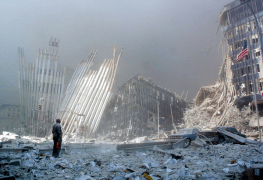
As some would continue to perpetrate the myth of progress, we live on this fifteenth anniversary of 9/11 under the cloud of a world dramatically changed since that terrible day. Anyone who travels sees and feels what a murderous ideology has done to our world. May we never forget what happened and ever be in pursuit of wisdom and courage to deal with those whose philosophy thrives on hate. Our prayers are for the families that lost a loved one and with gratitude for those who came to the rescue.
Civilization is always threatened by ideologues who embrace the moment and lose sight of the essential value of every human life. Answers will only be found in embracing the God of love and living by his precepts. Loving God and our fellow human beings are the two laws on which all other laws stand. May God guide our leaders. The Scriptures call us to understand the times and know what to do (see 1 Chronicles 12:32). May we be faithful.
September 11, 2001: Was God Present or Absent?
Every thinking person has at some time raised the question, “Where is God in the midst of suffering?” That question without doubt echoed in millions of minds on September 11, 2001, and continues to do so, fifteen years later. If illustration were argument, an event such as this would give fodder to both sides of the issue—to those who want to establish the complete absence of God and to those who testify that He exists and is involved in the circumstances of our lives. To a watching world, the finest testimonials to the faith of the nation were the crowded churches the following Sunday and the extraordinary national memorial service.
Stepping back from the scene, two starkly different stories from September 11 represent the struggle of the search for God. One story was told by the men of Ladder 6, a company of the New York City Fire Department. Seven firemen were helping a sixty-nine-year-old woman by the name of Josephine down from the 73rd floor of one of the World Trade Center towers. These brave men, already laboring under 110 pounds of equipment on their backs, led Josephine step by step down the staircase. At times, she was ready to give up, but they helped, encouraged, inspired, and assured her she would make it. “They were like angels to me,” she said. She would stop to catch her breath and they would stop with her. She started to shiver with fear and one gave her his jacket. One floor at a time they got her down until, finally, she could walk no more and just sat down on one of the steps of the fourth floor.
They waited with her, coaxing her to stand up and resume walking because they were almost to the ground floor. But she could not move, and they refused to leave her. Suddenly, they heard and felt the floors beneath them give way under the tremendous weight of the collapsing building, and they were hurtled down with terrific force and enveloped in a suffocating cloud of pitch-black smoke. One of them even prayed, “God, if this is it, please let it be quick.”
But as the noise lessened and the smoke began to clear, they found that they had settled over the rubble of the caved-in floors below them. Miraculously, Josephine had refused to go any further at the one point that remained intact as the building fell. All seven firemen plus Josephine were eventually brought into the daylight of safety.
“Had we continued descending when we were pleading with her to keep moving,” they said, “we would have been killed by the crush of the floors above us.” One of them added, “Josephine was like an angel sent from God to stop us so that we could be safe.”
How can we react to a story such as this but to concede that those who were rescued in this way saw the hand of God leading, guiding, and stopping their steps? Yet, not every story ended like Josephine’s. The hearts of thousands of others who lost loved ones may well throb with a different emotion. I think of one young woman who, through weeks of struggle, torn by indecision at the marriage proposal of a young man, finally made her choice during the night. In the pre-dawn hours of the 11th she phoned his office at the World Trade Center from her home in California. Her message awaited him when he arrived at work, with words of love and the welcome news that she would marry him. But at midmorning when she retrieved her own messages, her world was unforgettably changed. The voice she heard was not the voice of a man exultant at the news of her acceptance. Instead, she listened to the terror in his voice as he told her that he loved her with all his heart, but his building had been struck by an airplane and was beginning to crumble before his eyes. No angels dragged him to safety.
Was God near or far? Any time a catastrophic event happens, numerous human-interest stories give God glory, while others give Him blame.
The Problem Is Greater Than We Think
Theologians have an interesting description for this predicament. They call it “the hiddenness of God,” or “divine hiding.” Why does not God make his presence more obvious? Many arguments are offered for why God “hides” in a world that seeks to see Him. The answer is ultimately found in the divine purposes of God. It is not that God has absconded or is absent; it is that there is a divine purpose behind his visibility or invisibility. If one can rightly read the clues, the mystery is opened up in profound ways. Just as evil can be understood only in the light of the ultimate purpose, so also must God’s presence or seeming absence be judged on the basis of his purpose.
Numerous times in the Scriptures, signs were asked from God, and they were given. But in spite of that, trust in God was not automatic. Probably no disciple received more displays of God’s power than the apostle Peter. He was one of only three who witnessed the Transfiguration of Jesus. Jesus had taken his disciples to the top of a mountain where they saw a sight not given to any other human eye. They saw Jesus’s body begin to glow with a whiteness that was almost blinding. Suddenly Moses and Elijah appeared and began to talk with Jesus. Peter asked Jesus if he could build shelters there for the three luminaries, but a voice thundered from the heavens saying, “This is my Son. Listen to Him” (see Luke 9:35). This experience had everything—Sight! Sound! Words! Power! Peter was so overcome that he did not want to go down from the mountain. But Jesus told them it was time to return to the humdrum world of their day-to-day existence.
But there is more. Jesus was trying to help his disciples to understand the frailty He saw in them—their chronic bent to be enchanted every moment. Peter saw the proof of Jesus’s divinity in his transfiguration. He did not doubt after that who Jesus was. Yet, when Jesus was arrested, Peter floundered and even denied that he ever knew Jesus. He was in momentary awe of the miraculous but could not trust God for the future. This failing was also common in Israel’s exodus from Egypt. The people would witness a miracle and follow God with national repentance. But as soon as God seemed to hide for some time, the grumbling and skepticism began. Peter was in momentary awe of the miraculous but could not trust God for the future.
The examples of Israel and of Peter are repeated endlessly in our own experiences. We have a limitless ability to trust God only when it suits our purpose. Rather than allowing God to be God and serving Him for who He is, we actually try to play God and He becomes our subject, expected to do our bidding at our every whim. I do not know of any greater fickleness in the human heart than this. We lie to ourselves after a miraculous event, believing it will have staying power. But the moment another steep hill appears before us, we wonder whether the miracle we witnessed some time back actually happened or was only a delusion. Reality is threatened by this fickleness, and if we do not understand and accept this, we live in an illusionary world of chronic skepticism. Our demand for more information is, in a real sense, a fight against our finitude.
The Solution Must Go Deeper Than We Seek
A subtle delusion keeps us from the real battle. The truth behind our clamor for explanation is that we assume ourselves to be only intellectual entities and thus, if only our intellect can be satisfied, we will be content. One of the most powerful encounters in the Bible is between Jesus and a learned man named Nicodemus. Nicodemus recognized the supernatural character of Jesus and said to Him, “Teacher, no one could do the miracles you are doing unless God is with him” (see John 3:2). That tacit endorsement could have easily elicited a commendation from Jesus. Instead, Jesus challenged Nicodemus that if he wanted to be part of God’s kingdom, he needed to have a new birth. This was not the direction Nicodemus had planned on going, but Jesus knew exactly what He was about. He was telling Nicodemus that it is not the miracle over matter that ultimately has staying power; it is the miracle over the way we think about reality that has eternal ramifications. We are not all intellect, and therefore some need beyond the intellect needs to be met.
But there is a second point I wish to make. We look for God to be something concrete, something we can see or handle or fully explain. This is a fallacy born out of our addiction to the external, and human history has repeatedly challenged that disposition. There are many evidences of God’s miracle-working presence. Incredible stories abound for which there is often no natural interpretation that satisfactorily explains them.
The supernatural is possible. It happens, but it does not lead to the greatest miracle in a life. For you see, anyone can take a miraculous story and explain it a dozen different ways. At best it just proves that there is a power beyond our own. So where does that leave us? What God seeks in every individual is not just companionship based on his intervention, but communion with Him based on his indwelling. That is what makes the difference when a building is collapsing. It is not whether a hand grabs your hand and rescues you from the carnage; it is that no matter what happens, his strength empowers you to rise beyond the devastation.
If humanity was only mind or intellect, evidence from the physical world would be all that mattered. But there is a depth to our being; a spiritual essence that goes deeper than our intellect. We are spiritual beings and God responds to us in spirit. That essence hungers for intimacy.
I would not at all be surprised to learn someday, when the words and thoughts of those who died in the devastation of September 11th are revealed in God’s presence, that many, many of them knew a profound sense of his presence, even when they knew life in its earthly sojourn was coming to an end.
There is at least one profound lesson that I draw from these life and death stories, and it is this: There is an appointed time for each of us when life will meet its end.
Peter Marshall, former chaplain to the United States Senate, told a story, called “Rendezvous in Samara,” of a man who worked as the servant of a wealthy merchant. He had gone into town to shop for the day when suddenly he felt someone brush heavily against his shoulder. Somewhat offended, he turned toward the person who had jostled him and found himself staring into a pair of eyes that spoke death to him. Panicking, he dropped everything and ran home. His master saw him running breathlessly toward the house, and met him on the front steps. “What on earth is the matter?” asked the master. “Oh, sir! Someone in the marketplace rudely brushed me, and when I turned to face him, he looked like the Angel of Death to me. He, too, had a look of shock on his face. It was almost as if he wanted to grab me but then backed away. I am afraid, sir. I don’t want to go back to the market.”
“Saddle one of our horses and ride all day ’til you reach the distant village of Samara,” the master said. “Stay there ’til you get word from me that it is safe for you to return.”
The servant rode off, and the master made his way to the market to find the person who had so frightened his servant. As he wound his way through the crowded streets, he suddenly came face to face with this strange looking individual. “Who are you?” the master said. “Are you the one who just scared my servant?” “Yes, indeed.” “Why did you frighten him?”
“Well, I was truly surprised to see him here. I am the Angel of Death, and I chose to spend the day here before heading to my stop for tonight. You see, it was not so much that I surprised him, as that he surprised me. I did not expect to see him here because I have an appointment with him in Samara tonight.”
We can flee the marketplace, only to find that the quiet village of Samara is where our rendezvous was to be. But, thanks be to God, He seeks to remind us that Samara is not the end, for He has designed us with a hunger for eternal companionship and in communion with Him alone is that hunger fulfilled. That beautiful song “The Lost Chord” ends with the lines: “It may be that only in Heav’n I shall hear the grand Amen.”
By Ravi Zacharias
http://www.rzim.org/





