
The Problem with Lies

The Problem with Lies

Nowadays, we have a plethora of lies that are told knowingly and openly and without shame.

• “Genocide” is defined as the systematic extermination of a race. Either Israel is really bad at it, or it is in a war against Hamas, not committing genocide against Palestinians. 10-20,000 civilian deaths is terrible in human terms. But with two million Gaza residents and about 20,000 killed, including Hamas? Poorly done genocide.

The real problem in the Middle East? Jews refused to convert to Islam. The same is true of the nomads, Druze and Christians. Prominent Muslim leaders demand non-Muslims to either convert, subdue, or die. It isn’t only about Jews, you are just as evil for not converting to Islam. Don’t think you’re excused because you have an open heart, even people from the wrong form of Islam (Sunni/Shia/Ibadi/Ahmadiyya/Sufism) are just as evil as Jews, to most Muslim leaders.

• Our media is free, fair and impartial. Okay, stop laughing. When Peter Jennings said that 90% of the media is left wing, including him, you should have believed him. If you wish to believe they don’t tilt the news to the Left, wake up. The examples are enormous. Just one? President Barack Obama and Attorney General Eric Holder cooked up a plan to force U.S. gun sellers to provide guns to Mexican criminals, so that they could blame the NRA and gun owners. They were caught red-handed and then stonewalled the investigation. Holder refused to even testify. He had every chance to disprove the facts, he declined and the media dropped the subject.

• Consider Jeffery Epstein. We can assume that he was running a blackmail scheme on all sorts of prominent people. He may have done it with cooperation from government, at some level. He was guilty as hell and the wheels came off when they simply could no longer cover it up. No one (or few) in the mainstream media are demanding the client list be made public, so apparently some pedophiles are too important to be “under the law.” They can release some names, but rest assured that 90% of the list and the content of the videos will never be known. Proof? How many of his employees have testified in front of Congress?

• Another example is that we are led to believe America is a major polluter. We supposedly waste power, spew CO2 and pollution more than anyone — we are the biggest environmental problem in the world. There is zero evidence to support this. We’ve done far more than most anyone to reduce pollution and energy waste. India and China are far greater polluters and do not have to do anything to reduce their pollution or energy waste. I stood on a main street in Lahore, Pakistan several years ago and watched the traffic. A cloud of pollution, smoke, and dust traveled with traffic. The cloud moved with traffic, in two directions, depending on which lane. I have a friend who saw the same thing in China. They are building coal-burning power plants by the score. America is responsible for a small portion of energy waste and pollution.

• America is not fair to poor countries and that is why they remain poor. That anyone believes this is discouraging, as the evidence is quite the opposite. There is no limit on success. Poor countries are not poor because we aren’t. They are poor because the people are not allowed economic freedom. The simple fact is that capitalism and free enterprise are the natural way. All of life succeeds on merit. We seem to think nature is wrong. But when your child needs an operation, do you seek out a doctor who graduated in the bottom of his class and has a poor record? Of course not. You want the best you can get and if the child is injured, the doctor is taken off the job. This causes poor doctors to not do as many surgeries on sick kids.

Free enterprise is merit-based success and a form of natural evolution. A society that ignores merit for other goals becomes stagnant. Look at most Islamic countries today. Name a major international business or technology based in a Muslim country.

Nature doesn’t favor little fish over big fish. Nature allows the natural balance to cause the little fish to evolve ways to improve themselves to counter the predation of big fish.  Balance is natural, imbalance is unstable.

People are not fish, but we respond better to opportunity than to a police state. There is no limit on success, everyone can be successful, no one has to lose. They may have to change tactics or require assistance if they are handicapped in some way. But if you can work, you can achieve in a free society.

Government is there to keep things safe, not to guide and control society. But the people in charge have to allow the natural order to work by way of the success of better ideas — nothing succeeds like success.

Our biggest problem today is the guilt of people who know that that did not earn their cushy lives. These people think that they need to help poor people by giving them money. But that makes the problem worse. Mom and Dad may have worked hard to get their kid a great education, but the kid is told he doesn’t deserve it. The professors and elites running colleges feel guilty for having what they didn’t earn and think the solution is to give your money to the less fortunate in other countries who weren’t given the opportunity to earn it.

The irony is exquisite.

People need to deserve their success. It is human dignity we are talking about here. They need fair opportunity to be proud of their efforts. Give people in poorer countries fairness and freedom to succeed.

This isn’t advanced physics, rocket science or brain surgery, it is obvious, common sense.

Western civilization is the solution that works. China was in deep stagnation until they adopted some free enterprise. Look at Japan. After WW II, they embraced free enterprise and excelled. Look at Singapore, Korea, and Taiwan, grossly more successful than their unenlightened counterparts. America isn’t better due to race or any human condition, we are successful, as is Western Europe and Japan, due to providing our citizens with freedom and better opportunity.

America needs to stop accepting guilt for the failure of bad ideas, not embrace worse ones. Socialism and government plans for society have never worked. We aren’t smarter than Mother Nature. There is not a single example of a dictatorial societies’ success in the world today.


Source: The Problem with Lies – American Thinker

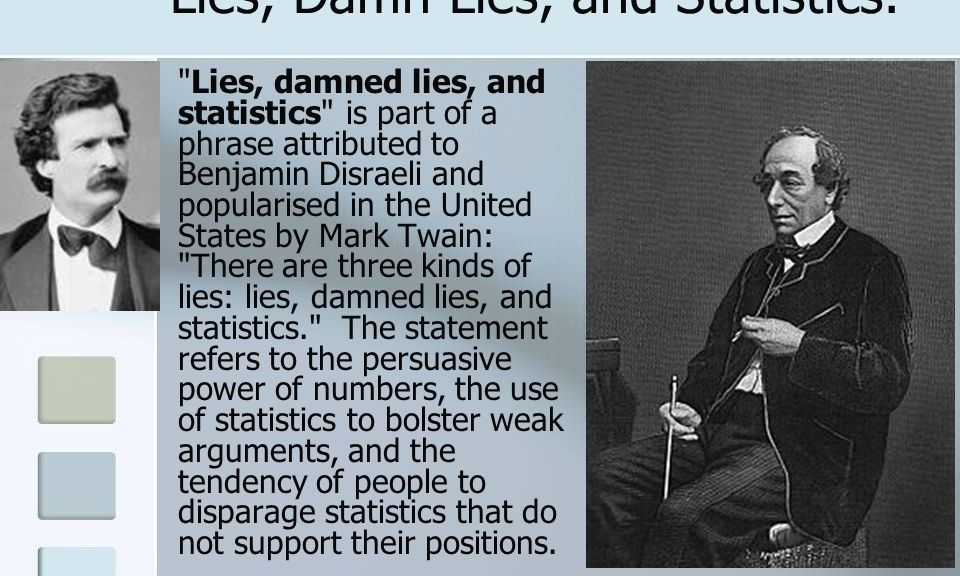
Main Picture Quote – “Lies, damned lies, and statistics” is part of a phrase attributed to Benjamin Disraeli and popularized in the United States by Mark Twain: “There are three kinds of lies: lies, damned lies, and statistics.” The statement refers to the persuasive power of numbers, the use of statistics to bolster weak arguments, and the tendency of people to disparage statistics that do not support their positions – Lies, Damn Lies, and Statistics.

Our Daily Bread — God at the Crossroads

Bible in a Year :

Stand at the crossroads and look; . . . ask where the good way is, and walk in it.

Jeremiah 6:16

Today’s Scripture & Insight :

Deuteronomy 30:15–20

After days of illness and then spiking a high temperature, it was clear my husband needed emergency care. The hospital admitted him immediately. One day folded into the next. He improved, but not enough to be released. I faced the difficult choice to stay with my husband or fulfill an important work trip where many people and projects were involved. My husband assured me he’d be fine. But my heart was torn between him and my work.

God’s people needed His help at the crossroads of life’s decisions. Far too often, they hadn’t adhered to His revealed instructions. So Moses implored the people to “choose life” by following His commands (Deuteronomy 30:19). Later, the prophet Jeremiah offered words of direction to God’s wayward people, wooing them to follow His ways: “Stand at the crossroads and look; ask for the ancient paths, ask where the good way is, and walk in it” (Jeremiah 6:16). The ancient paths of Scripture and God’s past provision can direct us.

I imagined myself at a physical crossroads and applied Jeremiah’s template of wisdom. My husband needed me. So did my work. Just then, my supervisor called and encouraged me to remain home. I drew a breath and thanked God for His provision at the crossroads. God’s direction doesn’t always come so clearly, but it does come. When we stand at the crossroads, let’s make sure to look for Him.

By:  Elisa Morgan

Reflect & Pray

Where do you need direction today? How might God be revealing Himself to you?

Dear God, when I’m uncertain, help me to stand at the crossroads and look for Your provision.

http://www.odb.org d1

Grace to You; John MacArthur – Approaching Life from a Divine Perspective

 “I, therefore, the prisoner of the Lord, entreat you to walk in a manner worthy of the calling with which you have been called” (Ephesians 4:1).

To mature in our faith, we must learn to see things from God’s perspective.

Paul was a prisoner of Rome. Why then did he call himself “the prisoner of the Lord”? Because he had the ability to see everything in terms of how it affected Christ. No matter what happened in his life, he saw it in relation to God. His questions were, “What does this mean, God?” and “How does this affect You?”

When a problem comes in life, we are prone to say, “Oh, woe is me!” and wonder how it will affect us: Will it cause me pain? Will it cost me money? Too often we think only on the earthly level. But like Paul, we should think on a heavenly level: What is God trying to teach me? How can I glorify Him in this? In fact, a good definition of Christian maturity is: automatically seeing things in light of the divine perspective.

This perspective, this God-consciousness, is the only right way for Christians to live. David said, “I have set the Lord continually before me; because He is at my right hand, I will not be shaken. Therefore my heart is glad, and my glory rejoices; my flesh also will dwell securely” (Ps. 16:8-9). Because David was always aware of God’s presence, he found joy and security, and no trouble could disturb him for long.

Paul was the same way: he knew there was a reason for his imprisonment and that Christ would be glorified by it (cf. Phil. 1:12-14). Paul wasn’t preoccupied with how it affected him, and thus he was able to rejoice, even in prison.

“God causes all things to work together for good to those who love God, to those who are called according to His purpose” (Rom. 8:28). Nothing happens outside of God’s control. Let’s trust that He knows what is best for us.

Suggestions for Prayer

If you tend to get discouraged or complain when troubles come, ask God to forgive you and help you see troubles from His perspective. Acknowledge before Him that He is in control of everything.

For Further Study

Paul’s attitude toward difficulties was cultivated by the experience he describes in 2 Corinthians 12:2-10. What did Christ teach him about troubles in verse 9, and how did that change Paul’s outlook?

From Strength for Today by John MacArthur

http://www.gty.org/ e0

Joyce Meyer – I Will Not Fear

I lie down and sleep; I wake again, because the Lord sustains me. I will not fear though tens of thousands assail me on every side.

— Psalm 3:5-6 (NIV)

Fear is one of the biggest problems people face, yet God’s Word encourages us frequently not to fear. One of the biggest reasons we do not need to fear is that God is with us. He will never fail us or forsake us (Deuteronomy 31:8), and just as He sustained the psalmist David, He sustains us. Therefore, we can say with David, “I will not fear.”

Can you try to imagine your life without any fear? I find myself responding in fear much more often than I wish I did, and perhaps like you, I am still studying God’s Word and praying about this area of my life because I want to live by faith and not allow fear to steal my joy. Fear brings torment (1 John 4:18 NKJV, and God does not want us tormented. He sent Jesus to earth so we could have an abundant quality of life and enjoy it (John 10:10).

At one time, I lived with great fears constantly. I am thankful that I have been delivered from most of them, but I want total victory in this area, and I am sure you do too. Don’t despair. God delivers us from our enemies “little by little” (Deuteronomy 7:22). Every day, you can get better and better in every way. Keep pressing in and remember that God sustains you and that you can trust Him.

Prayer of the Day: Father, I trust You, and I trust that You are sustaining me, working in me, and delivering me from all my fears. I will not fear because I believe You are with me. Thank You.

http://www.joycemeyer.org U

Truth for Life; Alistair Begg – Our Great High Priest

Every high priest chosen from among men is appointed to act on behalf of men in relation to God, to offer gifts and sacrifices for sins … No one takes this honor for himself, but only when called by God, just as Aaron was. So also Christ did not exalt himself to be made a high priest, but was appointed by him who said to him, “You are my Son, today I have begotten you”; as he says also in another place, “You are a priest forever, after the order of Melchizedek.”

Hebrews 5:1, Hebrews 5:4–6

The concept of priesthood and the sacrificial system is far removed from our contemporary Western world, but understanding it is fundamental to Christian living. The practice of animal sacrifice in Old Testament Israel was not a man-made system created as a futile attempt to reach God and make humans acceptable to Him. Rather, it was meant to help God’s covenant people understand His character, His expectations, and the wonder of His plan of redemption (and it can still help us in this way today). In all of its nuances, God was pointing His people toward the finished and perfect work of the Lord Jesus Christ, who would come both as His people’s Great High Priest and as the one perfect sacrifice offered on their behalf.

Historically, Israel’s high priest would have come from the line of Aaron, Moses’ brother, and would have been considered “chief among his brothers” (Leviticus 21:10). This individual would have experienced the same societal conditions, pressures, and trials as the men and women he was representing, which would have helped him to be a more compassionate advocate on their behalf.

Long before the arrival of Jesus, however, the historical pattern of high-priestly appointments had been corrupted by Herod the Great and other rulers, who chose the high priest for themselves. They didn’t understand that the high priest’s role was not an honor to be bestowed by man but ultimately a call from God, as it had been for Aaron. High priests were not to represent the political establishment; they were to represent God’s people to God Himself.

That is one of the factors that makes Jesus the very best high priest: He did not take upon Himself the glory of becoming a high priest; rather, He was appointed by the Father. He acknowledged, “If I glorify myself, my glory is nothing. It is my Father who glorifies me, of whom you say, ‘He is our God’” (John 8:54). He perfectly endured the same hardships we face. He has gone before Almighty God for our sins even though He was sinless. With a spirit of gentleness, Jesus spurs us toward righteousness. Because He offered the perfect sacrifice—indeed, because He was the perfect sacrifice—you and I can enjoy God’s presence both now and forevermore. No sin or suffering, no disappointment or despair, makes this glorious reality any less true: that you have a priest, forever, and therefore you have a place with Him, forever.

Questions for Thought

How is God calling me to think differently?

How is God reordering my heart’s affections — what I love?

What is God calling me to do as I go about my day today?

Further Reading

Hebrews 4:14–16, Hebrews 5:1–10

Topics: Christ as Priest Substitutionary Atonement

Devotional material is taken from the Truth For Life daily devotionals by Alistair Begg

http://www.truthforlife.org

Kids4Truth Clubs Daily Devotional – God Can Make You Happy

“Although the fig tree shall not blossom,…yet I will rejoice in the LORD, I will joy in the God of my salvation.” (Habakkuk 3:17-18)

A young missionary in China named Hudson Taylor was writing a letter home to his sister Amelia. What happy news could he share? Many of the Chinese people were dying from famine. He had very little money. The other missionaries did not like the way he dressed as the Chinese did. And the girl he loved and wanted to marry had just told him that she would not marry him. Hudson had every reason to be sad. His eyes moved to the Bible beside him on his desk. What had he read that very day about God’s love? He picked up his pen and wrote, “The love of God never changes. Can we ever love Jesus as much as He loves us?”

What would it take to make you happy? Another new toy? A room all to yourself? An “A” on your math paper? Having a certain person for your best friend? Only knowing God and His love for you can make you happy deep down in your heart. Only He can give you happiness that lasts, even when things go wrong.

Knowing God is the only thing that will make you truly happy.

My Response:
» Am I getting to know God through His Word?
» Do I find my happiness in God?

Denison Forum – Who’s to blame for the January 6 Capitol riot? How to live with the consequences of our actions

With the third anniversary of the January 6 Capitol riot (or attack or protest or insurrection or whichever descriptor you prefer) coming up tomorrow, reactions to the event continue to dominate the news. President Biden plans to address the subject in a speech that uses the events of that day to portray former President Trump as a threat who, in the words of Biden’s communications director Michael Taylor, “will use all his power to systematically dismantle and destroy our democracy.”
Not to be outdone, Trump plans to hold two campaign rallies on Saturday as well in what-if current polls are to be believed-will mark one of many attempts for the two candidates to control the national narrative surrounding the election across the coming months.
My purpose today is not to relitigate what happened at the January 6 Capitol riot three years ago or cast judgment on how the event continues to be used for political ends. Overall, my thoughts on that day have not really changed since I discussed it last year, and Dr. Jim Denison did an excellent job of speaking to why having a productive conversation on the topic can be so challenging in yesterday’s article.
Rather, I would like to look at what I think is the most pertinent and applicable lesson we can take from that event to help us protect our witness and grow in our walk with the Lord.
An indelible part of Trump’s legacy
Debate continues over how much responsibility the former president bears for what happened at the January 6 Capitol riot three years ago. However, it is beyond dispute that the day’s events continue to play an inescapable part in the narrative surrounding Donald Trump’s attempt to regain the Oval Office. It was felt in the red wave that turned into a trickle during the 2022 midterms and the repeated accusations of wanting to destroy democracy that have been part of the Democratic rhetoric whenever Trump is discussed.
And, ultimately, he has no one to blame but himself.
You see, people don’t typically get to choose the consequences of their decisions. For Trump, the consequence of his actions-or inactions-is that his political opponents have all the fodder necessary to repeatedly level accusations that he is a threat to democracy. And while you may or may not find those accusations convincing, enough Americans do that it has greatly clouded his path back to the White House.
And there is nothing the former president or any of his supporters can do to stop it. Those events and his role in them-whether accurately perceived or not-are an indelible part of his legacy.
When people discuss his presidency in fifty years, be it one term or two, January 6 will come up. As we discussed on a recent episode of The Denison Forum Podcast, the nature of what that conversation will look like is yet to be determined, but the odds are good that Trump will be remembered as much for the election he lost as for the four years that preceded it.
And therein lies the lesson for us today.
When Saul faced grave consequences
One of the facets of the Bible that sets it apart from the holy books of many other faiths is that its most important figures are often among its most flawed characters. Take King Saul, for example.
Saul was no stranger to thoughtless actions and the consequences that ensued, but perhaps the most noteworthy instance occurred in 1 Samuel 13. Facing the imposing might of the Philistines and an army that had begun to scatter, Saul took it upon himself to offer sacrifices that only Samuel was supposed to give. It’s important to note that he was not trying to usurp the prophet’s position or claim any special rights for himself. Rather, he was simply trying to keep his army together ahead of battle.
Yet, despite his motivations being reasonable on the surface, they demonstrated a lack of faith in the Lord, and it exhausted God’s patience.
Through Samuel, God told the king “You have done foolishly. You have not kept the command of the L??? your God, with which he commanded you. For then the L??? would have established your kingdom over Israel forever. But now your kingdom shall not continue. The L??? has sought out a man after his own heart, and the L??? has commanded him to be prince over his people, because you have not kept what the L??? commanded you” (1 Samuel 13:13-14).
When Saul offered those sacrifices, he had no way of knowing that it would cost him his kingdom. Had he understood what the consequences would be, chances are good that he would have acted differently. But, again, we typically don’t get to choose the consequence when we make a mistake, and focusing on whether the result of our sin seems proportionate or fair to us is ultimately pointless.
After all, the purpose of God’s judgment is to bring us back into a right relationship with him and to help us avoid sin in the first place. Far too often, though, we act like a child who is surprised to learn that his choices come with a cost. And while we serve a God who is quick to forgive any sin we confess, that forgiveness does not necessarily remove the natural consequences of our mistakes. Those are still often ours to bear, and the price is rarely what we might expect.
Dr. Jim Denison has frequently stated that sin will always take you further than you want to go, cost you more than you want to pay, and keep you longer than you want to stay.
That statement is just as true for former presidents as it is for you and for me.
Will you heed its warning today?

Denison Forum

Hagee Ministries; John Hagee –  Daily Devotion

For where your treasure is, there your heart will be also.

Matthew 6:21

The priorities that you choose wield great power in your life. They determine what you do and where you go; they decide your “Yes” and your “No.”

Where are your treasures and your heart? Take a look at your calendar and checking account! Where do you invest your time and energy? Where do you spend your money? Those are the things you value most. Follow the treasure trail to find your heart.

God has mapped out the year before you. He has promises to fulfill, good work for you to accomplish, people for you to reach, and lessons to be learned. The priorities that you establish today will set you up to accomplish what God has ordained in every tomorrow!

Take hold of the priorities that abound in God’s Word. More than just acknowledging His truth, your willingness to obey places you in the proper position to receive His blessings. These tried-and-true promises come from a God Who never fails.

Priorities are the keys to unlock the power and prosperity of God in every area of your life. Priorities apart from God are the keys that lock you into a penitentiary of what-might-have-been. Will you embrace the year that God has planned for you? The choice lies in the power of your priorities.

https://www.jhm.org

Turning Point; David Jeremiah – Gaining Perspective

And in this I rejoice, yes, and will rejoice. For I know that this [imprisonment] will turn out for my deliverance through your prayer and the supply of the Spirit of Jesus Christ.
Philippians 1:18-19

 Recommended Reading: Romans 8:28-29

Growing up in school, we learn that 1+1=2. But does it always? If one cloud merges with another, how many clouds are there? Not two, but one. Sometimes, from a different perspective, we see new things.

Nobody enjoys going through difficult times. (Take Job in the Old Testament as an example.) But if we step back and look at our situation from a different perspective, we might see it differently. That’s what Paul did when he was imprisoned in Rome. In spite of his difficulties, he found reasons to rejoice. And what were his reasons? That with the Holy Spirit’s help, he would be delivered from his chains. He didn’t know when or how, but he trusted that God was at work to bring good things out of bad and cause him to become more like Christ (Romans 8:28-29).

In times of trouble, ask God to broaden your perspective, to give you spiritual eyes to see the new growth that can result in your life.

There is a certain kind of maturity that can be attained only through the discipline of suffering.
D.A. Carson

https://www.davidjeremiah.org 7e

Harvest Ministries; Greg Laurie – Solomon the Searcher

I observed everything going on under the sun, and really, it is all meaningless—like chasing the wind. 

—Ecclesiastes 1:14

Scripture:

Ecclesiastes 1:14 

If anyone could ever say “Been there, done that, bought the T-shirt,” it was Solomon. He was the hedonist extraordinaire. He went after everything the world had to offer.

Solomon was highly educated, yet he went on unbelievable drinking binges. He was an architectural genius, building the most incredible structures. Yet he abandoned God in his search for meaning in life.

The irony is that Solomon knew better. He was raised in a godly home. His father was King David, and his mother was Bathsheba. While it’s true that David had a serious lapse of faith, it’s also true that he repented and got right with God.

The Bible describes David as “a man after [God’s] own heart” (1 Samuel 13:14 NLT), and he did his best to raise Solomon, the future king, in the way of the Lord.

Shortly before his death, David gave these words of wisdom to Solomon: “And Solomon, my son, learn to know the God of your ancestors intimately. Worship and serve him with your whole heart and a willing mind. For the Lord sees every heart and knows every plan and thought. If you seek him, you will find him. But if you forsake him, he will reject you forever” (1 Chronicles 28:9 NLT).

Essentially David was saying, “Son, you can’t live off your dad’s faith. You must get your own. You need to know the God of your father. Serve Him with an undivided heart and a willing mind, not because you have to, but because you want to. Don’t allow your heart to be divided. Set your heart completely on God.”

Initially Solomon followed his father’s advice. In fact, he did quite well in the beginning. But after a while, Solomon allowed his heart to be divided. He tried to walk with God yet dabble in sin and compromise his values. And it was only a matter of time until Solomon began to backslide and fall away.

Then one day Solomon basically said, “Forget it. I’m going to go for it.” He abandoned God, and the Old Testament book of Ecclesiastes is the account of what he learned in this backslidden state.

A phrase Solomon repeatedly used in Ecclesiastes was “under the sun.” He was talking about horizontal living. It is life this side of Heaven, life without God.

Solomon also used the word “meaningless” (NLT). For example, in Ecclesiastes 1:14 he wrote, “I observed everything going on under the sun, and really, it is all meaningless—like chasing the wind” (NLT).

Solomon the searcher was telling us there is nothing on this earth that will satisfy us completely.

That doesn’t mean it’s wrong to love life or have possessions. In fact, no one appreciates life more than the child of God does. And the Bible tells us that God “richly gives us all we need for our enjoyment” (1 Timothy 6:17 NLT).

Solomon set out to experience what most people only dream of. And in the end, it turned out to be a nightmare.

Days of Praise – Too Hard or Too Small

by Henry M. Morris, Ph.D.

“Ah Lord GOD! behold, thou hast made the heaven and the earth by thy great power and stretched out arm, and there is nothing too hard for thee.” (Jeremiah 32:17)This mighty declaration of faith in the Creator of heaven and Earth was given by Jeremiah in respect to a mundane sort of need—the need of assurance that his real estate investment would be safe even if he were forced to be away from it for many years. There is nothing too small for the Lord, just as there is nothing too hard for Him, and He delights to “shew himself strong in the behalf of them whose heart is perfect toward him” (2 Chronicles 16:9).

Since God created all things, He certainly can control all things. If a person really believes the very first verse of the Bible—the simple declaration that the entire space/mass (energy)/time universe had been called into existence by God—then he or she will never find it difficult to believe any of the other declarations or promises of His inspired Word.

In response to Jeremiah’s great statement of faith, God gave him the assurance he sought. “Behold, I am the LORD, the God of all flesh: is there any thing too hard for me?” (Jeremiah 32:27). God, who made the sea, could roll back its waters to enable His people to pass through its very midst unharmed (Exodus 14:29). He who made the earth could cause the earth to cease its rotation to give His people victory (Joshua 10:12-14). There is nothing too hard for the God of creation!

We can be confident that 21st-century problems are no more difficult for God than those of 600 BC. May our mighty Creator grant us trusting and obedient hearts in both the great problems and the small problems of life. In this verse, the Hebrew word for “hard” is the same as for “wonderful” (Psalm 107:8). God delights in transforming the hard things of life into the wonderful works of God! HMM

https://www.icr.org/articles/type/6


