Defenestrating the Deep State

Defenestrating the Deep State

(Defenestration the action of dismissing someone from a position of power or authority -OR- the action of throwing someone out of a window.)

It has become clear that our government needs to have its wings clipped. On multiple occasions, it has abused its power at the cost of the people it serves. The Department of Justice’s two-tiered justice system and its use of lawfare, the FBI and our intelligence agencies interfering in the election process, and the Department of Homeland [In]Security’s abandoning the slightest pretense of controlling our southern border by ignoring our immigration laws are examples of the deep-rooted corruption of the administrative state.

A three-point plan could help get accountable government back on track:

1. Implement Schedule F. Our government agencies have a set of existing career officials who can prevent a duly elected presidential administration from accomplishing its goals (e.g., the Russian dossier hoax). The Pendleton (Civil Service Reform) Act of 1883 sought to improve government efficiency and end the “spoils system” by creating a professional managerial element based on merit. A noble idea that, since its enactment, has been corrupted by demographical shifts. An elected presidential administration deserves to have a bureaucracy that facilitates accomplishing its goals, not one that obstructs it.

2. Direct the Office of Personnel Management (OPM) to recruit nationwide for federal positions GS-12 (middle management) and higher for openings in the metropolitan D.C. area. Nearly all do not include a relocation allowance for a move to the D.C. area. Not authorizing a relocation allowance is a cost-saving measure since the talent pool needed to fill these positions is locally available. Yet, while that talent pool is available, its demographics no longer represent the country.

A look at the demographics of D.C. and its surrounding area shows that those counties are overwhelmingly Democrat. This has limited most federal employee positions to that of candidates from a single political party that bounce from agency to agency as they climb up the career ladder. This incestuous group facilitates a Democrat administration’s goals while dragging its feet on implementing a Republican administration’s goals.

Providing a relocation allowance offers a level playing field for nationwide recruitment to these positions. It produces a more representative workforce in the D.C. area, promoting diversity of political opinion to prevent the current “groupthink” many agencies seem to suffer.

3. Government Reorganization. Disperse government agency headquarters throughout the country. This should be a no-brainer given the nuclear threat since the Cold War for survivability and continuity of government reasons. The technology exists to implement it. With all our federal tax dollars going to D.C., it is no wonder nine of the richest 20 counties are D.C. and its suburbs. It is time to share the wealth with the rest of the nation.

Instead of the new FBI headquarters in Maryland, construct it in a more central location, say St. Louis or Kansas City. Homeland Security could base out of a Texas city, preferably near our southern border — the Department of the Interior in Wyoming or Montana. Placing federal government agencies with the rest of America would give them a better understanding of the everyday lives of the people they administer. It would go a long way to spread our tax dollars nationwide and burst the D.C. bubble.

The establishment elite fears this idea; Tom Shoop in Government Executive states that this effort is based on two fallacies:

The first is: “the federal workforce is too Washington-centric. In fact, upwards of 80% of federal employees work outside the national capital region.”

The second is: “federal agencies can better serve the American people by being physically close to them.” He then uses the Covid-19 pandemic example and remote work allowed agencies to get their work done from anywhere.

As to the first fallacy, 20% of the D.C. federal workforce are the higher levels providing leadership and the agency’s direction, not the worker grades implementing those policies. It is time the top 20% are held accountable and face the people their policies affect. Energy Secretary Jennifer Granholm’s unrealistic crusade for EVs, ending gas stoves, etc., is a prime example of being out of touch with the people she regulates.

The second fallacy is laughable; applying for a passport during the pandemic was a clear example that the federal workforce could not get its work done. Average processing time reached as high as 18 weeks and has just returned to six to eight-week pre-pandemic processing norms. Even today, some federal employees continue to fight to return to the office long after the rest of us have returned to work.

At a minimum, adopting these three points would go a long way in disrupting the D.C. elites’ power base, ensuring continuity of government in the event of a catastrophic event in D.C., and providing a more politically diverse talent pool to serve in the federal government. Hopefully, we could return to Abraham Lincoln’s vision: “…a new birth of freedom — and that government of the people, by the people, for the people, shall not perish from the earth.”

By Kevin Mason

Kevin Mason retired from over 36-years of federal service, as an Army officer and then as a civilian working in various positions for the Department of the Army and Department of Defense. His career has taken him to Europe, Asia, and the Middle East. He holds three master’s degrees in International Relations – Strategic Studies, U.S. History, and Secondary Education.

Source: Defenestrating the Deep State – American Thinker

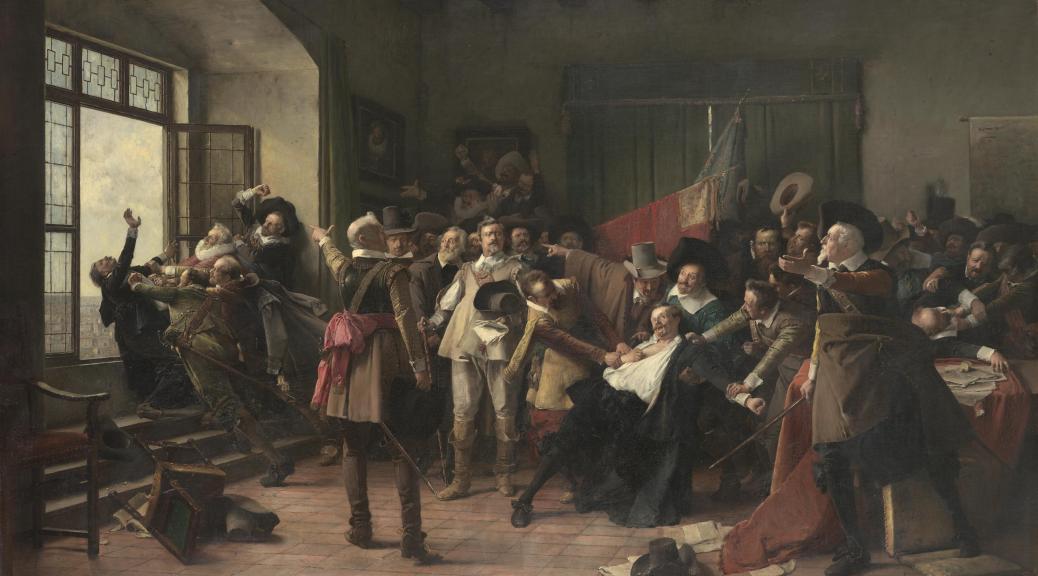
Painting by Václav Brožík from 1890 depicting the third defenestration of Prague.

Our Daily Bread — Quick to Listen

Bible in a Year :

Everyone should be quick to listen, slow to speak and slow to become angry.

James 1:19

Today’s Scripture & Insight :

James 1:18–20

I felt my heart rate increase as I opened my mouth to refute the charges a dear friend was leveling against me. What I had posted online had nothing to do with her as she implied. But before I replied, I whispered a prayer. I then calmed down and heard what she was saying and the hurt behind her words. It was clear that this went deeper than the surface. My friend was hurting, and my need to defend myself dissolved as I chose to help her address her pain.

During this conversation, I learned what James meant in today’s Scripture when he urged us to “be quick to listen, slow to speak and slow to become angry” (1:19). Listening can help us hear what may be behind the words and to avoid anger that “does not produce the righteousness that God desires” (v. 20). It allows us to hear the heart of the speaker. I think stopping and praying helped me greatly with my friend. I became much more sensitive to her words rather than my own offense. Perhaps if I hadn’t stopped to pray, I would have fired back my thoughts and shared how offended I was.

And while I haven’t always gotten the instruction James outlines right, that day, I think I did. Stopping to whisper a prayer before allowing anger and offense to take a hold of me was the key to listening quickly and speaking slowly. I pray that God will give me the wisdom to do this more often (Proverbs 19:11).

By:  Katara Patton

Reflect & Pray

How has James’ instruction helped you in the past? How can you employ it today?

Gracious God, please remind me to be quick to listen and slow to become offended.

http://www.odb.org

Grace to You; John MacArthur – Receiving Spiritual Enlightenment

“I pray that the eyes of your heart may be enlightened” (Eph. 1:18).

Spiritual enlightenment doesn’t come through self-effort or introspective meditation but through God’s Holy Spirit.

Our society has been enamored with the pursuit of spiritual enlightenment, especially since the influx of Eastern thought into the West during the 1960s. Now we are drowning in a sea of false religions and New Age philosophies.

True enlightenment continues to elude many because they have denied its source and have turned to gurus and teachers who have no light to give. They propagate self-effort and introspective meditation, but spiritual enlightenment doesn’t come through such means. It comes only through the Holy Spirit (1 Cor. 2:14-16). That’s why Paul prayed that God Himself would enlighten the hearts of the Ephesian believers (Eph. 1:18).

We might expect Paul to pray for enlightened minds rather than hearts, but that’s because we associate the word heart with emotions rather than with thought. But in Hebrew and Greek thinking, the heart was considered the seat of knowledge, thinking, and understanding. For example, Jesus said that evil thoughts come out of the heart (Matt. 15:19). Emotions are important, but they must be guided and controlled by an enlightened mind.

How does the Spirit enlighten you? As you pray and study God’s Word, He transforms and renews your mind (Rom. 12:2) by filling you with “the knowledge of [God’s] will in all spiritual wisdom and understanding” (Col. 1:9). He teaches you to recognize and uphold what is excellent so that you will be “sincere and blameless” before God (Phil. 1:10). He implants biblical truth into your thinking so that your responses become more and more like Christ’s.

How wonderful to know that each moment of the day God is working within you in such a way. Be diligent to pray and spend time in the Word so that your spiritual progress will be evident to all (1 Tim. 4:15).

Suggestions for Prayer

  • Thank God for the Spirit’s transforming work within you.
  • Reaffirm your love for Him, and express your willingness to be changed by His Spirit in any way He sees fit.
  • Be alert for attitudes or actions that need to be changed. Rely on His grace and strength in doing so.

For Further Study

Read Genesis 27–33, noting how God used the events of Jacob’s life to transform his weak spiritual commitment to one that was strong and unconditional (see especially Gen. 28:20-2232:9-12).

From Drawing Near by John MacArthur

http://www.gty.org/

Joyce Meyer – Prayer as the First Option, Not the Last Resort

For everyone who keeps on asking receives; and he who keeps on seeking finds; and to him who keeps on knocking, [the door] will be opened.

— Matthew 7:8 (AMPC)

One day I woke up with a throbbing headache. I walked around with that miserable headache almost all day, telling everybody I met about how terrible I felt—until I finally realized that I had complained most of the day and had never taken the time to simply pray and ask God to take the pain away.

Unfortunately, that response is rather typical for some of us. We complain about our problems and spend a majority of our time trying to figure out what we can do to solve them. We often do everything except the one thing we are told to do in the Word of God: ask, that we may receive, and our joy may be full (see John 16:24 KJV).

Thankfully, God wants to provide for our every need. We have the awesome privilege of “asking and receiving,” and we should always pray as a first response to every situation.

Prayer of the Day: I thank You, God, in everything, no matter what the circumstance may be. I desire to be the most thankful person I can be, and I ask You to help me reach my goal.

http://www.joycemeyer.org

Truth for Life; Alistair Begg – Giving Back to the Giver

But who am I, and what is my people, that we should be able thus to offer willingly? For all things come from you, and of your own have we given you.

1 Chronicles 29:14

Some time ago, some of the staff at our church decided to put stickers on everything in the building, announcing that it was “Property of Parkside Church.” Initially, I wondered if we really expected that someone wanting to steal a garbage can would turn it over, read the sticker, and suddenly decide to return it. It seemed like a fairly pointless exercise. I soon discovered, though, that I actually quite enjoyed turning things upside down and looking at these little stickers declaring, “This belongs to the church”!

Reminders of God’s ownership and gracious provision echo throughout Scripture. When King David was involved in making plans for the temple, he pointed to God’s providence with clarity and humility; he knew that as created beings in a created world, we can only give to our Creator what we have already been given by our Creator. In the New Testament, too, the apostle Paul writes, “What do you have that you did not receive? If then you received it, why do you boast as if you did not receive it?” (1 Corinthians 4:7).

David’s words were not a new insight for God’s people. Generations before, when the Israelites were preparing to build the tabernacle, Moses had instructed the Israelites, “Take from among you a contribution to the LORD” (Exodus 35:5). What did they have among them? Only what the Creator had provided. Only what the Redeemer had granted them in their exodus from Egypt (12:35-36). Only what the Sustainer of their lives had made possible for them to do (35:30-35).

As with the church property that has now been labeled, we might say that everything we have—indeed, everything in creation—is stamped with the seal of God’s possession. Abraham Kuyper, an influential theologian who also served as prime minister of the Netherlands at the beginning of the 20th century, said, “There is not a square inch in the whole domain of our human existence over which Christ, who is Sovereign over all, does not cry: ‘Mine!’”[1]

This viewpoint is vastly different from that of our contemporary culture, which tends toward two false notions: either that we are self-made people or that everything in the earth, including ourselves, is god. Not so, says the Bible: “The earth is the LORD’s and the fullness thereof, the world and those who dwell therein” (Psalm 24:1).

God is calling us to walk in humility as we remember that all we have comes from Him. Our very lives should proclaim, “I belong to God!” There is nothing you can offer to God that isn’t already in His possession. So give willingly and generously—money, time, talent—as God directs you, in response to His grace.

Questions for Thought

How is God calling me to think differently?

How is God reordering my heart’s affections — what I love?

What is God calling me to do as I go about my day today?

Further Reading

2 Corinthians 8:1–15

Topics: Giving Possessions

FOOTNOTES

1 Abraham Kuyper, “Sphere Sovereignty,” in Abraham Kuyper: A Centennial Reader, ed. James D. Bratt (Eerdmans, 1998), p 488 (emphasis added).

Devotional material is taken from the Truth For Life daily devotionals by Alistair Begg

http://www.truthforlife.org

Kids4Truth Clubs Daily Devotional – God Is Sovereign

“But our God is in the heavens: he hath done whatsoever He hath pleased.” (Psalm 115:3)

Imagine being surrounded by a large invisible net. Imagine that everywhere you go – school, your house, your friend’s house – you are surrounded by this net. The net is there to stop everything from touching you. If someone throws a volleyball at you during P.E. class, it would just bounce off of nothing. If someone throws their carrots at you in the lunch room, the carrots won’t touch you. Nothing can get past the net!

One of God’s gifts to us is His sovereignty. God’s sovereignty is much like an invisible net. Situations in life – both good and bad – cannot touch you without getting God’s permission.

The word sovereignty is a big word with a simple meaning. Sovereign means “chief” or “highest in power.” To say that God is sovereign means that God is the One in charge of everything – it means nothing can get past God’s control. A car accident can’t harm you without God’s permission. Surprises and blessings can’t touch you without God’s permission. God is in control of everything!

God’s sovereignty is like a net that surrounds and protects you.

My Response:
» How does knowing that God is sovereign change my life?

Kids4Truth Clubs Daily Devotional – God Is Sovereign

“But our God is in the heavens: he hath done whatsoever He hath pleased.” (Psalm 115:3)

Imagine being surrounded by a large invisible net. Imagine that everywhere you go – school, your house, your friend’s house – you are surrounded by this net. The net is there to stop everything from touching you. If someone throws a volleyball at you during P.E. class, it would just bounce off of nothing. If someone throws their carrots at you in the lunch room, the carrots won’t touch you. Nothing can get past the net!

One of God’s gifts to us is His sovereignty. God’s sovereignty is much like an invisible net. Situations in life – both good and bad – cannot touch you without getting God’s permission.

The word sovereignty is a big word with a simple meaning. Sovereign means “chief” or “highest in power.” To say that God is sovereign means that God is the One in charge of everything – it means nothing can get past God’s control. A car accident can’t harm you without God’s permission. Surprises and blessings can’t touch you without God’s permission. God is in control of everything!

God’s sovereignty is like a net that surrounds and protects you.

My Response:
» How does knowing that God is sovereign change my life?

Denison Forum – Trump and Biden win New Hampshire

Whom should we blame for the confusing state of American politics?

Christians.

But not for the reasons you might think.

Good news and bad news for the winners

Donald Trump won last night’s New Hampshire Republican primary. This is good news for his campaign in a variety of ways:

  • In twelve of the last fourteen elections, the Republican who won the New Hampshire primary went on to become the party’s nominee.
  • No Republican candidate has ever won the first two states and then lost the nomination.
  • Though Nikki Haley vowed to stay in the race, Mr. Trump leads her nationally, 67 percent to 12 percent.

Does this mean his path to the nomination is secure?

Not exactly:

  • He is facing legal battles that threaten his eligibility to run.
  • In one poll, 45 percent of Republican respondents said they would not support him if he were convicted of a felony.
  • He is one of only a handful of ex-presidents to run for the office again; only Grover Cleveland did so successfully.

On the other side, President Biden wasn’t on the printed ballot, but he still won the Democratic primary. He wanted South Carolina to hold the first primary, but New Hampshire refused to move its election, so Mr. Biden’s campaign chose not to participate. However, his supporters staged a write-in effort that secured his victory.

Does this mean Mr. Biden’s path to the nomination is secure?

Not exactly:

  • Two-thirds of Democrat-leaning voters do not want him to be the party’s nominee.
  • At eighty-one, he is the oldest person ever to hold the presidency, though Mr. Trump was the second-oldest. (On average, US presidents are fifty-five years old when sworn in.)
  • He trails Mr. Trump in the latest polls, 47 percent to 42 percent.

And there’s this: at 43 percent, independents outnumber Republicans and Democrats (at 27 percent each) by a wider collective margin than ever before.

“The rex is always subject to the lex

Our elections have always been highly contested and correspondingly chaotic, in large part because every eligible American is able to participate. If we don’t like our leaders, we can replace them. We believe, in Abraham Lincoln’s immortal words, that ours is a “government of the people, by the people, for the people” (my emphasis).

This belief that we are more valuable than the institutions that exist to serve us is a product of the Christian worldview.

I am reading Andrew Wilson’s fascinating Remaking the World: How 1776 Created the Post-Christian West. In it, he offers these observations regarding his readers:

You believe in limitations on the power of the state and that the rule of law is essential to a healthy society, whereby the rex (king) is always subject to the lex (law). . . . You think the central truth in human relations is the self, the sovereign individual, rather than the group to which the self belongs. . . .

You see your identity as something you choose and construct for yourself rather than something you are given. The true “you” is not imposed on you from the outside, by your ancestors or your community; it is something internal, and only you get to say exactly what it is.

These beliefs, according to Wilson, are “Christian assumptions about the world” that Americans embrace whether we believe in God or not. The biblical worldview motivated our nation’s founders and undergirds our democratic commitment to the “unalienable rights” of every person still today.

Why our government should serve us

Here’s the problem: Americans have forgotten why we are so valuable.

Our government should serve us not because we are worthy of being served but because we—not our institutions—are the objects of our Creator’s passionate love. And we are the objects of his love not because we deserve his love but because he is love (1 John 4:8).

How are we to respond?

Jesus answered our question: “Just as I have loved you, you also are to love one another” (John 13:34). In this divisive political season, remember that he added: “By this all people will know that you are my disciples, if you have love for one another” (v. 35).

Mother Teresa observed:

“When you know how much God is in love with you, then you can only live your life radiating that love.”

Do you know how much God is in love with you today?

Wednesday news to know

Quote for the day

“Here’s the paradox. We can fully embrace God’s love only when we recognize how completely unworthy of it we are.” —Ann Tatlock

Denison Forum

Hagee Ministries; John Hagee –  Daily Devotion

Today’s Scripture

Likewise you also, reckon yourselves to be dead indeed to sin, but alive to God in Christ Jesus our Lord.

Romans 6:11

God wove desires and cravings into our DNA. We cannot simply denounce our cravings and be done with them.

One of the first questions a doctor asks a new mother is: “How is the baby eating?” She wants to know if the child has cravings. A lack of craving indicates a serious issue, and she will quickly attempt to fix what is broken.

The dilemma is not whether we will or will not crave. It comes down to what we crave. Paul instructed us to reckon ourselves dead to sin. That does not mean that the capability to sin no longer lives within us.

In 1 Corinthians 15:31, Paul assured the believers that he died daily. He killed his cravings one day at a time. As long as his spirit was wrapped in flesh, he had to submit his carnal nature to the Word of God every day. He read, he prayed, and he gave thanks to God. And this daily dying awakened him to righteousness (v. 34).

When we submit to Jesus and His purposes, the desire to sin disappears. Our hearts are captured by a new love, and all of our desires and affections are bent more and more towards Him. We are dead to sin, but alive to God!

Blessing

May the Lord bless you and keep you. May the Lord make His face to shine upon you and be gracious unto you and give you His peace. May your old cravings be crucified with Christ. May He live in you to carry out His will on earth. Glory to God for sending us His Son!

Today’s Bible Reading: 

Old Testament

Genesis 48:1-49:33

New Testament 

Matthew 15:29-16:12

Psalms & Proverbs

Psalm 20:1-9

Proverbs 4:20-27

https://www.jhm.org

Turning Point; David Jeremiah – Secret Prayer

But when you pray, go away by yourself, all alone, and shut the door behind you and pray to your Father secretly.
Matthew 6:6, TLB

 Recommended Reading: Matthew 6:5-8

The renowned Scottish minister Andrew Bonar wrote, “I should count the days, not by what I have of new instances of usefulness, but by the times I have been enabled to pray in faith, and to take hold upon God…. Prayer should make time for itself.”

Every part of modern life thwarts the needed habit of secret prayer. Our schedules are too busy, our phones are too engaging, our world is too noisy, and our fatigue is too great. Yet without prayer—systematic, secret, sacred prayer—we cannot manage our schedules, control our phones, quiet our world, or counteract our fatigue. Secret prayer brings us into the presence of the energizing God who stills and strengthens us, who teaches us the way to Himself and the paths to avoid, and who fills us with the confidence of His own infinite power.

Make time for daily secret prayer. If we live with an attitude of prayer, we’re always in His presence. Pray today that your whole life might be a prayer as you walk day by day with Him.

The Lord…made me feel that I must be as much with Him alone as with souls in public.
Andrew Bonar

https://www.davidjeremiah.org

Harvest Ministries; Greg Laurie – Deadly Complacency

When a crime is not punished quickly, people feel it is safe to do wrong. 

—Ecclesiastes 8:11

Scripture:

Ecclesiastes 8:11 

For twenty long years, Samson had experienced the thrill of victory. It was clear from the very beginning that God’s hand was upon him. The Bible tells us that God blessed him as he grew up, and the Spirit of the Lord began to take hold of him (see Judges 13:24–25).

For twenty long years, Samson had never known the agony of defeat. That should have made him thankful to God. Instead, it produced in him a deadly complacency about his spiritual life.

And no sooner did Samson’s life of promise begin than he disobeyed God by going out and marrying a Philistine woman. God had clearly prohibited this. But Samson didn’t care. He told his parents he wanted to marry this woman, and he ignored their objections.

This is where the breakdown began that would culminate in his downfall with Delilah. Sure enough, after he married the Philistine woman, everything began to fall apart. God was giving him a wake-up call to turn from his sin.

Judges 16:1 tells us, “One day Samson went to the Philistine town of Gaza and spent the night with a prostitute” (NLT). Samson deliberately made this choice, crossing the line. He was sure there was no trap from which he couldn’t free himself. And he blatantly took this radical step.

Clearly, Samson wasn’t walking with the Lord at this point. We don’t read of any spiritual struggle beforehand or of any remorse afterward. But this episode in Gaza led to Samson’s destruction. What he sowed with the prostitute, he reaped with the devious Delilah.

When Samson’s enemies in Gaza found out he was in their city, they sealed up the massive city gate and waited to kill him. There was no other way out of the city, at least not for an ordinary man.

But at midnight, the Bible says, Samson “got up, took hold of the doors of the town gate, including the two posts, and lifted them up, bar and all. He put them on his shoulders and carried them all the way to the top of the hill across from Hebron” (verse 3 NLT).

God had once again delivered Samson. And what made his life so tragic is that he had power without purity. He had strength without self-control.

Sometimes when we get away with sin, we think we’ll always get away with it. But no one ever completely gets away with sin. God sometimes will extend His grace and not discipline us right away. As a result, we might begin to misinterpret the grace of God for His permission.

The Bible says, “When a crime is not punished quickly, people feel it is safe to do wrong” (Ecclesiastes 8:11 NLT). When we sin, we might not get caught right away, but we must not assume we will get away with it forever. We may not even experience the full ramifications of our actions until we stand before God. But sooner or later, it will catch up with us. There are no exceptions.

Days of Praise – The Integrity of the Written Word

by Henry M. Morris, Ph.D.

“Ye shall not add unto the word which I command you, neither shall ye diminish ought from it, that ye may keep the commandments of the LORD your God which I command you.” (Deuteronomy 4:2)

In addition to the numerous times when the writers of the Bible asserted that what they wrote came directly from God (e.g., Leviticus 1:1Jeremiah 1:4Revelation 1:1), there are at least four warnings against tampering with these revealed words.

The first is our text above, in which Moses commanded neither to add to nor diminish from anything he had written. This warning was supplemented later with the following: “What thing soever I command you, observe to do it: thou shalt not add thereto, nor diminish from it” (Deuteronomy 12:32).

Moses wrote the opening books of the Bible, and it was appropriate that he should give such a warning. The last warning was by John at the very end of the whole body of Scripture, and his warning was even more severe. “If any man shall add unto these things, God shall add unto him the plagues that are written in this book: And if any man shall take away from the words of the book of this prophecy, God shall take away his part out of the book of life” (Revelation 22:18-19).

Since John was the last apostle, it is clear that this warning is against any later attempt to add some new “revelation” to the now-complete Word of God.

Then, very near the middle of the Bible, there is this: “Every word of God is pure:…Add thou not unto his words, lest he reprove thee, and thou be found a liar” (Proverbs 30:5-6). And remember also the words of Christ: “Till heaven and earth pass, one jot or one tittle shall in no wise pass from the law, till all be fulfilled” (Matthew 5:18). So, don’t mess with the Word of God! HMM

https://www.icr.org/articles/type/6