Turning Point; David Jeremiah – Always Faithful

If we are faithless, He remains faithful; He cannot deny Himself.
2 Timothy 2:13

 Recommended Reading: Psalm 136

Perhaps the most challenging idea in biblical Christianity for new believers to grasp is the dual concept of God’s grace and mercy. The ideas that God always loves us and always forgives us are hard to embrace at first.

The grace of God means He blesses us when we don’t deserve it, and the mercy of God means He doesn’t punish us when we do deserve it. The mercy of God is a dominant theme in the Old Testament. The phrase, “His mercy endures forever,” occurs 41 times—26 times in Psalm 136 alone. God’s grace and mercy are reflections of His character, specifically His faithfulness. It is impossible for God to be unfaithful. Even when we are unfaithful, “He remains faithful; He cannot deny Himself.” Therefore, God can never be ungracious or unmerciful. His grace and mercy flow continually from His character, regardless of our behavior. There is nothing we can do to earn God’s faithfulness, nor is there anything we can do to lose it (Ephesians 2:8-9).

The next time you are less than faithful, don’t spend a second doubting God’s love or forgiveness. He has made you the righteousness of God in Christ Jesus (2 Corinthians 5:21).

Measure your growth in grace by your sensitiveness to sin.
Oswald Chambers

https://www.davidjeremiah.org

Harvest Ministries; Greg Laurie – Falling Short

So I said, “Laughter is silly. What good does it do to seek pleasure?” 

—Ecclesiastes 2:2

Scripture:

Ecclesiastes 2:2 

Shortly before his death at age thirty-three, comedian Chris Farley said in an interview, “I used to think that you could get to a level of success where the laws of the universe didn’t apply. But they do. It’s still life on life’s terms, not on movie-star terms. . . . Once I thought that if I just had enough in the bank, if I had enough fame, that it would be all right.”

But it wasn’t all right, was it? Farley overindulged himself and needlessly threw his life away. He may have been laughing on the outside, but apparently, he was crying on the inside.

Solomon, too, gave pleasure a try. He said, “ ‘Come on, let’s try pleasure. Let’s look for the “good things” in life.’ But I found that this, too, was meaningless” (Ecclesiastes 2:1 NLT).

“No fear” is a popular slogan for T-shirts. The problem is that we’re not afraid of what we ought to be afraid of. We ought to fear God.

When the Bible tells us to fear God, it means that we should have reverence for God. We should honor God and respect Him. To fear God means to recognize that He is God Almighty and never take His offer of forgiveness for granted.

Maybe you’ve tried to play by the rules, but you’ve failed. You’ve tried to clean up your life and live by God’s commandments, but you’ve fallen short.

When I became a Christian, I was full of doubt. Even as I was praying to ask Jesus Christ to come into my life, I thought, “I’m the one person this is not going to work for. I’m not a Christian type of person.”

I thought certain kinds of people were predisposed to become Christians, the kind of people who were naturally upbeat and optimistic. I wasn’t one of them. But I qualified because I was a sinner.

That is the kind of person God is looking for. We have all sinned. We have all fallen short of the glory of God (see Romans 3:23).

If that is the case, then who will get into Heaven? Without Jesus Christ, no one will. We can’t do it on our own. We can’t be flawless.

God knew that we would fall short. But He loved us so much that He sent His Son, Jesus Christ, to this earth. Jesus was more than a good man; He was the God-Man who went to the cross willingly, laid down His life, and shed His blood for us.

He paid the price of sin for us. He came to pay a debt He did not owe because we owed a debt we could not pay.

That is why Jesus Christ is the only way to the Father. It sounds radical, but it came from Jesus Himself. He said, “I am the way, the truth, and the life. No one can come to the Father except through me” (John 14:6 NLT).

Jesus—and Jesus alone—is uniquely qualified to connect us with the Father in Heaven.

Days of Praise – The Scars of Sin

by Henry M. Morris, Ph.D.


“But the Philistines took him, and put out his eyes, and brought him down to Gaza, and bound him with fetters of brass; and he did grind in the prison house.” (Judges 16:21)

The sad end of mighty Samson, who once had been so greatly energized and utilized by the Lord, is also an allegory and a grave warning to every Christian. “But every man is tempted, when he is drawn away of his own lust, and enticed. Then when lust hath conceived, it bringeth forth sin: and sin, when it is finished, bringeth forth death” (James 1:14-15).

Satan knows our individual weaknesses and tempts us accordingly. Many Christians have fallen into sin through some Delilah, but probably many more have fallen into sin through pride, or covetousness, or compromise, or apathy.

First, sin blinds. We are commanded to grow in Christ, adding to our initial faith the attributes of virtue, knowledge, temperance, patience, godliness, kindness, and love (2 Peter 1:5-7). Otherwise, “he that lacketh these things is blind, and cannot see afar off, and hath forgotten that he was purged from his old sins” (2 Peter 1:9).

Then, sin binds. It may not be with chains, as with Samson, but unconfessed sin quickly enslaves its practitioners. “While they promise them liberty, they themselves are the servants of corruption: for of whom a man is overcome, of the same is he brought in bondage” (2 Peter 2:19).

Finally, sin grinds. Instead of the promised freedom from restraint, a sinful life soon becomes a “grind,” tedious and tasteless, like “the dog turned to his own vomit again” (2 Peter 2:22).

Samson did return to God again before his death, but he was still blind, and bound, and grinding. God forgives, but the effects of sin are not easily removed. How much better it would be never to yield to the temptation at all. HMM

https://www.icr.org/articles/type/6

Our Daily Bread — Willing Savior

Bible in a Year :

While we were still sinners, Christ died for us.

Romans 5:8

Today’s Scripture & Insight :

Romans 5:6–8

While driving late at night, Nicholas saw a house on fire. He parked in the driveway, rushed into the burning home, and led four children to safety. When the teenage babysitter realized one of the siblings was still inside, she told Nicholas. Without hesitation, he reentered the inferno. Trapped on the second floor with the six-year-old girl, Nicholas broke a window. He jumped to safety with the child in his arms, just as emergency teams arrived at the scene. Choosing concern for others over himself, he rescued all the children.

Nicholas demonstrated heroism by his willingness to sacrifice his safety for the sake of others. This powerful act of love reflects the kind of sacrificial love shown by another willing rescuer who gave His life to deliver us from sin and death—Jesus. “You see, at just the right time, when we were still powerless, Christ died for the ungodly” (Romans 5:6). The apostle Paul emphasized that Jesus—fully God in the flesh and fully man—chose to lay His life down and pay the price for our sins, a price we could never pay on our own. “God demonstrates his own love for us in this: While we were still sinners, Christ died for us” (v. 8).

As we thank and trust Jesus, our willing Savior, He can empower us to love others sacrificially with our words and actions.

By:  Xochitl Dixon

Reflect & Pray

How do you feel when you consider the price Jesus willingly paid because He loves you? How can you put the needs of others before yourself this week?

Dear Jesus, help me trust in Your provision as I place others first today.

http://www.odb.org

Grace to You; John MacArthur – Matching Your Practice to Your Position

God chose us “that we should be holy and blameless before Him” (Eph. 1:4).

The challenge of Christian living is to increasingly match your practice to your position.

God chose you in Christ to make you holy and blameless in His sight. To be “holy” is to be separated from sin and devoted to righteousness. To be “blameless” is to be pure without spot or blemish—like Jesus, the Lamb of God (1 Pet. 1:19).

Ephesians 1:4 is a positional statement. That is, Paul describes how God views us “in Christ.” He sees us as holy and blameless because Christ our Savior is holy and blameless. His purity is credited to our spiritual bank account. That’s because God made Christ “who knew no sin to be sin on our behalf, that we might become the righteousness of God in Him” (2 Cor. 5:21).

Despite our exalted position in God’s sight, our practice often falls far short of His holy standard. Therefore the challenge of Christian living is to increasingly match our practice to our position, realizing that sinless perfection won’t come until we are in heaven fully glorified (Rom. 8:23).

How do you meet that challenge? By prayer, Bible study, and yielding your life to the Spirit’s control. Commit yourself to those priorities today as you seek to fulfill the great purpose to which you’ve been called: “good works, which God prepared beforehand, that you should walk in them” (Eph. 2:10).

Suggestions for Prayer

  • Thank God that He does not expect you to earn your own righteousness but has provided it in His Son.
  • Ask His Spirit to search your heart and reveal any sin that might hinder your growth in holiness. Confess that sin and take any steps necessary to eliminate it from your life.

For Further Study

Read Philippians 1:9-11.

  • What ingredients must be added to Christian love to produce sincerity and blamelessness?
  • What is the primary source of those ingredients (see Ps. 119:97-105)?
  • What specific steps are you going to take to add or increase those ingredients in your life?

From Drawing Near by John MacArthur 

http://www.gty.org/

Joyce Meyer – Keep On Keeping On

Let us not become weary in doing good, for at the proper time we will reap a harvest if we do not give up.

— Galatians 6:9 (NIV)

One of the most important truths you can be grateful for is that God has promised to never leave you—He is always by your side!

That’s why it is important to remember this: No matter how difficult the circumstances may seem around you, don’t give up! God is for you, and He is bigger than any trouble you may be facing.

You can regain the territory the devil has stolen from you. If necessary, regain it one inch at a time, being thankful for and always leaning on God’s grace and not on your own ability to get the desired results. In Galatians 6:9, the apostle Paul simply encourages us to keep on keeping on! Don’t be a quitter! Have an “I can do all things through Christ” attitude. God is looking for people who will go all the way through to the other side with Him.

Prayer of the Day: Thank You, Father, that You give me the strength to never quit. I am grateful that You are always with me and that You fight my battles.

http://www.joycemeyer.org

Truth for Life; Alistair Begg – Battling Bitterness

Now the Syrians on one of their raids had carried off a little girl from the land of Israel, and she worked in the service of Naaman’s wife. She said to her mistress, “Would that my lord were with the prophet who is in Samaria! He would cure him of his leprosy.”

2 Kings 5:2–3

Suffering in and of itself does not lead a person into a deeper relationship with God. As with those who hear the word of God yet do not respond to it with faith, suffering divorced from faith and hope will actually embitter us as our hearts grow harder rather than softer toward God. In other words, suffering will either make us run to God or away from Him. In the midst of trials, we must ask ourselves, “Is this trial making me bitter and callous, or is it making me loving and gentle?”

In the midst of the book of 2 Kings, among the stories of monarchs and prophets, we find an extraordinary picture of gentleness and humility in the face of great heartache through the example of a little Israelite girl. The Syrians had captured this young girl during a raid; they had carried her away from her family and from Israel and had forced her to work in the service of Naaman, a commander in the Syrian army. What an unfathomable tragedy for a young child and her family!

Yet in the midst of her great suffering, we catch a glimpse of her tender heart: upon learning that her master suffered from leprosy, this child told Naaman’s wife how he could be healed. If she had allowed herself to become embittered, then, when the word went around the house that her master was sick, she might have concluded, Well, it’s nothing more than what he deserves. But she didn’t. She wanted the best for her enemy, rather than hoping for the worst. This is remarkable. How could she do this? Because presumably, in the face of her emptiness and the sadness of being separated from her family, she had turned time and time again to her loving God and His promises.

As we journey through our own suffering, and as we seek to minister to those who are in deep affliction, we must not forget to cultivate a tender and open heart. Will it be easy? By no means! But God’s faithfulness is so vast, so comprehensive, that it is able to sustain us, even in our deepest pain. So turn to God in every circumstance and take comfort in His faithfulness and provision. When you do, then you “may be able to comfort those who are in any affliction, with the comfort with which we ourselves are comforted by God” (2 Corinthians 1:4).

Questions for Thought

How is God calling me to think differently?

How is God reordering my heart’s affections — what I love?

What is God calling me to do as I go about my day today?

Further Reading

2 Corinthians 5:6–21

Topics: Affliction Grace Suffering

Devotional material is taken from the Truth For Life daily devotionals by Alistair Begg

http://www.truthforlife.org

Kids4Truth Clubs Daily Devotional – God Is Powerful

“Ah Lord God! Behold, thou hast made the heaven and the earth by thy great power and stretched out arm, and there is nothing too hard for thee.” (Jeremiah 32:17)

Scientists tell us that there are at least 70 sextillion stars in the universe. Wow! That’s the number 7 followed by 22 zeroes!

Scientists also tell us that the Pacific Ocean holds 192 quintillion gallons of water and that the surface of the sun is 16 times hotter than boiling water.

Have you ever stopped to think that there is always enough oxygen for everyone in the world to breathe every day? In fact, by the time you are ten years old, you’ve taken about 74 million breaths.

So what or who could be more powerful than these facts? GOD! Genesis 1:1 says, “In the beginning God created the heaven and the earth.” God is so powerful that in one week and with one voice He made the world. He made the sextillion stars, the quintillion gallons of water, and the sun that is hotter than you can imagine. Nobody helped Him or told Him how to do it. He just said, Let there be light: and there was light (Genesis 1:3).

God is powerful. He has more power than all the people in the world combined. So who do you go to for help? Why not go to your powerful God! He wants to help you.

God has the power to help you; nothing is too difficult for Him!

My Response:
» In what ways do I need God’s help?
» Do I trust God to help me and answer my prayers?

Denison Forum – “Oppenheimer” and “Barbie” win Golden Globes: What their popularity says about our souls

Oppenheimer won five Golden Globes last night, including best drama, while Barbie took the award for cinematic and box office achievement. But everyone who attended the ceremony won something as well: they each received a gift bag worth $500,000. You read that right—thirty-eight different items were included in the bags, among them Colombian emerald earrings valued at $69,000 and six bottles of wine worth $193,500.

Giving such opulent gifts to such wealthy people seems to say something about the materialism of our consumeristic culture. The two movies pointed in the same direction.

Reviewer Simon Western explained the popularity of Barbie, the highest-grossing worldwide movie of 2023: “It reaffirmed the chosen ideology of our times, i.e. America Dream individualism, which makes us feel that we are filled with individual agency and are in control, and we can choose our futures.”

While I refused to see Oppenheimer due to its nudity and sex scenes, I found a New York Times interview with director Christopher Nolan most interesting. The film centers on scientist J. Robert Oppenheimer’s work in building the first atomic weapon, leading to the bombs that were later dropped on Japan and the atomic age that followed. Nolan describes Oppenheimer as “the most important person who ever lived,” explaining: “If my worst fears are true, he’ll be the man who destroyed the world. Who’s more important than that?”

Perhaps the One who created the world?

“The end of godlessness is anarchy”

Several people suffered gunshot wounds when six or seven shooters opened fire late Saturday night in Abbeville, Alabama. There have been six mass shootings so far in 2024, including the one in Perry, Iowa, that killed eleven-year-old Ahmir Jolliff. Ahmir kept a trunk of toys unlocked in his front yard so anyone could play with them, loved soccer, played the tuba, and sang in choir. Because of his joyful spirit, he was known as “Smiley” around his house.

What explains such senseless, horrific tragedy?

John Piper writes in Taste and See:

The root of all injustice in our urban centers, or anywhere else, is the pervasive human injustice against God. When the rights of our Creator and Savior are daily denied, we should not be surprised that the rights of persons created in his image are denied in a cavalier and selfish way. Until God is given his rights, no human rights will have much significance beyond convenience. And when they are no longer convenient, they will be ignored, whether by violent police, traffic violators, looters, or murderers. The end of godlessness is anarchy.

Piper is right. At the beginning of humanity’s story, we read: “The Lᴏʀᴅ saw that the wickedness of man was great in the earth, and that every intention of the thoughts of his heart was only evil continually” (Genesis 6:5). Our quest to “be like God,” (Genesis 3:5), to be creator rather than creature, to be the hero of history, explains every sin we commit and every evil we face in this broken world (cf. Romans 8:22).

In Jeremiah 17, God describes our fallen condition: “Thus says the Lᴏʀᴅ: ‘Cursed is the man who trusts in man and makes flesh his strength, whose heart turns away from the Lᴏʀᴅ. He is like a shrub in the desert, and shall not see any good come. He shall dwell in the parched places of the wilderness, in an uninhabited salt land’” (vv. 5–6).

By contrast, the text continues: “Blessed is the man who trusts in the Lᴏʀᴅ, whose trust is the Lᴏʀᴅ. He is like a tree planted by water, that sends out its roots by the stream, and does not fear when heat comes, for its leaves remain green, and is not anxious in the year of drought, for it does not cease to bear fruit” (vv. 7–8).

Who of us would want to be a “shrub in the desert” when we could be a “tree planted by water”? Obviously, then, we should choose to trust in the Lord rather than in ourselves.

Why don’t we?

My father’s heart condition

The next verse answers our question and explains our predicament: “The heart is deceitful above all things, and desperately sick” (v. 9). Heart in the Hebrew refers to “one’s inner self, will, inclination.” Desperately sick translates a word meaning “incurable, disastrous beyond repair.”

Clearly, our problem is “heart” disease. I know something about this illness: my father had a massive heart attack when I was two years old. In the years that followed, he did everything he could to manage his condition, but he could not heal himself. The only solution was a heart transplant, but he was too weak to survive the operation. As a result, he died of a second heart attack when I was in college.

Every human being is in the same condition spiritually that my father was in physically. But there’s good news: God can do for us what we cannot do for ourselves. He promises: “I will give you a new heart, and a new spirit I will put within you” (Ezekiel 36:26). Here’s how: “I will put my Spirit within you, and cause you to walk in my statutes and be careful to obey my rules” (v. 27).

If you have asked Jesus to be your Savior and Lord, God has already put his Spirit within you (1 Corinthians 3:16Romans 8:9). But you must decide every day to submit your life to this indwelling Spirit. Begin your day by surrendering your mind and heart to him (Ephesians 5:18). Pray through the day ahead, inviting him to lead, empower, and use you.

Make your commitment holistic and unconditional. As Elisabeth Elliot observed, “We cannot give our hearts to God and keep our bodies for ourselves.”

“If we live by the Spirit, let us also keep in step with the Spirit” (Galatians 5:25).

Are you “in step” with him right now?

If not, why not?

Denison Forum

Hagee Ministries; John Hagee –  Daily Devotion

As many as I love, I rebuke and chasten. Therefore be zealous and repent.

Revelation 3:19

Three basic truths come to mind when we mention repentance.

First of all, everybody needs it! The Bible clearly tells us that if we say that we do not have any sin, we only fool ourselves; we contradict God Himself (1 John 1:8). We are sinners, and God commands all of us everywhere to repent (Acts 17:30).

Secondly, repentance is absolutely effective. Repentance is not a feeling; it is a fact. If we confess our sin, God is faithful to forgive us and make us clean (1 John 1:9). Many regret what they did, whom they hurt, and the consequences of sin, but true repentance involves confession to God and turning away from sin to follow His plan.

Thirdly, God assures us that He will rebuke and chasten every child He loves. He cares enough to correct us, to help us align our priorities with His. When He does convict and convince us, we must be eager and enthusiastic to repent. We discover why in Revelation 3:20.

He stands at the door of our heart and knocks. The longer we refuse to repent, the harder it is to hear His hand against the door. Repentance sweeps away the barrier of sin. We now hear His insistent knock and throw open the door to experience sweet fellowship with our Savior.  

Blessing

May the Lord bless you and keep you. May the Lord make His face to shine upon you and be gracious unto you and give you His peace. Be zealous and repent! Open the door to Jesus and His healing and hope. Thank God for the mercy and grace that is yours through repentance!

Today’s Bible Reading: 

Old Testament

Genesis 18:20-19:38

New Testament 

Matthew 6:25-7:14

Psalms & Proverbs

Psalm 8:1-9

Proverbs 2:6-15

https://www.jhm.org

Turning Point; David Jeremiah – Promises Are Forever

JANUARY 8, 2024

And you know in all your hearts and in all your souls that not one thing has failed of all the good things which the Lord your God spoke.
Joshua 23:14

 Recommended Reading: Joshua 23:14-16

In 1971, the James Bond movie Diamonds Are Forever was released, and actor Sean Connery promised it was his last Bond film. He retired from the role, and others were cast as the suave British agent. But after suffering a series of movie flops and an empty bank account, Connery broke his promise and filmed another Bond movie, ironically titled Never Say Never Again.

It’s easy for us to make promises only to change our mind as time passes or circumstances change. But our Lord doesn’t change His mind or shift with the circumstances. Every promise He issues is perfectly good a thousand years later. His unchangeable commitment to His promises is called faithfulness.

God’s faithfulness allows us to have total confidence in every promise He’s written. It frees us from the grip of anxious worry. When we harbor fears and needless vexations, it’s not because God isn’t faithful but because we are doubting His ability to keep His promises. Don’t do that! Find a fresh promise for today—and trust Him!

God never overpromises or underdelivers. He always delivers on His promises, but He does it on His timeline!
Mark Batterson

https://www.davidjeremiah.org

Harvest Ministries; Greg Laurie – Walls of Protection

That’s the whole story. Here now is my final conclusion: Fear God and obey his commands, for this is everyone’s duty. 

—Ecclesiastes 12:13

Scripture:

Ecclesiastes 12:13 

As a pastor, I have talked to a lot of people who are facing death. And as I’ve listened to the regrets that people have, I have yet to meet anyone who said, “I regret that I became a Christian when I was eighteen.”

On the other hand, I’ve heard a lot of people say, “I regret that I didn’t do this sooner. I regret all the wasted years.”

Don’t let that happen to you.

After trying everything the world had to offer, King Solomon summed up his experience by saying, “Fear God and obey his commands, for this is everyone’s duty. God will judge us for everything we do, including every secret thing, whether good or bad” (Ecclesiastes 12:13–14 NLT).

Solomon was saying, “Listen to a seasoned pro. I know what I’m talking about here. If you leave God out of the picture, then your life will be empty, meaningless, and futile. But if you want to live a life that is full, a life of purpose, then here it is: fear God and obey His commands.”

That’s what will keep you on track with God’s plan for your life. Fear God and obey His commands.

However, a lot of us don’t like commands. We see them as restrictive. But if we want to live a life that is full, we must recognize there is structure, there are parameters, and there are absolutes.

It would be like someone saying, “I don’t like traffic laws. I’m not into stoplights. And I don’t like those dotted lines down the road. They really bug me. I’m going to drive wherever I want to drive and go wherever I want to go. I want my freedom.”

Instead, what they’ll get is the freedom to have an accident. They’d better stay in their lane and hope the other drivers do so as well. Those lanes and traffic laws are there for our protection. They exist so that we can go where we need to go.

We might look at the commandments of God and think they’re ruining our lives. But God didn’t give us His commands to make our lives miserable. Rather, they are walls and barriers of protection to keep evil out. That is what Solomon was saying. It’s for our own good.

Yes, the Bible does say that we shouldn’t do certain things. The Bible does tell us to stay away from particular things. But when it tells us not to do something, it also tells us to do something else instead.

For example, the Bible says, “Don’t be drunk with wine, because that will ruin your life” (Ephesians 5:18 NLT). There is the don’t.

It goes on to say, “Instead, be filled with the Holy Spirit, singing psalms and hymns and spiritual songs among yourselves, and making music to the Lord in your hearts” (verses 18–19 NLT). There is the do.

God’s plan is always better. Yes, He tells us what we should avoid. But it is for our own good.

Days of Praise – Not Giving, but Sowing

by Henry M. Morris, Ph.D.


“But this I say, He which soweth sparingly shall reap also sparingly; and he which soweth bountifully, shall reap also bountifully.” (2 Corinthians 9:6)

As John Calvin pointed out long ago in expounding this key passage, “We are not giving, but sowing” when we contribute of our financial means to the work of the Lord, for it miraculously is considered by the Lord of the harvest as seed sown in the soil of the hearts of men.

And it is a rule of the harvest that, other things being equal, the more seed planted, the more harvested. He who is deficient with his seed must necessarily anticipate a meager crop.

Of course, a bountiful harvest presupposes not only an abundance of seed but also good soil, properly prepared, watered, and cultivated. It is no good simply to give money to anyone or any cause, any more than it is good simply to throw a seed on a rocky slope or city street or weed-infested yard. One is responsible to give where God’s Word is honored—not just to give, but to give responsibly.

Furthermore, even though an abundant harvest is promised, the motive in giving is also vital. The harvest is souls—not gold! “God loveth a cheerful giver”—not a conditional giver (v. 7). “He that giveth, let him do it with simplicity” (Romans 12:8). Often God does bring financial blessing to a Christian who has proved faithful in the grace of giving, but this is so he can give still more and thus lay up still more treasure in heaven. “For unto whomsoever much is given, of him shall be much required” (Luke 12:48). “Therefore,” as Paul said, “see that ye abound in this grace also” (2 Corinthians 8:7).

And as we give, we must never forget that Christ has given more. “For ye know the grace of our Lord Jesus Christ, that, though he was rich, yet for your sakes he became poor” (2 Corinthians 8:9). HMM

https://www.icr.org/articles/type/6

The Problem with Lies

The Problem with Lies

Nowadays, we have a plethora of lies that are told knowingly and openly and without shame.

• “Genocide” is defined as the systematic extermination of a race. Either Israel is really bad at it, or it is in a war against Hamas, not committing genocide against Palestinians. 10-20,000 civilian deaths is terrible in human terms. But with two million Gaza residents and about 20,000 killed, including Hamas? Poorly done genocide.

The real problem in the Middle East? Jews refused to convert to Islam. The same is true of the nomads, Druze and Christians. Prominent Muslim leaders demand non-Muslims to either convert, subdue, or die. It isn’t only about Jews, you are just as evil for not converting to Islam. Don’t think you’re excused because you have an open heart, even people from the wrong form of Islam (Sunni/Shia/Ibadi/Ahmadiyya/Sufism) are just as evil as Jews, to most Muslim leaders.

• Our media is free, fair and impartial. Okay, stop laughing. When Peter Jennings said that 90% of the media is left wing, including him, you should have believed him. If you wish to believe they don’t tilt the news to the Left, wake up. The examples are enormous. Just one? President Barack Obama and Attorney General Eric Holder cooked up a plan to force U.S. gun sellers to provide guns to Mexican criminals, so that they could blame the NRA and gun owners. They were caught red-handed and then stonewalled the investigation. Holder refused to even testify. He had every chance to disprove the facts, he declined and the media dropped the subject.

• Consider Jeffery Epstein. We can assume that he was running a blackmail scheme on all sorts of prominent people. He may have done it with cooperation from government, at some level. He was guilty as hell and the wheels came off when they simply could no longer cover it up. No one (or few) in the mainstream media are demanding the client list be made public, so apparently some pedophiles are too important to be “under the law.” They can release some names, but rest assured that 90% of the list and the content of the videos will never be known. Proof? How many of his employees have testified in front of Congress?

• Another example is that we are led to believe America is a major polluter. We supposedly waste power, spew CO2 and pollution more than anyone — we are the biggest environmental problem in the world. There is zero evidence to support this. We’ve done far more than most anyone to reduce pollution and energy waste. India and China are far greater polluters and do not have to do anything to reduce their pollution or energy waste. I stood on a main street in Lahore, Pakistan several years ago and watched the traffic. A cloud of pollution, smoke, and dust traveled with traffic. The cloud moved with traffic, in two directions, depending on which lane. I have a friend who saw the same thing in China. They are building coal-burning power plants by the score. America is responsible for a small portion of energy waste and pollution.

• America is not fair to poor countries and that is why they remain poor. That anyone believes this is discouraging, as the evidence is quite the opposite. There is no limit on success. Poor countries are not poor because we aren’t. They are poor because the people are not allowed economic freedom. The simple fact is that capitalism and free enterprise are the natural way. All of life succeeds on merit. We seem to think nature is wrong. But when your child needs an operation, do you seek out a doctor who graduated in the bottom of his class and has a poor record? Of course not. You want the best you can get and if the child is injured, the doctor is taken off the job. This causes poor doctors to not do as many surgeries on sick kids.

Free enterprise is merit-based success and a form of natural evolution. A society that ignores merit for other goals becomes stagnant. Look at most Islamic countries today. Name a major international business or technology based in a Muslim country.

Nature doesn’t favor little fish over big fish. Nature allows the natural balance to cause the little fish to evolve ways to improve themselves to counter the predation of big fish.  Balance is natural, imbalance is unstable.

People are not fish, but we respond better to opportunity than to a police state. There is no limit on success, everyone can be successful, no one has to lose. They may have to change tactics or require assistance if they are handicapped in some way. But if you can work, you can achieve in a free society.

Government is there to keep things safe, not to guide and control society. But the people in charge have to allow the natural order to work by way of the success of better ideas — nothing succeeds like success.

Our biggest problem today is the guilt of people who know that that did not earn their cushy lives. These people think that they need to help poor people by giving them money. But that makes the problem worse. Mom and Dad may have worked hard to get their kid a great education, but the kid is told he doesn’t deserve it. The professors and elites running colleges feel guilty for having what they didn’t earn and think the solution is to give your money to the less fortunate in other countries who weren’t given the opportunity to earn it.

The irony is exquisite.

People need to deserve their success. It is human dignity we are talking about here. They need fair opportunity to be proud of their efforts. Give people in poorer countries fairness and freedom to succeed.

This isn’t advanced physics, rocket science or brain surgery, it is obvious, common sense.

Western civilization is the solution that works. China was in deep stagnation until they adopted some free enterprise. Look at Japan. After WW II, they embraced free enterprise and excelled. Look at Singapore, Korea, and Taiwan, grossly more successful than their unenlightened counterparts. America isn’t better due to race or any human condition, we are successful, as is Western Europe and Japan, due to providing our citizens with freedom and better opportunity.

America needs to stop accepting guilt for the failure of bad ideas, not embrace worse ones. Socialism and government plans for society have never worked. We aren’t smarter than Mother Nature. There is not a single example of a dictatorial societies’ success in the world today.


Source: The Problem with Lies – American Thinker

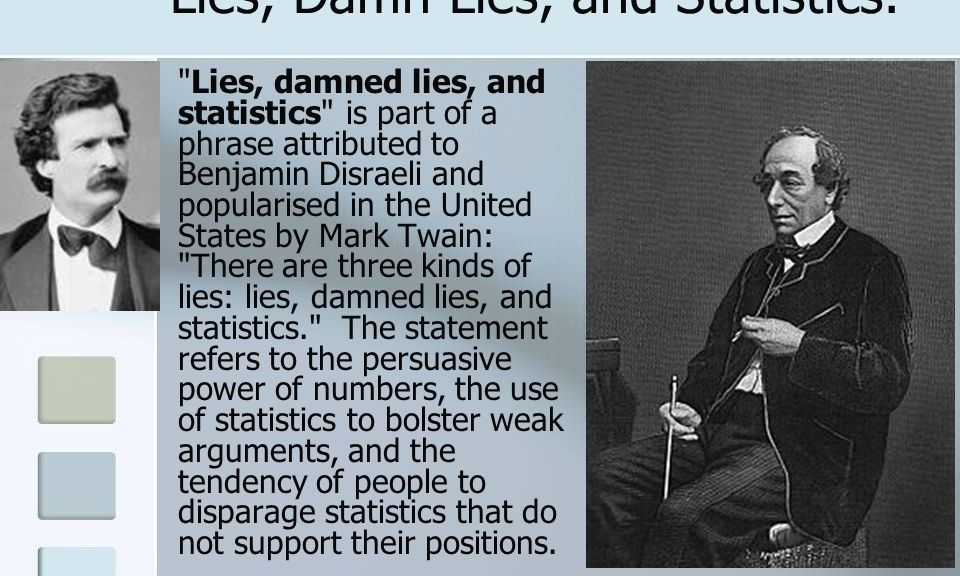
Main Picture Quote – “Lies, damned lies, and statistics” is part of a phrase attributed to Benjamin Disraeli and popularized in the United States by Mark Twain: “There are three kinds of lies: lies, damned lies, and statistics.” The statement refers to the persuasive power of numbers, the use of statistics to bolster weak arguments, and the tendency of people to disparage statistics that do not support their positions – Lies, Damn Lies, and Statistics.

Our Daily Bread — God at the Crossroads

Bible in a Year :

Stand at the crossroads and look; . . . ask where the good way is, and walk in it.

Jeremiah 6:16

Today’s Scripture & Insight :

Deuteronomy 30:15–20

After days of illness and then spiking a high temperature, it was clear my husband needed emergency care. The hospital admitted him immediately. One day folded into the next. He improved, but not enough to be released. I faced the difficult choice to stay with my husband or fulfill an important work trip where many people and projects were involved. My husband assured me he’d be fine. But my heart was torn between him and my work.

God’s people needed His help at the crossroads of life’s decisions. Far too often, they hadn’t adhered to His revealed instructions. So Moses implored the people to “choose life” by following His commands (Deuteronomy 30:19). Later, the prophet Jeremiah offered words of direction to God’s wayward people, wooing them to follow His ways: “Stand at the crossroads and look; ask for the ancient paths, ask where the good way is, and walk in it” (Jeremiah 6:16). The ancient paths of Scripture and God’s past provision can direct us.

I imagined myself at a physical crossroads and applied Jeremiah’s template of wisdom. My husband needed me. So did my work. Just then, my supervisor called and encouraged me to remain home. I drew a breath and thanked God for His provision at the crossroads. God’s direction doesn’t always come so clearly, but it does come. When we stand at the crossroads, let’s make sure to look for Him.

By:  Elisa Morgan

Reflect & Pray

Where do you need direction today? How might God be revealing Himself to you?

Dear God, when I’m uncertain, help me to stand at the crossroads and look for Your provision.

http://www.odb.org d1

Grace to You; John MacArthur – Approaching Life from a Divine Perspective

 “I, therefore, the prisoner of the Lord, entreat you to walk in a manner worthy of the calling with which you have been called” (Ephesians 4:1).

To mature in our faith, we must learn to see things from God’s perspective.

Paul was a prisoner of Rome. Why then did he call himself “the prisoner of the Lord”? Because he had the ability to see everything in terms of how it affected Christ. No matter what happened in his life, he saw it in relation to God. His questions were, “What does this mean, God?” and “How does this affect You?”

When a problem comes in life, we are prone to say, “Oh, woe is me!” and wonder how it will affect us: Will it cause me pain? Will it cost me money? Too often we think only on the earthly level. But like Paul, we should think on a heavenly level: What is God trying to teach me? How can I glorify Him in this? In fact, a good definition of Christian maturity is: automatically seeing things in light of the divine perspective.

This perspective, this God-consciousness, is the only right way for Christians to live. David said, “I have set the Lord continually before me; because He is at my right hand, I will not be shaken. Therefore my heart is glad, and my glory rejoices; my flesh also will dwell securely” (Ps. 16:8-9). Because David was always aware of God’s presence, he found joy and security, and no trouble could disturb him for long.

Paul was the same way: he knew there was a reason for his imprisonment and that Christ would be glorified by it (cf. Phil. 1:12-14). Paul wasn’t preoccupied with how it affected him, and thus he was able to rejoice, even in prison.

“God causes all things to work together for good to those who love God, to those who are called according to His purpose” (Rom. 8:28). Nothing happens outside of God’s control. Let’s trust that He knows what is best for us.

Suggestions for Prayer

If you tend to get discouraged or complain when troubles come, ask God to forgive you and help you see troubles from His perspective. Acknowledge before Him that He is in control of everything.

For Further Study

Paul’s attitude toward difficulties was cultivated by the experience he describes in 2 Corinthians 12:2-10. What did Christ teach him about troubles in verse 9, and how did that change Paul’s outlook?

From Strength for Today by John MacArthur

http://www.gty.org/ e0

Joyce Meyer – I Will Not Fear

I lie down and sleep; I wake again, because the Lord sustains me. I will not fear though tens of thousands assail me on every side.

— Psalm 3:5-6 (NIV)

Fear is one of the biggest problems people face, yet God’s Word encourages us frequently not to fear. One of the biggest reasons we do not need to fear is that God is with us. He will never fail us or forsake us (Deuteronomy 31:8), and just as He sustained the psalmist David, He sustains us. Therefore, we can say with David, “I will not fear.”

Can you try to imagine your life without any fear? I find myself responding in fear much more often than I wish I did, and perhaps like you, I am still studying God’s Word and praying about this area of my life because I want to live by faith and not allow fear to steal my joy. Fear brings torment (1 John 4:18 NKJV, and God does not want us tormented. He sent Jesus to earth so we could have an abundant quality of life and enjoy it (John 10:10).

At one time, I lived with great fears constantly. I am thankful that I have been delivered from most of them, but I want total victory in this area, and I am sure you do too. Don’t despair. God delivers us from our enemies “little by little” (Deuteronomy 7:22). Every day, you can get better and better in every way. Keep pressing in and remember that God sustains you and that you can trust Him.

Prayer of the Day: Father, I trust You, and I trust that You are sustaining me, working in me, and delivering me from all my fears. I will not fear because I believe You are with me. Thank You.

http://www.joycemeyer.org U

Truth for Life; Alistair Begg – Our Great High Priest

Every high priest chosen from among men is appointed to act on behalf of men in relation to God, to offer gifts and sacrifices for sins … No one takes this honor for himself, but only when called by God, just as Aaron was. So also Christ did not exalt himself to be made a high priest, but was appointed by him who said to him, “You are my Son, today I have begotten you”; as he says also in another place, “You are a priest forever, after the order of Melchizedek.”

Hebrews 5:1, Hebrews 5:4–6

The concept of priesthood and the sacrificial system is far removed from our contemporary Western world, but understanding it is fundamental to Christian living. The practice of animal sacrifice in Old Testament Israel was not a man-made system created as a futile attempt to reach God and make humans acceptable to Him. Rather, it was meant to help God’s covenant people understand His character, His expectations, and the wonder of His plan of redemption (and it can still help us in this way today). In all of its nuances, God was pointing His people toward the finished and perfect work of the Lord Jesus Christ, who would come both as His people’s Great High Priest and as the one perfect sacrifice offered on their behalf.

Historically, Israel’s high priest would have come from the line of Aaron, Moses’ brother, and would have been considered “chief among his brothers” (Leviticus 21:10). This individual would have experienced the same societal conditions, pressures, and trials as the men and women he was representing, which would have helped him to be a more compassionate advocate on their behalf.

Long before the arrival of Jesus, however, the historical pattern of high-priestly appointments had been corrupted by Herod the Great and other rulers, who chose the high priest for themselves. They didn’t understand that the high priest’s role was not an honor to be bestowed by man but ultimately a call from God, as it had been for Aaron. High priests were not to represent the political establishment; they were to represent God’s people to God Himself.

That is one of the factors that makes Jesus the very best high priest: He did not take upon Himself the glory of becoming a high priest; rather, He was appointed by the Father. He acknowledged, “If I glorify myself, my glory is nothing. It is my Father who glorifies me, of whom you say, ‘He is our God’” (John 8:54). He perfectly endured the same hardships we face. He has gone before Almighty God for our sins even though He was sinless. With a spirit of gentleness, Jesus spurs us toward righteousness. Because He offered the perfect sacrifice—indeed, because He was the perfect sacrifice—you and I can enjoy God’s presence both now and forevermore. No sin or suffering, no disappointment or despair, makes this glorious reality any less true: that you have a priest, forever, and therefore you have a place with Him, forever.

Questions for Thought

How is God calling me to think differently?

How is God reordering my heart’s affections — what I love?

What is God calling me to do as I go about my day today?

Further Reading

Hebrews 4:14–16, Hebrews 5:1–10

Topics: Christ as Priest Substitutionary Atonement

Devotional material is taken from the Truth For Life daily devotionals by Alistair Begg

http://www.truthforlife.org

Kids4Truth Clubs Daily Devotional – God Can Make You Happy

“Although the fig tree shall not blossom,…yet I will rejoice in the LORD, I will joy in the God of my salvation.” (Habakkuk 3:17-18)

A young missionary in China named Hudson Taylor was writing a letter home to his sister Amelia. What happy news could he share? Many of the Chinese people were dying from famine. He had very little money. The other missionaries did not like the way he dressed as the Chinese did. And the girl he loved and wanted to marry had just told him that she would not marry him. Hudson had every reason to be sad. His eyes moved to the Bible beside him on his desk. What had he read that very day about God’s love? He picked up his pen and wrote, “The love of God never changes. Can we ever love Jesus as much as He loves us?”

What would it take to make you happy? Another new toy? A room all to yourself? An “A” on your math paper? Having a certain person for your best friend? Only knowing God and His love for you can make you happy deep down in your heart. Only He can give you happiness that lasts, even when things go wrong.

Knowing God is the only thing that will make you truly happy.

My Response:
» Am I getting to know God through His Word?
» Do I find my happiness in God?

Denison Forum – Who’s to blame for the January 6 Capitol riot? How to live with the consequences of our actions

With the third anniversary of the January 6 Capitol riot (or attack or protest or insurrection or whichever descriptor you prefer) coming up tomorrow, reactions to the event continue to dominate the news. President Biden plans to address the subject in a speech that uses the events of that day to portray former President Trump as a threat who, in the words of Biden’s communications director Michael Taylor, “will use all his power to systematically dismantle and destroy our democracy.”
Not to be outdone, Trump plans to hold two campaign rallies on Saturday as well in what-if current polls are to be believed-will mark one of many attempts for the two candidates to control the national narrative surrounding the election across the coming months.
My purpose today is not to relitigate what happened at the January 6 Capitol riot three years ago or cast judgment on how the event continues to be used for political ends. Overall, my thoughts on that day have not really changed since I discussed it last year, and Dr. Jim Denison did an excellent job of speaking to why having a productive conversation on the topic can be so challenging in yesterday’s article.
Rather, I would like to look at what I think is the most pertinent and applicable lesson we can take from that event to help us protect our witness and grow in our walk with the Lord.
An indelible part of Trump’s legacy
Debate continues over how much responsibility the former president bears for what happened at the January 6 Capitol riot three years ago. However, it is beyond dispute that the day’s events continue to play an inescapable part in the narrative surrounding Donald Trump’s attempt to regain the Oval Office. It was felt in the red wave that turned into a trickle during the 2022 midterms and the repeated accusations of wanting to destroy democracy that have been part of the Democratic rhetoric whenever Trump is discussed.
And, ultimately, he has no one to blame but himself.
You see, people don’t typically get to choose the consequences of their decisions. For Trump, the consequence of his actions-or inactions-is that his political opponents have all the fodder necessary to repeatedly level accusations that he is a threat to democracy. And while you may or may not find those accusations convincing, enough Americans do that it has greatly clouded his path back to the White House.
And there is nothing the former president or any of his supporters can do to stop it. Those events and his role in them-whether accurately perceived or not-are an indelible part of his legacy.
When people discuss his presidency in fifty years, be it one term or two, January 6 will come up. As we discussed on a recent episode of The Denison Forum Podcast, the nature of what that conversation will look like is yet to be determined, but the odds are good that Trump will be remembered as much for the election he lost as for the four years that preceded it.
And therein lies the lesson for us today.
When Saul faced grave consequences
One of the facets of the Bible that sets it apart from the holy books of many other faiths is that its most important figures are often among its most flawed characters. Take King Saul, for example.
Saul was no stranger to thoughtless actions and the consequences that ensued, but perhaps the most noteworthy instance occurred in 1 Samuel 13. Facing the imposing might of the Philistines and an army that had begun to scatter, Saul took it upon himself to offer sacrifices that only Samuel was supposed to give. It’s important to note that he was not trying to usurp the prophet’s position or claim any special rights for himself. Rather, he was simply trying to keep his army together ahead of battle.
Yet, despite his motivations being reasonable on the surface, they demonstrated a lack of faith in the Lord, and it exhausted God’s patience.
Through Samuel, God told the king “You have done foolishly. You have not kept the command of the L??? your God, with which he commanded you. For then the L??? would have established your kingdom over Israel forever. But now your kingdom shall not continue. The L??? has sought out a man after his own heart, and the L??? has commanded him to be prince over his people, because you have not kept what the L??? commanded you” (1 Samuel 13:13-14).
When Saul offered those sacrifices, he had no way of knowing that it would cost him his kingdom. Had he understood what the consequences would be, chances are good that he would have acted differently. But, again, we typically don’t get to choose the consequence when we make a mistake, and focusing on whether the result of our sin seems proportionate or fair to us is ultimately pointless.
After all, the purpose of God’s judgment is to bring us back into a right relationship with him and to help us avoid sin in the first place. Far too often, though, we act like a child who is surprised to learn that his choices come with a cost. And while we serve a God who is quick to forgive any sin we confess, that forgiveness does not necessarily remove the natural consequences of our mistakes. Those are still often ours to bear, and the price is rarely what we might expect.
Dr. Jim Denison has frequently stated that sin will always take you further than you want to go, cost you more than you want to pay, and keep you longer than you want to stay.
That statement is just as true for former presidents as it is for you and for me.
Will you heed its warning today?

Denison Forum