Who Really Funds the Climate Agenda? 

President Trump’s efforts to dismantle parts of the Biden administration’s climate-policy framework have exposed just how much money and institutional power had become attached to it.

Renewable-energy companies, financial institutions, advocacy groups, labor organizations, and state governments are now fighting over subsidies, tax credits, regulations, and investments worth hundreds of billions of dollars.

Whatever one thinks of President Trump’s policy reversals, the controversy raises a more fundamental question: who built and financed this sprawling climate-policy system in the first place?

Most people assume climate policy emerges through the normal democratic process. Scientists publish research, governments consult experts, legislators debate proposals, and elected representatives decide the direction of public policy. Yet across both Europe and the United States, a vast network of philanthropic foundations, non-governmental organizations, think tanks, advocacy groups, and financial institutions also plays an important role in shaping climate policy and public opinion.

Lobbying itself is neither unusual nor inherently improper. What deserves closer examination is the scale, funding, and influence of the organisations promoting today’s climate agenda — and where their funding originates.

One organization that has attracted increasing attention is the European Climate Foundation (ECF), established in 2008 and headquartered in The Hague. Although headquartered in Europe, many of the foundation’s largest financial supporters are major American philanthropic organizations, illustrating the increasingly transatlantic nature of climate advocacy.

Dutch science journalist Marcel Crok recently examined the foundation’s role in European climate policy, arguing that it has become one of Europe’s most influential climate-focused philanthropic organizations while remaining largely unknown outside specialist circles.

His investigation raises important questions about how modern climate advocacy is financed and organized.

According to publicly available information cited by Crok, the ECF received approximately €275 million in funding during 2023. Among the listed supporters are several major American philanthropic organizations, including Bloomberg Philanthropies, the William and Flora Hewlett Foundation, and the Rockefeller Brothers Fund, alongside a number of European charitable foundations.

Grant recipients include research organisations, environmental NGOs, legal advocacy groups, communications initiatives, and media projects. Crok notes that organizations such as Carbon Brief, the European Environment Bureau, and CAN Europe have received ECF support, while Carbon Brief publicly discloses such funding as part of its transparency policy.

Climate policy today extends far beyond climate science. Across both Europe and the United States, it increasingly influences industrial strategy, financial regulation, banking, agriculture, transport, housing, taxation, and long-term investment decisions. Governments now work alongside NGOs, philanthropic foundations, research institutes, financial institutions, and private-sector organizations in developing climate and energy policy.

The 2022 Inflation Reduction Act alone originally included an estimated $369 billion in energy-security and climate-related programs, including grant funding and tax incentives, increasing the importance of understanding the organisations that help shape climate policy debates.

One example of this wider funding ecosystem is its growing connection with the international financial sector. Over the past decade, major American and international banks, asset managers and multinational corporations have become increasingly involved in developing climate-related financial frameworks.

In December 2015, the Financial Stability Board established the Task Force on Climate-related Financial Disclosures (TCFD), which represents $118 trillion of assets globally — see here.

The task force brings together representatives from many of the world’s largest financial institutions and corporations to develop climate-risk reporting standards. Over subsequent years, climate-related disclosure rapidly became embedded within investment management, Wall Street, banking regulation and corporate governance.

Critics, however, contend that they have also accelerated the financialisation of climate policy, embedding net-zero objectives within banking, investment and corporate decision-making.

When the world’s largest banks, corporations, and institutions, all align to push a climate change agenda that, in my view, is not supported by robust empirical evidence, one can see there is another agenda going on behind the scenes. This climate agenda tries to convince the public to make sacrifices and to accept significant economic and social changes under the emotive guise of “saving our planet.”

Meanwhile, corporations, financial institutions and investment funds stand to benefit financially, and political institutions implement worldwide technocratic policy systems under the banner of combatting man-made CO2-induced climate change.

Ultimately, critics argue that this agenda aligns with the objectives of U.N. Agenda 2030 while creating, or potentially creating, trillions of dollars in new financial opportunities for major banks and investment firms.

As a former science adviser at the U.K. Department of Energy and Climate Change, and one of more than 2,000 scientists and academics who have signed the Clintel World Climate Declaration, I believe this close relationship between climate policy and financial institutions deserves far greater public scrutiny.  The Clintel declaration argues that CO₂ is not the dominant driver of climate and that natural variability plays a much larger role than is commonly acknowledged.

The Rockefeller family’s support for climate initiatives has also attracted particular attention. How the Rockefeller banking dynasty became leading advocates of the global warning agenda is described in a report titled The Rockefeller Way: The Family’s Covert ‘Climate Change’ Plan published by the Energy & Environmental Legal Institute in  December 2016.

An article published by the institute  states:

In their Sustainable Development Program Review, the Rockefeller Brothers Fund boasts of being one of the first major global warming activists… Their highly complex integration of hedge funds, interlocking boards positions, and non-profit organizations has steered public policy on these issues and provided them with foreknowledge of emerging markets and access to the developing worlds’ natural resources …

Another important development has received surprisingly little public attention.

The developers of the next generation of official climate scenarios have concluded that the highest-emissions pathways, including RCP 8.5 and SSP5-8.5, are no longer considered plausible representations of likely future development. Because these scenarios influenced thousands of studies, policy recommendations and media reports, this shift has important implications. I examine the issue in detail in my earlier American Thinker article, “The Climate Scenario Behind A Decade of Alarmism Is No Longer Considered Plausible

A broader question concerns the underlying assumptions built into today’s climate models. Is carbon dioxide truly the dominant driver of climate, as argued by the U.N. IPCC, and can current models isolate its influence with the degree of precision implied by modern attribution studies? Many scientists and researchers—including the more than 2,000 signatories of the Clintel World Climate Declaration — argue that CO₂ is not the dominant driver of climate and that natural variability plays a much larger role than is commonly acknowledged.

Supporters argue that funding of net-zero initiatives accelerates action on an urgent global challenge. Critics contend that concentrated philanthropic funding amplifies particular policy perspectives while making alternative viewpoints less visible within public debate.

Regardless of one’s view of climate science, organisations spending hundreds of millions of dollars and euros to influence public opinion and public policy deserve greater transparency and public scrutiny. Whether in Europe or the United States, citizens have a right to know who is shaping climate policy, how it is being funded, and whether competing scientific perspectives are receiving a fair hearing.

These issues are examined in greater detail in the 2026 edition of my book Climate CO₂ Hoax: How Bankers Hijacked the Real Environment Movement.

Its purpose is to distinguish genuine environmental concerns from claims that, in my view, are not supported by robust empirical evidence.

Mark Keenan is a former United Nations technical expert and an independent writer on science, technology, political economy and human freedom. He is the author of Climate CO2 HoaxThe AI IllusionThe Debt Machine, and Demonic Economics. His articles are available on Substack at markgerardkeenan.substack.com.


Mark Keenan | July 18, 2026

Source: Who Really Funds the Climate Agenda? – American Thinker
America’s Independence From Tyrannical English Governance Would Never Have Succeeded Without Dependence On God 

America’s Independence From Tyrannical English Governance Would Never Have Succeeded Without Dependence On God


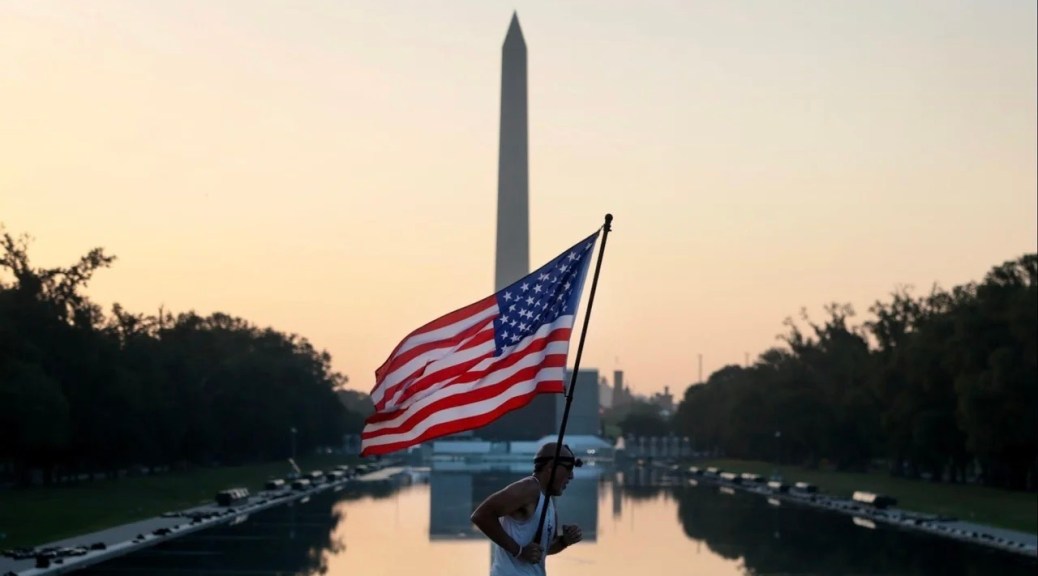
America’s celebration of birth since 1776 was spectacular, our independence from mother England 250 years previous having been a painful and bloody one, to say the least. That separation, however, wasn’t one of merely exerting cleavage from an empire determined to rule over the colonies. That is, there has been a much more profound leverage than a revolutionary spirit at work in producing that schism than just the colonists’ desire to break free of overbearing bondage.

America’s founding fathers—that is, a majority of them—recognized the nature of the profound leverage they were allowed to apply in order to burst free from the most powerful military on the planet at the time. It was providential leverage that most of them acknowledged as the intervening force that birthed this nation.

George Washington said on a number of occasions following the War of Independence that he felt the hand of the Almighty on him. He said he was providentially prevented from being shot on several occasions. In one incident, there were four rifle ball holes in his general’s uniform, but none of the balls had entered his body.

John Adams repeatedly wrote that America was a nation under God’s hand, that America was a moral nation, and the Constitution would work for no other than a moral people. Even Jefferson acknowledged a greater power as having guided the founders and seen to it that the War of Independence was won because of a providential power.

So, the desire for independence from a tyrannical, overbearing English governance was important as those patriots waged the Revolutionary War. But, in the words of almost every founding father, according to extensive documents we have seen presented by experts on America’s founding, such as David Barton, it was dependence on God in Heaven they acknowledged as the true reason for America’s winning independence.

This dependence was steeped in adherence to the Word of God. The Judeo-Christian reference to America’s founding is that its founding principles were based, by and large, within Old and New Testament principles.

Although there is debate on who made the statementFrench historian and political thinker Alexis de Tocqueville is attributed as saying: “America is great because she is good; if America ceases to be good, America will cease to be great.”

During the early times of the nation’s founding, America was indeed good in comparison to today’s America. Jesus Christ was the only good there was at the center of the founding principles. At this late date 250 years hence, however, we can but admit the truth that we have in many areas lost our way in comparison to those earlier times.

The entire world of earth’s inhabitants, for the most part, have strayed ever farther from Heaven’s governance. Independence is now a term that can be applied to the world pulling away from God’s desire that people come nearer to Him, not break away from Him. I believe that because of America’s founding fathers’ dependence on the principles found in God’s Holy Word, the nation could well call the date of July 4, 1776, Dependence Day. It was in large part a dependence upon Heaven above to secure the Revolutionary War victory and nationhood we enjoy today.

America, too, suffers from the independent spirit of anti-God behavior. It is actually the Antichrist Spirit that this country and all nations of the world suffer from as we dive more deeply into the end of the Age of Grace.

But vestiges of that early spirit of dependence upon the God of Heaven still linger in America during this evil day. Despite the world’s mainstream media’s constant railing against Americanism, and the leaderships of the world’s countries lying to their peoples about the ugly Americans, we see, through reports, that this nation that was once populated by a moral people can yet be sensed, even if during this time of liberty’s last gleaming.


American greatness left a World Cup traveler in tears as he admitted what initially caused him “fear to travel to the United States.”

In the weeks since the 2026 FIFA World Cup has been underway, communities across North America have embraced the prolific drinking of the Tartan Army, Norway’s Viking row, and the myriad guests soaking up cities and small towns alike. Despite seeing his home team eliminated by Paraguay, a German’s tears were for love of the U.S. after buying into propaganda about how “the country’s not safe.”

During an interview with NBC10 Boston’s Oscar Margáin, Sebastian Kraus could be seen repeatedly wiping away tears with his hands and his shirt as he got choked up about his experience as a visitor to America.

“I fell in love with this country, and this was so emotional, I even cried in the stadium,” he told the reporter after being seen taking a moment to collect himself, including a breathing exercise, having been asked, “Why? Help us understand, why is this so impactful to you?”

Juxtaposed against video he shared with the outlet of a group of strangers driving him back to his hotel where he joyfully expressed, “Bob takes us home,” and “America is great,” Kraus told Margáin, “To be honest, I was a bit scared or had a fear to travel to the United States. News about shootings and criminals and that the country’s not safe.”…

“We owe America a huge apology, because America is nothing like what the media tells us,” he said in a social media video. “Everyone is so friendly, everyone is so accommodating, and I’ve honestly had the best time.”…

His whole life in Germany, he’s been fed lies about America by their media. There’s a reason so many Europeans mock the US until they visit it for themselves; they’ve been brainwashed by the politicians and media elites. 


America’s relationship with God from its birth was independence from Great Britain through dependence on Heaven’s help. This is a truth that applies to believers in Jesus Christ. It also applies to those who are in Satan’s grip, needing to come into liberty offered only through God’s Son, who died and rose again to make the lost free from sin-bondage.

Our independence from the evil one, Satan, who seeks to destroy humankind, can be only achieved through dependence upon God’s plan of redemption.

Here yet again is that plan: “That if you will confess with your mouth the Lord Jesus, and will believe in your heart that God has raised Him from the dead, you will be saved. For with the heart man believes unto righteousness; and with the mouth confession is made unto salvation” (Romans 10:9-10).


Source: America’s Independence From Tyrannical English Governance Would Never Have Succeeded Without Dependence On God – Harbinger’s Daily

Today in the Word – Moody Bible Institute – What We Treasure


Read Matthew 6:19–24

What do you do out of habit? Maybe you always start the day with a cup of coffee or get in a walk around the block after dinner. Many of our habits are based on what we think is important. Habits can take us in surprising directions, either toward God or toward rival gods, priorities, or values.

In Matthew 6, Jesus asks us what we treasure. In other words, what do we truly love? The answer is revealed by our everyday actions. That’s where our heart truly is, no matter what we say on Sundays (vv. 19–21). Earthly treasures are temporary and vulnerable. By comparison, heavenly treasures are eternal and secure. Which of these would we prefer to be our “reward in full”? The second, of course.

In verses 22–23, there appears to be an abrupt change of topic. After discussing treasure, Jesus turns to a new topic: healthy versus unhealthy eyes. While at first it might seem unrelated, this metaphor is directly related to the treasure metaphor. To be “full of light” indicates that our knowledge and actions are righteous and thus please God. Eyes “full of darkness” indicate knowledge and actions that are sinful and thus dishonor the Lord. Healthy “eyes” discern and follow right teaching. They can see the foolishness of storing up earthly treasures. Unhealthy “eyes” are blind to these truths and thus pursue the wrong goals.

We must choose. Will we seek earthly treasures or heavenly treasures (v. 24)? We cannot serve both; we can have only one “master.” Earthly treasures are represented by money, given that wealth leads to the things that worldly people want most. But we can only love or be devoted to one thing. By definition or by comparison we will hate or despise the other thing. Which will it be? God or money? Heavenly treasures or earthly treasures?

Go Deeper

Psalm 1 also describes choosing between two spiritual paths. What do this psalm and today’s reading have in common?

Pray with Us

God, You are worth more than anything this world has to offer. When we become enticed by earthly riches, remind us that they do not last. Only You and Your words are eternal.

For where your treasure is, there your heart will be also.Matthew 6:21


https://www.moodybible.org/

Our Daily Bread – Road Closed, Spirit-Led


Today’s Scripture

Acts 16:6-10

Listen to Today’s Devotion

Apple LinkSpotify Link

Today’s Devotion

After a lengthy journey, my wife and I finally neared our street, but a large road closed to thru traffic sign blocked our path. I felt the urge to drive around it because home was just ahead, and I didn’t like being rerouted. But then I saw why the road was closed: A downed power line lay across the road. Had I ignored the warning, I could have driven into danger.

In Acts 16:6-10, Paul and his companions were eager to preach the gospel in the province of Asia, but the Holy Spirit closed that door. Detours aren’t always rejection, however. They can be divine redirections. Like the roadblock on our street, God rerouted Paul from entering the province of Bithynia. It must have been frustrating to be blocked, especially while Paul was striving to do his best. But then he received a vision in which a man said, “Come over to Macedonia and help us” (v. 9). God said “no” to something good because He was preparing them for something else—taking the gospel to the people of another continent (v. 10).

Rather than seeing “no” as punishment and rejection, we can see it as His Spirit-led redirection. His detours are often pathways to divine appointments. Let’s not simply trust His direction when the roads are open; let’s follow when He closes them too.

Reflect & Pray

When has God placed a “road closed” sign in front of you as you were striving to do something good? How are you listening for the Spirit’s guidance as you work out your plans?


Dear God, please help me to trust Your closed doors as much as I trust Your open ones.

To learn more read When God Says No

Today’s Insights

In Acts 16:6-7, it’s unclear how the Holy Spirit stopped Paul from moving forward with his plans. It may have been through a vision, a word of prophecy, or some other circumstance. When God prompted him to go to Macedonia so the gospel could be heard there, we’re told He spoke to him through a vision (vv. 9-10). Scripture doesn’t reveal the identity of the “man of Macedonia” (v. 9), but some scholars believe it may have been Luke, who wrote the book of Acts and joined the group at this point. As believers in Jesus, when God seems to close a door, it may be that the Holy Spirit is redirecting our plans to better align with His. The Spirit of God lives inside us to guide us. Christ said of the Spirit, “He will guide you into all the truth. He will not speak on his own; he will speak only what he hears” (John 16:13; see 14:26).


http://www.odb.org

Denison Forum – What makes a hero? A Christian review of “The Odyssey”


Christopher Nolan’s take on the 2,800-year-old epic poem, “The Odyssey,” is one of the summer’s most anticipated films, and it’s easy to see why. Outside of the fact that Nolan just doesn’t seem to make bad movies, it’s also the first time anyone has attempted to depict this classic tale on the big screen in more than 70 years.

Perhaps part of the reason for such a long gap is that elements of the story are so foundational to the way we see the ideas of heroism, struggle, and family that they pop up in other mediums often enough that we never really feel the original’s absence. The film is worth seeing, though, and the nearly three-hour runtime feels much shorter as Nolan crafts a story that jumps through time in a way that’s simultaneously disorienting yet clarifying for following along with Odysseus’s journey and the family he left behind.

Moreover, much of the controversy surrounding elements like casting choices is quickly forgotten once the story starts. Elliot Page does not play Achilles, despite frequent rumors to the contrary, though the transgender actor still looks out of place as a soldier, even when playing a physically weaker character. I also appreciated that, despite plot elements and characters that could have easily lent themselves to a more overtly sexualized portrayal, those elements were largely absent from the film as a whole.

At its core, The Odyssey remains a story about a man trying to get home while wrestling with the question of whether he is worthy of doing so. While Nolan’s version takes liberties with the original tale, they’re mostly in service of helping the audience follow along with Odysseus as he struggles to find that answer.

And understanding that struggle is important because, in many ways, it highlights the best answer our culture can offer and why that answer still falls woefully short of what we need.

Is it enough to be better?

I’m not sure if you can spoil a story that’s nearly 3,000 years old, but by the end of the film, Odysseus makes it home. The man he is when he arrives is quite different from the one who left, though. And, in Nolan’s telling, that’s largely what makes him a hero.

The saga tales about the Trojan Horse, infiltrating the otherwise impregnable walls of Troy, and creating the pathway to the Greeks’ final victory are ultimately viewed through a lens of shame rather than pride, and it’s only after coming to that realization and accepting the consequences of his actions that he feels worthy of reuniting with his family.

Owning our mistakes, rather than attempting to hide from them or explain them away, is a necessary corrective to so much of what’s wrong in how our world views sin. The problem is that it leaves little room for true redemption.

On our own, the best we can hope for is that the desire to avoid repeating our past mistakes helps us to become better people going forward. Those memories can—and should—inspire us to change, but to what extent are people really capable of that?

In one of the film’s more poignant scenes, Odysseus vows to protect his men from themselves, only to be told that it’s not up to him. And, to an extent, that’s true for all of us.

Even the best versions of who we are capable of being will fall short of the people God has created and called us to be. We can try to be better, we can learn from our mistakes, and we can vow not to repeat them, but our fallen nature will eventually win the day.

On some level, I think most people understand that. It’s why we find stories like The Odyssey inspiring. It’s why we identify with the flawed heroes who fail and long to see them restored.

And it’s why, apart from God, we will never find that longing fully satisfied.

New or improved?

The truth is that God has instilled in each of us a basic awareness of the fact that we are called to be more than we are capable of becoming on our own. However, if we’re not careful, that awareness will get buried under the desire to settle for something we can achieve without turning to the Lord.

If acknowledging our mistakes and striving to do better is enough, then we’ve lowered the bar to a standard that any human can meet. Doing so assumes a degree of eventual failure that lessens its sting and embraces its inevitability as simply part of the human condition. And, this side of heaven, such failure truly is inevitable, even when we have the Holy Spirit to help.

There will never come a moment when we have to sin, but enough of our fallen nature remains that we eventually will. So, what will you do when those moments come?

In the world’s telling, the key is to learn from our mistakes and strive to be better. But that still leaves those mistakes as the defining characteristics of who we are. Any changes we make, or personal improvements that come, are still based in an identity of failure.

God wants more for us than that, and he offers a new identity in Christ that not only forgives our mistakes but banishes them as far as the east is from the west (Psalm 103:12). In Jesus, we can find true restoration and redemption; the kind that makes us new rather than just improved (2 Corinthians 5:17).

But we can’t do it on our own. We were never meant to.

That’s good news if we can have the humility to accept it.

Can you?


Denison Forum

Days of Praise – When the Foundations Are Destroyed


by Henry M. Morris, Ph.D.

“If the foundations be destroyed, what can the righteous do?” (Psalm 11:3)

The word here for “foundations” is not the usual word for, say, a building foundation. Used rarely, a better translation of this word would be “purpose” or “basis.” The fear expressed is not that the foundations of our faith may be undermined but that we may lose our sense of purpose.

In the context of the psalm, David was in danger of becoming demoralized by the pressures of wicked desires and evil ambitions all around him, and Christians surely have the same problem today. Why should we try to maintain high standards of doctrinal integrity and moral purity when the people around us—even most Christians—seem to be occupied mostly with materialistic ambition and pursuit of pleasure? If we allow the devil to undermine the very purposes God has for our lives, wandering away from His will in favor of some temporal interest, then why even continue with a pretense of Christian living?

David’s solution was simply to remind himself that “the LORD is in his holy temple, the LORD’s throne is in heaven: his eyes behold, his eyelids try, the children of men” (v. 4). He may allow the righteous to be tried for a season, but we must not forget that “the righteous LORD loveth righteousness” (v. 7) and that “the wicked and him that loveth violence his soul hateth” (v. 5).

When we are tempted to wonder whether it is really worth all the effort, and when our very foundation and purpose for living seems to be crumbling, we should remember that our God is Creator, Sustainer, and Judge of all—He still is on His throne, and we who belong to Him have been “predestinated according to the purpose of him who worketh all things after the counsel of his own will” (Ephesians 1:11). HMM


https://www.icr.org/articles/type/6

Joyce Meyer – Jesus Has Overcome the World


I have told you these things, so that in Me you may have [perfect] peace and confidence. In the world you have tribulation and trials and distress and frustration; but be of good cheer [take courage; be confident, certain, undaunted]! For I have overcome the world. [I have deprived it of power to harm you and have conquered it for you.]

John 16:33 (AMPC)

Jesus tells us that in the world we will have tribulation. He doesn’t want us to be surprised by our troubles, but to hold our peace and remain confident in Him in the midst of them. He actually says that when trouble comes, we should cheer up, because He has overcome the world and deprived it of power to harm us.

This is such good news. Satan may come against us, but he will never win. We might lose a battle now and then, but we have already won the war. I used to think that life would be so good if only I didn’t have trouble stalking me all the time. I kept waiting for my trouble to go away, but I discovered that God wanted me to learn how to face it with confidence, knowing that He would always take care of me. He wants to do the same for you. Are you worried about something right now? If so, read today’s scripture over and over, and let the reality of what it says sink into your heart.

Prayer of the Day: Jesus, help me stay confident in You during difficult times. Remind me that You have overcome the world and are always with me, amen.


http://www.joycemeyer.org