How Government Created a Nation of Conspiracy Theorists

Five years ago, suggesting that COVID-19 may have originated in a laboratory rather than a wet market could earn someone the label “conspiracy theorist.”

Discussing vaccine injuries could result in a post being removed from social media. Questioning prolonged school closures, forced masking, or vaccine mandates often led to accusations of being “anti-science.”

Today, many of those once-forbidden discussions have become part of public debate.

That doesn’t mean every alternative theory is correct.

But it raises an important question.

What happens when institutions repeatedly assure the public that they are unquestionably right, only to revise, retreat, or quietly abandon those assurances months or years later?

The answer may be found in Rasmussen Reports’ latest survey.

Nearly half of Americans — 45 percent — now believe it is at least somewhat likely that COVID-19 was deliberately released as part of an effort to reduce the world’s population.

Not five percent.

Not fifteen percent.

Nearly half of the country.

I am not arguing that this belief is true. I have seen no evidence that COVID was part of a deliberate depopulation plan, and the Rasmussen survey does not make that claim.

But public opinion tells us something equally important.

Americans increasingly assume the worst about the institutions that once enjoyed their confidence.

In my recent Rasmussen Reports column, I argued that the greatest casualty of COVID was trust.

This new survey underscores just how profound that loss has become.

Conspiracy theories rarely flourish in societies where institutions are transparent, accountable, and willing to admit mistakes.

They flourish where information is incomplete, official explanations shift repeatedly, and legitimate questions are dismissed rather than answered.

Nature abhors a vacuum. Transparency fills that vacuum. Secrecy fills it with suspicion.

When government agencies refuse to fill that vacuum with openness, the public fills it with speculation.

Some of that speculation will prove wrong.

Some may ultimately prove correct.

History suggests that both outcomes are inevitable.

The point is that the vacuum never stays empty.

Consider how many official narratives changed during the pandemic.

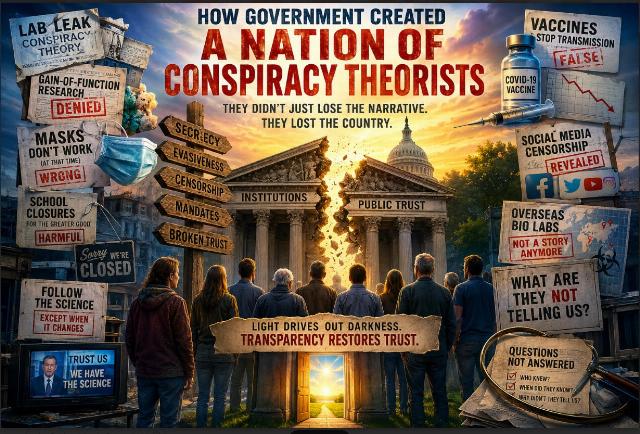
The lab-leak hypothesis was widely dismissed before it became a plausible explanation worthy of serious investigation.

The effectiveness of cloth masks became far more contested than early public messaging had suggested.

Extended school closures are now widely acknowledged to have imposed significant educational and psychological costs.

Claims that vaccination would prevent transmission gave way to more nuanced discussions about reducing severe illness and hospitalizations.

Government coordination with social media companies over COVID-related content have become the subject of congressional investigations and court cases.

Even recent disclosures about U.S.-supported biological laboratories overseas have fueled public skepticism, regardless of how those facts are interpreted.

None of this proves a grand conspiracy.

But it does explain why many Americans have stopped giving government officials the benefit of the doubt.

Trust works much like a marriage does.

Imagine one spouse repeatedly offering incomplete explanations, changing their story, deleting text messages, and insisting, “Nothing to see here.”

Perhaps there is an innocent explanation.

Perhaps there isn’t.

But evasiveness itself breeds suspicion.

Eventually, the other spouse begins to assume the worst—not necessarily because of what has been proven, but because confidence has been lost.

Governments are no different.

Trust isn’t destroyed by a single disagreement. It’s destroyed by a pattern of evasiveness.

Public trust depends less on perfection than on honesty

People generally understand that science evolves, and physicians certainly do.

Medicine is full of uncertainty. Recommendations change as evidence accumulates. At least they should

What patients find difficult to forgive is not an honest mistake.

It is the perception that information was withheld, inconvenient questions were discouraged, or uncertainty was replaced with unwarranted certainty.

Experienced physicians know that malpractice suits are often driven less by honest medical errors than by patients who believe they were misled or kept in the dark.

If officials had openly acknowledged what they didn’t know, admitted when recommendations changed, and explained why, public confidence might well be stronger today.

If physicians communicated with patients as many public officials did during COVID, informed consent would rightly be called into question.

Now, many Americans assume that every official statement conceals an undisclosed truth.

That should concern everyone.

The real danger isn’t whether one believes a particular conspiracy theory.

The danger is that millions of Americans no longer believe that the institutions responsible for protecting public health merit the presumption of honesty.

Trust, once lost, is very difficult to regain.

Public health depends on voluntary cooperation.

The next pandemic will almost certainly occur.

When it does, officials will once again ask Americans to believe them and to follow their recommendations.

But credibility cannot be restored through fact-checks, public relations campaigns, or censorship.

It can be restored only through transparency, humility, accountability, and a willingness to admit mistakes.

Transparency is the antidote to conspiracy theories.

If mistakes were made, the public deserves an honest accounting. If misconduct occurred, accountability should follow. Without either, official assurances will remain hollow.

If those qualities remain absent, Americans will continue connecting the dots — sometimes correctly, sometimes incorrectly, but almost always suspiciously.

The real lesson of Rasmussen’s poll isn’t that nearly half of Americans believe a depopulation theory. The real lesson is that nearly half of Americans now consider such a theory plausible. 

Those are not the same

Ironically, the officials who warned most loudly about “dangerous conspiracy theories” seldom paused to ask why those theories were gaining traction. People rarely abandon trusted institutions without cause.

That should alarm every physician, scientist, public health official, and elected leader across America.

Distrust doesn’t arise in a vacuum. It is cultivated when certainty supplants humility and questions are treated as threats rather than as opportunities for inquiry.

Trust is the foundation upon which modern medicine rests. Once that foundation is fractured, rebuilding it may take generations­—far longer than it took to destroy it


Brian C. Joondeph, M.D., is a Colorado-based ophthalmologist who writes frequently about medicine, science, and public policy.

Follow Brian:

Twitter @retinaldoctor

Substack Dr. Brian’s Substack

Truth Social @BrianJoondeph

LinkedIn @Brian Joondeph

Email brianjoondeph@gmail.com
Related Topics: Popular CultureGovernment

Turning Point; David Jeremiah – Active Waiting


NEW!Listen Now

Rest in the Lord, and wait patiently for Him…. Cease from anger, and forsake wrath; do not fret—it only causes harm.
Psalm 37:7-8

Recommended Reading: Psalm 37:9; Psalm 37:34

Television news often features segments at the nation’s largest airports—usually based around flight delays or cancellations. When the reporters interview travelers, they are often impatient or disgruntled. No one likes their plans to be delayed, much less canceled.

Delays happen all the time in our lives. We do our best to manage them with a measure of grace. What is harder is when we find ourselves in situations where we feel we have been wronged in some way and we ask God to intervene on our behalf. That was the motivation behind David writing Psalm 37—the contrast between the righteous who suffer at the hands of the wicked and the wicked themselves. David’s counsel to the righteous is not just to wait for the Lord to act but to wait “patiently.” If we are waiting patiently, we will not be angry or anxious. Instead, we will wait actively in prayer and in pursuit of acts of righteousness.

If your plans have been delayed or changed for whatever reason, do not fret. Instead, let your waiting be a time of seeking God’s will and finding joy in it.

Faith is not idle; it works while it waits.
Ronald Dunn


https://www.davidjeremiah.org

Our Daily Bread – God’s Drastic Love


God so loved the world that he gave his one and only Son. John 3:16

Today’s Scripture

John 3:16-21

Listen to Today’s Devotion

Apple LinkSpotify Link

Today’s Devotion

Daniel was born into a Romanian orphanage. For seven years, he only left his crib to go to the bathroom. When he turned eight, a family from another country adopted him. They knew about attachment disorders—that Daniel could have difficulty attaching to them as his parents. Slowly, Daniel started to trust them. Over time, though, he began to rage to the point his parents hired a bodyguard to protect them from Daniel’s outbursts. They decided on a controversial therapy: For the next five years they were never away from Daniel even if he had a meltdown. On his thirteenth birthday Daniel broke down and, for the first time, told his parents he loved them very much. His mother summarized the experience: “Creating love is not for the soft and sentimental. Love is a battlefield.”

We’re all born knowing that something or someone is missing. Like Daniel, we have an attachment disorder. But God “so loved the world” so much that he took drastic action—“he gave his one and only Son” (John 3:16), meeting us on earth’s battlefield in what we call the Incarnation. “Light has come into the world” (v. 19).

God took drastic measures to demonstrate His great love for the world. For you. His strong, determined Father-heart beats to hear from us the words Daniel’s parents finally heard: “I love you very much.”

Reflect & Pray

How have you felt that something or someone is missing? How can you respond to God’s drastic love for you?

Dear heavenly Father, I love You very much. Thank You for loving me first.

Today’s Insights

Many people are familiar with John 3:16, which describes the scope of God’s love for the world: “God so loved the world that he gave his one and only Son, that whoever believes in him shall not perish but have eternal life.” Many, however, misinterpret this verse. They think that if God’s love is so great, no one will “perish.” The critical phrase is “whoever believes in [Jesus].” John also writes, “Whoever does not believe [in Jesus] stands condemned already because they have not believed in the name of God’s one and only Son” (v. 18). John’s gospel begins with John introducing Christ as the light of the world (1:4-9). Jesus says of Himself, “Light has come into the world,” but people avoid the light “because their deeds [are] evil” (3:19). God is indeed love. But we must respond to His love by believing in His Son, Jesus—the light of the world.


http://www.odb.org

Denison Forum – The sudden deaths of Sen. Lindsey Graham and actor Sam Neill


A reflection on hope and the transforming presence of God

Lindsey Graham, a longtime Republican senator from South Carolina, has died, his office said early Sunday morning. He was seventy-one.

Sen. Graham was a former presidential candidate and a strong advocate for the war with Iran. He had been in Ukraine on Friday to meet with President Volodymyr Zelensky. He died after a tear in his aorta, according to a preliminary medical examiner’s finding.

Mr. Graham was first elected to the Senate in 2002. He was a strong supporter of Israel; Prime Minister Benjamin Netanyahu said his country had no better friend than the senator. He chaired the Senate Budget Committee and was a regular presence in the media. In fact, he had been scheduled to appear Sunday on NBC’s Meet the Press.

Continue reading Denison Forum – The sudden deaths of Sen. Lindsey Graham and actor Sam Neill

Harvest Ministries; Greg Laurie – Rediscovering the Passion


 So never be ashamed to tell others about our Lord. And don’t be ashamed of me, either, even though I’m in prison for him. With the strength God gives you, be ready to suffer with me for the sake of the Good News. For God saved us and called us to live a holy life. He did this, not because we deserved it, but because that was his plan from before the beginning of time—to show us his grace through Christ Jesus. 

—2 Timothy 1:8–9

Scripture:

Spiritual revival can be compared to a romance between a man and a woman. Guys know that when you first take a girl out, you want to make a good impression on her. So, you shower, make sure your shirt is clean, and show her great respect. Maybe you open the car door for her. You pull out her chair at a restaurant—a nice French restaurant.

But when you get married, things change. You still open the car door for her, but you close it before she’s all the way in. And the closest thing to a French restaurant that you take her to now is Jacque in the Box or Le Golden Arches. Something has happened. The passion has slipped away. You’re no longer making the effort.

That reminds me of a story I heard about a woman who wanted to divorce her husband. She told her attorney, “I want this divorce to hurt him badly. I want him to feel as much pain as possible.”

The attorney said, “Here’s how to do it. For the next three months, smother your husband with affection. Compliment him constantly. Tell him what a great guy he is and how much you care for him. Then, when he’s feeling on top of the world, drop the divorce papers on him. He won’t know what hit him. He’ll be devastated when you walk out.”

The woman agreed to the plan. For the next three months she complimented her husband, affirmed him, and told him how much she loved and appreciated him. When the three months ended, her attorney called her and said, “All right, let’s get this divorce started.”

The woman said, “Divorce? We’re going on our second honeymoon.” By committing to the relationship as God intends, the woman unwittingly ignited the flames of passion again.

Similarly, when believers commit to the Christian life as God intends—by studying Scripture, immersing ourselves in prayer, getting involved in a church, and sharing our faith—we fuel the fire of revival in ourselves and others.

That’s why Paul wrote, “So never be ashamed to tell others about our Lord. And don’t be ashamed of me, either, even though I’m in prison for him. With the strength God gives you, be ready to suffer with me for the sake of the Good News. For God saved us and called us to live a holy life. He did this, not because we deserved it, but because that was his plan from before the beginning of time—to show us his grace through Christ Jesus” (2 Timothy 1:8–9 NLT).

One person’s spiritual boldness paves the way for others to follow, just as John Hancock’s bold signature on the Declaration of Independence gave others courage to follow.

Passion and boldness are key ingredients of revival.


Reflection question: What would rediscovering your spiritual passion look like in your life? Discuss this with believers like you on Harvest Discipleship!


Harvest.org | Greg Laurie

Days of Praise – His Doom Is Sure


by John D. Morris, Ph.D.

“Ye are of your father the devil, and the lusts of your father ye will do. He was a murderer from the beginning, and abode not in the truth, because there is no truth in him. When he speaketh a lie, he speaketh of his own: for he is a liar, and the father of it.” (John 8:44)

The third verse of “A Mighty Fortress Is Our God” focuses on Satan’s end. God has willed triumph through His truth.

And though this world, with devils filled,
Should threaten to undo us,
We will not fear; for God hath willed
His truth to triumph through us:
The Prince of Darkness grim—We tremble not for him;
His rage we can endure, For lo, his doom is sure,
One little word shall fell him.

When Satan was cast from heaven, fully a third of the angels fell with him (Revelation 12:4), such that a “legion” of them could inhabit one individual (Mark 5:9). But God has other plans for His children. He desires “to turn them from darkness to light, and from the power of Satan unto God, that they might receive forgiveness of sins” (Acts 26:18). He desires us to “resist the devil” (James 4:7) and not “give place to the devil” (Ephesians 4:27).

He also has plans for Satan, including “everlasting chains under darkness” (Jude 1:6), and “everlasting fire, prepared for the devil and his angels” (Matthew 25:41). Just one word and Satan will be “cast into the lake of fire and . . . tormented day and night for ever and ever” (Revelation 20:10). Jesus, anticipating His execution, spoke of it triumphantly. This had been His Father’s will all along. “Now shall the prince of this world be cast out. And I, if I be lifted up from the earth, will draw all men unto me” (John 12:31–32), and now the battle is His. JDM


https://www.icr.org/articles/type/6

Joyce Meyer – Feel the Fear and Do It Anyway


Fear not [there is nothing to fear], for I am with you; do not look around you in terror and be dismayed, for I am your God…

Isaiah 41:10 (AMPC)

God’s Word is clear on this point: We are not to fear. Notice that He doesn’t say that we are never to feel fear, but He does say we shouldn’t allow fear to control us and steal our destiny.

It’s important to remember that what we hide in the darkness has to be brought into the light if we’re going to get rid of it. Go into a completely dark room and switch on the light. What happens? The darkness is swallowed up. That is the way God and His Word work in our lives. When we do what God’s Word tells us to do, those fears that try to torment us are swallowed up. They’re gone, and they have no power over you.

How I wish I had a magic wand I could wave or a prayer I could say that would end fear in your life once and for all. Unfortunately, that’s not going to happen. Prayer does give us the strength to stand against fear, but for us to overcome and be conquerors as God intends us to be, we must realize that we can “feel the fear and do it anyway,” and then we’ll be free.

Prayer of the Day: Lord, may the power of Your Word be effective in dealing with the fears I bring to You now. Show me the truths that set my soul free, amen.


http://www.joycemeyer.org

Max Lucado – What Sustains Your Belief 


Play

Many years ago I spent a week visiting the interior of Brazil with a longtime missionary pilot. Wilbur and Orville had a sturdier aircraft! I could not get comfortable. I kept thinking the plane was going to crash in the jungle, and I’d be gobbled up by piranhas. I kept shifting around, looking down, and gripping my seat—as if that would help. Finally, the pilot had enough of my squirming. He looked over at me and shouted over the airplane noise, “We won’t face anything that I can’t handle. You might as well trust me to fly the plane.”

Is God saying the same to you? Examine the truths which sustain your belief in God. Make sure one of them is etched with the words, “My God is sovereign!” Then, be anxious for nothing.


Home

Today in the Word – Moody Bible Institute – Be Perfect


Read Matthew 5:48

My students often ask me if I’m going to “grade on a curve,” that is, if I plan to make the top student grade equal to 100 percent and “curve” them from there. This type of grading allows more students to “earn” higher grades.

Sometimes we act as if God is going to “grade on a curve,” giving us extra points for effort or participation. Today’s verse teaches otherwise. God’s standard is perfection. Matthew chapter 5 and its Jesus-raises-the-bar commands reach a climax in His humbling and impossible command, “Be perfect, therefore, as your heavenly Father is perfect” (v. 48). Virtually every English translation says “perfect,” though a few commentators recommend “mature” instead. One wisely suggests “perfectly mature.”

One source notes that the word “perfect” used of God echoes the word “holy” as in Leviticus 11:44: “I am the Lord your God; consecrate yourselves and be holy, because I am holy.” Both “holy” and “perfect” are used so as to indicate not a specific attribute but God’s overall perfection.

What are we to do with this command? First, we admit that we have no chance of obeying it in our own strength. Second, we should recognize the connection to our salvation, which we receive by being credited with Jesus’ perfection. Third, we might understand from the alternate translation “mature” or “perfectly mature” that obedience is a process of growth. Fourth and finally, it might be better to see this verse as a promise as well as a command. Some translators render the opening phrase “You shall be perfect” or “You are going to be perfect.”

God will keep this promise of perfection as He sanctifies us! One day all the redeemed, all citizens of the kingdom of heaven, will live as the Sermon on the Mount describes.

Go Deeper

Would you use the word “perfect” to describe yourself? How are you doing in growing toward perfect maturity (James 1:4)?

Pray with Us

Perfect Lord, thank You for the truths You are teaching us this month. As we seek to serve and follow You, please bring us into perfect maturity through Your Word and Your Spirit.

Be perfect, therefore, as your heavenly Father is perfect.Matthew 5:48


https://www.moodybible.org/