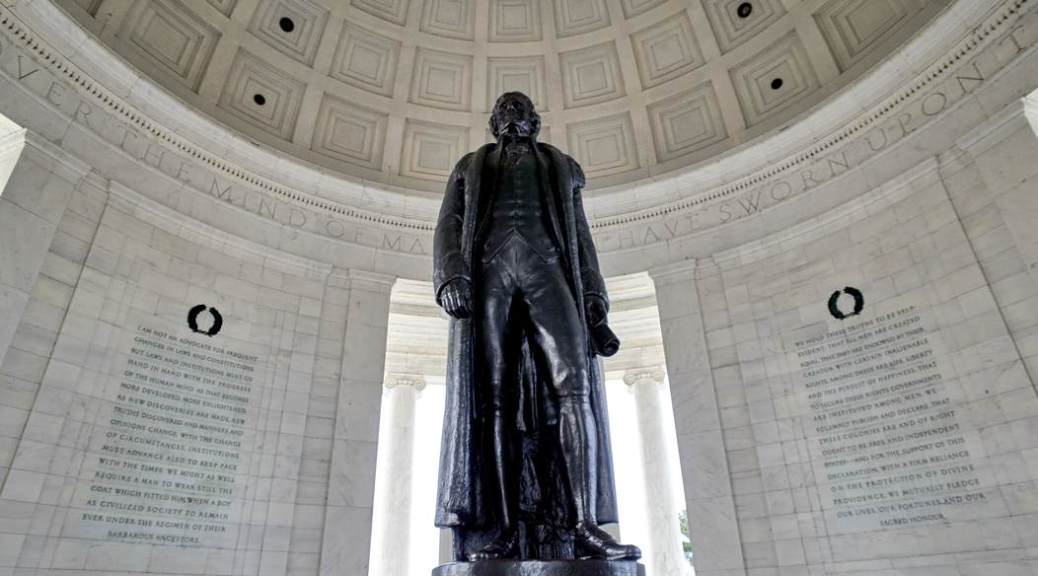
March 4, 1801

Analysis of Thomas Jefferson’s 1801 inaugural address emphasizing religion, government, and American virtues.


On March 4, 1801, Thomas Jefferson delivered his inaugural address as our third president. Here is part of what he said:


“Enlightened by a benign religion, professed, indeed, and practiced in various forms, yet all of them inculcating honesty, truth, temperance, gratitude, and the love of man; acknowledging and adoring an overruling Providence, which by all its dispensations proves that it delights in the happiness of man here and his greater happiness hereafter. With all these blessings, what more is necessary to make us a happy and prosperous people? Still one thing more, fellow citizens—a wise and frugal Government, which shall restrain men from injuring one another, shall leave them otherwise free to regulate their own pursuits of industry and improvement, and shall not take from the mouth of labor the bread it has earned…”


Let me provide a brief analysis of his words.

1. “Enlightened by a benign religion…” He obviously meant Christianity, for it was nearly universally practiced in early America. Notice: true Christianity “enlightened” the country, and was “benign”—not harmful to anyone.

2. “Professed, indeed, and practiced in various forms…” Meaning: the many denominations of post-Reformation Christendom, none of which could become an “established religion,” i.e., a national church like England had (First Amendment).

3. “Yet all of them inculcating honesty, truth, temperance, gratitude, and the love of man.” Yes, this is the essence of the true, original teachings of Jesus. Obviously, such would be beneficial to any society. But now, thanks to the atheistic, Marxist Left, the world has known 100-plus years of dishonesty, lies, uncontrolled radicalism, murder, ingratitude, and the hatred of mankind. Un-enlightenment and malignancy in the name of “progressivism.”

4. “Acknowledging and adoring an overruling Providence.” The virtues Jefferson listed (honesty, truth, etc.) are indeed “enlightening” and are taught to us by the “Providence” (God) who rules. If followed faithfully, the blessings of a successful society will surely develop. Any wise person will recognize and acknowledge this, and the early Americans certainly did. Those Americans, though far from perfect, still acknowledged this God Who gave them the wise counsel they should follow, and all, including Jefferson, accredited His “overruling” guidance.


5. “Which by all its dispensations proves that it delights in the happiness of man here and his greater happiness hereafter.” The bounty which all the earth is blessed with—evident in Jefferson’s day and ours—was used by the president as evidence that “Providence” (the guidance and direction of God) wished for man to be happy here and in the hereafter. Whatever the intellectual Jefferson meant, in his own mind, by “Providence,” he was smart enough to realize that his fellow citizens, adherents of Christianity almost to a man, would believe he was talking about their God and their religion.

6. “With all these blessings, what more is necessary to make us a happy and prosperous people?” What lack we yet? What responsibilities has this Providence given us to make sure we fully obtain the happiness and prosperity that we have access to through the blessings available to us?

7. “Still one thing more, fellow citizens—a wise and frugal Government.” “Wise” and “frugal”? Wise? Is there an ounce of wisdom in Washington, D.C., today? None at all in the Democratic Party, minuscule in the Republican. Frugal? Don’t make me laugh. “Wisdom” and “frugality” don’t buy votes, Tom, and power is the only game in town now. Our politicians learned well—or didn’t, depending on how you look at it—Benjamin Franklin’s warning, “When the people discover they can vote themselves money from the Treasury, that will herald the doom of the Republic.” That trumpet blast has been sounding, at least since the New Deal, and there appears to be no recovering from it. “Democracy always collapses over loose fiscal policy,” (Sir Alexander Fraser Tytler). The trumpet has sounded, but the army is not marching.


8. “Which shall restrain men from injuring one another.” That is the purpose of government: to protect our personal property, starting with our lives. Look at America’s big cities to inquire if government is doing its job. Chicago, anyone?

9. “Shall leave them otherwise free to regulate their own pursuits of industry and improvement.” Notice the idea here of “industry.” People should work for a living, not sponge off others, and government is intended to be structured to encourage such positive behavior. Not only “industry” but “improvement”—growth in beneficial virtues which will advance a society, not retard or degrade it. Government is to incentivize “industry” (hard work) and “improvement” (moral advancement), not encourage slothful, debauched, perverted behavior.

10. “And shall not take away from the mouth of labor the bread it has earned.” Another joke. There was no income tax in early America. The “frugal” government only received its income from land sales and tariffs. People got to keep the money they earned from the sweat of their brow and hard work.

Enter Karl Marx and the Left. And when that happened, Jefferson, God, a “benign” religion promoting “honesty, truth, temperance, gratitude, and the love of man”—virtues which an “adored” and “overruling Providence” supplied for our guidance and well-being, went flying out the window. And were replaced by malignancy, debauchery, profligacy, murder, mayhem, sexual hedonism and perversion, and a government that steals from its citizens rather than protects them. And that is on both sides of the aisle.


Thomas Jefferson told us, 225 years ago, what America needed. We haven’t listened. The country is virtually unrecognizable from what it was founded to be. We must return to these Jeffersonian virtues before it is too late. Such a return must begin with a restoration to its proper place of that “benign” religion which once “enlightened” us, but disastrously, is the bane of the Marxist, atheistic, murdering Left. Time is running out.


Mark Lewis | Mar 04, 2026

My substacks are a little unique. Not just current events, but history, our Founding Fathers, what America was meant to be, and Biblical exegesis. Check them out. “Mark It Down! (mklewis929.substack.com) and “Mark It Down! Bible Substack” (mklbibless.substack.com). Both free. Follow me on X: @thailandmkl. Read my western novels, “Whitewater,” “River Bend,” “Return to River Bend,” and Allie’s Dilemma,” all available on Amazon.

Source: March 4, 1801

Turning Point; David Jeremiah – Small Groups, Big Blessings


NEW!Listen Now

To Philemon our beloved friend and fellow laborer, to the beloved Apphia, Archippus our fellow soldier, and to the church in your house.
Philemon 1:1-2

Recommended Reading: Philemon 1:1-7

According to the World Happiness Report, 19 percent of young adults across the world have no one they can count on for support. That’s a 39 percent increase from 2006. At the same time, loneliness has risen with half of all U.S. college undergraduates facing significant loneliness.1 While this report targeted young adults, the same trends are true for all population groups.

When Jesus left for heaven, He left behind His Church. In those earliest day before church buildings, the Church met in homes. In Colossae, one of those groups met in the home of Philemon. Paul told him, “The hearts of the saints have been refreshed by you, brother” (Philemon 7).

During difficult times, small groups are vital to fellowship as we lift up each other. If you aren’t part of a small group, look for one you can join. Pray for each other and strengthen each other during the good times and the bad.

There is a brotherhood within the body of believers, and the Lord Jesus Christ is the common denominator.
J. Vernon McGee


https://www.davidjeremiah.org

Our Daily Bread – The Unnamed Women


These women were helping to support them out of their own means. Luke 8:3

Today’s Scripture

Luke 8:1-3

Listen to Today’s Devotional

Apple LinkSpotify Link

Today’s Devotional

After wiping down tables with disinfectant, Shelia stooped to tie a garbage bag filled with used cups and plates. She heaved the bag over her shoulder and turned to survey the church’s multipurpose room. She’d volunteered to clean it for the next gathering and wanted to make sure it was ready. A thought fluttered through her mind: Would anyone notice?

It’s easy to wonder if our everyday contributions to the kingdom are valued. Whether we clean, balance spreadsheets, lead a Bible study, or give money, so many of us remain unseen in our places of service and unnamed in public commendations.

In Luke 8:1-2, the historian catalogs the faithful service of women in the ministry of Jesus. He lists three by name from among the women freed of evil spirits and diseases: Mary of Magdalene; Joanna the wife of Chuza, who managed Herod’s household; and Susanna. Then Luke says, “Many others . . . were helping to support [Jesus and His disciples] out of their own means” (v. 3). Luke spotlights these unnamed women who invested themselves in supporting the gospel, and so underlines their value.

Just as God includes unnamed women in His account of valuable contributions to His kingdom, He sees our efforts. He knows our names (John 10:3), and He sees our investment in His work (Hebrews 6:10).

Reflect & Pray

When have you felt overlooked and undervalued? How does knowing that God included unnamed women in His catalog of contributions encourage you?


Dear God, thank You that You see me, know me, and value all I give You.

God made you with a purpose. Learn more about your worth in Jesus by watching this video.

Today’s Insights

Luke gives more attention to Jesus’ interactions with women than any other gospel writer. The women—both named and unnamed—mentioned in Luke 8:1-3 are one example, but others include His encounter with the widow of Nain (7:11-17), the “sinful” woman (vv. 36-50), Mary and Martha (10:38-42), a disabled woman (13:10-17), and the women who “mourned and wailed for him” prior to His crucifixion (23:27). Luke 2 also includes an extended account of Mary’s experience prior to Christ’s birth. In the ancient world, women were often undervalued or devalued, but Jesus elevated their status by showing great care for them. This can remind us today that when we feel undervalued and overlooked by others, we can be assured that we’re valued by God. He sees and knows all that we do in His name.


http://www.odb.org

Denison Forum – Will the Iran war forge a “very different” Middle East?


Political headlines this morning are focusing on overnight results from Senate primaries in Texas and North Carolina, races whose outcomes could help determine control of the Senate in the fall. However, a different political story is making fewer headlines, though its impact could affect the entire world.

As Iran has expanded the war by targeting US allies in the Middle East, it is facing a consequence it apparently did not expect: the Wall Street Journal reports that “Gulf states, rattled by volleys of Iranian drones and missiles targeting their hotels, ports, and airports, are concluding the Iranian peril must be confronted.”

This is of foundational significance. Arabs are not Persians. There has been enmity between the two cultures for millennia. And most Arab Muslims are Sunni, while most Iranian Muslims are Shiite. If Arab states (most notably Saudi Arabiaside with Israel and the West in responding to Iran, this geopolitical alliance will forge what one article calls a “very different” Middle East.

However, there is a consequence to the Arab states’ involvement in the war that is not military or political but spiritual and eternal.

Sincerely running on the wrong road

I’ve been responding this week to “Operation Epic Fury” by reminding Christians that our “front lines” in this conflict are the prayers by which we wage spiritual war for the protection of innocents and the conversion of multitudes. Here’s my point today: the more Muslims across the Arab world are endangered by this war, the more urgently we should pray for them to know Christ before it’s too late.

Of course, secularists and even some Christians will respond by claiming that Muslims and Christians worship the same God and that my call to intercession for Muslim conversions to Christ is therefore unnecessary and oppressive.

Is this true?

You’ve perhaps heard the saying with regard to world religions, “All roads lead up the same mountain.” But the reality is that Christianity and Islam are very different “mountains.” And when two mountains exist, you cannot climb them both at the same time.

As I noted in Monday’s Daily Article, the Qur’an explicitly denies the divinity of Jesus (cf. Surah 5:75; 19:36), while the New Testament explicitly states that trust in Christ as Savior is the one essential path to salvation (cf. John 3:1814:6Acts 4:122 Corinthians 5:20–21Revelation 20:15). If Islam is right about Jesus, Christianity is wrong about him. And faith in the wrong “road,” no matter how sincerely it is held, still leads to the wrong outcome.

You may have heard about the runner who was leading the US Half Marathon Championships in Atlanta last weekend before she was led off the course by a media vehicle. By the time she got back onto the right path, her lead was gone and she finished in ninth place.

She was sincere in running the wrong road, but she was sincerely wrong.

The biblical bottom line

If Muslims do not need to hear the gospel and respond by turning to Christ, why is God calling so many Christians to share the good news with them? You might say that these believers are wrong in thinking they are called to such ministry, but what of the dreams and visions by which Jesus himself is appearing to Muslims?

Is Jesus wrong as well?

I have encountered liberal theologians over the years who claim that the Bible commissions us to “make disciples of all nations” (Matthew 28:19) not because the lost will spend eternity in hell apart from Christ, but so they can live better lives in this world. But Jesus clearly stated, “Whoever believes in the Son has eternal life; whoever does not obey the Son shall not see life, but the wrath of God remains on him” (John 3:38).

And it is not necessarily true that Muslim converts to Jesus will live “better” lives in this world as a result. Many face the loss of their jobs, homes, families, and even their lives.

The biblical bottom line is clear and non-negotiable: Every person who does not know Jesus needs to know him personally. And every person who does know Jesus needs to share him personally.

“The whole purpose of becoming a Christian”

In The Reason for God: Belief in an Age of Skepticism, Tim Keller notes: “If you don’t live for Jesus, you will live for something else.” Why choose him? As Keller reminds us, “Jesus is the one Lord you can live for who died for you—who breathed his last breath for you.”

With all due respect, Muhammad did not die for Muslims. Buddha did not die for Buddhists. Jewish rabbis do not atone for their fellow Jews by their deaths, much less for the rest of humanity. But “God shows his love for us in that while we were still sinners, Christ died for us” (Romans 5:8). Each of us. All of us.

Now we are to imitate our Lord by paying forward the grace we have received.

In his Exposition on Galatians, St. Augustine wrote, “The believer who imitates Christ becomes … the same as Christ whom he imitates.” According to C. S. Lewis, such Christlikeness and nothing less is the purpose of the Christian faith.

In Mere Christianity, Lewis observed: “The whole offer which Christianity makes is this: that we can, if we let God have his way, come to share in the life of Christ. . . . Every Christian is to become a little Christ. The whole purpose of becoming a Christian is simply nothing else.”

To become like Jesus, we must embrace his mission as ours: “The Son of Man came not to be served but to serve” (Matthew 20:28).

How will you “serve” those who do not know your Lord today?

Quote for the day:

“God had only one Son, and he made him a missionary.” —David Livingstone

Our latest website resources:


Denison Forum

Harvest Ministries; Greg Laurie – Your Request Has Been Heard


 Then he said, ‘Don’t be afraid, Daniel. Since the first day you began to pray for understanding and to humble yourself before your God, your request has been heard in heaven. I have come in answer to your prayer. But for twenty-one days the spirit prince of the kingdom of Persia blocked my way. Then Michael, one of the archangels, came to help me, and I left him there with the spirit prince of the kingdom of Persia.’ 

—Daniel 10:12–13

Scripture:

Daniel 10:12–13 

An interesting story in the Old Testament book of Daniel offers us a rare, behind-the-scenes look at what happens when we pray. It seems only fitting that the story comes from the book of Daniel because Daniel was one of the great pray-ers in the Bible. He built his daily schedule around his prayer time. He prayed even at the risk of his own life.

In Daniel 10:12–13, Daniel receives a message confirming that his prayer reached Heaven. God heard Daniel’s prayer and dispatched an angel with a special message for Daniel. But the angel who was sent from Heaven was held up for twenty-one days because he was engaged in spiritual warfare with a powerful demon spirit. As a result, God dispatched Michael the archangel. (You might say that Michael is a head honcho among angels.) Michael overruled the demon power, and the answer eventually was brought to Daniel. But it took twenty-one days for the answer to get there.

That doesn’t necessarily mean that every prayer runs into the same delays. Remember, Daniel was a key figure during a very important time in the history of God’s people. He was a leading light not just among the Jewish people in exile but also among the rulers of Babylon.

The devil recognized Daniel’s spiritual potential and did everything in his power—including interfering with Daniel’s prayers—to thwart it.

That’s important to remember when our prayers seem to go unanswered. It may be that certain prayers have the potential to cause real damage to our spiritual enemy. He may be working overtime to thwart them. He won’t succeed, of course. But recognizing this possibility may help us be more patient when it comes to prayer.

Sometimes when God doesn’t answer our prayers as quickly as we would like Him to, we think that He’s letting us down. We need to understand that delays aren’t necessarily denials. When we pray and don’t see an answer as quickly as we would like, it may be a result of circumstances that we can’t see.

Maybe you’ve been praying for someone to come to know the Lord. Maybe you’ve been asking God to heal you. Maybe you’ve been asking the Lord to open doors of opportunity for you to serve Him. Don’t give up. Don’t be discouraged. Keep praying. Jesus said to keep asking, keep seeking, keep knocking, and the door would be opened. So be persistent. And watch what God will do.

Reflection Question: What do you do when a prayer seems to go unanswered? Discuss this with believers like you on Harvest Discipleship!


Harvest.org | Greg Laurie

Days of Praise – Fellowship in the Gospel


by Henry M. Morris III, D.Min.

“I thank my God upon every remembrance of you, always in every prayer of mine for you all making request with joy, for your fellowship in the gospel from the first day until now.” (Philippians 1:3–5)

This poignant letter was written to a church that Paul founded early in his ministry to the Gentiles (Acts 16:12–15). He endured challenging opposition there: he was followed for days by a demon-possessed young girl, tossed into prison by an angry business community, and beaten and locked immobile into wooden stocks (Acts 16:16–24).

Yet in that dark midnight while Paul and Silas sang hymns of the faith, God struck the jail with an earthquake and opened both the chains and the doors of the prison. The head jailor became converted, and along with the successful businesswoman Lydia, the seed of a flourishing church was planted (Acts 16:25–34).

It is to these “saints” and the “bishops and deacons” of the church at Philippi that Paul writes (Philippians 1:1). The church matured enough over the years of Paul’s absence to have established leadership and a strong testimony in that city. The “rememberance” of these faithful men and women gives rise to his thanks to God for their “fellowship in the gospel.”

May we never take for granted the sweet friends that we have known in our churches. Their fellowship is far more valuable than business or political contacts. Theirs is the bond of an eternal brother or sister; theirs is the friendship that is “closer than a brother” (Proverbs 18:24).

The apostle John understood this: “Truly our fellowship is with the Father, and with his Son Jesus Christ” (1 John 1:3). And because we share in a love for the Lord Jesus and walk together in the light of God’s truth, “we have fellowship one with another”(1 John 1:7). HMM III


https://www.icr.org/articles/type/6

Joyce Meyer – Self-Control


And in [exercising] knowledge [develop] self-control, and in [exercising] self-control [develop] steadfastness (patience, endurance), and in [exercising] steadfastness [develop] godliness (piety).

2 Peter 1:6 (AMPC)

As believers in Jesus Christ, God has given us a new nature, but at the same time, we also have to deal with the old nature. When we allow the old nature to rule, we will follow our feelings instead of operating in self-control. Self-control is a fruit of our new nature, and all we need to do is develop it. We can develop self-control by using it, just as we can develop muscles by using them.

Exercising self-control is a form of freedom. You don’t have to do what you feel like doing. You’re free to do what you know is wise. Discipline and self-control will help you be the person you want to be. Don’t ever say, “I just don’t have any self-control,” because the truth is that you do have it, but it needs to be exercised in order to be strong.

Prayer of the Day: God, thank You for giving me self-control through my new nature in Christ. Help me choose wisdom over feelings and strengthen my discipline as I practice obedience each day, amen.


http://www.joycemeyer.org

Max Lucado – The Hand of God 


Play

Come with me to the hill of Calvary. Watch as the soldiers press a knee against a forearm and a spike against a hand, as the soldier lifts the hammer to strike it. Think about the hand that received the nail. The fist doesn’t clench, the moment isn’t aborted.

A mallet drove a nail into the hand, not just of a carpenter, but into the hand of God. Fingers that formed Adam out of clay and furrowed truth into tablets felt the pain of crucifixion. The same hand that stilled the seas stilled your guilt. And as the hands of Jesus opened for the nail, the doors of heaven opened for you.


Home

Today in the Word – Moody Bible Institute – Letters to the Seven Churches


Read Revelation 2

Doubtless, we’ve all read one or more of the 21 letters, or epistles, in the New Testament. In each one, the author was writing to a specific church, including greetings, personal names, and specific spiritual issues. The “mini-epistles” we find in Revelation 2–3 are shorter but otherwise the same. These letters from Christ are aimed at specific churches, while also being aimed at readers throughout church history, including us.

These letters include five main ingredients: (1) something about Christ, the author of the letters—typically a quality already mentioned in chapter 1; (2) something good or praiseworthy; (3) a weakness or area for improvement; (4) a call to hear and respond rightly; and (5) rewards for those who are “victorious.” Not every letter has every ingredient, but the pattern is consistent. While we cannot exhaustively discuss each letter here, we’ll hit the highlights.

The first letter is to the church in Ephesus (vv. 1–7). The believers there are praised for their hard work, perseverance, and hatred of wickedness and false teaching. But they’re admonished to repent of their cold hearts to return to their “first love.”

The second letter is to the church in Smyrna (vv. 8–11). This congregation is recognized for their endurance of afflictions and poverty, slander and persecution from others. Impressively, no weaknesses are mentioned.

The third letter is to the church in Pergamum (vv. 12–17). They are praised for being faithful and true under pressure, even to the point of martyrdom, though some do follow false teaching and need to repent. Culturally, the “white stone” reward probably symbolizes admission to the Messianic banquet (Isa. 25:6; Rev. 19:9).

The fourth letter is to the church in Thyatira (vv. 18–29). They do well in love, faith, service, perseverance, and good deeds, but they’re much too tolerant of a certain false teaching.

Go Deeper

What letter might Christ write to you or your church? What are your strengths and weaknesses? Which of His qualities are most precious to you?

Pray with Us

Father, Your instruction to the churches is a reminder for us to examine our own walk with You. Show us where we need to grow and give us the strength to remain faithful to You.

Whoever has ears, let them hear what the Spirit says to the churches.Revelation 2:7


https://www.moodybible.org/