Making Statues Great Again

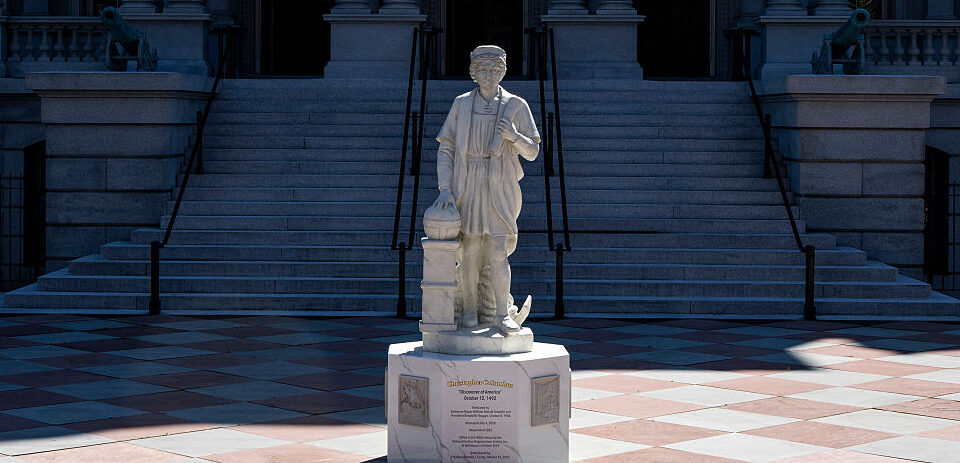
On Sunday, a new statue of Christopher Columbus was placed on the White House grounds. It’s a 13-foot-tall, one-ton marble masterpiece now sitting just outside the Eisenhower Executive Office Building adjacent to the West Wing.

In announcing the news, the administration stated on X, “In this White House, Christopher Columbus is a hero, and President Trump will ensure he’s honored as such for generations to come.”

Designed and crafted by Maryland sculptor Will Hemsley, the statue is a replica of the one that anarchists threw into Baltimore’s Inner Harbor in the summer of 2020. Back during that rage-fueled season, unhinged provocateurs were lashing out over cultural claims of racial injustice. Along with the desecration and destruction of the Columbus statue, more than 30 monuments were torn down or removed.

Ronald Reagan was president in 1984 when the original monument was dedicated. During his remarks just outside the “Gateway” to Baltimore’s “Little Italy,” he stated:

When Columbus discovered America, he set in force a motion mightier than the world had ever known. People came here from every corner of the planet to be free and to improve their lot and that of their family. Well, we got off course a few years ago, but now we’ve set the good ship Columbia back sailing in the right direction. And I thank you for letting me be here to help you honor the man who started it all, Christopher Columbus.

History revisionists with an agenda shade truth or ignore inconvenient facts altogether. One of the popular anti-Columbus narratives is that the sailing explorer was driven by greed and a desire to exploit others. In fact, he was a devout believer in Jesus Christ. He saw himself as a missionary in search of new people and new pathways to share the Good News of Jesus Christ.

Those goals and Columbus’ pioneering accomplishments make the mere mortal man worthy of becoming a monument.

In the early days of America, modest monuments were constructed to acknowledge both people and turning points in history. The Bunker Hill Monument marked the beginning of the American Revolution. Engraved on the 221-foot granite obelisk is a phrase taken from Governor William Bradford of Plymouth Plantation. It reads, “His hand that made all things of nothing.” It’s taken from his larger observation that God can do great and mighty things from very little.

The Washington Monument obelisk was intended to honor America’s first president and his noble ideals, especially his commitment to freedom and independence. At the very top, facing east to receive the day’s first rays of sunshine, are two Latin words: “Laus Deo” or “Praise be to God”.

Not every statue or monument is intended to communicate such firmness of faith, but many of the men and women carved out of stone or whose images have been hewn out of metal were strong and unapologetic Christian believers. In most cases, those testimonies were not ancillary to their greatness but the driving force behind it.

Replacing or restoring statues that were vandalized or recklessly torn down is a helpful step in reminding Americans about the heroes on whose shoulders we stand. But simply returning to the status quo by putting back up old monuments won’t necessarily tell the full story of America’s storied history.

That’s why President Trump, in conjunction with America’s semiquincentennial, has announced plans for the “Garden of American Heroes” in Washington, D.C. in an area just south of the National Mall. It would include 250 life-size statues made of marble, granite, bronze, copper and brass.

Officials have stated historical figures like George Washington and Benjamin Franklin will be featured, but the Garden will also include a broad spectrum of other personalities ranging from Harriet Tubman to Babe Ruth to Walt Disney and Thomas Edison.

As Christians, we recognize that Jesus of Nazareth was the one and only perfect person who has ever walked the earth. As such, we don’t bow down or make idols of anyone, but that doesn’t mean we can’t acknowledge, honor, and learn from the achievements of others.

In an era when historic monuments and statues have been toppled or torn down in protest, the rising generation deserves to know more about the men and women whose faith and sacrifice helped build our country.


by Paul Batura March 24, 2026 | Culture

Source: Making Statues Great Again – Daily Citizen

Faith and Grades: Could Religion Be the Missing Piece in Student Success?

What if the secret to stronger grades, better behavior, and brighter futures for students isn’t just in the classroom — but in the pews? A new report from researchers at Brigham Young University and Harvard found that religious faith and participation are linked to real academic advantages. The findings are turning heads as educators search for fresh ways to close stubborn learning gaps.

Titled “Faith in Educational Renewal: Religion as a Resource to Transform Learning Opportunities,” the report drew on decades of research examining religion and human flourishing. It showed that middle- and high-school students with the highest levels of religious involvement achieve GPAs roughly 0.144 points higher than peers who never participate in religious activities. That difference is noteworthy on its own. And yet, the benefits go beyond just grades, with the report also finding that teachers who feel “called” to the profession — often connected to a sense of spiritual devotion — tend to bring greater motivation and resilience into the classroom.

So, how does faith actually translate into better report cards and learning environments? Authors Bryant Jensen of BYU and Harvard’s Irvin Scott highlighted three key mechanisms.

First, moral frameworks rooted in faith traditions that steer young people away from risky behaviors such as substance use, truancy, and violence. Second, practical skills honed in religious settings — from public speaking and serving others to studying sacred texts, which sharpen literacy and the ability to distill complex ideas. Third, the “social capital” that comes from strong relationships with family, mentors, and peers — relationships that offer support, resources, and motivation that many students might not find anywhere else.

Looking ahead, the authors proposed thoughtful partnerships between public schools and local faith communities as a way to expand opportunity, especially for disadvantaged students. They drew clear boundaries, however. As Scott stated, “While we do not advocate for public schools to teach religious doctrine or use public funds for religious purposes, partnerships with faith communities can offer untapped resources to enrich student learning opportunities, especially for those in disadvantaged communities.”

Jensen framed the challenge this way: “After nearly two centuries, the promise of U.S. public schools to foster effective and meaningful learning opportunities for all children across race and social class remains unfulfilled. Large gaps in learning opportunities continue to persist,” and “we believe religious faith can help bridge these gaps.”

At a time when educators are wrestling with widening opportunity gaps, this report suggests faith-based communities could be an untapped resource worth exploring — regardless of personal beliefs. To explore the findings through a biblical worldview, Dr. David Closson, director of Family Research Council’s Center for Biblical Worldview, spoke with The Washington Stand.

“These findings are not surprising when viewed through a biblical lens,” he said. “Scripture consistently teaches that the formation of the heart, mind, and character is foundational to a flourishing life, including intellectual growth. Proverbs 1:7 tells us that ‘the fear of the Lord is the beginning of knowledge,’ and this report is essentially observing that principle in practice.”

Closson explained that when students are formed within a framework emphasizing moral responsibility, discipline, and purpose, their academic outcomes tend to improve. He pointed out that the report itself noted “that religious participation fosters moral codes, social competencies, and even literacy skills through practices like reading sacred texts and listening attentively to teaching” — all of which “reinforces what Scripture has long taught: education is not merely intellectual, but moral and spiritual as well.”

Students thrive, he added, when their “life is ordered around truth, meaning, and accountability.” This aligns closely with the report’s emphasis on “social capital,” which “closely mirrors the Bible’s vision of community and discipleship.”

“Churches and families can intentionally cultivate this by strengthening intergenerational relationships, ensuring that young people are known, mentored, and invested in by multiple adults,” Closson said. “This is especially important in disadvantaged communities, where students may lack stable support systems elsewhere.”

“Consistency and presence are key,” he continued. “Churches should be places of regular encouragement, accountability, and relational investment, not just weekly programming. Families and churches should also reinforce the connection between faith and learning, helping students see education as an act of stewardship and part of their calling before God.”

Closson also highlighted practical steps faith communities can take, such as offering tutoring, mentorship, and guidance on college and career pathways. These efforts, he noted, “provide not only structure, but hope. The gospel gives students identity, purpose, and a future-oriented vision that can motivate them to persevere and succeed.”

Regarding the report’s call for partnerships between schools and religious groups — while keeping doctrine and worship separate — Closson responded with both appreciation and caution: “The report’s recommendation for partnerships between schools and faith communities should be approached with both appreciation and discernment. It is encouraging that research is recognizing the positive role faith communities play in student success and human flourishing. At the same time, clear boundaries must be maintained. Public schools should not teach religious doctrine or coerce religious participation, as those protections are essential for preserving religious liberty. However, there are meaningful ways for Christians to engage that respect those boundaries.”

He suggested one clear path forward: “Faith communities can come alongside schools by offering tutoring, mentoring, and support for students and families, particularly in underserved areas. These efforts should be voluntary, transparent, and focused on serving the common good.”

As Closson concluded, “The key principle is that the church should never outsource its mission, but it can engage the public square in ways that reflect Christ’s love. Ultimately, this moment highlights something deeper: even a secular culture is rediscovering that formation matters, and the church is uniquely positioned to offer not just social support, but a comprehensive vision of human flourishing rooted in the gospel.”


Sarah Holliday March 26, 2026

Sarah Holliday is a reporter at The Washington Stand.

Source: Faith and Grades: Could Religion Be the Missing Piece in Student Success?

Turning Point; David Jeremiah – The Gift of Gifts


NEW!Listen Now

But one and the same Spirit works all these [spiritual gifts], distributing to each one individually as He wills.
1 Corinthians 12:11

Recommended Reading: Romans 12:3-8

Each human organ and limb has a role to play. No wonder the apostle Paul used the human body to illustrate how every member of the Body of Christ has a role to play in the Church. Instead of limbs and organs, God has equipped the Body of Christ with spiritual gifts to accomplish its purpose in the world.

And what is the purpose of the Church in the world? It is to spread the Gospel of Jesus Christ and see people become His followers (Matthew 28:19-20). Christians have different spiritual gifts based on the grace given to them by God (Romans 12:6). Just as all the parts of the human body have a role to play, so every member of the Body of Christ has a role to play in spreading the Gospel and making disciples. It is every Christian’s responsibility to understand their gift and employ it in fulfilling the Great Commission.

Do you know what role God has gifted you to play in the Body of Christ? If not, ask God to show you and help you to put your gift to work!

Pride of gifts robs us of God’s blessing in the use of them. 
William Gurnall


https://www.davidjeremiah.org

Our Daily Bread – God in the Details


During the forty years that I led you through the wilderness, your clothes did not wear out, nor did the sandals on your feet. Deuteronomy 29:5

Today’s Scripture

Nehemiah 9:19-21

Listen to Today’s Devotion

Apple LinkSpotify Link

Today’s Devotion

My niece, a college freshman, was busy with schoolwork and adjusting to a new residence. Because of recent security issues, her school required a vehicle pass. Since applying for this would be one more task on her long to-do list, I offered to do it. “Thanks!” she later said, surprised it had taken me only minutes in the campus office.

What she didn’t know was that the otherwise simple task had taken half a day of coordinating with the office, fixing a glitch in her application, and gathering unexpected documents. But I didn’t tell her this. “Anytime!” I said.

Love is in the details. Here, it was in taking care of details my niece was unaware of. Scripture tells us of God’s love as seen in two seemingly small details of the Israelites’ life in the wilderness: their clothes and shoes. Throughout forty years of walking, their “clothes did not wear out, nor did the sandals on [their] feet” (Deuteronomy 29:5). In fact, their feet didn’t even swell! (8:4).

God’s people had been unfaithful, but He showed “great compassion,” not abandoning them (Nehemiah 9:19). “They lacked nothing” (v. 21). God provided the “big” things, such as His presence, the counsel of His Spirit, and food and water (vv. 19-20); and the “smaller” but necessary things, such as clothes and shoes.

God shows His love in ways we may overlook or be unaware of. Such is His love, that He sees every detail of our life.

Reflect & Pray

What details in your life show God’s love? How do they help you trust Him?


Heavenly Father, thank You for Your enduring love.


Today’s Insights

Nehemiah 9:5-37 is a prayer of thanksgiving and praise to God by the Levites as the people were assembled. They listened to a reading of “the Book of the Law of the Lord their God” and then confessed their sins and worshiped “the Lord their God” (v. 3). When the Levites prayed, “For forty years you sustained [the Israelites] in the wilderness” (v. 21), we might forget that their time in the wilderness refers to God’s discipline of them. Because of Israel’s constant complaining and faithless lack of gratitude, every adult over the age of twenty had to die so the next generation could inhabit the promised land. And yet, God still cared for His wayward people. Now, as His perpetually wayward people were re-entering the promised land from their exile, He still showed His love for them by faithfully caring for their every need. Today, God still shows His care for us in the details of our lives.


For further study, read Love in a Minor Key.


http://www.odb.org

Denison Forum – NASA will spend $20 billion to build a base on the moon


Today’s headlines continue to center on Iran, a country some six thousand miles from the US. Meanwhile, I’m focusing on a location approximately 231,000 miles (the distance varies throughout the year) from us: NASA has announced plans to construct a $20 billion base on the moon’s surface.

Humans were last on the moon in 1972. Why go back now?

Joseph Silk, a Johns Hopkins and Oxford astrophysicist, explains that telescopes constructed there could see much further into space, adding immeasurably to our knowledge of the universe. He adds that rare earth elements critical for modern technologies are “a thousand times more abundant” on the moon than on earth.

And there’s the residual benefit of space exploration. Over the decades, CAT scans, baby formula, home insulation, camera phones, and portable computers and mice were all derived from technology first developed for space travel.

But there’s more. In his 1962 speech announcing the goal of traveling to the moon that decade, President John F. Kennedy cited the great British explorer George Mallory, who died on Mount Everest. When asked why he wanted to climb it, Mallory said simply, “Because it is there.”

President Kennedy added: “Well, space is there, and we’re going to climb it.”

There is something in us that wants to make an impact in life that surpasses and outlives us. This is a “signal of transcendence” (to use sociologist Peter Berger’s phrase), a desire that points to a dimension for which this transitory world is a means to an eternal end.

You and I are unlikely to seek such significance through space travel, but we can nonetheless live this day for its highest purpose.

How?

“The last of the human freedoms”

A traditional Jewish response to someone grieving the death of a loved one is to say, “May their memory be a blessing.” This sentiment has ancient roots.

Wise King Solomon observed, “The memory of the righteous is a blessing, but the name of the wicked will rot” (Proverbs 10:7). Righteous translates the Hebrew for someone who is “upright” and “devout,” while wicked describes the opposite, a person who is unrighteous, criminal, and impious. When the former are remembered, people thank God for them and are blessed by their memory, while the reputation and memory of the latter will “rot” and decay over time.

I think of Adolf Hitler, who was hailed as a national savior when he rose to power in Germany but whose name is now synonymous with the absolute worst of humanity. By contrast, Harry Truman was one of the most unpopular politicians in the United States when he left office in January 1953, but historians today rank him among our greatest presidents.

I say all of that to say this: Our character is more important to our impact on the world than our circumstances. We cannot always control or predict the latter. However, as Holocaust survivor Viktor Frankl wrote in Man’s Search for Meaning, “Everything can be taken from a man but one thing: the last of the human freedoms—to choose one’s attitude in any given set of circumstances, to choose one’s own way.”

The famed psychiatrist added: “Between stimulus and response there is a space. In that space is our power to choose our response. In our response lies our growth and our freedom.”

But there’s a catch.

“The young man who rings the bell at the brothel”

The theologian and novelist Frederick Buechner observed, “Lust is the craving for salt of a person who is dying of thirst.” The French philosopher Simone Weil would have agreed, asserting that “all sins are attempts to fill voids.”

However, the “voids” we attempt to fill are ultimately symptoms of a single source. As the Scottish novelist Bruce Marshall had one of his characters say, “The young man who rings the bell at the brothel is unconsciously looking for God.”

You and I possess a “God-shaped emptiness” because we were created for intimacy with our Creator. The psalmist therefore spoke for us all: “My soul longs, yes, faints for the courts of the Lᴏʀᴅ” (Psalm 84:2).

Accordingly, he prayed, “Blessed are those who dwell in your house, ever singing your praise!” (v. 4). When we experience such intimacy with the Almighty, though we travel through the deserts of the “Valley of Baca,” we “make it a place of springs” (v. 6). This is why the psalmist could say to God, “A day in your courts is better than a thousand elsewhere” (v. 10).

But there’s a catch.

“It was character that got us out of bed”

The key to the spiritual life is being yielded daily to the Spirit (Ephesians 5:18). However, our spiritual enemy wants us to do anything more than he wants us to do this. Accordingly, Oswald Chambers warned, “Christian work may be a means of evading the soul’s concentration on Christ.”

We can focus on working for God in his “courts” so fully that we do not walk with him through the day. Consequently, as Chambers noted in today’s My Utmost for His Highest reading, “If we are going to retain personal contact with the Lord Jesus Christ, it will mean there are some things we must scorn to do or think, some legitimate things we must scorn to touch.”

The good in this world can be the enemy of the best in the next. This is because, as Jesus said, “My kingdom is not of this world” (John 18:36), and our Father now “calls you into his own kingdom and glory” (1 Thessalonians 2:12).

One day “the kingdom of the world” will “become the kingdom of our Lord and of his Christ, and he shall reign forever and ever” (Revelation 11:15). The best way for our lives to be significant on that day is to make him our King today.

Whatever it takes, whatever he asks, whatever the cost.

Zig Ziglar noted,

“It was character that got us out of bed, commitment that moved us into action, and discipline that enabled us to follow through.”

Will you partner with the Spirit in choosing all three today, to the glory of God?

Quote for the day:

“Your commitments can develop you or destroy you, but either way, they will define you.” —Rick Warren

Our latest website resources:


Denison Forum

Harvest Ministries; Greg Laurie – The Hard Truth About the Cross


 The message of the cross is foolish to those who are headed for destruction! But we who are being saved know it is the very power of God. 

—1 Corinthians 1:18

Scripture:

1 Corinthians 1:18 

I heard a story about a couple who visited a jewelry store. As the jeweler showed them various crosses, the woman commented, “I like these, but do you have any without this little man on them?”

That’s what many people want today: a cross without Jesus. They want a cross without any offense—one that will look cool with their outfits. But the hard truth is that if we could travel back in time and see the cross in its original context, we would realize that it was a bloody and vile symbol. It would have been the worst picture imaginable to see someone hanging on a cross.

The Romans chose crucifixion because it was meant to be a slow, torturous way to die. It was designed to humiliate a person. The crucifixions outside Roman cities served as warnings to anyone who would dare oppose the rule of Rome.

Jesus said, “I am the way, the truth, and the life. No one can come to the Father except through me” (John 14:6 NLT). In other words, salvation and eternal life can be found only through Him. Many people today object to His words. They see John 14:6 as a statement of exclusivity and narrow-mindedness. But Jesus was simply explaining God’s plan of salvation.

Humankind’s decision to disobey God and pursue sin created an existential crisis with only one solution. To satisfy God’s perfect justice and wrath, a perfect sacrifice had to be offered in our place. Someone who had never sinned had to die in the place of everyone else who had. Only Jesus lived a sinless life. Only He had the power to conquer death. So, only He could save us.

If there had been any other way, do you think that God would have allowed His Son to suffer like that? If there had been any other way that we could have been forgiven, then God surely would have found it.

Jesus Himself prayed, “My Father! If it is possible, let this cup of suffering be taken away from me. Yet I want your will to be done, not mine” (Matthew 26:39 NLT). He was talking about the cross and the unimaginable suffering that lay ahead. But God did not take it away from Him because there was no other way.

If living a good, moral life could get us to Heaven, then Jesus never would have died for us. But He did die. He had to pay the price for our sin. At the cross, Jesus purchased the salvation of the world.

If you ever were tempted to doubt God’s love for you, even for a moment, then take a long, hard look at the cross. Nails did not hold Jesus to that cross; His love did.

Reflection Question: How would you explain Jesus’ sacrifice on the cross and God’s plan of salvation to an unbeliever? Discuss this with believers like you on Harvest Discipleship!


Harvest.org | Greg Laurie

Days of Praise – Life by Death


by Henry M. Morris III, D.Min.

“For to me to live is Christ, and to die is gain.” (Philippians 1:21)

This profound confidence comes at the conclusion of a threefold summary of Paul’s experience while serving the Lord Jesus as well as his deep bond with the church at Philippi. The salvation of which Paul speaks references victory in this life as much as the eternal rescue at the end.

Initially, the confidence comes “through your prayer, and the supply of the Spirit of Jesus Christ” (Philippians 1:19). Christian leaders covet the prayers of those with whom they serve. Twice, Paul specifically asked the Thessalonian church to pray for him (1 Thessalonians 5:252 Thessalonians 3:1). Most of us are familiar with the promise that the “effectual fervent prayer of a righteous man availeth much” (James 5:16). Should we be surprised when such prayer brings boldness?

There is also the experience that the “supply” of the Spirit of God engenders faith. God’s providential care, experienced during the testing of our life, produces a growing hope and confidence (Romans 5:4–5). It is most often true that we learn more of God’s faithfulness in times of need than in times of plenty.

Then there is an “earnest expectation and . . . hope” that result in “boldness” (Philippians 1:20). Growing confidence in the Lord’s provision and protection undergirds an anticipation for God’s direction and wisdom. Expecting something to happen is the flip side of hope. Experience in kingdom work brings spiritual joy and peace (Romans 15:13).

Thus, the confident statement: “now also Christ shall be magnified in my body, whether it be by life, or by death. For to me to live is Christ, and to die is gain” (Philippians 1:20–21). HMM III


https://www.icr.org/articles/type/6

Joyce Meyer – Do It Afraid!


The Lord said to Abram, Go … away from your country, from your relatives and your father’s house, to the land that I will show you.

Genesis 12:1 (AMPC)

How would you feel if God told you to leave your home, your family, and everything that is familiar and comfortable and head out to who knows where?

That is the challenge Abram faced, and it frightened him. But God kept saying to him, “Fear not.” That’s the same message He gave to Joshua when He called him to lead the children of Israel to the promised land.

You want to wait until you’re not afraid before you do anything, but if you do that, you will accomplish very little for God. Abram and Joshua had to step out in faith and obedience to do what God had commanded them to do—and they had to do it afraid. They took “steps of faith” even though they had “feelings of fear.”

That’s what you will have to do to accomplish the job God wants you to do. But He’ll be with you, saying, “Fear not.”

Prayer of the Day: God, help me step out in faith even when I feel afraid. I trust Your presence, Your guidance, and Your promises as I obey You, amen.


http://www.joycemeyer.org

Max Lucado – Jesus is Worthy of Our Trust 


Play

Why did Jesus live on the earth as long as He did?  To take on our sins is one thing, to experience death yes, but to put up with long roads and long days?  Why did He do it? Because He wants you to trust Him. Even His final act on earth was intended to win your trust.

Mark 15:22-24 says, “they brought Jesus to the place called Golgotha where they offered Him wine mixed with myrrh, but he did not take it.  And they crucified Him” (NIV).  Why?  Why did He endure all this suffering—all  these feelings?

Well, because He knew you’d be weary, disturbed, and angry.  He knew you would be grief-stricken, and hungry, that you would face pain. A pauper knows better than to beg from another pauper. He needs someone who is stronger than he is. Jesus’ message from the Cross is this: I am that Person. Trust Me.


Home

Today in the Word – Moody Bible Institute – New Heaven and Earth


Read Revelation 21:1–8

The classic allegory, The Pilgrim’s Progress, was written in 1678 by pastor John Bunyan while imprisoned for his faith. The main character, Christian, goes on a journey from the City of Destruction to the Celestial City. He has adventures and experiences along the way, which represent typical events in the Christian life.

At the end of Bunyan’s book, we get a peek at the Celestial City. Similarly, we get a glimpse of the New Jerusalem at the end of the book of Revelation. After the Millennium comes “a new heaven and a new earth,” which we also call the “eternal state” (v. 1). The lack of a sea likely indicates there is now no more sin, death, or rebellion against God. Everything will be made new (v. 5).

At this time, believers will live in heaven, seen here as the heavenly New Jerusalem (vv. 2–4). In this city God will dwell eternally with His people, thus fulfilling the desire of every worshiper’s heart (Psalm 84). There will be no more sorrow, pain, or death, because “the old order of things has passed away.”

The Lamb said to John, “It is done” (vv. 6–8)—reminiscent of His words from the cross, “It is finished” (John 19:30). He’s the Alpha and the Omega, the Beginning and the End. As He was there at Creation, so now He’s there at the end of history and time. There are only two eternal destinies: One is in heaven, with Christ and those who have accepted God’s gift of the water of life (Isa. 55:1; John 4:10; 7:37–38). The other is in hell, the “second death,” with sinners. Why are the “cowardly” on this list? They chose fear over faith. All this encourages believers not only to stand firm and endure but also to spread the good news of the gospel (Matt. 28:19–20).

Go Deeper

Are we genuinely looking forward to God dwelling with us? To what extent do we truly long for His presence in our daily lives and activities?

Pray with Us

Our hearts long for the day when You make all things new, Lord. Until then, strengthen our desire to dwell in Your presence and share the good news with those around us!

The old order of things has passed away.Revelation 21:4


https://www.moodybible.org/