All posts by broboinhawaii

Bible believing christian worshiping God in Hawaii and Pennsylvania

Using Biblical Reasoning, Rubio Pinpoints Why Globalism Is A Recipe For Disaster

‘Ignoring Human Nature’: Using Biblical Reasoning, Rubio Pinpoints Why Globalism Is A Recipe For Disaster


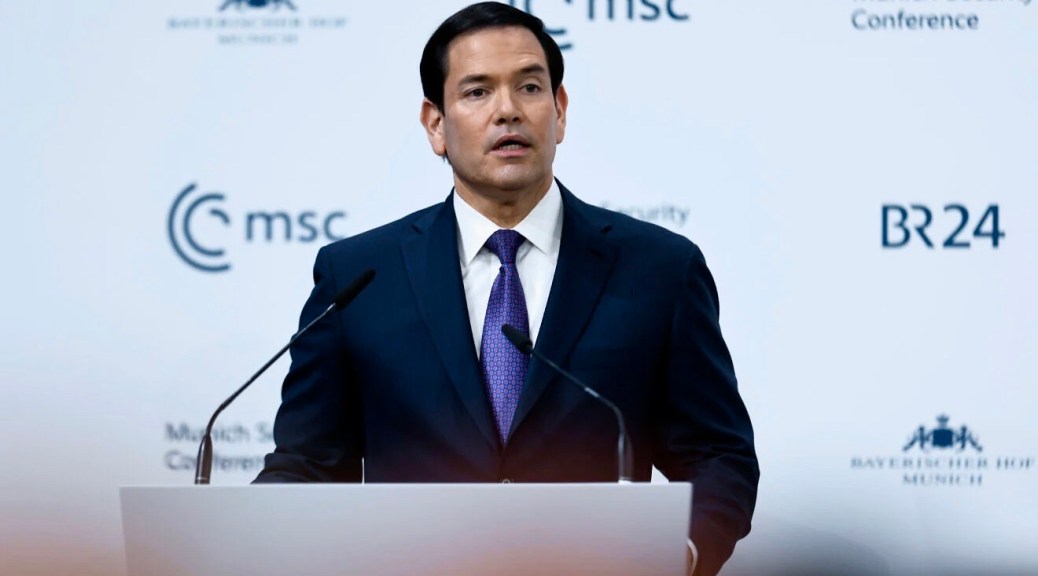
US Secretary of State Marco Rubio’s powerful message at the Munich Security Conference (MSC) has garnered well-deserved attention. Standing before a room of European and Western leaders, Rubio boldly exposed the folly of globalist policies and how they have been used to undermine sovereignty, national strength, and the Judeo-Christian foundation of Western civilization.

One particular statement was truly profound, and its tremendous accuracy stems from being bred out of a Biblical worldview.

Discussing the collapse of communism in Germany, Rubio warned that the celebration of this success in the West quickly morphed into an ill-conceived fantasy about the future of nations.

“The euphoria of this triumph led us to a dangerous delusion: that we had entered, ‘the end of history;’” Rubio emphasized, “that every nation would now be a liberal democracy; that the ties formed by trade and by commerce alone would now replace nationhood; that the rules-based global order – an overused term – would now replace the national interest; and that we would now live in a world without borders where everyone became a citizen of the world.”

This globalist mentality, he stressed, “was a foolish idea that ignored both human nature and it ignored the lessons of over 5,000 years of recorded human history. And it has cost us dearly.”

The Secretary of State correctly pinpointed the fatal flaw of today’s globalism: “human nature.”

This vital truth is confirmed by Scripture.

By man’s naivete, globalism sounds like a perfect ideal. What could be wrong with a world united together in harmony? Even popular science fiction series like Star Trek envision a future in which we have “evolved” past the supposedly barbaric concept of individual nations into a global system of governance. No more bloody wars, corruption, violations of human rights, hunger, and wicked regimes. Surely no one could argue against a future like that!

To many, especially the young, those who fight against globalism are viewed as selfish, power-hungry, and lacking humanity. This is not reality. Those who resist globalism do so out of wisdom.

Equipped with an understanding of human nature and history, we know that globalism would not produce a worldwide “utopia” but rather the creation of a global regime—equipped with all the wicked qualities of human nature—whose power would be limitless. The danger is obvious.

Unfortunately, despite the discernment of Rubio’s warning from Munich, his impactful words will ultimately fall on deaf ears.

God, who knows the future, told us that a day is coming when there will be a global government—and it looks nothing like the appealing picture of peace and harmony presented from the buildings of Davos.

This global government will fall under the leadership of an individual whom the Bible refers to as “the anti-Christ.” While he will come with lofty and deceptive words promising “peace,” his global regime will be blood-soaked and freedom-crushing (Daniel 9:27Rev. 6:2). Its leader will impose his own religious system, and, like all good tyrants, he will demand to be worshipped as god (2 Thess. 2:3-4). Those who refuse will be unable to buy and sell and will be systematically killed (Revelation 13:15-18). Jesus Christ will be the only one with the power to decisively end his rule—and He will do just that (Rev. 19:202 Thess. 2:8).

Even prior to this global government, as Rubio highlighted, globalist-driven policies have “cost us dearly.” The Secretary of State said plainly that the push for open borders has resulted in disastrous mass immigration, the “climate cult” has impoverished societies, and the hostility toward national sovereignty has weakened the West and emboldened global bad actors.

Far from bringing harmony and peace, the agenda-driven goals of globalists have sown instability and catered to the power-hungry.

Which brings us to the other side of globalism. Is “ideal globalism” possible? You might be surprised to learn that it is… but only when sinful human nature is no longer a factor. The Bible tells us that after the collapse of the anti-Christ’s regime, Jesus Christ will establish a global kingdom for a thousand years, with Himself as the head. Those who rule and reign with Him will be resurrected saints—those who, through Christ’s shed blood, have had the chains of sinful human nature broken.

During this time, the world “shall beat their swords into plowshares, and their spears into pruninghooks: nation shall not lift up sword against nation, neither shall they learn war any more” (Isaiah 2:4).

There will be no need to train for war, no injustice or government corruption, and no ideology driven supression of freedom. People are not wrong to want to live in a world like that; however, ignoring sinful human nature and attempting to bring it about with the exclusion of Christ is a recipe for a disaster that is global in scope.


Source: ‘Ignoring Human Nature’: Using Biblical Reasoning, Rubio Pinpoints Why Globalism Is A Recipe For Disaster – Harbinger’s Daily

Turning Point; David Jeremiah – Better Than Money


NEW!Listen Now

Wisdom is good with an inheritance…. For wisdom is a defense as money is a defense, but the excellence of knowledge is that wisdom [preserves the life of] those who have it.
Ecclesiastes 7:11-12

Recommended Reading: Proverbs 8:33-36

The late primatologist Jane Goodall was the first to provide evidence that some primates made and used tools. Her discovery reversed the long-standing belief that only humans were capable of making and using tools.

Almost everything humans do is accomplished with tools, all of which are inanimate objects. Tools have no life or mind of their own; they are employed by a human facilitator. Whether tools are used for positive or negative ends depends entirely on the wisdom of the owner. Take money, for example. It can serve good ends and bring positive benefits to the owner. But compared to wisdom, tools like money are limited. Money can be used for many things, but it cannot ultimately preserve, protect, or provide life to those who have it. Solomon, who made this observation, knew what money could and couldn’t do—he had more than anyone in his day.

Whatever amount of money God has entrusted to you, pray for even more wisdom. Whoever finds wisdom finds life (Proverbs 8:35).

We may love money without having it, just as we may have money without loving it. 
J. C. Ryle


https://www.davidjeremiah.org

Our Daily Bread – Lavish Love


If one of your fellow Israelites falls into poverty . . . allow him to live with you. Leviticus 25:35 nlt

Today’s Scripture

Leviticus 25:35-43

Listen to Today’s Devotional

Apple LinkSpotify Link

Today’s Devotional

Todd invited his younger brother Alex, a recent college graduate, to come live with him in the house he’d built. He wanted to help his sibling gain some financial footing by allowing him to live rent-free for a while. After six months, Todd asked Alex to begin paying rent. Years later, Alex made an offer on his own home. When the offer was accepted, Todd surprised him by telling him that he’d deposited Alex’s rent payments in a savings account over the years and that the substantial sum of money was now his! Alex wept as he received the lavish gift.

In Leviticus 25, God gave Moses commands for the Israelites that included allowing those in need “to live with you” (v. 35 nlt). This command was part of God enacting “a jubilee year” (v. 10 nlt)—when debts were forgiven, those in poverty were helped, and the enslaved were freed (vv. 23-55). He declared that He’d lovingly led His people “out of Egypt to give [them] the land of Canaan and to be [their] God” (v. 38). He’d provided a new homeland, and now they were to imitate Him by showing love and opening their homes to others.

The apostle John would later write, “See what great love the Father has lavished on us, that we should be called children of God!” (1 John 3:1). By Jesus’ sacrifice we can receive the fullness of that lavish love (v. 16). And as He helps us, we can lavish it on others.

Reflect & Pray

How have you experienced God’s lavish love? How can you extend it to others?


Loving God, please help me pour out Your amazing, lavish love on others.

God’s very nature is love. Learn more by reading this piece by Oswald Chambers.

Today’s Insights

As the nation of Israel began to take shape, God wanted them to understand how they were to treat each other. Enslaving fellow Israelites was never to be part of the equation. “If any of your fellow Israelites become poor and are unable to support themselves among you,” He said, “help them as you would a foreigner and stranger” (Leviticus 25:35). And if any of them “become poor and sell themselves to you, do not make them work as slaves” (v. 39). Even this arrangement of indentured servitude wasn’t permanent. God said, “They are to work for you until the Year of Jubilee [every fiftieth year]. Then they and their children are to be released, and they will go back to their own clans and to the property of their ancestors” (vv. 40-41). It’s God’s desire that we never exploit one another but look out for each other’s interests. Because He lavished His love on us by sending Jesus, He’ll help us lavish His love on others.


http://www.odb.org

Denison Forum – Why are the new voter ID laws so controversial?


Republicans have been trying to pass some version of voter ID laws for years, with the latest attempt set for a vote in the Senate coming soon. Few expect the bill to pass, though, despite overwhelming popular support. And the reasons why have less to do with the ID requirements than with the rest of what the law is trying to change.

Why it matters: Election integrity remains a focal point for the Trump administration and many in the Republican Party. If Democrats continue to oppose the SAVE America Act, it could prompt Republicans to remove or alter the filibuster in ways that would have a profound impact on how laws are passed down the line. Or, if the bill stalls, President Trump has promised to push it through via executive order, even though a similar attempt was already deemed illegal last year. Either way, the issue doesn’t appear to be headed toward a resolution anytime soon.

The backstory: Third time’s a charm?

For the third consecutive year, the House of Representatives has passed a version of the Safeguard American Voter Eligibility Act, or the SAVE Act for short. So far, it has died in the Senate each time without even getting a vote. Senate Majority Leader John Thune promised that it would not happen again, given that he now has the support necessary to bring it to the floor and force representatives to go on record as either supporting or rejecting it.

Still, few expect the law to pass. It would need sixty votes unless Republicans either get rid of the filibuster—a step leadership has repeatedly said they will not take—or change the requirements to oppose the bill. There’s a lot of risk either way, though, and it’s unclear if Thune will be willing to take that step.

Continue reading Denison Forum – Why are the new voter ID laws so controversial?

Harvest Ministries; Greg Laurie – You Serve


 Who will listen when you talk like this? We share and share alike—those who go to battle and those who guard the equipment. 

—1 Samuel 30:24

Scripture:

1 Samuel 30:24 

In 1 Samuel 30, we find the story of David leading his men to victory in battle against Amalekite raiders who had plundered and burned the town of Ziklag. As David and the four hundred soldiers who had fought with him were returning home, those who had stayed behind to guard the camp and the supplies met them. Some of the troublemakers who had fought in the battle didn’t want to give any of the spoils of the battle to those who stayed by the camp. David said to the troublemakers, “Who will listen when you talk like this? We share and share alike—those who go to battle and those who guard the equipment” (1 Samuel 30:24 NLT).

Those who fought in the battle assumed that their role in God’s plan was more important than those who didn’t fight. David didn’t see it that way—and neither did God. And that principle still applies today to people who answer God’s call.

Whether God has called you to serve Him in such a way that people see you or whether He has called you to serve Him by supporting others who are seen, God will bless you and reward you for your service.

Maybe you feel as though your life isn’t really making a difference or that what you have to offer God doesn’t mean all that much. If so, you’ll be in for some surprises in Heaven, because what may not seem very valuable on earth will be of great value in Heaven.

God’s Word leaves little doubt as to our worth in God’s eyes. The apostle Peter wrote, “But you are not like that, for you are a chosen people. You are royal priests, a holy nation, God’s very own possession. As a result, you can show others the goodness of God, for he called you out of the darkness into his wonderful light” (1 Peter 2:9 NLT).

We also have immeasurable value because we are God’s creation. The apostle Paul wrote, “For we are God’s masterpiece. He has created us anew in Christ Jesus, so we can do the good things he planned for us long ago” (Ephesians 2:10 NLT).

I read a story about a man who found an old, blue-and-white vase while he was cleaning his attic. He took it to an auction to sell it, thinking he would probably get twenty or thirty dollars from it, maybe one hundred dollars if he was lucky. To his utter amazement, the vase turned out to be an original fifteenth-century work of art from the Ming Dynasty. It sold for $324,000.

What may not seem especially valuable now will prove to be extremely valuable later. Until then, we need to be faithful with what God has given us to do.

Reflection Question: What value does God see in your acts of faithfulness and service? Discuss this with believers like you on Harvest Discipleship!


Harvest.org | Greg Laurie

Days of Praise – With Christ


by Henry M. Morris, Ph.D.

“Set your affection on things above, not on things on the earth. For ye are dead, and your life is hid with Christ in God.” (Colossians 3:2–3)

The apostle Paul, looking forward to the time when we shall “ever be with the Lord” (1 Thessalonians 4:17), wrote, “For I am in a strait betwixt two, having a desire to depart, and to be with Christ; which is far better: nevertheless to abide in the flesh is more needful for you” (Philippians 1:23–24).

The fact is, however, that we can be “with Christ” even while still abiding in the flesh, as Paul himself emphasized. This is the great principle called positional truth. “Positionally,” we are already “with Christ,” for that is where God sees us and how He relates to us. He has “raised us up together, and made us sit together in heavenly places in Christ Jesus” (Ephesians 2:6).

Before we could be raised up with Christ, however, we first had to die with Him. “I am crucified with Christ: nevertheless I live; yet not I, but Christ liveth in me” (Galatians 2:20). God even saw us as buried with Christ when He was buried, and this is the great truth symbolized in our baptism. “We are buried with him by baptism into death” (Romans 6:4).

“Now if we be dead with Christ, we believe that we shall also live with him: knowing that Christ being raised from the dead dieth no more” (Romans 6:8–9). He died for us, so our deserved death became His substitutionary death, and His victorious resurrection becomes our own unmerited deliverance from death in eternal resurrection life. This is our position now, and our assured everlasting possession then, for we are with Christ, who “dieth no more.”

This truth is not only a wonderful doctrine, but as we see in our text, it is a focus for our thoughts and a real incentive for godly living. HMM


https://www.icr.org/articles/type/6

Joyce Meyer – Sanctification of the Soul


So get rid of all uncleanness and the rampant outgrowth of wickedness, and in a humble (gentle, modest) spirit receive and welcome the Word which implanted and rooted [in your hearts] contains the power to save your souls.

James 1:21 (AMPC)

Once you are born again, your spirit has been reborn, and you will go to heaven when you die. But God is not finished—He is just beginning. You need to “work out your own salvation with fear and trembling” (Philippians 2:12 KJV). In other words, your soul needs to be saved. The soul is often defined as the mind, the will, and the emotions. Each of these areas needs salvation.

The Holy Spirit works relentlessly to transform the whole man into God’s perfect will. This process is called sanctification. When your soul is renewed with His Word, you think His thoughts and not your own. Submit yourself to the Holy Spirit and allow Him to change every thought and motive.

Prayer of the Day: Holy Spirit, renew my mind, will, and emotions. Help me submit every thought to You. Shape my motives, guide my steps, and continue Your sanctifying work in me each day, amen.


http://www.joycemeyer.org

Max Lucado – Look for Jesus in the Storm 


Play

Peter and his fellow storm riders knew they were in trouble. According to Matthew 14:24-26, “But the boat was now in the middle of the sea, tossed by the waves, for the wind was contrary.” About 4:00 a.m. the unspeakable happened. They spotted someone walking on the water. “‘A ghost!’ they said, crying out in terror!” They didn’t expect Jesus to come to them this way.

Neither do we. We expect to find Jesus in morning devotionals, church suppers, and meditation. We never expect to see him in a storm. But that’s where he does his finest work, for it is in storms that he has our keenest attention. He said. “Take courage; I am here” (Matthew 14:27 NLT).

Look over your shoulder friend; that’s God following you. Look into the storm friend; that’s Christ coming toward you.


Home

Today in the Word – Moody Bible Institute – Hebrews: Better Than


Read Hebrews 3:1–6

I recently watched a documentary about the laying of the first transatlantic telegraph cable. It was a heroic enterprise. At the time, communication between Europe and North America was limited by the speed at which a ship could cross the ocean. The first cable allowed for near instant communication. It was described as the conquering of space and time. Today such means of communication seem quaint at best. Anyone with a cell phone knows what they have is just better.

The writer of Hebrews wrote to Christians who were tempted to return to keeping the Law of Moses. They were facing persecution and believed it would be better to abandon faith in Christ and return to faith in their own ability to keep the Law. The writer of Hebrews warns them against this decision. Central to his argument is the idea that Jesus and the new covenant are better than what they had before (vv. 3, 6).

It’s not that the old covenant was bad, it is just that the work Jesus does for those who trust in Him surpasses anything that came before. Jesus inaugurated a new covenant, which freed people from the obligation to keep the Mosaic Law as a means of relationship with God (Luke 22:20).

This was a hard thing for some early Christians to accept. They came from a Jewish background, committed to keeping the Law of Moses as a way of earning favor with God. But the writer notes that Jesus is a better high priest. While the Israelite high priests served in a physical Temple, offering physical gifts according to the Mosaic covenant, Jesus serves in heaven, the true sanctuary of God, according to a better covenant (vv. 1, 6). This new covenant is built on better promises (v. 6). Why would anyone return to the old covenant?

Go Deeper

Why did people want to return to their old ways of worship? What did Jesus provide that the old way never could give? Extended Reading:

Hebrews 1-3

Pray with Us

God, we are grateful for the deep truths of faith in the book of Hebrews. Thank You that in Your Son we received a better law, a better covenant, and a better high priest. Jesus, Your love is better than life!

Fix your thoughts on Jesus, whom we acknowledge as our apostle and high priest.Hebrews 3:1


https://www.moodybible.org/

Remembering Rush: Five Years On – Mark Steyn

Five years ago today, a couple of hours before airtime, I was pottering about getting ready to guest-host The Rush Limbaugh Show when the telephone rang. It was Kraig Kitchin, his longtime friend (and head of the network that distributed his show), calling to break the news that Rush had died earlier that morning.

Post-Limbaugh, talk radio seems smaller to me than it once did – not just because Rush had a big personality, but because he managed to fit the flotsam and jetsam of the news cycle into the big picture. Whatever topic he’d alight on, he would enlarge, and connect to the great coursing currents of the age. He was also incredibly, naturally funny. I have nothing against any of his successors up and down the dial, but, on the very rare occasions I switch on the radio in his time-slot, it’s not the same.

Three years ago, the anniversary of Rush’s death fell on the day of our weekly Clubland Q&A. It wasn’t intended to be a one-hour remembrance of America’s anchorman, but, because listeners had so many questions about him and his show, it somehow turned into one. Listening to it later, I thought it was worth a re-broadcast – not just for the questions and answers, but for other aspects, too: a musical selection courtesy of his beloved Kathryn, a brief evocation of my guest-hosting days, and the last words Rush ever spoke on air.

Click above to listen.

As you can hear toward the end, I was still recuperating from my (first two) heart attacks. Nothing like a spot of ill health to prompt intimations of mortality. We all deal with it in our own way, as I reflect re Rush in the course of the show. Two years ago, in the witness box of the DC Superior Court, I was asked by Michael E Mann’s lead counsel John Williams whether it was not the case that I was a guest-host of The Rush Limbaugh Show. I said I was.

A lot of trial observers seem to think that was the moment when the DC lefties on the jury determined to convict me, of whatever they could. Some of those close to hand suggested that I should have finessed the question: “Oh, I may have guest-hosted that show a couple of times over the years …long time ago …can’t really recall all the shows I’ve guest-hosted …Anne Robinson on the BBC, all kinds of things…”

Instead, as Steve from Manhattan, who was present in the courtroom, reminded me:

Mark, I remember that, when John Williams asked you if you had guest-hosted for Rush, your response was: ‘Till his dying day.’ As with all of your testimony: well said.

As I say, intimations of mortality: If I’m going down, I’d rather go down as who I am than try to thread a needle of lies. Rush was profoundly decent to me – especially when it mattered. He was very decent to untold legions of people, and certainly a much better man than either the revenge-obsessed misogynist psycho or his shyster sitting across the courtroom from me – both since sanctioned by the Court for misleading the jury. So please click away and enjoy the show.

© 2026 Mark Steyn Enterprises (US) Inc. All rights reserved.
No part of this website or any of its contents may be reproduced, copied, modified or adapted, without the prior written consent of Mark Steyn Enterprises.


Source: Remembering Rush: Five Years On :: SteynOnline

Turning Point; David Jeremiah – Be Correctable


NEW!Listen Now

It is better to hear the rebuke of the wise than for a man to hear the song of fools.
Ecclesiastes 7:5

Recommended Reading: 1 Kings 3:4-15

The main theme of Proverbs is comparing the life of a wise person with the life of a fool. A wise person is one who through instruction and correction has developed the skills needed to live successfully. A fool has, by rejecting instruction and correction, not learned to live a skillful life. A fool is a person who refuses to accept correction and rebuke when needed.

Solomon, the writer of most of Proverbs, knew well the results of correction versus the flattery of “the song of fools.” As king, he asked God for wisdom to rule (1 Kings 3:4-15) and no doubt endured the flattery of those in his court seeking favor from him. So nearing the end of his reign, it is no surprise that he wrote that rebuke was far better than flattery. Solomon wrote that correction can come from the words of the wise and that the wise person will receive it willingly (Proverbs 9:8-9).

Ask God to make you correctable and immune to flattery so that you may develop a heart of wisdom.

God’s house of correction is His school of instruction.
Thomas Brooks


https://www.davidjeremiah.org

Our Daily Bread – Divine Restoration


I will repay you for the years the locusts have eaten. Joel 2:25

Today’s Scripture

Joel 2:21-27

Listen to Today’s Devotional

Apple LinkSpotify Link

Today’s Devotional

My heart sank. My mind started to swirl. A friend who’d been helping set up my new laptop accidentally deleted all the photos and videos I’d transferred to it. Years of precious memories with family and friends were all gone in an instant. Panic set in.  I’d never be able to recreate those cherished moments from past holidays, travels, and special occasions. Before sentimental me could have a complete meltdown, my friend said he was hopeful he could recover my files. Thankfully, a few agonizing hours later I was overjoyed to see my special media files reappear.

I waited anxiously for only a few hours, but the fear was real. Loss can be scary and painful. In Joel 2, the prophet called the people of Judah to repentance after devastation by a horde of locusts that destroyed the grain fields, vineyards, gardens, and trees. The prophet had warned the people of the impending consequences of their rebellion against God. But God hadn’t abandoned them. He would help and bring restoration if they placed their trust in God: “I will repay you for the years the locusts have eaten” (2:25).

God restored Judah when they turned to Him. God wants to restore you as well.

Whatever circumstances you’re in, you can turn to God and trust Him—knowing that He’s “the Lord your God, and that there is no other” (v. 27). He is faithful to help you recover from what was lost and bring you into a relationship with Him.

Reflect & Pray

How has God helped you during loss? How can you turn to God in your current situation?


Dear God, thank You for restoring me.

Do you trust God to look after you? Learn more by reading The Lord is My Shepherd.

Today’s Insights

For believers in Jesus, perhaps the greatest impact of Joel 2 comes when Peter quotes a portion of it during his Pentecost sermon (Acts 2:17-21) and rightly shows the timeless nature of God’s plan for the rescue and restoration of His lost creation (Joel 2:28-32). Yet, while Peter used Joel 2 to help explain the divine purpose behind the events of those recent days in Jerusalem (Acts 2:22-24), some of the things Joel prophesied would reach even further into the future: “I will show wonders in the heavens above and signs on the earth below . . . . The sun will be turned to darkness and the moon to blood before the coming of the great and glorious day of the Lord” (Acts 2:19-20; see Joel 2:30-31). The events preceding Pentecost fulfilled one part of these prophecies, and Christ’s return will fulfill the rest! His faithful ways allow us to experience a relationship with Him and a bright future in His presence


http://www.odb.org

Denison Forum – The deaths of Jesse Jackson and Robert Duvall


An Ash Wednesday reflection on what matters most in life

The Rev. Jesse Jackson, described by the New York Times as America’s “most influential Black figure in the years between the civil rights crusades of the Rev. Dr. Martin Luther King Jr. and the election of Barack Obama,” died yesterday morning at the age of eighty-four. He was hospitalized last November with a severe neurodegenerative condition; his family said he “died peacefully.”

Rev. Jackson was with Dr. King when he was assassinated in 1968, eventually formed the National Rainbow Coalition, and ran for president in 1984 and 1988. Both times, he secured millions of votes in the primaries and delivered speeches at the Democratic National Conventions that electrified those in attendance. In 2000, President Clinton bestowed on him the Presidential Medal of Freedom, our nation’s highest civilian honor.

Another death making headlines this week was the passing of famed actor Robert Duvall at the age of ninety-five. He was especially known for his roles in The GodfatherThe Godfather Part IIApocalypse Now, and Tender Mercies (for which he won the Best Actor Oscar). He also starred in the TV miniseries Lonesome Dove; his costar Tommy Lee Jones said after his death, “Even though I have lost a friend, Bob’s work will be with us indefinitely.”

I appreciate his kind tribute, but let’s think about his words for a moment.

The eighty-six-year-old actor Ian McKellen recently told an interviewer, “I have accepted that I’m not immortal.” It is vital that you and I accept the same fact, for reasons that reveal what matters most in life.

When most people died of an infectious disease

Even if Jesse Jackson had been elected president of the United States, his earthly work would not have been immortal. As President George W. Bush noted in his Presidents’ Day tribute to Gen. George Washington, our first president’s humility in stepping down from office helped define that office. He also built a mansion at Mt. Vernon that I and millions of others have toured.

However, neither the nation he helped birth nor the mansion he constructed will stand forever.

Robert Duvall likewise acted in some of our most iconic films and will be seen in them long after his death, but his films will not live forever.

There was a time when we understood the fact of our mortality better than we do now. As Susan Wise Bauer reports in The Great Shadow: A History of How Sickness Shapes What We Do, Think, Believe, and Buy, we are only four or five generations removed from a world where most people, most of the time, died of an infectious disease.

As examples, she discusses plague, typhus, smallpox, typhoid, influenza, polio, tuberculosis, dysentery, scarlet fever, cholera, measles, and malaria. The fact that medical science has defeated most of them does not make us any less mortal, a lesson the COVID-19 pandemic should have taught us.

There was also a time when we understood the temporality of our world better than we do now. But as I noted yesterday, materialism has convinced many that this world is all there is. Rather than using this life to prepare for the next, we ignore the latter and focus myopically on the former.

How death is like anesthesia

Could this be one reason God allows the reality of physical death? He could take us deathlessly from this world to the next, as he did with Enoch and Elijah. But he chooses to allow our bodies to die, in part to remind us of our finitude in the face of infinity and our mortality on the precipice of immortality.

When we die, we obviously have no agency by which to determine what happens to us next. At death, we are like a patient under anesthesia. What happens to us depends not on us, but on those who have power over us we no longer possess.

This fact should lead us to trust God not just with our lives beyond life but with our lives in this life.

As C. S. Lewis noted in Mere Christianity, humans were designed to depend on God as the “petrol” on which our “car” runs. Accordingly, he wrote, “It is just no good asking God to make us happy in our own way without bothering about religion. God cannot give us a happiness and peace apart from himself, because it is not there. There is no such thing.”

“Destinations of which the traveler is unaware”

How, then, are we to live most effectively for eternal purposes? I don’t know the answer for my own life, much less for yours.

The Jewish philosopher Martin Buber observed, “All journeys have destinations of which the traveler is unaware.” This is especially true with regard to God’s omniscient purposes for his people, plans our finite and fallen minds cannot fully comprehend (cf. Isaiah 55:8–9).

I would guess that Paul considered the individuals he won to Christ during his missionary journeys to be his most lasting legacy. His letters were “task theology” written to specific congregations and people for specific purposes. But it was these letters that became his global contribution to God’s eternal kingdom.

I would also guess that John thought his public ministry was over when he was exiled to Patmos. He had written a Gospel and three letters, so he presumably had no regrets. Accordingly, when he was worshiping Jesus “in the Spirit” on the Lord’s Day, he had no idea he would receive the Revelation that completed the New Testament (Revelation 1:10–20).

Our Father will lead us into our most impactful lives if we leave the choice with him. Every moment spent in his perfect will is obedience that echoes in eternity. If we choose to measure success in this world by significance for the next, and we ask Jesus to make our choice a reality, he will always answer our prayer.

“You became what you were not”

On this Ash Wednesday, as Christians around the world begin a season focused on Jesus’ suffering and death for us, we can join them in contemplating such sacrificial love. And we can respond by committing our lives to serving and glorifying such a Savior.

To this end, we can pray with Martin Luther:

“Lord Jesus, you are my righteousness, I am your sin. You took on you what was mine, yet set on me what was yours. You became what you were not, that I might become what I was not.”

How grateful are you for such grace today?

Quote for the day:

“A Christian knows that death shall be the funeral of all his sins, his sorrows, his afflictions, his temptations, his vexations, his oppressions, his persecutions. He knows that death shall be the resurrection of all his hopes, his joys, his delights, his comforts, his contentments.” —Thomas Brooks (1608–80)

Our latest website resources:


Denison Forum

Harvest Ministries; Greg Laurie – It’s Not Your Battle


 And everyone assembled here will know that the Lord rescues his people, but not with sword and spear. This is the Lord’s battle, and he will give you to us! 

—1 Samuel 17:47

Scripture:

1 Samuel 17:47 

The encounter between David and Goliath is one of the best-known stories in all of Scripture. In fact, it’s so well-known that it’s become a cliché. Today, any contest that involves an underdog is invariably referred to as a “David versus Goliath battle.”

The irony is that, strictly speaking, there’s no such thing as a David versus Goliath battle. No such fight ever occurred. David himself said so when he went out to meet the giant on the battlefield. “And everyone assembled here will know that the LORD rescues his people, but not with sword and spear. This is the LORD’s battle, and he will give you to us!” (1 Samuel 17:47 NLT).

It wasn’t David’s battle; it was the Lord’s battle. David didn’t defeat Goliath; the Lord did. One reason David was chosen to represent God on the battlefield is that he was humble enough to recognize and acknowledge that truth. He was also wise enough not to rely on his own strength and skills when faced with a ridiculously powerful opponent.

That’s an important takeaway from this story because we are living in a critical time right now. I think all of us can agree that the devil is working overtime. He knows his days are numbered. He knows his judgment is certain. So, he is doing everything he can to wreak havoc until the day he faces his judgment. That means we, as the targets of his attacks, must stay battle-ready. Not to fight him using our own strength and tactics, but to stay close to the Lord so that we can call on His power and wisdom.

The apostle Paul wrote, “The night is almost gone; the day of salvation will soon be here. So remove your dark deeds like dirty clothes, and put on the shining armor of right living. Because we belong to the day, we must live decent lives for all to see” (Romans 13:12–13 NLT). Before we put on our spiritual armor, we need to cast off the works of darkness. We need to be done with the compromising life. We need to be done with trying to live in two different worlds. We need to get busy living as Christian soldiers.

No matter how much the devil tries to trip us up, our Commander-in-Chief will lead us to victory if we stay close to Him. Remember, “The battle is the Lord’s.” You will never get in over your head if you let God fight your spiritual battles.

The battle cry, the cry of victory, went forth from the cross as Jesus hung suspended between Heaven and earth, with nails in His hands and feet. In triumph, He cried out, “It is finished!” Those three words reverberated through Heaven and Hell. Every demon likely heard them. So, now we can stand in the victorious strength of Jesus. We can fight for Him as He works through us, marching on, taking ground for the kingdom.

I promise you—your life will never be boring as a spiritual soldier for the Lord!

Reflection Question: How can you resist the urge to fight your spiritual battles alone? Discuss this with believers like you on Harvest Discipleship!


Harvest.org | Greg Laurie

Days of Praise – The Higher Ways


by John D. Morris, Ph.D.

“For as the heavens are higher than the earth, so are my ways higher than your ways, and my thoughts than your thoughts.” (Isaiah 55:9)

God’s thoughts and ways are by no means equivalent to man’s. How, then, can we hope to understand those things that He has communicated to us in His Word? To be sure, God has not told us all He knows, but what He has provided is sufficient for our faith, and He has also given clues as to the nature of many things we can only fully know in eternity. We know enough now to trust Him for the things we can’t verify. But the aspect of Scripture that sets it apart from all other religious writings is that its truths are surrounded by and based on historical and scientific facts that are verifiable. The fact that we find Scripture to be accurate wherever it can be checked gives us reason to believe that those teachings that we can’t check are accurate as well.

What are some of God’s favorite object lessons? Certainly His creation is one. A God who can call something into existence that didn’t exist before can do anything. “Lift up your eyes on high, and behold who hath created these things” (Isaiah 40:26). Another standard is God’s deliverance of Israel from Egypt. “According to the days of thy coming out of the land of Egypt will I shew unto him marvellous things” (Micah 7:15). Yet another is the second regathering of Israel in the last days. “The LORD liveth, that brought up the children of Israel from . . . all the lands whither he had driven them” (Jeremiah 16:15; cf. v. 14). The final great guarantee that He will work on our behalf is the fact of the resurrection. “His power to us-ward who believe, according to the working of his mighty power, which he wrought in Christ, when he raised him from the dead” (Ephesians 1:19–20).

Make no mistake! God is capable of solving any problem we have. And what’s more, He wants us to know it! JDM


https://www.icr.org/articles/type/6

Joyce Meyer – Abound in Grace


And God is able to make all grace abound to you, so that in all things at all times, having all that you need, you will abound in every good work.

2 Corinthians 9:8 (NIV)

My definition of get is to obtain by struggle and effort, and receive is to act like a receptacle and simply take in what is offered. We can receive mercy, grace, strength, forgiveness, and love from the Lord. It is a new day—and God’s mercy is new every morning (Lamentations 3:22–23).

You can have a brand-new start today. Allow God’s mercy to strengthen and heal you before starting your routine activities. Receive His healing power and let its grace work in you. Today can be effortless as you depend on God’s grace to do what He has called you.

Prayer of the Day: Lord, thank You for new mercy today. Help me receive Your grace, strength, and healing without striving. I depend on You to empower everything You’ve called me to do.


http://www.joycemeyer.org

Max Lucado – Look for Jesus in the Storm 


Play

Peter and his fellow storm riders knew they were in trouble. According to Matthew 14:24-26, “But the boat was now in the middle of the sea, tossed by the waves, for the wind was contrary.” About 4:00 a.m. the unspeakable happened. They spotted someone walking on the water. “‘A ghost!’ they said, crying out in terror!” They didn’t expect Jesus to come to them this way.

Neither do we. We expect to find Jesus in morning devotionals, church suppers, and meditation. We never expect to see him in a storm. But that’s where he does his finest work, for it is in storms that he has our keenest attention. He said. “Take courage; I am here” (Matthew 14:27 NLT).

Look over your shoulder friend; that’s God following you. Look into the storm friend; that’s Christ coming toward you.


Home

Today in the Word – Moody Bible Institute – Philemon: Family Matters


Read Philemon 1

A marriage changes relationships. When a man and woman join in marriage, they form a new family. Relationships may change, as their loyalty shifts from their birth family to their new family. But an even deeper family change happens when we are born again. Salvation puts us into a new family, the family of God, and that means relationships change deeply.

Onesimus was a young man who ran away from slavery. As a fugitive, his prospects were limited. But he encountered Paul who led him to Christ. As a result, Onesimus was placed into a new family by the Holy Spirit. What did this change of family mean? It meant new relationships with everyone, including his legal owner.

Notice that Paul does not ignore the reality that there were customary obligations to be acknowledged. He could not just take Onesimus for his own purposes; he needed Philemon’s consent (v. 14). However, notice also that Philemon must be reminded that a fundamental change in relationship has taken place (v. 16). Onesimus simply could not be considered a slave anymore, he was a brother!

United in Christ, Philemon and Onesimus were brothers. They would spend eternity together. They would share the joys of heaven together. While he was being diplomatic, Paul also acknowledged that this new reality had consequences. Philemon would suffer a loss in some way; he would lose a slave. On the other hand, he would gain a dear brother because of Christ.

Surely some must have heard about this and reminded Philemon of his rights or of the law. They might have been quick to emphasize the cost he would suffer and ask about his plan to recoup this loss. Paul focused on none of that. He reminded his readers about this change in family status that changed everything. Onesimus is your brother!

Go Deeper

How did becoming a Christian change your relationships? Have you considered that every true Christian is your brother or sister in Christ? Extended Reading:

Philemon

Pray with Us

Holy Spirit, we pray for unity and love in our churches and Christian organizations. May we see true believers as our brothers and sisters in Christ and love our neighbors with genuine humility.

Your love has given me great joy and encouragement, because you, brother, have refreshed the hearts of the Lord’s people.Philemon 1:7


https://www.moodybible.org/

Rubio Delivers One Of The Most Important Speeches Since The End Of World War II

We just witnessed one of the most important speeches by an American official since the end of World War II. Secretary of State Marco Rubio’s address at the Munich Security Conference in Germany over the weekend was extraordinarily timely and impactful—and it was delivered before an audience that badly needed to hear it in these perilous times.

The assembled leaders and diplomats, mostly from Europe and across the Western world, heard Secretary Rubio deliver a rousing defense of Judeo-Christian Western civilization. It was a call for the West to unite around our shared history, values, and Christian heritage—and to proudly stand for faith, family, and freedom. Rubio received a standing ovation when he was done, and for good reason.

The Secretary of State powerfully articulated:

For the United States and Europe, we belong together. America was founded 250 years ago, but the roots began here on this continent long before. The man who settled and built the nation of my birth arrived on our shores carrying the memories and the traditions and the Christian faith of their ancestors as a sacred inheritance, an unbreakable link between the old world and the new.


We are part of one civilization — Western civilization. We are bound to one another by the deepest bonds that nations could share, forged by centuries of shared history, Christian faith, culture, heritage, language, ancestry, and the sacrifices our forefathers made together for the common civilization to which we have fallen heir.

He’s exactly right. Rubio went on to say that the fate of the United States and Europe is intertwined. And yet in recent decades, Europe has turned away from that history and those values that made Western civilization the freest, most powerful, and most prosperous the world has ever known.

European nations, not to mention Canada and Australia, have embraced open borders and mass Muslim migration. They have pushed woke gender madness and climate change hysteria. They have refused to take their own national defense seriously. They have seen a rise in anti-Christian and antisemitic sentiments. They have not hesitated to censor, even arrest, anyone who dares speak out against the madness.

Secretary Rubio implored Europe to remember what they’re giving away before it’s too late:

The fundamental question we must answer at the outset is what exactly are we defending, because armies do not fight for abstractions. Armies fight for a people; armies fight for a nation. Armies fight for a way of life. And that is what we are defending: a great civilization that has every reason to be proud of its history, confident of its future, and aims to always be the master of its own economic and political destiny.


It was here in Europe where the ideas that planted the seeds of liberty that changed the world were born. It was here in Europe where the world — which gave the world the rule of law, the universities, and the scientific revolution… They testify not just to the greatness of our past or to a faith in God that inspired these marvels. They foreshadow the wonders that await us in our future. But only if we are unapologetic in our heritage and proud of this common inheritance can we together begin the work of envisioning and shaping our economic and our political future.

Very well said!

Rubio called for a new Western century. But that cannot happen if mass migration continues to transform Western societies into something unrecognizable.

Together, we can not only take back control of our own industries and supply chains — we can prosper in the areas that will define the 21st century.


But we must also gain control of our national borders. Controlling who and how many people enter our countries, this is not an expression of xenophobia. It is not hate. It is a fundamental act of national sovereignty. And the failure to do so is not just an abdication of one of our most basic duties owed to our people. It is an urgent threat to the fabric of our societies and the survival of our civilization itself.


Mass migration is not, was not, some fringe concern of little consequence. It was, and continues to be, a crisis which is transforming and destabilizing societies all across the West.

If you have any doubt about what Secretary Rubio is saying, consider that in practically every European nation, Islam is the fastest-growing religion—and it’s not even close.

That’s why Rubio had to deliver some hard truths in Munich, but he did it all in a tone of optimism and encouragement:

This is what we did together once before, and this is what President Trump and the United States want to do again now, together with you. 


And this is why we do not want our allies to be weak, because that makes us weaker.  We want allies who can defend themselves so that no adversary will ever be tempted to test our collective strength.  This is why we do not want our allies to be shackled by guilt and shame.  We want allies who are proud of their culture and of their heritage, who understand that we are heirs to the same great and noble civilization, and who, together with us, are willing and able to defend it. 


And this is why we do not want allies to rationalize the broken status quo rather than reckon with what is necessary to fix it, for we in America have no interest in being polite and orderly caretakers of the West’s managed decline.  We do not seek to separate, but to revitalize an old friendship and renew the greatest civilization in human history.

What an incredible speech from Secretary Rubio, channeling great leaders of the past like Reagan and Churchill. It came during a very critical hour; the stakes have never been higher. China, Russia, North Korea, Iran, Islam on the march, and an unholy alliance between the woke left and Islam that seeks to destroy the Judeo-Christian West and replace it with something from your worst nightmare.

Colonel Richard Kemp, a good friend and the former commander of all British forces in Afghanistan, talked recently about what could lie ahead for his country, the UK, and it should make everyone sit up and take notice. Remember, this is Great Britain we’re talking about.

“No government—neither the government now nor a prospective government of the UK—has the guts to stop it,” Kemp warned. “If they want to take strong action to prevent the Islamification of the UK, then it’s going to mean big trouble for them. They don’t want trouble. They look four years ahead. They will kick the can down the road to somebody else.”

“I think the end result of that is very likely to be civil war in Britain,” he emphasized. “I’m not talking about the American Civil War… something more like Northern Ireland, but on a much more intensive scale, where you have the indigenous British, some of the immigrant population, and the British government, all on three different sides fighting against each other. I’d be very surprised if that doesn’t happen, because there’s no prospect of the government—any government today—stopping this from occurring.”

America, are you paying attention? Great Britain is arguably our closest ally in the world, our cousin across the pond, and because of weak leadership that despises its own people, the abandonment of Christian heritage and values, and an embrace of mass Muslim migration, Great Britain—a nuclear-armed nation—could be staring at civil war in the not-so-distant future.

Now you see why Secretary Rubio’s speech in Munich was delivered with such urgency. And now you see why preserving our history and way of life is so important.


Source: Rubio Delivers One Of The Most Important Speeches Since The End Of World War II – Harbinger’s Daily

Turning Point; David Jeremiah – The House of Mourning


NEW!Listen Now

The heart of the wise is in the house of mourning, but the heart of fools is in the house of mirth.
Ecclesiastes 7:4

Recommended Reading: Psalm 119:67

Randy Alcorn is well-known for his writing on heaven and eternity. However, after his wife died of cancer, the knowledge that she is in heaven waiting for him hasn’t minimized the fact that he misses her deeply. Of this time of grief, he says, “The Lord has—through the process of grief—restored me to a place of being able to…write again, to be able to do things again.”1

The lessons “in the house of mourning” are always the deepest. When Jesus faced death, He said, “Nevertheless not My will, but Yours, be done” (Luke 22:42). Everyone who has suffered, especially in the “house of mourning,” knows that lessons are learned in that “house” that cannot be learned elsewhere—especially not in a party house. It is only in difficult days that the reality of Romans 8:28 hits home—that God is able to cause all things to work together for good.

Embrace the hard times God allows you to experience. Embrace them as wise teachers that will take you deeper into God’s sufficiency.

Death is the foreshadowing of life. We die that we may die no more. 
Thomas Hooker

  1. Joy Lucius, “Randy Alcorn on Life, Grief, & Hope,” Eternal Perspective Ministries, July 14, 2025.


https://www.davidjeremiah.org