It Is Right and Proper to Laugh at the Suffering of Journalists

A provocative take on the layoffs at the Washington Post and the author’s unapologetic reaction.

If it’s wrong to spend a week celebrating the misery of your opponents, like that of the scores of just-fired Washington Post hacks who are crying like teenage girls learning there are no more “Twilight” movies coming, then I’m incredibly, totally, enthusiastically wrong. The former journos/current drive-thru operators still have not shut up about the WaPo’s mass layoffs, and I am taking unmitigated delight in their pain. Their suffering energizes me. Their tears nourish me. Their humiliation fuels my joy. Hey, maybe democracy dies in darkness, but as long as the WaPo dies, I’m good.

I would tell them to learn the code, but that’s old and cliché. Instead, I’ve been on X, inviting them to earn a little money for their kombucha and rent by buffing out my sweet luxury ride, which I paid for with my writing jobs. I’m a professional writer, and they’re not.

But hey, I’m sure that journalism degree from the University of College is going to get them another gigsoon. Say it with me – “Would you like to supersize that, sir?”

They haven’t taken their involuntary career tangent particularly well. They are all over X moaning about it and about us being giddy about it. Some people have told me that, because of my hysterical laughter at their situation, I’m going to be the victim of karma, but I think I’m actually karma’s enforcer. After all, these are the people who have done nothing but lie to us and about us for decades. From Russian collusion to Hunter’s laptop to J6 pogrom cheerleading to every other fraud and scam, they’ve obediently held to the Democrat line and done everything they could to screw with us patriots. Now that they’re being laid off en masse, we owe it to ourselves to take a moment and laugh at their pain.

Look, how about if I agree to care about them as much as they’ve cared about me for the last few decades? Agreed? Great. Now, back to reveling in their agony.

It’s been a few days, and I’m still laughing, and there is a smorgasbord of facets of their misery to laugh at. Certainly, the fact that a bunch of people who wanted us to lose everything – like our ability to govern ourselves, to be secure from criminals, and to keep our jobs (which they wanted sacrificed on the altar of their angry weather goddess) – are themselves losing everything is funny. There’s a glorious symmetry in their suffering, but there’s so much more. There’s their incessant whining about Jeff Bezos refusing to continue to subsidize their little bubble, like some bratty girl at Wellesley who graduates and finds that Daddy is cutting off her money and she’s got to actually work. Did these people actually work? They told themselves consistently how important and vital their “work” was, but mostly searched the thesaurus for admiring adjectives for dead monsters and retyped Democrat talking points for their dwindling coterie of readers. I guess that’s a kind of work, but it’s kind of hilarious how proud of it they were. If they could monetize patting themselves on the back, they’d be richer than the guy who founded Amazon and owned their paper, and who just owned them.

Personally, I love their incessant whining that Jeff Bezos somehow owes them sinecures. Why, he’s got so much money he could easily continue paying for them to provide zero value! It’s his moral duty! One even referred to his “stewardship” of the Washington Post in a typically overwrought X post. Stewardship? He’s a steward? What, like some sort of ink-stained Denethor? Well, they’ve got the funeral pyre part down.

No, the word they’re looking for and not finding is “owner.” Jeff Bezos owns the Washington Post. He can do what he wants with it. If he wants to turn it into a newsprint version of Maxim  is Maxim still a thing?  he can do it, although judging from the avatars of the canned reporters, they would need to seek out some outside talent. Most of the former writers look exactly like you think they would, SSRI-gobbling neuroticas and push-upaphobic soyboyz who, if they weren’t scribbling for a dying tabloid, would probably be out yelling obscenities at the heroic middle-class men of ICE who protect them from the savages.

What was Jeff Bezos getting for his money? Did you know that they had 13 people on the climate change beat? They were paying over a dozen people to write about a giant hoax. I think I’m going to go approach Storm Paglia at Townhall to see if I can get a personal research assistant to put on the Unicorn beat. Just kidding. We have to earn our views because we don’t have a zillionaire daddy subsidizing us.

Its subscription base was shrinking as the boomers who read newspapers were dying. I grew up with newspapers. I look back fondly on papers, just like I look back fondly on rotary phones. It’s part of the past. The Internet does the job more efficiently and effectively, but the regime media never changed its mindset. The Washington Post, and almost every other newspaper, has failed to evolve, and now it will die. The New York Times branched out into other things that were profitable. The same with The Wall Street Journal. Everybody else that is still trying to be a newspaper, as we once understood newspapers, is headed for the ash heap of history.

But even as the trend lines were headed downhill, they strapped a rocket to their back in their race to failure. They were always hard left, and they went harder left, not really understanding that the entire world is not a bunch of frustrated women, deviants, and neutered eunuchs searching for affirmation of their bizarre race-commie conceits. Even today, they’re still assuring each other that none of this is their fault. In fact, it’s all their fault.

Read Kurt Schlichter’s JUST RELEASED new bestseller in the Kelly Turnbull People’s Republic conservative action novel series, “Panama Red,” and follow Kurt on Twitter @KurtSchlichter.

Source: It Is Right and Proper to Laugh at the Suffering of Journalists

In Defense of Civilization: Contemporary Britain

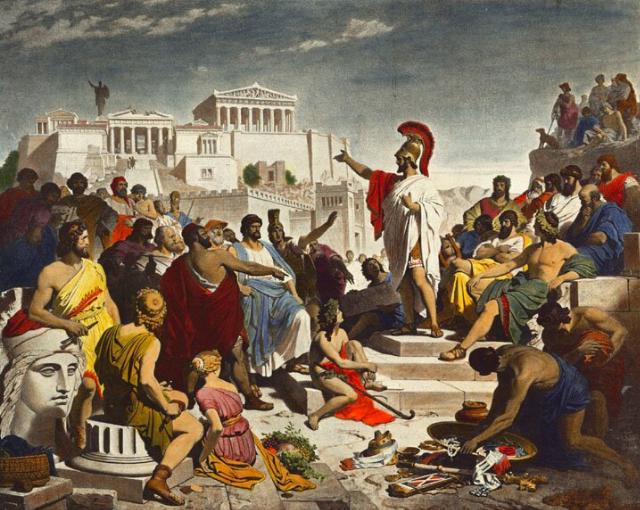
Picture Credit: From Wikimedia Commons: Pericles Gives the Funeral Speech (Philipp von Foltz, 1852)


In periods of civilizational stress, the defining intellectuals are rarely those who echo prevailing orthodoxies. Rather, they are individuals insisting on the legitimacy of first principles when those principles have become unfashionable or even dangerous to articulate. In contemporary Britain, Natasha Hausdorff, Douglas Murray, and Matt Goodwin exemplify this truth-seeking, altruistic calling. Each operates within a distinct professional domain—law, cultural criticism, and political science—yet all share a deeply anti-totalitarian idealism rooted in the defense of liberal democracy against ideological capture. Their engagement is not abstract but personal, involving reputational risk, social ostracism, and sustained public hostility. What unites them is not only dissent, but also a principled refusal to surrender truth, legality or democratic consent to coercive moral narratives.

Natasha Hausdorff’s contribution is distinguished by its juridical precision and moral clarity. As an international lawyer, she confronts one of the most ideologically distorted arenas of contemporary discourse: the legal treatment of Israel. Her merit lies not only in her mastery of international law but also in her insistence that law must remain tethered to evidence, context, and equal standards. In an environment where legal language is routinely weaponized to achieve political ends, her work exposes how selective interpretation and institutional bias corrode the credibility of the legal order itself.

Hausdorff’s anti-totalitarianism manifests in her resistance to what might be termed “normative inversion”: the process by which democratic self-defense is reframed as criminality, while terror, incitement, and authoritarian violence are excused as resistance. This inversion, which includes “victim blaming” at the national level, is not accidental but ideological, sustained by international bodies and NGOs that claim neutrality while advancing a rigid moral hierarchy. Hausdorff’s idealism consists in her refusal to abandon universal legal principles even when doing so would grant her professional safety. By applying the same standards to Israel as to any other state—and insisting those standards be applied universally—she challenges a deeply corrupt system that depends on exception and scapegoating.

The personal courage involved in this stance should not be underestimated. Defending Israel in contemporary legal and academic spaces often entails professional isolation, harassment, and reputational damage. Hausdorff’s willingness to endure these costs reflects a deeper conviction: that the erosion of legal objectivity in one case endangers all liberal democracies. Her engagement is therefore not parochial but civilizational. She understands that when law becomes a tool of ideological enforcement, it ceases to restrain power and instead legitimizes its abuse.

Douglas Murray’s singular merit lies in his capacity to articulate civilizational questions with philosophical depth and rhetorical force at a time when such questions are actively suppressed by mainstream media and academia. His legendary appearance at the Oxford Union twelve years ago became the precursor to numerous daring charges. Time and again, he has taken on Islamists and left-wing celebrities in front of menacing audiences. Importantly, he is not only a shrewd polemicist, who remains calm under pressure, but also a moral diagnostician of Western self-doubt. His anti-totalitarian idealism emerges from his insistence that liberal societies must believe in themselves to remain liberal. Against the prevailing assumption that self-criticism is the highest virtue, he argues that relentless self-denunciation becomes indistinguishable from moral abdication.

Murray’s battleground is primarily cultural. He confronts what might be called the “soft totalitarianism” of consensus enforcement: the informal but pervasive mechanisms by which dissenting views are marginalized without overt coercion. By challenging dogmas surrounding mass immigration, identity politics, and historical guilt, he violates the unspoken rules of acceptable discourse. The ferocity of the response to his work—character assassination, deplatforming campaigns, and persistent misrepresentation—testifies to the power of those rules.

Murray’s idealism is not reactionary nostalgia but a defense of Enlightenment inheritance: reason, individual moral agency, and universal rights. He rejects the reduction of individuals to group identities and resists the moral determinism that excuses behavior based on origin or grievance. This position places him in direct opposition to ideologies that divide society into permanent oppressors and victims, a framework mirroring the propagandistic logic of totalitarian systems even when expressed in therapeutic language.

Crucially, Murray’s engagement is animated by empathy rather than contempt. His unwavering critique of Islamism, for instance, is paired with a compassionate defense of Muslims who seek to live freely within liberal societies. What he rejects is not “diversity” as such but the refusal to draw moral boundaries. His courage consists in naming those boundaries when institutions and elites prefer ambiguity. In doing so, he exposes the paradox of a liberalism unwilling to defend its own conditions of existence. His deep concern is that the West, instead of standing firm on its Judeo-Christian ideals, is giving in to barbarism and thus preparing its own suicide.

Matt Goodwin’s merit is anchored in democratic realism. As a political scientist, he confronts the gap between elite consensus and popular consent, particularly on immigration, national identity, and sovereignty. His anti-totalitarian idealism is grounded in a simple but increasingly radical proposition: that democracy requires listening to voters even when their views are considered “inconvenient.” His work challenges the technocratic assumption that policy legitimacy flows from expertise alone rather than from democratic authorization.

Goodwin’s courage lies in his tireless determination to document and articulate patterns that many academics prefer to obscure for fear of ostracism or collapse of preferred theses. By analyzing electoral data, public opinion, and class realignments, he reveals how large segments of the population have been systematically excluded from meaningful representation. His critics often accuse him of “legitimizing extremism,” yet this accusation itself reflects a totalitarian impulse: the belief that certain preferences are illegitimate by definition and must therefore be managed rather than debated.

What distinguishes Goodwin’s idealism is his refusal to moralize disagreement. He does not portray voters as dupes or villains but as rational actors—fellow citizens with a claim to respect in that very capacity—responding to lived experience. In doing so, he restores dignity to democratic participation. This stance is costly in an academic environment increasingly aligned with activist (and, occasionally, extremist) priorities. Professional sanction, media hostility, and institutional marginalization (cancellation) are familiar risks for scholars who deviate from progressive orthodoxy. Goodwin accepts these risks as the price of intellectual honesty.

Taken together, Hausdorff, Murray, and Goodwin exemplify different dimensions of liberal, anti-totalitarian resistance. Hausdorff defends the integrity of law against ideological capture; Murray defends cultural confidence against moral coercion; Goodwin defends democratic consent against technocratic paternalism. Their idealism is not utopian but grounded in institutional realism. Unlike utopians, they do not imagine a conflict-free society, but they insist that conflict must be governed by rules, reason, and accountability rather than by intimidation or narrative dominance.

Hausdorff, Murray, and Goodwin have not spared themselves in the never-ending fight for justice. What makes the engagement of these three individuals particularly significant is that it occurs within liberal democracies that deny any resemblance to totalitarianism. Yet totalitarian tendencies rarely announce themselves openly. They emerge through the normalization of double standards, the stigmatization of dissent, and the substitution of moral certainty for empirical inquiry. Each in their own way, Hausdorff, Murray, and Goodwin recognize these patterns and refuse to accommodate them, even when accommodation would be personally advantageous.

The courage of those three modern heroes is therefore not performative but structural. It consists in sustained engagement over time—under conditions of persistent pressure. They do not retreat into irony or detachment but remain publicly accountable for their arguments. In doing so, behaving like true students of Socrates, they uphold a model of intellectual citizenship that is increasingly rare: one that treats truth as an honorable responsibility rather than a (narcissistic) posture.

Ultimately, the significance of Hausdorff, Murray, and Goodwin lies not only in the positions that they defend but also in the example that they set. They demonstrate that idealism need not be naïve, that realism need not be cynical, and that courage remains possible even in environments intrinsically hostile to independent thought. Their work reminds us that liberal democracy is not self-sustaining. It survives only so long as individuals are willing to defend its principles against both overt enemies and internal corrosion. In that defense, these three individuals stand as serious, if controversial, guardians of a fragile inheritance.

Related Topics: EnglandHistoryIslam


Lars Møller | February 12, 2026


original article located here has Audio Play feature so that you can listen to the article;

Source: In Defense of Civilization – American Thinker

Scientific Studies Attempt To Prove That People Are Born Gay

Normalizing Sin And Removing Responsibility: Scientific Studies Attempt To Prove That People Are Born Gay


Recent scientific studies claim that some people are born gay. Could this be?

Many Christian parents have asked me this question. They are struggling with a child who has recently “come out” and are trying to grapple with this new reality. These parents have lovingly taught their children the Bible, taken them to church all their young lives, and can’t understand how their children could possibly choose this sinful sexual behavior. They think biology may help explain what they are wrestling to explain any other way. So can it? And if biology can explain it, is homosexual behavior still sinful if God made them that way?

An ‘Evolutionary’ Dead End

From a secular evolutionary perspective, it really wouldn’t make any sense for homosexuality to have a biological basis. One of the major tenets of evolution is reproduction and passing on one’s genes to the next generation. As one author put it, “The existence of homosexuality amounts to a profound evolutionary mystery, since failing to pass on your genes means that your genetic fitness is a resounding zero.”

And if homosexual behavior has a genetic component, how could it even be passed on to future generations? In many ways, it’s an evolutionary dead end. Some evolutionists have tried to explain it with the idea of kin selection. Even though homosexuals won’t pass on their genes, they help raise nieces and nephews who will have some of their genetic information. However, studies have shown no difference in how homosexual and heterosexual individuals treat their close relations, so this work-around seems to fall short.

A Series of Inconclusive Studies

Historically speaking, the search for a biological explanation for homosexuality has been unsuccessful or at the very least inconclusive. Two prominent studies were those of geneticist Dean Hamer and neuroscientist Simon LeVay in the early 1990s. Hamer tried to show that a region on the X chromosome was linked to homosexuality. He suggested a gene or genes existed in that region that had variants more often associated with homosexual behavior. However, later scientists failed to find this linkage.

LeVay looked to see if differences existed in the hypothalamus in the brain of homosexual men versus heterosexual men. He reported that a particular structure in the hypothalamus (known as INAH-3) was smaller in homosexual men. However, there were several problems with the study. The sample size was small, and the size of this region of the brain was in the same range for both homosexual and heterosexual men.

Two recent studies have once again shined the spotlight on possible biological causes for homosexuality but with still very inconclusive results. It’s important to remember that both studies assumed that sexual orientation has at least some measure of biological causation, which may or may not be the case.

One study found certain variations (known as single nucleotide polymorphisms—SNPs) in regions associated with two genes, SLITRK6 on chromosome 13 and TSHR on chromosome 14, were more commonly found in homosexual men. The proteins produced by these genes are involved in the development of the brain and thyroid cell metabolism, respectively.

However, it is unknown whether these proteins play any role in sexual orientation. Even the scientists who performed the research admitted there were problems with the study. For example, all of the participants were from one ancestral group (European), so the question arises whether these variants (SNPs) are just normal variations in people with that ancestry and not related to homosexuality. They also admit to having a small sample size, which may affect the results.

Another study looked at a possible biological cause for a supposed phenomenon that has been observed among homosexual men, known as the fraternal birth order effect. In summary, homosexual men tend to have more older brothers than heterosexual men. Why would this be? Some scientists proposed that the mother’s immune system develops antibodies against a protein important for the development of her male baby’s brain while in her womb.

If the mother’s body develops the ability to make antibodies against this protein when she is pregnant with her first son, when she becomes pregnant with subsequent sons, the antibodies will be produced and inhibit the actions of those proteins, making it more likely that these sons will exhibit homosexual behavior. The study found that these mothers did, indeed, have high levels of antibodies that attack this protein (NLGN4Y). However, it found that mothers of gay sons with no older brothers also had high levels of these antibodies, so the result seems inconclusive at best. The sample size was also small.

Even the authors themselves admitted they don’t know how this protein might have a role in determining behavior. They stated, “It is not certain how NLGN4Y might operate at the cellular level on the neuropsychology of men’s sexual orientation” and “sexual orientation is clearly a complex phenomenon with likely many factors influencing it.”

Both past and present scientific studies have shown no conclusive evidence that homosexual behavior is biological; and even if there is a biological basis, the researchers themselves admit that it would likely make a relatively small contribution (less than one-third if at all, with the environment and other cultural factors having a much greater influence).

The Root Problem Is Not Biology

In many ways, the attempt to tie behavior to biology is an effort to normalize sin and remove responsibility for people’s feelings and actions. The idea of genetic determinism is rampant and important in evolutionary thought, as humans would have to be nothing more than “matter in motion” with no soul and merely the preprogrammed product of their genes.

However, starting with a biblical worldview, we know that we are made in the image of God (Genesis 1:27) and have a soul (Matthew 16:2622:37). We are much more than the sum of our genes. We also know that we have a will and can make choices for or against God (Joshua 24:15Matthew 12:30). God’s Word makes it clear that homosexual behavior is sinful (Romans 1:26–281 Timothy 1:9–111 Corinthians 6:9–11) but so are many other things like alcoholism, drug addiction, promiscuity, lying, cheating, stealing, and many other sins. If a gene was found that made it harder for people not to commit adultery, would that excuse adulterers who were born that way?

Ever since Adam’s rebellion, all of us are born sinners (Psalm 51:5), and all of us struggle with sin, but we must remember, “No temptation has overtaken you that is not common to man. God is faithful, and he will not let you be tempted beyond your ability, but with the temptation he will also provide the way of escape, that you may be able to endure it” (1 Corinthians 10:13).

True hope for those struggling with homosexuality is found only in the gospel of Jesus Christ.


Source: Normalizing Sin And Removing Responsibility: Scientific Studies Attempt To Prove That People Are Born Gay – Harbinger’s Daily

Turning Point; David Jeremiah – No Need to Promise


NEW!Listen Now

It is better not to make a vow than to make one and not fulfill it.
Ecclesiastes 5:5, NIV

Recommended Reading: Matthew 5:33-37

Parents sometimes hear their young children negotiating: “When will it be my turn?” “Just five more minutes—I promise!” Where do young children learn the technique of “promising”? Possibly from other children, but possibly from their parents. “I promise” is a modern version of the ancient practice of making a vow.

A vow in the Old Testament was a voluntary promise to God to perform a service that would be pleasing to Him in return for some desired benefit. For example, Jacob made a vow to serve God and pay Him a tithe if God delivered him safely back to his home (Genesis 28:20-22). Vows were taken seriously; there were strict protocols directing their use (Numbers 30). Solomon warned about the dangers of making a hasty vow to God: “It is better not to make a vow than to make one and not fulfill it” (Ecclesiastes 5:5, NIV). By Jesus’ day, the Pharisees had added layers of complication to vow-making which Jesus unwound. He made it simple: “But let your ‘Yes’ be ‘Yes’ and your ‘No,’ ‘No’” (Matthew 5:33-37).

Let your word be your bond. Keeping your “Yes” or “No” eliminates the need to promise.

The life of an honest man is an oath. 
Richard Sibbes


https://www.davidjeremiah.org

Our Daily Bread – A Nonanxious Presence


In peace I will lie down and sleep. Psalm 4:8

Today’s Scripture

Psalm 4

Listen to Today’s Devotional

Apple LinkSpotify Link

Today’s Devotional

In his 1985 book Generation to Generation, family therapist and Rabbi Edwin Friedman introduced the phrase “a nonanxious presence.” Friedman’s thesis, later articulated in A Failure of Nerve, is that “the climate of contemporary America has become so chronically anxious that our society has gone into an emotional regression that is toxic to well-defined leadership.” Friedman focused on how chronic anxiety spreads within a system—a family, a workplace, a congregation. Yet in the same way, a leader can offer a nonanxious presence that will spread through a system, becoming a person of peace in the middle of a storm.

Psalm 4 is a psalm of David, written in the middle of one of life’s storms. David was in the grip of anxiety. So he cried out to God, “Give me relief from my distress; have mercy on me and hear my prayer” (v. 1). While he was fearful for his life, he was also aware that his followers were fearful too: “Many, Lord, are asking, ‘Who will bring us prosperity?’” (v. 6).

David’s decision to trust God created a nonanxious presence in the presence of anxiety! “In peace I will lie down and sleep,” he said. David could rest because “you alone, Lord, make me dwell in safety” (v. 8).

We too can rest in the nonanxious presence God provides. We can spread His peace wherever we go.

Reflect & Pray

What’s a current situation causing you anxiety? What would it look like to lead with a nonanxious presence?

You alone, God of peace, are my safety. May my trust in You encourage others to do the same.

Today’s Insights

Psalm 4 expresses David’s quiet confidence in God amid distressing circumstances and slanderous attacks (vv. 1-2, 8). Affirming that God had set him apart to live a life that honored Him (v. 3) and acknowledging his propensity to seek revenge on those who’d attacked him, the psalmist reminded himself, “Don’t sin by letting anger control you. Think about it overnight and remain silent” (v. 4 nlt). Instead of angry retribution, he chose silent reflection on God’s goodness and faithfulness (vv. 4-8). In another psalm, David similarly wrote, “Be still before the Lord . . . . Do not fret—it leads only to evil” (37:7-8). Today, when we’re anxious, we can ask God to help us and to remind us of His presence and faithfulness.

Discover the secret to lasting peace in Christ.


http://www.odb.org

Denison Forum – Popular podcast calls evangelicals “cancer”


Four biblical responses when Christians are stigmatized

Jennifer Welch was an Oklahoma City-based interior designer and reality show actress before launching a podcast in 2022. Titled “I’ve Had It,” her podcast now has 1.5 million subscribers on YouTube and 4.5 million followers across social media. She has interviewed former President Barack Obama, Rep. Alexandria Ocasio-Cortez (D-NY), then-Vice President Kamala Harris, and New York City Mayor Zohran Mamdani, among many others.

Known for her profane rants against conservatives—she claims the 2024 assassination attempt on President Trump was “totally staged,” for example—she has now turned her ire on evangelicals.

Bonnie Kristian reports in the Free Press that Welch recently called us “the worst people in our country” and said in May, “I detest, with every molecule . . . in my being, evangelical Christianity. I think it is a dumb factory.”

Welch claims that “evangelical Christianity is the biggest racket on the planet” and repeatedly uses the epithet “cancer” to describe us. In her view, “Until we start dealing with this horrific cancer that is white evangelical Christianity in this country, we’re going to continue to have these problems.”

Kristian notes that “scorn heaped on evangelicals is not new.” She cites Yale University legal scholar Stephen L. Carter, who wrote in 1994 that secular progressives saw evangelicals as “wide-eyed zealots.”

Political scientist Ryan Burge explains: “People on the left side of the political spectrum need an enemy. They need to personify what the other side is, and because white evangelicals are so prominent in America, they have become the totem for all the liberal ire against conservatives in America.”

As corrosive to the common good as Welch’s rhetoric is, it is also a signal of something even more systemic, a trend we must recognize clearly so we can respond redemptively.

The four-part strategy continues

My wife and I watched a television show this week in which one of the female characters develops a romantic relationship with another woman. The other characters respond with delight that their colleague has finally “found someone” and hope their relationship lasts.

I was reminded again of the LGBTQ strategy that has been developed and followed over recent decades: normalize unbiblical immorality, legalize it, stigmatize those who disagree, and criminalize such disagreement.

However, the apparent chronological staging of this strategy is deceptive. Those who follow it will continue their efforts to normalize such immorality until they convince us that it is not immoral. Many will continue their work to legalize their immorality, as with current efforts to protect and legalize pedophilia. And they will continue stigmatizing those who disagree until there is no one left to disagree, all the while criminalizing such opposition in the service of the first three stages.

Jennifer Welch’s profane diatribes against evangelicals are obviously in the service of the stigmatizing stage. If Dr. Burge is right (and I think he is), we should not assume that there will not be others, or that criminalization of evangelicals who defend biblical morality is not in our future.

Numerous efforts have already been mounted to threaten our religious liberty, as the so-called Equality Act that passed the House twice demonstrates. Christianity Today reports that “across Western Europe, Christians report ‘discrimination and bullying’ and in some instances even ‘loss of employment’ for expressing faith-based opinions in their workplaces.” Some have even faced repercussions for views they expressed in private conversations or posted on private social media accounts.

Of course, such persecution does not begin to rise to the opposition believers face in North Korea, China, Cuba, and parts of the Muslim world. But when evangelicals are so blatantly stigmatized on one of the most popular podcasts in America, we should take note of where things are and where they may be going.

An “anonymous Christian” is a contradiction in terms

At this point, you might be discouraged by what you’ve read. My purpose, however, is just the opposite.

Jesus assured his followers, “Blessed are you when others revile you and persecute you and utter all kinds of evil against you falsely on my account” (Matthew 5:11, my emphasis). Our Lord warned us that we would be persecuted just as he was persecuted, which makes sense: those who saw him as a threat would see his followers as a threat. If they opposed him for proclaiming truth, they would oppose his followers for doing the same (cf. Acts 5:17–40).

A simple way out of this, of course, is to be silent about our faith as we hide our beliefs from those who would oppose them. However, an “anonymous Christian” is a contradiction in terms. If a “Christian” is a “Christ imitator” (cf. 1 Corinthians 11:11 John 2:6), we cannot imitate our Lord and be anything but vocal and courageous in speaking his word and advancing his kingdom (cf. Acts 4:19–20).

As a result, the more we are stigmatized for our faith, the more we can know that we are being appropriately public with our biblical beliefs. And the more we can know that Satan himself is using those willing to be used as he fights truth with lies.

Four practical responses

In this sense, it is an odd compliment when someone like Jennifer Welch castigates us so profanely and hatefully. Our response should be to expect such attacks, then to redeem them for God’s glory.

Here’s how the Bible teaches us to respond to those who oppose our faith:

  1. Forgive others their trespasses” (Matthew 6:14), choosing to pardon rather than to punish in the knowledge that we have been forgiven much as well (cf. Luke 7:47).
  2. Pray for those who persecute you” (Matthew 5:44), recognizing that the more they reject biblical truth, the more they need it.
  3. Love your enemies, do good to those who hate you” (Luke 6:27), seeking tangible ways to meet their needs so as to earn the right to share Christ with them.
  4. Be strong and courageous” (Joshua 1:9), asking God to help us “continue to speak your word with all boldness” (Acts 4:29).

In all things, we must remember that we are not “culture warriors” for whom people like Jennifer Welch are our enemies, but cultural missionaries for whom they are our mission field. The good news, as my wife writes in her latest blog, is that God’s Spirit can fill us with the same agape love that God’s Son has for us.

Then, as Janet notes, “we can love like Jesus.”

Whom do you know who needs such love today?

Quote for the day:

“The good man has his enemies. He would not be like his Lord if he had not. If we were without enemies, we might fear that we were not the friends of God, for friendship of the world is enmity to God.” —Charles Spurgeon

Our latest website resources:


Denison Forum

Harvest Ministries; Greg Laurie – Faith vs. Worry


 Don’t worry about anything; instead, pray about everything. Tell God what you need, and thank him for all he has done. Then you will experience God’s peace, which exceeds anything we can understand. His peace will guard your hearts and minds as you live in Christ Jesus. 

—Philippians 4:6–7

Scripture:

Philippians 4:6-7 

Some people can sleep through anything. I’m not one of them. If I hear one little noise, I’m awake. If a bird chirps, I’m awake. I’m a light sleeper.

Apparently, Jesus was a heavy sleeper. Luke’s Gospel tells us that as the disciples battled a violent storm on the Sea of Galilee, Jesus was sound asleep. Water made its way into the boat as it pitched back and forth. Sinking seemed like a very real possibility. The terrified disciples woke up Jesus, crying, “Master, Master, we’re going to drown!” (Luke 8:24 NLT).

On the one hand, they panicked. And they can be faulted for that. On the other hand, they channeled their anxiety in the right direction. They cried out to the Lord. In a sense, they prayed.

When we are in trouble, we need to follow their example. We need to pray. We need to give our worries to the Lord and trust Him. We need to place our faith in Him.

Faith and worry cannot coexist. One chases out the other. Do you know people who don’t get along? Maybe you want to invite one of them to your house, but you’re hesitant to invite the other because there’s always conflict between the two of them. Faith and worry have the same type of relationship. Where there is worry, there is no place for faith. Faith is driven out by worry, and worry is driven out by faith.

The apostle Paul wrote, “Don’t worry about anything; instead, pray about everything. Tell God what you need, and thank him for all he has done. Then you will experience God’s peace, which exceeds anything we can understand. His peace will guard your hearts and minds as you live in Christ Jesus” (Philippians 4:6–7 NLT).

The New Testament in the modern English PHILLIPS Bible puts it this way: “Don’t worry over anything whatever; tell God every detail of your needs in earnest and thankful prayer, and the peace of God which transcends human understanding, will keep constant guard over your hearts and minds as they rest in Christ Jesus.”

It has been said that if your knees start shaking, you should kneel on them. In other words, when things get scary, pray. Cry out to God.

Prayer is essential to discipleship. The sooner new believers learn to give their fears, doubts, concerns, and problems to God as those issues arise, the quicker they will grow in their faith.

The disciples in the boat that day were left in awe by Jesus’ ability to answer their prayers. Their faith was bolstered beyond measure. The same thing happens when Jesus’ followers pray today.

Reflection Question: How can you prioritize prayer in your life? Discuss this with believers like you on Harvest Discipleship!


Harvest.org | Greg Laurie

Days of Praise – Our Ministry to Angels


by Henry M. Morris, Ph.D.

“To the intent that now unto the principalities and powers in heavenly places might be known by the church the manifold wisdom of God.” (Ephesians 3:10)

There is “an innumerable company of angels” in heaven (Hebrews 12:22). They serve as “ministering spirits, sent forth to minister for them who shall be heirs of salvation” (Hebrews 1:14).

At the same time, it is instructive to realize we also have a ministry to the angels. Despite their great power and knowledge, angels are not the “heirs of salvation” themselves and so will never personally experience that peculiar type of love and fellowship that we share with our Lord and Savior. Nevertheless, as personal beings with the free will to reject their role as God’s servants if they choose, they are intensely interested in our salvation, “Which things the angels desire to look into” (1 Peter 1:12).

In addition to serving for the protection and guidance of individual believers, apparently certain angels are also assigned by God to serve Christian congregations functioning corporately, especially in true local churches. Paul mentions the observing presence of angels in the Corinthian church (1 Corinthians 11:10), for example.

In His letters to the seven representative churches, Christ addressed the individual angels of each church (Revelation 2:1, etc.). That these are heavenly angels (not human pastors or other human church leaders) seems probable from the fact that the word “angel” is used 65 other times in Revelation and always refers to real angels.

Finally, the words of our text for the day give a special incentive for our lives, for there we are reminded that it is through God’s dealings with “the church” that His holy angels are able to learn for themselves “the manifold wisdom of God.” HMM


https://www.icr.org/articles/type/6

Joyce Meyer – Make Each Day Extraordinary


…But David encouraged and strengthened himself in the Lord his God.

1 Samuel 30:6 (AMPC)

No day will seem ordinary if we are thankful for the gift God is giving us at the start of each day. An extraordinary attitude can quickly turn an ordinary day into an amazing adventure. Jesus said He came so that we might have and enjoy life (see John 10:10). If we refuse to enjoy it, then it’s no one’s fault but our own.

I would like to suggest that you take responsibility for your joy and never again give anyone else the job of keeping you happy. You can control what you do, but you cannot control what other people do. So you may be unhappy a lot of the time if you depend on them as your source of joy. The psalmist David said that he encouraged himself in the Lord, and if he can do it, then we can do it too.

Prayer of the Day: Father, I am grateful for this new day that You have given me. Regardless of the actions or attitudes of others, I am going to enjoy this day because You are the source of my joy.


http://www.joycemeyer.org

Max Lucado – Eight Worry Stoppers 


Play

Here are eight worry-stoppers, found in the letters of the word P-E-A-C-E-F-U-L:

Pray, first.  “Casting the whole of your care upon Him …”

Easy, now.  “Rest in the Lord, and wait patiently for Him.”

Act on it.  Be a doer, not a stewer.

Compile a worry list.  Keep a list of things that trouble you.  How many have turned into a reality?

Evaluate your worry categories.  Pray specifically about them.

Focus on today.  God meets daily needs daily.

Unleash a worry army.  Ask a few loved ones to pray with you and for you.

Let God be enough.  “Seek the Kingdom of God above all else

P-E-A-C-E-F-U-L. Peaceful!


Home

Today in the Word – Moody Bible Institute – Colossians: It Takes Work


Read Colossians 2:1–15

Home ownership is attractive. Why pay rent when you can invest your hard-earned money into an asset that may appreciate over time? However, owning a home takes effort. The lawn must be mowed, the siding must be painted, and the roof must be repaired. But even while a rental might be easier, homeownership is considered a worthy investment.

In his letter to the Colossians, Paul encourages his readers to do the hard work of maintaining the faith they have attained. They need to continue to live their lives in submission to the authority of Jesus (v. 6). He uses two images to describe the hard work they need to do. First, they need to remain rooted in Christ (v. 7). Like a plant extending roots for nutrients in the soil, they need to sink their roots deep in the knowledge of their Savior.

Second, their faith needs to be built up like a firm foundation that supports a building. They are to strengthen their faith and cultivate a heart “overflowing with thankfulness” (v. 7). Paul’s advice was important because the Colossians lived in a dangerous place, awash in “hollow and deceptive philosophy” (v. 8). These teachings were not based on Christ but on cultural practices and even the demonic world. Proponents of these ideas were always on the lookout for converts to ensnare. The Colossians needed to avoid being taken captive, and Paul’s warnings also ring true for us today!

Like home ownership, living out our faith takes work. The Colossians could not assume that just because they came to faith in Christ in the past, they would not need to expend energy on a regular basis to maintain that faith against opposition. In the same way, we need to realize that the work we do now for Christ is of eternal value.

Go Deeper

Do you consider your faith a rental unit or a home you’ve purchased? How will sinking deep roots in Christ help you defend against the world’s philosophies? Or how has it? Extended Reading:

Colossians 1-4

Pray with Us

Lord, how do we discern and avoid “hollow and deceptive philosophy” (Col. 2:8) of the world? The book of Colossians teaches us how: by being “rooted and built up” in Christ (v. 7). May we grow in faith and love!

Just as you received Christ Jesus as Lord, continue to live your lives in him, rooted and built up in him.Colossians 2:6–7


https://www.moodybible.org/