‘Experts’ Know Less than They Think

All ‘authorities’ should be challenged.


Occasionally I hear credentialed professionals with prestigious titles whine about the so-called “war on expertise.”  It really bothers people who see themselves as “experts” that a growing share of society ignores them.  A psychologist might intuit something revealing from the lack of self-confidence plaguing our “expert” class.  If all the fancy degrees, voluminous curricula vitae, and lofty career positions have failed to instill a resilient modicum of self-esteem, then perhaps all those things are not the true measures of a person’s worth.

“Experts” do not like to be challenged.  They say things such as, “I have a PhD in this,” or, “I get paid a lot of money to talk about that,” and expect everybody listening to stop thinking and immediately agree with everything the “expert” has to say.  I once witnessed a young “race studies” professor intrude into an online debate and tell everyone that she was correct and everybody else was wrong.  Her evidence?  She cited the costs of her education, her recent promotion, and her new annual salary.  Traditionally, that’s considered a specific kind of logical fallacy known as an appeal to authority.  When appeals to “expertise” replace reason and rationality, false conclusions are more easily justified.

We have been living in an era rife with appeals to authority masquerading as truth.  In fact, I came across something hilariously unsurprising as I was writing this essay.  Because Internet search engines no longer operate as research tools but rather as propaganda aggregators, I often have to peruse many pages of search results before I find topical and pertinent sources.  Leftwing disinformation index Wikipedia routinely receives prime placement for any online query.  I decided to check how the propagandists at Wikipedia describe appeals to authority these days, and the editors did not disappoint (someone as cynical as I):

“While all sources agree this is not a valid form of logical proof, and therefore, obtaining knowledge in this way is fallible, there is disagreement on the general extent to which it is fallible — historically, opinion on the appeal to authority has been divided: it is listed as a non-fallacious argument as often as a fallacious argument in various sources.”  My sides, they hurt so much as I laugh uncontrollably!  Then Wikipedia’s meaningless equivocation ends with this gem: “Some consider it a practical and sound way of obtaining knowledge that is generally likely to be correct when the authority is real.”

There you go, kids!  So long as the “authority” is “real,” it’s quite “practical” and “sound” to hand your brain over to the resident “expert” or AI machine and let he/she/it do your thinking for you!  It’s not a “logical fallacy” if the “authority” says it’s not!  How very twenty-first-century of the 1984-like censors, history rewriters, and information warfare specialists who manage the world’s “free” encyclopedia.  Wikipedia may be “free,” but it still levies a steep tax.  The “price” of offshoring one’s thinking to “experts” is a life filled with few cogent thoughts.  That’s too high of a cost for any human seeking wisdom.

Appeals to authority are often absurd.  Since the mid-twentieth-century, most of the handsome or beautiful news anchors who tell the world what to believe have been empty-headed script-readers with subpar intellects (Hello, Dan Rather!).  According to renowned climate scientist Al Gore, Miami and Manhattan should have spent the last decade submerged under ten feet of water.  At the 2018 United Nations Climate Change Conference, then-fifteen-year-old Swede Greta Thunberg told world leaders that they were “not mature enough to tell it like it is.”  Those world leaders — prone to lean directly into appeals to authority themselves — immediately told the planet’s youngest generations to listen to the Swedish teenager if they wanted to survive the carbon apocalypse.  Similarly, noted virologist Bill Gates (I forget: Does he have Nobels in both chemistry and medicine?) assured us that we would all die unless we allowed his corporate friends to inject us regularly with experimental serums and did everything government officials say.  All the very smartest people spent at least two years telling us that only totalitarianism and censorship could save us from COVID.

It may be absurd to mindlessly trust the “expertise” of Dan Rather, Al Gore, Greta Thunberg, and Bill Gates, but it’s no less dangerous to mindlessly trust the “expertise” of someone whom Wikipedia would no doubt describe as a “real authority.”  Dr. Anthony Fauci has all the credentials that people who enjoy credentials salivate over.  He has a medical degree.  He has a trophy room full of awards.  He’s a member of the best institutions.  He was the director of the National Institute of Allergy and Infectious Diseases for nearly forty years, for goodness’ sake!  Wasn’t he even the highest paid employee in the federal government?  Money, accolades, social status — Fauci has it all.  His prestige drips with prestige.

Yet he told us that COVID couldn’t possibly have come from a Chinese bio-lab (that he and his associates partially funded).  He told us that experimental mRNA “vaccines” would prevent infection…er, reduce spread…er, make symptoms less severe.  He told us that natural immunity was no good (because the pharmaceutical companies can’t profit from that).  He told us to wear one mask (cloth or paper or whatever), then two masks, then three masks, then three masks and a plastic shield.  He told us that small businesses should close their doors, but that “critical” businesses — such as Walmart — should remain open.  He told us that kids should be kept out of school…but perhaps they’d be safe behind plexiglass walls…so long as the powerful heads of public school teachers’ unions thought that “science” was sound.  And plenty of people around the world (including America’s cult of “authority”-worshiping Karens and government-worshiping Democrats) admired Fauci’s lustrous prestige, ignored his illogical and contradictory pronouncements, and did whatever he said.

That’s the danger with appeals to authority.  When you hand your brain to third-parties, don’t be surprised to discover that “experts” value your life less than you do.

Europeans are learning this lesson the hard way right now.  For decades, the “elites” have shunned hydrocarbon energies and made their economies too dependent upon unreliable wind and solar alternatives.  European “authorities” decommissioned nuclear power plants, even though doing so meant that European industries became more dependent upon Russian natural gas.  Then came the War in Ukraine and the sabotage of the Nord Stream pipelines.  Eventually, Ukraine’s martial-law-holdover-president/dictator, Volodymyr Zelenskyy, blocked oil deliveries from Russia through the Druzhba pipeline to Poland, Hungary, Slovakia, the Czech Republic, and Germany.  And President Trump’s strikes on Iran made it much more difficult for Europe to obtain critical hydrocarbons from the Middle East.

European “authorities” have spent decades using the “global warming” hobgoblin to scare the public into accepting expensive and unreliable sources of energy whose use will do nothing to “save the planet.”  Those “authorities” have managed, however, to cripple most European industries and make Europe’s cost of living prohibitively expensive.

Inevitably, whenever I even passingly mention Ukraine President/Dictator Zelenskyy, some unhappy readers call me names.  Regular commenter “Megan Draper, M.S.” recently wondered, “how much money the Russian government” must be giving me.  Another commenter going by the handle “asherpat” implied that I am “a Russian influencing agent.”  Putting aside their casual libel, I will point out that both commenters employ another kind of logical fallacy: appeal to ridicule.  Although besmirching my character is one way to counter my arguments, it is not one based on solid reasoning.

I suggest that all authorities be challenged regardless of their credentials.  Just as degrees are incomplete measures of one’s education, titles of “authority” are poor substitutes for wisdom.  It is our capacity for reasoned debate that helps us separate the wheat from the chaff.


J.B. Shurk | March 13, 2026

Source: ‘Experts’ Know Less than They Think – American Thinker
Roll Your Eyes All You Want… The Rapture Is Real

Is the Rapture real? There’s always debate around this topic.

Let’s start with the obvious: the Rapture sounds crazy. Jesus descends from Heaven, dead people rise from their graves, and living believers are suddenly caught up into the sky—like the world’s strangest episode of “Stranger Things.” Sounds like the stuff your uncle mutters about after three cups of church coffee. Except—the Rapture is right there in Scripture. Paul says it. John says it. Jesus says it.

Opposing Views 

Now, critics like to pounce: “But the word Rapture isn’t even in the Bible!” Neither are the words Trinity or even Bible. And yet, here we are, still believing in all three. The word comes from the Latin rapturus, which translates the Greek word harpazo—meaning “to snatch up, grab by force.” Imagine a parent reaching out and pulling their child away from danger just in time. That’s the picture Scripture gives us of the Rapture.

Some say, “Oh, the Rapture is just a modern invention, some 19th-century gimmick.” Nonsense. Yes, J.N. Darby helped popularize it in more recent times, but long before him, the early Church Fathers like Irenaeus and Cyprian wrote about believers being “snatched up” before judgment.

It’s not new—it’s biblical.

The Rapture in Scripture

We also hear about the Rapture straight from Paul, Peter, James, and most importantly, Jesus Himself: “‘And if I go and prepare a place for you, I will come again and receive you to Myself; that where I am, there you may be also’” (John 14:3 NKJV).

The most familiar passage on the Rapture is 1 Thessalonians 4:16–18“For the Lord Himself will descend from heaven with a shout, with the voice of an archangel, and with the trumpet of God. And the dead in Christ will rise first. Then we who are alive and remain shall be caught up together with them in the clouds to meet the Lord in the air. And thus we shall always be with the Lord. Therefore comfort one another with these words.”

And if that sounds far-fetched, remember Enoch—who literally walked off the face of the earth into God’s presence—and Elijah, who rode to Heaven in a fiery chariot. The prototypes are already in the Old Testament.

Why the Rapture Matters

Here’s why this isn’t just a fun theological parlor game: the Rapture gives hope. Paul calls it the “blessed hope.” When you’ve buried a loved one, you don’t need vague talk about them being “in a better place.” You need the solid promise that in one split second you’ll be with them again. Parents reunited with children. Husbands with wives. Brothers and sisters together again. And at the center of it all—Jesus Christ Himself.

And it does more than comfort grief. It motivates godliness. If you really believe Jesus could return at any moment, maybe don’t binge sin like it’s Netflix. You wouldn’t invite your best friend into a house piled with dirty laundry and Taco Bell wrappers. Don’t greet your Savior that way either. You want to be ready—walking with Him, keeping your spiritual house in order.

When Will the Rapture Happen?

People get themselves into trouble trying to date-set the Rapture.

Jesus made it pretty clear: “No one knows the day or the hour” (see Matthew 24:36). Which, funnily enough, includes you, me, and that guy on YouTube with the chart and the whiteboard. Yet, periodically, there’s always that someone with their calendar: “88 Reasons Jesus Will Return in 1988!” Let’s just stop with the speculation.

The Rapture isn’t about prediction—it’s about preparation.

The Takeaway

What do we do with all this? We wake up. We stay alert. And we stop living like the world is a Vegas buffet that never closes. Paul said: “The night is almost gone; the day of salvation will soon be here…” (Romans 13:12). Translation: Time is short. Knock it off. If you’re a believer, live clean, live holy, live hopeful. If you’re not—well, get right or get left.

Because one day, maybe in our lifetime, maybe tonight—in a blink, in the twinkling of an eye—everything changes. Loved ones raised. The Church caught up. Judgment delayed until after the Bride has been rescued.

It’s not escapism. It’s not fantasy. As C.S. Lewis reminded us, looking forward to the eternal world is one of the things a Christian is meant to do.

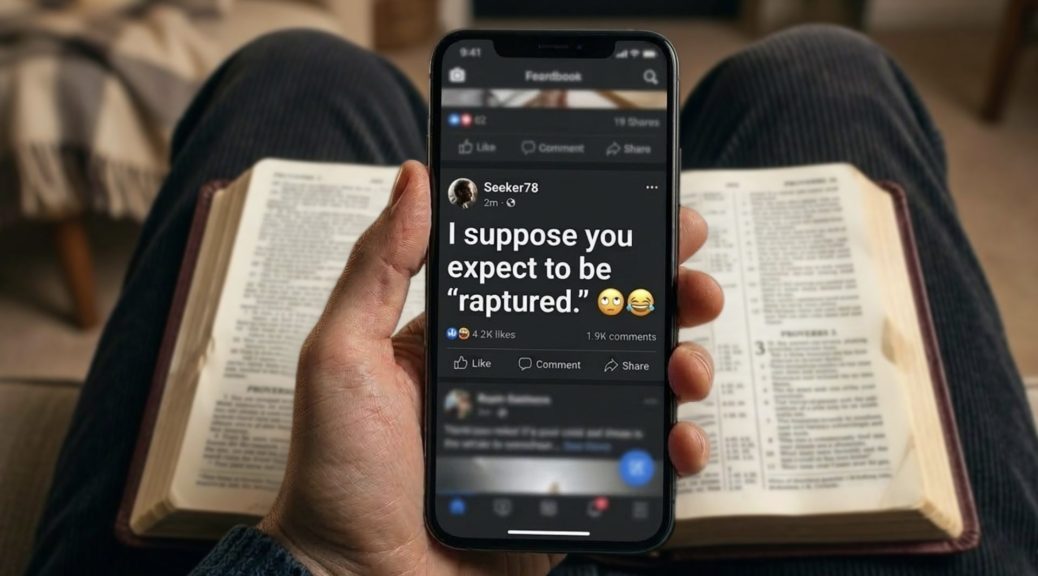
So, laugh if you want. Roll your eyes. Write your snarky post. But the Rapture is real. And when it happens—when the shout comes, when the trumpet blows—mockery won’t matter. Only hope will.


Source: Roll Your Eyes All You Want… The Rapture Is Real – Harbinger’s Daily

Turning Point; David Jeremiah – Test Yourself


NEW!Listen Now

Examine yourselves as to whether you are in the faith. Test yourselves. Do you not know yourselves, that Jesus Christ is in you?—unless indeed you are disqualified.
2 Corinthians 13:5

Recommended Reading: 2 Thessalonians 2:1-4

We are tested in school and sometimes in the workplace. God even tested Israel in the wilderness (Exodus 16:4; 20:20; Deuteronomy 8:2). In general, we have a negative attitude toward being tested—and tend to avoid tests when we can.

The idea of testing ourselves is a unique idea found in Scripture. The apostle Paul exhorted the Corinthian Christians to test themselves, to examine whether they were genuine Christians or not. Why is that important? Because a day is coming when many who profess to be Christians will fall away from the faith when their faith is tested (Matthew 24:10-12; 1 Timothy 4:1). Jesus even said that not all who profess faith in Him will enter the Kingdom of heaven (Matthew 7:21-23). The time to examine the genuineness of one’s faith is before the test comes.

Don’t let this day pass without knowing for sure that you are in Christ and that He is in you. If you haven’t already, embrace Him as your Lord and Savior today.

We do believe in eternal security, but we do not believe in eternal presumption. Let a man examine himself.
Donald Grey Barnhouse


https://www.davidjeremiah.org

Our Daily Bread – Sitting with the Suffering


No one said a word to [Job], because they saw how great his suffering was. Job 2:13

Today’s Scripture

Job 2:7-13

Listen to Today’s Devotion

Apple LinkSpotify Link

Today’s Devotion

“Daddy, my head hurts.” “Daddy, I’m so cold.” “Daddy, can you rub my feet?”

A high fever, chills, and body aches recently descended cruelly upon my teenage daughter. She wanted me to make it better. But mostly she just wanted me near. Eventually we took her to urgent care. “Virus,” we were told. Nothing to do but ride it out.

I sat with my sick girl for hours that day. Rubbing her feet. Getting her medicine. Desperately wanting her to feel better. Occasionally, my selfish side complained, This is hard. Indeed, it is hard to sit with people’s suffering, to witness their hurt up close.

Job’s friends saw his suffering up close too. These three guys are often—fairly!—criticized for their later poor treatment of Job. But it’s easy to forget that, initially, they simply sat with him: “They sat on the ground with him for seven days and seven nights. No one said a word to him, because they saw how great his suffering was” (Job 2:13).

Jobs’ friends remind us that when someone we love is hurting, it’s our presence—our being there, whether we speak or not—that often matters most. Their example reminds us that even though we may not always know what to say, simply sitting with someone in their suffering may be the greatest gift we can give.

Reflect & Pray

Who do you know who’s struggling? How might you be present for them?


Heavenly Father, thank You for sending Jesus to save our suffering world. Please help me to see those whom You might have me encourage amid their struggles and pain.  

Obadiah is the least-read book of the Bible. Check out this book from Reclaim Today to help navigate the book of Obadiah and learn to hear God’s voice through it.

Today’s Insights

Job’s friends were doing very well in their mission of comfort until they started talking. For seven days, they were a silent presence with their suffering friend (Job 2:13). Silence tends to make us uncomfortable, so we may try to fill that void with words. But in times of great suffering (like Job’s), words alone are often inadequate to express the comfort or help that the hurting person truly needs. We can credit Job’s friends for their sacrificial seven days of silent presence, but they caused hurt when they began to offer answers that didn’t ease Job’s hurt, pain, or loss. We can ask God to give us wisdom to know when to speak and when to offer the comfort of a silent presence with those who are hurting.


http://www.odb.org

Denison Forum – While the US considers a “friendly takeover,” God is already at work in Cuba


While the Trump Administration’s focus remains largely on the war in Iran, the president took some time earlier this week to address the situation with Cuba as well. Hinting that they may be next in line for regime change, he stated, “It may be a friendly takeover, it may not be a friendly takeover. It wouldn’t matter because they’re really, they’re down to, as I say, fumes.”

Trump went on to add, “They have no energy. They have no money. They’re in deep trouble on a humanitarian basis.” As I discussed in the News Worth Knowing section of this week’s Focus, those comments came after he’d previously mused, “They want to make a deal, and so I’m going to put Marco [Rubio] over there, and we’ll see how that works out.”

As we’ve seen with Iran, Russia and Ukraine, Venezuela, and in a host of other conflicts, wanting to make a deal and being willing to give up what it would take to get a deal are rarely the same. And while the president is correct that Cuba is struggling in almost every way, it’s still unclear what any such negotiations would entail.

Cuba does not have a clear successor who could take over, like in Venezuela. They also don’t have the same kind of economic or natural resources that could prove appealing. Instead, it’s likely that any concessions of interest to the administration would center around the country’s relationships with Russia and China.

A report from the Center for Strategic & International Studies found that there are likely multiple sites on the island that China is currently using to spy on the United States. Russia is also thought to utilize Cuba and other Latin American countries like Nicaragua for similar purposes. Reducing our neighbor nation’s ties to these countries would be difficult, but it would also fit well within the administration’s foreign policy focus on the Western hemisphere.

Yet, until a deal is reached, it’s the people in Cuba who will continue to suffer, and it’s crucial that we don’t lose sight of their plight as we consider the broader negotiations between governments.

“You can tell something isn’t right”

While the toppling of former Venezuelan president Nicolás Maduro—and, more specifically, the cessation of free oil to Cuba—was, in many ways, the tipping point for the Cuban people, many were in dire straits well before then.

Cuba is one of only two Latin American nations currently in a recession, with Haiti the other. 89 percent of the population lives in extreme poverty, and even their government admits that most live on one meal a day, if that. Moreover, a mosquito-borne illness—easily treated with acetaminophen like Tylenol—has proved difficult to contain and has led to 55 deaths since November due to a shortage of medicine.

nationwide blackout was triggered recently after the Antonio Guitera thermoelectric plant, the island’s largest power station, failed. Even when the plant was functioning, though, the aforementioned fuel shortages meant many went without power. Power cuts of up to twenty hours are common, while the lack of fuel makes getting to work, transporting food, or simply getting around too great a struggle for most.

And, as Jaob Lesniewski, the Mennonite Central Committee (MCC) regional codirector for Cuba, described, it gets worse the farther you get from the capital:

When you arrive in Havana, you can tell something isn’t right. But it’s nothing compared to what you begin to see as you travel farther east. Entire cities look like ghost towns. There are factories, schools, and hospitals that once functioned but now stand empty and severely deteriorated.

As is often the case, however, God is already at work through his people in ways that are making a genuine difference in the lives of those in need.

“Christian churches have become essential spaces”

Hernán Restrepo has an excellent article in Christianity Today about the work believers are doing in Cuba. In it, he describes how Christians are using whatever means are at their disposal to help those around them. Whether it’s providing food, clothing, hygiene products, or simply comfort, God’s people are giving from what little they have to be his hands and feet to the people the Lord has placed around them.

Moreover, even the government has started to recognize the value of getting help from believers. Ministries like MCC have met remarkably little resistance as they’ve brought in shipping containers of humanitarian relief. Instead, their greatest problems have come from getting that aid to the people once it arrives.

The oil embargo has made it difficult to use trucks to distribute the supplies, and the churches with whom they work are often forced to rely on “underfed horses” and carts instead. Still, they’re doing what they can, and it’s still often far more than the people receive from the government.

As Mayra Espino, a sociologist and researcher in Cuba, points out:

In a country where the state can no longer provide basic services like health care and education, Christian churches have become essential spaces for society—not only to receive humanitarian aid or spiritual comfort, but also to build community.

And it’s been that way for quite a while.

In 2008, for example, Cuba was devastated by four hurricanes in a single year. Espino notes that Christians earned a newfound respect after local churches helped repair the roofs of their non-Christian neighbors before fixing their own. It was a gesture of care that was not soon forgotten, in part because Cuban believers have continued to demonstrate that kind of concern in the years since.

And, in so doing, they offer an important example for believers everywhere.

“The gospel is relational”

Sometimes it can be easy to look at the gravity of the needs around us and feel overwhelmed. And that’s alright. Many of those needs are truly overwhelming and, to put it a bit cynically, there’s a reason Jesus told his disciples that they would always have the poor with them (Matthew 26:11).

But the lesson we should learn from our brothers and sisters in Cuba is that we don’t have to meet every need in order to make a tangible difference. Moreover, seldom will you be called to meet those needs alone.

Cuban believers, at their best, make a difference in their communities by working together. They try to model the kind of fellowship Luke describes at the end of Acts 2, where the believers devoted themselves to the study of God’s word, to sharing meals, to prayer, and to providing for the needs of those around to the extent that it was within their capacity to do so (Acts 2:42–46).

And the result is often the same today as it was two thousand years ago: “The Lord added to their number day by day those who were being saved” (Acts 2:47).

As Pastor Carlos Alamino of Proclaim Cuba described when he and his son were guests on the Denison Forum Podcast, “The gospel is relational . . . So if we are able to provide for a person, if we’re able to meet their needs, their hearts are going to be ready to receive the gospel.”

And the key is that they are not doing it alone. Carlos went on to describe how “if I close my eyes and I touch any part of the island, we have somebody there that we can call and do ministry with.”

Can you imagine how much more we could accomplish for God’s kingdom in America if we could say the same? Can you imagine how much more you could accomplish just in your city or your town if you could point to any part of your community and know that your finger would fall on someone you could “do ministry with”?

The best place to start toward that goal is to make sure you are willing to be that someone in your community.

While your role in the Body of Christ is essential, you can’t play that role well if you’re trying to do it by yourself. So don’t try. Instead, take some time today to ask God where he would like you to serve, then pray for people to serve with you in that capacity.

Let’s start right now.

  • Note: If you would like to find out more about what God is doing in Cuba and how you can help, I encourage you to visit ProclaimCuba.org. There are a number of organizations doing God’s work on the island, and they’re a great place to start learning more.

Quote of the day: 

“If God only used perfect people, nothing would get done. God will use anybody if you’re available.”—Rick Warren

Our latest website resources:


Denison Forum

Harvest Ministries; Greg Laurie – Days of Doubt


 Why am I discouraged? Why is my heart so sad? I will put my hope in God! I will praise him again—my Savior and my God! 

—Psalm 42:11

Scripture:

Psalm 42:11 

It’s not unusual for even the most spiritual people to have days of doubt. Moses, on one occasion at least, was overwhelmed by his circumstances. After he had listened to the constant complaining of the children of Israel, he said to the Lord, “I can’t carry all these people by myself! The load is far too heavy! If this is how you intend to treat me, just go ahead and kill me. Do me a favor and spare me this misery!” (Numbers 11:14–15 NLT).

Elijah, after his contest with the prophets of Baal on Mount Carmel, heard that Jezebel had put a contract out on his life. He was overwhelmed by his circumstances, discouraged, uncertain, and filled with doubt. First Kings 19:3–4 says, “Elijah was afraid and fled for his life. He went to Beersheba, a town in Judah, and he left his servant there. Then he went on alone into the wilderness, traveling all day. He sat down under a solitary broom tree and prayed that he might die. ‘I have had enough, LORD,’ he said. ‘Take my life, for I am no better than my ancestors who have already died’” (NLT).

The Old Testament prophet Jeremiah struggled occasionally, too. He was ridiculed and harassed for sharing the Word of God—so much so that he wanted to stop. He prayed, “O LORD, you misled me, and I allowed myself to be misled. You are stronger than I am, and you overpowered me. Now I am mocked every day; everyone laughs at me. When I speak, the words burst out. ‘Violence and destruction!’ I shout. So these messages from the LORD have made me a household joke. But if I say I’ll never mention the LORD or speak in his name, his word burns in my heart like a fire. It’s like a fire in my bones! I am worn out trying to hold it in! I can’t do it!” (Jeremiah 20:7–9 NLT).

Even the great apostle Paul had moments when he was discouraged. He wrote to the church at Corinth, “We think you ought to know, dear brothers and sisters, about the trouble we went through in the province of Asia. We were crushed and overwhelmed beyond our ability to endure, and we thought we would never live through it” (2 Corinthians 1:8 NLT).

So, if you struggle with doubt, uncertainty, anxiety, or depression, you’re in good company. And, like the heroes of the faith, you need to be reminded that we can’t always see the big picture of God’s plan. But we can echo the words of the psalmist who said, “Why am I discouraged? Why is my heart so sad? I will put my hope in God! I will praise him again—my Savior and my God!” (Psalm 42:11 NLT).

Remember: We can always trust God’s heart, even when we can’t trace His path.

Reflection Question: How will you respond when doubt, anxiety, or depression threaten to overwhelm you? Discuss this with believers like you on Harvest Discipleship!


Harvest.org | Greg Laurie

Days of Praise – Promised Performance


by Henry M. Morris III, D.Min.

“Being confident of this very thing, that he which hath begun a good work in you will perform it until the day of Jesus Christ.” (Philippians 1:6)

Our Lord gave this powerful promise to perform the good work that He began at and with the church at Philippi (the “you” is plural in the Greek text).

It is an earthly, temporal promise; that is, the promise is to perfect the good work “until the day of Jesus Christ.” The church at Philippi closed its earthly doors centuries ago. Something much more than mere continuation is pledged.

Surely our Lord has in mind His assurance that “the gates of hell” would not prevail against His church (Matthew 16:18). But there were some churches to whom Christ spoke who were in danger of losing their “candlestick” or church-hood (Revelation 2:4; 3:16). What, then, can we be assured of by this marvelous promise?

Perhaps the basic “good work” that our Lord refers to is seen in the list of commendations given to the seven churches in the letters dictated to John at the beginning of Revelation. All except Laodicea had some strengths. Even troubled Sardis had a “few names” not yet sullied and “things which remain” that were still good and worth preserving (Revelation 3:1–4). Our Lord knows all His works “from the beginning” (Acts 15:18) and sees the eternal fruit of our ministry that ripples long beyond our short earthly life (Revelation 14:13).

There is also the mystery of our being “builded together for an habitation of God through the Spirit” (Ephesians 2:22)—a “spiritual house” that produces “spiritual sacrifices, acceptable to God by Jesus Christ” (1 Peter 2:5). All of this, perhaps, is what our Lord had in mind when He promised to perform the good work He had started in Philippi. HMM III


https://www.icr.org/articles/type/6

Joyce Meyer – You Only Have One Life


Let Your hand become my help, for I have chosen Your precepts.

Psalm 119:173 (NKJV)

As you start your day today, remember that many people live their lives without doing much they intend to do because they get busy doing things that don’t accomplish what is truly important to them. “I’m busy” has become the standard excuse for everything we should have done but didn’t do. If you see people you once heard from regularly but don’t return your calls anymore, they will probably say, “I’m sorry I haven’t called you back. I’ve just been so busy.”

What if God never answered us and gave the excuse of being too busy?

I truly wonder how many people, at the end of their lives, feel they lived the life they were meant to live. How many have nothing but regret about what they did or didn’t do during their time on earth? You only have one life, and if it isn’t going as you want it to, now is the time to make changes.

When we live unproductive lives, we should take responsibility for them. God gives us free will. This means we have the ability to make choices in every area of life. If we don’t follow the Holy Spirit’s leading in our choices, we will end up with regrets. Today’s scripture is a prayer for God to help us when we choose to live according to His will.

God has a will and purpose for you. Use your free will to choose His will to enjoy the best life possible.

Prayer of the Day: God, help me use my time wisely today. Guide my choices by Your Spirit so I live with purpose, avoid regret, and follow Your will instead of distractions, amen.


http://www.joycemeyer.org

Max Lucado – Reconcilliation 


Play

The most notorious road in the world is the Via Dolorosa, “the Way of Sorrows.” According to tradition, it’s the route Jesus took from Pilate’s hall to Calvary. The path is marked by stations frequently used by Christians for their devotions— each one a reminder of the events of Christ’s final journey. No one actually knows the exact route Christ followed that Friday. But we do know where the path began. In heaven.

Jesus began his journey when he left his home in search of us. The Bible has a word for this quest:  reconciliation. “God was in Christ reconciling the world to Himself” (2 Corinthians 5:19). Reconciliation re-stiches the unraveled, reverses the rebellion, and rekindles the cold passion. Reconciliation touches the shoulder of the wayward and woos him homeward. The path to the cross tells us exactly how far God will go to call us back!


Home

Today in the Word – Moody Bible Institute – Two Witnesses


Read Revelation 11:1–14

One day, Jesus took Peter, James, and John up a mountain to pray (Luke 9:28–36). There He was transfigured, and His divine glory revealed. Moses and Elijah appeared and talked with Jesus about what would soon happen to Him in Jerusalem. An awed and nervous Peter wanted to put up three shelters, one for each of them.

This is one reason why some believe that the “two witnesses” in today’s reading are Moses and Elijah (vv. 3–6). The text doesn’t say so, but it does assign these two men powers notably similar to those wielded by Moses and Elijah. For example, they can turn water to blood (like Moses) and stop it from raining (like Elijah). They wear sackcloth, signifying mourning, and call people to repentance. Their coming had been prophesied by Zechariah (Zech. 4). Amazingly, this late in the game, God is still making sure the gospel is proclaimed, and salvation is offered! The two witnesses are divinely empowered and protected to do so until their work is done.

When that time comes, the beast from the Abyss attacks and kills them (vv. 7–13). The world celebrates their death and gives gifts as if it’s a holiday while the bodies of the two witnesses lie unburied. Why? Unrepentant people had been “tormented” by the witnesses’ message. Miraculously, after three-and-a-half days the Spirit raises them to life, showing that the “breath of life” is entirely God’s to control. His enemies are understandably terrified, especially when the two witnesses ascend to heaven (like Christ), and an earthquake hits. “They gave glory to the God of heaven” even though their hearts remained hard. No believer dies until their work is done. Believers facing persecution and martyrdom can take heart from this end times narrative!

Go Deeper

What do we learn about these two witnesses? What do we learn about the sinful heart of people?

Pray with Us

Lord, You give us work to do while we are on earth. Let today’s reading remind us that You protect us to accomplish Your purposes and bring You glory!

I will appoint my two witnesses.Revelation 11:3


https://www.moodybible.org/