A Society Without God Is a Society Without Truth

Explore how belief in God anchors truth and moral order in society, crucial for civilization’s survival.


Next Thursday evening, Jews will celebrate the holiday of Shavuot. This holiday, which occurs seven weeks and one day after Passover (hence the name Shavuot, which literally means “weeks”), commemorates perhaps the most transformative event in all of human history: the revelation of the Word of God to the ancient Israelite nation. It was at Mount Sinai, congregated at the base of the smoking and trembling mountain, that God promised the Israelites they would be a “kingdom of princes and a holy nation” if they accepted and maintained fidelity to His covenant. In unison, before they had even received the Ten Commandments, the Israelites responded, “All that the Lord has spoken we shall do!”

Because of the breadth and depth of its impact and lasting influence, the Divine Revelation at Sinai was the logical starting point for what we now call Western civilization. Writing thousands of years later at another inflection point in human history, Alexander Hamilton wrote in The Federalist No. 31: “In disquisitions of every kind, there are certain primary truths, or first principles, upon which all subsequent reasonings must depend.” In the United States specifically, and in Western civilization more generally, it was long obvious what those “primary truths” and “first principles” actually meant: the Word of God Himself. Such a properly anchored and oriented society is uniquely suited to improve mankind’s lot and advance human flourishing.

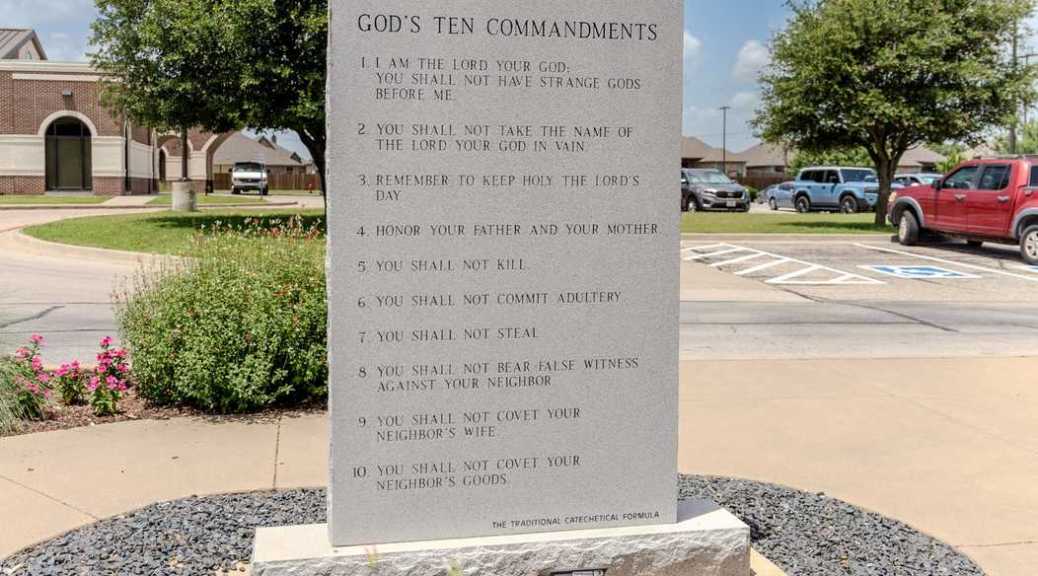
In a Washington Post op-ed earlier this month, Gregory Conti, a politics professor at perennially top-ranked Princeton University, lamented: “Several years ago, one of my colleagues at Princeton University hosted a lecture on religion and free speech. The talk didn’t seem to be landing with the students. Finally, he realized why: The speaker had made repeated reference to the Ten Commandments, and several students didn’t know what they were.” Conti noted that Princeton students are often smart and driven, but they lack basic religious literacy — even the difference between the Old and New Testaments. In short, many of America’s future leaders do not even recognize the “primary truths” and “first principles” upon which our civilization rests.

There is a clear casualty of this ignorance: our ability to accept reality and the truth. Consider, for example, the shocking inability to do precisely that among far too many members of America’s more avowedly secularist political party, the Democrats. A whopping 42% of Democrats believe the attempted assassination of Donald Trump in Butler, Pennsylvania in July 2024 was staged. A similarly galling 34% of Democrats believe the same about the recent attempted assassination of Trump and his Cabinet members at the White House Correspondents’ Dinner in Washington, D.C. There is, of course, zero evidence to support either belief. One might as well believe in Bigfoot, or that Neil Armstrong’s moon landing was fake.

There can be nothing good down this road. Only a society that is rooted in, and oriented toward, the eternal and the transcendental can ever hope to cultivate decent, truth-seeking citizens. When a free people loses the ability to discern between truth and fiction, rightness and wrongness, justice and injustice, there can only be only misery, despair and destruction. We’re losing that because, for far too long, we’ve been missing God. There is no better time than the run-up to America’s semiquincentennial — when we will celebrate the assertion of the self-evident truths that birthed the nation — to find Him once again. Frankly, America’s survival for another 250 years depends on it.

        To find out more about Josh Hammer and read features by other Creators Syndicate writers and cartoonists, visit the Creators Syndicate website at http://www.creators.com.


Josh Hammer  5:00 PM | May 17, 2026

Source: A Society Without God Is a Society Without Truth – HotAir

Our Daily Bread – Deep Roots


Blessed is the one who trusts in the Lord. Jeremiah 17:7

Today’s Scripture

Jeremiah 17:5-8

Listen to Today’s Devotion

Apple LinkSpotify Link

Today’s Devotion

As Douglas Kent, a landscape architect, toured a charred Los Angeles neighborhood after the city’s raging 2025 wildfires, he encountered a shocking surprise—trees, alive and green, right next to melted cars and burned buildings. Many of them bore lush palms and leaves, abundant fruit, and strong trunks and branches. How?

After two consecutive rainy winters, the trees’ roots had reached deep into the soil to draw moisture, carrying it to branches and leaves. In a fire, they proved resistant. “What I saw,” said Kent, “was that if you were deep-rooted, you survived.”

Our faith during the fiery trials of life can be like that. As we set our spiritual roots deep in Christ and His love, we become “like a tree planted by the water that sends out its roots by the stream. It does not fear when heat comes; its leaves are always green. It has no worries in a year of drought and never fails to bear fruit” (Jeremiah 17:8).

Jeremiah, who never minced words, warned that those who trust in “mere flesh” are “cursed” (v. 5). “That person will be like a bush in the wastelands; they will not see prosperity when it comes.” Instead, “they will dwell in the parched places of the desert, in a salt land where no one lives” (vv. 5-6). How much better to trust in God! Well-watered by His sustaining love, we thrive even in raging times, bearing spiritual fruit in Him.

Reflect & Pray

How deep are your roots in Christ? How can you trust Him during fiery trials?

Dear God, as the world seems to burn around me, please remind me to trust in You.

Today’s Insights

Jeremiah warned the unrepentant, idolatrous people of Judah that God would exile them to Babylon for their unfaithfulness (Jeremiah 25:8-11). God persistently and patiently urged them to repent before it was too late (35:15) and promised restoration and blessing once discipline was complete (31:23-28). In chapter 17, Jeremiah contrasts the curses on the ungodly with the blessings on the godly (vv. 5-8). In language reminiscent of Psalm 1:1-3, the prophet proclaims: “Blessed is the one who trusts in the Lord. . . . They will be like a tree planted by the water” (Jeremiah 17:7-8). In contrast, cursed are those who “turn their hearts away from the Lord . . . with no hope for the future” (vv. 5-6 nlt). The curse and blessing motifs are also in line with the covenantal consequences laid out in Deuteronomy 28. In times of adversity, Jeremiah reminds us that our security, stability, faithfulness, and fruitfulness are rooted in our trust in God, not in men.

Learn how to move from a shallow life to the firm foundation of your identity in Christ.


http://www.odb.org

Days of Praise – The Virtue of Having Enemies


by Henry M. Morris, Ph.D.

“Woe unto you, when all men shall speak well of you! for so did their fathers to the false prophets.” (Luke 6:26)

It is no compliment to say about a Christian that he has no enemies, for that could mean he has accomplished nothing. The apostle Paul had many bitter enemies, and they finally got him executed. In fact, almost all of the great heroes of the faith, through all the centuries since Satan gained his victory over Adam and Eve, have had to overcome bitter opposition from that wicked one.

So, instead of resenting our enemies, we should thank God for them, for they enable us to become more like our Lord and Savior, Jesus Christ! Only through such experiences can we learn what it means to say with Paul, “I am crucified with Christ” (Galatians 2:20). Only if we have enemies can we learn to obey Christ’s difficult command to “love your enemies, bless them that curse you, do good to them that hate you, and pray for them which despitefully use you, and persecute you” (Matthew 5:44).

The Lord Jesus easily could have called on 12 legions of angels to rout His enemies (Matthew 26:53). Instead, He submitted to their vicious insults and cruel tortures, even praying in His agony on the cross, “Father, forgive them; for they know not what they do” (Luke 23:34). The enemies of Christ killed Him, but had they not done so He would not have died for our sins, and we would be lost eternally. This is a mystery to ponder and difficult to comprehend, yet, as the Bible promises, “surely the wrath of man shall praise thee” (Psalm 76:10).

The enmity of men can thus be a channel of divine grace to the believer, for “tribulation worketh patience” (Romans 5:3), and “our light affliction, which is but for a moment, worketh for us a far more exceeding and eternal weight of glory” (2 Corinthians 4:17). HMM


https://www.icr.org/articles/type/6

Joyce Meyer – The Power in Jesus’ Name


I tell you the truth, my Father will give you whatever you ask in my name. Until now you have not asked for anything in my name. Ask and you will receive, and your joy will be complete.

John 16:23-24 (AMPC)

When our youngest son was still in school, sometimes people stayed with him when Dave and I traveled. In order for them to get medical treatment for him if it was ever needed, we had to sign a legal document stating they had the right to use our names on our son’s behalf—literally to make decisions in our place.

This is exactly what Jesus did for His disciples and, ultimately, for all who would believe in Him—He gave us the right to use His name when we go to God in prayer. When we pray in His name, it is the same as if He were praying. This privilege seems almost too wonderful to believe! But we can believe it because we have Scripture to back it up.

Prayer of the Day: Lord, thank You for the authority of Jesus’ name. Help me pray with confidence and faith, knowing You hear me and respond as I trust in the power of His name, amen.


http://www.joycemeyer.org