SPLC Was The Hub, But Many Spokes Made Up The Wheel Designed To Crush Christians And Conservatives

Americans once associated the Southern Poverty Law Center with fighting the Ku Klux Klan during the civil rights era. That reputation gave the SPLC enormous moral credibility. But in November 2010, SPLC shifted its focus beyond violent groups and began targeting Christian organizations opposing efforts to redefine marriage and human sexuality. Family Research Council was among the most prominent of that first wave.

In August 2012, FRC joined Governor Mike Huckabee in supporting Chick-fil-A Appreciation Day after the company was boycotted because its leadership publicly affirmed natural marriage. Two weeks later, on August 15, LGBT activist Floyd Corkins entered FRC headquarters here in Washington carrying a 9mm pistol, 50 rounds of ammunition, and 15 Chick-fil-A sandwiches. According to his later confession, his intent was to kill as many as possible and stuff the sandwiches in our mouths.

As he entered the building and pulled his gun, our building manager, Leo Johnson, confronted him. Though seriously wounded, Leo stopped the attacker and prevented a mass casualty event. After multiple surgeries and rehabilitation, Leo returned to work and remains today, affectionately known as Leo the Hero.

The following day, investigators confirmed that Corkins confessed to selecting FRC because of the SPLC website and hate map.

Following the attack, FRC appealed to the SPLC to remove mainstream Christian organizations from its inflammatory classifications. Those requests were rejected.

The attack has cost FRC more than $6 million in security-related costs. But the costs extend beyond the one act of violence.

Over time, SPLC’s “hate” labels and Intelligence Project became deeply influential as banks, payment processors, and technology companies increasingly relied on SPLC classifications to decide which organizations could maintain accounts, process transactions, or operate online.

Around 2016, the SPLC began pressuring corporations and technology companies to de-platform and defund organizations it labeled extremist.

Then came Charlottesville in 2017.

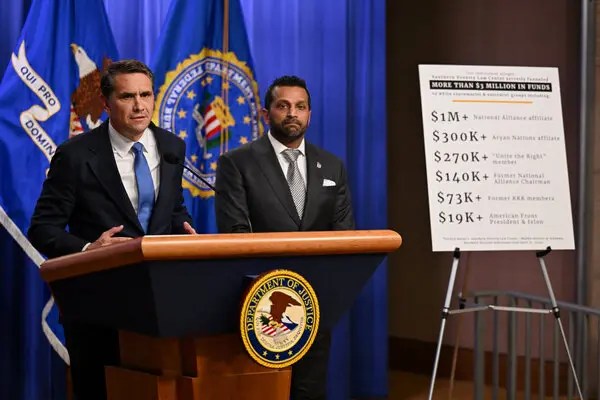
According to the recent federal indictment of SPLC, a member of the online leadership that planned the “Unite the Right” rally at the direction of the SPLC, and helped coordinate transportation for attendees, was bankrolled by SPLC. Charlottesville was a catalytic event for SPLC, as major corporations like Apple and JPMorgan Chase aligned with SPLC, contributing millions of dollars.

Shortly afterward, the coalition known as “Change the Terms,” led by the SPLC and the Center for American Progress, established standards that would encourage technology and financial companies to deny digital access and financial infrastructure to organizations the SPLC labeled.

The timeline of Change the Terms closely parallels the acceleration of efforts to debank and deplatform conservative and Christian organizations. FRC experienced this from Truist Financial, Fidelity Investments, GuideStar, Mobile Cause, and other technology-related companies. SPLC officials openly acknowledged this strategy before Congress in January 2020. SPLC official Lecia Brooks stated: “We have lobbied internet companies, one by one… A key part of this strategy has been to target these organizations’ funding.”

Brooks continued to describe the coordinated effort to pressure technology companies and financial institutions to restrict access for organizations they opposed.

The issue before this committee is larger than FRC or any one organization.

In America, citizens should not lose access to banking services, digital platforms, public credibility, or physical safety because they believe in biblical teaching on marriage and human sexuality. When government-regulated institutions can apply ideological labels in a coordinated fashion to silence, isolate, or financially cripple opponents, we allow political targeting by proxy, and freedom is at risk.

SPLC was the hub, but there were many spokes that made up this wheel designed to crush Christians and conservatives — the congressional inquiry should not stop with SPLC.


Source: SPLC Was The Hub, But Many Spokes Made Up The Wheel Designed To Crush Christians And Conservatives – Harbinger’s Daily

Pastors In The Crosshairs: The War Of Attrition Against Free Speech In The UK Must End


Police have dropped charges against a Christian pastor following a months-long investigation into his street preaching.

Dia Moodley, 58, was arrested on November 22 and detained on suspicion of “inciting religious hatred” after peacefully sharing his Christian views in Bristol city center. After four months of criminal investigation, police with Avon and Somerset informed him that “no further action will be taken,” according to a news release from Alliance Defending Freedom International, which defended him in the case.

“I’m glad Avon and Somerset Police decided to eventually do the right thing and drop their criminal investigation,” Moodley said in a statement. “This is a win for free speech, but I never should have been arrested, treated like a criminal, and investigated for months for peacefully sharing my faith in the public square.”

Moodley was accused of preaching against transgender ideology, comparing Christianity with Islam, and committing a Section 4A religiously aggravated public order offense under the Public Order Act of 1986. He was arrested after a bystander appeared to reach for the wire of his speaker, and he reportedly pushed her away.

He was held for eight hours in a police cell, interrogated by police, and initially placed under bail conditions that restricted him from entering Bristol city center over Christmas, said ADF International.

While the bail conditions were later dropped, the investigation into criminal investigation continued, resulting in what ADF called de facto censorship, as the pastor refrained from publicly preaching over Christmas and in the weeks leading up to Easter for fear of rearrest.

November was the second time Moodley has been arrested for commenting on Islam and transgender ideology while street preaching. In March 2024, he was arrested outside the University of Bristol after speaking on Islam and stating that sex is binary. Police dropped that investigation as well. Also, in 2021, police banned him from commenting on any other faith, and from delivering sermons without prior police approval.

The pastor has faced repeated violence and threats from bystanders while street preaching, ADF said, many of which the police have failed to adequately address. And he is now considering legal action against Avon & Somerset Police, for the violation of his free speech rights and for the police’s failure to promptly investigate serious crimes against him.

ADF legal counsel Jeremiah Igunnubole described the police’s decision to drop the November charges as a “vindication” of Moodley’s conduct. He said the case is a symptom of a wider pattern and called on Parliament to take action.

“The war of attrition against free speech in the U.K., demonstrated in Pastor Dia’s case, must end,” Igunnubole said. “Censorial laws need to be repealed urgently, and stronger protections, including a Free Speech Bill, are needed to reverse the growing culture of censorship within law enforcement.”

Meanwhile, Moodley will continue expressing his faith in the public square.

“I will continue to share my faith publicly, undeterred by the police’s censorship and the threats and violence I have faced, and will stand for free speech not just for myself, but for the rights of all people in the U.K.”


Source: Pastors In The Crosshairs: The War Of Attrition Against Free Speech In The UK Must End – Harbinger’s Daily

Turning Point; David Jeremiah – Still Smiling


NEW!Listen Now

I have faith in God that it will happen just as he told me.
Acts 27:25, NIV

Recommended Reading: Acts 27:21-25

Scott Smiley is an American soldier who was blinded while fighting in Mosul, Iraq. In his book, Hope Unseen, he describes how he and his wife Tiffany learned to trust God with tragedy. Tiffany said, “The words that I read in the Bible prior to all of this became real. It was like oh, this is the peace that surpasses all understanding, you know, this is the hope that carries you through. So it all came to life for me. There’s still times where we’re like ‘Yeah, we wish Scotty could see.’ But God what has taught us through His word…. And going through this trial and this valley with the Lord, I wouldn’t trade that for anything.”1

When we go through trouble, we struggle, but out of the struggle comes strength. And out of the strength comes a shout of praise. Express your faith when you are experiencing a time of trouble. The action of expressing your faith aloud is often the first step toward courage and victory.

A lot of people look at the events in my life as a huge tragedy, and I don’t necessarily. I think God has given me the ability to understand Him more and to understand His purpose through my blindness.
Scott Smiley

  1. Julie Blim, “Scott Smiley: A Soldier’s Sacrifice,” CBN, accessed January 26, 2026.


https://www.davidjeremiah.org

Our Daily Bread – Seeking God’s Face


I will set . . . the fir and the cypress together, so that people may see and know . . . the Lord has done this. Isaiah 41:19-20

Today’s Scripture

Isaiah 41:17-20

Listen to Today’s Devotion

Apple LinkSpotify Link

Today’s Devotion

Those who drive along Highway 18 in western Oregon each fall are greeted with a delightful surprise from the tree-covered hillside flanking the road: a giant smiley face. The cheerful face is only visible in the autumn when the Larch tree needles turn yellow, contrasting with the surrounding, dark green Douglas fir trees (which create the eyes and mouth). A lumber company planted the three-hundred-foot-diameter face in 2011 as part of an effort to replenish the timber they’d harvested.

Isaiah invites us to know God as the one who brings life to desolate places. He reminded the Israelites during the barrenness of their captivity that God “[makes] rivers flow,” can “turn the desert into pools of water,” and grow “the cedar and the acacia” in the desert (Isaiah 41:18-19). God does these things not solely for His (and our) delight; He plants junipers, fir, and cypress “so that people may see and know” (v. 20) that He authors all and will ultimately redeem all—even those places thought to be a “wasteland” (v. 19).

Though we may not glimpse a face smiling back at us from a hillside, all of creation can remind us of God’s redemptive power over our world and our individual circumstances—even in the wake (or fear) of devastation. Let’s seek His face as our source of hope and joy amid our struggles.

Reflect & Pray

When has God brought joy or hope to a place of sadness in your life? How does creation direct your focus to Him in times of hardship?

Thank You, dear Father, for Your creative and redemptive work in the world.

Today’s Insights

In chapters 1-39, Isaiah warns an unrepentant people that God will use the Assyrians and the Babylonians to discipline them for their idolatrous unfaithfulness. But beginning in chapter 40, the prophet extols God’s grace and covenantal kindness and prophesies a future restoration and glorious blessing. As the sovereign God, He has the power to save, protect, and restore (40:10-17). The prophet also reminds them of God’s loving, providential care. The Israelites have a very special relationship with Him, having been graciously chosen to be His servant (41:8). God won’t abandon them but will keep them close and care for them (vv. 8-10, 17). He’ll bountifully provide for them and turn the arid desert into a land of flowing water and great productivity (vv. 18-19). Like the people in Isaiah’s days, creation reminds us that He is “the Lord” (v. 13), our “Redeemer” (v. 14), “the Holy One of Israel,” and Creator (v. 20). We can trust Him with the circumstances in our lives.

Learn how ordinary outdoor moments can encourage you to connect with the Father on a deeper level. 


http://www.odb.org

Denison Forum – Why “The Late Show” matters to our culture and our souls


The Late Show with Stephen Colbert will air its last show tonight. Why should you care?

The ending could be nostalgic if you’re old enough to remember when David Letterman started the show in 1993 after being passed over as Johnny Carson’s successor on The Tonight Show. You might care about the controversy over the show’s ending: some claim that CBS acted for political reasons, while others point to reports that the show had been losing $40 million a year.

I think the show’s ending is relevant for a different reason.

As Elahe Izadi reports in the Washington Post, “We no longer choose from a handful of late-night hosts to get our fix of breezy celebrity interviews; there’s a seemingly endless supply of video podcasts for that.” She quotes Robert Thompson, a Syracuse University professor of television and popular culture:

Like all broadcast television, it was cultural glue. We all fed from the same cultural trough at the same time. That is gone and only remains in a few pockets, and those pockets are falling one by one. When Colbert leaves, another one of those important pockets will have fallen.

Continue reading Denison Forum – Why “The Late Show” matters to our culture and our souls

Harvest Ministries; Greg Laurie – A Place of Pure Bliss


 After that the end will come, when he will turn the Kingdom over to God the Father, having destroyed every ruler and authority and power. For Christ must reign until he humbles all his enemies beneath his feet. And the last enemy to be destroyed is death. 

—1 Corinthians 15:24–26

Scripture:

1 Corinthians 15:24–26 

When we lose a loved one, there’s a time and place for mourning. The depth of our sorrow is an indication of the depth of our love for that person. But there’s also a place for rejoicing if that loved one is a believer because we know we will see them again.

Even Jesus wept at the tomb of Lazarus when He saw the devastating power of death. Death is an enemy, although one whose fate is already determined. The apostle Paul wrote, “After that the end will come, when he will turn the Kingdom over to God the Father, having destroyed every ruler and authority and power. For Christ must reign until he humbles all his enemies beneath his feet. And the last enemy to be destroyed is death” (1 Corinthians 15:24–26 NLT).

No one wants to die. After all, this life is all we know. No one looks forward to the end of it. But the reality is that we all will die. That’s why it’s important to put our faith in Christ before we enter eternity. It’s also important that we not lose sight of what awaits believers when we die.

The Bible doesn’t offer pictorials of Heaven, but it does provide some tantalizing descriptions. Paul was given a glimpse of Heaven and tried to put his experience into words. “I was caught up to the third heaven fourteen years ago. Whether I was in my body or out of my body, I don’t know—only God knows. Yes, only God knows whether I was in my body or outside my body. But I do know that I was caught up to paradise and heard things so astounding that they cannot be expressed in words, things no human is allowed to tell” (2 Corinthians 12:2–4 NLT). (We’ll explore this passage further next week in our study of 2 Corinthians.)

You’ll notice that he used the word paradise to describe what he saw. Paradise is a Greek word that refers to the royal garden of a king. Think about the most beautiful garden you’ve ever seen. If you’re not into gardens, think about the most amazing sight you’ve ever laid eyes on. That’s the depiction of Heaven Paul gave. He was saying, “I don’t really have the words for it, but it was like a paradise.”

As Pastor Adrian Rogers put it, “The God who sculpted the wings of the butterfly, blended the hues of the rainbow, and painted the meadows with daffodils is the same who made Heaven.”

In Heaven all questions are answered, all tears are dried, and all pain is gone. Heaven is pure bliss. That’s why Paul said that he longed to be there. He saw for himself that Heaven is far, far better than earth.

And that’s what all believers can look forward to.

Reflection question: What are your feelings about Heaven? Discuss this with believers like you on Harvest Discipleship!


Harvest.org | Greg Laurie

Days of Praise – Near to the Heart of God


by Randy J. Guliuzza, P.E., M.D.

“And Aaron shall bear the names of the children of Israel in the breastplate of judgment upon his heart, when he goeth in unto the holy place, for a memorial before the LORD continually.” (Exodus 28:29)

The clothing of the high priest was made according to very specific instructions. Each piece of the garment both symbolized and preshadowed a ministry of the Lord Jesus Christ as the “one mediator between God and man” (1 Timothy 2:5).

The names of the tribes of Israel were engraved upon two stones (six names per stone), and they were to be mounted upon the shoulders of the ephod. The broad shoulders of a man are often used as a symbol of strength, particularly in carrying a heavy load. Illustrating His perfect faithfulness and capability, the burden-bearing work of Christ weighted with the sins and needs of His people is pictured through Aaron, who would “bear their names before the LORD upon his two shoulders for a memorial” (Exodus 28:12). It is with great confidence in that capability that His people can therefore turn to Him, “casting all your care upon him; for he careth for you” (1 Peter 5:7).

As seen from the text verse, this work is not a drudgery but a labor of love. The names of the children of Israel were not only on the high priest’s shoulders but also carried “upon his heart.” In one sense this was a visible token of what He had said of old: “Yea, I have loved thee with an everlasting love: therefore with lovingkindness have I drawn thee” (Jeremiah 31:3). For believers today, Christ’s high priestly ministry is explained more fully in the book of Hebrews, where believers are assured that “because he continueth ever, [he] hath an unchangeable priesthood” (Hebrews 7:24). Therefore, “let not your heart be troubled” (John 14:1), for He has your name upon His own heart “for a memorial before the LORD continually.” RJG


https://www.icr.org/articles/type/6

Joyce Meyer – Guard Your Heart and Stay Spiritually Alert


Keep awake (give strict attention, be cautious and active) and watch and pray, that you may not come into temptation. The spirit indeed is willing, but the flesh is weak.

Matthew 26:41 (AMPC)

Suppose you knew your house was surrounded by enemy agents and at any moment they might break through the door and attack you. Do you think you would be inclined to stay awake and watch the door?

What would you do if for some reason you couldn’t stay awake and watch? Wouldn’t you make sure someone else in the family was awake and alerted to the danger?

You need to be just as careful to guard against any potential attacks from the enemy of your soul. The devil is out to get you, and you must watch and pray at all times, asking God to help you when you feel weak.

Ask God to provide the strength you need to overcome any temptation the devil brings your way. Guard your heart and take every thought captive.

Prayer of the Day: Lord, help me stay alert and guard my heart. Strengthen me to resist temptation, take every thought captive, and rely on You to overcome every attack of the enemy, amen.


http://www.joycemeyer.org

Max Lucado – Speak the Truth 


Play

In Acts 1:8 Jesus says, “You will be my witnesses—in Jerusalem, in all of Judea, in Samaria, and in every part of the world” (MSG).  We are God’s witnesses.

And we are to speak truthfully.  God loves the truth and God hates deceit. But Jeremiah 17:9 tells us that “the heart is deceitful above all things” (NIV).  How do we explain our dishonesty?  Well, for one thing, we don’t like the truth because the truth isn’t fun.  The wages of deceit is death.  Not death of the body, perhaps, but death of a marriage, a conscience, a career, or faith. But perhaps the most tragic death that occurs from deceit is our witness.

Examine your heart.  Do you tell the truth…always? If not, start today.  Be just like Jesus.  Tell the truth, the whole truth, and nothing but the truth.


Home

Today in the Word – Moody Bible Institute – The Beauty of God’s People


Read Numbers 23:27–24:25

Have you ever noticed parents’ eyes light up when they talk about their newborn child? They see beauty, potential, and hope. They speak with pride about attributes and qualities others might miss. This is the way God sees His children.

King Balak of Moab had hired the prophet Balaam to curse Israel as they camped in the wilderness. Three times Balak positioned Balaam on different mountains, desperate for him to pronounce judgment on God’s people. But each time, instead of the curses he desired, blessings would flow from Balaam’s lips. Balak’s plan was a dismal failure. In Balaam’s final attempt from Mount Peor, he delivers his most beautiful oracle yet. When Balaam “looked out and saw Israel encamped tribe by tribe,” something remarkable happened (24:2). The Spirit of God came upon him, and he saw Israel not through human eyes, but through God’s eyes. His words capture this divine perspective: “How beautiful are your tents, Jacob, your dwelling places, Israel!” (v. 5).

Israel had worshiped the golden calf, grumbled against Moses, and would soon fall into idolatry. Even so, God saw beauty in His covenant people. Balaam continued: “Like valleys they spread out, like gardens beside a river, like aloes planted by the LORD, like cedars beside the waters” (v. 6). He saw flourishing, growth, and divine blessing.

The prophecy reaches its climax with this messianic promise: “I see him, but not now; I behold him, but not near. A star will come out of Jacob; a scepter will rise out of Israel” (v. 17). Even in the wilderness, God’s ultimate plan of redemption through Christ was unfolding. God works through sin or weakness to further His eternal purpose.

Go Deeper

Remember that God sees beauty in you that others—and even you yourself—might miss. Consider today how God sees you as His chosen and beloved child.

Pray with Us

God, how is it possible that You look upon us, Your children, with such love? How do You see beauty in us, even with our frailty and failure? Thank You, God, for Your steadfast love.

How beautiful are your tents, O Jacob, your dwelling places, O Israel!Numbers 24:5


https://www.moodybible.org/