Debt remembered and debt ignored

The debt paid by America’s fallen is unpayable, but it is not unteachable; it is written in sacrifice, in folded flags, in names etched into stone.


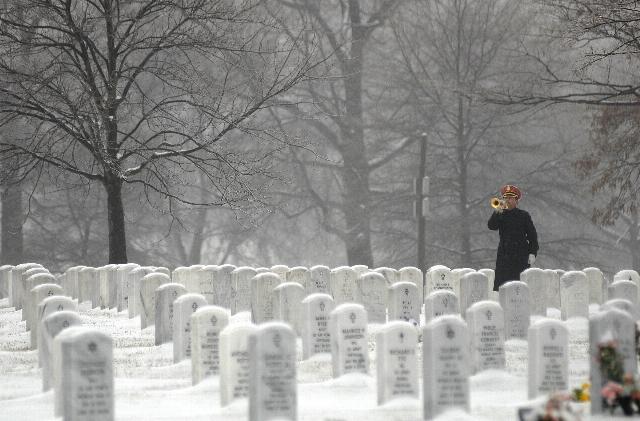
Memorial Day compels Americans to confront a word we avoid: debt. Not the financial kind that Congress pretends will magically resolve itself, but the older, heavier meaning — the kind carved into headstones at Arlington and cemeteries across the country. It is the debt paid in full by those who gave their lives, so the rest of us could live free.

No interest rate can measure it. No budget line can contain it. It is final, irrevocable, and sacred.

Every year, we pause, as we should, to acknowledge that liberty is no accident. Its purchase price is steep. Many stood a post, walked point, climbed into a cockpit, or sailed into hostile waters so that we could enjoy the ordinary luxuries of American life: arguing about politics, grilling in the backyard, complaining about work, raising families in relative peace. The fallen paid the ultimate debt, while the rest of us live on the dividends of their courage.

There remains another debt that all Americans must face, one far less noble and far more self-inflicted: the national debt that at $39 trillion is growing faster than the economy and its current path is unsustainable with interest payments amounting to $1 trillion a year — a figure most cannot comprehend.

Unlike the solemn debt honored on Memorial Day, this one grows not from sacrifice but from avoidance, avarice and unaccountability. It is the bill we keep pushing onto future generations because those elected lack the discipline and forbearance to make the difficult choices.

The contrast is stark.

On one side are the young Americans who never hesitated when their country asked for everything. On the other, a political culture that bemoans over the smallest act of fiscal restraint. The fallen gave their lives, while Washington can’t forego a spending increase.

The laws of economics will not suspend themselves out of patriotic courtesy. We borrow to fund today’s comforts while expecting tomorrow’s citizens, many of whom are not yet born, to pay the bill.

Imagine explaining this to a Marine who never made it home from Fallujah or a soldier who fell in the Korengal Valley. They understood duty in its rawest form. They lived by the credo that you don’t hand your problems over to the next guy.  You handle them.  You carry your weight.  You complete the mission.

The contrast is telling and that is the point.

If we truly want to honor their memory, we can start by adopting even a fraction of that discipline. We can demand leaders who treat the national debt as a real threat, not a distant abstraction. We can stop pretending that borrowing without limit is a harmless national pastime. And we can remember that the freedoms secured by the fallen are weakened when the nation they died for is weighed down by obligations it cannot meet.

The debt paid by America’s fallen is unpayable, but it is not unteachable. It is written in sacrifice, in folded flags, in names etched into stone.

One debt was paid in blood. The other is being charged to our children.

And if we forget the difference, then we have learned nothing from those who paid the first.


Greg Maresca | May 25, 2026

Source: Debt remembered and debt ignored – American Thinker

On Memorial Day, Unpatriotic Americans Know Nothing of America’s Greatness

Americans who, in shocking numbers, hate America know nothing of the values that made us the kindest, most generous country in history.


As the United States celebrates its 250th anniversary, patriotism and pride in being an American have hit historic lows. Only 58% of citizens are extremely or very proud to be Americans, compared to 90% in 2004. Among those who identify as Democrats, only 36% are extremely or very proud to be Americans, compared to 88% in 2004.

On this Memorial Day, when the nation remembers those who made the ultimate sacrifice to preserve the freedoms that so many take for granted, it is a tragedy that the United States, a nation that has so advanced the welfare of mankind, is faced with such a stark reality while celebrating its milestone semiquincentennial anniversary.

The true account of America’s contribution to the world and its people is one of magnificent achievement, whether freeing millions from tyranny by force of arms or dramatically improving their standard of living by fostering global economic growth and new, ever-evolving technology.

Perhaps the one thing above all others that most United States citizens do not appreciate is the indispensable and unprecedented role this nation has played in giving hope and a real-life vision of the blessings of true freedom and liberty to countless millions throughout the world. Nothing this country has done in its history can compare to being what Ronald Reagan referred to as “The Shining City on the Hill.”

Befitting the true intent of Memorial Day, to the 20% of citizens who are only a little or not at all proud to be Americans, here is a story based on personal experience. It is emblematic of the strain of honor, bravery, and patriotism that permeates the American character, as well as this nation’s historical commitment to freedom and liberty for all mankind.

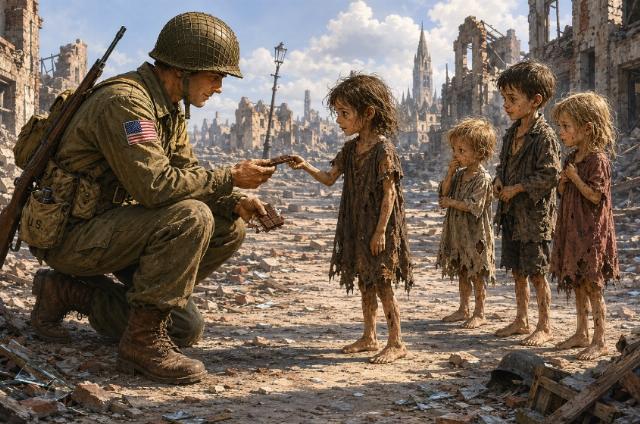
As World War II grinds to an end, an American soldier slowly walks through the streets of a once-bustling European city now lying in ruin. The few still-upright walls, their windows and doors blown out, appear as skeletons framed against the blue sky. His senses, honed to a fine razor’s edge to react to the slightest sound or movement, lead the soldier to step carefully around the piles of broken bricks and shattered glass that serve as perfect cover for an ambush or a sniper’s lair.

The soldier hears a faint stirring behind him and, wheeling around, rifle raised in anticipation of the worst, he sees instead a young girl, perhaps five or six years old, slowly walking towards him, her tattered clothes barely able to cover her emaciated frame. Their eyes meet as kindred spirits. In the cauldron that is unconditional war, the psyche of the soldier has been dulled by the weariness of unremitting death and destruction, and that of the child by the never-ending and soul-crushing struggle for survival.

Welcoming them into the group, the soldier, smiling gently, gives all his rations to the youngsters. For an hour or so, the children, some for the first time in their brief lives, revel in a sense of security and companionship as they gather around him. They sit and talk to each other as best they can while the young man’s thoughts gradually turn to the memory of his childhood and parents in a small town somewhere in the heartland of America, and of his high school sweetheart and their plans for a family when he returns from the war.

When the time comes for the soldier to depart, the little girl tugs at his sleeve and, as a tear rolls down her cheek, she hugs him while the other children hold on to him, unwilling to let go. Doing what he must, the soldier reluctantly turns away and, without hesitation, returns to his duty and the bloody cauldron of war. Still, he leaves behind children who, for the rest of their lives, will cherish the memory of that day and of the young man from another country who had shown them such genuine friendship and kindness.

The following day, a sniper’s bullet found its mark, and the same young man, so full of hopes and dreams, lay dead beneath the gaunt image of a splintered and shattered oak tree silhouetted by the purple haze of the setting sun.

The country, the United States of America, whence this soldier came, is unique in the history of mankind. When attacked by foreign powers, America never viewed those incidents as a pretext to conquer and permanently subjugate other nations. Rather, in pursuit of self-defense, this country also aspired to the noble calling of freeing others from tyranny and allowing the people of those nations to establish their own freely elected governments.

The basic tenets in the founding of the United States—(1) that all men are endowed by God with certain inalienable rights, and (2) that the individual and not the state is paramount—enabled a society to evolve that fostered love and respect not only of country but of fellow man, regardless of race, ethnicity, or where he might live.

It is this distinctive trait among all global communities that has motivated countless American men and women over the years not only to willingly take up arms to defend a land they cherish but to expend blood and treasure so they and others can live in peace and freedom.

American military cemeteries, with their verdant fields of seemingly endless rows of monuments, crosses, and Stars of David marking the graves of those who made the ultimate sacrifice, dot the globe. The sons and daughters of the United States interred there now reside in the pantheon of the most noble and heroic in the history of mankind.

As the years march inexorably on, memories of the past, particularly the most unpleasant, are pushed into the recesses of daily consciousness. In the United States, with each new generation, the knowledge and experience of war, survival, and adversity are replaced with the demands of day-to-day living and an unfortunate tendency to fall prey not only to the false but fashionable proclivity of blaming America for all of mankind’s ills but also to the inexorable acceptance of the belief that a powerful central government is the source and arbiter of human rights and freedom.

I have lived among the people of the United States for seventy-five years after having been welcomed to its shores as a displaced war orphan from World War II. I have been privileged to get to know the magnificent citizens of this country from all walks of life, whether in the foothills of Appalachia, the farm fields of the Great Plains, the small towns and cities that dot the landscape, the imposing vistas of the West, or the streets of America’s major cities.

Their forebears created and molded the country that became the foremost nation on earth. That drive, determination, and above all patriotism still beat deep within the hearts of all who are proud to call this nation their home, and they will make certain that America’s best days are still ahead.


Steve McCann | May 25, 2026

Image created using AI.

Source: On Memorial Day, Unpatriotic Americans Know Nothing of America’s Greatness – American Thinker

Turning Point; David Jeremiah – Grace for a Lifetime


NEW!Listen Now

Sing praise to the Lord, you saints of His, and give thanks at the remembrance of His holy name. For His anger is but for a moment, His favor is for life; weeping may endure for a night, but joy comes in the morning.
Psalm 30:4-5

Recommended Reading: Lamentations 3:22-23

In the New Testament era, the most prominent theme is the grace of God—encompassing love, mercy, and forgiveness. But it is important to remember that God is our Father who is willing to discipline His children when the need arises (Hebrews 12:5-13).

There are two aspects of discipline which need to be viewed differently. One is in the form of correction for sin as seen in 1 Corinthians 11:27-32—discipline in the form of punishment. The other is discipline for the purpose of training during times of hardship: “Endure hardship as discipline; God is treating you as his children” (Hebrews 12:7, NIV). For His children, God’s discipline—regardless of the reason—is temporary. But His grace is never-ending: “His anger is but for a moment, His favor is for life.” As the prophet Jeremiah wrote, God’s compassions never fail—“they are new every morning” (Lamentations 3:22-23).

If God has you in training, remember: It is only temporary. His grace and compassions fail not.

Discipline is a proof of sonship.
John Blanchard


https://www.davidjeremiah.org

Our Daily Bread – Finding Rest


I lie down and sleep; I wake again, because the Lord sustains me. Psalm 3:5

Today’s Scripture

2 Samuel 15:23-27, 29-31

Listen to Today’s Devotion

Apple LinkSpotify Link

Today’s Devotion

“Tactical napping” is a series of guidelines for soldiers for effective, ten to thirty minutes of sleep. While experiencing a rush of adrenaline, loneliness, or anxiety, sleep-deprived soldiers may not be able to relax. Tips include using earplugs and reading before bed. They’re even offered military-grade, caffeinated chewing gum to reduce grogginess after a nap.

It’s when we most need rest that it’s often difficult to find. King David experienced this after fleeing into the wilderness to escape his son Absalom’s treason. David and his followers wept aloud at his betrayal with their heads covered in mourning (2 Samuel 15:30-31). In fact, “the whole countryside wept aloud” (v. 23). It was around this time that David cried out, “Lord, how many are my foes!” (Psalm 3:1). Perhaps thinking about past troubled nights, however, David continued, “I lie down and sleep; I wake again, because the Lord sustains me. I will not fear” (vv. 5-6). David realized that God, not Absalom, was in charge of his situation. David even sent the ark of the covenant back to Jerusalem, acknowledging that the future was fully in God’s hands (2 Samuel 15:25-26).

Sleep feels especially fleeting when we’re facing adversity in our waking hours, but it’s a good reminder of how many things are outside our control. Yet God sustains us and, as we trust Him, He can help us lie down in peace.

Reflect & Pray

What keeps you from true rest? How can your surrender to God produce peace?

Dear God, thank You for keeping watch while I sleep and when I wake.

Today’s Insights

As David fled Jerusalem, his enemy Shimei hurled stones and cursed at him (2 Samuel 16:5-8). David’s warrior Abishai wanted to kill Shimei, but the king wouldn’t permit it (vv. 9-11). Instead, he trusted God to “restore to [him] his covenant blessing” (v. 12). Despite Shimei’s abuse, “The king and all the people with him arrived at their destination exhausted. And there he refreshed himself” (v. 14). This is the setting for David’s psalm: “I lie down and sleep; I wake again, because the Lord sustains me” (Psalm 3:5). No matter our circumstances, we can find rest in God.

When God created mankind, He designed us with the necessity to rest.


http://www.odb.org

Denison Forum – “The last full measure of devotion”


A Memorial Day reflection on our nation and our souls

Christians are used to our religious holidays being preempted for secular purposes. In American culture, Easter is more about colored eggs and bunnies than the empty tomb and risen Lord. Thanksgiving is more about food and football than faith and gratitude. Christmas is more about the coming of Santa Claus than the coming of Jesus Christ.

Other religions have not suffered such a fate in our society. Many Muslims begin their Hajj pilgrimage to Mecca today, but no revision of this “pillar” of Islam has emerged in secular society. Observant Jews completed Shavuot last Saturday, commemorating the revelation of the Torah at Mount Sinai, but there is no secular version.

Nonetheless, it is unsurprising that Christian holy days would become secular holidays in a post-Christian and even anti-Christian culture. But we should be surprised that even a secular holiday has been secularized as well.

Continue reading Denison Forum – “The last full measure of devotion”

Harvest Ministries; Greg Laurie – Heaven Is Real


 I was caught up to the third heaven fourteen years ago. Whether I was in my body or out of my body, I don’t know—only God knows. Yes, only God knows whether I was in my body or outside my body. But I do know that I was caught up to paradise and heard things so astounding that they cannot be expressed in words, things no human is allowed to tell. 

—2 Corinthians 12:2–4

Scripture:

2 Corinthians 12:2–4 

In this week’s devotions, we’re going to focus on passages from the apostle Paul’s second letter to the believers in Corinth. And we’re going to start with a familiar passage, one we looked at briefly in last week’s devotions. We’re going to focus on Paul’s account of his vision of Heaven in 2 Corinthians 12.

Countless books and passages have been written about Heaven, many from people who claim to have experienced the afterlife and then returned to tell the tale. Obviously, most of these accounts must be taken with a grain of salt. There are a few, however, that deserve our attention because they’re found in God’s Word, the ultimate source of truth.

One thing these passages have in common is the difficulty their authors have in describing what they see.

Here’s just one of the things the apostle John wrote about his experience: “Then as I looked, I saw a door standing open in heaven, and the same voice I had heard before spoke to me like a trumpet blast. The voice said, ‘Come up here, and I will show you what must happen after this.’ And instantly I was in the Spirit, and I saw a throne in heaven and someone sitting on it. The one sitting on the throne was as brilliant as gemstones—like jasper and carnelian. And the glow of an emerald circled his throne like a rainbow” (Revelation 4:1–3 NLT).

It appears human words are insufficient to fully capture the heavenly reality. And make no mistake, Heaven is a reality. It’s not a metaphor. It’s not a symbolic place. It’s not a state of mind. Heaven is real.

Like John, Paul was given a glimpse of Heaven and lived to write about it. “I was caught up to the third heaven fourteen years ago. Whether I was in my body or out of my body, I don’t know—only God knows. Yes, only God knows whether I was in my body or outside my body. But I do know that I was caught up to paradise and heard things so astounding that they cannot be expressed in words, things no human is allowed to tell” (2 Corinthians 12:2–4 NLT).

The word paradise he uses to describe Heaven occurs in two other places in the New Testament. One is found in Jesus’ words to the criminal on the cross next to Him: “I assure you, today you will be with me in paradise” (Luke 23:43 NLT). The other is found in Revelation 2:7 to describe the future dwelling place of believers.

Both passages refer to an actual place. Heaven is real.

Reflection question: What are your takeaways from the biblical descriptions of Heaven? Discuss this with believers like you on Harvest Discipleship!


Harvest.org | Greg Laurie

Days of Praise – God’s Memorial Day


by Henry M. Morris, Ph.D.

“And God said moreover unto Moses, Thus shalt thou say unto the children of Israel, The LORD God of your fathers, the God of Abraham, the God of Isaac, and the God of Jacob, hath sent me unto you: this is my name for ever, and this is my memorial unto all generations.” (Exodus 3:15)

It is surely a good thing that Americans have designated an annual Memorial Day in which we call to remembrance the great sacrifices of those before us who fought and suffered (and often died) to form our nation and preserve its freedom. Without them we would not be here today, and we need to remember them.

It is even more important, however, to remember the God of our fathers, our true Author of liberty. He has established His own memorial, wanting us to remember not only our ancient spiritual forefathers but also His own great name, Jehovah. “The LORD God” in our text verse is Jehovah Elohim. The sense of God’s announcement to Moses was that Jehovah was the name of the God of Abraham and, in fact, the name of the Creator of the world. Jehovah is the redemptive name of God, while Elohim is His name as omnipotent Creator.

We must always remember this, He says. The word “memorial” is used here for the first time in the Bible and thus is very significant. We should remember Him as Creator every seventh day when we devote a day to rest and worship (Exodus 20:8, 11). But there is also another day to remember the Lord for His work of redemption. When He became man, dying to save us from our sins, He established a memorial supper, saying, “This do in remembrance of me” (Luke 22:19). Thus, when we observe each weekly Lord’s day and whenever we partake of the Lord’s supper, we are really observing a special memorial day in His honor, remembering His great name “unto all generations.” HMM


https://www.icr.org/articles/type/6

Joyce Meyer – Do Your Own Thinking


We destroy arguments and every lofty opinion raised against the knowledge of God, and take every thought captive to obey Christ.

2 Corinthians 10:5 (ESV)

Do you think about what you’re thinking about? Learning to regularly take inventory of our thoughts is essential to having a good life. Instead of being “unthinking” people, we can train ourselves to think about what’s going on in our minds.

It was a glorious revelation for me when I realized I don’t have to think about just anything that comes into my mind. I can choose my thoughts and do my own thinking—on purpose. I can deliberately choose to think positive, faith-filled thoughts that line up with God’s Word.

If your mood begins to sink or you have a bad attitude, take an inventory of your current thoughts, and you will very likely find the culprit. Negative thinking not only makes you upset and bitter, but it also prevents God from working in your life. We receive from God through faith, and faith is always positive.

You don’t have to sit by passively and let the enemy fill your mind with poisonous and destructive thoughts. Instead, you can learn to recognize them, and with God’s help, you can think about something else that will be beneficial.

Make a decision to think and say the right things—things that line up with the Word of God.

Prayer of the Day: Father God, help me recognize when my thoughts aren’t my own so that I can take them captive and replace them with thoughts that are beneficial. Help me think with the mind of Christ, amen.


http://www.joycemeyer.org

Max Lucado – The Doorway to the Heart 


Play

Proverbs 4:23 advises, “Above all else, guard your heart, for it is the wellspring of life.”

Think of your heart as a greenhouse and consider your thoughts as seed. We must be selective about the seeds we allow to come into the greenhouse. To have a pure heart, we must submit all our thoughts to the authority of Christ. You see, your mind is the doorway to your heart. The Holy Spirit stands with you on the threshold, helping you manage and filter the thoughts that try to enter. If Jesus agrees with the thought, then let it in. If not, kick it out.

How do you know if Jesus agrees or disagrees? You open your Bible. Armed with the opinion of Christ and the sword of the Spirit, guard the doorway of your heart. The more selective you are about seeds, the more delighted you will be with the crop.


Home

Today in the Word – Moody Bible Institute – Rhythm of Remembrance


Read Numbers 28:1–29:11

We are creatures of habit, and our habits reveal a great deal about who we are and what we value.

In Numbers 28–29, God establishes a different kind of rhythm, centered on worship and offering. In these two chapters, we find a comprehensive calendar of offerings and festivals for Israel. These commanded rhythms served as constant reminders of God’s character and Israel’s identity as His chosen people. God begins with the foundation: “Give this command to the Israelites and say to them: ‘Make sure that you present to me at the appointed time my food offerings, as an aroma pleasing to me’” (28:2). The daily offerings—morning and evening—created bookends for each day. Israel would begin and end the day by acknowledging God’s presence and provision.

The passage details “two lambs a year old without defect, as a regular burnt offering each day” (28:3), accompanied by grain and drink offerings. These weren’t afterthoughts squeezed into busy schedules; they were the rhythm around which life was structured. Beyond daily offerings, God prescribed additional sacrifices for Sabbaths (28:9–10), monthly New Moon festivals (28:11–15), and major celebrations including Passover (28:16–25) and the Festival of Weeks (28:26–31). The Feast of Trumpets required “one young bull, one ram and seven male lambs a year old, all without defect” (29:2), demonstrating the significance God placed on these appointed times.

Each festival carried deep meaning—Passover recalled their deliverance from Egypt, while the Feast of Trumpets marked new beginnings. These were grace-filled opportunities to remember who God is and what He had done.

Go Deeper

How do intentional daily rhythms anchor your relationship with God? How can you bookend your day with time in God’s presence? Let every day be an offering.

Pray with Us

Loving Father, we yearn to be near You and to feel Your presence, and yet often a day can pass without spending time with You. Help us make daily time with You a beloved habit.

Do this in remembrance of me.Luke 22:19


https://www.moodybible.org/