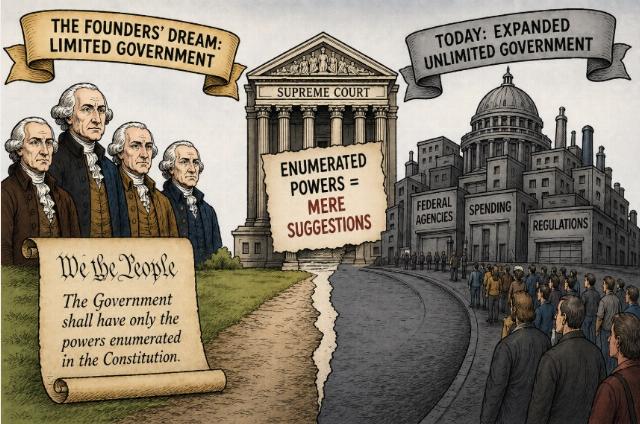
The Founders’ dream of limited government ended when the Supreme Court ruled that enumerated powers were mere suggestions. We need to walk that back.
I read with pleasure Mike Tsichlis’ piece on the American Dream. It was a wonderful walk through history, written with a flowing pen and a musician’s ear. It almost reached the flowering heights of the Declaration of Independence or the powerful prose of The Federalist.
But the historical reality is that none of the huddled masses thought in that language. Yes, they heard the siren song of what Horace Greeley later put on paper, and gladly endured brutal conditions on small ships to get to America and seek their fortune. However, they only heard one word: “opportunity.”
Like so much of language, America as the “land of opportunity” sprang full-grown from the common mind, much as Athena sprang full-grown from the head of Zeus. It was an irresistible phrase describing an irresistible force pulling people away from truly oppressed lives on the (loosely described) treadmill of sweatshops and slaveholdings of one sort or another. This pull was so strong that they were willing to risk their lives to reach for the brass ring.
The “po-folk” saw a chance to work hard and get ahead in America. The problem with that view was simple. Lots of people left the sweatshops of European cities, only to end up in sweatshops in American cities. They lived in slums and did menial work with little hope of a better life. Many became desperate to make a leap and head for the frontier with little but the shirts on their backs. Some died, but others made it through, ultimately creating the place called “America.”
It was a simple idea that possessed that creative power. You could risk everything to bust your butt and make a better life. This was the American Dream. Period. Full stop.
The second half of the American Dream is the idea that once you produced something, it was yours. No one could take it from you. But that covered wagon you bought could be destroyed in a minute by flaming Indian arrows. The crop you brought in could be stolen by a more powerful landowner. So people banded together to protect themselves and their property. This eventually became governments. Unfortunately, the government itself failed.
Fully stated, the American Dream says this: The American Dream is the idea that you can bust your butt to make a better life, and not have it stolen from you by the government.
This full formulation is very important because it explains our problem in the US. We need the government to be the policeman who stops the thief. But the lure of easy money and power turns that officer into a dirty cop who runs the protection racket for his own benefit. And this ultimately happens at every level. The phenomenon of “regulatory capture” demonstrates it at the highest level.
Regulatory capture is a situation in which a government regulatory agency, created to protect the public interest, instead acts primarily in the interests of the industry or companies it is supposed to regulate. The agency was supposed to set basic “rules of the road” so that everyone “plays by the same rules.”
When the agency hires people from those big companies, it gets worse. And after a tour of duty with the government, the expert can then return to “private” industry and be paid well for his temporary duty in the government.
Our current situation presents the citizen with a bloated federal government that legislates willy-nilly on every vanity project that comes near the D.C. media echo chamber. This is based on the false idea, put forward by New Deal Justices Roberts and Cardozo, that the “enumerated powers” (particularly in Article I § 8) are merely “examples.”
Actually, the Framers were extremely cautious, with Anti-Federalists forcibly expressing a fear that a central government with unlimited powers would become the Swamp. No, they didn’t use that language, but that’s what they were afraid of. All the Federalists were united in explaining that the Constitution simply did not allow that level of central authority. The listed powers were all that the feds would be allowed to do.
We now know that their fears were fully justified. Lord Acton was right. Power corrupts, and absolute power corrupts absolutely.
The Constitution allows nearly limitless taxation, but not limitless spending on projects not specifically enumerated. But with unchecked power after the New Deal, the grift was on. Congress could drain your wallet to support its habit, and there was no meaningful recourse. You don’t have “standing” to challenge anything.
CongressCritters and BureauRats love to hand out favors paid for with your tax dollars. The groups that get this filthy lucre are now loyal supporters of the thieves who stole your hard-earned money. They provide campaign finance money to re-elect their benefactors, who then answer the key question: “What have you done for me lately?” There is no end to the imagination of the Swamp.
And this brings us full circle. We saw that the American Dream implicitly understood by real Americans is “The idea that I’m free to bust my butt to make a better life, and NOT have it stolen by the government.” The Socialist Dream, constantly enacted by the Swamp, is: “The idea that the government should steal what real Americans busted their butts to create, and give it to people who won’t get off their own butts.”
James Madison was quite emphatic that competing interests placed in mutual opposition by the separation of powers would help protect the citizen. But since the New Deal Court decisions in Butler and Helvering, the incentives for the Legislative and Executive branches have aligned. Graft and corruption are now approved by the Supreme Court. Most of George III’s evils decried in the Declaration of Independence are now fair game in Mordor on the Potomac.
There’s only one real way to restore the American Dream at the federal level. We must rein in Congress by restoring the limits of enumerated powers, as the Framers intended. With real guardrails, the incentive to steal from hard-working taxpayers will be largely eliminated, and the American Dream will be resurrected.
Ted Noel is a retired physician who posts on social media as Doctor Ted, @Vidzette on X, and occasionally does Doctor Ted’s Prescription podcast on multiple podcast channels.