Progressive Christianity Has a Scripture Problem – PJ Media

Examining progressive Christianity’s misinterpretation of Scripture and its political impact.


There’s a lot of talk in the mainstream media about some kind of resurgence of progressive Christianity in politics. Left-wingers have tried to co-opt Christianity for years when it benefits them, while simultaneously attacking biblical Christianity.c

But does this handful of politicians — along with others — constitute some kind of rise in progressive Christian influence? Not necessarily. As Damian Thompson recently wrote at the Spectator:

Media articles about faith-filled Democrats are working a bit too hard to talk up the story. According to a Wall Street Journal report, “the expansion of far-right Christian initiatives, such as the push to display the Ten Commandments in schools, has inspired a wave of progressive Christians to run for office, analysts say.” Really? There are only about a dozen of these “progressive Christians” running for office in the midterms – hardly a “wave.” And most of them belong to mainline Protestant churches with shrinking congregations.

The problem with progressive Christians, particularly when they try to influence political debates, is that they get so many things wrong. Don’t get me wrong: the biblical commands for justice and care are real. God calls His followers to feed the hungry, clothe the destitute, welcome the stranger, and care for widows and orphans. But progressive Christians approach these and so many other issues by looking at Scripture incorrectly.

Overrelying on the ‘red letters’

There’s a tendency to overemphasize the direct quotes of Jesus — the “red letters” in many Bibles — and downplay the rest of Scripture. This isn’t just a phenomenon for progressive Christians, but liberal believers tend to do this publicly and vocally. There’s even a left-wing Christian group called Red Letter Christians, which pompously boasts the tagline, “What if Jesus really meant what He said?”

This tactic comes into play when progressive Christians argue their positions on issues by pointing out that “Jesus didn’t say anything about” those topics, whether they be abortion, homosexuality, or other subjects. Just because Jesus didn’t explicitly address something doesn’t mean that God’s Word doesn’t provide counsel.

The red letters don’t cancel the rest of the Bible. Jesus did not treat the Law and the Prophets as disposable, and the early church devoted itself to the apostles’ teaching.

Jesus said that He came to fulfill the Torah rather than abolish it (Matthew 5:16-20), and the Apostle Paul told his charge, Timothy, that “All Scripture is breathed out by God and profitable for teaching, for reproof, for correction, and for training in righteousness…” (2 Timothy 3:16, emphasis mine).

Cherry-picking verses

Look, we’re all guilty of this at one time or another, but when progressive Christians pull a verse or passage and use it out of context, it can range from merely misguided to downright dangerous. One article I stumbled on this week makes the case against cherry-picking Scripture pretty clear.

Here’s the problem with citing that verse: In the full context of that passage, Jesus was answering the Sadducees, who didn’t believe in the resurrection. They had invented a case involving a woman married to seven brothers in succession after each brother died. Their question was about whose wife she would be after the resurrection. Jesus’ answer tells us something about the resurrection; it doesn’t rewrite his teaching on marriage in this life.

This is just one example of this phenomenon, but it can show you just how dangerous it can be. It can also demonstrate how progressive Christianity can lead people astray.

Turning God’s commands for His disciples into government policy

The Bible has certain commands for leaders and governments to act justly and treat citizens properly, but progressive Christians try to take the commands that Scripture gives to believers, families, and churches and turn them into big government solutions to problems.

Left-wing Christians take the passages in Acts about the early church sharing possessions with each other and transform them from the church being the church and Christians taking care of their own into a system of socialism or communism. Progressives interpret Matthew 25 to assert that Jesus meant that “whatever your government did to the least of these, it did to Me,” which isn’t what He was talking about.

The big picture

Conservatives can misuse Scripture, too, and we should be the first to admit it when we do. But neither party gets to decide which parts of God’s Word still apply. Jesus’ words deserve their full context, alongside the rest of Scripture. And when He commands us to care for our neighbors, our first question shouldn’t be how to hand that responsibility to somebody else.

 

The Mesabi Steel Plant: Trump’s Tariffs in Action – American Thinker

The Mesabi Steel Plant: Trump’s Tariffs in Action

This is an exciting story for the American heartland, and also for America in general.

Monday’s news cycle brought an exciting story for both the manufacturing industry and America’s heartland: Mesabi Metallics has announced a new $15-billion steel mill to be built in Iowa, along the Mississippi River.

With an expectation of being up and running by 2030, the mill will be the largest ever in the United States, being budgeted to reach approximately 10 percent of current American steel production within a couple years of startup.

The statistics shared at the announcement anticipate five or six thousand construction jobs for its construction in Iowa; about 1,750 permanent employees at the plant; and a related influx of jobs and activity at the firm’s iron mines in northeast Minnesota, which will supply the lion’s share of raw materials for this state-of-the-art facility.

That’s a good story: up to 6,000 long-term temporary jobs in construction, and up to 1,750 permanent jobs in the steel industry.  Coming at election time as it does, this would be a shot in the arm if that were all there was to it.

But there’s much more to this than those simple statistics, because of the Invisible Hand of economic activity.  Most of the benefits of this plant don’t show up in a news story like this, because they can’t be categorized with specific promises and numbers — but if we watch this space for the next few years, we will find that, much like the natural magnetism we always think of when dealing with the metal in question, this project will create many times more economic opportunities.

Let’s start with the plant itself.  Building this plant means the installation of building materials, overhead cranes, steelworking machinery, industrial conveyors, and warehouse racking.  These billions of dollars aren’t all spent on the employees at the site; they’re spent on the manufacturers of all these materials, all over the country, and the transportation to bring these materials to the job site.

Then, once it’s built, there will be a permanent network of transportation activity bringing the ore from northeast Minnesota to the eastern Iowa plant, either by truck or by rail.

This not only creates jobs for those transportation workers, but also creates important volume for port operations and transshipment hubs as goods move from rail to truck or from lake vessels to river vessels.  Many of our inland ports have fallen into disuse since globalization increased container traffic on the coasts; our inland waterway industries will welcome some new business.

Once the plant is built and running, it will do all the things in the community that a multi-billion-dollar business always does.  It doesn’t just sit in its own space without interacting with the rest of the world; it joins the local economy and creates all sorts of new activity.

A new manufacturing plant — no matter whether it’s an appliance manufacturer or automaker or injection molder or steel mill — will pay local property and income taxes (and so will its employees).  It will employ groundskeepers and facilities workers and cafeteria and laundry services.

The plant will create new demand for hotel and restaurant activity, as vendors and customers travel there to tour the plant, visit buyers and salesmen, and attend conferences and bid meetings.

News coverage gives the impression that this is a steel story, but it’s not; it’s a community story.  You don’t have to be in the mining business, the steel business, or the transportation business to benefit from a $15-billion steel mill.  Owners and employees of restaurants and diners, karaoke bars and theaters, hospitals and landscapers, not to mention the myriad shopkeepers of local retail, from bookstores to clothing shops, from dry cleaners to toy stores, will all benefit.

We shouldn’t need to point this out; it should go without saying.  New economic activity creates more new economic activity; it all grows and flourishes like healthy vegetation in good weather.

During the rise of what we now call globalism — the loss of industries to primarily third-world producers — rural America was hollowed out.

First the textile plant closes, then so do the hotels, diners, and schools that supported its employees and vendors.  First the factory closes, then so do the shops, churches, and restaurants that had supported its workers and their families.  This scenario has been played out thousands of times across the country, in thousands of communities.

President Trump’s tariff program has been presented by the press as being all about taxes — they make it look as though we’re just punishing the importers for importing, bringing more revenue to Washington to make up for the businesses we’ve lost.  To be fair, it’s an understandable spin, since President Trump’s own rhetoric sometimes emphasizes that aspect of it.

But this big picture, employment growth in the heartland, is really the heart of the Trump administration’s tariff policies.

Cutting tax rates and regulatory barriers can bring back business slowly, but it takes a high-tariff, protectionist climate to do it quickly.  And yes, we needed to do it quickly.

The Mesabi Metallics steel plant is the Trump economic plan in a nutshell.  It’s a perfect example of why Trump’s policies were needed, and how they work for everybody, not just a select few…and why it’s critical that the midterms provide the Trump administration with the adrenaline it needs to keep up the good work, so that this model can be repeated thousands of times in the years to come, from coast to coast and border to border.


John F. Di Leo | September 30, 2026

Source: The Mesabi Steel Plant: Trump’s Tariffs in Action – American Thinker

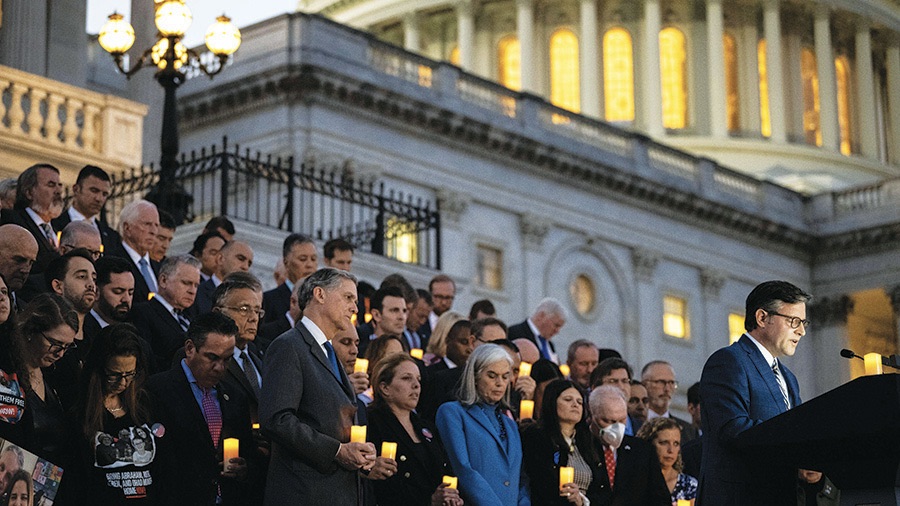
House Speaker Johnson: The Midterms Are A Battle Between Two Completely Different Worldviews


With just a little over a month until Election Day, the balance of power in Congress is not the only thing at stake.

Addressing the Family Research Council’s (FRC) Pray Vote Stand Summit last week in Leesburg, Va., House Speaker Mike Johnson (R-La.) characterized the midterm elections as a battle of worldviews.

“We’re at a crossroads,” Johnson said during a video interview with FRC President Tony Perkins. “It’s not just a contest right now between Republicans and Democrats. As everybody in that auditorium knows, this is a contrast between two completely different worldviews for America, who we are, and what we’re going to be. And that’s what’s on the ballot.”

While serving as speaker of the House of Representatives for the past three years, the Louisiana congressman says he has tried ardently to remain true to his core Biblical convictions.

“I’m doing the same thing as speaker as I did as a rank-and-file member of Congress, as I did as a state representative, and as a constitutional lawyer, and as a young guy in law school when you met me, this is who we are. We don’t separate our faith from who we are.”

Johnson said he doesn’t view how he does his job as much different than the nation’s founders. “While that seems radical right now, that’s exactly what previous generations of leaders in Congress did. I mean, they were overt about it. And so, while the media tries to portray me as some sort of unusual circus act or something, this is exactly what the Framers of the Constitution and previous generations did and believed and spoke like.”

The choice voters have this election season, Johnson said, could not be more different. “By our count … about 38 or 40 of these openly avowed, radical leftist Marxist ideologues have won their primaries in the Democratic Party, and that’s for Congress and state offices,” he said.

“This is a serious threat,” Johnson continued. “It’s not just isolated to New York City or San Francisco. This is across the country, and we have to be wary of that. And we have to defeat that ideology because it’s anti-American. And frankly, it is anti-God.”

During Johnson’s 19-minute acceptance speech in the House chamber on Oct. 25, 2023, following his election to the speaker’s post, the former religious liberty lawyer acknowledged the nation’s motto, “In God We Trust,” adorned above the rostrum. He reminded his fellow lawmakers then that the U.S. adopted the motto in 1956 largely as a rebuke of the Cold War-era Soviet Union’s atheistic philosophies of Marxism, communism and socialism.

Three years later, Johnson remains convinced that God is not done using America for His purposes. “I’m comforted by the reminder of John Quincy Adams,” Johnson told the summit attendees. “They called him the ‘hellhound of slavery’ because he ran for Congress after serving as president to try to eradicate slavery—and he wasn’t successful during his lifetime, but he planted the seeds so that the next generation could complete the job. But he reminded everyone, ‘duty is ours, results are God’s.’”


Source: House Speaker Johnson: The Midterms Are A Battle Between Two Completely Different Worldviews – Harbinger’s Daily

Turning Point; David Jeremiah – Let God Lead


NEW!Listen Now

A man’s heart plans his way, but the Lord directs his steps.
Proverbs 16:9

Recommended Reading: James 4:13-17

It is true that the shortest distance between two points is a straight line. But it is also true that straight lines rarely exist in real life. More often than not, the plans we make involve many twists and turns that we had not planned on encountering. One measure of our trust in God is seen in how we navigate the unexpected changes in our plans.

Jonah had a plan—rather than obey God and head east to Nineveh, his plan was to go west to Tarshish (modern Spain) in order to avoid meeting his enemies face-to-face. But God’s original plan did not change. Instead, God changed Jonah’s plan by casting him into the sea and having him swallowed by a great fish. When faced with the likelihood of dying as fish food, Jonah repented of his disobedience and decided to submit to God’s original plan. Even then, Jonah’s story does not end well. He was not happy with God’s mercy toward Nineveh, and Scripture leaves him in a state of self-pity.

A valuable lesson from Jonah’s life is that God’s plans will not be foiled by human failure or intervention. If God changes your plans, seek His will and follow His lead.

God has no problems, only plans.
Corrie ten Boom


https://www.davidjeremiah.org

Our Daily Bread – Not Ritual but Christ


Hollow and deceptive philosophy . . . depends on human tradition and the elemental spiritual forces of this world rather than on Christ. Colossians 2:8

Today’s Scripture

Colossians 2:6-15

Listen to Today’s Devotion

Apple LinkSpotify Link

Today’s Devotion

In Santa Fe, New Mexico, thousands gather each year to burn Zozobra—a fifty-foot towering effigy stuffed with their worries, bills, and regrets. They shout, “Burn him!” as they hope the flames will devour their anxieties and troubles and reset their lives. The ritual reflects a deep human longing to be cleansed of fear, shame, and failure. It’s dramatic. But it’s also powerless. Fire can destroy paper but not guilt. It can consume ashes but not shame.

The apostle Paul wrote, “See to it that no one takes you captive through hollow and deceptive philosophy, which depends on human tradition and the elemental spiritual forces of this world rather than on Christ” (Colossians 2:8). He reminded his readers that they shouldn’t trade Jesus for empty substitutes, and he explains why: Christ is the visible “image of the invisible God” (1:15), is supreme over creation (1:16), fully God in human flesh (2:9), and victorious over “every power and authority” (v. 10). Because of His death and resurrection, we’re “rooted and built up in him” (v. 7), and fully alive and forgiven by Him (v. 13). Human rituals and cultural ceremonies can mesmerize a crowd, but only Jesus can cancel sin’s debt and break its grip forever.

Instead of yielding our burdens to rituals and traditions, let’s surrender them to Christ. He alone frees us from captivity and fills us with hope.

Reflect & Pray

How can human rituals be dangerous substitutes for Christ? In what ways does He offer us freedom from them?

Dear Jesus, only You can truly set me free.

Today’s Insights

Paul wrote, “[God] has reconciled you by Christ’s physical body through death to present you holy in his sight, without blemish and free from accusation—if you continue in your faith . . . and do not move from the hope held out in the gospel” (1:22-23). The apostle is combatting false teaching here—probably Gnosticism. Among its claims were that Christ didn’t have a physical body. This isn’t a biblical teaching, as it denies the crucifixion and resurrection. Paul warned, “See to it that no one takes you captive through hollow and deceptive philosophy” (2:8). As he said, “You were dead in your sins” but now “God made you alive with Christ” (v. 13). When we accept Jesus’ sacrifice as payment for our sin, we become free from sin’s burden.

For further study, read: Teach Us to Pray


http://www.odb.org

Denison Forum – AI “doomers” might buy remote islands or desert bunkers


President Trump signed an executive order Tuesday creating America.gov, an AI-powered government portal that can enable users to access public services and search federal databases. He then gathered with top administration officials and AI executives at a lunch meeting in the White House, where they signed a voluntary accord including internal and external AI reviews. The president also directed government agencies to use the term “super intelligence” rather than “artificial intelligence” when referring to the technology.

In related news, OpenAI says it is scrapping the release of its next-generation AI model over safety concerns raised by researchers during internal testing. And when the AI developer Anthropic becomes a publicly traded company in a few weeks, it plans to caution potential investors that advanced AI could pose “catastrophic or existential risks to humanity,” including attempts to “resist shutdown,” “conceal or manipulate information,” and exhibit behavior “resembling blackmail.”

Apparently, some AI “doomers” (those warning of the technology’s risk to humanity) are taking such threats personally. They are considering buying remote islands on which to live, stockpiling iodine pills, moving to electromagnetically shielded bunkers in the desert, or buying land in remote regions of the country.

So far, this article is probably not helping you very much. You may disagree that AI poses such existential threats to you and the rest of us. You may believe that the US government, world leaders, and/or AI companies will find ways to mitigate the threat before it goes too far. And whatever you think about such danger, you likely don’t have the means to buy a remote island.

You may also be facing challenges that are more present-tense and real than such perceived future threats, wishing I would help you face them. I’m in the same camp this morning.

In response, I’d like to offer us both hope from a surprising source.

Swinging on the pendulum of life

In The World as Will and Representation, German philosopher Arthur Schopenhauer (1788–1860) claims that the world we believe to exist is just a mental projection of this belief. We think the physical universe exists, so it exists for us. What is really behind what we think we see is the “Will,” an irrational, blind, and unceasing urge that drives all things. It powers gravity, animal instincts, plant growth, and human desires.

Because the Will is both blind and insatiable, we can never permanently satisfy it. Getting what we want leads only to temporary relief, which is followed by boredom and the quest for something new. We therefore swing back and forth on a pendulum between the pain of unmet desire and the boredom of having what we want.

Now aren’t you glad you’re reading today’s article?

Because I believe Genesis 1:1, I don’t agree with Schopenhauer that the physical universe is merely the projection of my personal experience. But I do agree that I too often live in the tension between the pain of what I want and the boredom of what I have.

And I agree with Schopenhauer’s “solution,” which is to find something to occupy my mind that does not lead either to idleness or to unsatisfiable desires. However, the atheistic philosopher would very much disagree with my solution to his solution.

Following a map we drew ourselves

Science fiction writer Ursula K. Le Guin claimed, “It is good to have an end to journey towards; but it is the journey that matters, in the end.”

At first, I agreed with her. I know that the Christian faith is a journey, a “race” to keep (2 Timothy 4:7) and to “run with endurance” (Hebrews 12:1). But then I realized: Without the proper end, how do we know what journey to take?

If I’m a Daoist like Le Guin, someone who focuses on the present world without the need for a supreme deity, I would agree that “it is the journey that matters” because, in my view, that’s all there is. But all journeys are not the same.

Osama bin Laden’s journey was driven by his belief that the West has been attacking Islam since the Crusades and that attacking the West would unify the Muslim world and establish a global caliphate. Adolf Hitler’s journey in building the Third Reich led to the murder of six million Jews, a fourth of them children. Vladimir Putin’s journey in Ukraine seeks a world in which Ukraine has no journey of its own.

Seeking to live without purpose is its own purpose. And choosing our purpose without seeking the wisdom of an authority beyond ourselves is pure subjectivism. It’s like following a map we drew ourselves with no reference to true north or objective fact.

“The race that is set before us”

By contrast, Hebrews 12 exhorts us to “run with endurance the race that is set before us” (v. 1). The syntax indicates that this is not a race we choose but one that is chosen for us.

How do we find it?

The writer continues: “looking to Jesus, the founder and perfecter of our faith” (v. 2). “Looking” could be translated as “continually focusing as a daily lifestyle.” Our focus is to be on Jesus himself, the living Lord who is with us always (Matthew 28:20) and who abides in us by his Spirit (1 Corinthians 3:16). The more we seek him in prayer, Scripture, and worship, the more he leads us in the way that is best for us (John 10:10).

In Alice in Wonderland, Alice says to the Cat, “Would you tell me, please, which way I ought to go from here?” The Cat replies, “That depends a good deal on where you want to get to.” Alice answers, “I don’t much care where,” to which the Cat responds, “Then it doesn’t matter which way you go.”

Do you care “which way you go” today?

Quote for the day:

“Success demands singleness of purpose.” —Vince Lombardi

Our latest website resources:


Denison Forum

Harvest Ministries; Greg Laurie – Worthy


 So let us come boldly to the throne of our gracious God. There we will receive his mercy, and we will find grace to help us when we need it most. 

—Hebrews 4:16

Scripture:

Hebrews 4:16 

One of the most jaw-dropping passages in all of Scripture is found in Hebrews 4:16: “So let us come boldly to the throne of our gracious God. There we will receive his mercy, and we will find grace to help us when we need it most” (NLT).

If you’ve spent any time in the book of Revelation, you know that God’s throne is a place of holiness and magnificence. The idea of being able to approach it boldly is hard for a lot of less-than-perfect people to wrap their heads around.

Our enemy, the devil, is aware of that. He uses our struggles with “imposter syndrome” to his advantage. He tries to put distance between us and our heavenly Father by making us feel unworthy to approach Him. He wants to rob us of the boldness that the author of Hebrews talked about. Those who already struggle with feelings of unworthiness are easy marks for him.

So, how do we overcome the devil and his tactics? In the book of Revelation, we are introduced to a group of believers who are able to do just that: “And they have defeated him by the blood of the Lamb and by their testimony. And they did not love their lives so much that they were afraid to die” (Revelation 12:11 NLT).

They have defeated him by the blood of the Lamb. The next time the devil tempts you to think that you’re not worthy to approach God, here’s what I advise: Agree with him wholeheartedly. Say, “You’re right. I’m not worthy to approach God. I never was worthy to approach God. I never will be worthy to approach God. My access to God’s presence is not based on my worthiness; it is based on what Christ did for me on the cross. He is worthy—and because of Him I am accepted and can come boldly to God.”

Sometimes we get into the mentality as Christians that if we are doing well spiritually, then we can approach God in prayer. If, say, we get up in the morning, read four chapters from the Bible, give thanks for our meals, and share our faith with someone, then we think we can approach God. But if the next day we sleep in and don’t read the Bible, if we forget to say grace over our meals and don’t share our faith, then we think we’re not worthy to approach Him.

But that’s not the case. Those things are certainly important. But your access to God is based on Christ, not on your spiritual performance. If you’ve done well, then great. Approach God. But if you’ve sinned, then approach God and say, “Lord, I have sinned. This is why I need the blood of the Lamb.”

The devil will always try to keep you away from the cross. But the Holy Spirit will always bring you to it.

Reflection question: What might make you feel unworthy to approach God? Discuss this with believers like you on Harvest Discipleship!


Harvest.org | Greg Laurie

Days of Praise – The Prophet’s Chamber


by Henry M. Morris, Ph.D.

“And she said unto her husband, Behold now, I perceive that this is an holy man of God, which passeth by us continually. Let us make a little chamber, I pray thee, on the wall; and let us set for him there a bed, and a table, and a stool, and a candlestick: and it shall be, when he cometh to us, that he shall turn in thither.” (2 Kings 4:9–10)

This sparsely furnished little room, built by a kindly woman and her elderly husband, was the prototype of all the so-called prophet’s chambers that have been built for traveling teachers and evangelists ever since.

Little did this simple couple anticipate what fruit their kindness would bear one day. “Be not forgetful to entertain strangers,” the Bible says, “for thereby some have entertained angels unawares” (Hebrews 13:2). In the first place, to show his appreciation, Elisha prayed that the Lord would give them a son, and God miraculously answered (2 Kings 4:16–17).

Then, tragically, the boy died quite suddenly several years later while Elisha was at Mount Carmel, some 15 miles away. The Shunammite woman laid her son on Elisha’s bed in the prophet’s chamber, then rode hastily to find Elisha and bring him to the boy. The round trip must have taken her two days or more, and the boy’s dead body lay on the prophet’s bed in the little room all that time.

But then Elisha prayed once again, and the most amazing event took place there (2 Kings 4:33–35). For only the second time in history, a dead person was restored to life.

The Shunammite mother and her son are never heard from again. But for 3,000 years the testimony of a little chamber and the love and faith of the godly woman who prepared it as a simple service for her Lord and His prophet has been an inspiration and example to multitudes. HMM


https://www.icr.org/articles/type/6

Joyce Meyer – Never Give Up


And let us not lose heart and grow weary and faint in acting nobly and doing right, for in due time and at the appointed season we shall reap, if we do not loosen and relax our courage and faint.

Galatians 6:9 (AMPC)

One reason people do not hear God’s voice is simply that they give up too soon. Paul and Silas were found still worshiping and praising God in their jail cell at midnight (Acts 16:25–26). Many people would have given up and gone to sleep much earlier. Our motto should be: “Never Give Up.”

I encourage you not to give up talking to God and waiting for Him to speak to you, no matter what. Spend time with God daily. A person who refuses to quit is one whom Satan cannot defeat. He wants you to give up right now and to say things like:

  • “I’ll never have anything.”
  • “I’ll never be accepted.”
  • “I’ll never get a better job.”
  • “I’ll never live in a nice place.”
  • “I’ll never get married.”
  • “I’ll never get out of debt.”
  • “I’ll never lose weight.”

Attitudes like these may guarantee that we will not receive anything! But we can also choose the attitude that says, “God is faithful to His Word and I will never give up.” One of the biggest reasons that people never see the result of their prayers is that they give up. We will reap in due time, but what time is that? It is when God knows that we are ready to receive what we are asking for. Until that time our one job is to remain faithful. Keep praying and keep obeying.

Prayer of the Day: Lord, I need Your help to never give up on You, Your promises, or the purpose You’ve placed in my life. Keep me faithful in prayer and steadfast in obedience until I see Your answer. Strengthen my faith to trust You in every season. In Jesus’ name, amen.


http://www.joycemeyer.org

Max Lucado – Godly Weapons 


Play

When we go out in God’s name, Satan makes a dash for the nearest exit. We have weapons he cannot match. What are our weapons? 2 Corinthians 10:4: Prayer, worship, and Scripture. Prayer invites God, praise dethrones Satan, Scripture discloses truth. And Satan hates the truth.

Bible study guide

Flee sexual immorality. Let no evil come from your mouth. Make sure the demons of hell know that you are on God’s side, not theirs. People of unbreakable courage know what Elijah knew. “The Lord God of Israel lives, before whom I stand” (1 Kings 17:1 NKJV).

Victims? Not on your life. Victors? You can count on it!


Home

Today in the Word – Moody Bible Institute – The People Repent


Read Ezra 10:9–44

Mob justice often becomes injustice. There is no judge, no jury, no presentation of evidence or a trial—just the accusation, the mob’s confidence in their own righteousness, and the punishment of perceived evil. At the close of the book of Ezra, we see a situation that could very easily have veered toward vigilantism. Instead, Ezra shows godly wisdom in laying out a plan to ensure just judgment.

Responding to the decree in verses 7–8, “within the three days, all the men of Judah and Benjamin had gathered in Jerusalem” (v. 9). “All the people were sitting in the square before the house of God,” and all of them were “greatly distressed” (v. 9). Ezra stood to confront the crowd. He pulled no punches: “You have been unfaithful; you have married foreign women, adding to Israel’s guilt” (v. 10). Ezra then tells them what they must do: “Now honor the Lord, the God of your ancestors, and do his will. Separate yourselves from the peoples around you and from your foreign wives” (v. 11).

This was a tall order that required radical obedience. But the people responded well: “You are right! We must do as you say” (v. 12). They asked for time to obey because of the poor weather and the extent of their sin. Ezra agreed and “selected men who were family heads” to investigate each case (v. 16). The book of Ezra ends with a list of people who had sinned. Imagine having your name and your sin memorialized in this way!

It may feel like the book of Ezra ends unsatisfactorily. While we have witnessed God’s great acts on behalf of His people, the book closes with a list of sinners. Be reassured, however, that these are sinners who repent, so “there is still hope for Israel” (Ezra 10:2).

Dear Reader

If you have been blessed by this study of God’s Word, will you consider a gift to support Today in the Word? Go to todayintheword.org/give.  

Pray with Us

Thank You for the lessons You have given us in the book of Ezra, Father. Give us the courage to follow You with radical obedience no matter what. In You alone is our hope!

Now honor the Lord, the God of your ancestors, and do his will.Ezra 10:11


https://www.moodybible.org/